

Sign Up
Thank you for Submitting!
AI adoption is accelerating across regulated sectors, but a surprising fact looms over U.S. enterprises: there is no comprehensive federal AI law, yet. If that sounds like you are in the clear, think again. The compliance landscape is rapidly shifting from guidance to enforcement, driven by a patchwork of emerging state AI laws, sector-specific mandates, and regulatory frameworks that demand organization-wide due diligence. Even without federal edict, enterprise accountability is here, and the penalties for ignoring it are real.
Many IT leaders, CIOs, and compliance professionals are asking: "What are the current U.S. federal AI compliance requirements?" The shortest answer is none, yet. But the practical reality is far more urgent. States like Texas, California, and others are enacting robust AI compliance laws, imposing significant financial and operational obligations on enterprises operating in their jurisdictions. State-level uncurable AI violations now carry penalties of $80,000 to $200,000 per violation, with continuing violations fined up to $40,000 per day.
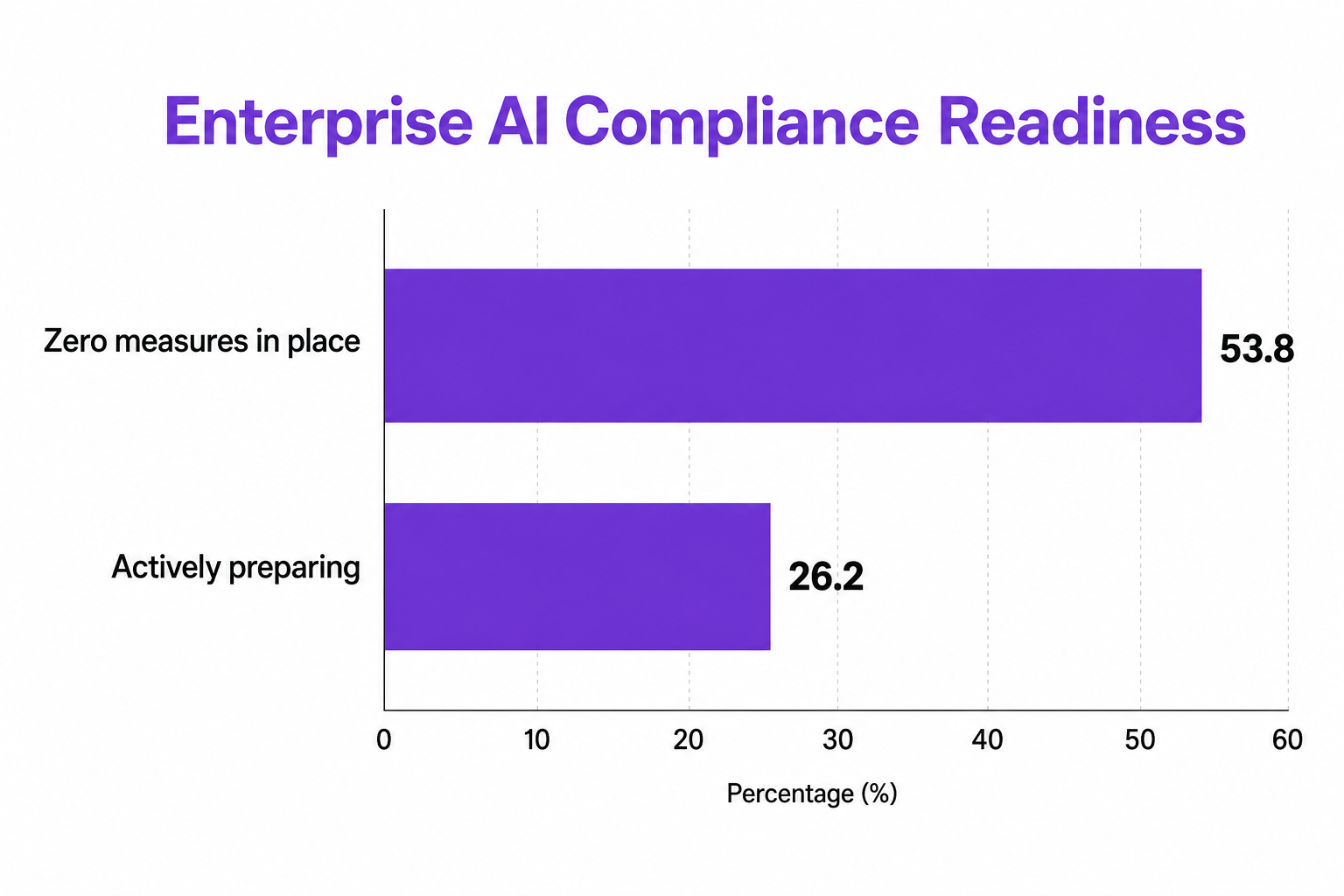
This means that enterprise AI compliance is less about chasing future federal rules and more about proactively addressing a complex web of current, enforceable state and sector-specific obligations. In fact, 53.8% of firms have zero AI compliance measures in place right now, while only 26.2% have begun active preparations.
State-level regulation is rapidly fragmenting into a complex system of requirements:
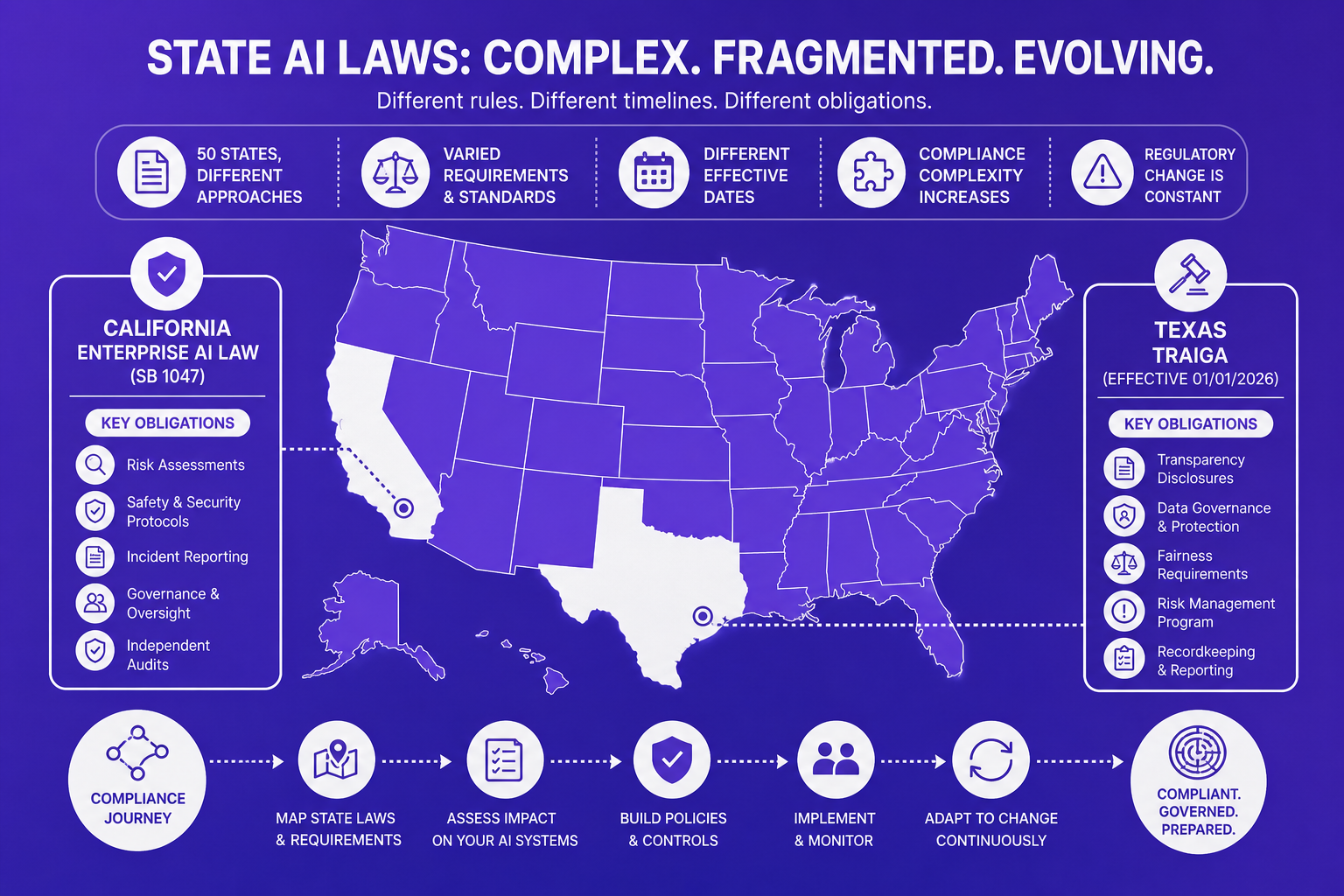
States like Texas and California are setting concrete operational standards with laws like Texas TRAIGA and California’s enterprise AI statutes.
Some focus on sectoral obligations, while others delay or proceed in phases, creating balkanized compliance mandates.
Most require comprehensive audit trails, continuous documentation of risk management policies, and real-time visibility into AI impacts and failures.
State AI law compliance is not geographically tied to company headquarters. As expert insights confirm, systems must be inventoried jurisdiction by jurisdiction, mapping every AI deployment by where staff and customers are located, not where leadership sits.
Texas TRAIGA demands organizations create, retain, and present impact assessments, AI model documentation, and risk/incident logs on demand.
California’s enterprise AI law mandates evidence of robust testing, impact analysis, and public disclosure for consequential AI deployments.
Other states are increasingly referencing frameworks like NIST’s AI Risk Management Framework as the de facto minimum standard.
The result? A patchwork AI regulatory landscape that is comprehensive, dynamic, and already enforceable.
One of the clearest through-lines in emerging laws: audit trails are required, not optional. Whether under Texas TRAIGA, California law, or other statutes, the ability to generate continuous, audit-ready records is the new baseline for avoiding exposure.
Why does this matter?
Regulatory investigations and enforcement actions almost always start with a demand for audit records.
Audit trails must document not only AI usage, but also testing processes, prompt histories, risk classifications, access controls, and incident management workflows.
Failing to provide these records is often treated as a violation itself and may trigger the largest fines.
Enterprises without automated, holistic audit readiness are at highest risk. This is where AI compliance solutions like CloudNuro AI Custodian provide strategic value.
Many CIOs wonder: "Are these penalties for real?" Consider the facts:
Fines for state-level violations start at $80,000 per incident and can reach up to $200,000; every day a violation continues may incur another $40,000 fine.
Regulatory action is triggered even if only one division or user in one jurisdiction is noncompliant.
Lack of a documented audit trail is often used as evidence of willful neglect.
52.3% of enterprises now worry expanding regulation could restrict innovation due to compliance overhead and exposure.
But the costs are not limited to regulatory penalties. High-risk AI system remediation costs average $8 to $15 million, while ongoing compliance for each AI system averages over €29,277 per year.
CloudNuro is purpose-built for cost optimization, security, and governance. Here’s how it tackles the “AI compliance checklist” in an environment with no one-size-fits-all federal framework:
Complete Visibility and Automated Audit Trails:
Monitors prompt volumes, adoption rates, and usage at the app-level.
Segments users into Power, General, Low, and Dormant for license optimization and compliance scoping.
Surfaces unapproved shadow AI usage, rogue accounts, and compliance gaps such as missing MFA or public exposure of sensitive data.
Zero-Touch Discovery and Continuous Audit Automation:
Seamless integration with 400+ SaaS and cloud apps; no local tracking agents required.
Audit-ready logs and records generated by configuring API tokens, continuous compliance with virtually zero labor overhead.
Security and Policy Governance:
Integration with Microsoft Purview to detect oversharing and PII leakage.
Automated enforcement of policy-based restrictions, access verification, and ongoing risk management.
IT and Finance Alignment for Cost Consciousness:
Project-based chargeback for AI agents, detailed cost breakdown, and regular reports for IT/Finance.
Ensures that compliance and cost governance never compete, they reinforce each other.
Case Example:
An industrial enterprise used CloudNuro to discover and remediate rogue and orphaned accounts, significantly reducing both security exposure and hidden spend. Zero-touch discovery enabled them to complete an auditable software and AI compliance inventory in just 15 minutes, cutting weeks off traditional manual audit efforts.
For organizations facing mounting state-level legal obligations, this kind of automation is now the only scalable way to achieve audit readiness without disruption or prohibitive costs.
The underlying trend is clear: AI regulation will not wait on Congress. Sectoral and state requirements are multiplying, and all signs suggest that any eventual federal law will inherit the strictest of these provisions. Enterprises must structure their compliance programs now to:
Inventory all AI systems against state and sectoral rules
Map risk and usage by jurisdiction, not just globally
Automate comprehensive audit trails, across every user, app, and workflow
Align with gold-standard frameworks like NIST for oversight and transparency
CloudNuro’s governance-first architecture gives IT and compliance leaders the tools to operationalize these requirements, automate what would otherwise be months of labor, and foster a culture of security and cost accountability.
What are the current US federal AI compliance requirements?
There are currently no comprehensive federal AI compliance mandates. However, state governments including Texas and California have active regulations that require strict audit trails, risk assessments, and usage documentation, so compliance at the enterprise level is still mandatory.
How can enterprises stay compliant with state AI laws like Texas TRAIGA and California’s AI law?
By inventorying all AI deployments by jurisdiction, documenting prompt and usage data, implementing ongoing audit trails, and automating compliance checks using platforms such as CloudNuro AI Custodian to meet diverse recordkeeping and disclosure mandates.
Why is an audit trail essential for AI regulation compliance?
Audit trails are now required evidence in virtually every state law. They prove that your business tests, monitors, and controls AI usage responsibly, and they are the first material demanded in enforcement actions, for both risk management and legal defense.
What happens if my organization ignores new AI compliance requirements?
You risk large per-violation fines (up to $200,000), escalating daily penalties, forced remediation at very high cost, and reputational damage. Regulatory action may be triggered by any ungoverned AI deployment or missing documentation.
How does CloudNuro support AI regulation compliance for enterprises?
CloudNuro automates audit trails, unifies SaaS and AI usage logging, integrates compliance and cost management, and detects compliance gaps across the entire technology estate, aligning directly with demanding state and sectoral statutes.
AI compliance in the U.S. is defined not by waiting for federal law but by responding to live, enforceable rules applicable where you operate and where your data flows. The most strategic enterprises are getting ahead of state law requirements, building governance and audit capabilities today, and leveraging solutions like CloudNuro AI Custodian to hardwire compliance and cost optimization into daily operations. For CIOs, IT chiefs, and compliance officers, the time to act is now.
About CloudNuro
CloudNuro is a leader in Enterprise AI Adoption Management, providing enterprises with unmatched visibility, governance, and cost optimization. Recognized twice in a row in the SaaS Management Platforms category and named a Leader in the SoftwareReviews Data Quadrant, CloudNuro is trusted by global enterprises and government agencies to bring financial discipline to SaaS, cloud, and AI. Trusted by enterprises, CloudNuro provides centralized SaaS inventory, license optimization, and renewal management along with advanced cost allocation and chargeback, giving IT and Finance leaders the visibility, control, and cost-conscious culture needed to drive financial discipline.
Request a no cost, no obligation free assessment —just 15 minutes to savings!
Get StartedAI adoption is accelerating across regulated sectors, but a surprising fact looms over U.S. enterprises: there is no comprehensive federal AI law, yet. If that sounds like you are in the clear, think again. The compliance landscape is rapidly shifting from guidance to enforcement, driven by a patchwork of emerging state AI laws, sector-specific mandates, and regulatory frameworks that demand organization-wide due diligence. Even without federal edict, enterprise accountability is here, and the penalties for ignoring it are real.
Many IT leaders, CIOs, and compliance professionals are asking: "What are the current U.S. federal AI compliance requirements?" The shortest answer is none, yet. But the practical reality is far more urgent. States like Texas, California, and others are enacting robust AI compliance laws, imposing significant financial and operational obligations on enterprises operating in their jurisdictions. State-level uncurable AI violations now carry penalties of $80,000 to $200,000 per violation, with continuing violations fined up to $40,000 per day.
This means that enterprise AI compliance is less about chasing future federal rules and more about proactively addressing a complex web of current, enforceable state and sector-specific obligations. In fact, 53.8% of firms have zero AI compliance measures in place right now, while only 26.2% have begun active preparations.
State-level regulation is rapidly fragmenting into a complex system of requirements:
States like Texas and California are setting concrete operational standards with laws like Texas TRAIGA and California’s enterprise AI statutes.
Some focus on sectoral obligations, while others delay or proceed in phases, creating balkanized compliance mandates.
Most require comprehensive audit trails, continuous documentation of risk management policies, and real-time visibility into AI impacts and failures.
State AI law compliance is not geographically tied to company headquarters. As expert insights confirm, systems must be inventoried jurisdiction by jurisdiction, mapping every AI deployment by where staff and customers are located, not where leadership sits.
Texas TRAIGA demands organizations create, retain, and present impact assessments, AI model documentation, and risk/incident logs on demand.
California’s enterprise AI law mandates evidence of robust testing, impact analysis, and public disclosure for consequential AI deployments.
Other states are increasingly referencing frameworks like NIST’s AI Risk Management Framework as the de facto minimum standard.
The result? A patchwork AI regulatory landscape that is comprehensive, dynamic, and already enforceable.
One of the clearest through-lines in emerging laws: audit trails are required, not optional. Whether under Texas TRAIGA, California law, or other statutes, the ability to generate continuous, audit-ready records is the new baseline for avoiding exposure.
Why does this matter?
Regulatory investigations and enforcement actions almost always start with a demand for audit records.
Audit trails must document not only AI usage, but also testing processes, prompt histories, risk classifications, access controls, and incident management workflows.
Failing to provide these records is often treated as a violation itself and may trigger the largest fines.
Enterprises without automated, holistic audit readiness are at highest risk. This is where AI compliance solutions like CloudNuro AI Custodian provide strategic value.
Many CIOs wonder: "Are these penalties for real?" Consider the facts:
Fines for state-level violations start at $80,000 per incident and can reach up to $200,000; every day a violation continues may incur another $40,000 fine.
Regulatory action is triggered even if only one division or user in one jurisdiction is noncompliant.
Lack of a documented audit trail is often used as evidence of willful neglect.
52.3% of enterprises now worry expanding regulation could restrict innovation due to compliance overhead and exposure.
But the costs are not limited to regulatory penalties. High-risk AI system remediation costs average $8 to $15 million, while ongoing compliance for each AI system averages over €29,277 per year.
CloudNuro is purpose-built for cost optimization, security, and governance. Here’s how it tackles the “AI compliance checklist” in an environment with no one-size-fits-all federal framework:
Complete Visibility and Automated Audit Trails:
Monitors prompt volumes, adoption rates, and usage at the app-level.
Segments users into Power, General, Low, and Dormant for license optimization and compliance scoping.
Surfaces unapproved shadow AI usage, rogue accounts, and compliance gaps such as missing MFA or public exposure of sensitive data.
Zero-Touch Discovery and Continuous Audit Automation:
Seamless integration with 400+ SaaS and cloud apps; no local tracking agents required.
Audit-ready logs and records generated by configuring API tokens, continuous compliance with virtually zero labor overhead.
Security and Policy Governance:
Integration with Microsoft Purview to detect oversharing and PII leakage.
Automated enforcement of policy-based restrictions, access verification, and ongoing risk management.
IT and Finance Alignment for Cost Consciousness:
Project-based chargeback for AI agents, detailed cost breakdown, and regular reports for IT/Finance.
Ensures that compliance and cost governance never compete, they reinforce each other.
Case Example:
An industrial enterprise used CloudNuro to discover and remediate rogue and orphaned accounts, significantly reducing both security exposure and hidden spend. Zero-touch discovery enabled them to complete an auditable software and AI compliance inventory in just 15 minutes, cutting weeks off traditional manual audit efforts.
For organizations facing mounting state-level legal obligations, this kind of automation is now the only scalable way to achieve audit readiness without disruption or prohibitive costs.
The underlying trend is clear: AI regulation will not wait on Congress. Sectoral and state requirements are multiplying, and all signs suggest that any eventual federal law will inherit the strictest of these provisions. Enterprises must structure their compliance programs now to:
Inventory all AI systems against state and sectoral rules
Map risk and usage by jurisdiction, not just globally
Automate comprehensive audit trails, across every user, app, and workflow
Align with gold-standard frameworks like NIST for oversight and transparency
CloudNuro’s governance-first architecture gives IT and compliance leaders the tools to operationalize these requirements, automate what would otherwise be months of labor, and foster a culture of security and cost accountability.
What are the current US federal AI compliance requirements?
There are currently no comprehensive federal AI compliance mandates. However, state governments including Texas and California have active regulations that require strict audit trails, risk assessments, and usage documentation, so compliance at the enterprise level is still mandatory.
How can enterprises stay compliant with state AI laws like Texas TRAIGA and California’s AI law?
By inventorying all AI deployments by jurisdiction, documenting prompt and usage data, implementing ongoing audit trails, and automating compliance checks using platforms such as CloudNuro AI Custodian to meet diverse recordkeeping and disclosure mandates.
Why is an audit trail essential for AI regulation compliance?
Audit trails are now required evidence in virtually every state law. They prove that your business tests, monitors, and controls AI usage responsibly, and they are the first material demanded in enforcement actions, for both risk management and legal defense.
What happens if my organization ignores new AI compliance requirements?
You risk large per-violation fines (up to $200,000), escalating daily penalties, forced remediation at very high cost, and reputational damage. Regulatory action may be triggered by any ungoverned AI deployment or missing documentation.
How does CloudNuro support AI regulation compliance for enterprises?
CloudNuro automates audit trails, unifies SaaS and AI usage logging, integrates compliance and cost management, and detects compliance gaps across the entire technology estate, aligning directly with demanding state and sectoral statutes.
AI compliance in the U.S. is defined not by waiting for federal law but by responding to live, enforceable rules applicable where you operate and where your data flows. The most strategic enterprises are getting ahead of state law requirements, building governance and audit capabilities today, and leveraging solutions like CloudNuro AI Custodian to hardwire compliance and cost optimization into daily operations. For CIOs, IT chiefs, and compliance officers, the time to act is now.
About CloudNuro
CloudNuro is a leader in Enterprise AI Adoption Management, providing enterprises with unmatched visibility, governance, and cost optimization. Recognized twice in a row in the SaaS Management Platforms category and named a Leader in the SoftwareReviews Data Quadrant, CloudNuro is trusted by global enterprises and government agencies to bring financial discipline to SaaS, cloud, and AI. Trusted by enterprises, CloudNuro provides centralized SaaS inventory, license optimization, and renewal management along with advanced cost allocation and chargeback, giving IT and Finance leaders the visibility, control, and cost-conscious culture needed to drive financial discipline.
Request a no cost, no obligation free assessment - just 15 minutes to savings!
Get StartedWe're offering complimentary ServiceNow license assessments to only 25 enterprises this quarter who want to unlock immediate savings without disrupting operations.
Get Free AssessmentGet Started




CloudNuro Corp
1755 Park St. Suite 207
Naperville, IL 60563
Phone : +1-630-277-9470
Email: info@cloudnuro.com




.webp)

Recognized Leader in SaaS Management Platforms by Info-Tech SoftwareReviews


.png)
.svg)