

Sign Up
Thank you for Submitting!
User access review best practices are no longer a “nice to have” for regulated enterprises. They are a core control for enforcing least privilege, proving compliance, and reducing identity-driven risk across hybrid and multi-cloud environments.
Yet 68% of enterprises cite scalability as the top challenge in achieving effective user access reviews at enterprise scale (Gartner 2026). Manual, spreadsheet-driven campaigns quickly break when you have thousands of users, hundreds of applications, and multiple regulatory frameworks.
This guide breaks down practical user access review best practices that help you build trusted, audit-ready reviews at scale, and shows how cloud-native identity governance can turn an annual fire drill into continuous compliance.
User access reviews, sometimes called access certifications, are periodic checks that validate who has access to what, and whether that access is still appropriate. They are a foundational part of identity governance best practices and zero trust.
At a minimum, they help you:
Enforce the least privilege principle across employees, contractors, and third parties
Identify toxic combinations and segregation of duties conflicts
Prove your controls for SOX user access, HIPAA access reviews, GDPR, and other regulatory regimes
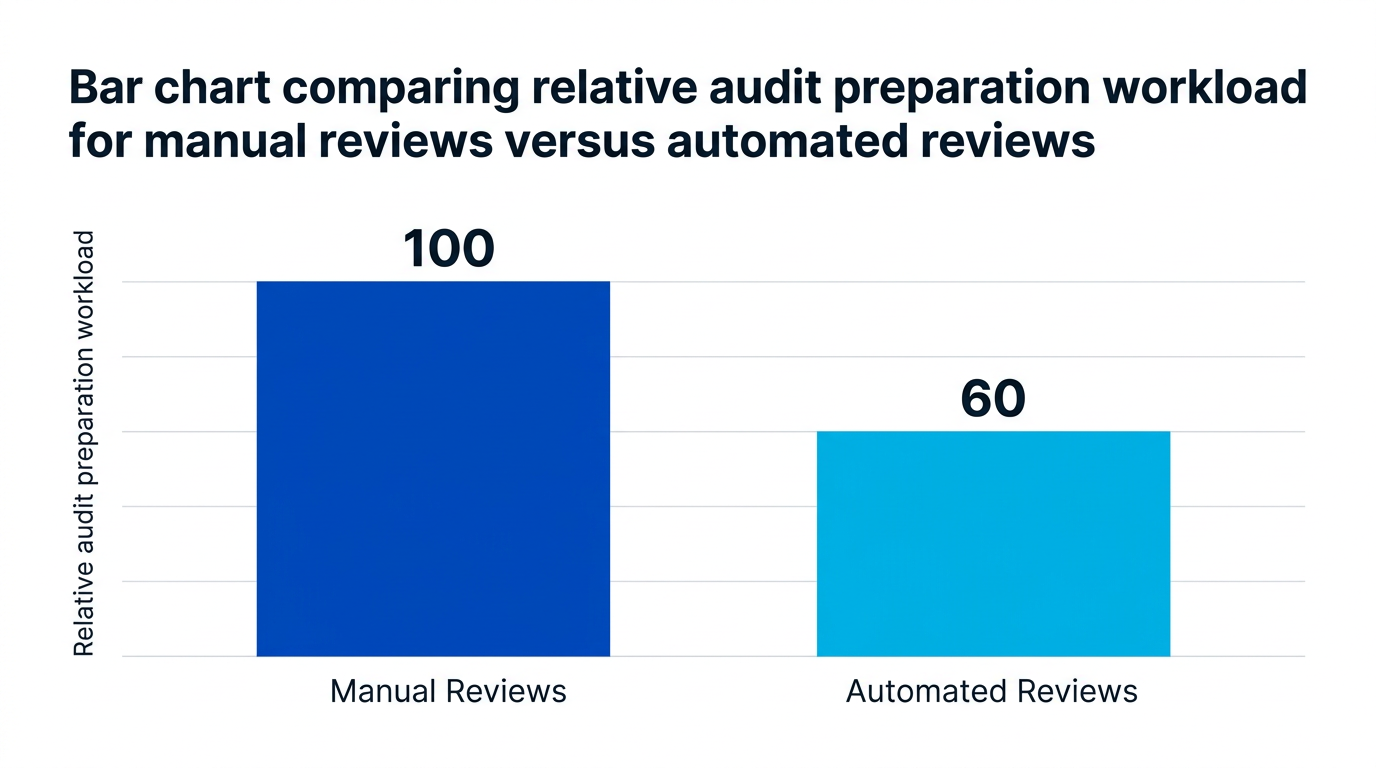
Regulators increasingly expect evidence of audit-ready access reviews. A major audit firm reports that 90% of regulated enterprises now rank user access review automation as critical to audit readiness (Deloitte 2026). Another study notes that 72% of compliance leaders saw audit preparation workloads drop by at least 40% after adopting automated access review capabilities (Forrester 2026).
Poorly executed access review best practices create both real security risk and operational drag. A conversational analogy: trying to manage access with static spreadsheets is like running intrusion detection by reading raw firewall logs in Excel. It might work at 50 users, but it collapses completely at 50,000.
Common failure modes include:
Rubber-stamp approvals: Managers approve everything because the volume is overwhelming and context is missing.
Stale entitlements: Departed employees, role changes, and project end dates are not reflected, so access accumulates.
Missed privileged access: High-risk admin or root access is buried among thousands of low-risk entitlements.
Gartner notes that 68% of enterprises struggle primarily with scale in user access reviews, not with policy design. At the same time, KPMG finds that 61% of organizations using AI-driven identity governance see fewer access certification violations (KPMG 2026). In other words, design is critical, but execution at scale is where many programs fail.
To build consistent and scalable UAR best practices, you need structure, automation, and context. Below are the building blocks that high-performing programs share.
User access governance starts with identity lifecycle management: joiner, mover, and leaver events. If access is not provisioned and deprovisioned accurately, your certifications will always be noisy.
Best practices:
Tie review scope to lifecycle events. When someone changes department, role, or region, trigger an immediate, focused access review for high-risk systems.
Automate deprovisioning. Ensure accounts and entitlements are revoked automatically on termination, then use reviews to verify exceptions.
Use policy-based access controls. Map standard roles to entitlements, then review the role design itself rather than each entitlement in isolation.
This approach shortens your access certification process and sharply reduces review fatigue, because reviewers see only contextually relevant items instead of every entitlement a user ever accumulated.
Treating all users and applications the same leads to inefficient, ineffective campaigns. A risk-based access review program aligns effort with actual exposure.
Key elements of a risk-based access review strategy:
Tier your applications and entitlements. Classify by data sensitivity, regulatory impact, and privileged capabilities.
Prioritize high-risk identities. Focus on privileged users, finance roles subject to segregation of duties, and identities with broad data access.
Vary cadence by risk. Review privileged access monthly or quarterly, business-critical access semi-annually, and low-risk access annually.
Organizations that adopt risk-weighted reviews report better focus and fewer false positives, which leads to more deliberate decisions and stronger access risk mitigation.
Many programs optimize for passing audits rather than enabling reviewers to make good security decisions. Reviewers often see cryptic entitlement names, no usage data, and no guidance. The predictable result: blanket approvals.
To fix this, design around the reviewer:
Provide context-rich screens: business-friendly entitlement names, descriptions, ownership, and data classification.
Surface usage analytics: last login, last access, and frequency so reviewers can quickly revoke unused or dormant access.
Highlight conflicts and anomalies: mark segregation of duties issues, unusual combinations, or access far outside peer norms.
This is where identity governance automation shines. With analytics embedded into the access certification process, reviewers can distinguish routine access from risky outliers in seconds, not hours.
Third-party access management is often fragmented across vendor managers, IT, and security teams. However, suppliers and contractors frequently have direct access to sensitive systems.
UAR best practices for third parties include:
Governing third-party identities in the same platform as your workforce
Using standard onboarding workflows with explicit contract end dates
Running dedicated third-party access management campaigns for high-risk suppliers
A strong third-party program aligns with zero trust access review principles and reduces the chance that a forgotten vendor account becomes an attack vector.

Manual access reviews do not scale. For large enterprises, analysts warn that attempting to scale without automation leads to audit fatigue, delays, and errors, and they now see cloud-native platforms as table stakes (Forrester 2026).
Automation is not just a productivity play. It is central to continuous compliance. IDC reports that 84% of companies using cloud-native IGA solutions maintain ongoing compliance across multi-cloud environments (IDC 2026).
Here are the most impactful automation patterns.
Instead of spinning up campaigns manually for every audit, define review cycle automation rules:
Auto-generate campaigns by application tier, region, or business unit
Auto-assign reviewers based on manager, system owner, or data owner
Apply different cadences based on regulatory needs, such as SOX user access or HIPAA access reviews
This reduces human error in campaign design and ensures alignment with compliance-driven IT controls.
Analytics-powered, automated access review workflows help reviewers focus on what matters:
Pre-approve low-risk, low-usage access according to policy
Flag high-risk entitlements, segregation of duties conflicts, and privileged access certification items for explicit review
Use peer group analysis to spot anomalous access in similar job functions
One research shows that workflow automation can reduce manual errors in access reviews by 54%. KPMG similarly notes that organizations with AI-driven identity governance see fewer access certification violations, reinforcing the value of analytics and automation together.
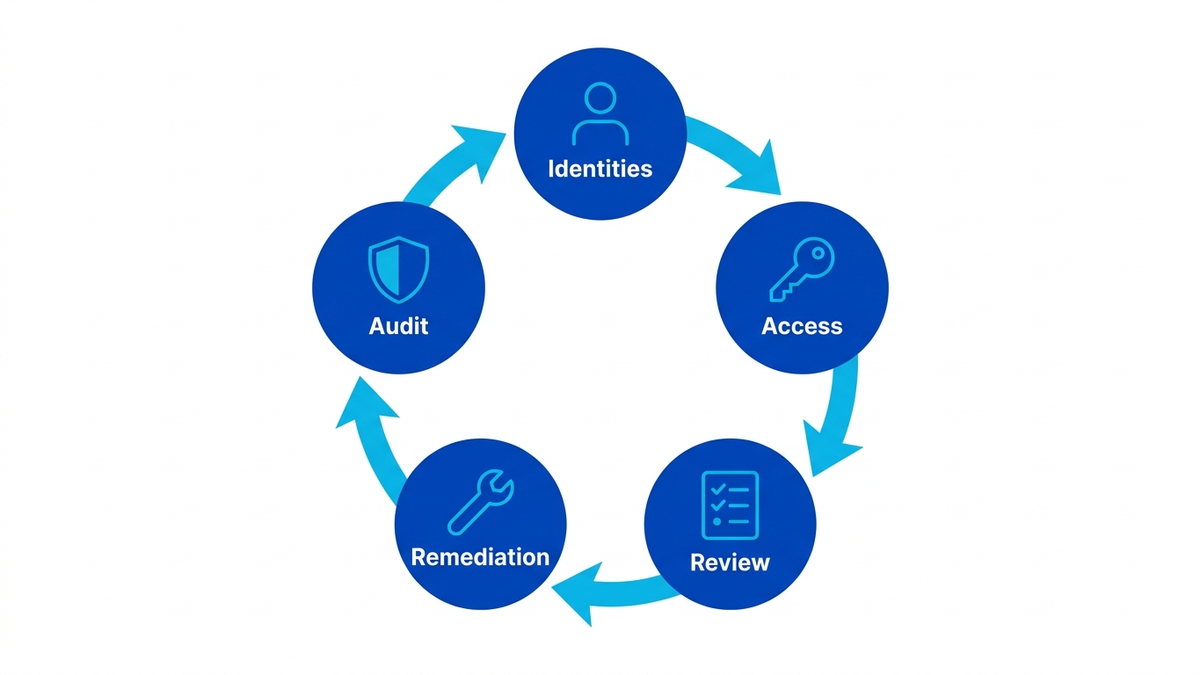
A decision in a review is only useful if the remediation workflow executes correctly downstream.
Strong remediation workflow practices include:
Automatically generating deprovisioning tasks downstream from review outcomes
Escalating uncompleted tasks to system owners or security teams
Applying continuous access monitoring to confirm that removed entitlements do not reappear through other processes
This turns reviews into a closed-loop control instead of a one-time audit artefact.
Audit-ready identity governance is about more than proving you ran a campaign. You must prove that your process is repeatable, controlled, and effective.
Leading identity governance best practices for audit-ready access reviews include:
Maintain a single system of record that captures:
Review configurations and scope
Reviewer assignments and delegation rules
Decisions, timestamps, and comments
This should align with your broader cloud identity governance program, not live in disconnected tools and email threads.
Auditors increasingly ask why reviews are configured as they are. Be ready to demonstrate:
How risk classifications drive review cadence
How policy-based access controls define toxic combinations and segregation of duties scenarios
How exceptions and overrides are monitored and approved
This shifts the discussion from firefighting to a structured, risk-based control environment.
Most large enterprises face overlapping requirements: SOX user access, HIPAA access reviews, PCI-DSS, regional privacy laws, and more.
Rather than building separate programs, design a single user access governance framework that:
Tags systems and entitlements by regulatory coverage
Associates campaigns with control IDs across multiple frameworks
Produces auditor-ready reports filtered by regulation, entity, and time period
A major consulting firm notes a 45% increase in investment in access review automation, driven largely by the need to meet multi-regulatory expectations efficiently (PwC 2026).
One Enterprise Identity Cloud is purpose-built to help enterprises operationalize user access review best practices at scale. Its cloud-native architecture supports hybrid and multi-cloud ecosystems while reducing reliance on brittle, manual processes.
Here is how they address the most common UAR challenges.
The Identity Governance & Administration centralizes access certifications for employees, contractors, third parties, and privileged users. Organizations can:
Configure risk-based access review campaigns with templates aligned to SOX, HIPAA, and other compliance-driven IT controls
Use AI-driven analytics to surface high-risk entitlements, anomalous access, and dormant accounts
Provide context-rich reviewer experiences with entitlement descriptions, ownership, and usage data
The insights data shows organizations implementing workflow automation through the platform reduce manual access review errors by 54%.
With Access Risk Management, it embeds advanced segregation of duties policies directly into the access certification process. This enables:
Real-time detection of toxic combinations during reviews
Prioritized views for privileged access certification across cloud and on-prem systems
Automated remediation workflow for SoD violations, routed to application owners or security teams
This risk-centric model aligns reviews with identity and compliance automation objectives instead of treating them as check-the-box exercises.
Application Access Governance extends user access governance across SaaS, IaaS, and on-prem applications from a single platform.
Organizations can:
Automate review cycles on critical apps, using review cycle automation tied to business calendars and regulatory deadlines
Orchestrate remediation workflow directly into connected systems
Maintain unified reporting and dashboards for enterprise access certification across the portfolio
For privileged cloud infrastructure, Cloud Privileged Access Management enables just-in-time access and integrates with certifications so access elevation aligns with zero trust access review practices.
Third-Party Access Governance capabilities that fold partner, vendor, and contractor identities into the same lifecycle and review framework.
This includes:
Delegated administration for vendor managers
Time-bound access and automated review triggers at contract milestones
Continuous access monitoring for high-risk third-party connections
By unifying internal and external identities, can strengthens zero trust and reduces gaps introduced by fragmented tools.
A Fortune 100 healthcare provider implemented this Enterprise Identity Cloud to modernize its access certification process across multiple electronic health record systems, financial platforms, and cloud applications.
Within one year, the organization:
Automated user access reviews across a multi-cloud environment
Reduced audit preparation time by 56%
Achieved zero compliance deficiencies in its 2026 HIPAA audit
This is a practical demonstration of how identity and compliance automation, when combined with a cloud-native IGA approach, translates into measurable improvements in continuous compliance.
Even well-intentioned programs fall into recurring traps. Addressing these early can dramatically raise the quality of your certifications.
Many organizations run a single, huge annual campaign to satisfy an auditor request. The result is chaos: overloaded reviewers, rushed approvals, and poor data.
Best practice: Shift to a mix of continuous access monitoring, targeted event-driven certifications, and smaller periodic campaigns aligned with risk.
When security or IT designs reviews in isolation, business leaders see them as a burden, not a control that protects their data.
Best practice: Involve application owners, data owners, and key managers in defining entitlement schemas, review frequencies, and attestation workflows. This improves terminology, ownership, and adoption.
Focusing only on employees and core systems leaves partner, contractor, and shadow IT access ungoverned.
Best practice: Ingest identities from vendor portals, HR, and directory sources into a central platform. Include them in user access governance policies and campaigns, especially for sensitive data.
Buying a cloud identity governance solution is not the same as having mature identity governance best practices.
Best practice: Establish clear metrics, such as percentage of high-risk entitlements reviewed on time, rate of revoked access, and number of SoD conflicts detected per cycle.
Some leaders argue that full automation will obscure human judgment or that manual reviews maintain more control. In practice, poorly structured manual processes lead to less control, not more, because volume overwhelms reviewers.
A balanced approach combines:
Automated orchestration of campaigns and routing
Analytics-driven prioritization of risk
Human decisions on high-impact access, supported by strong context
This hybrid model preserves accountable decision-making while eliminating rote, error-prone work.
User access reviews are periodic evaluations of who has access to which systems and data, and whether that access is still appropriate. They enforce the least privilege principle, reduce insider and external risk, and provide the evidence regulators expect for compliance-focused controls.
When aligned with identity governance best practices, access reviews become a continuous, risk-based control instead of a once-a-year scramble.
To achieve scalable access reviews, organizations should centralize identities and entitlements, define standardized review templates, and use identity governance automation to generate and route campaigns.
Platforms enable automated access review creation, risk-weighted prioritization, and integrated remediation workflows that remove the manual heavy lifting from compliance teams.
Identity governance provides the policies, data models, analytics, and workflows that make access certifications reliable and repeatable. It connects identity lifecycle management, policy-based access controls, and the access certification process into a single fabric.
With strong identity governance, reviews inherit accurate entitlement definitions, risk scoring, and role models, which improves both reviewer decisions and audit outcomes.
Audit-ready access reviews require centralized evidence, consistent configurations, and clear mapping to control objectives. You should be able to show what was reviewed, by whom, when, with which policy context, and what remediation occurred.
Using a cloud-native IGA solution, organizations can generate auditor-ready reports for SOX user access, HIPAA access reviews, and other frameworks from the same underlying data.
Frequency should reflect risk. High-risk applications and privileged access often warrant monthly or quarterly reviews, while medium-risk business systems may be reviewed semi-annually, and low-risk resources annually.
A risk-based access review strategy aligns cadence to data sensitivity, regulatory coverage, and role criticality instead of using a one-size-fits-all schedule.
Helpful access recertification tips include: using short, focused campaigns instead of one large event, grouping entitlements into business-friendly roles, and pre-populating recommendations based on usage data.
Enterprises should also separate standard access from exceptions, so reviewers focus their attention on unusual or high-risk cases rather than routine patterns.
User access review best practices sit at the intersection of identity, risk, and compliance. To succeed, enterprises must move away from manual, spreadsheet-driven campaigns and toward cloud-native, automated, and risk-aware user access governance.
By anchoring reviews in identity lifecycle management, prioritizing high-risk access, designing for reviewer experience, and centralizing evidence, you can build a program that satisfies auditors and meaningfully reduces risk.
Enterprise Identity Cloud delivers the cloud identity governance capabilities needed to automate scalable access reviews, integrate advanced analytics and SoD controls, and maintain continuous compliance across complex hybrid environments.
CloudNuro is a leader in Enterprise SaaS Management Platforms, giving enterprises unmatched visibility, governance, and cost optimization.
We are proud to be recognized twice in a row by Gartner in the SaaS Management Platforms and named a Leader in the Info-Tech SoftwareReviews Data Quadrant.
Trusted by global enterprises and government agencies, CloudNuro provides centralized SaaS inventory, license optimization, and renewal management. With a 15-minute setup and measurable results in under 24 hours, CloudNuro gives IT teams a fast path to value.
Request a Demo | Get Free Savings Assessment | Explore Product
Request a no cost, no obligation free assessment —just 15 minutes to savings!
Get StartedUser access review best practices are no longer a “nice to have” for regulated enterprises. They are a core control for enforcing least privilege, proving compliance, and reducing identity-driven risk across hybrid and multi-cloud environments.
Yet 68% of enterprises cite scalability as the top challenge in achieving effective user access reviews at enterprise scale (Gartner 2026). Manual, spreadsheet-driven campaigns quickly break when you have thousands of users, hundreds of applications, and multiple regulatory frameworks.
This guide breaks down practical user access review best practices that help you build trusted, audit-ready reviews at scale, and shows how cloud-native identity governance can turn an annual fire drill into continuous compliance.
User access reviews, sometimes called access certifications, are periodic checks that validate who has access to what, and whether that access is still appropriate. They are a foundational part of identity governance best practices and zero trust.
At a minimum, they help you:
Enforce the least privilege principle across employees, contractors, and third parties
Identify toxic combinations and segregation of duties conflicts
Prove your controls for SOX user access, HIPAA access reviews, GDPR, and other regulatory regimes
Regulators increasingly expect evidence of audit-ready access reviews. A major audit firm reports that 90% of regulated enterprises now rank user access review automation as critical to audit readiness (Deloitte 2026). Another study notes that 72% of compliance leaders saw audit preparation workloads drop by at least 40% after adopting automated access review capabilities (Forrester 2026).
Poorly executed access review best practices create both real security risk and operational drag. A conversational analogy: trying to manage access with static spreadsheets is like running intrusion detection by reading raw firewall logs in Excel. It might work at 50 users, but it collapses completely at 50,000.
Common failure modes include:
Rubber-stamp approvals: Managers approve everything because the volume is overwhelming and context is missing.
Stale entitlements: Departed employees, role changes, and project end dates are not reflected, so access accumulates.
Missed privileged access: High-risk admin or root access is buried among thousands of low-risk entitlements.
Gartner notes that 68% of enterprises struggle primarily with scale in user access reviews, not with policy design. At the same time, KPMG finds that 61% of organizations using AI-driven identity governance see fewer access certification violations (KPMG 2026). In other words, design is critical, but execution at scale is where many programs fail.
To build consistent and scalable UAR best practices, you need structure, automation, and context. Below are the building blocks that high-performing programs share.
User access governance starts with identity lifecycle management: joiner, mover, and leaver events. If access is not provisioned and deprovisioned accurately, your certifications will always be noisy.
Best practices:
Tie review scope to lifecycle events. When someone changes department, role, or region, trigger an immediate, focused access review for high-risk systems.
Automate deprovisioning. Ensure accounts and entitlements are revoked automatically on termination, then use reviews to verify exceptions.
Use policy-based access controls. Map standard roles to entitlements, then review the role design itself rather than each entitlement in isolation.
This approach shortens your access certification process and sharply reduces review fatigue, because reviewers see only contextually relevant items instead of every entitlement a user ever accumulated.
Treating all users and applications the same leads to inefficient, ineffective campaigns. A risk-based access review program aligns effort with actual exposure.
Key elements of a risk-based access review strategy:
Tier your applications and entitlements. Classify by data sensitivity, regulatory impact, and privileged capabilities.
Prioritize high-risk identities. Focus on privileged users, finance roles subject to segregation of duties, and identities with broad data access.
Vary cadence by risk. Review privileged access monthly or quarterly, business-critical access semi-annually, and low-risk access annually.
Organizations that adopt risk-weighted reviews report better focus and fewer false positives, which leads to more deliberate decisions and stronger access risk mitigation.
Many programs optimize for passing audits rather than enabling reviewers to make good security decisions. Reviewers often see cryptic entitlement names, no usage data, and no guidance. The predictable result: blanket approvals.
To fix this, design around the reviewer:
Provide context-rich screens: business-friendly entitlement names, descriptions, ownership, and data classification.
Surface usage analytics: last login, last access, and frequency so reviewers can quickly revoke unused or dormant access.
Highlight conflicts and anomalies: mark segregation of duties issues, unusual combinations, or access far outside peer norms.
This is where identity governance automation shines. With analytics embedded into the access certification process, reviewers can distinguish routine access from risky outliers in seconds, not hours.
Third-party access management is often fragmented across vendor managers, IT, and security teams. However, suppliers and contractors frequently have direct access to sensitive systems.
UAR best practices for third parties include:
Governing third-party identities in the same platform as your workforce
Using standard onboarding workflows with explicit contract end dates
Running dedicated third-party access management campaigns for high-risk suppliers
A strong third-party program aligns with zero trust access review principles and reduces the chance that a forgotten vendor account becomes an attack vector.
Manual access reviews do not scale. For large enterprises, analysts warn that attempting to scale without automation leads to audit fatigue, delays, and errors, and they now see cloud-native platforms as table stakes (Forrester 2026).
Automation is not just a productivity play. It is central to continuous compliance. IDC reports that 84% of companies using cloud-native IGA solutions maintain ongoing compliance across multi-cloud environments (IDC 2026).
Here are the most impactful automation patterns.
Instead of spinning up campaigns manually for every audit, define review cycle automation rules:
Auto-generate campaigns by application tier, region, or business unit
Auto-assign reviewers based on manager, system owner, or data owner
Apply different cadences based on regulatory needs, such as SOX user access or HIPAA access reviews
This reduces human error in campaign design and ensures alignment with compliance-driven IT controls.
Analytics-powered, automated access review workflows help reviewers focus on what matters:
Pre-approve low-risk, low-usage access according to policy
Flag high-risk entitlements, segregation of duties conflicts, and privileged access certification items for explicit review
Use peer group analysis to spot anomalous access in similar job functions
One research shows that workflow automation can reduce manual errors in access reviews by 54%. KPMG similarly notes that organizations with AI-driven identity governance see fewer access certification violations, reinforcing the value of analytics and automation together.
A decision in a review is only useful if the remediation workflow executes correctly downstream.
Strong remediation workflow practices include:
Automatically generating deprovisioning tasks downstream from review outcomes
Escalating uncompleted tasks to system owners or security teams
Applying continuous access monitoring to confirm that removed entitlements do not reappear through other processes
This turns reviews into a closed-loop control instead of a one-time audit artefact.
Audit-ready identity governance is about more than proving you ran a campaign. You must prove that your process is repeatable, controlled, and effective.
Leading identity governance best practices for audit-ready access reviews include:
Maintain a single system of record that captures:
Review configurations and scope
Reviewer assignments and delegation rules
Decisions, timestamps, and comments
This should align with your broader cloud identity governance program, not live in disconnected tools and email threads.
Auditors increasingly ask why reviews are configured as they are. Be ready to demonstrate:
How risk classifications drive review cadence
How policy-based access controls define toxic combinations and segregation of duties scenarios
How exceptions and overrides are monitored and approved
This shifts the discussion from firefighting to a structured, risk-based control environment.
Most large enterprises face overlapping requirements: SOX user access, HIPAA access reviews, PCI-DSS, regional privacy laws, and more.
Rather than building separate programs, design a single user access governance framework that:
Tags systems and entitlements by regulatory coverage
Associates campaigns with control IDs across multiple frameworks
Produces auditor-ready reports filtered by regulation, entity, and time period
A major consulting firm notes a 45% increase in investment in access review automation, driven largely by the need to meet multi-regulatory expectations efficiently (PwC 2026).
One Enterprise Identity Cloud is purpose-built to help enterprises operationalize user access review best practices at scale. Its cloud-native architecture supports hybrid and multi-cloud ecosystems while reducing reliance on brittle, manual processes.
Here is how they address the most common UAR challenges.
The Identity Governance & Administration centralizes access certifications for employees, contractors, third parties, and privileged users. Organizations can:
Configure risk-based access review campaigns with templates aligned to SOX, HIPAA, and other compliance-driven IT controls
Use AI-driven analytics to surface high-risk entitlements, anomalous access, and dormant accounts
Provide context-rich reviewer experiences with entitlement descriptions, ownership, and usage data
The insights data shows organizations implementing workflow automation through the platform reduce manual access review errors by 54%.
With Access Risk Management, it embeds advanced segregation of duties policies directly into the access certification process. This enables:
Real-time detection of toxic combinations during reviews
Prioritized views for privileged access certification across cloud and on-prem systems
Automated remediation workflow for SoD violations, routed to application owners or security teams
This risk-centric model aligns reviews with identity and compliance automation objectives instead of treating them as check-the-box exercises.
Application Access Governance extends user access governance across SaaS, IaaS, and on-prem applications from a single platform.
Organizations can:
Automate review cycles on critical apps, using review cycle automation tied to business calendars and regulatory deadlines
Orchestrate remediation workflow directly into connected systems
Maintain unified reporting and dashboards for enterprise access certification across the portfolio
For privileged cloud infrastructure, Cloud Privileged Access Management enables just-in-time access and integrates with certifications so access elevation aligns with zero trust access review practices.
Third-Party Access Governance capabilities that fold partner, vendor, and contractor identities into the same lifecycle and review framework.
This includes:
Delegated administration for vendor managers
Time-bound access and automated review triggers at contract milestones
Continuous access monitoring for high-risk third-party connections
By unifying internal and external identities, can strengthens zero trust and reduces gaps introduced by fragmented tools.
A Fortune 100 healthcare provider implemented this Enterprise Identity Cloud to modernize its access certification process across multiple electronic health record systems, financial platforms, and cloud applications.
Within one year, the organization:
Automated user access reviews across a multi-cloud environment
Reduced audit preparation time by 56%
Achieved zero compliance deficiencies in its 2026 HIPAA audit
This is a practical demonstration of how identity and compliance automation, when combined with a cloud-native IGA approach, translates into measurable improvements in continuous compliance.
Even well-intentioned programs fall into recurring traps. Addressing these early can dramatically raise the quality of your certifications.
Many organizations run a single, huge annual campaign to satisfy an auditor request. The result is chaos: overloaded reviewers, rushed approvals, and poor data.
Best practice: Shift to a mix of continuous access monitoring, targeted event-driven certifications, and smaller periodic campaigns aligned with risk.
When security or IT designs reviews in isolation, business leaders see them as a burden, not a control that protects their data.
Best practice: Involve application owners, data owners, and key managers in defining entitlement schemas, review frequencies, and attestation workflows. This improves terminology, ownership, and adoption.
Focusing only on employees and core systems leaves partner, contractor, and shadow IT access ungoverned.
Best practice: Ingest identities from vendor portals, HR, and directory sources into a central platform. Include them in user access governance policies and campaigns, especially for sensitive data.
Buying a cloud identity governance solution is not the same as having mature identity governance best practices.
Best practice: Establish clear metrics, such as percentage of high-risk entitlements reviewed on time, rate of revoked access, and number of SoD conflicts detected per cycle.
Some leaders argue that full automation will obscure human judgment or that manual reviews maintain more control. In practice, poorly structured manual processes lead to less control, not more, because volume overwhelms reviewers.
A balanced approach combines:
Automated orchestration of campaigns and routing
Analytics-driven prioritization of risk
Human decisions on high-impact access, supported by strong context
This hybrid model preserves accountable decision-making while eliminating rote, error-prone work.
User access reviews are periodic evaluations of who has access to which systems and data, and whether that access is still appropriate. They enforce the least privilege principle, reduce insider and external risk, and provide the evidence regulators expect for compliance-focused controls.
When aligned with identity governance best practices, access reviews become a continuous, risk-based control instead of a once-a-year scramble.
To achieve scalable access reviews, organizations should centralize identities and entitlements, define standardized review templates, and use identity governance automation to generate and route campaigns.
Platforms enable automated access review creation, risk-weighted prioritization, and integrated remediation workflows that remove the manual heavy lifting from compliance teams.
Identity governance provides the policies, data models, analytics, and workflows that make access certifications reliable and repeatable. It connects identity lifecycle management, policy-based access controls, and the access certification process into a single fabric.
With strong identity governance, reviews inherit accurate entitlement definitions, risk scoring, and role models, which improves both reviewer decisions and audit outcomes.
Audit-ready access reviews require centralized evidence, consistent configurations, and clear mapping to control objectives. You should be able to show what was reviewed, by whom, when, with which policy context, and what remediation occurred.
Using a cloud-native IGA solution, organizations can generate auditor-ready reports for SOX user access, HIPAA access reviews, and other frameworks from the same underlying data.
Frequency should reflect risk. High-risk applications and privileged access often warrant monthly or quarterly reviews, while medium-risk business systems may be reviewed semi-annually, and low-risk resources annually.
A risk-based access review strategy aligns cadence to data sensitivity, regulatory coverage, and role criticality instead of using a one-size-fits-all schedule.
Helpful access recertification tips include: using short, focused campaigns instead of one large event, grouping entitlements into business-friendly roles, and pre-populating recommendations based on usage data.
Enterprises should also separate standard access from exceptions, so reviewers focus their attention on unusual or high-risk cases rather than routine patterns.
User access review best practices sit at the intersection of identity, risk, and compliance. To succeed, enterprises must move away from manual, spreadsheet-driven campaigns and toward cloud-native, automated, and risk-aware user access governance.
By anchoring reviews in identity lifecycle management, prioritizing high-risk access, designing for reviewer experience, and centralizing evidence, you can build a program that satisfies auditors and meaningfully reduces risk.
Enterprise Identity Cloud delivers the cloud identity governance capabilities needed to automate scalable access reviews, integrate advanced analytics and SoD controls, and maintain continuous compliance across complex hybrid environments.
CloudNuro is a leader in Enterprise SaaS Management Platforms, giving enterprises unmatched visibility, governance, and cost optimization.
We are proud to be recognized twice in a row by Gartner in the SaaS Management Platforms and named a Leader in the Info-Tech SoftwareReviews Data Quadrant.
Trusted by global enterprises and government agencies, CloudNuro provides centralized SaaS inventory, license optimization, and renewal management. With a 15-minute setup and measurable results in under 24 hours, CloudNuro gives IT teams a fast path to value.
Request a Demo | Get Free Savings Assessment | Explore Product
Request a no cost, no obligation free assessment - just 15 minutes to savings!
Get StartedWe're offering complimentary ServiceNow license assessments to only 25 enterprises this quarter who want to unlock immediate savings without disrupting operations.
Get Free AssessmentGet Started




CloudNuro Corp
1755 Park St. Suite 207
Naperville, IL 60563
Phone : +1-630-277-9470
Email: info@cloudnuro.com




.webp)

Recognized Leader in SaaS Management Platforms by Info-Tech SoftwareReviews


.png)
.svg)