

Sign Up
Thank you for Submitting!
SaaS discovery is the starting point for every serious SaaS management, cost optimization, and security program. If you cannot accurately see all the SaaS applications in use, you cannot control spend, enforce policies, or reduce risk.
For IT and procurement teams managing hundreds of cloud tools, SaaS discovery provides the single source of truth that every decision depends on. According to a SaaS Trends Report 2026, the average enterprise uses over 360 SaaS applications but formally tracks only 210. The gap between usage and visibility is where waste, risk, and compliance exposure accumulate.
This guide explains what SaaS discovery is, how a robust SaaS discovery process works, why automated SaaS discovery matters, and how platforms like CloudNuro give IT and procurement teams continuous control.
SaaS discovery is the ongoing process of identifying, cataloging, and monitoring all SaaS applications used across an organization. It covers both sanctioned tools acquired through procurement and unsanctioned or unknown tools, often referred to as shadow IT.
In practice, SaaS discovery answers three foundational questions:
A SaaS Governance Analyst at Gartner notes, "SaaS discovery is foundational to effective SaaS management. Without a full inventory of applications, organizations cannot ensure security or optimize spend" (Gartner 2026). This visibility underpins everything from SaaS lifecycle management to SaaS risk assessment.
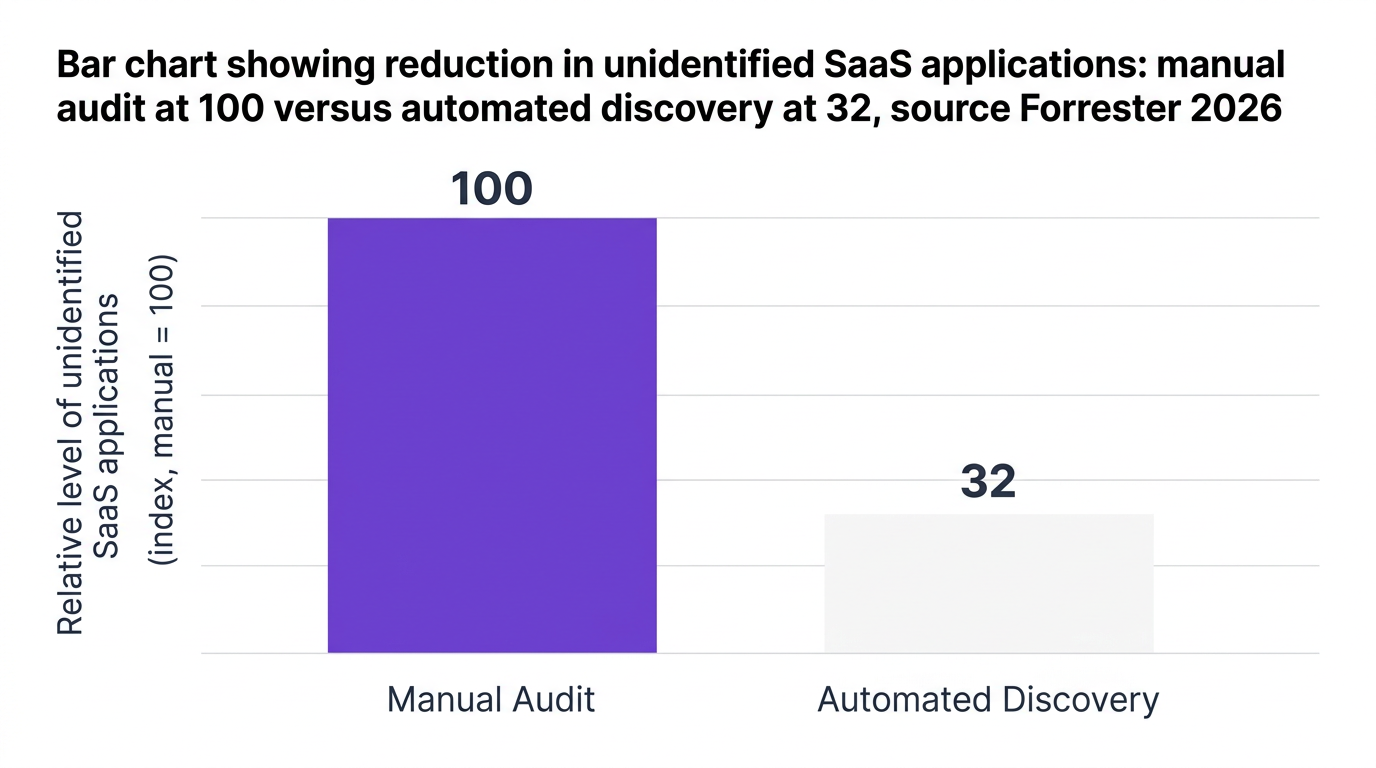
According to Forrester 2026, automated SaaS discovery platforms reduce unidentified software by up to 68 percent compared to manual audits. That shift directly impacts cost, risk, and governance outcomes.
SaaS discovery is not just an inventory exercise. It is a strategic capability for IT, procurement, and finance leaders who must balance innovation with control.
Gartner reports that 81 percent of organizations cite shadow IT as a growing concern when managing SaaS. ISACA 2026 notes that 48 percent of IT leaders report at least one significant security incident annually tied to unknown or unmanaged SaaS apps.
Unknown tools often bypass SSO, MFA, and central logging. This weakens SaaS security monitoring, increases the risk of orphaned accounts, and makes SaaS compliance audits more difficult. Effective SaaS discovery drives better cloud application visibility so security teams can enforce policies consistently.

Untracked SaaS apps and unused licenses erode budgets quietly. IDC 2026 found that enterprises implementing automated SaaS discovery realize 22 percent average cost savings on SaaS spend in the first year.
With accurate usage analytics and an up to date IT SaaS inventory, organizations can:
For procurement teams, real time visibility removes guesswork from negotiations and renewal conversations, and supports structured SaaS cost governance.
Highly regulated sectors like healthcare, finance, and government depend on strong cloud governance. Yet 68 percent of procurement teams list lack of real time SaaS inventory visibility as their top challenge for cost containment and compliance (ProcureTech 2026).
SaaS discovery feeds:
The result is fewer surprises during audits and faster response to new regulations.
If SaaS discovery is so critical, why do so many organizations struggle with it? The answer lies in volume, velocity, and fragmentation.
SaaS usage and spend data lives across identity providers, finance systems, browser logs, and individual teams. A typical manual SaaS discovery process might involve:
This approach often misses small teams, pilot projects, and departmental spend. It also fails to capture feature level usage needed for accurate license optimization.
Shadow IT identification is difficult when teams can sign up for tools with a corporate email in seconds. Over time, this leads to entitlement sprawl, where more users, roles, and permissions exist than anyone realizes.
This creates several risks:
The larger the SaaS portfolio, the harder it becomes to manage these risks without automated SaaS discovery.
Many organizations still perform SaaS audits once or twice a year. This snapshot approach cannot keep pace with self service adoption and continuous SaaS integration patterns.
As Michael Doherty, CTO at Forrester, notes, "Automated discovery tools leveraging AI and deep integrations have become essential for identifying, monitoring, and governing SaaS use at scale in 2026" (Forrester 2026). Without automation, IT teams end up chasing stale spreadsheets instead of actively managing risk.
SaaS discovery sits at the intersection of IT, security, procurement, and finance. Each group has its own priorities:
Without a shared view, decisions are fragmented. This slows license reclamation, duplication clean-up, and enterprise SaaS monitoring.
Automated SaaS discovery replaces manual, periodic audits with continuous, data-driven visibility. Think of it as moving from a flashlight to a full building lighting system.
Automated discovery platforms typically aggregate data from:
This multi-source approach improves the visibility of SaaS apps and reduces blind spots.
A mature automated SaaS discovery solution usually includes:
Over time, this data underpins broader SaaS lifecycle management, from evaluation and onboarding to renewal or retirement.
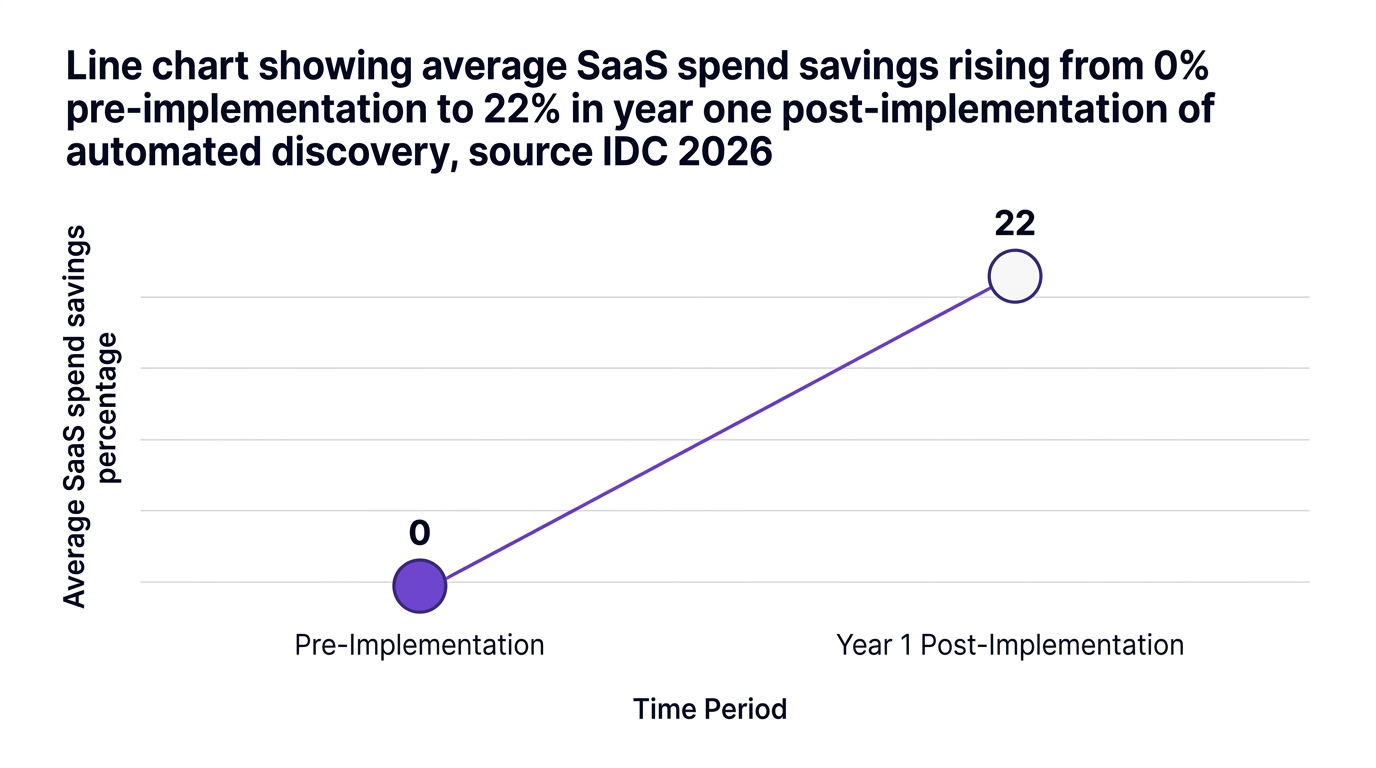
IDC 2026 found that organizations that adopt automated discovery see average 22 percent savings on SaaS spend within year one. Cost savings continue as discovery data informs procurement, vendor management, and ongoing cloud governance.
Manual methods can temporarily work for small environments. However, they tend to fail when:
At that point, manual audits cannot produce accurate, timely data. Automated SaaS discovery becomes essential to maintain control.
To translate SaaS discovery into action, IT and procurement teams need a repeatable checklist. Use the steps below as a baseline framework.
Define who owns SaaS discovery: typically a joint initiative between IT, security, and procurement. Clarify what you want to improve first, such as cost savings, SaaS compliance, or security outcomes.
Agree on metrics such as:
Start assembling your inventory with these data sources:
If you use an automated SaaS management platform, connect core systems and prioritize coverage for high risk and high spend categories.
For each discovered app, capture:
This classification supports SaaS vendor management and targeted SaaS risk assessment. It also clarifies who participates in renewal and rationalization decisions.
Use usage analytics and spend analysis to segment applications into:
For each category, define actions, such as license rightsizing, consolidation, or retirement. This is where SaaS spend optimization and license optimization translate into measurable savings.
Use your inventory to identify:
Feed this insight into SaaS security monitoring, compliance workflows, and access review cycles.
Finally, shift SaaS discovery from a one time project to a continuous process. Define:

CloudNuro is built specifically to give IT, procurement, and finance leaders unified, AI driven control over SaaS and cloud environments. SaaS discovery is at the heart of the platform.
CloudNuro AI Custodian provides continuous, automated SaaS discovery by integrating with over 400 enterprise SaaS and cloud applications. It connects to identity providers, finance systems, and application APIs to build a real time IT SaaS inventory.
Key capabilities include:
This unified view enables accurate enterprise SaaS monitoring, even across multi cloud SaaS management scenarios.
CloudNuro uses AI powered analytics to identify underused licenses, inactive accounts, and redundant applications. Unified spend dashboards highlight high opportunity areas for SaaS spend optimization.
With CloudNuro, teams can:
CloudNuro's FinOps Services add renewal benchmark analytics, spend reduction recommendations, and negotiation support to strengthen SaaS cost governance.
CloudNuro's governance first architecture is designed for sectors with stringent SaaS compliance requirements. Deep security integrations with SSO and MFA, plus automated compliance workflow features, provide continuous monitoring.
Capabilities include:
This turns raw discovery data into enforceable cloud governance and SaaS security monitoring.
A Fortune 100 healthcare provider used CloudNuro AI Custodian to complete a full SaaS inventory across clinical and corporate functions. Before CloudNuro, the organization relied on spreadsheets and annual audits.
With automated SaaS discovery, the provider:
CloudNuro's continuous discovery and automated reporting transformed SaaS lifecycle management from a reactive chore into a proactive program aligned with security and compliance objectives.
SaaS discovery is the process of finding and cataloging all SaaS applications in use, including shadow IT. SaaS management builds on discovery by adding cost optimization, security controls, vendor management, and SaaS lifecycle management.
You cannot have effective SaaS management without accurate SaaS discovery. Discovery is the foundation; management is the ongoing practice.
IT teams typically combine multiple data sources: SSO logs, finance and expense data, admin APIs, and user surveys. However, manual consolidation from these sources is slow and error-prone.
Automated SaaS discovery through a SaaS management platform simplifies this process by continuously ingesting data from identity, finance, and application sources, then presenting a unified IT SaaS inventory.
By revealing all active applications, users, and entitlements, SaaS discovery gives security teams the context they need to enforce SSO, MFA, and access control policies. It also highlights orphaned accounts and unsanctioned apps that increase risk.
This visibility strengthens SaaS compliance by providing reliable evidence for audits, data protection reviews, and sector-specific regulations in healthcare, finance, and government.
Procurement owns contracts, renewals, and many spend controls. Their data is crucial to building an accurate SaaS inventory and supporting SaaS spend optimization.
With strong cloud application visibility, procurement can prioritize vendor rationalization, negotiate from actual usage data, and coordinate with IT on renewal strategy and SaaS vendor management.
If your organization manages more than about 100 SaaS apps, operates across multiple regions, or supports remote and hybrid work, manual discovery will struggle to keep up. Indicators include frequent surprises at renewal, inconsistent offboarding, and incomplete audit responses.
At that point, an automated SaaS discovery solution such as CloudNuro AI Custodian becomes essential to maintain accurate, real time visibility and strong cloud governance.
Yes. Modern discovery tools are designed for multi-cloud SaaS management scenarios, where apps span multiple public clouds and regions. By integrating with identity providers, finance tools, and the apps themselves, discovery platforms unify data across environments.
This unified view simplifies SaaS integration and helps central teams enforce consistent policies regardless of where individual apps or data reside.
Effective SaaS discovery turns an opaque, fragmented SaaS portfolio into a manageable, governed ecosystem. For IT, procurement, and finance leaders, it is the essential first step toward cost optimization, risk reduction, and confident compliance.
Automated SaaS discovery, backed by AI and deep integrations, gives you continuous IT SaaS inventory, accurate usage analytics, and actionable insights for license reclamation, SaaS spend optimization, and security monitoring. CloudNuro AI Custodian was built for this reality, unifying SaaS and cloud visibility across your enterprise.
If you are ready to replace manual audits and spreadsheets with real time control, schedule a CloudNuro discovery assessment and see how much hidden SaaS, unused spend, and avoidable risk you can eliminate.
Request a Demo | Get Free Savings Assessment | Explore Product
Request a no cost, no obligation free assessment —just 15 minutes to savings!
Get StartedSaaS discovery is the starting point for every serious SaaS management, cost optimization, and security program. If you cannot accurately see all the SaaS applications in use, you cannot control spend, enforce policies, or reduce risk.
For IT and procurement teams managing hundreds of cloud tools, SaaS discovery provides the single source of truth that every decision depends on. According to a SaaS Trends Report 2026, the average enterprise uses over 360 SaaS applications but formally tracks only 210. The gap between usage and visibility is where waste, risk, and compliance exposure accumulate.
This guide explains what SaaS discovery is, how a robust SaaS discovery process works, why automated SaaS discovery matters, and how platforms like CloudNuro give IT and procurement teams continuous control.
SaaS discovery is the ongoing process of identifying, cataloging, and monitoring all SaaS applications used across an organization. It covers both sanctioned tools acquired through procurement and unsanctioned or unknown tools, often referred to as shadow IT.
In practice, SaaS discovery answers three foundational questions:
A SaaS Governance Analyst at Gartner notes, "SaaS discovery is foundational to effective SaaS management. Without a full inventory of applications, organizations cannot ensure security or optimize spend" (Gartner 2026). This visibility underpins everything from SaaS lifecycle management to SaaS risk assessment.
According to Forrester 2026, automated SaaS discovery platforms reduce unidentified software by up to 68 percent compared to manual audits. That shift directly impacts cost, risk, and governance outcomes.
SaaS discovery is not just an inventory exercise. It is a strategic capability for IT, procurement, and finance leaders who must balance innovation with control.
Gartner reports that 81 percent of organizations cite shadow IT as a growing concern when managing SaaS. ISACA 2026 notes that 48 percent of IT leaders report at least one significant security incident annually tied to unknown or unmanaged SaaS apps.
Unknown tools often bypass SSO, MFA, and central logging. This weakens SaaS security monitoring, increases the risk of orphaned accounts, and makes SaaS compliance audits more difficult. Effective SaaS discovery drives better cloud application visibility so security teams can enforce policies consistently.
Untracked SaaS apps and unused licenses erode budgets quietly. IDC 2026 found that enterprises implementing automated SaaS discovery realize 22 percent average cost savings on SaaS spend in the first year.
With accurate usage analytics and an up to date IT SaaS inventory, organizations can:
For procurement teams, real time visibility removes guesswork from negotiations and renewal conversations, and supports structured SaaS cost governance.
Highly regulated sectors like healthcare, finance, and government depend on strong cloud governance. Yet 68 percent of procurement teams list lack of real time SaaS inventory visibility as their top challenge for cost containment and compliance (ProcureTech 2026).
SaaS discovery feeds:
The result is fewer surprises during audits and faster response to new regulations.
If SaaS discovery is so critical, why do so many organizations struggle with it? The answer lies in volume, velocity, and fragmentation.
SaaS usage and spend data lives across identity providers, finance systems, browser logs, and individual teams. A typical manual SaaS discovery process might involve:
This approach often misses small teams, pilot projects, and departmental spend. It also fails to capture feature level usage needed for accurate license optimization.
Shadow IT identification is difficult when teams can sign up for tools with a corporate email in seconds. Over time, this leads to entitlement sprawl, where more users, roles, and permissions exist than anyone realizes.
This creates several risks:
The larger the SaaS portfolio, the harder it becomes to manage these risks without automated SaaS discovery.
Many organizations still perform SaaS audits once or twice a year. This snapshot approach cannot keep pace with self service adoption and continuous SaaS integration patterns.
As Michael Doherty, CTO at Forrester, notes, "Automated discovery tools leveraging AI and deep integrations have become essential for identifying, monitoring, and governing SaaS use at scale in 2026" (Forrester 2026). Without automation, IT teams end up chasing stale spreadsheets instead of actively managing risk.
SaaS discovery sits at the intersection of IT, security, procurement, and finance. Each group has its own priorities:
Without a shared view, decisions are fragmented. This slows license reclamation, duplication clean-up, and enterprise SaaS monitoring.
Automated SaaS discovery replaces manual, periodic audits with continuous, data-driven visibility. Think of it as moving from a flashlight to a full building lighting system.
Automated discovery platforms typically aggregate data from:
This multi-source approach improves the visibility of SaaS apps and reduces blind spots.
A mature automated SaaS discovery solution usually includes:
Over time, this data underpins broader SaaS lifecycle management, from evaluation and onboarding to renewal or retirement.
IDC 2026 found that organizations that adopt automated discovery see average 22 percent savings on SaaS spend within year one. Cost savings continue as discovery data informs procurement, vendor management, and ongoing cloud governance.
Manual methods can temporarily work for small environments. However, they tend to fail when:
At that point, manual audits cannot produce accurate, timely data. Automated SaaS discovery becomes essential to maintain control.
To translate SaaS discovery into action, IT and procurement teams need a repeatable checklist. Use the steps below as a baseline framework.
Define who owns SaaS discovery: typically a joint initiative between IT, security, and procurement. Clarify what you want to improve first, such as cost savings, SaaS compliance, or security outcomes.
Agree on metrics such as:
Start assembling your inventory with these data sources:
If you use an automated SaaS management platform, connect core systems and prioritize coverage for high risk and high spend categories.
For each discovered app, capture:
This classification supports SaaS vendor management and targeted SaaS risk assessment. It also clarifies who participates in renewal and rationalization decisions.
Use usage analytics and spend analysis to segment applications into:
For each category, define actions, such as license rightsizing, consolidation, or retirement. This is where SaaS spend optimization and license optimization translate into measurable savings.
Use your inventory to identify:
Feed this insight into SaaS security monitoring, compliance workflows, and access review cycles.
Finally, shift SaaS discovery from a one time project to a continuous process. Define:
CloudNuro is built specifically to give IT, procurement, and finance leaders unified, AI driven control over SaaS and cloud environments. SaaS discovery is at the heart of the platform.
CloudNuro AI Custodian provides continuous, automated SaaS discovery by integrating with over 400 enterprise SaaS and cloud applications. It connects to identity providers, finance systems, and application APIs to build a real time IT SaaS inventory.
Key capabilities include:
This unified view enables accurate enterprise SaaS monitoring, even across multi cloud SaaS management scenarios.
CloudNuro uses AI powered analytics to identify underused licenses, inactive accounts, and redundant applications. Unified spend dashboards highlight high opportunity areas for SaaS spend optimization.
With CloudNuro, teams can:
CloudNuro's FinOps Services add renewal benchmark analytics, spend reduction recommendations, and negotiation support to strengthen SaaS cost governance.
CloudNuro's governance first architecture is designed for sectors with stringent SaaS compliance requirements. Deep security integrations with SSO and MFA, plus automated compliance workflow features, provide continuous monitoring.
Capabilities include:
This turns raw discovery data into enforceable cloud governance and SaaS security monitoring.
A Fortune 100 healthcare provider used CloudNuro AI Custodian to complete a full SaaS inventory across clinical and corporate functions. Before CloudNuro, the organization relied on spreadsheets and annual audits.
With automated SaaS discovery, the provider:
CloudNuro's continuous discovery and automated reporting transformed SaaS lifecycle management from a reactive chore into a proactive program aligned with security and compliance objectives.
SaaS discovery is the process of finding and cataloging all SaaS applications in use, including shadow IT. SaaS management builds on discovery by adding cost optimization, security controls, vendor management, and SaaS lifecycle management.
You cannot have effective SaaS management without accurate SaaS discovery. Discovery is the foundation; management is the ongoing practice.
IT teams typically combine multiple data sources: SSO logs, finance and expense data, admin APIs, and user surveys. However, manual consolidation from these sources is slow and error-prone.
Automated SaaS discovery through a SaaS management platform simplifies this process by continuously ingesting data from identity, finance, and application sources, then presenting a unified IT SaaS inventory.
By revealing all active applications, users, and entitlements, SaaS discovery gives security teams the context they need to enforce SSO, MFA, and access control policies. It also highlights orphaned accounts and unsanctioned apps that increase risk.
This visibility strengthens SaaS compliance by providing reliable evidence for audits, data protection reviews, and sector-specific regulations in healthcare, finance, and government.
Procurement owns contracts, renewals, and many spend controls. Their data is crucial to building an accurate SaaS inventory and supporting SaaS spend optimization.
With strong cloud application visibility, procurement can prioritize vendor rationalization, negotiate from actual usage data, and coordinate with IT on renewal strategy and SaaS vendor management.
If your organization manages more than about 100 SaaS apps, operates across multiple regions, or supports remote and hybrid work, manual discovery will struggle to keep up. Indicators include frequent surprises at renewal, inconsistent offboarding, and incomplete audit responses.
At that point, an automated SaaS discovery solution such as CloudNuro AI Custodian becomes essential to maintain accurate, real time visibility and strong cloud governance.
Yes. Modern discovery tools are designed for multi-cloud SaaS management scenarios, where apps span multiple public clouds and regions. By integrating with identity providers, finance tools, and the apps themselves, discovery platforms unify data across environments.
This unified view simplifies SaaS integration and helps central teams enforce consistent policies regardless of where individual apps or data reside.
Effective SaaS discovery turns an opaque, fragmented SaaS portfolio into a manageable, governed ecosystem. For IT, procurement, and finance leaders, it is the essential first step toward cost optimization, risk reduction, and confident compliance.
Automated SaaS discovery, backed by AI and deep integrations, gives you continuous IT SaaS inventory, accurate usage analytics, and actionable insights for license reclamation, SaaS spend optimization, and security monitoring. CloudNuro AI Custodian was built for this reality, unifying SaaS and cloud visibility across your enterprise.
If you are ready to replace manual audits and spreadsheets with real time control, schedule a CloudNuro discovery assessment and see how much hidden SaaS, unused spend, and avoidable risk you can eliminate.
Request a Demo | Get Free Savings Assessment | Explore Product
Request a no cost, no obligation free assessment - just 15 minutes to savings!
Get StartedWe're offering complimentary ServiceNow license assessments to only 25 enterprises this quarter who want to unlock immediate savings without disrupting operations.
Get Free AssessmentGet Started




CloudNuro Corp
1755 Park St. Suite 207
Naperville, IL 60563
Phone : +1-630-277-9470
Email: info@cloudnuro.com





.webp)

Recognized Leader in SaaS Management Platforms by Info-Tech SoftwareReviews


.png)
.svg)