

Sign Up
Thank you for Submitting!
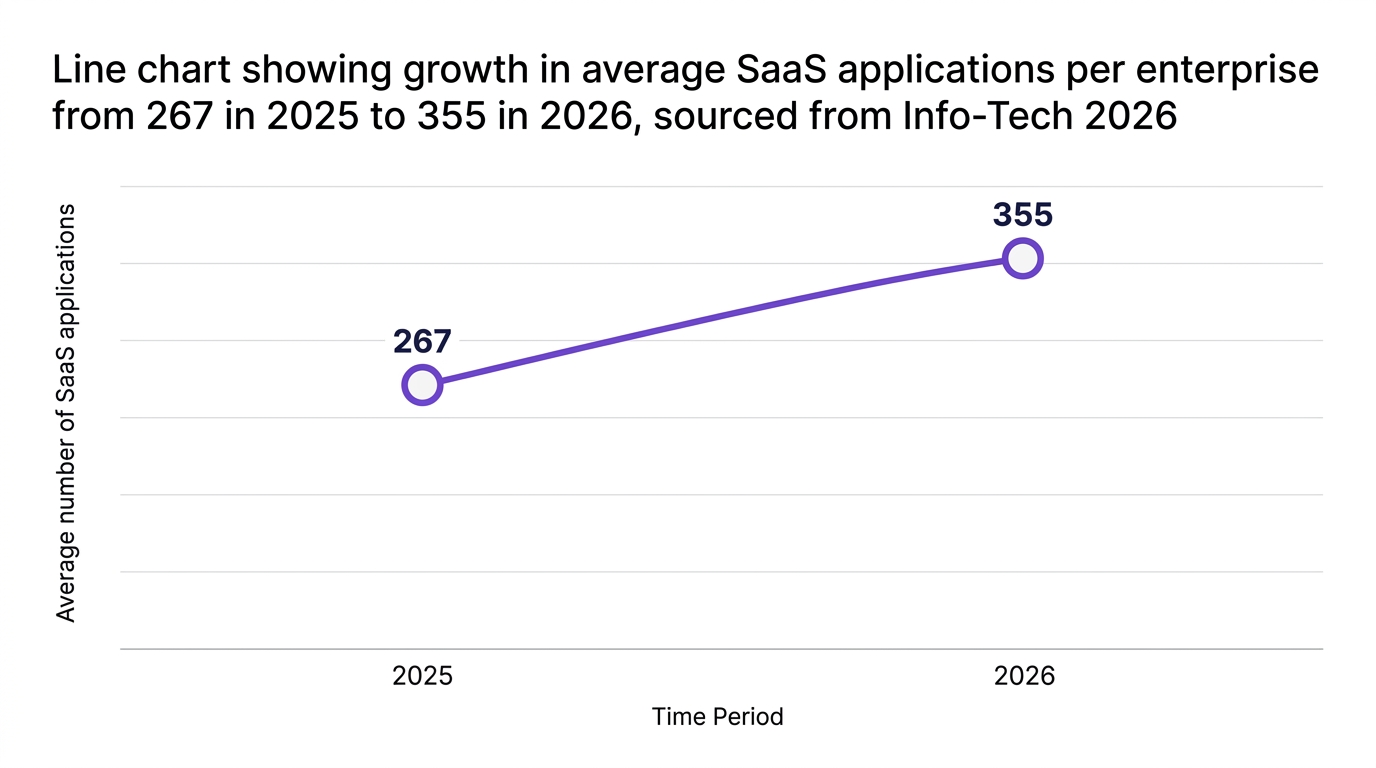
Why One-Time SaaS Audits Fail and What Continuous SaaS Discovery Looks Like Instead Periodic SaaS audits used to feel sufficient: export some reports, reconcile licenses, clean up a few unused apps, and declare victory for another year. In a world where the average enterprise now runs 355 SaaS applications and 39% are unmanaged or unknown to IT (Info-Tech 2026), that model breaks down quickly. This is where continuous SaaS discovery becomes essential. Instead of a static snapshot, you gain a living inventory of every application, user, and permission, updated in near real time. For CIOs, IT asset leaders, and finance teams, that shift directly influences cost, risk, and governance. In this article, we unpack why one-time SaaS audits fail, what ongoing SaaS discovery looks like in practice, and how CloudNuro helps enterprises move from reactive audits to continuous SaaS discovery at scale. ## Why One-Time SaaS Audits Cannot Keep Up Traditional SaaS audits are built around a point-in-time review. They answer the question, "What does our SaaS landscape look like this quarter?" but not "What changed yesterday?" or "What will change tomorrow?". According to Gartner (2026), 67% of enterprises report that one-time SaaS audits fail to capture dynamic changes in app usage and licensing, which drives an average 29% overspend annually. In other words, the moment the audit finishes, it is already out of date.
Several structural limitations explain why one-time audits struggle: 1. They ignore SaaS velocity. New tools can be purchased on a corporate card, approved by a line manager, and connected to production data in a single afternoon. 2. They miss user-level changes. Joiners, movers, and leavers constantly shift access patterns, which affects license counts, security risk, and compliance exposure. 3. They are costly and distracting. Coordinating spreadsheets, exports, and interviews across business units pulls IT and finance away from higher-value work. From a governance perspective, this is like relying on an annual security review while attackers adapt daily. The audit might look thorough, yet 44% of organizations using only scheduled SaaS audits still missed critical risks related to unapproved software or data leakage (TechTarget 2026). ## The Hidden Risk: Shadow IT and SaaS Sprawl A major blind spot for one-time audits is shadow IT: software adopted without IT involvement or centralized governance. Info-Tech (2026) reports that over 55% of SaaS applications in enterprises are adopted outside IT, introducing both cost and compliance concerns. Think of your SaaS environment like an airport. Official flights are scheduled, tracked, and secured. Shadow IT is the unscheduled traffic trying to land without a flight plan. You might not notice the risk until something goes wrong.

Shadow IT and unmanaged SaaS sprawl create several issues:
Data exposure risk. Unapproved tools may connect to sensitive finance, HR, or customer data without proper controls.
Compliance gaps. Untracked systems make it harder to meet frameworks like SOC, ISO, or sector-specific mandates.
Contract inefficiencies. Multiple teams may buy the same category tool with separate contracts, eroding volume discounts.
Orphaned accounts. Employees leave, but their SaaS access persists, creating both cost leakage and security risk.
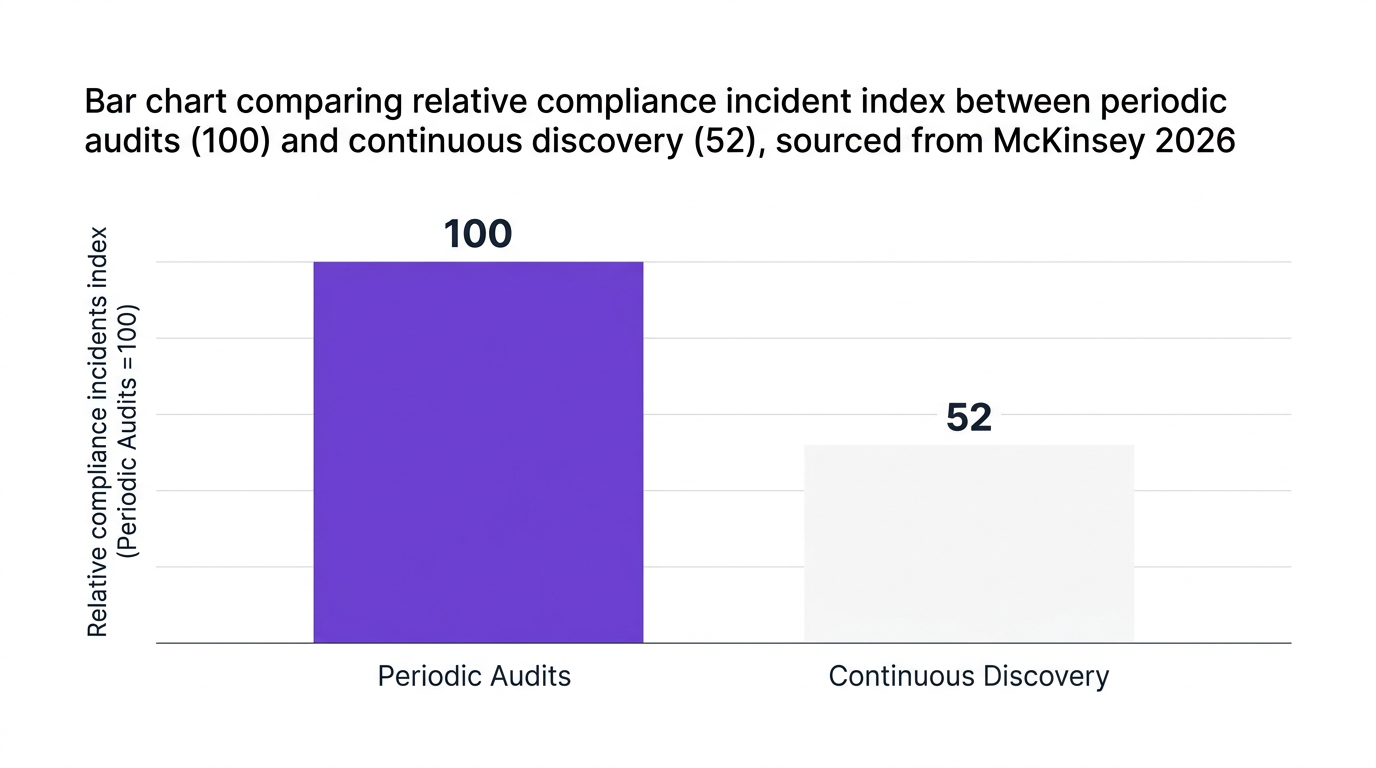
A McKinsey (2026) analysis found that companies practicing ongoing SaaS discovery reduced compliance incidents by 48% compared to those relying on periodic audits. That improvement is not only about finding more apps. It reflects continuously updated visibility into who uses what, and why. ## What Continuous SaaS Discovery Actually Is Continuous SaaS discovery is a persistent, automated process that identifies every SaaS application, user, license, and integration across your environment, in as close to real time as possible. Forrester (2026) notes that 81% of IT leaders now see continuous SaaS discovery as essential for compliance and cost control. By 2026, IDC reports 73% of enterprises have moved from periodic SaaS audits to persistent, automated discovery platforms.
A mature continuous discovery capability typically includes:
Automatic SaaS discovery. Network logs, SSO, CASB, financial systems, and admin APIs are used to automatically discover and classify applications, including shadow IT SaaS.
Real-time SaaS monitoring. Usage, access, and configuration changes are tracked continuously, not just quarterly.
Identity and access visibility. Every user, role, and permission is tied back to HR and identity sources for accurate SaaS access audit capabilities.
Lifecycle context. Joiner, mover, and leaver events are correlated so that license and access changes occur alongside HR events.
Policy automation. Violations of your SaaS governance framework trigger automated workflows, from access reviews to app deprovisioning.
In practical terms, ongoing SaaS discovery gives you an always-current inventory, enriched with risk and cost signals. It transforms SaaS audits from an isolated project into a continuous control. ## SaaS Audit vs Continuous Discovery: Cost, Risk, and Control To understand the tradeoffs of saas audit vs continuous discovery, it helps to compare how each model affects three areas: cost, risk, and operational control. ### 1. Cost: From Retroactive Cleanup to Proactive SaaS Spend Management One-time audits can identify unused licenses and redundant applications, but only at a fixed point. By the time optimizations are implemented, new waste has already accumulated. IDC (2026) found that automated, real-time SaaS discovery tools enable average license cost savings of 23% by uncovering unused and underutilized applications. When that insight is continuous, SaaS cost optimization becomes a routine process, not a once-a-year project. Continuous discovery enables:
Ongoing SaaS spend management with right-sizing recommendations by department and user.
Identification of duplicate tools across teams to consolidate contracts and reduce SaaS spend.
Early warning for unapproved vendor purchases before renewals lock in waste.
### 2. Risk: From Blind Spots to Continuous SaaS Compliance Periodic audits help support a SaaS compliance checklist 2026, but they do not address the constant onboarding of new tools. As Forrester (2026) notes, 78% of organizations now cite SaaS-related compliance as a top-three risk at the board level. Continuous SaaS discovery supports:
Real-time updates to your SaaS discovery and inventory for regulatory reporting.
Continuous SaaS compliance monitoring to detect apps that lack required certifications or data residency guarantees.
Automated SaaS risk assessment tool workflows that score new apps on security posture and compliance alignment.
When SaaS audit limitations are removed, IT and security teams can maintain continuous SaaS compliance rather than scrambling to prepare for each external review. ### 3. Control: From Manual Spreadsheets to SaaS Management Automation Manual audits rely heavily on spreadsheets and ad hoc data exports. With hundreds of applications, that approach is fragile. Continuous discovery, anchored by SaaS management automation, provides:
System-of-record visibility for apps, contracts, owners, and usage.
Automated notifications for risky behavior, such as data exports from unmanaged apps.
Built-in workflows for SaaS lifecycle management, including provisioning and deprovisioning.
A leading analyst described it well: periodic SaaS audits are like "glancing in the rearview mirror", while continuous discovery is how you drive safely at highway speed. ## When One-Time SaaS Audits Still Help (And Where They Fail) There is still a place for periodic audits. Many enterprises use them:
Before a regulatory review or IPO event.
During major vendor renegotiations.
After mergers or large reorganizations.
These structured moments can validate assumptions and provide formal evidence. However, there are clear failure patterns:
Audit-only cultures treat discovery as a project, so shadow IT quickly returns.
Spreadsheet-based audits break once SaaS volume passes a few dozen apps.
IT-only audits ignore the reality that business units buy and configure many tools directly.
The most resilient enterprises pair periodic audits with continuous SaaS discovery. The audit becomes a confirmation of your ongoing controls, not your only source of truth. ## What to Look For in a SaaS Discovery Tool If you aim to move beyond one-off audits, the choice of SaaS discovery tool matters. The goal is to support automatic SaaS discovery, real-time SaaS monitoring, and AI-powered SaaS discovery at scale. Key capabilities to prioritize include:
Comprehensive discovery methods
- Integrations with identity providers, finance systems, and major SaaS admin APIs.
- Network and browser discovery to discover unmanaged SaaS apps and support shadow IT SaaS discovery.
AI-powered classification and risk scoring
- Use of AI SaaS audit automation to categorize apps by function, department, and risk.
- Built-in risk scoring for data sensitivity, user volume, and compliance impact.
Deep user and access visibility
- Complete SaaS access audit views across apps, roles, and entitlements.
- Correlation with HR data for joiner, mover, and leaver workflows.
Automation for cost and compliance
- Rules-based deprovisioning, license reclamation, and renewal alerts.
- Automated SaaS audit automation reports aligned with your SaaS compliance audit tool needs.
Strong integration and governance features
- Support for software asset management for SaaS and ITAM processes.
- A centralized SaaS governance platform for policy definition, enforcement, and reporting.
If you are evaluating the best SaaS discovery tools 2026, prioritize platforms that can grow with your environment and cover SaaS, PaaS, and IaaS in a unified control plane.
How CloudNuro Delivers Continuous SaaS Discovery in Practice CloudNuro is designed from the ground up to replace fragile, manual audits with continuous SaaS discovery across SaaS, cloud, and AI services. For enterprise IT, finance, and security teams, it becomes the operational backbone for SaaS cost, risk, and compliance. At a high level, CloudNuro combines AI-powered SaaS discovery, deep integrations, and policy automation to provide an authoritative system of record for your SaaS estate. ### AI Custodian: Real-Time SaaS and Shadow IT Discovery CloudNuro’s AI Custodian delivers continuous, real-time discovery of unmanaged SaaS and shadow IT:
Uses AI to identify and classify new apps from network, identity, and financial data.
Automatically flags risky or non-compliant applications for review.
Maintains a living catalog, enabling ongoing SaaS discovery that never goes stale.
This directly addresses saas audit limitations, since new tools and accounts are surfaced as they appear, not months later. ### Unified Cloud Custodian: Governance Across SaaS, PaaS, and IaaS With Unified Cloud Custodian, CloudNuro extends real-time SaaS monitoring into a broader governance layer:
Centralizes controls across SaaS, PaaS, and IaaS, including chargeback and cost allocation.
Ties every app and account to policies, owners, and business context.
Automates workflows for access reviews, offboarding, and configuration checks.
This gives IT teams a unified SaaS governance platform and supports both SaaS security posture management and compliance. ### License Optimization and SaaS Spend Management CloudNuro helps reduce SaaS spend through continuous optimization:
Automated identification of unused and underutilized licenses across key platforms.
Consolidation insights to eliminate redundant tools and negotiate better contracts.
Dashboards for SaaS spend management, chargeback, and financial accountability.
Combined with CloudNuro’s SaaS management capabilities and FinOps services, this turns SaaS cost optimization into a repeatable process embedded in daily operations. ### Compliance, Security, and Audit-Ready Reporting CloudNuro’s platform supports IT, risk, and security leaders through:
Continuous SaaS compliance monitoring, with visibility into app certifications and control adherence.
Detailed SaaS data security monitoring signals based on access, activity, and integration patterns.
Automated reports that feed into your SaaS compliance audit tool workflows and external reviews.
Security and compliance teams can deepen this posture using CloudNuro’s IT security solution, which builds on continuous discovery for risk-driven controls. ### Case Example: Moving from Annual Audit to Continuous Discovery A global financial organization (as cited by Gartner 2026) transitioned from annual SaaS audits to continuous discovery with an AI-powered platform. Within a year, they:
Reduced SaaS overspend by 4.1 million dollars.
Cut unused licenses by 37%.
Passed a major SOX compliance assessment with significantly fewer pre-audit remediation tasks.
Similarly, a healthcare provider studied by Forrester (2026) used real-time monitoring to achieve a 52% reduction in shadow IT incidents, improved HIPAA compliance posture, and saved 2.3 million dollars. CloudNuro is built to deliver similar outcomes across industries. Its product overview details how Microsoft 365, Salesforce, ServiceNow, and cloud environments are brought into a unified SaaS discovery and inventory. ## Practical Steps to Evolve From Audits to Continuous SaaS Discovery Moving away from audit-only models does not require a big bang. You can phase in continuous control.
Baseline your current SaaS inventory
Use your existing tools and data to create a starting list of apps, owners, and contracts. This provides a reference point for future improvements.
Introduce automatic SaaS discovery in one domain
Start with a critical platform like Microsoft 365 or Salesforce. Use a discovery tool to identify unused licenses and shadow apps. CloudNuro offers a free Microsoft 365 assessment and a free Salesforce assessment to accelerate this step.
Align IT, security, and finance on a shared catalog
Agree that the continuously updated SaaS inventory is the system of record for decisions, from renewals to access reviews.
Automate one policy at a time
For example, automatically reclaim licenses after 60 days of inactivity or trigger an access review when a new high-risk app is discovered.
Retain audits, but change their purpose
Use periodic audits as validation of your continuous controls, not as your primary way to discover issues.
Over time, this approach embeds continuous SaaS discovery into your operating rhythm and makes SaaS audits faster, cheaper, and lower risk.
FAQ: Continuous SaaS Discovery and One-Time Audits
1. What is continuous SaaS discovery and why is it necessary?
Continuous SaaS discovery is an automated, always-on process that identifies and tracks every SaaS application, user, and license across your enterprise. It is necessary because SaaS environments change daily, and one-time audits cannot keep up. With more than half of apps entering through shadow IT and hundreds of tools in use, continuous discovery ensures accurate SaaS visibility, supports compliance, and drives sustained SaaS cost optimization.
2. How do one-time SaaS audits fall short in dynamic environments?
One-time audits provide a static snapshot. They miss new apps and accounts created the day after the audit ends, and they rarely capture full user-level context. Research shows that 67% of enterprises say one-time audits fail to reflect actual usage, contributing to material overspending and risk. In fast-moving organizations, this lag can translate directly into compliance gaps and budget surprises.
3. What are the main risks of shadow IT and unmanaged SaaS?
Shadow IT introduces unvetted apps that may access sensitive data without appropriate security controls. This increases the likelihood of data leakage, privacy violations, and audit findings. It also fragments spend across overlapping tools, making it harder to reduce SaaS spend or negotiate enterprise-wide contracts. Without shadow IT SaaS discovery, many of these risks remain invisible.
4. How does ongoing SaaS discovery support compliance?
Ongoing discovery maintains an accurate SaaS discovery and inventory that can be mapped to your SaaS compliance checklist 2026 and external frameworks. It provides continuous evidence of which apps are in use, where data resides, and who has access. This reduces the manual effort needed before audits, shrinks remediation windows, and helps demonstrate continuous SaaS compliance rather than sporadic checks.
5. What features should I prioritize in a SaaS discovery tool?
Look for comprehensive discovery methods, identity and access visibility, strong SaaS management automation, and robust integration with ITAM and security workflows. AI capabilities for classification, risk scoring, and AI-powered SaaS discovery can significantly reduce manual analysis. A platform like CloudNuro that supports SaaS, cloud, and AI in one place simplifies long-term governance.
About CloudNuro
CloudNuro is a leader in Enterprise SaaS Management Platforms, providing enterprises with unmatched visibility, governance, and cost optimization. Recognized twice in a row in the SaaS Management Platforms category and named a Leader in the SoftwareReviews Data Quadrant, CloudNuro is trusted by global enterprises and government agencies to bring financial discipline to SaaS, cloud, and AI. Trusted by enterprises such as Konica Minolta and Federal Signal, CloudNuro provides centralized SaaS inventory, license optimization, and renewal management along with advanced cost allocation and chargeback, giving IT and Finance leaders the visibility, control, and cost-conscious culture needed to drive financial discipline.
Request a no cost, no obligation free assessment —just 15 minutes to savings!
Get StartedWhy One-Time SaaS Audits Fail and What Continuous SaaS Discovery Looks Like Instead Periodic SaaS audits used to feel sufficient: export some reports, reconcile licenses, clean up a few unused apps, and declare victory for another year. In a world where the average enterprise now runs 355 SaaS applications and 39% are unmanaged or unknown to IT (Info-Tech 2026), that model breaks down quickly. This is where continuous SaaS discovery becomes essential. Instead of a static snapshot, you gain a living inventory of every application, user, and permission, updated in near real time. For CIOs, IT asset leaders, and finance teams, that shift directly influences cost, risk, and governance. In this article, we unpack why one-time SaaS audits fail, what ongoing SaaS discovery looks like in practice, and how CloudNuro helps enterprises move from reactive audits to continuous SaaS discovery at scale. ## Why One-Time SaaS Audits Cannot Keep Up Traditional SaaS audits are built around a point-in-time review. They answer the question, "What does our SaaS landscape look like this quarter?" but not "What changed yesterday?" or "What will change tomorrow?". According to Gartner (2026), 67% of enterprises report that one-time SaaS audits fail to capture dynamic changes in app usage and licensing, which drives an average 29% overspend annually. In other words, the moment the audit finishes, it is already out of date.
Several structural limitations explain why one-time audits struggle: 1. They ignore SaaS velocity. New tools can be purchased on a corporate card, approved by a line manager, and connected to production data in a single afternoon. 2. They miss user-level changes. Joiners, movers, and leavers constantly shift access patterns, which affects license counts, security risk, and compliance exposure. 3. They are costly and distracting. Coordinating spreadsheets, exports, and interviews across business units pulls IT and finance away from higher-value work. From a governance perspective, this is like relying on an annual security review while attackers adapt daily. The audit might look thorough, yet 44% of organizations using only scheduled SaaS audits still missed critical risks related to unapproved software or data leakage (TechTarget 2026). ## The Hidden Risk: Shadow IT and SaaS Sprawl A major blind spot for one-time audits is shadow IT: software adopted without IT involvement or centralized governance. Info-Tech (2026) reports that over 55% of SaaS applications in enterprises are adopted outside IT, introducing both cost and compliance concerns. Think of your SaaS environment like an airport. Official flights are scheduled, tracked, and secured. Shadow IT is the unscheduled traffic trying to land without a flight plan. You might not notice the risk until something goes wrong.
Shadow IT and unmanaged SaaS sprawl create several issues:
Data exposure risk. Unapproved tools may connect to sensitive finance, HR, or customer data without proper controls.
Compliance gaps. Untracked systems make it harder to meet frameworks like SOC, ISO, or sector-specific mandates.
Contract inefficiencies. Multiple teams may buy the same category tool with separate contracts, eroding volume discounts.
Orphaned accounts. Employees leave, but their SaaS access persists, creating both cost leakage and security risk.
A McKinsey (2026) analysis found that companies practicing ongoing SaaS discovery reduced compliance incidents by 48% compared to those relying on periodic audits. That improvement is not only about finding more apps. It reflects continuously updated visibility into who uses what, and why. ## What Continuous SaaS Discovery Actually Is Continuous SaaS discovery is a persistent, automated process that identifies every SaaS application, user, license, and integration across your environment, in as close to real time as possible. Forrester (2026) notes that 81% of IT leaders now see continuous SaaS discovery as essential for compliance and cost control. By 2026, IDC reports 73% of enterprises have moved from periodic SaaS audits to persistent, automated discovery platforms.
A mature continuous discovery capability typically includes:
Automatic SaaS discovery. Network logs, SSO, CASB, financial systems, and admin APIs are used to automatically discover and classify applications, including shadow IT SaaS.
Real-time SaaS monitoring. Usage, access, and configuration changes are tracked continuously, not just quarterly.
Identity and access visibility. Every user, role, and permission is tied back to HR and identity sources for accurate SaaS access audit capabilities.
Lifecycle context. Joiner, mover, and leaver events are correlated so that license and access changes occur alongside HR events.
Policy automation. Violations of your SaaS governance framework trigger automated workflows, from access reviews to app deprovisioning.
In practical terms, ongoing SaaS discovery gives you an always-current inventory, enriched with risk and cost signals. It transforms SaaS audits from an isolated project into a continuous control. ## SaaS Audit vs Continuous Discovery: Cost, Risk, and Control To understand the tradeoffs of saas audit vs continuous discovery, it helps to compare how each model affects three areas: cost, risk, and operational control. ### 1. Cost: From Retroactive Cleanup to Proactive SaaS Spend Management One-time audits can identify unused licenses and redundant applications, but only at a fixed point. By the time optimizations are implemented, new waste has already accumulated. IDC (2026) found that automated, real-time SaaS discovery tools enable average license cost savings of 23% by uncovering unused and underutilized applications. When that insight is continuous, SaaS cost optimization becomes a routine process, not a once-a-year project. Continuous discovery enables:
Ongoing SaaS spend management with right-sizing recommendations by department and user.
Identification of duplicate tools across teams to consolidate contracts and reduce SaaS spend.
Early warning for unapproved vendor purchases before renewals lock in waste.
### 2. Risk: From Blind Spots to Continuous SaaS Compliance Periodic audits help support a SaaS compliance checklist 2026, but they do not address the constant onboarding of new tools. As Forrester (2026) notes, 78% of organizations now cite SaaS-related compliance as a top-three risk at the board level. Continuous SaaS discovery supports:
Real-time updates to your SaaS discovery and inventory for regulatory reporting.
Continuous SaaS compliance monitoring to detect apps that lack required certifications or data residency guarantees.
Automated SaaS risk assessment tool workflows that score new apps on security posture and compliance alignment.
When SaaS audit limitations are removed, IT and security teams can maintain continuous SaaS compliance rather than scrambling to prepare for each external review. ### 3. Control: From Manual Spreadsheets to SaaS Management Automation Manual audits rely heavily on spreadsheets and ad hoc data exports. With hundreds of applications, that approach is fragile. Continuous discovery, anchored by SaaS management automation, provides:
System-of-record visibility for apps, contracts, owners, and usage.
Automated notifications for risky behavior, such as data exports from unmanaged apps.
Built-in workflows for SaaS lifecycle management, including provisioning and deprovisioning.
A leading analyst described it well: periodic SaaS audits are like "glancing in the rearview mirror", while continuous discovery is how you drive safely at highway speed. ## When One-Time SaaS Audits Still Help (And Where They Fail) There is still a place for periodic audits. Many enterprises use them:
Before a regulatory review or IPO event.
During major vendor renegotiations.
After mergers or large reorganizations.
These structured moments can validate assumptions and provide formal evidence. However, there are clear failure patterns:
Audit-only cultures treat discovery as a project, so shadow IT quickly returns.
Spreadsheet-based audits break once SaaS volume passes a few dozen apps.
IT-only audits ignore the reality that business units buy and configure many tools directly.
The most resilient enterprises pair periodic audits with continuous SaaS discovery. The audit becomes a confirmation of your ongoing controls, not your only source of truth. ## What to Look For in a SaaS Discovery Tool If you aim to move beyond one-off audits, the choice of SaaS discovery tool matters. The goal is to support automatic SaaS discovery, real-time SaaS monitoring, and AI-powered SaaS discovery at scale. Key capabilities to prioritize include:
Comprehensive discovery methods
- Integrations with identity providers, finance systems, and major SaaS admin APIs.
- Network and browser discovery to discover unmanaged SaaS apps and support shadow IT SaaS discovery.
AI-powered classification and risk scoring
- Use of AI SaaS audit automation to categorize apps by function, department, and risk.
- Built-in risk scoring for data sensitivity, user volume, and compliance impact.
Deep user and access visibility
- Complete SaaS access audit views across apps, roles, and entitlements.
- Correlation with HR data for joiner, mover, and leaver workflows.
Automation for cost and compliance
- Rules-based deprovisioning, license reclamation, and renewal alerts.
- Automated SaaS audit automation reports aligned with your SaaS compliance audit tool needs.
Strong integration and governance features
- Support for software asset management for SaaS and ITAM processes.
- A centralized SaaS governance platform for policy definition, enforcement, and reporting.
If you are evaluating the best SaaS discovery tools 2026, prioritize platforms that can grow with your environment and cover SaaS, PaaS, and IaaS in a unified control plane.
How CloudNuro Delivers Continuous SaaS Discovery in Practice CloudNuro is designed from the ground up to replace fragile, manual audits with continuous SaaS discovery across SaaS, cloud, and AI services. For enterprise IT, finance, and security teams, it becomes the operational backbone for SaaS cost, risk, and compliance. At a high level, CloudNuro combines AI-powered SaaS discovery, deep integrations, and policy automation to provide an authoritative system of record for your SaaS estate. ### AI Custodian: Real-Time SaaS and Shadow IT Discovery CloudNuro’s AI Custodian delivers continuous, real-time discovery of unmanaged SaaS and shadow IT:
Uses AI to identify and classify new apps from network, identity, and financial data.
Automatically flags risky or non-compliant applications for review.
Maintains a living catalog, enabling ongoing SaaS discovery that never goes stale.
This directly addresses saas audit limitations, since new tools and accounts are surfaced as they appear, not months later. ### Unified Cloud Custodian: Governance Across SaaS, PaaS, and IaaS With Unified Cloud Custodian, CloudNuro extends real-time SaaS monitoring into a broader governance layer:
Centralizes controls across SaaS, PaaS, and IaaS, including chargeback and cost allocation.
Ties every app and account to policies, owners, and business context.
Automates workflows for access reviews, offboarding, and configuration checks.
This gives IT teams a unified SaaS governance platform and supports both SaaS security posture management and compliance. ### License Optimization and SaaS Spend Management CloudNuro helps reduce SaaS spend through continuous optimization:
Automated identification of unused and underutilized licenses across key platforms.
Consolidation insights to eliminate redundant tools and negotiate better contracts.
Dashboards for SaaS spend management, chargeback, and financial accountability.
Combined with CloudNuro’s SaaS management capabilities and FinOps services, this turns SaaS cost optimization into a repeatable process embedded in daily operations. ### Compliance, Security, and Audit-Ready Reporting CloudNuro’s platform supports IT, risk, and security leaders through:
Continuous SaaS compliance monitoring, with visibility into app certifications and control adherence.
Detailed SaaS data security monitoring signals based on access, activity, and integration patterns.
Automated reports that feed into your SaaS compliance audit tool workflows and external reviews.
Security and compliance teams can deepen this posture using CloudNuro’s IT security solution, which builds on continuous discovery for risk-driven controls. ### Case Example: Moving from Annual Audit to Continuous Discovery A global financial organization (as cited by Gartner 2026) transitioned from annual SaaS audits to continuous discovery with an AI-powered platform. Within a year, they:
Reduced SaaS overspend by 4.1 million dollars.
Cut unused licenses by 37%.
Passed a major SOX compliance assessment with significantly fewer pre-audit remediation tasks.
Similarly, a healthcare provider studied by Forrester (2026) used real-time monitoring to achieve a 52% reduction in shadow IT incidents, improved HIPAA compliance posture, and saved 2.3 million dollars. CloudNuro is built to deliver similar outcomes across industries. Its product overview details how Microsoft 365, Salesforce, ServiceNow, and cloud environments are brought into a unified SaaS discovery and inventory. ## Practical Steps to Evolve From Audits to Continuous SaaS Discovery Moving away from audit-only models does not require a big bang. You can phase in continuous control.
Baseline your current SaaS inventory
Use your existing tools and data to create a starting list of apps, owners, and contracts. This provides a reference point for future improvements.
Introduce automatic SaaS discovery in one domain
Start with a critical platform like Microsoft 365 or Salesforce. Use a discovery tool to identify unused licenses and shadow apps. CloudNuro offers a free Microsoft 365 assessment and a free Salesforce assessment to accelerate this step.
Align IT, security, and finance on a shared catalog
Agree that the continuously updated SaaS inventory is the system of record for decisions, from renewals to access reviews.
Automate one policy at a time
For example, automatically reclaim licenses after 60 days of inactivity or trigger an access review when a new high-risk app is discovered.
Retain audits, but change their purpose
Use periodic audits as validation of your continuous controls, not as your primary way to discover issues.
Over time, this approach embeds continuous SaaS discovery into your operating rhythm and makes SaaS audits faster, cheaper, and lower risk.
FAQ: Continuous SaaS Discovery and One-Time Audits
1. What is continuous SaaS discovery and why is it necessary?
Continuous SaaS discovery is an automated, always-on process that identifies and tracks every SaaS application, user, and license across your enterprise. It is necessary because SaaS environments change daily, and one-time audits cannot keep up. With more than half of apps entering through shadow IT and hundreds of tools in use, continuous discovery ensures accurate SaaS visibility, supports compliance, and drives sustained SaaS cost optimization.
2. How do one-time SaaS audits fall short in dynamic environments?
One-time audits provide a static snapshot. They miss new apps and accounts created the day after the audit ends, and they rarely capture full user-level context. Research shows that 67% of enterprises say one-time audits fail to reflect actual usage, contributing to material overspending and risk. In fast-moving organizations, this lag can translate directly into compliance gaps and budget surprises.
3. What are the main risks of shadow IT and unmanaged SaaS?
Shadow IT introduces unvetted apps that may access sensitive data without appropriate security controls. This increases the likelihood of data leakage, privacy violations, and audit findings. It also fragments spend across overlapping tools, making it harder to reduce SaaS spend or negotiate enterprise-wide contracts. Without shadow IT SaaS discovery, many of these risks remain invisible.
4. How does ongoing SaaS discovery support compliance?
Ongoing discovery maintains an accurate SaaS discovery and inventory that can be mapped to your SaaS compliance checklist 2026 and external frameworks. It provides continuous evidence of which apps are in use, where data resides, and who has access. This reduces the manual effort needed before audits, shrinks remediation windows, and helps demonstrate continuous SaaS compliance rather than sporadic checks.
5. What features should I prioritize in a SaaS discovery tool?
Look for comprehensive discovery methods, identity and access visibility, strong SaaS management automation, and robust integration with ITAM and security workflows. AI capabilities for classification, risk scoring, and AI-powered SaaS discovery can significantly reduce manual analysis. A platform like CloudNuro that supports SaaS, cloud, and AI in one place simplifies long-term governance.
About CloudNuro
CloudNuro is a leader in Enterprise SaaS Management Platforms, providing enterprises with unmatched visibility, governance, and cost optimization. Recognized twice in a row in the SaaS Management Platforms category and named a Leader in the SoftwareReviews Data Quadrant, CloudNuro is trusted by global enterprises and government agencies to bring financial discipline to SaaS, cloud, and AI. Trusted by enterprises such as Konica Minolta and Federal Signal, CloudNuro provides centralized SaaS inventory, license optimization, and renewal management along with advanced cost allocation and chargeback, giving IT and Finance leaders the visibility, control, and cost-conscious culture needed to drive financial discipline.
Request a no cost, no obligation free assessment - just 15 minutes to savings!
Get StartedWe're offering complimentary ServiceNow license assessments to only 25 enterprises this quarter who want to unlock immediate savings without disrupting operations.
Get Free AssessmentGet Started




CloudNuro Corp
1755 Park St. Suite 207
Naperville, IL 60563
Phone : +1-630-277-9470
Email: info@cloudnuro.com





.webp)

Recognized Leader in SaaS Management Platforms by Info-Tech SoftwareReviews


.svg)