

Sign Up
Thank you for Submitting!
For the modern enterprise, operational resilience and cost efficiency depend on robust, secure, and reliable AI and SaaS infrastructure. Yet a recent 18,day AI platform outage reminded organizations across sectors that relying too heavily on a single provider exposes them to significant disruption. From frozen workflows to skyrocketing costs and lost compliance visibility, the incident laid bare the extent of risk that rests on the shoulders of just one AI supplier. What exactly did businesses learn during this crisis, and how can they build a more resilient future?
This guide explores:
The scale and costs of single,vendor AI risk
Real enterprise lessons from the extended AI outage
Best practices for AI risk management and operational continuity
How CloudNuro empowers safer, more robust AI adoption
Recent events have revealed just how disruptive AI vendor dependency risk can be. Enterprises reported experiencing an average of six AI,related disruptions over a two,year period, with vendor services cited as a leading cause. Critically, 74% of enterprise executives admit that losing their primary AI vendor would disrupt day,to,day operations or leave them unable to function altogether. Even short,term issues are costly: a leading AI platform maintained uptime of around 99.3%, translating to approximately five hours of operational downtime each month,enough to freeze mission,critical processes in healthcare, finance, and government.
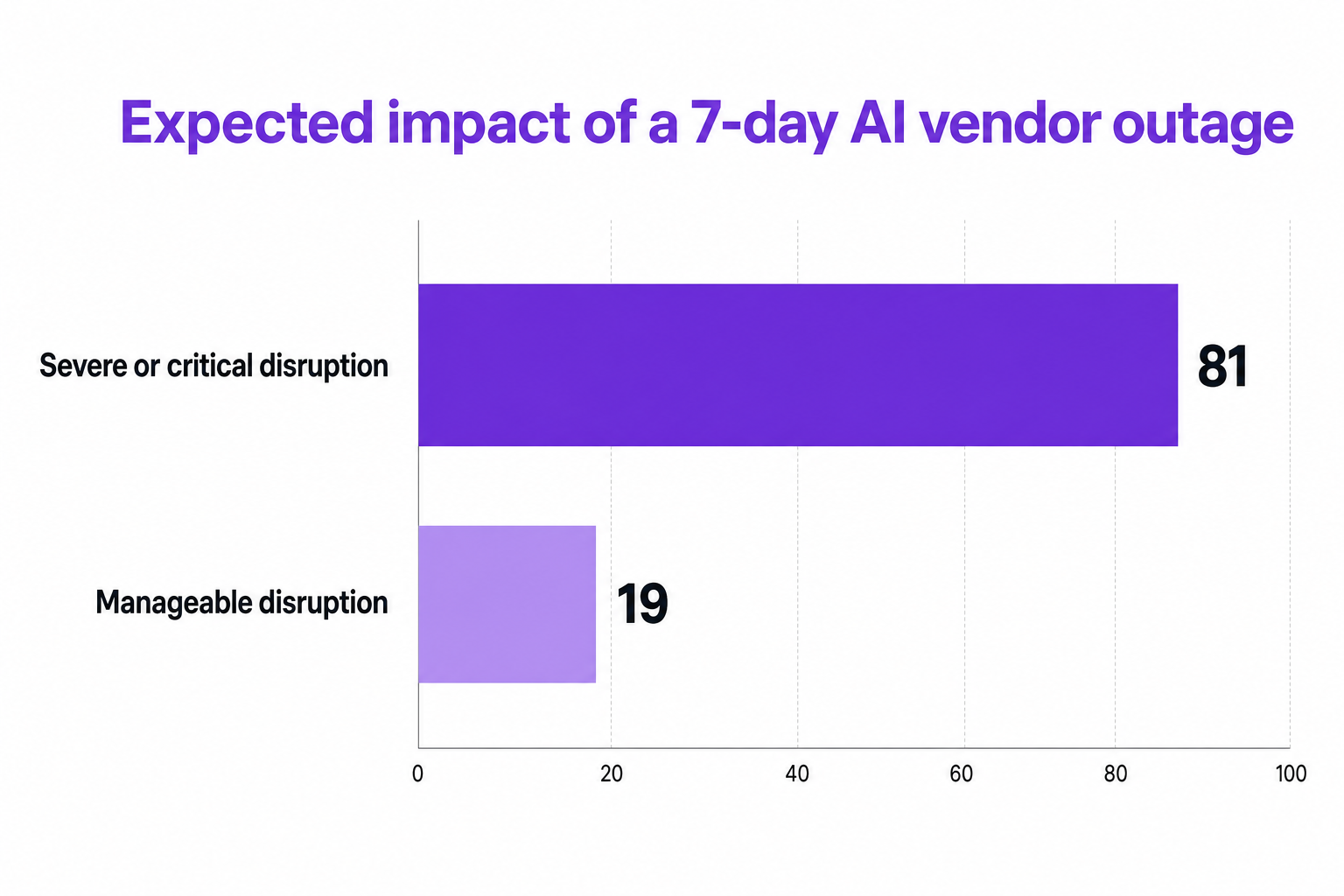
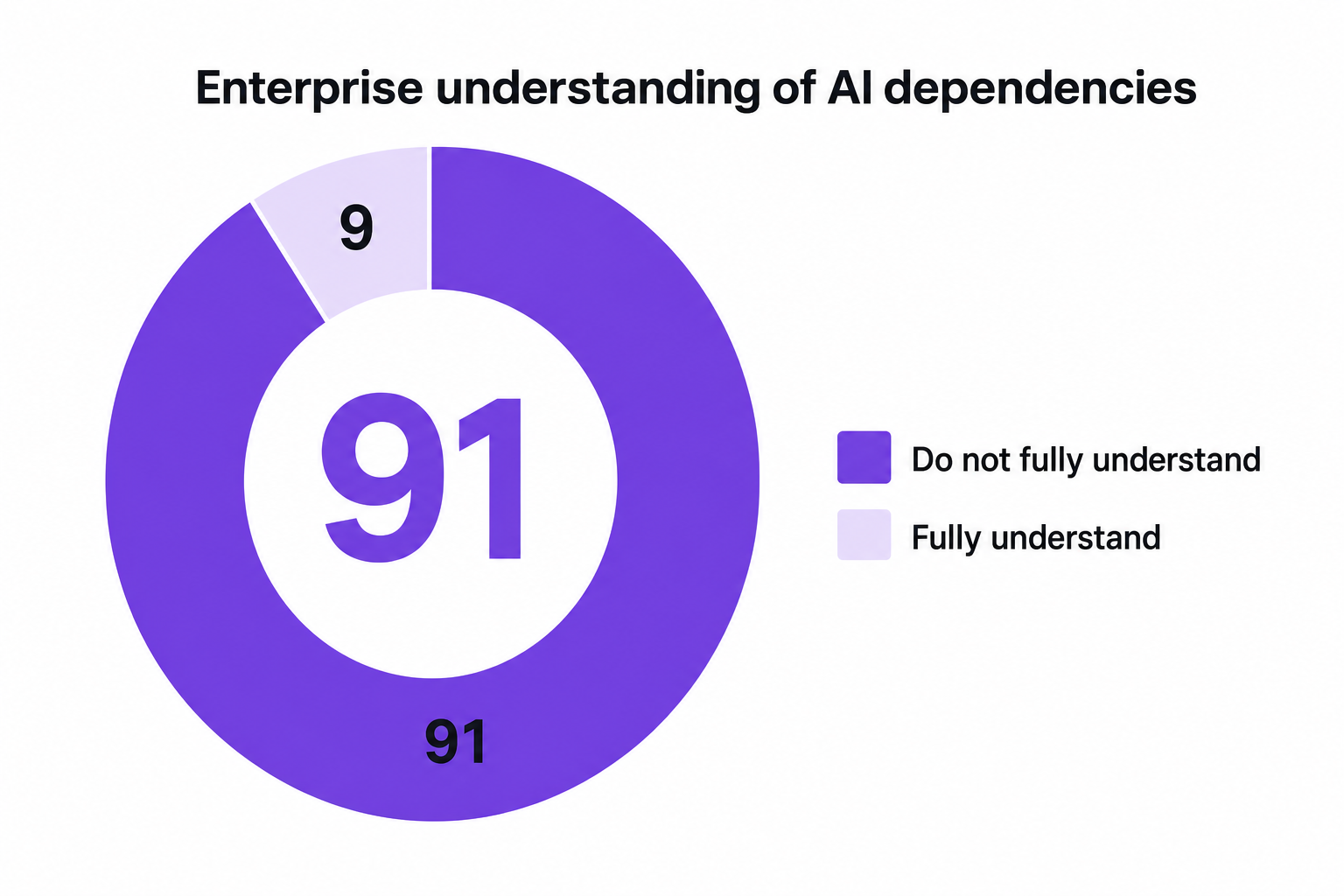
The financial and reputational stakes are growing. 81% of organizations surveyed believed a seven,day AI vendor outage would cause severe or critical business disruption. Organizations often lack the visibility to fully understand where risks lie: 91% of business leaders confess they cannot map their actual AI dependencies across vendors, models, and infrastructure components. A single supply chain fragility can put digital transformation efforts at risk.
During the 18,day disruption, enterprises discovered that AI provider concentration risk is not simply a procurement or SLA matter. As workflows became tightly integrated with vendor APIs and unique model features, operational flexibility vanished almost overnight. Teams struggled to identify which business units were affected, lacked fallback options, and found themselves negotiating rushed contracts at a premium just to maintain baseline functionality.
Vendor lock,in has real, measurable impacts:
Urgent, out,of,cycle spending for ad,hoc integrations and alternative licenses
Unplanned downtime effecting everything from customer service to regulated compliance operations
Loss of control over cost allocation and departmental budgeting amid crisis response
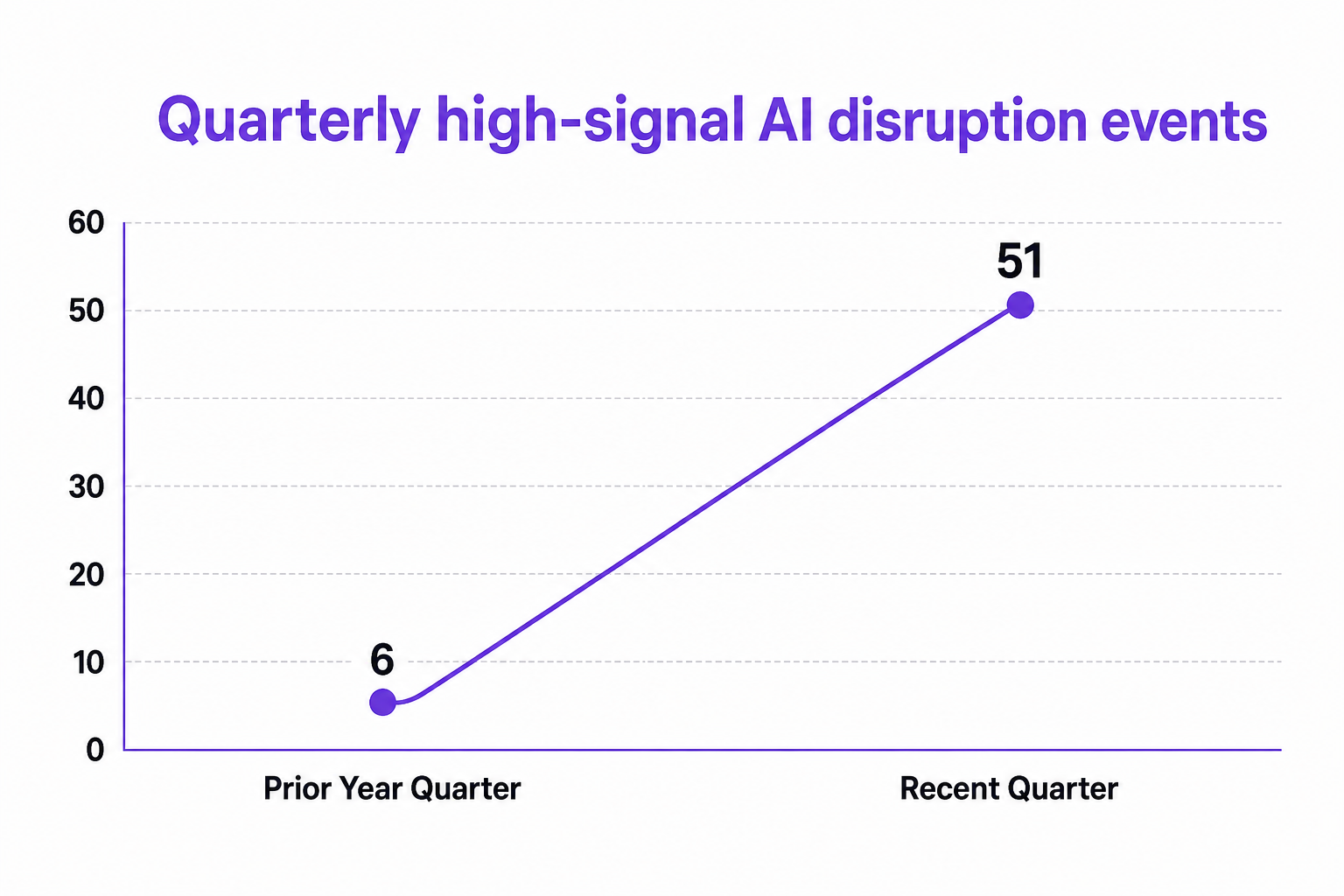
One high,signal outcome: enterprises experienced a skyrocketing number of major AI disruption events, rising from only six incidents in one quarter to 51 in the next,a snapshot of volatility that reinforces the need for comprehensive SaaS management and AI governance.
What lessons did IT and risk leaders take from this disruption? Leading frameworks now treat AI service concentration as a core business continuity risk,requiring systematic resilience planning rather than simple provider SLAs or cost negotiation.
Key best practices include:
Comprehensive Dependency Inventories: Build agency,wide maps of every AI and SaaS tool, categorizing by operational criticality and vendor switching costs.
Rationalized SaaS Portfolio: Identify and track duplicate capabilities to enable rapid failover strategies.
Failover Architecture: Maintain at least one secondary provider for critical functions, using integration frameworks to decouple workflows from a single AI platform.
Policy-Driven Procurement: Embed vendor continuity and data portability clauses into every new AI and SaaS contract.
Active Governance: Monitor actual usage, shadow IT adoption, and financial exposure in real time to ensure adaptation as risk profiles change.
Organizations are increasingly embedding abstraction layers and multi,vendor strategies, ensuring AI workflows can failover seamlessly during provider downtime.
Enterprises need more than just ad hoc risk lists. CloudNuro AI Custodian delivers purpose,built enterprise resilience and governance at a scale that matches the real operational landscape.
How CloudNuro strengthens continuity and cost-control:
Centralized AI and SaaS Inventory: By integrating with Single Sign,On, financial data, and security tools, CloudNuro creates a unified, real,time map of every application and vendor dependency, including custom or unsanctioned AI tools.
Governance-First Architecture: Built,in automated workflows empower IT and procurement teams to monitor actual usage, optimize spend, and enforce continuous financial discipline,even in crisis mode.
Rapid Onboarding and Integration: With out,of,the,box support for 400+ platforms and frameworks for custom apps, organizations can consolidate their dependency landscape or pivot to alternatives in less than two days.
Smart Failover Support: When a primary AI service fails, CloudNuro highlights overlapping approved tools and switches workflows, minimizing disruption and safeguarding compliance.
Proof in Action:
A global manufacturing enterprise achieved continuous oversight of technology expenditure, uncovering cost savings and ensuring strict budget adherence. A municipal water district successfully tracked AI exposure and managed shadow AI adoption with CloudNuro at the center of its governance framework.
The lesson from the 18,day outage is clear: ignoring single,vendor AI dependency risk is no longer an option. A governance,first approach, prioritizing comprehensive visibility and rationalization across SaaS and AI services, is now a board,level expectation.
CloudNuro’s technology makes best practices operational:
Automated mapping of critical AI and SaaS dependencies
Cost and risk allocation for better business discipline
Flexible, rapid response workflows for continuity and failover
Integration across all major SaaS and cloud environments
In an era of accelerating AI adoption and mounting operational risk, proactive governance is the shield against future supply chain shocks.
What is the risk of relying on a single AI vendor?
Relying on a sole AI provider exposes organizations to catastrophic service disruptions, cost spikes, and strategic lock,in. Without alternatives, even brief outages can halt operations or disrupt regulatory compliance.
How do enterprises mitigate AI provider outages?
Leading organizations implement multi,vendor strategies, maintain comprehensive dependency inventories, enforce procurement safeguards, and use platforms like CloudNuro for complete operational oversight and rapid failover.
What are the best practices to avoid AI vendor lock-in?
Key steps include mapping all AI use cases and dependencies, building flexible integration architectures, embedding portability terms in contracts, and rationalizing overlapping applications.
What lessons were learned from recent AI outages?
Enterprises must treat AI vendor dependencies as a core business continuity issue, invest in unified visibility and governance, and prioritize resilient, multi,source AI strategies.
How can governance minimize single-vendor AI risk?
Strong governance provides continuous insight into AI usage, automates risk identification, and supports adaptive workflows,enabling IT and finance to allocate resources effectively and react quickly to disruption.
Single,vendor AI risk has moved from a theoretical concern to a daily boardroom challenge. Learning from real outages, it is vital that enterprises move beyond reactive responses to proactive, governance,led resilience. CloudNuro stands ready to partner with organizations that demand not just continuity, but control, discipline, and confidence along their AI adoption journey.
About CloudNuro
CloudNuro is a leader in Enterprise AI Adoption Management, providing enterprises with unmatched visibility, governance, and cost optimization. Recognized twice in a row in the SaaS Management Platforms category and named a Leader in the SoftwareReviews Data Quadrant, CloudNuro is trusted by global enterprises and government agencies to bring financial discipline to SaaS, cloud, and AI. Trusted by enterprises, CloudNuro provides centralized SaaS inventory, license optimization, and renewal management along with advanced cost allocation and chargeback, giving IT and Finance leaders the visibility, control, and cost,conscious culture needed to drive financial discipline.
Request a Demo | Get Free Savings | Explore Product
Request a no cost, no obligation free assessment —just 15 minutes to savings!
Get StartedFor the modern enterprise, operational resilience and cost efficiency depend on robust, secure, and reliable AI and SaaS infrastructure. Yet a recent 18,day AI platform outage reminded organizations across sectors that relying too heavily on a single provider exposes them to significant disruption. From frozen workflows to skyrocketing costs and lost compliance visibility, the incident laid bare the extent of risk that rests on the shoulders of just one AI supplier. What exactly did businesses learn during this crisis, and how can they build a more resilient future?
This guide explores:
The scale and costs of single,vendor AI risk
Real enterprise lessons from the extended AI outage
Best practices for AI risk management and operational continuity
How CloudNuro empowers safer, more robust AI adoption
Recent events have revealed just how disruptive AI vendor dependency risk can be. Enterprises reported experiencing an average of six AI,related disruptions over a two,year period, with vendor services cited as a leading cause. Critically, 74% of enterprise executives admit that losing their primary AI vendor would disrupt day,to,day operations or leave them unable to function altogether. Even short,term issues are costly: a leading AI platform maintained uptime of around 99.3%, translating to approximately five hours of operational downtime each month,enough to freeze mission,critical processes in healthcare, finance, and government.
The financial and reputational stakes are growing. 81% of organizations surveyed believed a seven,day AI vendor outage would cause severe or critical business disruption. Organizations often lack the visibility to fully understand where risks lie: 91% of business leaders confess they cannot map their actual AI dependencies across vendors, models, and infrastructure components. A single supply chain fragility can put digital transformation efforts at risk.
During the 18,day disruption, enterprises discovered that AI provider concentration risk is not simply a procurement or SLA matter. As workflows became tightly integrated with vendor APIs and unique model features, operational flexibility vanished almost overnight. Teams struggled to identify which business units were affected, lacked fallback options, and found themselves negotiating rushed contracts at a premium just to maintain baseline functionality.
Vendor lock,in has real, measurable impacts:
Urgent, out,of,cycle spending for ad,hoc integrations and alternative licenses
Unplanned downtime effecting everything from customer service to regulated compliance operations
Loss of control over cost allocation and departmental budgeting amid crisis response
One high,signal outcome: enterprises experienced a skyrocketing number of major AI disruption events, rising from only six incidents in one quarter to 51 in the next,a snapshot of volatility that reinforces the need for comprehensive SaaS management and AI governance.
What lessons did IT and risk leaders take from this disruption? Leading frameworks now treat AI service concentration as a core business continuity risk,requiring systematic resilience planning rather than simple provider SLAs or cost negotiation.
Key best practices include:
Comprehensive Dependency Inventories: Build agency,wide maps of every AI and SaaS tool, categorizing by operational criticality and vendor switching costs.
Rationalized SaaS Portfolio: Identify and track duplicate capabilities to enable rapid failover strategies.
Failover Architecture: Maintain at least one secondary provider for critical functions, using integration frameworks to decouple workflows from a single AI platform.
Policy-Driven Procurement: Embed vendor continuity and data portability clauses into every new AI and SaaS contract.
Active Governance: Monitor actual usage, shadow IT adoption, and financial exposure in real time to ensure adaptation as risk profiles change.
Organizations are increasingly embedding abstraction layers and multi,vendor strategies, ensuring AI workflows can failover seamlessly during provider downtime.
Enterprises need more than just ad hoc risk lists. CloudNuro AI Custodian delivers purpose,built enterprise resilience and governance at a scale that matches the real operational landscape.
How CloudNuro strengthens continuity and cost-control:
Centralized AI and SaaS Inventory: By integrating with Single Sign,On, financial data, and security tools, CloudNuro creates a unified, real,time map of every application and vendor dependency, including custom or unsanctioned AI tools.
Governance-First Architecture: Built,in automated workflows empower IT and procurement teams to monitor actual usage, optimize spend, and enforce continuous financial discipline,even in crisis mode.
Rapid Onboarding and Integration: With out,of,the,box support for 400+ platforms and frameworks for custom apps, organizations can consolidate their dependency landscape or pivot to alternatives in less than two days.
Smart Failover Support: When a primary AI service fails, CloudNuro highlights overlapping approved tools and switches workflows, minimizing disruption and safeguarding compliance.
Proof in Action:
A global manufacturing enterprise achieved continuous oversight of technology expenditure, uncovering cost savings and ensuring strict budget adherence. A municipal water district successfully tracked AI exposure and managed shadow AI adoption with CloudNuro at the center of its governance framework.
The lesson from the 18,day outage is clear: ignoring single,vendor AI dependency risk is no longer an option. A governance,first approach, prioritizing comprehensive visibility and rationalization across SaaS and AI services, is now a board,level expectation.
CloudNuro’s technology makes best practices operational:
Automated mapping of critical AI and SaaS dependencies
Cost and risk allocation for better business discipline
Flexible, rapid response workflows for continuity and failover
Integration across all major SaaS and cloud environments
In an era of accelerating AI adoption and mounting operational risk, proactive governance is the shield against future supply chain shocks.
What is the risk of relying on a single AI vendor?
Relying on a sole AI provider exposes organizations to catastrophic service disruptions, cost spikes, and strategic lock,in. Without alternatives, even brief outages can halt operations or disrupt regulatory compliance.
How do enterprises mitigate AI provider outages?
Leading organizations implement multi,vendor strategies, maintain comprehensive dependency inventories, enforce procurement safeguards, and use platforms like CloudNuro for complete operational oversight and rapid failover.
What are the best practices to avoid AI vendor lock-in?
Key steps include mapping all AI use cases and dependencies, building flexible integration architectures, embedding portability terms in contracts, and rationalizing overlapping applications.
What lessons were learned from recent AI outages?
Enterprises must treat AI vendor dependencies as a core business continuity issue, invest in unified visibility and governance, and prioritize resilient, multi,source AI strategies.
How can governance minimize single-vendor AI risk?
Strong governance provides continuous insight into AI usage, automates risk identification, and supports adaptive workflows,enabling IT and finance to allocate resources effectively and react quickly to disruption.
Single,vendor AI risk has moved from a theoretical concern to a daily boardroom challenge. Learning from real outages, it is vital that enterprises move beyond reactive responses to proactive, governance,led resilience. CloudNuro stands ready to partner with organizations that demand not just continuity, but control, discipline, and confidence along their AI adoption journey.
About CloudNuro
CloudNuro is a leader in Enterprise AI Adoption Management, providing enterprises with unmatched visibility, governance, and cost optimization. Recognized twice in a row in the SaaS Management Platforms category and named a Leader in the SoftwareReviews Data Quadrant, CloudNuro is trusted by global enterprises and government agencies to bring financial discipline to SaaS, cloud, and AI. Trusted by enterprises, CloudNuro provides centralized SaaS inventory, license optimization, and renewal management along with advanced cost allocation and chargeback, giving IT and Finance leaders the visibility, control, and cost,conscious culture needed to drive financial discipline.
Request a Demo | Get Free Savings | Explore Product
Request a no cost, no obligation free assessment - just 15 minutes to savings!
Get StartedWe're offering complimentary ServiceNow license assessments to only 25 enterprises this quarter who want to unlock immediate savings without disrupting operations.
Get Free AssessmentGet Started




CloudNuro Corp
1755 Park St. Suite 207
Naperville, IL 60563
Phone : +1-630-277-9470
Email: info@cloudnuro.com




.webp)

Recognized Leader in SaaS Management Platforms by Info-Tech SoftwareReviews

.png)
.svg)