

Sign Up
Thank you for Submitting!

AI has become business critical infrastructure, yet governance profiles still resemble emerging risk programs characterized by wide adoption, narrow maturity, and significant blind spots. While adoption accelerates across all sectors, only 25 percent of organizations possess comprehensive visibility into employee AI use. This gap in visibility creates tangible exposure; unauthorized AI usage adds approximately 670,000 dollars to average breach costs compared to organizations with low or no shadow AI usage. Documented AI related incidents increased by 55 percent over a single year. To bridge this gap between strategic adoption and security posture, enterprise leaders must shift focus from static access controls to continuous AI user behavior monitoring. The solution lies in AI behavioral analytics, a discipline that consolidates telemetry across users, projects, tools, and model activity into a unified governance framework. This approach functions as a core security and compliance control rather than a mere productivity metric. Without comprehensive enterprise AI governance, organizations remain blind to the actual operational footprint of their technology investments. Addressing these CISO AI challenges requires migrating from reactive audits to automated, behavioral risk indicators that detect anomalies instantly.
Enterprises are rapidly building hybrid telemetry stacks, combining cloud native governance for model monitoring with on premises logging and SIEM integration for security. However, as agentic AI usage scales, demand is surging for fine grained analytics that track task logs, decision traces, prompt histories, and user behavior analytics. More than a third of organizations describe shadow AI as pervasive or widespread, with nearly half calling it moderately prevalent. Traditional network perimeter defenses cannot identify when an approved user inputs sensitive intellectual property into an unsanctioned generative model.
Only 18 percent of organizations have active mitigation covering most or all identified AI risks. Furthermore, nearly 90 percent of enterprises have not publicly committed to any named AI governance framework. Accountability mechanisms are shifting to the board level, with nearly half of major corporate boards now explicitly overseeing AI risk and governance frameworks. Unmonitored AI use directly correlates with higher breach costs and undisclosed tools. CISO AI analytics must evolve to inspect the exact prompts, parameters, and payloads moving through both authorized and unauthorized channels. Establishing robust cloud AI governance is no longer optional for maintaining a defensible security posture.
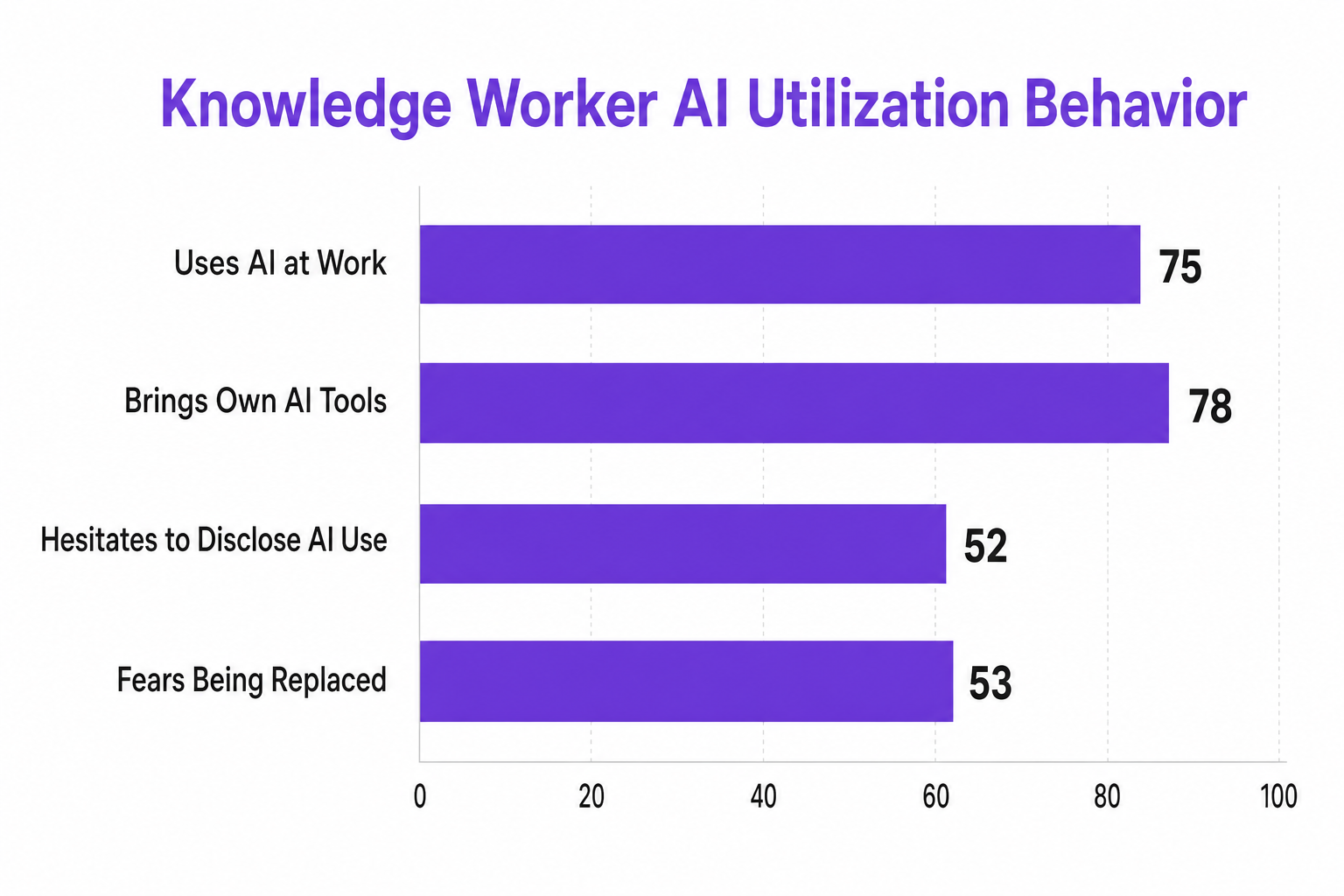
Building a behavioral analytics architecture requires visibility at the individual user level. Fully 75 percent of knowledge workers report using AI at work, and 78 percent bring their own AI tools into the enterprise environment. At the same time, 52 percent hesitate to disclose their AI use, often because 53 percent fear being replaced by the technology.
This dynamic mandates a governance first architecture for enterprise grade AI operations. Organizations cannot secure platforms they do not know exist. Through comprehensive AI activity tracking, an organization illuminated substantial savings opportunities and maintained strict budget compliance through continuous oversight of major cloud applications. Governance enablement correlates with higher production success; companies using AI governance tools get over 12 times more AI projects into production. Integrating identity analytics AI ensures that behavioral baselines represent reality rather than hypothetical use cases.
Effective risk detection with AI requires an understanding of how data moves across hundreds of integrated applications. The platform consolidates visibility across users, projects, tools, agents, and model activity into a single pane of glass to capture the true footprint of enterprise AI adoption. Focus is actively shifting toward bias and fairness management alongside drift and latency monitoring as core components of platform visibility operations. Administrators can apply guardrails, policy based controls, budget thresholds, and anomaly detection across AI projects to prevent cost overruns and runaway agents.
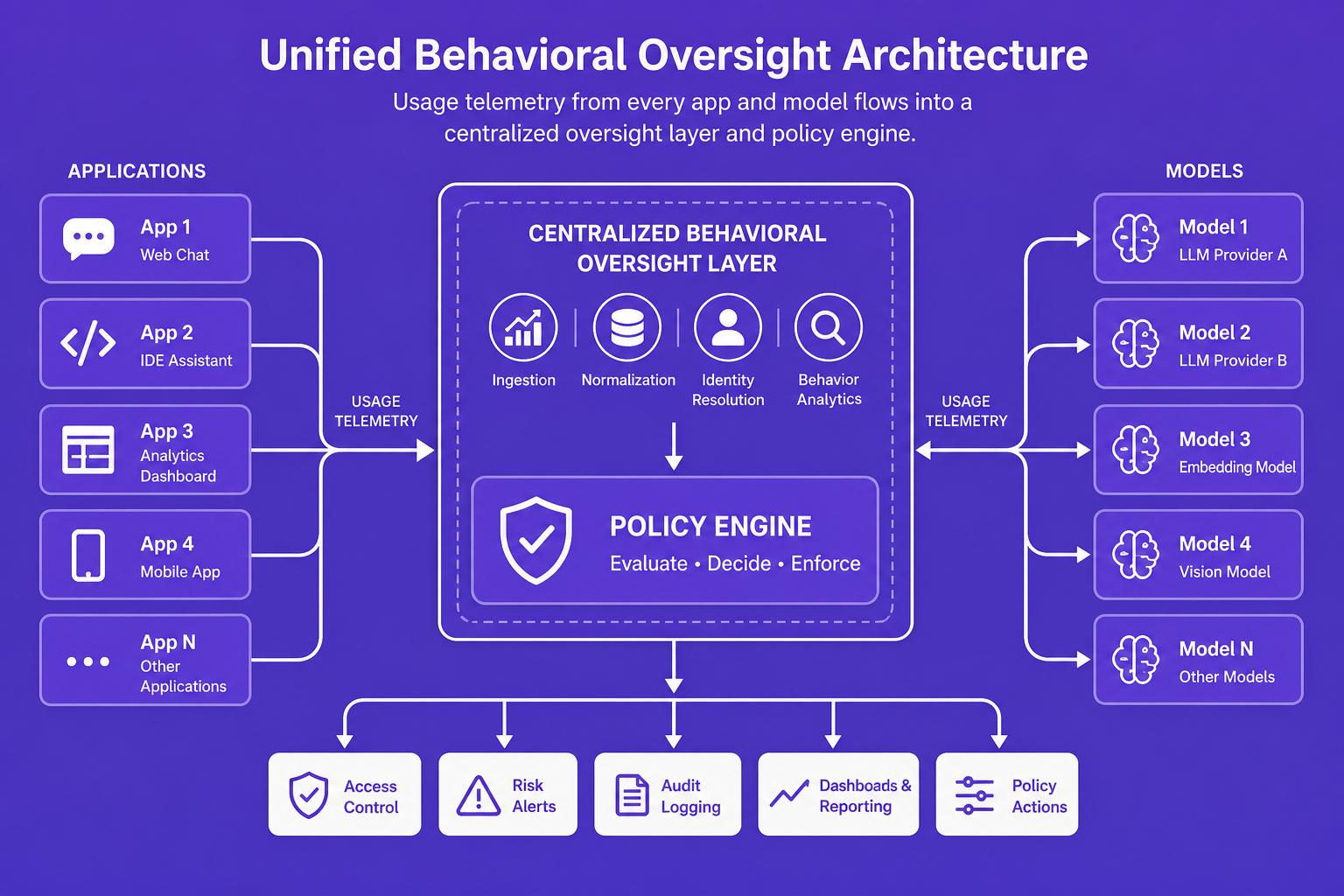
By establishing a centralized behavioral oversight layer, CloudNuro attributes specific AI spend and usage risk directly to individuals, teams, and projects without slowing innovation. This level of AI usage telemetry provides the foundation for identifying behavioral risk indicators before they escalate into compliance failures. Monitoring AI access ensures that critical operations remain restricted to authenticated personnel. User risk assessment AI continuously updates the threat profile of every connected account based on deviation from historical usage norms.
Compliance requires documented proof of control. A portfolio of global enterprise clients streamlined compliance tracking for ISO, SOC 2, GDPR, and CCPA by leveraging comprehensive audit trails for AI and SaaS usage. CloudNuro addresses complex compliance requirements by automatically maintaining comprehensive audit trails, tracking security certifications, and instantly flagging severe security gaps like disabled MFA or exposed databases.
User and application data follows a defined creation and destruction lifecycle governed by specific DLP policies, ensuring data is safely purged upon contract termination. Risk scores are actively assigned to discovered SaaS tools while the platform continuously evaluates the security posture AI of the cloud infrastructure. Maintaining robust AI audit logs converts hypothetical regulatory alignment into mathematically provable compliance automation AI. Organizations can easily satisfy auditors by centralizing governance risk and compliance AI documentation into unified reporting structures.
Visibility into AI access and usage directly influences the financial efficiency of cloud operations. Spend tracking attributes AI costs to specific projects, agents, teams, and models, allowing organizations to identify idle assets, duplicate implementations, or overpowered models. An enterprise client transitioned from manual oversight to a governed FinOps model, gaining immediate cost optimization opportunities across their entire SaaS estate.
Historical metrics, including 90 day CPU and memory peaks, are evaluated to deliver precise, actionable rightsizing intelligence tailored to the specific operational environment. Automated cost optimization with complete behavioral visibility ensures that AI governance pays for itself through immediate software rationalization. Connecting financial efficiency to usage behavior analytics creates a compelling internal business case for security expansion. By linking cloud security AI with procurement data, enterprises halt the financial bleed of redundant application licenses.
Only 21 percent of organizations report a mature governance model for agentic AI that includes audit trails and clear decision boundaries. Today, cross functional ownership of AI governance remains fragmented. Currently, IT departments hold 25 percent of the ownership, risk management teams hold 18 percent, cross functional arrangements account for 17 percent, and dedicated AI teams manage 10 percent.
CloudNuro AI Custodian tackles the challenge of widespread shadow AI and uncontrolled adoption by applying budget thresholds, policy based guardrails, and anomaly detection across all enterprise agents and models. The platform offers a unified view of SaaS and AI usage across over 400 integrated apps. This seamless compliance and security alignment for regulated industries enables CISOs to manage enterprise AI compliance effectively.
AI behavioral analytics in enterprise governance involves the continuous monitoring of how employees, applications, and automated agents interact with artificial intelligence models. This discipline tracks user behavior analytics, task logs, decision traces, and prompt histories to establish baselines of acceptable use. By identifying deviations from these baselines, organizations can detect shadow AI tools and unauthorized data sharing.
Security leaders utilize AI behavioral analytics to transition from static access controls to dynamic risk management. CISOs leverage deep behavioral insights to attribute specific actions and system requests to individual users. This fine grained telemetry enables security teams to instantly flag anomalies such as unusually high token consumption or sudden downloads of sensitive training data. Applying behavioral risk indicators allows security personnel to proactively contain incidents before they materialize into costly data breaches.
The primary obstacle to implementing AI behavioral analytics is the sheer scale and fragmentation of enterprise cloud environments. Employees frequently adopt unvetted consumer generative AI applications outside the purview of traditional IT security. Capturing unstructured interactions requires integrating cloud native governance with existing on premises logging systems. This complexity is compounded by employee reluctance to disclose experimental AI usage.
Applying continuous AI user behavior monitoring creates an immutable record of all system interactions and data flows. This audit trail is critical for organizations operating under strict regulatory frameworks. Administrators can automatically enforce DLP policies and maintain oversight of data residency requirements. Centralized monitoring simplifies compliance audits by providing immediate evidence that guardrails are actively restricting unauthorized data exposure.
Usage telemetry provides the raw data necessary to power effective AI security analytics. Telemetry systems measure exactly who accessed a model, what data they provided, and the computational resources consumed during the interaction. Spend tracking relies on this telemetry to attribute costs to specific projects and teams. This comprehensive data set forms the foundation for detecting compliance gaps, enforcing budget thresholds, and identifying compromised accounts accessing enterprise models.
The modern enterprise cannot govern what it cannot see. Deploying AI behavioral analytics transforms opaque usage patterns into actionable security and compliance intel. Moving from disjointed policies to an automated behavioral governance platform creates a clear path to scalable, secure AI deployment across the organization. Security leaders must equip their teams with the tools needed to monitor user telemetry analysis and apply data residency AI enforcement mechanisms.
Read the it security overview or explore the ai custodian to establish comprehensive governance across your technology operations. Get started by evaluating your current ai usage policy, then talk to a human to design your behavioral analytics architecture.
CloudNuro is a leader in Enterprise AI Adoption Management, providing enterprises with unmatched visibility, governance, and cost optimization. Recognized twice in a row in the SaaS Management Platforms category and named a Leader in the SoftwareReviews Data Quadrant, CloudNuro is trusted by global enterprises and government agencies to bring financial discipline to SaaS, cloud, and AI. Trusted by enterprises such as Konica Minolta and Federal Signal, CloudNuro provides centralized SaaS inventory, license optimization, and renewal management along with advanced cost allocation and chargeback, giving IT and Finance leaders the visibility, control, and cost-conscious culture needed to drive financial discipline.
Request a no cost, no obligation free assessment —just 15 minutes to savings!
Get StartedAI has become business critical infrastructure, yet governance profiles still resemble emerging risk programs characterized by wide adoption, narrow maturity, and significant blind spots. While adoption accelerates across all sectors, only 25 percent of organizations possess comprehensive visibility into employee AI use. This gap in visibility creates tangible exposure; unauthorized AI usage adds approximately 670,000 dollars to average breach costs compared to organizations with low or no shadow AI usage. Documented AI related incidents increased by 55 percent over a single year. To bridge this gap between strategic adoption and security posture, enterprise leaders must shift focus from static access controls to continuous AI user behavior monitoring. The solution lies in AI behavioral analytics, a discipline that consolidates telemetry across users, projects, tools, and model activity into a unified governance framework. This approach functions as a core security and compliance control rather than a mere productivity metric. Without comprehensive enterprise AI governance, organizations remain blind to the actual operational footprint of their technology investments. Addressing these CISO AI challenges requires migrating from reactive audits to automated, behavioral risk indicators that detect anomalies instantly.
Enterprises are rapidly building hybrid telemetry stacks, combining cloud native governance for model monitoring with on premises logging and SIEM integration for security. However, as agentic AI usage scales, demand is surging for fine grained analytics that track task logs, decision traces, prompt histories, and user behavior analytics. More than a third of organizations describe shadow AI as pervasive or widespread, with nearly half calling it moderately prevalent. Traditional network perimeter defenses cannot identify when an approved user inputs sensitive intellectual property into an unsanctioned generative model.
Only 18 percent of organizations have active mitigation covering most or all identified AI risks. Furthermore, nearly 90 percent of enterprises have not publicly committed to any named AI governance framework. Accountability mechanisms are shifting to the board level, with nearly half of major corporate boards now explicitly overseeing AI risk and governance frameworks. Unmonitored AI use directly correlates with higher breach costs and undisclosed tools. CISO AI analytics must evolve to inspect the exact prompts, parameters, and payloads moving through both authorized and unauthorized channels. Establishing robust cloud AI governance is no longer optional for maintaining a defensible security posture.
Building a behavioral analytics architecture requires visibility at the individual user level. Fully 75 percent of knowledge workers report using AI at work, and 78 percent bring their own AI tools into the enterprise environment. At the same time, 52 percent hesitate to disclose their AI use, often because 53 percent fear being replaced by the technology.
This dynamic mandates a governance first architecture for enterprise grade AI operations. Organizations cannot secure platforms they do not know exist. Through comprehensive AI activity tracking, an organization illuminated substantial savings opportunities and maintained strict budget compliance through continuous oversight of major cloud applications. Governance enablement correlates with higher production success; companies using AI governance tools get over 12 times more AI projects into production. Integrating identity analytics AI ensures that behavioral baselines represent reality rather than hypothetical use cases.
Effective risk detection with AI requires an understanding of how data moves across hundreds of integrated applications. The platform consolidates visibility across users, projects, tools, agents, and model activity into a single pane of glass to capture the true footprint of enterprise AI adoption. Focus is actively shifting toward bias and fairness management alongside drift and latency monitoring as core components of platform visibility operations. Administrators can apply guardrails, policy based controls, budget thresholds, and anomaly detection across AI projects to prevent cost overruns and runaway agents.
By establishing a centralized behavioral oversight layer, CloudNuro attributes specific AI spend and usage risk directly to individuals, teams, and projects without slowing innovation. This level of AI usage telemetry provides the foundation for identifying behavioral risk indicators before they escalate into compliance failures. Monitoring AI access ensures that critical operations remain restricted to authenticated personnel. User risk assessment AI continuously updates the threat profile of every connected account based on deviation from historical usage norms.
Compliance requires documented proof of control. A portfolio of global enterprise clients streamlined compliance tracking for ISO, SOC 2, GDPR, and CCPA by leveraging comprehensive audit trails for AI and SaaS usage. CloudNuro addresses complex compliance requirements by automatically maintaining comprehensive audit trails, tracking security certifications, and instantly flagging severe security gaps like disabled MFA or exposed databases.
User and application data follows a defined creation and destruction lifecycle governed by specific DLP policies, ensuring data is safely purged upon contract termination. Risk scores are actively assigned to discovered SaaS tools while the platform continuously evaluates the security posture AI of the cloud infrastructure. Maintaining robust AI audit logs converts hypothetical regulatory alignment into mathematically provable compliance automation AI. Organizations can easily satisfy auditors by centralizing governance risk and compliance AI documentation into unified reporting structures.
Visibility into AI access and usage directly influences the financial efficiency of cloud operations. Spend tracking attributes AI costs to specific projects, agents, teams, and models, allowing organizations to identify idle assets, duplicate implementations, or overpowered models. An enterprise client transitioned from manual oversight to a governed FinOps model, gaining immediate cost optimization opportunities across their entire SaaS estate.
Historical metrics, including 90 day CPU and memory peaks, are evaluated to deliver precise, actionable rightsizing intelligence tailored to the specific operational environment. Automated cost optimization with complete behavioral visibility ensures that AI governance pays for itself through immediate software rationalization. Connecting financial efficiency to usage behavior analytics creates a compelling internal business case for security expansion. By linking cloud security AI with procurement data, enterprises halt the financial bleed of redundant application licenses.
Only 21 percent of organizations report a mature governance model for agentic AI that includes audit trails and clear decision boundaries. Today, cross functional ownership of AI governance remains fragmented. Currently, IT departments hold 25 percent of the ownership, risk management teams hold 18 percent, cross functional arrangements account for 17 percent, and dedicated AI teams manage 10 percent.
CloudNuro AI Custodian tackles the challenge of widespread shadow AI and uncontrolled adoption by applying budget thresholds, policy based guardrails, and anomaly detection across all enterprise agents and models. The platform offers a unified view of SaaS and AI usage across over 400 integrated apps. This seamless compliance and security alignment for regulated industries enables CISOs to manage enterprise AI compliance effectively.
AI behavioral analytics in enterprise governance involves the continuous monitoring of how employees, applications, and automated agents interact with artificial intelligence models. This discipline tracks user behavior analytics, task logs, decision traces, and prompt histories to establish baselines of acceptable use. By identifying deviations from these baselines, organizations can detect shadow AI tools and unauthorized data sharing.
Security leaders utilize AI behavioral analytics to transition from static access controls to dynamic risk management. CISOs leverage deep behavioral insights to attribute specific actions and system requests to individual users. This fine grained telemetry enables security teams to instantly flag anomalies such as unusually high token consumption or sudden downloads of sensitive training data. Applying behavioral risk indicators allows security personnel to proactively contain incidents before they materialize into costly data breaches.
The primary obstacle to implementing AI behavioral analytics is the sheer scale and fragmentation of enterprise cloud environments. Employees frequently adopt unvetted consumer generative AI applications outside the purview of traditional IT security. Capturing unstructured interactions requires integrating cloud native governance with existing on premises logging systems. This complexity is compounded by employee reluctance to disclose experimental AI usage.
Applying continuous AI user behavior monitoring creates an immutable record of all system interactions and data flows. This audit trail is critical for organizations operating under strict regulatory frameworks. Administrators can automatically enforce DLP policies and maintain oversight of data residency requirements. Centralized monitoring simplifies compliance audits by providing immediate evidence that guardrails are actively restricting unauthorized data exposure.
Usage telemetry provides the raw data necessary to power effective AI security analytics. Telemetry systems measure exactly who accessed a model, what data they provided, and the computational resources consumed during the interaction. Spend tracking relies on this telemetry to attribute costs to specific projects and teams. This comprehensive data set forms the foundation for detecting compliance gaps, enforcing budget thresholds, and identifying compromised accounts accessing enterprise models.
The modern enterprise cannot govern what it cannot see. Deploying AI behavioral analytics transforms opaque usage patterns into actionable security and compliance intel. Moving from disjointed policies to an automated behavioral governance platform creates a clear path to scalable, secure AI deployment across the organization. Security leaders must equip their teams with the tools needed to monitor user telemetry analysis and apply data residency AI enforcement mechanisms.
Read the it security overview or explore the ai custodian to establish comprehensive governance across your technology operations. Get started by evaluating your current ai usage policy, then talk to a human to design your behavioral analytics architecture.
CloudNuro is a leader in Enterprise AI Adoption Management, providing enterprises with unmatched visibility, governance, and cost optimization. Recognized twice in a row in the SaaS Management Platforms category and named a Leader in the SoftwareReviews Data Quadrant, CloudNuro is trusted by global enterprises and government agencies to bring financial discipline to SaaS, cloud, and AI. Trusted by enterprises such as Konica Minolta and Federal Signal, CloudNuro provides centralized SaaS inventory, license optimization, and renewal management along with advanced cost allocation and chargeback, giving IT and Finance leaders the visibility, control, and cost-conscious culture needed to drive financial discipline.
Request a no cost, no obligation free assessment - just 15 minutes to savings!
Get StartedWe're offering complimentary ServiceNow license assessments to only 25 enterprises this quarter who want to unlock immediate savings without disrupting operations.
Get Free AssessmentGet Started




CloudNuro Corp
1755 Park St. Suite 207
Naperville, IL 60563
Phone : +1-630-277-9470
Email: info@cloudnuro.com





.webp)

Recognized Leader in SaaS Management Platforms by Info-Tech SoftwareReviews



.png)

.svg)