

Sign Up
Thank you for Submitting!
Most enterprises still start their SaaS visibility journey in the same place: a shared spreadsheet that tries to track every subscription, user, and renewal. That approach can work at 20 apps. It completely breaks at 200, let alone 374, which is the average number of SaaS apps managed by organizations in 2026 according to a SaaS trends report.
A modern SaaS management strategy requires more than rows and columns. It requires real-time SaaS discovery, automation, and governance baked into daily operations so IT, finance, and security teams see exactly what they own, who is using it, and what it costs.
Spreadsheets were never designed to be a system of record for dynamic, API-driven cloud services. They are static by nature while SaaS is fluid. New tools appear with every employee credit card, trials convert silently to paid, and usage changes week by week.
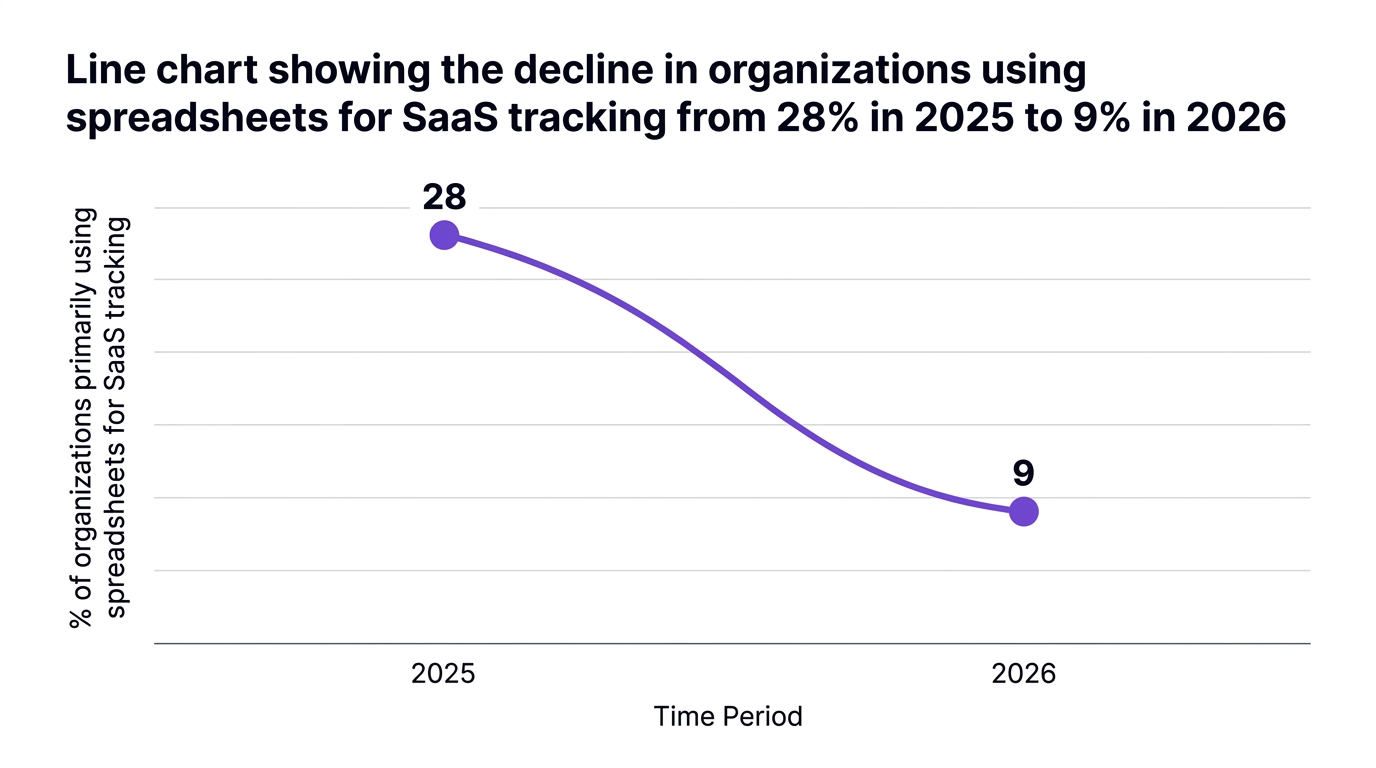
By 2026, only 9% of large organizations rely primarily on spreadsheets for SaaS tracking, down from 28% in 2025, according to a SaaS management pulse study. At the same time, 83% of enterprises have shifted to automated SaaS management platforms for improved visibility and control, as reported by Forrester in 2026.
The core limitations of spreadsheets for SaaS visibility include:
A useful analogy for leaders is traffic management. Spreadsheets are like relying on a paper map to understand city congestion. A modern SaaS management strategy is more like live GPS traffic: constantly refreshed, route aware, and responsive.
A SaaS management strategy is the set of policies, processes, and technologies an organization uses to monitor, control, and optimize its SaaS portfolio throughout the entire SaaS lifecycle.
In 2026, an effective strategy spans:
Analysts highlight that automated SaaS management reduces manual auditing time by 72%, according to IDC 2026. That time goes back to higher value activities like architecture improvements, security posture reviews, and proactive application portfolio management.
A robust SaaS visibility strategy also connects IT, finance, and security. Instead of siloed logs, invoices, and spreadsheets, teams work from a shared, real-time view of every subscription and user.

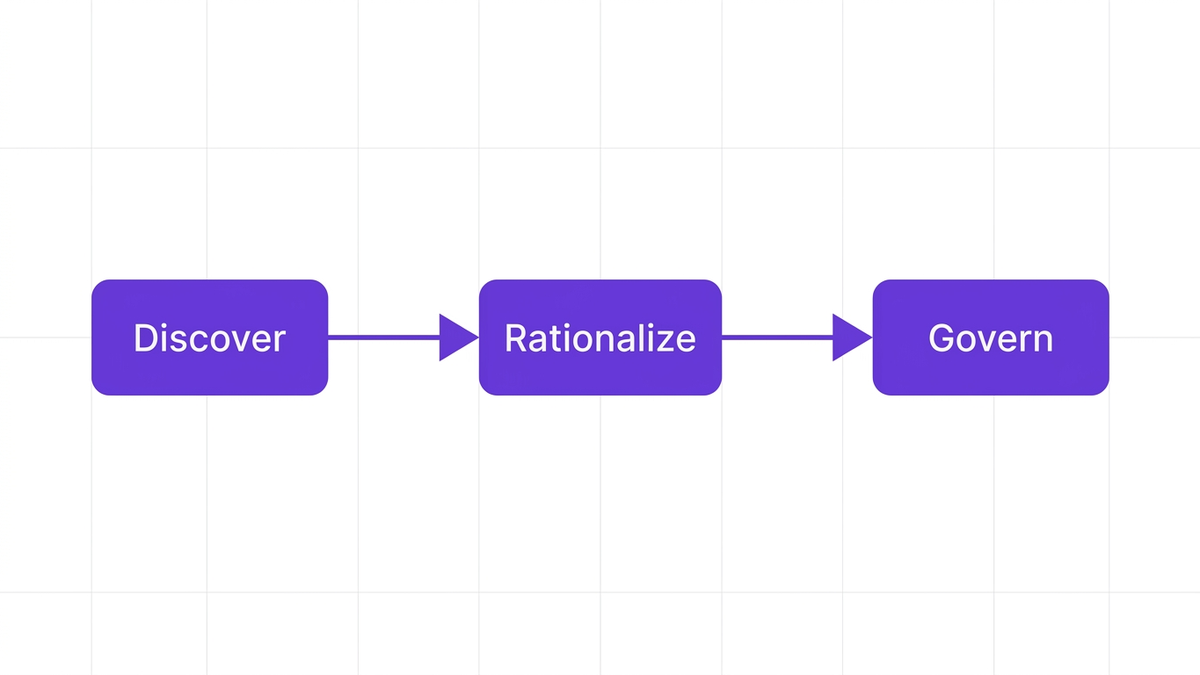
To replace spreadsheet SaaS tracking, organizations typically move through three stages. CloudNuro uses a simple framework called "Discover, Rationalize, Govern" to describe this evolution.
Real-time SaaS discovery automation uses multiple data sources to reveal the true SaaS app inventory:
A SaaS trends report in 2026 found that the average organization manages 374 apps, up from 292 in 2025, a 22% increase in a single year. Manual tracking cannot keep pace with this growth.
Priya Ramesh, a SaaS governance analyst cited in Forrester 2026, notes that "real-time SaaS discovery is a non-negotiable for organizations managing hundreds of cloud apps" because manual tracking simply cannot keep pace with usage and compliance demands.
Key outcomes of the Discover stage:
Once the full SaaS app inventory is visible, the next step is rationalization. This is where SaaS license optimization and cost control mature from reactive cleanups to proactive policy.
Gartner reported in 2026 that 93% of organizations experienced reduced SaaS spend leakage after implementing automated discovery and license optimization. Typical savings come from:
A case study from a global finance group in 2026 showed that replacing Excel-based SaaS app inventory with an automated platform uncovered 47% more active applications and drove 3.1 million dollars in annual reductions in redundant software spend.
The final stage establishes governance as a continuous practice, not a one-off cleanup. Here, IT and security define policies, workflows, and controls supported by SaaS management software.
Governance elements typically include:
Deloitte research in 2026 found that SaaS spend under management grew to 68% when automation tools replaced spreadsheets. That growth directly reflects better software asset governance and policy enforcement.
Many leaders ask how SaaS discovery automation functions behind the scenes. It is less magic and more disciplined data engineering.
A modern SaaS management platform typically:
This approach turns what used to be one-off SaaS spend audits into continuous monitoring. It is similar to moving from annual stock-takes in a warehouse to real-time barcode scanning at every shelf.

The benefits include:
A healthcare provider, cited in a 2026 SaaS management pulse report, implemented real-time discovery and cut software compliance audit preparation time by 62%, while eliminating manual spreadsheet processes.
Selecting the right SaaS management solution is a strategic decision. For CIOs, procurement, and security leaders, the question is not simply about SaaS management pricing or feature checklists. It is about whether the platform can support enterprise-grade governance for the next five years.
Modern SaaS management software should provide at least these core capabilities:
Many IT leaders pair this with dedicated saas management practices and it asset management policies.
A FinOps-aligned approach often includes specialized finops services so finance and engineering share a common spend view.
Analysts report that 85% of enterprises in 2026 cite shadow IT discovery and compliance auditing as the top drivers for software sprawl management and SaaS governance programs.
This is where modern SaaS management diverges completely from spreadsheets. Automation does not just show the problem. It can act on it.
CloudNuro was built specifically to help enterprises replace spreadsheet SaaS tracking with a governance-first, AI-enabled platform.
CloudNuro aligns closely with the Discover, Rationalize, Govern framework to operationalize a modern SaaS visibility strategy.
CloudNuro AI Custodian delivers real-time SaaS discovery and cloud visibility across more than 400 integrations. Using identity, financial, and network signals, it continuously builds and updates your SaaS app inventory.
Key capabilities include:
CloudNuro's visibility-first design supports enterprise it security teams and FinOps leaders who need authoritative data, not scattered logs.
CloudNuro's Microsoft 365 Custodian and Salesforce Custodian specialize in SaaS license optimization for two of the most widely used enterprise suites. The platform uses behavioral data to identify unused or low-value licenses, then recommends right-sizing.
Benefits customers typically see include:
Across the broader portfolio, CloudNuro's cost analytics support comprehensive SaaS spend management. This enables organizations to treat SaaS as a managed investment, not a fragmented expense line.
CloudNuro's governance-first architecture supports long-term software asset governance and cloud compliance. The platform provides:
As a result, auditors can rely on CloudNuro as a central system of record, instead of stitching together spreadsheets and screenshots from dozens of tools.
CloudNuro integrates with more than 400 applications, as documented on the integrations page. The platform orchestrates automation across identity, finance, and IT workflows, reducing manual tasks such as access reviews and renewal tracking.
Compared with typical SaaS management alternatives, CloudNuro focuses on three pillars: automation, governance, and full-cloud visibility. This combination helps enterprises move beyond simple SaaS management comparison exercises and toward a strategic, long-term partnership.

Even with clear benefits, some leaders hesitate to move beyond spreadsheets. Two common counterarguments come up in SaaS management reviews and internal discussions.
This argument often holds when the portfolio is small or one person owns the entire file. It breaks as soon as:
A SaaS management pulse report showed that manual auditing time drops by 72% once automated tools replace spreadsheets. That is a material productivity gain, not just a small improvement.
Some teams compare the license cost of a SaaS management platform to the price of doing nothing. A more accurate comparison is against the value of recovered spend and avoided risk.
Given that 93% of organizations reduce SaaS spend leakage after implementing automation, a modest percentage of waste in a multi-million-dollar SaaS budget can more than cover the investment. When combined with reduced audit exposure and faster renewal negotiations, the ROI becomes clear.
In many SaaS management comparison efforts, organizations also consider intangible benefits like improved collaboration between IT and finance, and better employee experience from consistent access to the right tools.
To move from spreadsheets to a modern SaaS management strategy, consider the following step-by-step path:
CloudNuro supports this journey end to end, from pilot discovery to full enterprise rollout, as detailed in resources like the blog on a comprehensive guide to saas operations and the article on saas management metrics to watch.
A SaaS management strategy is the coordinated approach an organization uses to discover, manage, and optimize its SaaS portfolio. It covers discovery, inventory, cost optimization, security, compliance, and vendor management.
In 2026, a strategy that relies on spreadsheets alone is no longer viable for enterprises that manage hundreds of apps. Automation and real-time discovery are essential ingredients.
Companies can replace spreadsheet tracking by implementing a SaaS management platform that:
CloudNuro enables a phased transition, starting with discovery, then expanding to governance, cost optimization, and audit automation.
Real-time SaaS discovery is critical because portfolios are expanding quickly and regulatory scrutiny is increasing. With the average organization managing 374 apps in 2026, usage and risk change too fast for manual audits.
Continuous discovery also reduces exposure from shadow IT, improves contract negotiation positions, and underpins accurate SaaS spend management.
A strong SaaS visibility strategy delivers:
Organizations report material savings and improved agility once SaaS visibility is unified and automated.
A modern SaaS management solution should provide:
CloudNuro's platform addresses these needs for enterprises who require governance-first, compliant SaaS operations.
Modernizing your SaaS management strategy is no longer optional. With hundreds of applications, rising compliance demands, and growing pressure to optimize spend, spreadsheets have reached their limit.
Real-time SaaS discovery, automated license optimization, and governance-first controls transform SaaS from an ungoverned expense into a strategic, well-managed asset. CloudNuro provides the SaaS management platform to make that shift practical at enterprise scale.
To see how CloudNuro can help you move from spreadsheets to real-time visibility and control, explore the CloudNuro website at www.cloudnuro.ai and request a tailored walkthrough of your environment.
CloudNuro is a leader in Enterprise SaaS Management Platforms, providing enterprises with unmatched visibility, governance, and cost optimization. Recognized twice in a row in the SaaS Management Platforms category and named a Leader in the SoftwareReviews Data Quadrant, CloudNuro is trusted by global enterprises and government agencies to bring financial discipline to SaaS, cloud, and AI. Trusted by enterprises such as Konica Minolta and Federal Signal, CloudNuro provides centralized SaaS inventory, license optimization, and renewal management along with advanced cost allocation and chargeback, giving IT and Finance leaders the visibility, control, and cost-conscious culture needed to drive financial discipline. Request a Demo | Get Free Savings | Explore Product Request a Demo Get Free Savings Explore Product
Request a no cost, no obligation free assessment —just 15 minutes to savings!
Get StartedMost enterprises still start their SaaS visibility journey in the same place: a shared spreadsheet that tries to track every subscription, user, and renewal. That approach can work at 20 apps. It completely breaks at 200, let alone 374, which is the average number of SaaS apps managed by organizations in 2026 according to a SaaS trends report.
A modern SaaS management strategy requires more than rows and columns. It requires real-time SaaS discovery, automation, and governance baked into daily operations so IT, finance, and security teams see exactly what they own, who is using it, and what it costs.
Spreadsheets were never designed to be a system of record for dynamic, API-driven cloud services. They are static by nature while SaaS is fluid. New tools appear with every employee credit card, trials convert silently to paid, and usage changes week by week.
By 2026, only 9% of large organizations rely primarily on spreadsheets for SaaS tracking, down from 28% in 2025, according to a SaaS management pulse study. At the same time, 83% of enterprises have shifted to automated SaaS management platforms for improved visibility and control, as reported by Forrester in 2026.
The core limitations of spreadsheets for SaaS visibility include:
A useful analogy for leaders is traffic management. Spreadsheets are like relying on a paper map to understand city congestion. A modern SaaS management strategy is more like live GPS traffic: constantly refreshed, route aware, and responsive.
A SaaS management strategy is the set of policies, processes, and technologies an organization uses to monitor, control, and optimize its SaaS portfolio throughout the entire SaaS lifecycle.
In 2026, an effective strategy spans:
Analysts highlight that automated SaaS management reduces manual auditing time by 72%, according to IDC 2026. That time goes back to higher value activities like architecture improvements, security posture reviews, and proactive application portfolio management.
A robust SaaS visibility strategy also connects IT, finance, and security. Instead of siloed logs, invoices, and spreadsheets, teams work from a shared, real-time view of every subscription and user.
To replace spreadsheet SaaS tracking, organizations typically move through three stages. CloudNuro uses a simple framework called "Discover, Rationalize, Govern" to describe this evolution.
Real-time SaaS discovery automation uses multiple data sources to reveal the true SaaS app inventory:
A SaaS trends report in 2026 found that the average organization manages 374 apps, up from 292 in 2025, a 22% increase in a single year. Manual tracking cannot keep pace with this growth.
Priya Ramesh, a SaaS governance analyst cited in Forrester 2026, notes that "real-time SaaS discovery is a non-negotiable for organizations managing hundreds of cloud apps" because manual tracking simply cannot keep pace with usage and compliance demands.
Key outcomes of the Discover stage:
Once the full SaaS app inventory is visible, the next step is rationalization. This is where SaaS license optimization and cost control mature from reactive cleanups to proactive policy.
Gartner reported in 2026 that 93% of organizations experienced reduced SaaS spend leakage after implementing automated discovery and license optimization. Typical savings come from:
A case study from a global finance group in 2026 showed that replacing Excel-based SaaS app inventory with an automated platform uncovered 47% more active applications and drove 3.1 million dollars in annual reductions in redundant software spend.
The final stage establishes governance as a continuous practice, not a one-off cleanup. Here, IT and security define policies, workflows, and controls supported by SaaS management software.
Governance elements typically include:
Deloitte research in 2026 found that SaaS spend under management grew to 68% when automation tools replaced spreadsheets. That growth directly reflects better software asset governance and policy enforcement.
Many leaders ask how SaaS discovery automation functions behind the scenes. It is less magic and more disciplined data engineering.
A modern SaaS management platform typically:
This approach turns what used to be one-off SaaS spend audits into continuous monitoring. It is similar to moving from annual stock-takes in a warehouse to real-time barcode scanning at every shelf.
The benefits include:
A healthcare provider, cited in a 2026 SaaS management pulse report, implemented real-time discovery and cut software compliance audit preparation time by 62%, while eliminating manual spreadsheet processes.
Selecting the right SaaS management solution is a strategic decision. For CIOs, procurement, and security leaders, the question is not simply about SaaS management pricing or feature checklists. It is about whether the platform can support enterprise-grade governance for the next five years.
Modern SaaS management software should provide at least these core capabilities:
Many IT leaders pair this with dedicated saas management practices and it asset management policies.
A FinOps-aligned approach often includes specialized finops services so finance and engineering share a common spend view.
Analysts report that 85% of enterprises in 2026 cite shadow IT discovery and compliance auditing as the top drivers for software sprawl management and SaaS governance programs.
This is where modern SaaS management diverges completely from spreadsheets. Automation does not just show the problem. It can act on it.
CloudNuro was built specifically to help enterprises replace spreadsheet SaaS tracking with a governance-first, AI-enabled platform.
CloudNuro aligns closely with the Discover, Rationalize, Govern framework to operationalize a modern SaaS visibility strategy.
CloudNuro AI Custodian delivers real-time SaaS discovery and cloud visibility across more than 400 integrations. Using identity, financial, and network signals, it continuously builds and updates your SaaS app inventory.
Key capabilities include:
CloudNuro's visibility-first design supports enterprise it security teams and FinOps leaders who need authoritative data, not scattered logs.
CloudNuro's Microsoft 365 Custodian and Salesforce Custodian specialize in SaaS license optimization for two of the most widely used enterprise suites. The platform uses behavioral data to identify unused or low-value licenses, then recommends right-sizing.
Benefits customers typically see include:
Across the broader portfolio, CloudNuro's cost analytics support comprehensive SaaS spend management. This enables organizations to treat SaaS as a managed investment, not a fragmented expense line.
CloudNuro's governance-first architecture supports long-term software asset governance and cloud compliance. The platform provides:
As a result, auditors can rely on CloudNuro as a central system of record, instead of stitching together spreadsheets and screenshots from dozens of tools.
CloudNuro integrates with more than 400 applications, as documented on the integrations page. The platform orchestrates automation across identity, finance, and IT workflows, reducing manual tasks such as access reviews and renewal tracking.
Compared with typical SaaS management alternatives, CloudNuro focuses on three pillars: automation, governance, and full-cloud visibility. This combination helps enterprises move beyond simple SaaS management comparison exercises and toward a strategic, long-term partnership.
Even with clear benefits, some leaders hesitate to move beyond spreadsheets. Two common counterarguments come up in SaaS management reviews and internal discussions.
This argument often holds when the portfolio is small or one person owns the entire file. It breaks as soon as:
A SaaS management pulse report showed that manual auditing time drops by 72% once automated tools replace spreadsheets. That is a material productivity gain, not just a small improvement.
Some teams compare the license cost of a SaaS management platform to the price of doing nothing. A more accurate comparison is against the value of recovered spend and avoided risk.
Given that 93% of organizations reduce SaaS spend leakage after implementing automation, a modest percentage of waste in a multi-million-dollar SaaS budget can more than cover the investment. When combined with reduced audit exposure and faster renewal negotiations, the ROI becomes clear.
In many SaaS management comparison efforts, organizations also consider intangible benefits like improved collaboration between IT and finance, and better employee experience from consistent access to the right tools.
To move from spreadsheets to a modern SaaS management strategy, consider the following step-by-step path:
CloudNuro supports this journey end to end, from pilot discovery to full enterprise rollout, as detailed in resources like the blog on a comprehensive guide to saas operations and the article on saas management metrics to watch.
A SaaS management strategy is the coordinated approach an organization uses to discover, manage, and optimize its SaaS portfolio. It covers discovery, inventory, cost optimization, security, compliance, and vendor management.
In 2026, a strategy that relies on spreadsheets alone is no longer viable for enterprises that manage hundreds of apps. Automation and real-time discovery are essential ingredients.
Companies can replace spreadsheet tracking by implementing a SaaS management platform that:
CloudNuro enables a phased transition, starting with discovery, then expanding to governance, cost optimization, and audit automation.
Real-time SaaS discovery is critical because portfolios are expanding quickly and regulatory scrutiny is increasing. With the average organization managing 374 apps in 2026, usage and risk change too fast for manual audits.
Continuous discovery also reduces exposure from shadow IT, improves contract negotiation positions, and underpins accurate SaaS spend management.
A strong SaaS visibility strategy delivers:
Organizations report material savings and improved agility once SaaS visibility is unified and automated.
A modern SaaS management solution should provide:
CloudNuro's platform addresses these needs for enterprises who require governance-first, compliant SaaS operations.
Modernizing your SaaS management strategy is no longer optional. With hundreds of applications, rising compliance demands, and growing pressure to optimize spend, spreadsheets have reached their limit.
Real-time SaaS discovery, automated license optimization, and governance-first controls transform SaaS from an ungoverned expense into a strategic, well-managed asset. CloudNuro provides the SaaS management platform to make that shift practical at enterprise scale.
To see how CloudNuro can help you move from spreadsheets to real-time visibility and control, explore the CloudNuro website at www.cloudnuro.ai and request a tailored walkthrough of your environment.
CloudNuro is a leader in Enterprise SaaS Management Platforms, providing enterprises with unmatched visibility, governance, and cost optimization. Recognized twice in a row in the SaaS Management Platforms category and named a Leader in the SoftwareReviews Data Quadrant, CloudNuro is trusted by global enterprises and government agencies to bring financial discipline to SaaS, cloud, and AI. Trusted by enterprises such as Konica Minolta and Federal Signal, CloudNuro provides centralized SaaS inventory, license optimization, and renewal management along with advanced cost allocation and chargeback, giving IT and Finance leaders the visibility, control, and cost-conscious culture needed to drive financial discipline. Request a Demo | Get Free Savings | Explore Product Request a Demo Get Free Savings Explore Product
Request a no cost, no obligation free assessment - just 15 minutes to savings!
Get StartedWe're offering complimentary ServiceNow license assessments to only 25 enterprises this quarter who want to unlock immediate savings without disrupting operations.
Get Free AssessmentGet Started




CloudNuro Corp
1755 Park St. Suite 207
Naperville, IL 60563
Phone : +1-630-277-9470
Email: info@cloudnuro.com





.webp)

Recognized Leader in SaaS Management Platforms by Info-Tech SoftwareReviews

.png)
.svg)