

Sign Up
Thank you for Submitting!
By 2026, a striking 78% of enterprises are projected to rely on AI for cost prediction and spend forecasting. This surge reflects an urgent need to govern rapidly expanding cloud and SaaS investments, instill financial discipline, and keep unforeseen expenses in check. It is not simply about budgeting smarter, it is about staying competitive as AI adoption continues to transform IT operations, finance, and governance at scale.
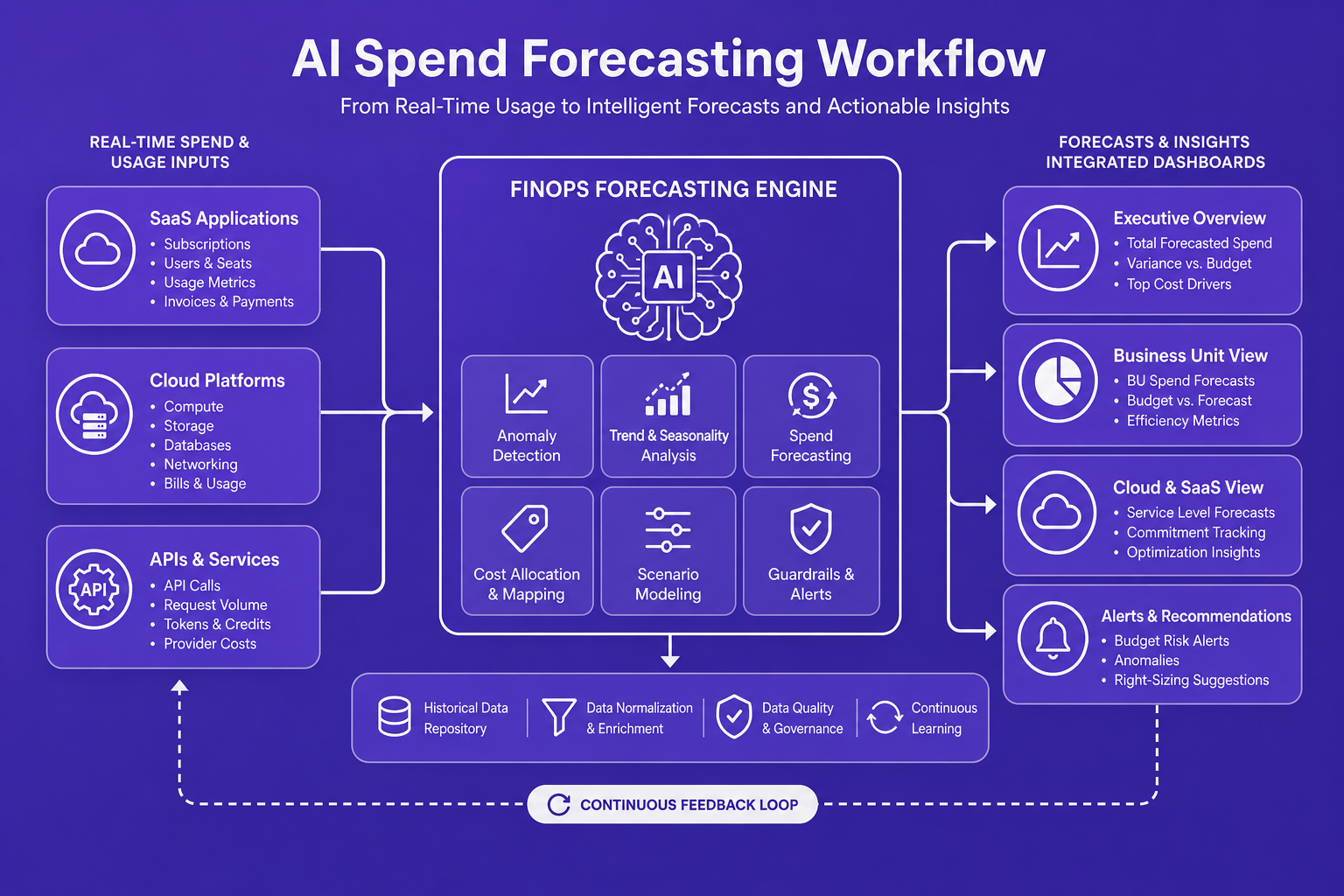
AI spend forecasting sits at the heart of this revolution. As complexity and consumption-based models introduce new risks, organizations are embracing FinOps strategies powered by automation, scenario modeling, and integrated cost intelligence. The payoff? Greater visibility, tighter control, sharper compliance, and real cost savings.
This blog demystifies AI spend forecasting, illustrates how enterprises wield it for budgetary precision, and unpacks why CloudNuro leads in this critical domain.
Recent statistics lay bare the challenge:
79% of enterprises faced AI cost overruns in the past year.
85% systematically misestimate AI costs during planning.
56% miss cost forecasts by 11% to 25%, and 24% overshoot by more than 50%.
AI now accounts for over 10% of the IT budget in 28% of organizations.
The root? Traditional budgeting methods, annual cycles, manual spreadsheets, and static forecasts, no longer work for AI, where usage patterns shift by the week, pricing is dynamic, and new workloads emerge overnight. Inferring costs from last year’s run rates does not reflect modern, usage-driven contracts or fast-shifting business demands.
Enterprises no longer view AI as just a line item for experimentation. It is a core function of digital transformation. Driver-based financial modeling is gaining prominence, tying AI spend forecasts directly to tangible business drivers such as document volumes, API calls, or user growth.
Organizations are abandoning static forecasts for dynamic rolling forecasts. These blend real-time usage with scenario modeling, allowing teams to adjust assumptions, react to consumption spikes, and plan for change. Financial leaders, in parallel, increasingly demand:
Granular visibility into where AI investments go
Proactive alerts on abnormal spend
Compliance with allocation policies
Unbudgeted expenses spiral, blindsiding finance teams
Shadow IT emerges as teams deploy their own AI tools
Overprovisioning results in waste; underprovisioning risks innovation slowdowns
Proof points underline this urgency:
One major enterprise reduced licensing waste by 55% and reclaimed 1,700 unused licenses, saving 300 operational hours annually
A healthcare technology provider cut unbudgeted expenses by 22% and completely eliminated shadow IT AI spend within three quarters
AI spend forecasting merges live SaaS and cloud usage data with machine learning models that adapt to real-world consumption. The process typically involves:
Ingesting multi-source usage and billing data. AI spending is rarely centralized; real-time visibility across platforms is crucial.
Pattern identification and cost prediction. Predictive analytics learns from historic trends, seasonality, and contract terms to estimate future expenses.
Scenario modeling. Teams simulate what-if scenarios, e.g., "What if our token usage doubles next quarter?", and instantly see how budgets respond.
Automated governance and alerts. Systems trigger warnings or throttle workloads if costs breach set thresholds, keeping spend aligned to policy.
Organizations using automated AI forecasting approaches reduced average budget overruns from roughly 17% to about 6%.
A multinational financial services firm implemented real-time AI monitoring tools, pushing unforeseen service charges to near zero.
Since inference costs represent 85% of AI budget expenses, targeted tracking and right-sizing make a measurable difference.
FinOps, a proven framework for cloud cost management, is evolving to encompass AI’s unique challenges. FinOps for AI means making spending transparent, driving accountability, and enabling rapid course-correction, all powered by deep automation.
Key market trends shaping this evolution:
Real-time cost intelligence: Companies are shifting from broad-strokes budgeting to proactive, scenario-driven FinOps strategies.
Governance-first approach: Automated policy enforcement and visibility are now the baseline, not the bonus.
Integration: Unified dashboards pull data from more than 400 applications; linking spend forecasts to actionable drivers is a focus area.
CloudNuro’s Solution: CloudNuro delivers rolling forecasts that blend live spending data and predictive modeling, enabling IT and finance teams to spot variance, adjust plans, and enforce policy in a unified workflow. Automated chargeback, unified reconciliation, and custom rules ensure cost allocation without the overhead of manual spreadsheets.
A persistent challenge is the "black box" effect, AI costs are scattered across departments, projects, and procurement cycles.
CloudNuro addresses this by:
Unifying spend data from AI platforms, SaaS tools, and cloud providers
Surfacing granular detail on token, API, and seat/license consumption
Allowing what-if analyses tied to licensing, pricing, and operational scale
Enabling proactive, rules-driven policy enforcement for compliance
For example: Medical societies using CloudNuro cut resource waste by 27% with automated reporting. Platform integration with Microsoft 365 Custodian and Salesforce Custodian reveals and rightsizes underutilized AI-related licenses in real time.
The next two years will cement AI-driven spend forecasting as a critical discipline. Key drivers include:
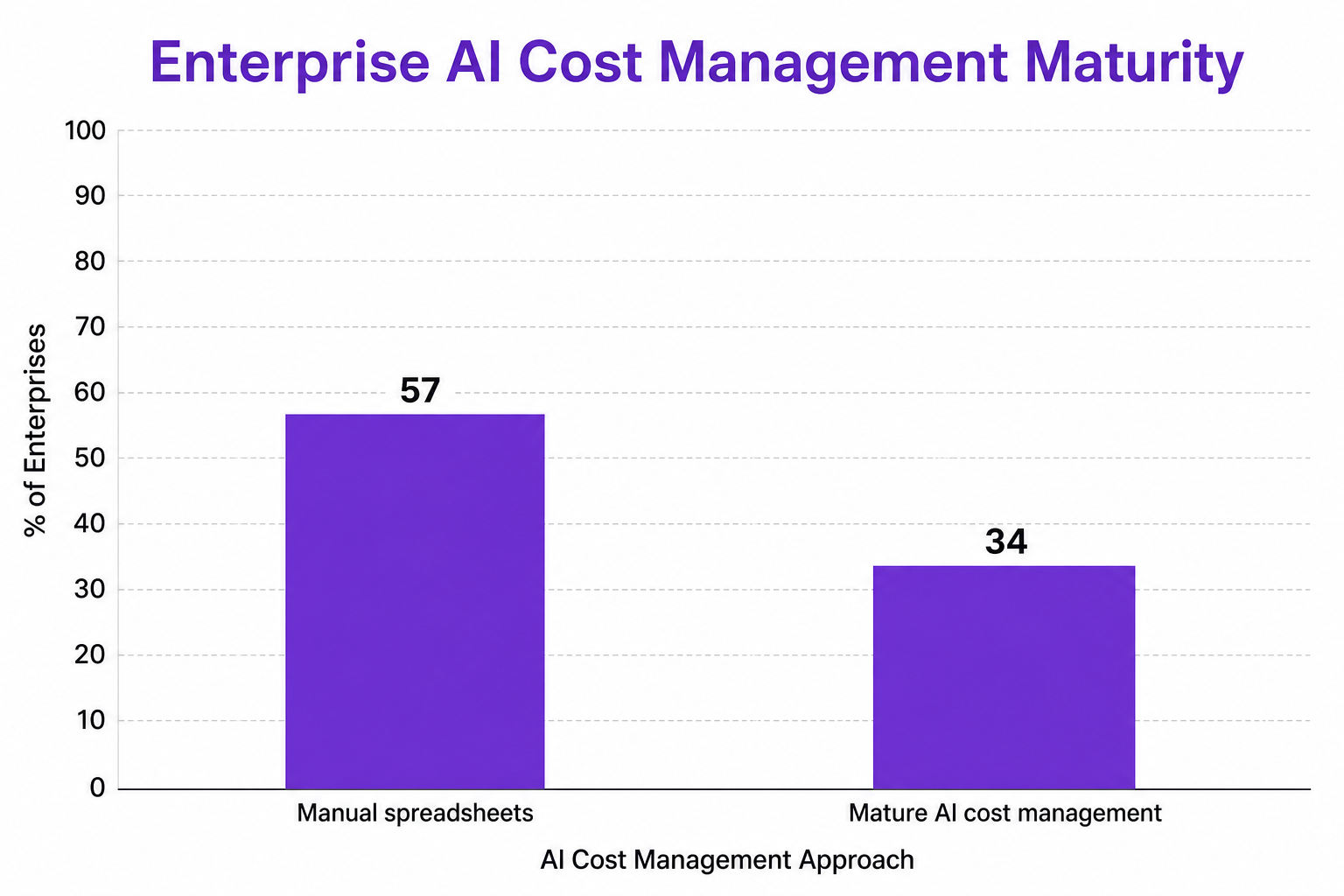
Scaling from manual tracking (currently 57% rely on spreadsheets) to mature AI cost management (already 34% have adopted advanced solutions)
Predictive modeling for total cost of ownership, going beyond upfront expenses to include infrastructure, pipelines, and ongoing support
Chargeback and accountability; ensuring teams pay for what they use, motivating better consumption choices
Budgets for AI are set to expand: 86% of enterprises expect higher AI budgets in 2026, with global AI spend projected to reach $2.59 trillion, a steep 47% YoY increase.
CloudNuro gives enterprises the toolkit needed to:
Eliminate end-of-quarter budget surprises with unified chargeback and rolling forecasts
Enforce spend thresholds automatically and receive dynamic alerts if workloads exceed policies
Gain full spend visibility across 400+ application integrations, from tokens and API calls to license fees
Empower both IT and Finance teams with a common platform for modeling, reporting, and decision-making
CloudNuro’s value pillars, cost optimization, real-time governance, and compliance, are purpose-built for enterprise-scale FinOps and AI cost control. As AI moves from pilot project to board-level priority, CloudNuro ensures organizations retain visibility and control every step of the way.
What is AI spend forecasting?
AI spend forecasting uses automation and predictive analytics to estimate future AI and cloud-related costs. It relies on live usage data and historical trends to help organizations proactively manage budgets, flag anomalies, and optimize allocations.
How can enterprises use AI for cost prediction?
Enterprises leverage platforms like CloudNuro to ingest multi-source data, model different usage scenarios, and receive real-time alerts. This enables accurate predictions about future consumption and budget impacts, reducing overruns and waste.
What are the benefits of AI-driven spend forecasting?
Benefits include improved accuracy of budget forecasts, faster reaction to spending anomalies, reduced operational waste, greater financial discipline, and tighter compliance with internal policies. Automated AI forecasting reduces average budget overruns significantly.
How does FinOps relate to AI forecasting?
FinOps provides the framework for transparent, accountable management of cloud and AI costs. AI forecasting tools automate and enhance FinOps, giving teams real-time insights, policy enforcement, and detailed allocation reporting.
What trends are shaping enterprise AI budget strategies by 2026?
Key trends include a shift to dynamic rolling forecasts, adoption of AI integration for true-up and chargeback, prioritizing total cost of ownership modeling, and making AI a standard budget line item across departments.
By 2026, AI spend forecasting will be a defining characteristic of enterprise IT and finance departments. Competitive organizations are acting now, investing in integrated platforms and processes that connect usage to budget, boost accountability, and create a foundation for future growth.
CloudNuro leads this evolution, delivering the cost optimization, visibility, and governance capabilities enterprises need to master AI-enabled FinOps. Embrace AI forecasting, not just to manage costs, but to gain an operational edge where every dollar counts.
About CloudNuro
CloudNuro is a leader in Enterprise AI Adoption Management, providing enterprises with unmatched visibility, governance, and cost optimization. Recognized twice in a row in the SaaS Management Platforms category and named a Leader in the SoftwareReviews Data Quadrant, CloudNuro is trusted by global enterprises and government agencies to bring financial discipline to SaaS, cloud, and AI. Trusted by enterprises, CloudNuro provides centralized SaaS inventory, license optimization, and renewal management along with advanced cost allocation and chargeback, giving IT and Finance leaders the visibility, control, and cost-conscious culture needed to drive financial discipline.
Request a no cost, no obligation free assessment —just 15 minutes to savings!
Get StartedBy 2026, a striking 78% of enterprises are projected to rely on AI for cost prediction and spend forecasting. This surge reflects an urgent need to govern rapidly expanding cloud and SaaS investments, instill financial discipline, and keep unforeseen expenses in check. It is not simply about budgeting smarter, it is about staying competitive as AI adoption continues to transform IT operations, finance, and governance at scale.
AI spend forecasting sits at the heart of this revolution. As complexity and consumption-based models introduce new risks, organizations are embracing FinOps strategies powered by automation, scenario modeling, and integrated cost intelligence. The payoff? Greater visibility, tighter control, sharper compliance, and real cost savings.
This blog demystifies AI spend forecasting, illustrates how enterprises wield it for budgetary precision, and unpacks why CloudNuro leads in this critical domain.
Recent statistics lay bare the challenge:
79% of enterprises faced AI cost overruns in the past year.
85% systematically misestimate AI costs during planning.
56% miss cost forecasts by 11% to 25%, and 24% overshoot by more than 50%.
AI now accounts for over 10% of the IT budget in 28% of organizations.
The root? Traditional budgeting methods, annual cycles, manual spreadsheets, and static forecasts, no longer work for AI, where usage patterns shift by the week, pricing is dynamic, and new workloads emerge overnight. Inferring costs from last year’s run rates does not reflect modern, usage-driven contracts or fast-shifting business demands.
Enterprises no longer view AI as just a line item for experimentation. It is a core function of digital transformation. Driver-based financial modeling is gaining prominence, tying AI spend forecasts directly to tangible business drivers such as document volumes, API calls, or user growth.
Organizations are abandoning static forecasts for dynamic rolling forecasts. These blend real-time usage with scenario modeling, allowing teams to adjust assumptions, react to consumption spikes, and plan for change. Financial leaders, in parallel, increasingly demand:
Granular visibility into where AI investments go
Proactive alerts on abnormal spend
Compliance with allocation policies
Unbudgeted expenses spiral, blindsiding finance teams
Shadow IT emerges as teams deploy their own AI tools
Overprovisioning results in waste; underprovisioning risks innovation slowdowns
Proof points underline this urgency:
One major enterprise reduced licensing waste by 55% and reclaimed 1,700 unused licenses, saving 300 operational hours annually
A healthcare technology provider cut unbudgeted expenses by 22% and completely eliminated shadow IT AI spend within three quarters
AI spend forecasting merges live SaaS and cloud usage data with machine learning models that adapt to real-world consumption. The process typically involves:
Ingesting multi-source usage and billing data. AI spending is rarely centralized; real-time visibility across platforms is crucial.
Pattern identification and cost prediction. Predictive analytics learns from historic trends, seasonality, and contract terms to estimate future expenses.
Scenario modeling. Teams simulate what-if scenarios, e.g., "What if our token usage doubles next quarter?", and instantly see how budgets respond.
Automated governance and alerts. Systems trigger warnings or throttle workloads if costs breach set thresholds, keeping spend aligned to policy.
Organizations using automated AI forecasting approaches reduced average budget overruns from roughly 17% to about 6%.
A multinational financial services firm implemented real-time AI monitoring tools, pushing unforeseen service charges to near zero.
Since inference costs represent 85% of AI budget expenses, targeted tracking and right-sizing make a measurable difference.
FinOps, a proven framework for cloud cost management, is evolving to encompass AI’s unique challenges. FinOps for AI means making spending transparent, driving accountability, and enabling rapid course-correction, all powered by deep automation.
Key market trends shaping this evolution:
Real-time cost intelligence: Companies are shifting from broad-strokes budgeting to proactive, scenario-driven FinOps strategies.
Governance-first approach: Automated policy enforcement and visibility are now the baseline, not the bonus.
Integration: Unified dashboards pull data from more than 400 applications; linking spend forecasts to actionable drivers is a focus area.
CloudNuro’s Solution: CloudNuro delivers rolling forecasts that blend live spending data and predictive modeling, enabling IT and finance teams to spot variance, adjust plans, and enforce policy in a unified workflow. Automated chargeback, unified reconciliation, and custom rules ensure cost allocation without the overhead of manual spreadsheets.
A persistent challenge is the "black box" effect, AI costs are scattered across departments, projects, and procurement cycles.
CloudNuro addresses this by:
Unifying spend data from AI platforms, SaaS tools, and cloud providers
Surfacing granular detail on token, API, and seat/license consumption
Allowing what-if analyses tied to licensing, pricing, and operational scale
Enabling proactive, rules-driven policy enforcement for compliance
For example: Medical societies using CloudNuro cut resource waste by 27% with automated reporting. Platform integration with Microsoft 365 Custodian and Salesforce Custodian reveals and rightsizes underutilized AI-related licenses in real time.
The next two years will cement AI-driven spend forecasting as a critical discipline. Key drivers include:
Scaling from manual tracking (currently 57% rely on spreadsheets) to mature AI cost management (already 34% have adopted advanced solutions)
Predictive modeling for total cost of ownership, going beyond upfront expenses to include infrastructure, pipelines, and ongoing support
Chargeback and accountability; ensuring teams pay for what they use, motivating better consumption choices
Budgets for AI are set to expand: 86% of enterprises expect higher AI budgets in 2026, with global AI spend projected to reach $2.59 trillion, a steep 47% YoY increase.
CloudNuro gives enterprises the toolkit needed to:
Eliminate end-of-quarter budget surprises with unified chargeback and rolling forecasts
Enforce spend thresholds automatically and receive dynamic alerts if workloads exceed policies
Gain full spend visibility across 400+ application integrations, from tokens and API calls to license fees
Empower both IT and Finance teams with a common platform for modeling, reporting, and decision-making
CloudNuro’s value pillars, cost optimization, real-time governance, and compliance, are purpose-built for enterprise-scale FinOps and AI cost control. As AI moves from pilot project to board-level priority, CloudNuro ensures organizations retain visibility and control every step of the way.
What is AI spend forecasting?
AI spend forecasting uses automation and predictive analytics to estimate future AI and cloud-related costs. It relies on live usage data and historical trends to help organizations proactively manage budgets, flag anomalies, and optimize allocations.
How can enterprises use AI for cost prediction?
Enterprises leverage platforms like CloudNuro to ingest multi-source data, model different usage scenarios, and receive real-time alerts. This enables accurate predictions about future consumption and budget impacts, reducing overruns and waste.
What are the benefits of AI-driven spend forecasting?
Benefits include improved accuracy of budget forecasts, faster reaction to spending anomalies, reduced operational waste, greater financial discipline, and tighter compliance with internal policies. Automated AI forecasting reduces average budget overruns significantly.
How does FinOps relate to AI forecasting?
FinOps provides the framework for transparent, accountable management of cloud and AI costs. AI forecasting tools automate and enhance FinOps, giving teams real-time insights, policy enforcement, and detailed allocation reporting.
What trends are shaping enterprise AI budget strategies by 2026?
Key trends include a shift to dynamic rolling forecasts, adoption of AI integration for true-up and chargeback, prioritizing total cost of ownership modeling, and making AI a standard budget line item across departments.
By 2026, AI spend forecasting will be a defining characteristic of enterprise IT and finance departments. Competitive organizations are acting now, investing in integrated platforms and processes that connect usage to budget, boost accountability, and create a foundation for future growth.
CloudNuro leads this evolution, delivering the cost optimization, visibility, and governance capabilities enterprises need to master AI-enabled FinOps. Embrace AI forecasting, not just to manage costs, but to gain an operational edge where every dollar counts.
About CloudNuro
CloudNuro is a leader in Enterprise AI Adoption Management, providing enterprises with unmatched visibility, governance, and cost optimization. Recognized twice in a row in the SaaS Management Platforms category and named a Leader in the SoftwareReviews Data Quadrant, CloudNuro is trusted by global enterprises and government agencies to bring financial discipline to SaaS, cloud, and AI. Trusted by enterprises, CloudNuro provides centralized SaaS inventory, license optimization, and renewal management along with advanced cost allocation and chargeback, giving IT and Finance leaders the visibility, control, and cost-conscious culture needed to drive financial discipline.
Request a no cost, no obligation free assessment - just 15 minutes to savings!
Get StartedWe're offering complimentary ServiceNow license assessments to only 25 enterprises this quarter who want to unlock immediate savings without disrupting operations.
Get Free AssessmentGet Started




CloudNuro Corp
1755 Park St. Suite 207
Naperville, IL 60563
Phone : +1-630-277-9470
Email: info@cloudnuro.com





.webp)

Recognized Leader in SaaS Management Platforms by Info-Tech SoftwareReviews


.svg)