

Sign Up
Thank you for Submitting!
With the meteoric rise of AI-enabled SaaS products, executives are sharpening their focus on understanding the true economics of their AI offerings. Unlike classic subscription models, AI features often carry unpredictable, usage-based costs that directly impact profitability. For enterprises, accurately calculating the cost-per-customer for AI features is vital for effective budgeting, pricing, and sustained ROI.
AI has transformed SaaS from static subscription services to dynamic, outcome-driven platforms where costs scale with customer usage. Today, a single customer can rapidly shift from being highly profitable to eroding margins, simply based on their frequency of AI interactions. With AI-first B2B SaaS gross margins trending between 50% and 60% (much lower than traditional SaaS margins of 80.90%), misjudging unit economics can spell disaster for even the most innovative offerings.
Achieving control and transparency requires a new approach to financial governance. Enterprises are moving away from fixed subscription pricing for AI workloads and embracing granular cost tracking, automated chargeback, and continuous optimization to maintain economic health amid hyper-variable demand.
AI unit economics refers to the cost structure and profitability of delivering specific AI features to each customer or user. It answers the critical question: "What does it actually cost us to deliver this AI-powered experience, and how does that cost scale as feature adoption grows?"
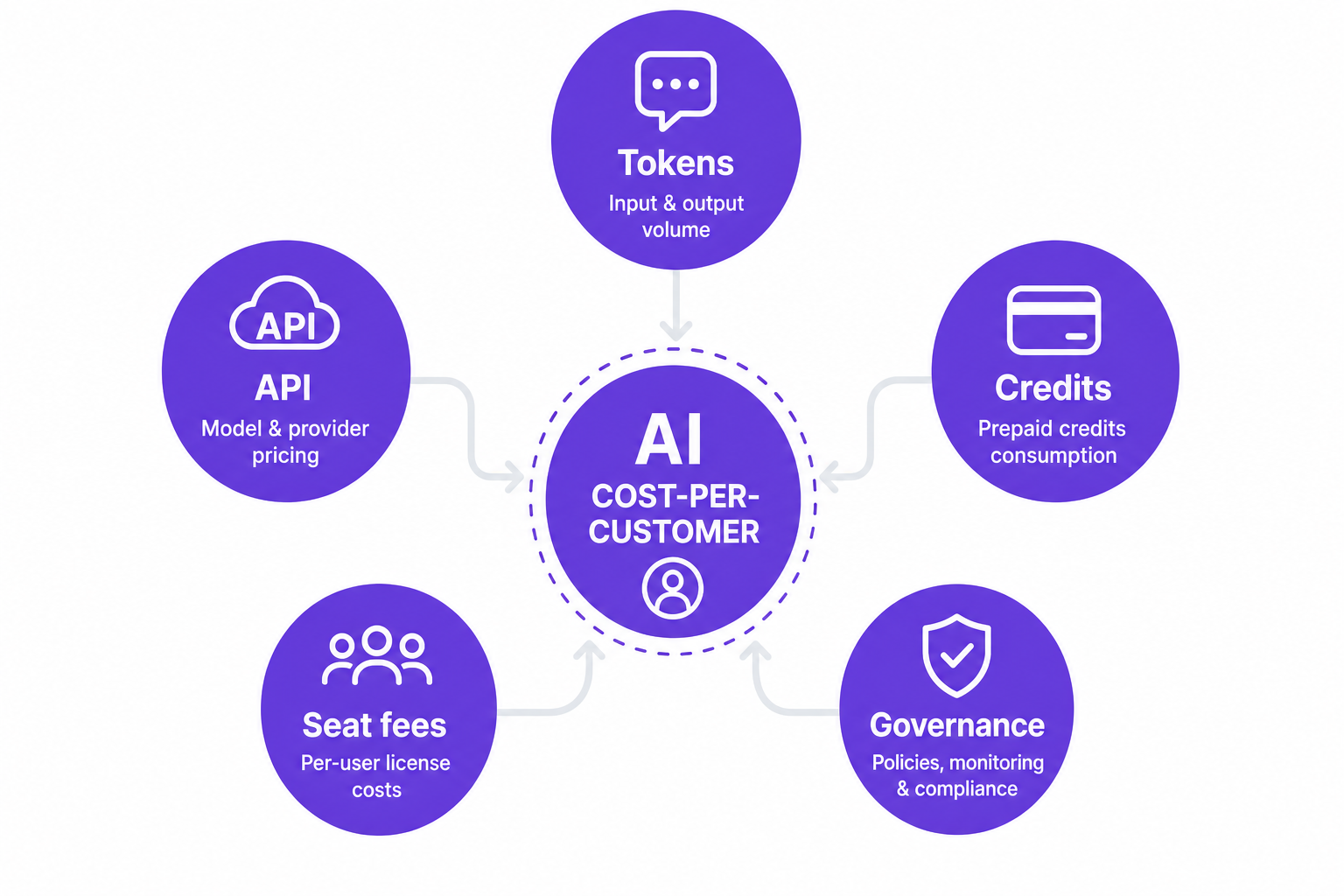
Compared to classic SaaS, where fixed costs are spread across a user base, AI features introduce a complex bundle of variable costs, including:
Token and API call charges from LLM providers and cloud AI services
Platform credits and support fees
License or seat fees for advanced AI modules
Hidden operational costs of monitoring, compliance, and governance
To reveal the true cost-per-customer for AI features, organizations should map actual usage data against invoiced costs, rather than relying on rough estimates or blended averages. Expert insights stress the importance of segmenting users by actual consumption tiers, since heavy users can dramatically skew profitability models.
Here's a practical approach:
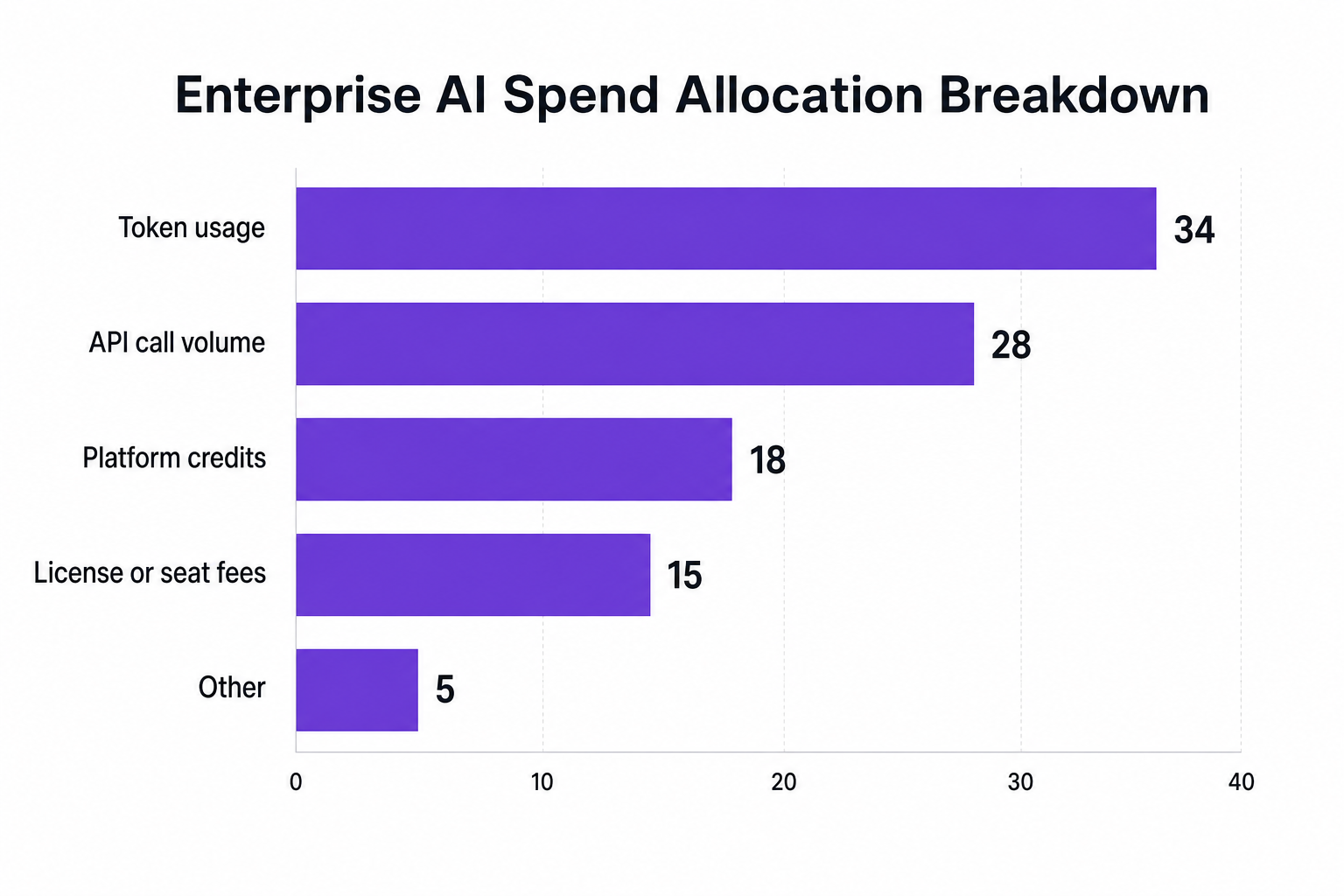
Token Usage: Track the exact number of tokens or inference units processed by each customer. Token usage now accounts for up to 34% of enterprise AI spend.
API Call Volume: Each interaction, query, or completed job via external or internal AI APIs drives incremental cost (28% of total spend).
Platform Credits & License Fees: These fixed costs provide the baseline, but often represent less than 20% of total spend in optimized environments.
Operational Overhead: Compliance monitoring, governance, data security, and chargeback efforts become more significant as usage scales.
Healthy AI feature cost per monthly active user (MAU): $0.10. $0.30 (optimized), up to $0.50 (acceptable ceiling)
LLM costs should remain below 15%. 20% of total revenue for viable margins
Several factors directly affect the marginal cost of AI features per user:
1. Model Complexity and Routing: Dynamically routing simple requests to smaller models, and reserving premium models for complex reasoning, optimizes cost efficiency.
2. User Segment Behavior: Light users cost less; power users can flip a profitable customer relationship into a loss unless segmented and managed.
3. Prompt Reuse and Caching: Proactive caching and prompt reuse architectures can lower API call loads by more than 90% in mature deployments.
4. Vendor Pricing Dynamics: LLM providers' token pricing, tiered volume discounts, and support levels all shift real per-customer cost curves.
AI-first SaaS platforms often see COGS (cost of goods sold) approach 40% to 50% or more of revenue, due to variable AI workloads. To drive durable profitability:
Keep per-feature AI costs tightly benchmarked to MAU cohorts
Monitor and enforce strict budget limits at project or user level
Assess and optimize margin using real data, not projections
A healthy AI gross margin depends on governance: regular audits, tight access control, and outcome-based budgeting foster a culture of accountability and transparency.
Getting control of AI unit economics demands more than manual tracking:
Automated Platforms: Solutions like CloudNuro centralize AI usage, cost breakdown, and governance. Finance and IT teams gain real-time, detailed dashboards of token usage, API expenditure, and per-feature cost analysis.
Chargeback Workflows: Automatically map costs to users, departments, or projects, supporting split-billing and transparent internal chargebacks.
Budget Limit Enforcement: Set and enforce granular spend thresholds at the project, team, or even individual user level. CloudNuro AI Custodian and Chargeback modules allow organizations to enforce token spending policies and instantly flag anomalies.
Cost Allocation and Reporting: Sync with identity providers for dynamic mapping and create periodical consumption reports with GL-level granularity, eliminating manual reconciliation.
Outcome-Based Pricing Models: Tie costs and pricing to business value or realized savings, rather than blanket subscriptions.
Visibility: CloudNuro’s AI Governance dashboard delivers precise, agent-level cost breakdowns, displaying token usage, financial cost, and historical consumption patterns. all in one view.
Governance: The platform flags potential misuse or compliance violations, ensuring spending aligns with policy and regulatory requirements.
Optimization: Automated chargeback and integration with 400+ apps mean every dollar spent on AI is tracked, justified, and reportable.
Proof Points:
A large financial platform reduced budget overruns by 78% and scaled from 2 to 18 AI-powered features with enforceable limits using CloudNuro Chargeback and AI Custodian.
A SaaS leader cut monthly AI spend by 63% while tripling shipped features by adopting per-feature budgeting and strict model routing.
Typical CloudNuro clients unlock 20%. 30% immediate savings, with a payback period averaging 1.5 months.
For more on optimizing your AI unit economics, explore CloudNuro's FinOps AI Unit Economics, AI Pricing Models, and Chargeback Methods.
What is AI unit economics?
AI unit economics is the cost and profit structure of delivering specific AI features to each customer. It highlights per-customer AI spend, including direct LLM/API usage, operations, and overhead.
How do you calculate AI cost per customer?
Calculate the sum of token usage, API call fees, license charges, and operational overhead mapped directly to each user’s actual activities. Use logs and invoices, not projections.
What impacts LLM unit cost in enterprise AI?
The main factors are model routing efficiency, customer segmentation, prompt reuse strategies, and vendor pricing terms.
How does AI gross margin affect SaaS profitability?
Lower margins (50. 60% for AI-first SaaS) mean per-feature costs must be tightly controlled and benchmarked to ensure sustainable profits.
What tools help with AI cost optimization?
Automated governance and cost allocation platforms like CloudNuro, which provide real-time analytics, chargeback enforcement, budget controls, and financial reporting.
As enterprise SaaS continues its evolution, so must its cost controls and governance frameworks. AI unit economics are fundamental to business success. not just for finance teams, but as a core competency for any company seeking to scale AI features responsibly. By combining granular cost tracking, automated chargeback, and continuous optimization, firms can confidently deliver innovative AI at scale while protecting gross margins and maximizing ROI.
CloudNuro empowers leaders to monitor, forecast, and optimize every dimension of their AI economics. driving a measurable culture of cost-conscious innovation.
About CloudNuro
CloudNuro is a leader in Enterprise AI Adoption Management, providing enterprises with unmatched visibility, governance, and cost optimization. Recognized twice in a row in the SaaS Management Platforms category and named a Leader in the SoftwareReviews Data Quadrant, CloudNuro is trusted by global enterprises and government agencies to bring financial discipline to SaaS, cloud, and AI. Trusted by enterprises, CloudNuro provides centralized SaaS inventory, license optimization, and renewal management along with advanced cost allocation and chargeback, giving IT and Finance leaders the visibility, control, and cost-conscious culture needed to drive financial discipline.
Request a no cost, no obligation free assessment —just 15 minutes to savings!
Get StartedWith the meteoric rise of AI-enabled SaaS products, executives are sharpening their focus on understanding the true economics of their AI offerings. Unlike classic subscription models, AI features often carry unpredictable, usage-based costs that directly impact profitability. For enterprises, accurately calculating the cost-per-customer for AI features is vital for effective budgeting, pricing, and sustained ROI.
AI has transformed SaaS from static subscription services to dynamic, outcome-driven platforms where costs scale with customer usage. Today, a single customer can rapidly shift from being highly profitable to eroding margins, simply based on their frequency of AI interactions. With AI-first B2B SaaS gross margins trending between 50% and 60% (much lower than traditional SaaS margins of 80.90%), misjudging unit economics can spell disaster for even the most innovative offerings.
Achieving control and transparency requires a new approach to financial governance. Enterprises are moving away from fixed subscription pricing for AI workloads and embracing granular cost tracking, automated chargeback, and continuous optimization to maintain economic health amid hyper-variable demand.
AI unit economics refers to the cost structure and profitability of delivering specific AI features to each customer or user. It answers the critical question: "What does it actually cost us to deliver this AI-powered experience, and how does that cost scale as feature adoption grows?"
Compared to classic SaaS, where fixed costs are spread across a user base, AI features introduce a complex bundle of variable costs, including:
Token and API call charges from LLM providers and cloud AI services
Platform credits and support fees
License or seat fees for advanced AI modules
Hidden operational costs of monitoring, compliance, and governance
To reveal the true cost-per-customer for AI features, organizations should map actual usage data against invoiced costs, rather than relying on rough estimates or blended averages. Expert insights stress the importance of segmenting users by actual consumption tiers, since heavy users can dramatically skew profitability models.
Here's a practical approach:
Token Usage: Track the exact number of tokens or inference units processed by each customer. Token usage now accounts for up to 34% of enterprise AI spend.
API Call Volume: Each interaction, query, or completed job via external or internal AI APIs drives incremental cost (28% of total spend).
Platform Credits & License Fees: These fixed costs provide the baseline, but often represent less than 20% of total spend in optimized environments.
Operational Overhead: Compliance monitoring, governance, data security, and chargeback efforts become more significant as usage scales.
Healthy AI feature cost per monthly active user (MAU): $0.10. $0.30 (optimized), up to $0.50 (acceptable ceiling)
LLM costs should remain below 15%. 20% of total revenue for viable margins
Several factors directly affect the marginal cost of AI features per user:
1. Model Complexity and Routing: Dynamically routing simple requests to smaller models, and reserving premium models for complex reasoning, optimizes cost efficiency.
2. User Segment Behavior: Light users cost less; power users can flip a profitable customer relationship into a loss unless segmented and managed.
3. Prompt Reuse and Caching: Proactive caching and prompt reuse architectures can lower API call loads by more than 90% in mature deployments.
4. Vendor Pricing Dynamics: LLM providers' token pricing, tiered volume discounts, and support levels all shift real per-customer cost curves.
AI-first SaaS platforms often see COGS (cost of goods sold) approach 40% to 50% or more of revenue, due to variable AI workloads. To drive durable profitability:
Keep per-feature AI costs tightly benchmarked to MAU cohorts
Monitor and enforce strict budget limits at project or user level
Assess and optimize margin using real data, not projections
A healthy AI gross margin depends on governance: regular audits, tight access control, and outcome-based budgeting foster a culture of accountability and transparency.
Getting control of AI unit economics demands more than manual tracking:
Automated Platforms: Solutions like CloudNuro centralize AI usage, cost breakdown, and governance. Finance and IT teams gain real-time, detailed dashboards of token usage, API expenditure, and per-feature cost analysis.
Chargeback Workflows: Automatically map costs to users, departments, or projects, supporting split-billing and transparent internal chargebacks.
Budget Limit Enforcement: Set and enforce granular spend thresholds at the project, team, or even individual user level. CloudNuro AI Custodian and Chargeback modules allow organizations to enforce token spending policies and instantly flag anomalies.
Cost Allocation and Reporting: Sync with identity providers for dynamic mapping and create periodical consumption reports with GL-level granularity, eliminating manual reconciliation.
Outcome-Based Pricing Models: Tie costs and pricing to business value or realized savings, rather than blanket subscriptions.
Visibility: CloudNuro’s AI Governance dashboard delivers precise, agent-level cost breakdowns, displaying token usage, financial cost, and historical consumption patterns. all in one view.
Governance: The platform flags potential misuse or compliance violations, ensuring spending aligns with policy and regulatory requirements.
Optimization: Automated chargeback and integration with 400+ apps mean every dollar spent on AI is tracked, justified, and reportable.
Proof Points:
A large financial platform reduced budget overruns by 78% and scaled from 2 to 18 AI-powered features with enforceable limits using CloudNuro Chargeback and AI Custodian.
A SaaS leader cut monthly AI spend by 63% while tripling shipped features by adopting per-feature budgeting and strict model routing.
Typical CloudNuro clients unlock 20%. 30% immediate savings, with a payback period averaging 1.5 months.
For more on optimizing your AI unit economics, explore CloudNuro's FinOps AI Unit Economics, AI Pricing Models, and Chargeback Methods.
What is AI unit economics?
AI unit economics is the cost and profit structure of delivering specific AI features to each customer. It highlights per-customer AI spend, including direct LLM/API usage, operations, and overhead.
How do you calculate AI cost per customer?
Calculate the sum of token usage, API call fees, license charges, and operational overhead mapped directly to each user’s actual activities. Use logs and invoices, not projections.
What impacts LLM unit cost in enterprise AI?
The main factors are model routing efficiency, customer segmentation, prompt reuse strategies, and vendor pricing terms.
How does AI gross margin affect SaaS profitability?
Lower margins (50. 60% for AI-first SaaS) mean per-feature costs must be tightly controlled and benchmarked to ensure sustainable profits.
What tools help with AI cost optimization?
Automated governance and cost allocation platforms like CloudNuro, which provide real-time analytics, chargeback enforcement, budget controls, and financial reporting.
As enterprise SaaS continues its evolution, so must its cost controls and governance frameworks. AI unit economics are fundamental to business success. not just for finance teams, but as a core competency for any company seeking to scale AI features responsibly. By combining granular cost tracking, automated chargeback, and continuous optimization, firms can confidently deliver innovative AI at scale while protecting gross margins and maximizing ROI.
CloudNuro empowers leaders to monitor, forecast, and optimize every dimension of their AI economics. driving a measurable culture of cost-conscious innovation.
About CloudNuro
CloudNuro is a leader in Enterprise AI Adoption Management, providing enterprises with unmatched visibility, governance, and cost optimization. Recognized twice in a row in the SaaS Management Platforms category and named a Leader in the SoftwareReviews Data Quadrant, CloudNuro is trusted by global enterprises and government agencies to bring financial discipline to SaaS, cloud, and AI. Trusted by enterprises, CloudNuro provides centralized SaaS inventory, license optimization, and renewal management along with advanced cost allocation and chargeback, giving IT and Finance leaders the visibility, control, and cost-conscious culture needed to drive financial discipline.
Request a no cost, no obligation free assessment - just 15 minutes to savings!
Get StartedWe're offering complimentary ServiceNow license assessments to only 25 enterprises this quarter who want to unlock immediate savings without disrupting operations.
Get Free AssessmentGet Started




CloudNuro Corp
1755 Park St. Suite 207
Naperville, IL 60563
Phone : +1-630-277-9470
Email: info@cloudnuro.com





.webp)

Recognized Leader in SaaS Management Platforms by Info-Tech SoftwareReviews

.svg)