
Sign Up
Thank you for Submitting!
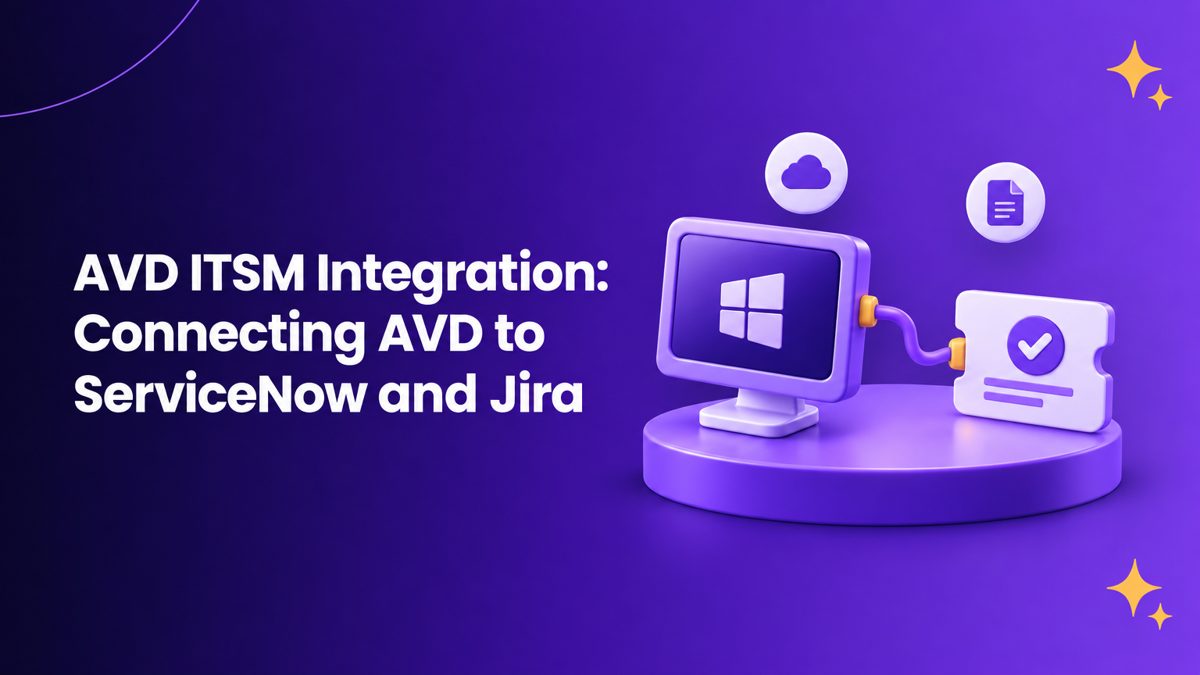
AVD ITSM integration connects Azure Virtual Desktop health signals to ServiceNow or Jira Service Management so that every session host failure becomes a tracked, owned ticket.
Microsoft began deprecating the legacy Azure Monitor ITSM actions for ServiceNow in September 2022, and since October 2023 the Azure portal no longer lets teams create those connector actions in the UI.
This guide covers the current reference architecture, field mapping for ServiceNow and Jira, deduplication and auto-resolve rules, and the license and cost governance layer most integrations leave out.
The integration path many teams built for Azure Virtual Desktop and ServiceNow is on a retirement track, and new builds need a different design.
An AVD ITSM integration routes session host, connection, and FSLogix profile alerts into the service desk, so outages are owned, tracked, and closed instead of discovered by end users.
End-user computing teams, service desk managers, and CIOs feel the gap first: alerts land in an inbox, tickets are opened by hand, and nobody can tie desktop incidents back to cost or license data.
The same fragmentation drives SaaS sprawl, which is why CloudNuro treats AVD, ITSM, and licensing as one governed estate, as described in its overview of SaaS management platforms.
This guide explains the reference architecture, shows how to connect ServiceNow and Jira step by step, and lists the mistakes that flood a service desk with duplicate tickets.
See how CloudNuro links ServiceNow and Jira to license and cost governance in one view.
Request a DemoAVD ITSM integration is the automated flow that turns Azure Virtual Desktop telemetry into incidents in an IT service management platform such as ServiceNow or Jira Service Management. Azure Monitor detects and routes, a Logic App orchestrates, automation remediates, and the ITSM tool manages the human lifecycle.
If you are still choosing the service desk itself, CloudNuro's comparison of IT service management tools covers the main platforms.
Every production design follows one chain: AVD signals, Azure Monitor alert rule, Action Group, Logic App, then ServiceNow or Jira.

Session host heartbeat and registration state, connection failures, login duration, VM CPU and memory, and FSLogix profile mount errors.
Use metric alerts for host health and resource thresholds, and Log Analytics scheduled-query alerts for event-driven conditions such as FSLogix failures.
The Action Group is the routing layer. Standardize on the Common Alert Schema so every downstream workflow parses one payload format.
The Logic App deduplicates, enriches the alert with host pool and subscription context, sets severity and assignment group, and optionally starts remediation.
The ITSM platform receives a create or update call, and the Logic App closes the record when Azure Monitor reports recovery.
Send host pool and session host diagnostics to one Log Analytics workspace. You know it worked when AVD Insights shows connection and host data for every pool.
Start with host unavailable, host pool below capacity buffer, repeated connection failures, and repeated FSLogix mount failures. Aggregate at the host pool level so one outage does not open one ticket per user.
For new builds, use a Logic App with the ServiceNow connector, or a secure webhook into ServiceNow Event Management. Treat the legacy ITSM action path as deprecated and migrate any existing actions.
Jira Service Management connects through a Logic App calling the Jira REST API. Use a narrowly scoped integration identity and store credentials in Azure Key Vault.
A ticket an engineer can act on carries the context below.
| Alert data | ServiceNow field | Jira field |
|---|---|---|
| Alert rule and severity | Short description, impact, urgency | Summary, priority |
| Host pool and session host | Configuration item | Component, labels |
| Subscription, resource group, region | Work notes | Environment |
| Environment (prod or dev) | Assignment group | Project, assignee team |
| Correlation ID | Correlation ID | Custom field or label |
| Log query link, remediation status | Work notes | Comment |
Correlate on alert rule, resource ID, and active state, then update the open record instead of creating a new one. Close the ticket automatically when Azure Monitor reports the alert as resolved.
Drain mode, VM restart, or reimage run as a separate branch with maintenance window and active session checks. A failed remediation must still open a ticket.
Get a free assessment of unused ServiceNow, Jira, and Microsoft licenses across your estate.
Get Free Savings AssessmentNew builds on a deprecated path need rework before they deliver value.
Solution: Use a Logic App or secure webhook from day one.
A single host pool outage can open dozens of duplicate incidents and bury the real one.
Solution: Correlate on resource ID and alert state, and aggregate at host pool level.
Without a cost center on the ticket, finance cannot see which departments drive desktop incidents and spend.
Solution: Tag host pools by cost center and carry the tag into the ticket, then feed it into your chargeback and showback strategy.
More automated tickets often bring more fulfiller seats, many of which go unused.
Solution: Review fulfiller usage before every renewal with license management software.
Ticket automation answers "what broke." It does not answer who owns the cost, which ServiceNow and Jira seats are idle, or which AVD users still hold licenses after they leave.
CloudNuro integrates with ServiceNow and Jira to identify unused fulfiller licenses and to create IT tickets for access requests, role changes, and deprovisioning, across its IT operations and IT asset management capabilities.
Enterprises with complex service operations can compare platforms in CloudNuro's guide to ITSM solutions for large enterprises.
Azure Virtual Desktop can create ServiceNow incidents automatically through Azure Monitor alerts routed to a Logic App or secure webhook. The Logic App creates, updates, and closes the incident as the alert changes state.
The Azure Monitor ITSM Connector's ServiceNow actions entered a three-year deprecation process in September 2022. Since October 2023 the portal no longer supports creating them in the UI, so new builds should use secure webhooks or Logic Apps.
AVD alerts connect to Jira Service Management through an Action Group that calls a Logic App, which then uses the Jira REST API. Jira automation can send status changes back to close or comment on the alert.
Duplicate AVD tickets stop when the Logic App correlates alerts on alert rule, resource ID, and active state, then updates the existing record. Aggregating alerts at host pool level removes most remaining noise.
The AVD alerts that should open a ticket are user-impacting ones: unavailable session hosts, host pools below capacity buffer, repeated connection failures, and repeated FSLogix profile failures. Resource threshold alerts can stay as notifications until they persist.
CloudNuro integrates with ServiceNow and Jira to identify unused fulfiller licenses and automate tickets for access requests, role changes, and deprovisioning. Learn more on the CloudNuro SaaS management page.
The legacy connector era is ending, and AVD ITSM integration now runs on Logic Apps, secure webhooks, and REST APIs.
Teams that only automate tickets still miss idle ITSM seats, unowned desktop costs, and stale access. The better model pairs incident automation with unified visibility and cost allocation across SaaS, cloud, and AI.
See how CloudNuro maps AVD, ITSM, and SaaS spend to owners and cost centers.
Request a DemoCloudNuro connects to ServiceNow and Jira to surface unused fulfiller licenses and to automate tickets for access, role changes, and deprovisioning. With 250+ integrations and SOC 2 Type II certification, it brings your desktop, ITSM, and SaaS spend into one governed view with chargeback by cost center.
CloudNuro is a leader in Enterprise AI Adoption Management, providing enterprises with unmatched visibility, governance, and cost optimization. Recognized twice in a row by Gartner in the SaaS Management Platforms and named a Leader in the Info-Tech SoftwareReviews Data Quadrant, CloudNuro is trusted by global enterprises and government agencies to bring financial discipline to SaaS, cloud, and AI. Trusted by enterprises, CloudNuro provides centralized SaaS inventory, license optimization, and renewal management along with advanced cost allocation and chargeback, giving IT and Finance leaders the visibility, control, and cost-conscious culture needed to drive financial discipline.
Request a no cost, no obligation free assessment —just 15 minutes to savings!
Get StartedAVD ITSM integration connects Azure Virtual Desktop health signals to ServiceNow or Jira Service Management so that every session host failure becomes a tracked, owned ticket.
Microsoft began deprecating the legacy Azure Monitor ITSM actions for ServiceNow in September 2022, and since October 2023 the Azure portal no longer lets teams create those connector actions in the UI.
This guide covers the current reference architecture, field mapping for ServiceNow and Jira, deduplication and auto-resolve rules, and the license and cost governance layer most integrations leave out.
The integration path many teams built for Azure Virtual Desktop and ServiceNow is on a retirement track, and new builds need a different design.
An AVD ITSM integration routes session host, connection, and FSLogix profile alerts into the service desk, so outages are owned, tracked, and closed instead of discovered by end users.
End-user computing teams, service desk managers, and CIOs feel the gap first: alerts land in an inbox, tickets are opened by hand, and nobody can tie desktop incidents back to cost or license data.
The same fragmentation drives SaaS sprawl, which is why CloudNuro treats AVD, ITSM, and licensing as one governed estate, as described in its overview of SaaS management platforms.
This guide explains the reference architecture, shows how to connect ServiceNow and Jira step by step, and lists the mistakes that flood a service desk with duplicate tickets.
See how CloudNuro links ServiceNow and Jira to license and cost governance in one view.
Request a DemoAVD ITSM integration is the automated flow that turns Azure Virtual Desktop telemetry into incidents in an IT service management platform such as ServiceNow or Jira Service Management. Azure Monitor detects and routes, a Logic App orchestrates, automation remediates, and the ITSM tool manages the human lifecycle.
If you are still choosing the service desk itself, CloudNuro's comparison of IT service management tools covers the main platforms.
Every production design follows one chain: AVD signals, Azure Monitor alert rule, Action Group, Logic App, then ServiceNow or Jira.
Session host heartbeat and registration state, connection failures, login duration, VM CPU and memory, and FSLogix profile mount errors.
Use metric alerts for host health and resource thresholds, and Log Analytics scheduled-query alerts for event-driven conditions such as FSLogix failures.
The Action Group is the routing layer. Standardize on the Common Alert Schema so every downstream workflow parses one payload format.
The Logic App deduplicates, enriches the alert with host pool and subscription context, sets severity and assignment group, and optionally starts remediation.
The ITSM platform receives a create or update call, and the Logic App closes the record when Azure Monitor reports recovery.
Send host pool and session host diagnostics to one Log Analytics workspace. You know it worked when AVD Insights shows connection and host data for every pool.
Start with host unavailable, host pool below capacity buffer, repeated connection failures, and repeated FSLogix mount failures. Aggregate at the host pool level so one outage does not open one ticket per user.
For new builds, use a Logic App with the ServiceNow connector, or a secure webhook into ServiceNow Event Management. Treat the legacy ITSM action path as deprecated and migrate any existing actions.
Jira Service Management connects through a Logic App calling the Jira REST API. Use a narrowly scoped integration identity and store credentials in Azure Key Vault.
A ticket an engineer can act on carries the context below.
| Alert data | ServiceNow field | Jira field |
|---|---|---|
| Alert rule and severity | Short description, impact, urgency | Summary, priority |
| Host pool and session host | Configuration item | Component, labels |
| Subscription, resource group, region | Work notes | Environment |
| Environment (prod or dev) | Assignment group | Project, assignee team |
| Correlation ID | Correlation ID | Custom field or label |
| Log query link, remediation status | Work notes | Comment |
Correlate on alert rule, resource ID, and active state, then update the open record instead of creating a new one. Close the ticket automatically when Azure Monitor reports the alert as resolved.
Drain mode, VM restart, or reimage run as a separate branch with maintenance window and active session checks. A failed remediation must still open a ticket.
Get a free assessment of unused ServiceNow, Jira, and Microsoft licenses across your estate.
Get Free Savings AssessmentNew builds on a deprecated path need rework before they deliver value.
Solution: Use a Logic App or secure webhook from day one.
A single host pool outage can open dozens of duplicate incidents and bury the real one.
Solution: Correlate on resource ID and alert state, and aggregate at host pool level.
Without a cost center on the ticket, finance cannot see which departments drive desktop incidents and spend.
Solution: Tag host pools by cost center and carry the tag into the ticket, then feed it into your chargeback and showback strategy.
More automated tickets often bring more fulfiller seats, many of which go unused.
Solution: Review fulfiller usage before every renewal with license management software.
Ticket automation answers "what broke." It does not answer who owns the cost, which ServiceNow and Jira seats are idle, or which AVD users still hold licenses after they leave.
CloudNuro integrates with ServiceNow and Jira to identify unused fulfiller licenses and to create IT tickets for access requests, role changes, and deprovisioning, across its IT operations and IT asset management capabilities.
Enterprises with complex service operations can compare platforms in CloudNuro's guide to ITSM solutions for large enterprises.
Azure Virtual Desktop can create ServiceNow incidents automatically through Azure Monitor alerts routed to a Logic App or secure webhook. The Logic App creates, updates, and closes the incident as the alert changes state.
The Azure Monitor ITSM Connector's ServiceNow actions entered a three-year deprecation process in September 2022. Since October 2023 the portal no longer supports creating them in the UI, so new builds should use secure webhooks or Logic Apps.
AVD alerts connect to Jira Service Management through an Action Group that calls a Logic App, which then uses the Jira REST API. Jira automation can send status changes back to close or comment on the alert.
Duplicate AVD tickets stop when the Logic App correlates alerts on alert rule, resource ID, and active state, then updates the existing record. Aggregating alerts at host pool level removes most remaining noise.
The AVD alerts that should open a ticket are user-impacting ones: unavailable session hosts, host pools below capacity buffer, repeated connection failures, and repeated FSLogix profile failures. Resource threshold alerts can stay as notifications until they persist.
CloudNuro integrates with ServiceNow and Jira to identify unused fulfiller licenses and automate tickets for access requests, role changes, and deprovisioning. Learn more on the CloudNuro SaaS management page.
The legacy connector era is ending, and AVD ITSM integration now runs on Logic Apps, secure webhooks, and REST APIs.
Teams that only automate tickets still miss idle ITSM seats, unowned desktop costs, and stale access. The better model pairs incident automation with unified visibility and cost allocation across SaaS, cloud, and AI.
See how CloudNuro maps AVD, ITSM, and SaaS spend to owners and cost centers.
Request a DemoCloudNuro connects to ServiceNow and Jira to surface unused fulfiller licenses and to automate tickets for access, role changes, and deprovisioning. With 250+ integrations and SOC 2 Type II certification, it brings your desktop, ITSM, and SaaS spend into one governed view with chargeback by cost center.
CloudNuro is a leader in Enterprise AI Adoption Management, providing enterprises with unmatched visibility, governance, and cost optimization. Recognized twice in a row by Gartner in the SaaS Management Platforms and named a Leader in the Info-Tech SoftwareReviews Data Quadrant, CloudNuro is trusted by global enterprises and government agencies to bring financial discipline to SaaS, cloud, and AI. Trusted by enterprises, CloudNuro provides centralized SaaS inventory, license optimization, and renewal management along with advanced cost allocation and chargeback, giving IT and Finance leaders the visibility, control, and cost-conscious culture needed to drive financial discipline.
Request a no cost, no obligation free assessment - just 15 minutes to savings!
Get StartedWe're offering complimentary ServiceNow license assessments to only 25 enterprises this quarter who want to unlock immediate savings without disrupting operations.
Get Free AssessmentGet Started




CloudNuro Corp
1755 Park St. Suite 207
Naperville, IL 60563
Phone : +1-630-277-9470
Email: info@cloudnuro.com







Recognized Leader in SaaS Management Platforms by Info-Tech SoftwareReviews