

Sign Up
Thank you for Submitting!
Chief Information Officers and computing operations leaders face a modern paradox. As organizations embrace artificial intelligence to accelerate productivity, the underlying infrastructure costs threaten to erase the financial benefits of these innovations. Enterprise deployments of Retrieval-Augmented Generation architectures empower knowledge workers by combining vast enterprise data repositories with advanced generative capabilities. Unfortunately, scaling these solutions introduces immense financial friction. API spending for enterprise models doubled over a six-month period to reach 8.4 billion dollars globally. For corporate IT teams spanning the healthcare, finance, and government sectors, identifying actionable RAG cost optimization strategies is priority number one. Without comprehensive governance, organizations risk continuous cost leakage across compute workloads, storage implementations, and token charges. Building a sustainable artificial intelligence application requires an operational mindset that prioritizes continuous expense reduction at every layer of the technology stack. We will explore the critical levers technology leaders utilize to bring financial discipline to enterprise LLM budget optimization initiatives.
To effectively execute AI cost saving techniques, operations leaders must first understand the primary RAG pipeline cost factors. Artificial intelligence applications do not rely on a single monolithic step. They string together complex workflows involving data embedding, vector storage searching, semantic reranking, and ultimately text generation. Every step requires bespoke computational resources, and each API call pulls incrementally from departmental budgets. It is a well-established finding that 40 to 60 percent of LLM budgets are wasted on inefficiencies like over-long contexts, poor routing, and redundant calls.
Understanding the financial scale requires examining foundational metrics. Operating costs for a 100,000 queries per day generation system can be reduced by 40 to 46 percent following optimization. Finding these savings begins by isolating where the money goes. Baseline monthly costs for such a high-volume system total approximately 19,460 dollars.
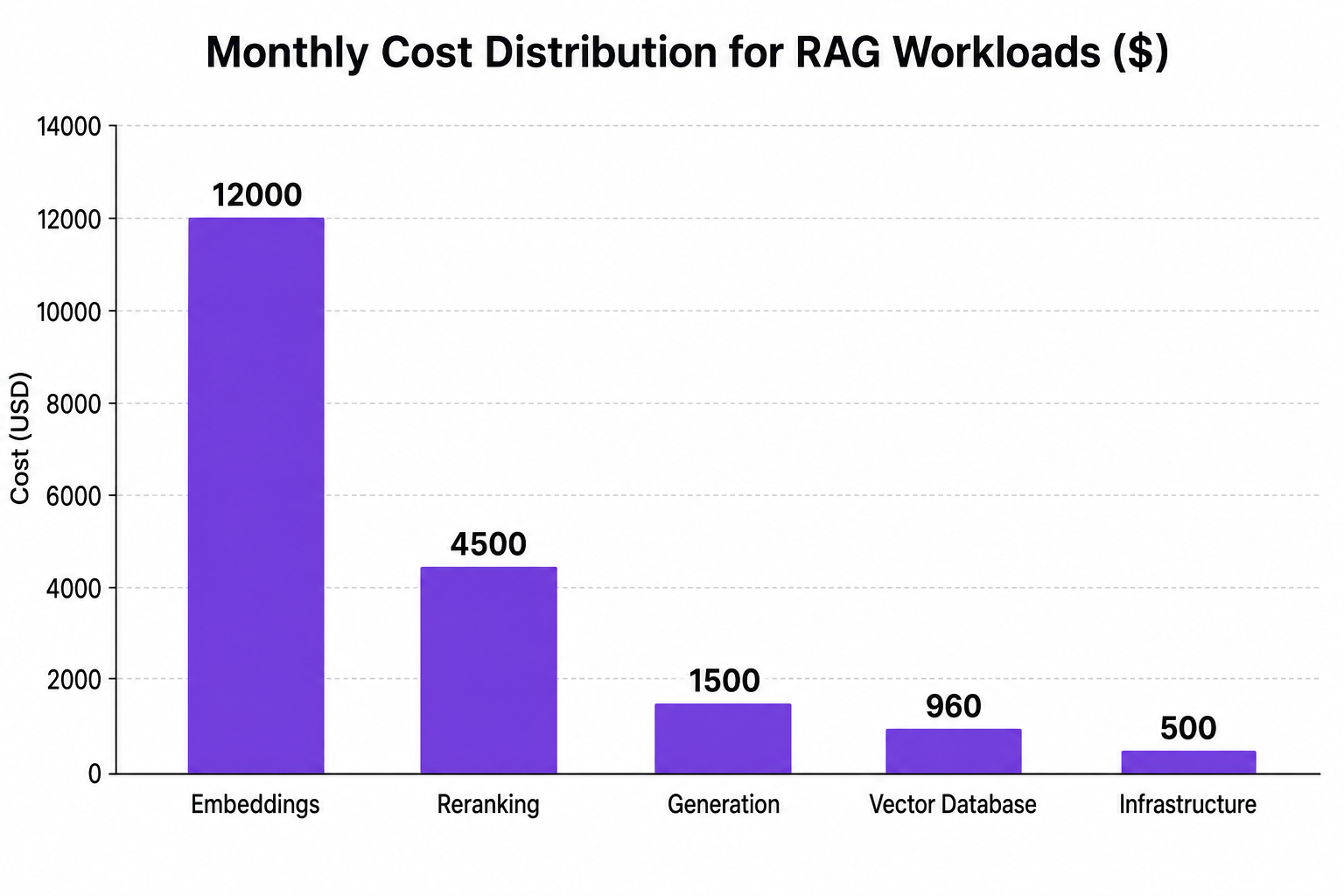
This breakdown exposes a critical insight. Embeddings drive 12,000 dollars of the expenditure, reranking accounts for 4,500 dollars, generation uses 1,500 dollars, the vector database consumes 960 dollars, and general infrastructure requires roughly 500 dollars. Contrary to popular belief, token generation is rarely the dominant expense in a mature corporate environment. Vector databases and embedding generation processes often account for 60 to 70 percent of total infrastructure costs across many production systems. Recognizing these drivers is the first practical step toward meaningful vector database expense reduction and holistic RAG inference cost reduction.
Organizations frequently default to utilizing the largest and most capable generative platforms for every query. This approach guarantees high-quality responses but creates structural inefficiencies. Implementing a tiered model routing strategy to classify queries by complexity can reduce overall expenses by 60 to 80 percent while keeping quality completely acceptable.
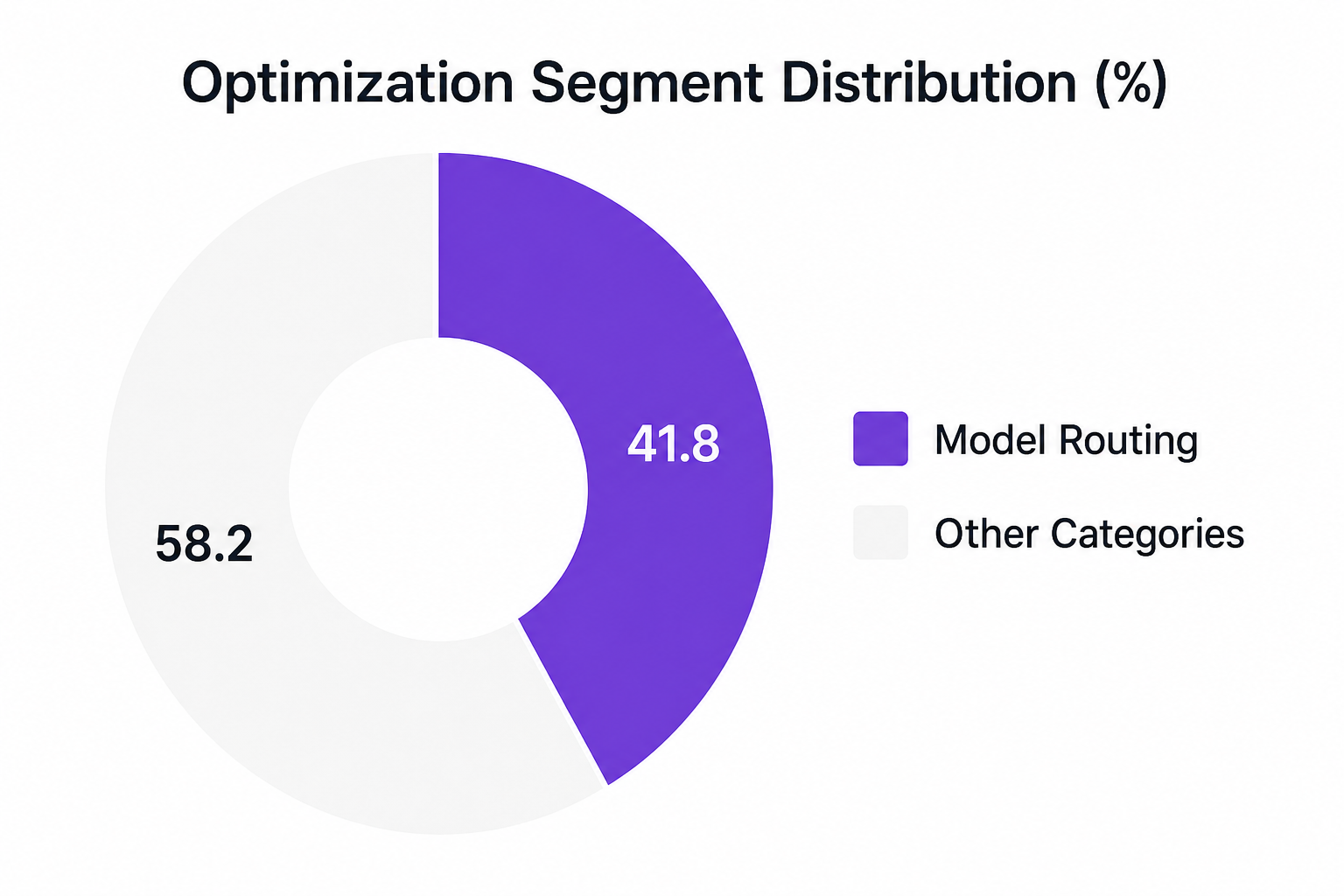
Cost optimization is emerging as a dedicated tooling category featuring gateways, routing engines, and control layers designed to rein in API spend. In fact, model selection and routing capabilities represent a 41.8 percent share of the optimization market.
By analyzing incoming requests, an intelligent routing layer determines if a standard customer interaction requires advanced reasoning or simple factual extraction. Organizations are increasingly leveraging smaller specialist models and fine-tuning them to replace expensive general-purpose models for routine tasks. Directing basic interactions to smaller computational models slashes inference cost control barriers almost immediately. The language model cost optimization market is forecast to grow at a 26.7 percent compound annual growth rate, driven significantly by large organizations adopting these exact tiered architectures to sustain enterprise RAG cost best practices.
Effective LLM prompt efficiency directly impacts the bottom line. Prompt engineering for cost involves structuring input interactions to utilize the lowest possible token count required to achieve successful model behavior. It is vital to remember that every character sent to the model API contributes to enterprise API bills. Compression and summarization pipelines are transitioning from optional strategies to standard practices in retrieval deployments to minimize context payloads.
Compressing conversation and retrieval context before generation yields 20 to 40 percent savings on input tokens. When operations leaders enforce prompt compression, they systematically shrink the data footprint required for the model to understand the user's intent. Query filtering for savings is another highly effective tactic. Instead of retrieving and passing thirty potentially relevant documents to the application, advanced retrieval API efficiency mechanisms evaluate metadata to restrict the knowledge base payload to only the top three highly relevant blocks.
Reducing the embedding dimensions from 1536 to 512 parameters can cut overall storage requirements by 66 percent. These combined actions ensure cost-aware RAG workflows limit the ingestion size, translating directly into both memory and compute savings over continuous operational lifecycles.
One of the highest yield large language model tuning methodologies requires no model adjustments at all. Caching repeated answers drastically lowers RAG infrastructure costs by bypassing the generation sequence altogether.
When users ask variations of the same procedural questions or generic industry queries, processing the full retrieval and generation loop represents pure redundant waste. Semantic caching leverages a rapid search of localized short-term memory to see if the current prompt conceptually matches a previously answered prompt. If a match occurs, the application instantly returns the cached answer.
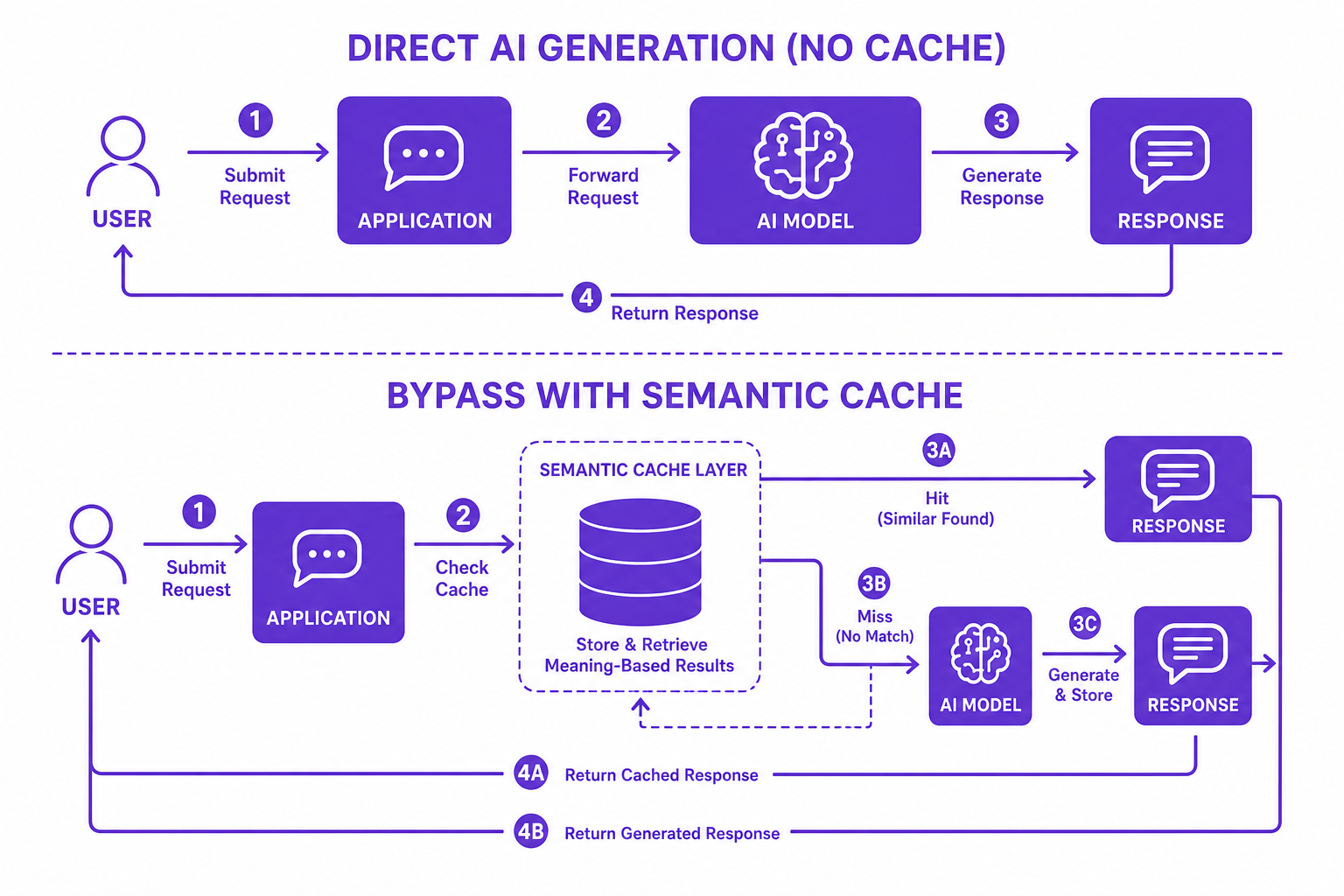
Analytics reveal that semantic caching can achieve a 98.5 percent hit rate and contribute to an 85.8 percent reduction in total costs at 10,000 daily requests. The method bypasses token calculation rates entirely and facilitates low-latency RAG delivery. Operations leaders see massive improvements in user application speed alongside immense expense reductions. Understanding the dynamic of RAG vs cache architectures is fundamental to comprehensive FinOps Services for AI workloads, ensuring that organizations do not repeatedly pay for knowledge they have already synthesized.
Beyond algorithmic updates and pipeline modifications, systemic AI application cost governance dictates long-term success. Expanding computational deployments creates untracked infrastructure instances, unused developmental endpoints, and unutilized software licenses. Production LLM cost management demands complete visibility across software as a service and cloud provider domains.
CloudNuro delivers AI-enabled SaaS and cloud management to organizations looking to optimize costs and govern usage at scale. The platform brings financial discipline to complex AI initiatives. CloudNuro’s FinOps Services deliver complete visibility across cloud infrastructure supporting complex generation models, enabling rapid identification of unutilized compute or vector matching resources to control overall expenses.
An enterprise organization eliminated multi-account cloud sprawl to achieve 27 percent savings from unutilized resources and executed recommendations with 42 percent efficiency through detailed operational governance. By utilizing entitlement hygiene workflows, another customer marked over 500 inactive communication platform licenses for immediate recovery, ensuring continuous savings. A separate client rationalized access identities and recovered inactive seats to secure a 25 percent savings on collaboration software renewals while realizing a 26 percent efficiency gain in user rightsizing.
CloudNuro maps workload consumption to departmental budgets using automated chargebacks, ensuring retrieval pipelines and API expenditures do not cause organizational budget overruns. The platform's automated usage analytics establish comprehensive application visibility to improve renewal accuracy and align compute resources based on actual consumption. Continuous compliance workflows enforce governance without limiting scalable infrastructure deployments, preventing architectural sprawl during rapid deployment scaling.
When IT organizations adopt a centralized orchestration platform, they inherently correct misaligned resources. The FinOps Services platform from CloudNuro provides operational analytics for multi-cloud environments, surfacing idle capacity and optimization opportunities for computational resources. Governance-first architectures ensure compliance even during rapid AI scaling. Entitlement intelligence identifies inactive identities and rogue accounts to eliminate recurring cost leakage across the technology stack.
By utilizing seamless integrations with over 400 applications, data sources, and cloud providers, enterprises effortlessly track computational spend directly back to the responsible business units. This precise allocation strategy changes the internal conversation. Department heads suddenly have actionable insights into how much their AI applications actually cost compared to the value generated for the enterprise. CloudNuro ensures robust security and compliance standards remain intact while deploying advanced cost management solutions tailored to the organizational technology footprint.
What are the most effective strategies for RAG cost optimization?
Effective RAG infrastructure reduction begins with minimizing context windows and optimizing vector storage dimensions. Prompt compression techniques combined with sophisticated model routing algorithms offer immediate API expense relief. By isolating pipeline friction points, IT teams successfully deploy resource reduction tactics without altering application quality.
How do RAG and caching compare for cost savings?
While basic retrieval models dictate paying API generation costs for every interaction, semantic caching intercepts familiar queries and returns stored answers without generating new API calls. Semantic caches drastically lower expenses by utilizing localized memory, generating substantially cheaper operational models compared to standard retrieval queries traversing external networks.
Which LLM optimization levers have the highest ROI?
Model tier routing and semantic layer cache architectures frequently deliver the greatest return on investment. Directing easy conversational queries to smaller regional models frees up expensive general-purpose network structures for intensely complex tasks. Eliminating repeated calculation loops cuts significant waste globally.
How can prompt engineering reduce RAG expenses?
Strategically engineered prompts limit the total input token count by forcing language models to operate strictly on the essential contextual payload. Operations leaders enforce text filtering layers to only select the most dense, highly relevant organizational knowledge bases, slashing generation compute demands across external APIs.
Developing robust artificial intelligence infrastructure introduces significant complexity and massive operational expenditures. Technology leaders tasked with adopting modern generative systems must concurrently master RAG cost optimization techniques to prevent unchecked organizational spending. From optimizing vector storage schemas to deploying strategic model routing integrations, the opportunities to streamline token generation budgets span the entire pipeline hierarchy. Scaling artificial intelligence solutions correctly mandates embedding strict operational governance into every deployment. By centralizing cloud analytics and enforcing strict entitlement hygiene, operations teams maintain scalable intelligent workflows while preserving fundamental financial integrity. Incorporating a dedicated governance platform guarantees that organizational efficiency metrics reflect the true transformative power of integrated enterprise artificial intelligence.
About CloudNuro
CloudNuro is a leader in Enterprise AI Adoption Management, providing enterprises with unmatched visibility, governance, and cost optimization. Recognized twice in a row in the SaaS Management Platforms category and named a Leader in the SoftwareReviews Data Quadrant, CloudNuro is trusted by global enterprises and government agencies to bring financial discipline to SaaS, cloud, and AI. Trusted by enterprises such as Konica Minolta and Federal Signal, CloudNuro provides centralized SaaS inventory, license optimization, and renewal management along with advanced cost allocation and chargeback, giving IT and Finance leaders the visibility, control, and cost-conscious culture needed to drive financial discipline.
Request a no cost, no obligation free assessment —just 15 minutes to savings!
Get StartedChief Information Officers and computing operations leaders face a modern paradox. As organizations embrace artificial intelligence to accelerate productivity, the underlying infrastructure costs threaten to erase the financial benefits of these innovations. Enterprise deployments of Retrieval-Augmented Generation architectures empower knowledge workers by combining vast enterprise data repositories with advanced generative capabilities. Unfortunately, scaling these solutions introduces immense financial friction. API spending for enterprise models doubled over a six-month period to reach 8.4 billion dollars globally. For corporate IT teams spanning the healthcare, finance, and government sectors, identifying actionable RAG cost optimization strategies is priority number one. Without comprehensive governance, organizations risk continuous cost leakage across compute workloads, storage implementations, and token charges. Building a sustainable artificial intelligence application requires an operational mindset that prioritizes continuous expense reduction at every layer of the technology stack. We will explore the critical levers technology leaders utilize to bring financial discipline to enterprise LLM budget optimization initiatives.
To effectively execute AI cost saving techniques, operations leaders must first understand the primary RAG pipeline cost factors. Artificial intelligence applications do not rely on a single monolithic step. They string together complex workflows involving data embedding, vector storage searching, semantic reranking, and ultimately text generation. Every step requires bespoke computational resources, and each API call pulls incrementally from departmental budgets. It is a well-established finding that 40 to 60 percent of LLM budgets are wasted on inefficiencies like over-long contexts, poor routing, and redundant calls.
Understanding the financial scale requires examining foundational metrics. Operating costs for a 100,000 queries per day generation system can be reduced by 40 to 46 percent following optimization. Finding these savings begins by isolating where the money goes. Baseline monthly costs for such a high-volume system total approximately 19,460 dollars.
This breakdown exposes a critical insight. Embeddings drive 12,000 dollars of the expenditure, reranking accounts for 4,500 dollars, generation uses 1,500 dollars, the vector database consumes 960 dollars, and general infrastructure requires roughly 500 dollars. Contrary to popular belief, token generation is rarely the dominant expense in a mature corporate environment. Vector databases and embedding generation processes often account for 60 to 70 percent of total infrastructure costs across many production systems. Recognizing these drivers is the first practical step toward meaningful vector database expense reduction and holistic RAG inference cost reduction.
Organizations frequently default to utilizing the largest and most capable generative platforms for every query. This approach guarantees high-quality responses but creates structural inefficiencies. Implementing a tiered model routing strategy to classify queries by complexity can reduce overall expenses by 60 to 80 percent while keeping quality completely acceptable.
Cost optimization is emerging as a dedicated tooling category featuring gateways, routing engines, and control layers designed to rein in API spend. In fact, model selection and routing capabilities represent a 41.8 percent share of the optimization market.
By analyzing incoming requests, an intelligent routing layer determines if a standard customer interaction requires advanced reasoning or simple factual extraction. Organizations are increasingly leveraging smaller specialist models and fine-tuning them to replace expensive general-purpose models for routine tasks. Directing basic interactions to smaller computational models slashes inference cost control barriers almost immediately. The language model cost optimization market is forecast to grow at a 26.7 percent compound annual growth rate, driven significantly by large organizations adopting these exact tiered architectures to sustain enterprise RAG cost best practices.
Effective LLM prompt efficiency directly impacts the bottom line. Prompt engineering for cost involves structuring input interactions to utilize the lowest possible token count required to achieve successful model behavior. It is vital to remember that every character sent to the model API contributes to enterprise API bills. Compression and summarization pipelines are transitioning from optional strategies to standard practices in retrieval deployments to minimize context payloads.
Compressing conversation and retrieval context before generation yields 20 to 40 percent savings on input tokens. When operations leaders enforce prompt compression, they systematically shrink the data footprint required for the model to understand the user's intent. Query filtering for savings is another highly effective tactic. Instead of retrieving and passing thirty potentially relevant documents to the application, advanced retrieval API efficiency mechanisms evaluate metadata to restrict the knowledge base payload to only the top three highly relevant blocks.
Reducing the embedding dimensions from 1536 to 512 parameters can cut overall storage requirements by 66 percent. These combined actions ensure cost-aware RAG workflows limit the ingestion size, translating directly into both memory and compute savings over continuous operational lifecycles.
One of the highest yield large language model tuning methodologies requires no model adjustments at all. Caching repeated answers drastically lowers RAG infrastructure costs by bypassing the generation sequence altogether.
When users ask variations of the same procedural questions or generic industry queries, processing the full retrieval and generation loop represents pure redundant waste. Semantic caching leverages a rapid search of localized short-term memory to see if the current prompt conceptually matches a previously answered prompt. If a match occurs, the application instantly returns the cached answer.
Analytics reveal that semantic caching can achieve a 98.5 percent hit rate and contribute to an 85.8 percent reduction in total costs at 10,000 daily requests. The method bypasses token calculation rates entirely and facilitates low-latency RAG delivery. Operations leaders see massive improvements in user application speed alongside immense expense reductions. Understanding the dynamic of RAG vs cache architectures is fundamental to comprehensive FinOps Services for AI workloads, ensuring that organizations do not repeatedly pay for knowledge they have already synthesized.
Beyond algorithmic updates and pipeline modifications, systemic AI application cost governance dictates long-term success. Expanding computational deployments creates untracked infrastructure instances, unused developmental endpoints, and unutilized software licenses. Production LLM cost management demands complete visibility across software as a service and cloud provider domains.
CloudNuro delivers AI-enabled SaaS and cloud management to organizations looking to optimize costs and govern usage at scale. The platform brings financial discipline to complex AI initiatives. CloudNuro’s FinOps Services deliver complete visibility across cloud infrastructure supporting complex generation models, enabling rapid identification of unutilized compute or vector matching resources to control overall expenses.
An enterprise organization eliminated multi-account cloud sprawl to achieve 27 percent savings from unutilized resources and executed recommendations with 42 percent efficiency through detailed operational governance. By utilizing entitlement hygiene workflows, another customer marked over 500 inactive communication platform licenses for immediate recovery, ensuring continuous savings. A separate client rationalized access identities and recovered inactive seats to secure a 25 percent savings on collaboration software renewals while realizing a 26 percent efficiency gain in user rightsizing.
CloudNuro maps workload consumption to departmental budgets using automated chargebacks, ensuring retrieval pipelines and API expenditures do not cause organizational budget overruns. The platform's automated usage analytics establish comprehensive application visibility to improve renewal accuracy and align compute resources based on actual consumption. Continuous compliance workflows enforce governance without limiting scalable infrastructure deployments, preventing architectural sprawl during rapid deployment scaling.
When IT organizations adopt a centralized orchestration platform, they inherently correct misaligned resources. The FinOps Services platform from CloudNuro provides operational analytics for multi-cloud environments, surfacing idle capacity and optimization opportunities for computational resources. Governance-first architectures ensure compliance even during rapid AI scaling. Entitlement intelligence identifies inactive identities and rogue accounts to eliminate recurring cost leakage across the technology stack.
By utilizing seamless integrations with over 400 applications, data sources, and cloud providers, enterprises effortlessly track computational spend directly back to the responsible business units. This precise allocation strategy changes the internal conversation. Department heads suddenly have actionable insights into how much their AI applications actually cost compared to the value generated for the enterprise. CloudNuro ensures robust security and compliance standards remain intact while deploying advanced cost management solutions tailored to the organizational technology footprint.
What are the most effective strategies for RAG cost optimization?
Effective RAG infrastructure reduction begins with minimizing context windows and optimizing vector storage dimensions. Prompt compression techniques combined with sophisticated model routing algorithms offer immediate API expense relief. By isolating pipeline friction points, IT teams successfully deploy resource reduction tactics without altering application quality.
How do RAG and caching compare for cost savings?
While basic retrieval models dictate paying API generation costs for every interaction, semantic caching intercepts familiar queries and returns stored answers without generating new API calls. Semantic caches drastically lower expenses by utilizing localized memory, generating substantially cheaper operational models compared to standard retrieval queries traversing external networks.
Which LLM optimization levers have the highest ROI?
Model tier routing and semantic layer cache architectures frequently deliver the greatest return on investment. Directing easy conversational queries to smaller regional models frees up expensive general-purpose network structures for intensely complex tasks. Eliminating repeated calculation loops cuts significant waste globally.
How can prompt engineering reduce RAG expenses?
Strategically engineered prompts limit the total input token count by forcing language models to operate strictly on the essential contextual payload. Operations leaders enforce text filtering layers to only select the most dense, highly relevant organizational knowledge bases, slashing generation compute demands across external APIs.
Developing robust artificial intelligence infrastructure introduces significant complexity and massive operational expenditures. Technology leaders tasked with adopting modern generative systems must concurrently master RAG cost optimization techniques to prevent unchecked organizational spending. From optimizing vector storage schemas to deploying strategic model routing integrations, the opportunities to streamline token generation budgets span the entire pipeline hierarchy. Scaling artificial intelligence solutions correctly mandates embedding strict operational governance into every deployment. By centralizing cloud analytics and enforcing strict entitlement hygiene, operations teams maintain scalable intelligent workflows while preserving fundamental financial integrity. Incorporating a dedicated governance platform guarantees that organizational efficiency metrics reflect the true transformative power of integrated enterprise artificial intelligence.
About CloudNuro
CloudNuro is a leader in Enterprise AI Adoption Management, providing enterprises with unmatched visibility, governance, and cost optimization. Recognized twice in a row in the SaaS Management Platforms category and named a Leader in the SoftwareReviews Data Quadrant, CloudNuro is trusted by global enterprises and government agencies to bring financial discipline to SaaS, cloud, and AI. Trusted by enterprises such as Konica Minolta and Federal Signal, CloudNuro provides centralized SaaS inventory, license optimization, and renewal management along with advanced cost allocation and chargeback, giving IT and Finance leaders the visibility, control, and cost-conscious culture needed to drive financial discipline.
Request a no cost, no obligation free assessment - just 15 minutes to savings!
Get StartedWe're offering complimentary ServiceNow license assessments to only 25 enterprises this quarter who want to unlock immediate savings without disrupting operations.
Get Free AssessmentGet Started




CloudNuro Corp
1755 Park St. Suite 207
Naperville, IL 60563
Phone : +1-630-277-9470
Email: info@cloudnuro.com




.webp)

Recognized Leader in SaaS Management Platforms by Info-Tech SoftwareReviews

.svg)