

Sign Up
Thank you for Submitting!

The Complete IT Offboarding Checklist for 2026 (Free Template) An incomplete employee offboarding checklist is one of the biggest blind spots in enterprise security and SaaS cost governance. In 2026, 96% of SaaS breaches tied to ex-employee access involved organizations without automated deprovisioning processes (Verizon DBIR 2026). That is not a marginal risk, it is a systemic failure. This guide gives you a complete, 2026-ready employee offboarding checklist plus a practical framework you can apply immediately. You will also get links to a free employee offboarding checklist template in Word and Excel formats, and see how automation platforms like CloudNuro make secure offboarding both reliable and cost-efficient.
Offboarding used to be about collecting a laptop and disabling an Active Directory account. In a multi-cloud, multi-SaaS world, that is no longer enough. A single knowledge worker can easily accumulate 30 to 70 SaaS accounts, spread across shadow IT, team-owned tools, and corporate systems. Research in 2026 shows that 88% of IT leaders say comprehensive offboarding significantly reduces the risk of shadow IT and data leaks (Gartner 2026). At the same time, 74% of enterprises cite regulatory compliance as their top offboarding priority (IDC 2026). Security, compliance, and cost are now tightly connected.
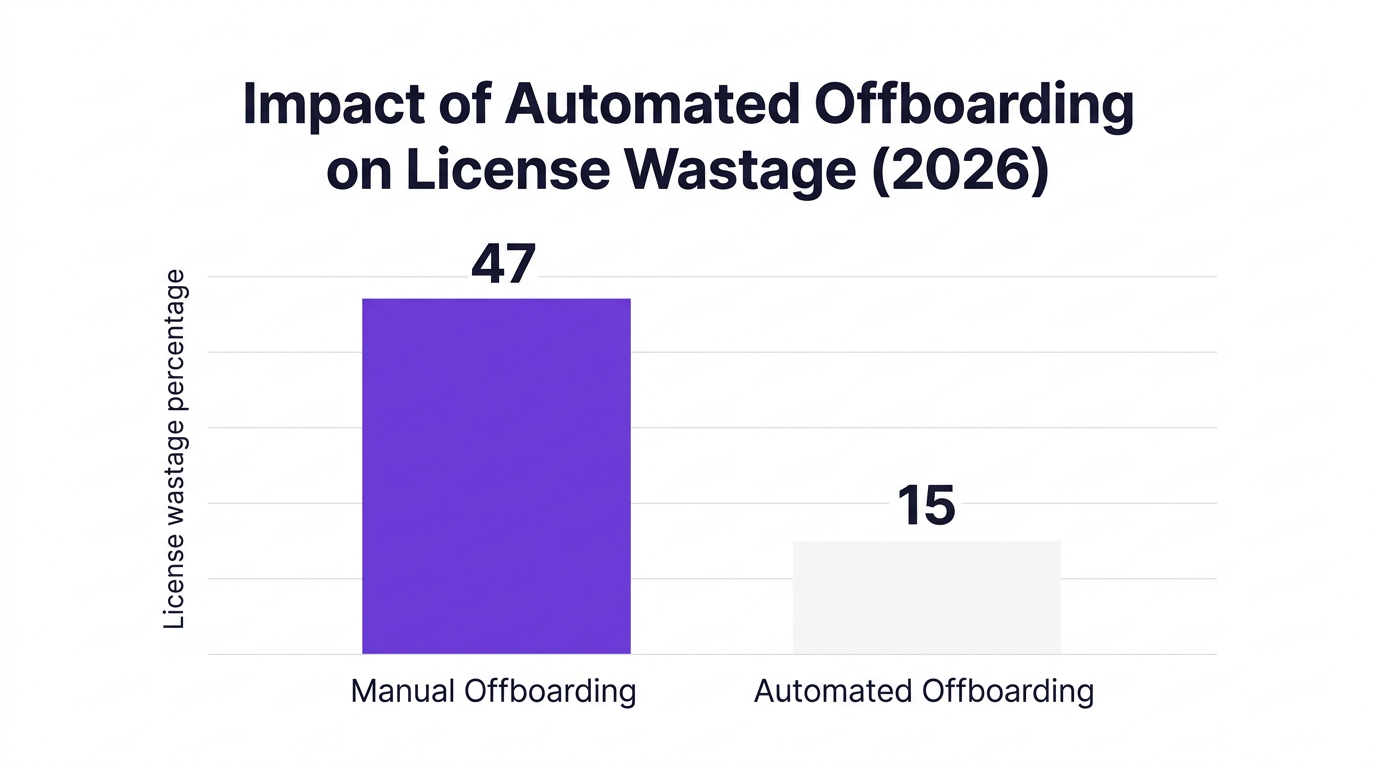
Automated offboarding is becoming the norm. By 2026, automated platforms handle over 70% of enterprise offboarding events (Gartner 2026). Enterprises using automated IT offboarding workflows saw a 47% reduction in license wastage and SaaS sprawl (Forrester 2026). In other words, a weak offboarding process is not only a security risk, it is a direct cost governance problem. Two ideas matter most:
Every exit is a security event that must be handled with the same discipline as an incident response.
Every exit is a cost optimization opportunity through license recovery and IT asset reclamation.
Think of your employee offboarding checklist as a flight checklist. Even experienced pilots use one, because the cost of a missed step is unacceptable. The same logic applies to enterprise IT offboarding. Here is a structured, six-stage it offboarding checklist tailored to 2026 realities.
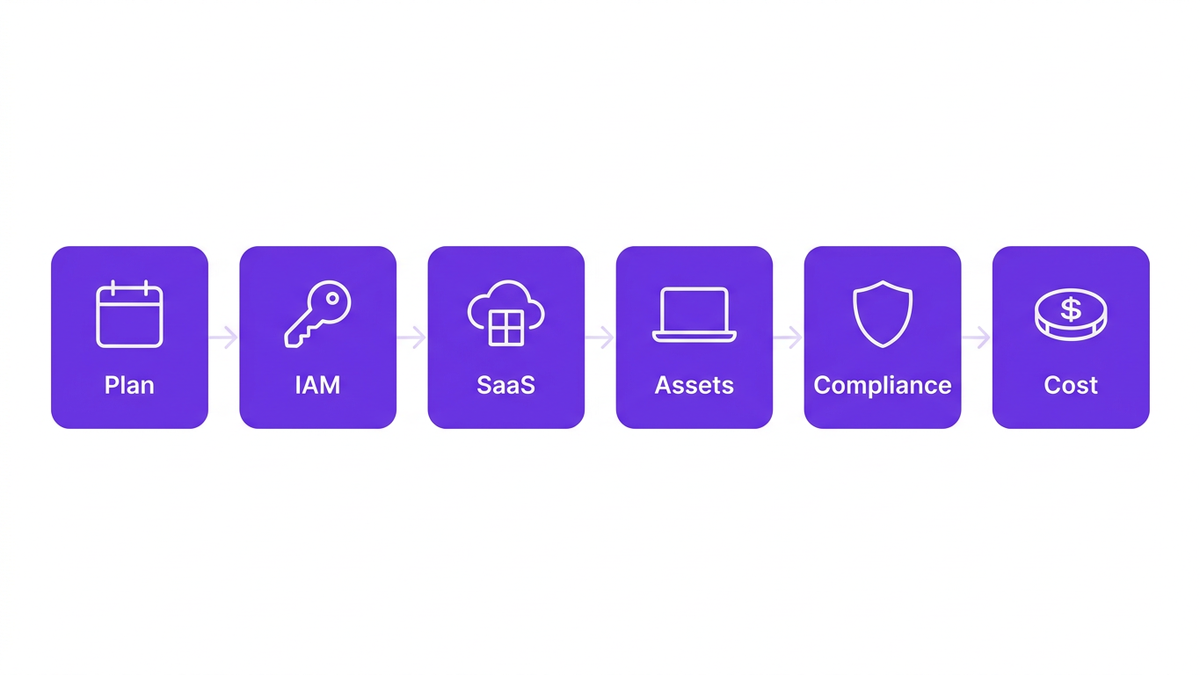
The offboarding process should start as soon as HR or a manager records a resignation, termination, or role change. The trigger can be an HRIS update, a ticket in your ITSM tool, or a manual request, but it must always activate the same standardized offboarding process document. Key actions:
Confirm employee type, last working day, and region for compliance context.
Assign an owner for the off boarding employee checklist, typically IT operations.
Identify risk level: privileged admin, access to sensitive data, or regulated workloads.
Pre-plan access restrictions for high-risk exits (for example, immediate lockout on notice).
Best practice: Use an it onboarding and offboarding checklist so the same system that provisions access also deprovisions it. This reduces drift and surprises late in the process.
Identity is the control plane of modern SaaS and cloud. If it is not revoked, nothing else you do really matters. As one SaaS security expert put it in 2026, automation in IT offboarding is now the cornerstone of security and regulatory compliance. Core IAM steps for your it employee offboarding checklist:
Central identity provider
Disable primary corporate account and enforce sign-out from all active sessions.
Revoke MFA tokens, hardware keys, and mobile authenticator registrations.
Single sign-on and password managers
Revoke SSO assignments and delete or reassign shared vault entries.
Rotate shared credentials used by teams or service accounts the user accessed.
Privileged and admin accounts
Remove all elevated roles in infrastructure, CRM, ERP, and collaboration platforms.
Reassign ownership of key admin-only configuration objects and automations.
This is where offboarding security best practices intersect directly with SOC 2 offboarding requirements. Every change should feed a compliance audit trail that links user, system, timestamp, and action.
The hardest part of modern offboarding is SaaS sprawl. Most organizations underestimate how many tools each employee touches, especially for roles in marketing, product, and data. Key steps for SaaS account deprovisioning:
Use a saas management or discovery tool to compile a list of all SaaS applications tied to the user.
For each app, execute a standard action: deactivate user, transfer ownership, or anonymize.
For high-risk apps, export a data archive and confirm that access tokens and API keys are revoked.
To address shadow IT prevention:
Analyze expense and card feeds for unmanaged SaaS spend.
Cross-check browser extensions, unsanctioned file-sharing tools, and personal inbox integrations.
Add detected tools into your centralized inventory so future offboarding is complete.
A cloud governance expert in 2026 notes that workflow-driven offboarding is critical to counteract shadow IT and support audit readiness. This is also where automated platforms excel at consolidating SaaS account deprovisioning into a consistent, repeatable flow.
Hardware and data remnants can be just as risky as a lingering SaaS login. In 2026, enterprises that used cloud-based automated offboarding achieved a 63% faster IT asset reclamation cycle (InfoTech Research Group 2026). Your it offboarding checklist template should include:
Hardware collection
Laptops, desktops, tablets, smartphones, and peripherals.
Network devices, keycards, security tokens, and on-premise storage media.
IT asset reclamation workflow
Log asset return in your it asset management system.
Wipe and reimage devices per your data sanitization policy.
Data transfer and retention
Transfer ownership of cloud folders, mailboxes, and project workspaces.
Archive email, chat logs, and project artifacts per retention and privacy policies.
This is where cost and compliance intersect. Proper reclamation avoids unnecessary asset purchases and supports a cleaner posture for audits.
In regulated industries, a missing offboarding document template is a direct audit risk. The good news: only 19% of enterprises failed their 2026 IT compliance audit due to incomplete offboarding documentation, down from 28% in 2025 (Forrester 2026). The drop is largely due to better templates and automation. Your offboarding process document should include:
The standardized off boarding checklist template used for every exit.
Fields for manager, HR, and IT sign-off with timestamps.
A reference to system audit logs that show account disablement and data transfers.
Critical compliance artifacts:
Records demonstrating SOC 2 offboarding controls in action.
Evidence of email and file retention or deletion, depending on regulation.
Confirmation that access to regulated systems, such as healthcare or finance platforms, is fully revoked.
Audit-ready offboarding shifts you from hurried evidence collection during an assessment to simply exporting a report from your offboarding system.
IT offboarding is also one of your strongest cost governance levers. When every exit triggers license recovery, you directly defend budgets. Research in 2026 shows that enterprises implementing automated workflows saw a 47% reduction in license wastage and SaaS sprawl (Forrester 2026). Another study found that unified SaaS and cloud offboarding helped organizations target a 40% reduction in unused subscriptions by the end of 2026 (ESG 2026). Key cost actions:
Identify all licenses assigned to the user in major SaaS suites, CRMs, and specialized tools.
Decide to reclaim, downgrade, or retire licenses based on utilization data.
Route cost savings to a chargeback model so business units see the impact.
This is where using an offboarding employee checklist that integrates financial insights is vital. It transforms offboarding from a pure risk task into a recurring savings event.
Not every team is ready to deploy a full automation platform tomorrow. That is why a solid employee offboarding checklist template remains essential, even if some steps are manual. For this guide, structure your templates into four logical sections:
Identity and access
Central accounts, MFA, SSO, admin roles.
SaaS and applications
Business apps, collaboration tools, developer platforms.
Hardware and data
Devices, storage, shared folders, knowledge transfer.
Compliance and finance
Audit trail, retention, licenses, cost allocation.
Recommended file formats:
Offboarding checklist template Word and offboarding checklist template Word free versions for HR and legal sign-offs.
Employee offboarding checklist template Excel for IT teams that need structured, filterable tracking.
A consolidated free employee offboarding checklist template linked from your IT knowledge base.
You can adapt these into an offboarding policy template that defines roles, SLAs by risk tier, and which exits require immediate action versus standard processing.
Tip: Keep your offboarding template and offboarding process document version-controlled. Auditors increasingly expect to see change history for controls documentation.
Manual offboarding can work at small scale, but it cracks under volume, remote work, and complex SaaS estates. The difference is similar to reconciling cloud spend in a spreadsheet versus using a dedicated saas management platform.
Enterprises that adopt automated IT offboarding report several measurable gains:
Speed and consistency: Offboarding events processed in minutes instead of days, with the same sequence every time.
Security posture: 80% of organizations implementing unified SaaS and cloud offboarding in 2026 achieved full audit trail visibility for compliance requirements (ESG 2026).
Cost impact: Better license optimization means less shelfware and tighter cost governance.
There are real-world pitfalls to be aware of:
Disconnected systems: If HR, identity, and SaaS are not integrated, workflows can silently fail.
Shadow IT blind spots: Automation helps only where tools are discovered and inventoried.
One-size-fits-all policies: High-risk exits need stricter, sometimes immediate, controls compared with routine resignations.
This is why automated workflows must be supported by solid discovery, governance rules, and manual override options for escalated situations.
For a deeper look at the broader lifecycle, many teams pair this with resources like an employee onboarding offboarding software a complete guide to ensure symmetry between joiner, mover, and leaver processes.
CloudNuro is designed around governance-first it operations, with automation woven through the entire offboarding journey. It connects HR triggers, identity, SaaS, and cloud platforms into a single workflow that eliminates blind spots. Here is how CloudNuro supports a modern employee offboarding checklist.
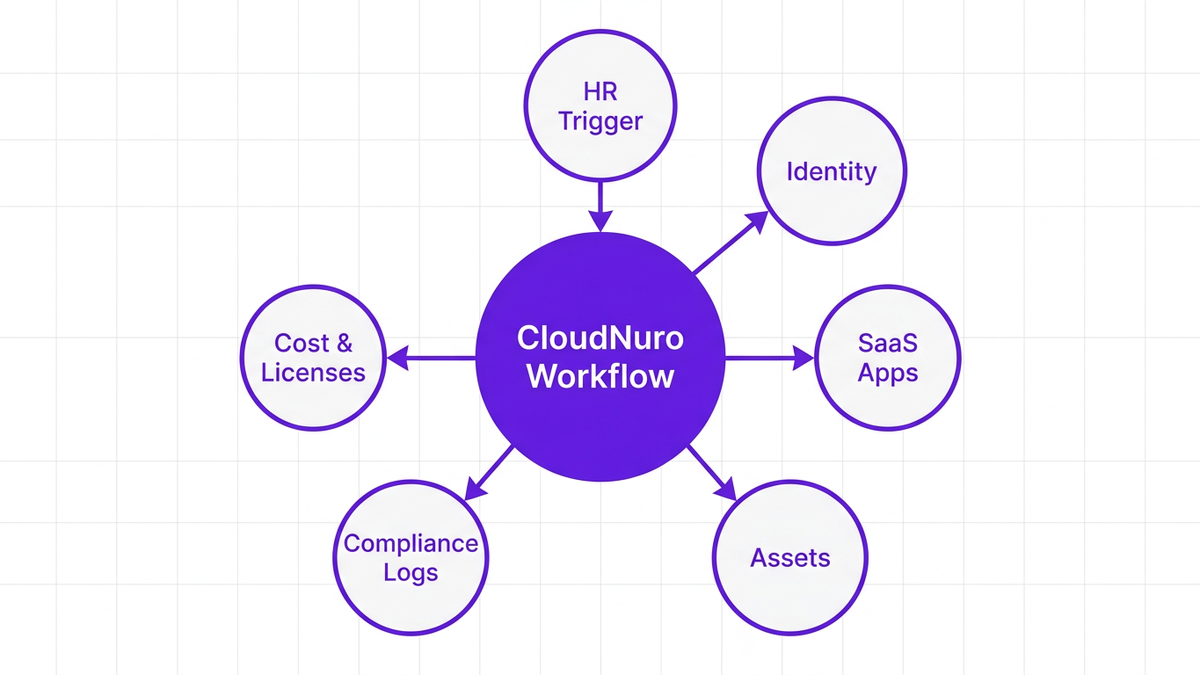
CloudNuro’s Unified Cloud Custodian provides complete visibility across SaaS, Cloud, and AI workloads. It discovers applications via SSO, direct APIs, and financial data so your it offboarding checklist is based on reality, not guesses. Key capabilities:
Centralized inventory of all user-linked SaaS accounts across 400 plus integrations.
Automated deprovision user accounts flows that revoke access, transfer ownership, and archive data.
Built-in shadow IT prevention through continuous discovery and risk scoring.
This aligns your offboarding execution with your documented offboarding policy template, so every exit follows the same governed pattern.
CloudNuro’s AI Custodian module is tailored for offboarding security best practices and SOC 2 offboarding needs. Every identity and access change becomes part of a robust compliance audit trail. Features that matter to security and compliance teams:
End-to-end workflow tracking for joiner, mover, and leaver scenarios.
Evidence-ready exports for SOC 2, GDPR, and industry-specific audits.
Continuous monitoring of risky access patterns even before offboarding starts.
This approach gives CISOs and compliance officers confidence that offboarding controls are enforced and demonstrable, not just written in an offboarding process document.
CloudNuro’s Microsoft 365 Custodian and Salesforce Custodian modules bring automated cost optimization into the heart of offboarding. As employees leave, the platform identifies unused licenses, cross-checks usage, and flags optimization opportunities. Cost governance benefits:
Automatic license recovery and reassignment based on real utilization.
Integration with chargeback models so business units see reclaimed spend.
Insights into recurring SaaS contracts where underutilization is chronic.
This turns your off boarding checklist template into a recurring financial discipline tool, not just a security requirement.
Because CloudNuro connects with IT operations tools and it asset management systems, it can track hardware, cloud resources, and SaaS entitlements in one place. Combined with its ai-first governance approach, CloudNuro helps you:
Standardize offboarding workflows across global regions and business units.
Maintain centralized visibility into who has access to what, and when that access was revoked.
Quickly answer the question auditors and boards increasingly ask: “Show me how you offboarded this high-risk role.”
Organizations evaluating platforms for onboarding and offboarding also refer to resources like why CloudNuro to understand how governance, security, and cost come together.
A 2026-ready it offboarding checklist should include identity and access revocation, SaaS and application deprovisioning, hardware and IT asset reclamation, data transfer and retention, and compliance documentation. It must also capture cost governance tasks, such as license recovery and reallocation. Finally, the checklist should define roles and SLAs for HR, managers, IT, and security.
A structured offboarding employee checklist reduces the risk of data leaks, shadow IT, and lingering admin access to critical systems. Research in 2026 links 96% of ex-employee SaaS breaches to missing or manual deprovisioning processes. On the cost side, automated checklists help you recover unused licenses, which has been shown to cut license wastage by nearly half.
Use a combination of SaaS discovery tools, policy-driven IAM offboarding workflow, and strict data transfer steps. Ensure all project workspaces, documents, and code repositories are transferred or archived before accounts are disabled. A strong offboarding document template also includes a review of expense and usage data to catch unsanctioned or unrecorded tools.
Compliance-focused offboarding must generate a clear audit trail: who initiated offboarding, what systems were updated, when access was revoked, and where data was archived or deleted. Your offboarding policy template should point to centralized logs, HR records, and IT workflow outputs. Auditors often expect standardized off boarding checklist template forms plus system-generated reports that confirm technical controls.
You can start with an employee offboarding template in Word or an employee offboarding checklist template Excel for smaller environments. However, as SaaS usage grows, manual steps do not scale and are prone to error. Most enterprises use templates to define policy and automated workflows to execute it reliably.
Many organizations publish a free offboarding checklist template that you can adapt for your policies and regulatory requirements. Look for versions that cover identity, SaaS, devices, data, and compliance, not just HR tasks. You can then tailor separate formats such as an it offboarding checklist template for IT teams and an offboarding checklist template Word free for HR and legal sign-off.
A strong employee offboarding checklist is no longer a nice-to-have. It is a frontline control for security, cost governance, and regulatory compliance. Automation platforms and disciplined templates are converging, helping organizations cut license waste, improve audit readiness, and shrink the attack surface created by ex-employees. Start by standardizing your it offboarding checklist, then connect it to automated workflows for identity, SaaS, and assets. As you mature, integrate offboarding into a broader saas management and governance strategy so every joiner, mover, and leaver event is secure, compliant, and cost-aware. If you want to modernize your offboarding approach, explore how CloudNuro can operationalize automation, visibility, and financial discipline across your entire SaaS and cloud estate.
CloudNuro is a leader in Enterprise SaaS Management Platforms, providing enterprises with unmatched visibility, governance, and cost optimization. Recognized twice in a row in the SaaS Management Platforms category and named a Leader in the SoftwareReviews Data Quadrant, CloudNuro is trusted by global enterprises and government agencies to bring financial discipline to SaaS, cloud, and AI. Trusted by enterprises such as Konica Minolta and Federal Signal, CloudNuro provides centralized SaaS inventory, license optimization, and renewal management along with advanced cost allocation and chargeback, giving IT and Finance leaders the visibility, control, and cost-conscious culture needed to drive financial discipline.
Request a no cost, no obligation free assessment —just 15 minutes to savings!
Get StartedThe Complete IT Offboarding Checklist for 2026 (Free Template) An incomplete employee offboarding checklist is one of the biggest blind spots in enterprise security and SaaS cost governance. In 2026, 96% of SaaS breaches tied to ex-employee access involved organizations without automated deprovisioning processes (Verizon DBIR 2026). That is not a marginal risk, it is a systemic failure. This guide gives you a complete, 2026-ready employee offboarding checklist plus a practical framework you can apply immediately. You will also get links to a free employee offboarding checklist template in Word and Excel formats, and see how automation platforms like CloudNuro make secure offboarding both reliable and cost-efficient.
Offboarding used to be about collecting a laptop and disabling an Active Directory account. In a multi-cloud, multi-SaaS world, that is no longer enough. A single knowledge worker can easily accumulate 30 to 70 SaaS accounts, spread across shadow IT, team-owned tools, and corporate systems. Research in 2026 shows that 88% of IT leaders say comprehensive offboarding significantly reduces the risk of shadow IT and data leaks (Gartner 2026). At the same time, 74% of enterprises cite regulatory compliance as their top offboarding priority (IDC 2026). Security, compliance, and cost are now tightly connected.
Automated offboarding is becoming the norm. By 2026, automated platforms handle over 70% of enterprise offboarding events (Gartner 2026). Enterprises using automated IT offboarding workflows saw a 47% reduction in license wastage and SaaS sprawl (Forrester 2026). In other words, a weak offboarding process is not only a security risk, it is a direct cost governance problem. Two ideas matter most:
Every exit is a security event that must be handled with the same discipline as an incident response.
Every exit is a cost optimization opportunity through license recovery and IT asset reclamation.
Think of your employee offboarding checklist as a flight checklist. Even experienced pilots use one, because the cost of a missed step is unacceptable. The same logic applies to enterprise IT offboarding. Here is a structured, six-stage it offboarding checklist tailored to 2026 realities.
The offboarding process should start as soon as HR or a manager records a resignation, termination, or role change. The trigger can be an HRIS update, a ticket in your ITSM tool, or a manual request, but it must always activate the same standardized offboarding process document. Key actions:
Confirm employee type, last working day, and region for compliance context.
Assign an owner for the off boarding employee checklist, typically IT operations.
Identify risk level: privileged admin, access to sensitive data, or regulated workloads.
Pre-plan access restrictions for high-risk exits (for example, immediate lockout on notice).
Best practice: Use an it onboarding and offboarding checklist so the same system that provisions access also deprovisions it. This reduces drift and surprises late in the process.
Identity is the control plane of modern SaaS and cloud. If it is not revoked, nothing else you do really matters. As one SaaS security expert put it in 2026, automation in IT offboarding is now the cornerstone of security and regulatory compliance. Core IAM steps for your it employee offboarding checklist:
Central identity provider
Disable primary corporate account and enforce sign-out from all active sessions.
Revoke MFA tokens, hardware keys, and mobile authenticator registrations.
Single sign-on and password managers
Revoke SSO assignments and delete or reassign shared vault entries.
Rotate shared credentials used by teams or service accounts the user accessed.
Privileged and admin accounts
Remove all elevated roles in infrastructure, CRM, ERP, and collaboration platforms.
Reassign ownership of key admin-only configuration objects and automations.
This is where offboarding security best practices intersect directly with SOC 2 offboarding requirements. Every change should feed a compliance audit trail that links user, system, timestamp, and action.
The hardest part of modern offboarding is SaaS sprawl. Most organizations underestimate how many tools each employee touches, especially for roles in marketing, product, and data. Key steps for SaaS account deprovisioning:
Use a saas management or discovery tool to compile a list of all SaaS applications tied to the user.
For each app, execute a standard action: deactivate user, transfer ownership, or anonymize.
For high-risk apps, export a data archive and confirm that access tokens and API keys are revoked.
To address shadow IT prevention:
Analyze expense and card feeds for unmanaged SaaS spend.
Cross-check browser extensions, unsanctioned file-sharing tools, and personal inbox integrations.
Add detected tools into your centralized inventory so future offboarding is complete.
A cloud governance expert in 2026 notes that workflow-driven offboarding is critical to counteract shadow IT and support audit readiness. This is also where automated platforms excel at consolidating SaaS account deprovisioning into a consistent, repeatable flow.
Hardware and data remnants can be just as risky as a lingering SaaS login. In 2026, enterprises that used cloud-based automated offboarding achieved a 63% faster IT asset reclamation cycle (InfoTech Research Group 2026). Your it offboarding checklist template should include:
Hardware collection
Laptops, desktops, tablets, smartphones, and peripherals.
Network devices, keycards, security tokens, and on-premise storage media.
IT asset reclamation workflow
Log asset return in your it asset management system.
Wipe and reimage devices per your data sanitization policy.
Data transfer and retention
Transfer ownership of cloud folders, mailboxes, and project workspaces.
Archive email, chat logs, and project artifacts per retention and privacy policies.
This is where cost and compliance intersect. Proper reclamation avoids unnecessary asset purchases and supports a cleaner posture for audits.
In regulated industries, a missing offboarding document template is a direct audit risk. The good news: only 19% of enterprises failed their 2026 IT compliance audit due to incomplete offboarding documentation, down from 28% in 2025 (Forrester 2026). The drop is largely due to better templates and automation. Your offboarding process document should include:
The standardized off boarding checklist template used for every exit.
Fields for manager, HR, and IT sign-off with timestamps.
A reference to system audit logs that show account disablement and data transfers.
Critical compliance artifacts:
Records demonstrating SOC 2 offboarding controls in action.
Evidence of email and file retention or deletion, depending on regulation.
Confirmation that access to regulated systems, such as healthcare or finance platforms, is fully revoked.
Audit-ready offboarding shifts you from hurried evidence collection during an assessment to simply exporting a report from your offboarding system.
IT offboarding is also one of your strongest cost governance levers. When every exit triggers license recovery, you directly defend budgets. Research in 2026 shows that enterprises implementing automated workflows saw a 47% reduction in license wastage and SaaS sprawl (Forrester 2026). Another study found that unified SaaS and cloud offboarding helped organizations target a 40% reduction in unused subscriptions by the end of 2026 (ESG 2026). Key cost actions:
Identify all licenses assigned to the user in major SaaS suites, CRMs, and specialized tools.
Decide to reclaim, downgrade, or retire licenses based on utilization data.
Route cost savings to a chargeback model so business units see the impact.
This is where using an offboarding employee checklist that integrates financial insights is vital. It transforms offboarding from a pure risk task into a recurring savings event.
Not every team is ready to deploy a full automation platform tomorrow. That is why a solid employee offboarding checklist template remains essential, even if some steps are manual. For this guide, structure your templates into four logical sections:
Identity and access
Central accounts, MFA, SSO, admin roles.
SaaS and applications
Business apps, collaboration tools, developer platforms.
Hardware and data
Devices, storage, shared folders, knowledge transfer.
Compliance and finance
Audit trail, retention, licenses, cost allocation.
Recommended file formats:
Offboarding checklist template Word and offboarding checklist template Word free versions for HR and legal sign-offs.
Employee offboarding checklist template Excel for IT teams that need structured, filterable tracking.
A consolidated free employee offboarding checklist template linked from your IT knowledge base.
You can adapt these into an offboarding policy template that defines roles, SLAs by risk tier, and which exits require immediate action versus standard processing.
Tip: Keep your offboarding template and offboarding process document version-controlled. Auditors increasingly expect to see change history for controls documentation.
Manual offboarding can work at small scale, but it cracks under volume, remote work, and complex SaaS estates. The difference is similar to reconciling cloud spend in a spreadsheet versus using a dedicated saas management platform.
Enterprises that adopt automated IT offboarding report several measurable gains:
Speed and consistency: Offboarding events processed in minutes instead of days, with the same sequence every time.
Security posture: 80% of organizations implementing unified SaaS and cloud offboarding in 2026 achieved full audit trail visibility for compliance requirements (ESG 2026).
Cost impact: Better license optimization means less shelfware and tighter cost governance.
There are real-world pitfalls to be aware of:
Disconnected systems: If HR, identity, and SaaS are not integrated, workflows can silently fail.
Shadow IT blind spots: Automation helps only where tools are discovered and inventoried.
One-size-fits-all policies: High-risk exits need stricter, sometimes immediate, controls compared with routine resignations.
This is why automated workflows must be supported by solid discovery, governance rules, and manual override options for escalated situations.
For a deeper look at the broader lifecycle, many teams pair this with resources like an employee onboarding offboarding software a complete guide to ensure symmetry between joiner, mover, and leaver processes.
CloudNuro is designed around governance-first it operations, with automation woven through the entire offboarding journey. It connects HR triggers, identity, SaaS, and cloud platforms into a single workflow that eliminates blind spots. Here is how CloudNuro supports a modern employee offboarding checklist.
CloudNuro’s Unified Cloud Custodian provides complete visibility across SaaS, Cloud, and AI workloads. It discovers applications via SSO, direct APIs, and financial data so your it offboarding checklist is based on reality, not guesses. Key capabilities:
Centralized inventory of all user-linked SaaS accounts across 400 plus integrations.
Automated deprovision user accounts flows that revoke access, transfer ownership, and archive data.
Built-in shadow IT prevention through continuous discovery and risk scoring.
This aligns your offboarding execution with your documented offboarding policy template, so every exit follows the same governed pattern.
CloudNuro’s AI Custodian module is tailored for offboarding security best practices and SOC 2 offboarding needs. Every identity and access change becomes part of a robust compliance audit trail. Features that matter to security and compliance teams:
End-to-end workflow tracking for joiner, mover, and leaver scenarios.
Evidence-ready exports for SOC 2, GDPR, and industry-specific audits.
Continuous monitoring of risky access patterns even before offboarding starts.
This approach gives CISOs and compliance officers confidence that offboarding controls are enforced and demonstrable, not just written in an offboarding process document.
CloudNuro’s Microsoft 365 Custodian and Salesforce Custodian modules bring automated cost optimization into the heart of offboarding. As employees leave, the platform identifies unused licenses, cross-checks usage, and flags optimization opportunities. Cost governance benefits:
Automatic license recovery and reassignment based on real utilization.
Integration with chargeback models so business units see reclaimed spend.
Insights into recurring SaaS contracts where underutilization is chronic.
This turns your off boarding checklist template into a recurring financial discipline tool, not just a security requirement.
Because CloudNuro connects with IT operations tools and it asset management systems, it can track hardware, cloud resources, and SaaS entitlements in one place. Combined with its ai-first governance approach, CloudNuro helps you:
Standardize offboarding workflows across global regions and business units.
Maintain centralized visibility into who has access to what, and when that access was revoked.
Quickly answer the question auditors and boards increasingly ask: “Show me how you offboarded this high-risk role.”
Organizations evaluating platforms for onboarding and offboarding also refer to resources like why CloudNuro to understand how governance, security, and cost come together.
A 2026-ready it offboarding checklist should include identity and access revocation, SaaS and application deprovisioning, hardware and IT asset reclamation, data transfer and retention, and compliance documentation. It must also capture cost governance tasks, such as license recovery and reallocation. Finally, the checklist should define roles and SLAs for HR, managers, IT, and security.
A structured offboarding employee checklist reduces the risk of data leaks, shadow IT, and lingering admin access to critical systems. Research in 2026 links 96% of ex-employee SaaS breaches to missing or manual deprovisioning processes. On the cost side, automated checklists help you recover unused licenses, which has been shown to cut license wastage by nearly half.
Use a combination of SaaS discovery tools, policy-driven IAM offboarding workflow, and strict data transfer steps. Ensure all project workspaces, documents, and code repositories are transferred or archived before accounts are disabled. A strong offboarding document template also includes a review of expense and usage data to catch unsanctioned or unrecorded tools.
Compliance-focused offboarding must generate a clear audit trail: who initiated offboarding, what systems were updated, when access was revoked, and where data was archived or deleted. Your offboarding policy template should point to centralized logs, HR records, and IT workflow outputs. Auditors often expect standardized off boarding checklist template forms plus system-generated reports that confirm technical controls.
You can start with an employee offboarding template in Word or an employee offboarding checklist template Excel for smaller environments. However, as SaaS usage grows, manual steps do not scale and are prone to error. Most enterprises use templates to define policy and automated workflows to execute it reliably.
Many organizations publish a free offboarding checklist template that you can adapt for your policies and regulatory requirements. Look for versions that cover identity, SaaS, devices, data, and compliance, not just HR tasks. You can then tailor separate formats such as an it offboarding checklist template for IT teams and an offboarding checklist template Word free for HR and legal sign-off.
A strong employee offboarding checklist is no longer a nice-to-have. It is a frontline control for security, cost governance, and regulatory compliance. Automation platforms and disciplined templates are converging, helping organizations cut license waste, improve audit readiness, and shrink the attack surface created by ex-employees. Start by standardizing your it offboarding checklist, then connect it to automated workflows for identity, SaaS, and assets. As you mature, integrate offboarding into a broader saas management and governance strategy so every joiner, mover, and leaver event is secure, compliant, and cost-aware. If you want to modernize your offboarding approach, explore how CloudNuro can operationalize automation, visibility, and financial discipline across your entire SaaS and cloud estate.
CloudNuro is a leader in Enterprise SaaS Management Platforms, providing enterprises with unmatched visibility, governance, and cost optimization. Recognized twice in a row in the SaaS Management Platforms category and named a Leader in the SoftwareReviews Data Quadrant, CloudNuro is trusted by global enterprises and government agencies to bring financial discipline to SaaS, cloud, and AI. Trusted by enterprises such as Konica Minolta and Federal Signal, CloudNuro provides centralized SaaS inventory, license optimization, and renewal management along with advanced cost allocation and chargeback, giving IT and Finance leaders the visibility, control, and cost-conscious culture needed to drive financial discipline.
Request a no cost, no obligation free assessment - just 15 minutes to savings!
Get StartedWe're offering complimentary ServiceNow license assessments to only 25 enterprises this quarter who want to unlock immediate savings without disrupting operations.
Get Free AssessmentGet Started




CloudNuro Corp
1755 Park St. Suite 207
Naperville, IL 60563
Phone : +1-630-277-9470
Email: info@cloudnuro.com




.webp)

Recognized Leader in SaaS Management Platforms by Info-Tech SoftwareReviews


.png)
.svg)