

Sign Up
Thank you for Submitting!

If you are part of a FinOps, IT, or Finance team tasked with optimizing SaaS and cloud costs, you already know that invisible billing details can torpedo your cost models. Nowhere is this more apparent than in Microsoft Fabric and similar usage-metered environments. The shift from legacy pay-as-you-go models to usage-based fabric billing hinges on a deceptively minor detail: the distinction between CU-seconds and CU-minutes. That difference can make or break budget predictability, chargeback accuracy, and overall governance. This article untangles the technical and financial implications of CU-based billing and reveals how CloudNuro brings clarity, automation, and control to capacity-unit chaos.
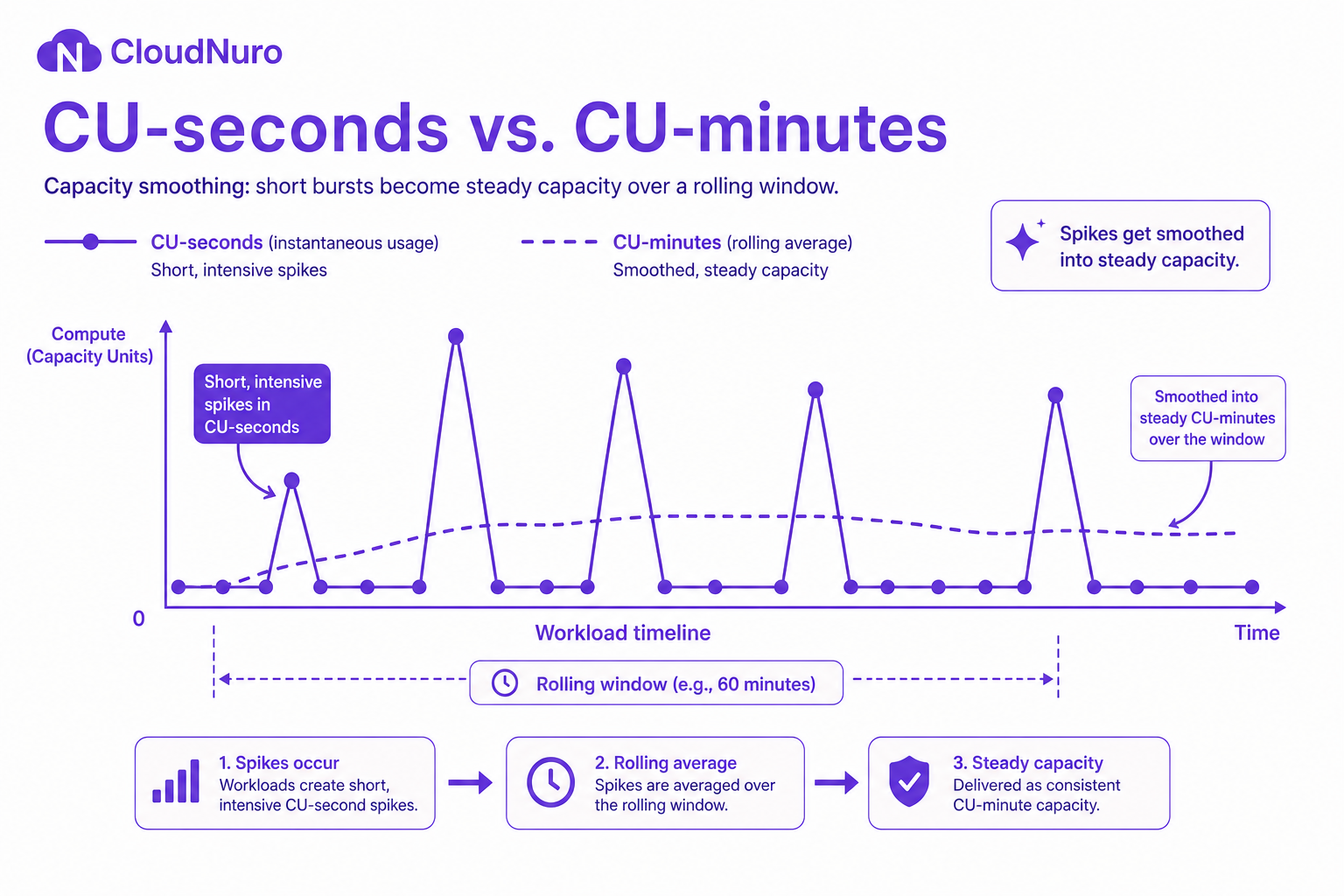
Modern SaaS and cloud analytics platforms have transitioned to billing models based on underlying capacity units, also known as compute units (CUs). These units measure the computational work or data processed for a given operation over time.
CU-seconds: Amount of computation performed by one capacity unit over one second.
CU-minutes: Computation performed by one capacity unit over one minute.
Why does the time granularity matter? Because workloads are evaluated and billed over specific intervals. Microsoft Fabric, for example, analyzes capacity consumption in 30-second increments, smoothing out unpredictable spikes. A workload that creates a bursty, high-intensity demand for a few seconds may appear more economical than a consistently high drain, depending on how usage is averaged into CU-minutes.
This subtlety can mask idle costs, distort true workload economics, and leave teams baffled at unexpected overages or underreported inefficiencies.
FinOps leaders agree: tracking fabric capacity units in the rawest detail is the first step to cloud cost optimization. Here are the key reasons why CU granularity matters:
Idle Capacity Detection: Many organizations pay for reserved or dedicated capacity pools. If capacity is allocated but only sporadically consumed, minute-based smoothing can hide idle waste that would otherwise be detected in CU-seconds dumps.
Chargeback Accuracy: Chargebacks at the business unit or departmental level need precision. If you allocate costs in CU-minutes, a single long-running report could be averaged out, leading to disputes about true resource utilization, especially for short-running automation jobs that spike for seconds.
Budgeting and Forecasting: Dedicated capacity pools enhance predictability. However, understanding the minute-by-minute (and second-by-second) nature of utilization can prevent unwelcome surprises at close.
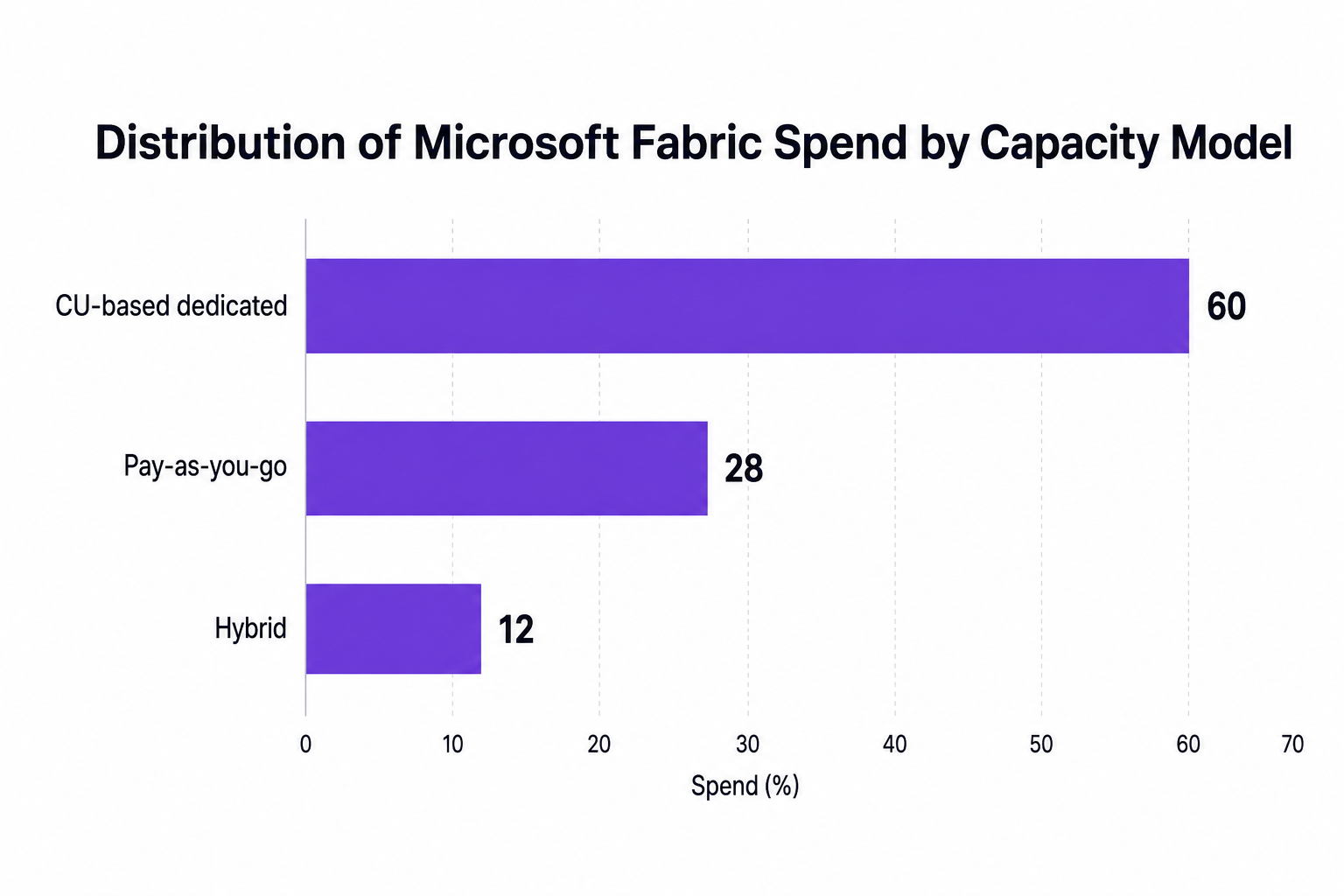
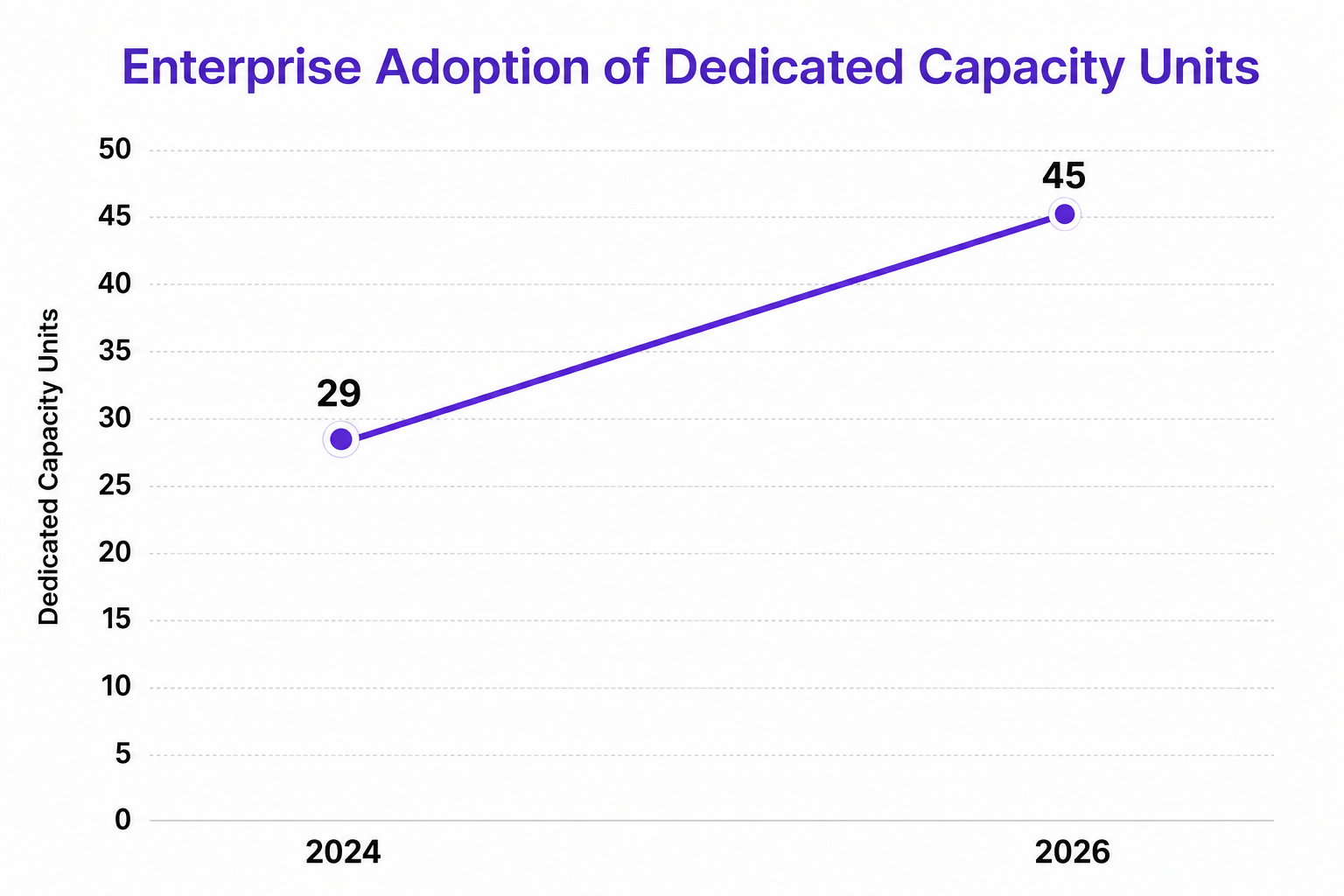
Key Statistic: Dedicated capacity unit pools now account for roughly 60% of all ongoing data compute expenditure, and adoption is accelerating as more enterprises seek predictable costs with clear chargeback models.
It is easy to say "track everything," but in practice, teams struggle to unpack the raw telemetry:
Many platforms, including Microsoft Fabric, report average utilization over windows of 30 seconds to several minutes.
Heavy machine learning jobs may consume between 500 and 5,000 CU-seconds for a single execution, compounding line-item charges as workloads scale.
Frequent semantic model refreshes can rack up 200 to 400 CU-seconds per 10GB calculation, but these costs are distributed across time buckets, leading to opacity in true workload cost attribution.
Fact: A large financial institution achieved a 25% reduction in idle capacity and $2.1 million in annual cost avoidance through automated rightsizing and anomaly detection within the first year of CloudNuro's deployment. The difference? Full visibility into both CU-seconds and CU-minutes analytics.
Many chargeback systems smooth usage over 30 or 60 second windows. Short spikes, such as a nightly backup or a batch data transformation, may be dramatically underrepresented.
Without unified, cross-platform reporting in raw units, IT and Finance face siloed data from each vendor, forcing manual reconciliation between CU-second logs and rolled-up CU-minute charges.
Idle and underutilized capacity can drain budgets silently. Manual anomaly detection is slow and error-prone; automated solutions need a governance-first approach to set thresholds and enforce action before costs run away.
Expert Insight: Organizations that integrate raw capacity unit monitoring with advanced FinOps platforms see significantly faster cost optimization compared to teams relying on native reporting alone.
CloudNuro was built exactly for this scenario: eliminating billing opacity and delivering actionable transparency at every level.
CloudNuro’s Microsoft 365 Custodian provides direct, real-time telemetry into both CU-seconds and CU-minutes for Fabric environments. Teams can instantly pinpoint which background jobs or ad-hoc queries are draining capacity.
Unified Cloud Custodian actively enforces governance policies:
Flags underutilized capacity automatically
Triggers workload rightsizing without manual review
Suspends non-production nodes during off-hours. reducing hourly billing drain from idle analytic workloads
Case in Point: A Fortune 500 healthcare provider enabled business unit-level chargeback for clinical departments, improving cost accountability and shortening quarterly financial close by 30 percent with CloudNuro’s advanced cost allocation.
CloudNuro’s unique tagging and identity integration allows precise mapping of fabric capacity usage to departments, regions, or product teams. This enforces a culture of ownership and accountability. and eliminates friction in chargeback disputes.
Advanced cost allocation by department, product, or region
Automated reports in usage-based metrics, mapped dollar-for-dollar
As enterprises scale up generative AI and large language model operations, the baseline computational overhead and unpredictable surges become financially risky. CloudNuro surfaces true usage at the raw CU-second layer, revealing the full cost (and optimization potential) of every model training cycle, background refresh, and semantic query job.
Real Result: A national pathology organization realized 27% baseline savings in cloud commitments and achieved a 30% deep rightsizing efficiency through CloudNuro’s capacity reclamation tools.
70% of FinOps practitioners now manage SaaS costs alongside cloud infrastructure.
Over 85% of SaaS companies have adopted usage-based pricing.
The spread of AI workloads is compressing idle time, driving the need for continuous optimization.
Dedicated capacity pools are projected to dominate the next phase of enterprise cloud spend.
"The transparency of capacity unit models enables IT and finance teams to align cloud investments with real business outcomes, provided they establish operational discipline."
Capture Usage at the Rawest Granularity: Use tools that record utilization in CU-seconds, not just minute-level aggregates.
Automate Idle Capacity Alerts: Deploy platforms capable of automatic idle detection and suspension routines.
Adopt Advanced Cost Allocation: Ensure your tagging and reporting supports fine-grained chargebacks by business unit or project.
Align Clouds and SaaS in One System: Only cross-platform platforms like CloudNuro fully bridge SaaS, cloud, and Hybrid usage-based charges.
Educate Finance and IT on Metric Definitions: Make sure all stakeholders understand how smoothing windows impact fake savings and hidden waste.
What are CU-seconds and CU-minutes in fabric billing?
CU-seconds measure the use of one capacity unit per second, while CU-minutes measure usage over one minute. They are two different lenses for understanding workload consumption in usage-based billing models such as Microsoft Fabric.
How do fabric capacity units impact SaaS cost management?
The way capacity units are measured and billed affects cost allocation, chargeback, and overall SaaS optimization. Accurate tracking allows IT and Finance leaders to minimize idle spend and maximize ROI.
What is the difference between CU-seconds and CU-minutes?
CU-seconds offer more granular and precise visibility of actual workload demand, revealing spikes and short-lived jobs that might be averaged out in CU-minute readings.
How do FinOps teams analyze fabric billing granularity?
Sophisticated FinOps teams rely on platforms that surface raw CU-second telemetry, apply automated rightsizing policies, and map capacity consumption directly to business units.
Why does understanding CU-based fabric billing matter for IT finance?
It matters because without this insight, teams risk overprovisioning, cost disputes, audit nightmares, and chronic overspend. precisely the challenges CloudNuro was built to solve.
CU-seconds versus CU-minutes is not just a technical distinction. It is the difference between accurate, actionable SaaS cost management and unchecked financial waste. As enterprise workloads grow more complex and billing models shift to granular capacity units, only platforms built for deep telemetry, cross-system integration, and automation. like CloudNuro. can provide the assurance and governance modern FinOps teams need.
Explore FinOps resources:
CloudNuro is a leader in Enterprise AI Adoption Management, providing enterprises with unmatched visibility, governance, and cost optimization. Recognized twice in a row in the SaaS Management Platforms category and named a Leader in the SoftwareReviews Data Quadrant, CloudNuro is trusted by global enterprises and government agencies to bring financial discipline to SaaS, cloud, and AI. Trusted by enterprises, CloudNuro provides centralized SaaS inventory, license optimization, and renewal management along with advanced cost allocation and chargeback, giving IT and Finance leaders the visibility, control, and cost-conscious culture needed to drive financial discipline.
Request a no cost, no obligation free assessment —just 15 minutes to savings!
Get StartedIf you are part of a FinOps, IT, or Finance team tasked with optimizing SaaS and cloud costs, you already know that invisible billing details can torpedo your cost models. Nowhere is this more apparent than in Microsoft Fabric and similar usage-metered environments. The shift from legacy pay-as-you-go models to usage-based fabric billing hinges on a deceptively minor detail: the distinction between CU-seconds and CU-minutes. That difference can make or break budget predictability, chargeback accuracy, and overall governance. This article untangles the technical and financial implications of CU-based billing and reveals how CloudNuro brings clarity, automation, and control to capacity-unit chaos.
Modern SaaS and cloud analytics platforms have transitioned to billing models based on underlying capacity units, also known as compute units (CUs). These units measure the computational work or data processed for a given operation over time.
CU-seconds: Amount of computation performed by one capacity unit over one second.
CU-minutes: Computation performed by one capacity unit over one minute.
Why does the time granularity matter? Because workloads are evaluated and billed over specific intervals. Microsoft Fabric, for example, analyzes capacity consumption in 30-second increments, smoothing out unpredictable spikes. A workload that creates a bursty, high-intensity demand for a few seconds may appear more economical than a consistently high drain, depending on how usage is averaged into CU-minutes.
This subtlety can mask idle costs, distort true workload economics, and leave teams baffled at unexpected overages or underreported inefficiencies.
FinOps leaders agree: tracking fabric capacity units in the rawest detail is the first step to cloud cost optimization. Here are the key reasons why CU granularity matters:
Idle Capacity Detection: Many organizations pay for reserved or dedicated capacity pools. If capacity is allocated but only sporadically consumed, minute-based smoothing can hide idle waste that would otherwise be detected in CU-seconds dumps.
Chargeback Accuracy: Chargebacks at the business unit or departmental level need precision. If you allocate costs in CU-minutes, a single long-running report could be averaged out, leading to disputes about true resource utilization, especially for short-running automation jobs that spike for seconds.
Budgeting and Forecasting: Dedicated capacity pools enhance predictability. However, understanding the minute-by-minute (and second-by-second) nature of utilization can prevent unwelcome surprises at close.
Key Statistic: Dedicated capacity unit pools now account for roughly 60% of all ongoing data compute expenditure, and adoption is accelerating as more enterprises seek predictable costs with clear chargeback models.
It is easy to say "track everything," but in practice, teams struggle to unpack the raw telemetry:
Many platforms, including Microsoft Fabric, report average utilization over windows of 30 seconds to several minutes.
Heavy machine learning jobs may consume between 500 and 5,000 CU-seconds for a single execution, compounding line-item charges as workloads scale.
Frequent semantic model refreshes can rack up 200 to 400 CU-seconds per 10GB calculation, but these costs are distributed across time buckets, leading to opacity in true workload cost attribution.
Fact: A large financial institution achieved a 25% reduction in idle capacity and $2.1 million in annual cost avoidance through automated rightsizing and anomaly detection within the first year of CloudNuro's deployment. The difference? Full visibility into both CU-seconds and CU-minutes analytics.
Many chargeback systems smooth usage over 30 or 60 second windows. Short spikes, such as a nightly backup or a batch data transformation, may be dramatically underrepresented.
Without unified, cross-platform reporting in raw units, IT and Finance face siloed data from each vendor, forcing manual reconciliation between CU-second logs and rolled-up CU-minute charges.
Idle and underutilized capacity can drain budgets silently. Manual anomaly detection is slow and error-prone; automated solutions need a governance-first approach to set thresholds and enforce action before costs run away.
Expert Insight: Organizations that integrate raw capacity unit monitoring with advanced FinOps platforms see significantly faster cost optimization compared to teams relying on native reporting alone.
CloudNuro was built exactly for this scenario: eliminating billing opacity and delivering actionable transparency at every level.
CloudNuro’s Microsoft 365 Custodian provides direct, real-time telemetry into both CU-seconds and CU-minutes for Fabric environments. Teams can instantly pinpoint which background jobs or ad-hoc queries are draining capacity.
Unified Cloud Custodian actively enforces governance policies:
Flags underutilized capacity automatically
Triggers workload rightsizing without manual review
Suspends non-production nodes during off-hours. reducing hourly billing drain from idle analytic workloads
Case in Point: A Fortune 500 healthcare provider enabled business unit-level chargeback for clinical departments, improving cost accountability and shortening quarterly financial close by 30 percent with CloudNuro’s advanced cost allocation.
CloudNuro’s unique tagging and identity integration allows precise mapping of fabric capacity usage to departments, regions, or product teams. This enforces a culture of ownership and accountability. and eliminates friction in chargeback disputes.
Advanced cost allocation by department, product, or region
Automated reports in usage-based metrics, mapped dollar-for-dollar
As enterprises scale up generative AI and large language model operations, the baseline computational overhead and unpredictable surges become financially risky. CloudNuro surfaces true usage at the raw CU-second layer, revealing the full cost (and optimization potential) of every model training cycle, background refresh, and semantic query job.
Real Result: A national pathology organization realized 27% baseline savings in cloud commitments and achieved a 30% deep rightsizing efficiency through CloudNuro’s capacity reclamation tools.
70% of FinOps practitioners now manage SaaS costs alongside cloud infrastructure.
Over 85% of SaaS companies have adopted usage-based pricing.
The spread of AI workloads is compressing idle time, driving the need for continuous optimization.
Dedicated capacity pools are projected to dominate the next phase of enterprise cloud spend.
"The transparency of capacity unit models enables IT and finance teams to align cloud investments with real business outcomes, provided they establish operational discipline."
Capture Usage at the Rawest Granularity: Use tools that record utilization in CU-seconds, not just minute-level aggregates.
Automate Idle Capacity Alerts: Deploy platforms capable of automatic idle detection and suspension routines.
Adopt Advanced Cost Allocation: Ensure your tagging and reporting supports fine-grained chargebacks by business unit or project.
Align Clouds and SaaS in One System: Only cross-platform platforms like CloudNuro fully bridge SaaS, cloud, and Hybrid usage-based charges.
Educate Finance and IT on Metric Definitions: Make sure all stakeholders understand how smoothing windows impact fake savings and hidden waste.
What are CU-seconds and CU-minutes in fabric billing?
CU-seconds measure the use of one capacity unit per second, while CU-minutes measure usage over one minute. They are two different lenses for understanding workload consumption in usage-based billing models such as Microsoft Fabric.
How do fabric capacity units impact SaaS cost management?
The way capacity units are measured and billed affects cost allocation, chargeback, and overall SaaS optimization. Accurate tracking allows IT and Finance leaders to minimize idle spend and maximize ROI.
What is the difference between CU-seconds and CU-minutes?
CU-seconds offer more granular and precise visibility of actual workload demand, revealing spikes and short-lived jobs that might be averaged out in CU-minute readings.
How do FinOps teams analyze fabric billing granularity?
Sophisticated FinOps teams rely on platforms that surface raw CU-second telemetry, apply automated rightsizing policies, and map capacity consumption directly to business units.
Why does understanding CU-based fabric billing matter for IT finance?
It matters because without this insight, teams risk overprovisioning, cost disputes, audit nightmares, and chronic overspend. precisely the challenges CloudNuro was built to solve.
CU-seconds versus CU-minutes is not just a technical distinction. It is the difference between accurate, actionable SaaS cost management and unchecked financial waste. As enterprise workloads grow more complex and billing models shift to granular capacity units, only platforms built for deep telemetry, cross-system integration, and automation. like CloudNuro. can provide the assurance and governance modern FinOps teams need.
Explore FinOps resources:
CloudNuro is a leader in Enterprise AI Adoption Management, providing enterprises with unmatched visibility, governance, and cost optimization. Recognized twice in a row in the SaaS Management Platforms category and named a Leader in the SoftwareReviews Data Quadrant, CloudNuro is trusted by global enterprises and government agencies to bring financial discipline to SaaS, cloud, and AI. Trusted by enterprises, CloudNuro provides centralized SaaS inventory, license optimization, and renewal management along with advanced cost allocation and chargeback, giving IT and Finance leaders the visibility, control, and cost-conscious culture needed to drive financial discipline.
Request a no cost, no obligation free assessment - just 15 minutes to savings!
Get StartedWe're offering complimentary ServiceNow license assessments to only 25 enterprises this quarter who want to unlock immediate savings without disrupting operations.
Get Free AssessmentGet Started




CloudNuro Corp
1755 Park St. Suite 207
Naperville, IL 60563
Phone : +1-630-277-9470
Email: info@cloudnuro.com





.webp)

Recognized Leader in SaaS Management Platforms by Info-Tech SoftwareReviews





.svg)