

Sign Up
Thank you for Submitting!
Shadow AI cost is no longer a theoretical concern. It is a measurable, multi-million-dollar drain on enterprise budgets that often escapes traditional IT and procurement controls.
Gartner projects that enterprises will waste an average of $4.6 million annually in unused or redundant AI and SaaS licensing because of shadow AI and untracked spend by 2026. For organizations already wrestling with SaaS sprawl, that is the equivalent of lighting an entire product team's annual budget on fire.
This article breaks down what is really behind hidden AI spend, how AI license waste accumulates so quickly, and what effective shadow AI cost management requires. It also shows how CloudNuro helps enterprises expose, control, and reduce that spend.
Shadow AI refers to any AI tools, GenAI features, add-ons, or models that teams adopt without formal approval or central oversight. It is the AI version of shadow IT, but with higher pricing volatility and very different risk.
In practice, shadow AI shows up as:
Individual teams expensing AI tools on corporate cards
Product groups turning on AI add-ons inside existing SaaS
Data scientists using external models or APIs outside standard governance
According to a 2026 study from a major research body, up to 28 percent of AI software spend in large organizations is invisible to IT and procurement. Another benchmark finds that in enterprises over 5,000 employees, shadow AI accounts for nearly 38 percent of all AI-related SaaS costs.
This hidden slice of spend drives three core problems:
License duplication and overlap across overlapping AI tools and SaaS sprawl
Untracked usage-based billing, which can spike month to month
Compliance and security exposure, especially for regulated data
Industry analysts now call shadow AI “the fastest-growing category of unsanctioned spend in enterprise technology, often outpacing traditional shadow IT by a factor of two.” That growth curve is exactly why shadow AI cost optimization has become urgent for CIOs and FinOps leaders.
Hidden AI spend rarely appears as a single big line item. Instead, it accumulates through hundreds or thousands of small decisions that fragment visibility.
Think of it like a leaky pipe behind the walls. Each drip looks insignificant, but over time it rots the structure. In financial terms, those “drips” are:
AI seats quietly added inside collaboration or CRM tools
Usage-based GenAI calls that spike with new use cases
Trial accounts that quietly convert into paid subscriptions
Research from 2026 highlights several hotspots:
AI add-ons inside core platforms: AI license waste in SaaS often hides here, since AI seats are purchased by business units, not IT
Unmanaged GenAI experiments: Pilot projects stand up AI instances, then leave unused AI licenses in SaaS tools when the pilot ends
Redundant AI tool subscriptions: Multiple teams buy near-identical capabilities, each with their own contracts and AI subscription waste
One 2026 study from a global advisory firm found that 92 percent of enterprises cite lack of unified AI and SaaS discovery as the primary driver behind hidden license waste. In other words, you cannot optimize what you cannot see.
Unmanaged GenAI is particularly dangerous because of usage-based pricing. A major sourcing benchmark found that AI SaaS pricing can swing 15 to 30 percent quarterly for unsanctioned tools due to usage spikes and tier changes.
Without real-time visibility, IT and finance teams only discover these swings after the invoice arrives. By then, reclaiming unused AI licenses or shutting down ghost AI accounts is reactive, not proactive.

Multiple 2026 data points paint a clear picture of scale and risk.
$4.6M average annual waste in unused or redundant AI and SaaS licenses for large enterprises
79 percent of CIOs report at least one incident of unauthorized AI tool adoption that resulted in license or compliance issues in the past 12 months
61 percent of large enterprises have launched shadow AI governance initiatives, yet many still lack full discovery coverage
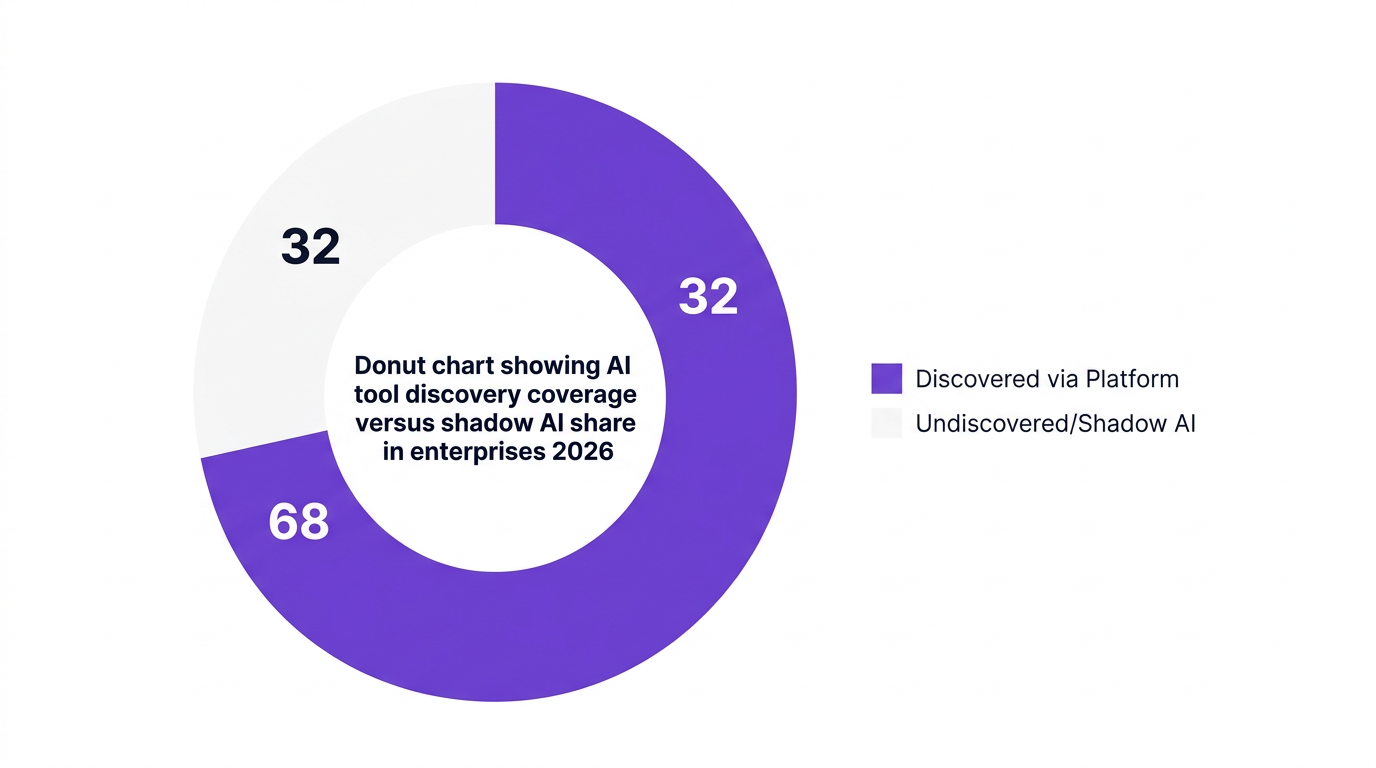
A separate analysis shows that 32 percent of AI tools in enterprises remain undiscovered by central IT or procurement. Those tools still process data, incur costs, and expose risk.
From a risk lens, experts warn that “the biggest challenge is not just the spend, but the operational risk and data compliance exposure introduced by unmanaged AI licenses.” Shadow AI in SaaS security and cost is inseparable from shadow AI in compliance.
The financial impact of shadow AI cost is multi-dimensional:
Direct AI license waste: Unused seats and unused AI licenses in SaaS subscriptions
Overlapping AI tools and SaaS sprawl: Paying for three tools where one would suffice
AI SaaS pricing volatility: Budget unpredictability due to usage surges
Audit and remediation costs: Time spent investigating and cleaning up ghost AI accounts
For a 10,000-employee enterprise, a conservative scenario might look like:
2,000 employees with some form of AI or GenAI access
25 percent of those licenses unused or under-utilized
Average cost of $1,000 to $2,500 per AI user annually
Even at the low end, that is $500,000 in direct AI license waste, often before counting overlapping tools, usage-based overruns, or hidden AI spend in shadow projects.
Many IT and procurement teams assume that existing SaaS management or ITAM processes will cover shadow AI. In reality, shadow AI behaves differently from traditional SaaS.
AI capabilities increasingly come as features, add-ons, or per-user entitlements inside existing suites. Traditional tooling that inventories standalone apps often misses:
Per-user AI entitlements inside suites like collaboration, CRM, or ERP
AI add-on SKUs that share naming with non-AI plans
Consumption-based GenAI features billed as part of a larger invoice
This is where AI add-on cost management becomes critical. Without deep SKU awareness and usage analytics, those entitlements blend into general SaaS spend.
Usage-based AI pricing models mean the unit cost per active user is only half the story. AI SaaS pricing volatility can cause sudden spikes when:
A team enables new GenAI use cases
A pilot expands across departments without approval
An integration triggers more model calls than planned
Traditional monthly or quarterly reviews are too slow for true AI SaaS cost management. Teams need near real-time usage telemetry and AI license utilization analytics.
Research from 2026 notes that “effective shadow AI governance now demands real-time visibility and automated remediation, not just periodic audits.” Yet many organizations still:
Rely on manual surveys or spreadsheets for AI tracking
Have unclear policies on what constitutes permitted vs shadow AI
Lack automated workflows to block, approve, or remediate usage
This is why shadow IT and shadow AI management can no longer be decoupled from FinOps for SaaS and AI. Cost, security, and compliance have to move together.

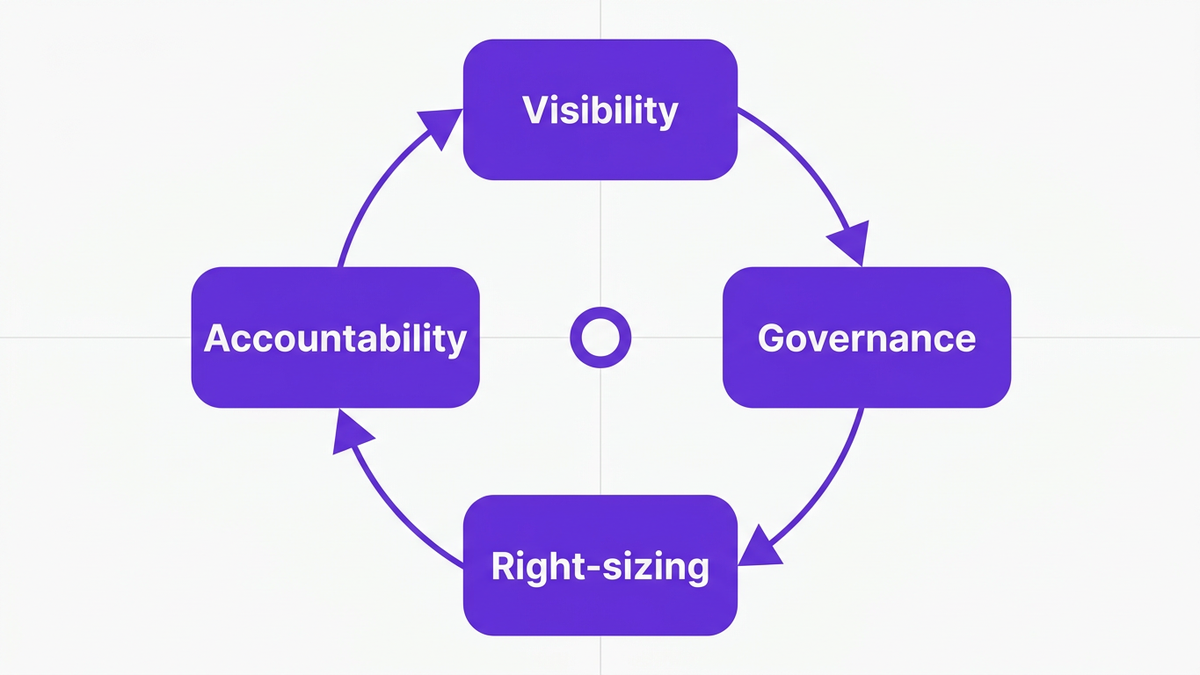
To move from firefighting to control, enterprises need a repeatable framework. A useful way to think about this is the V-G-R-A model for shadow AI SaaS management:
Visibility: Discover all AI tools, features, and entitlements
Governance: Define policies, owners, and guardrails
Right-sizing: Optimize licenses, remove redundancy, reclaim waste
Accountability: Align costs with business units and outcomes
Start with comprehensive discovery:
Use network, SSO, and financial data to surface unsanctioned AI tools
Map AI features inside major SaaS platforms, not just standalone apps
Classify tools by risk level, data sensitivity, and business criticality
Many enterprises now use dedicated SaaS management platforms for shadow SaaS and shadow AI visibility. One 2026 benchmark found that automated license discovery and cost optimization tools can reduce shadow AI-related SaaS overspend by 33 percent.
Shadow AI governance for SaaS should translate into clear policy and enforcement, for example:
Approved vs restricted categories of AI tools
Data residency and data sharing rules
Required controls such as MFA, DLP, and app risk scoring
Tie this to shadow IT and shadow AI cost control by requiring cost center tags or business owner assignment for any new AI subscription.
This is where concrete savings appear:
Identify unused AI licenses in SaaS and auto-reclaim after inactivity windows
Consolidate redundant AI tool subscriptions with similar capabilities
Adjust tiering and quotas for usage-based AI tools
Automation is key. A 2026 survey shows that 54 percent of enterprises now use automated platforms to identify and recover unused AI and SaaS licenses.
Finally, connect FinOps for SaaS and AI with security and compliance teams:
Implement chargeback or showback for AI spend by BU or product line
Surface unit economics, such as AI cost per ticket resolved or per document processed
Use quarterly reviews to refine policies and retire legacy tools
This creates a virtuous cycle where SaaS license waste reduction becomes an ongoing practice, not a one-time cleanup.
Recent case studies show that disciplined shadow AI cost management can deliver seven-figure savings.
A large financial services enterprise cut $7.2 million in annual shadow AI license spend by implementing end-to-end AI and SaaS discovery plus automated license reclamation
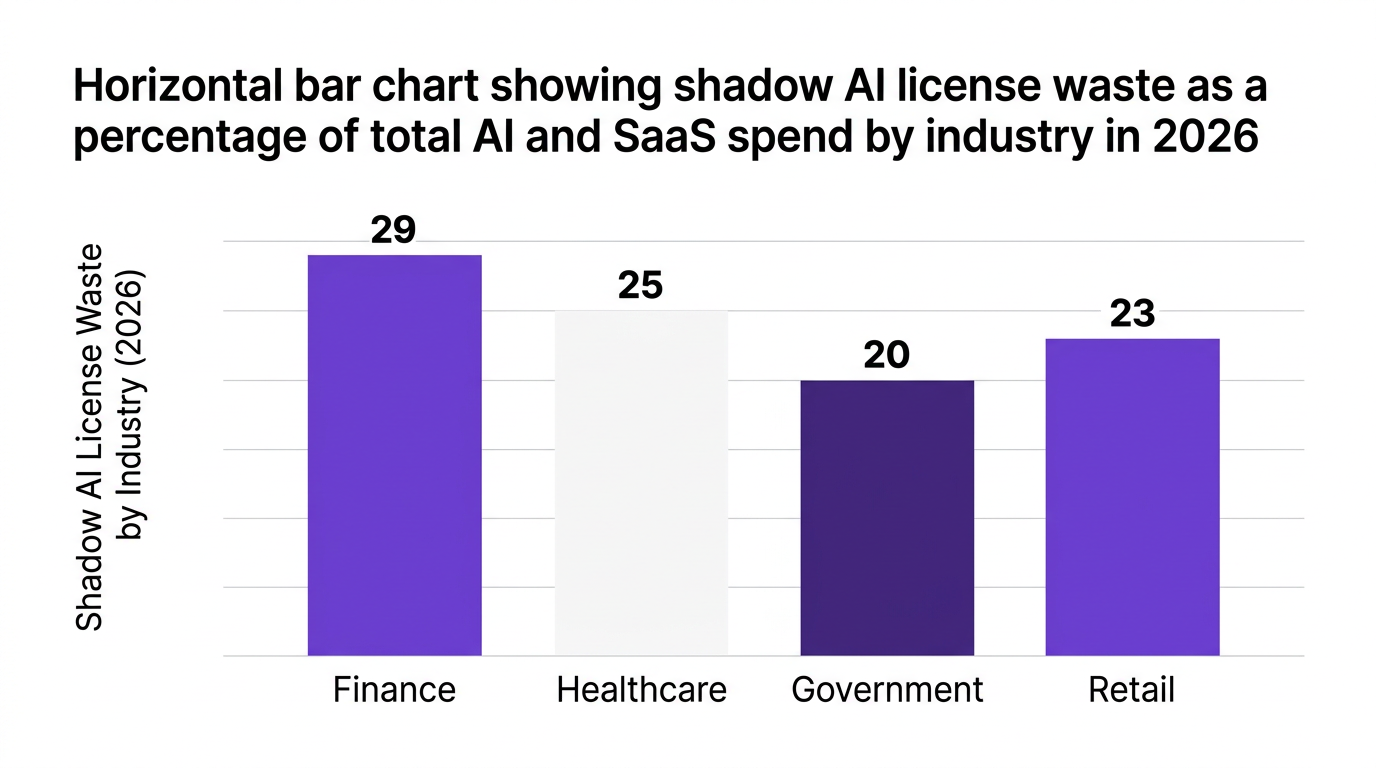
A major healthcare system achieved a 27 percent reduction in hidden AI and SaaS spend, saving $3.9 million per year, through unified shadow SaaS and shadow AI visibility, combined with strict governance
Common success patterns across these efforts include:
Achieving 90 percent or better discovery coverage of AI tools within 6 months
Reclaiming 20 to 35 percent of AI seats as ghost AI accounts and unused seats
Reducing overlapping AI tools and SaaS sprawl by consolidating into fewer strategic platforms
The critical point: these organizations treated AI SaaS cost management platform capabilities as core infrastructure, not a nice-to-have add-on.
CloudNuro was built specifically to give enterprises end-to-end visibility and governance across SaaS, cloud, and AI. That same architecture directly addresses the hidden shadow AI cost problem.
Here is how.
CloudNuro’s AI Custodian delivers real-time discovery of all AI, SaaS, and PaaS tools, including unsanctioned shadow AI accessed via browser, SSO, or expense channels.
Key capabilities include:
Deep discovery of AI features and add-ons inside major suites
Correlation of network, identity, and billing data to surface hidden AI spend
Risk scoring that highlights high-risk, unsanctioned AI tools for remediation
This gives IT, security, and finance teams unified shadow SaaS and shadow AI visibility instead of fragmented, tool-specific views.
CloudNuro’s platform focuses on automated cost optimization, not one-off audits. For AI specifically, it enables:
Detection of unused AI licenses SaaS wide, based on real utilization
Policy-driven reclaiming unused AI licenses after configurable inactivity windows
Identification of overlapping AI capabilities that drive AI subscription waste in enterprises
Customers routinely see up to 35 percent reduction in SaaS overspend when they automate these workflows.
CloudNuro also offers specialized products, such as Microsoft 365 Custodian and Salesforce Custodian, that go deep on AI entitlements in those ecosystems. For complex environments, Microsoft license optimization is often a major component of AI add-on cost management.
CloudNuro’s governance-first approach embeds control into the platform:
Automated user access review and approval flows for new AI tools
Enforcement of MFA and privileged access controls for AI apps
Integration with ITSM for structured onboarding and offboarding of AI access
Through CloudNuro Chargeback and financial accountability features, organizations can:
Associate AI spend with specific business units or projects
Run showback or chargeback reports that surface shadow AI cost to owners
Build a cost-conscious culture where teams think twice before adding redundant tools
This aligns with FinOps services and helps connect AI governance and SaaS cost reduction into a single operating motion.
Unlike legacy ITAM deployments that take months, CloudNuro is designed for rapid rollout. Most enterprises see meaningful AI and SaaS discovery within days, and concrete savings within the first quarter.
To explore how CloudNuro can support SaaS cost optimization for AI tools and broader IT asset management, you can learn more at Why CloudNuro or request a tailored demo.
Shadow AI refers to any AI tools, GenAI features, or AI add-ons adopted outside official IT governance. It impacts SaaS costs by introducing hidden AI spend and untracked usage that drives budget overruns.
Because many AI entitlements sit inside existing SaaS platforms, they rarely appear as clean line items. This leads to overlapping tools, unused seats, and AI license waste in SaaS environments that traditional discovery misses.
According to 2026 research, large enterprises are projected to waste around $4.6 million per year on unused or redundant AI and SaaS licenses.
This includes direct AI license waste, overlapping AI subscriptions, and overspend from unmanaged GenAI and usage-based pricing models. In some regulated industries, that figure climbs even higher once compliance remediation costs are included.
The most effective route is to deploy a unified SaaS and AI discovery platform that correlates identity, usage, and billing data. With this, teams can:
Detect ghost AI accounts and inactive users
Flag unused AI licenses SaaS wide based on real utilization
Automate deprovisioning and reclaiming unused AI licenses under clear policies
Manual audits can help, but they are often outdated before they are complete. Automated platforms provide continuous monitoring and remediation.
Governance is the mechanism that turns visibility into action. Shadow AI governance for SaaS defines which tools are permitted, under what controls, and how approvals work.
Strong governance ensures that AI spend is tied to accountable owners, that security controls are enforced, and that shadow IT and shadow AI cost control are part of normal operations instead of emergency cleanups.
CloudNuro provides a unified AI SaaS cost management platform that discovers AI tools, analyzes license utilization, and automates cost optimization.
Its AI Custodian and SaaS management capabilities identify shadow AI, flag AI license waste, and trigger workflows to reclaim unused licenses, reduce redundant AI tool subscriptions, and allocate costs to the right business units.
Shadow AI cost is already a material line item for enterprises, frequently burning $4.6 million or more per year in hidden waste. The organizations that win will treat shadow AI cost management as a strategic discipline that combines visibility, governance, and FinOps.
By investing in SaaS management for shadow AI, automating license reclamation, and aligning IT, security, and finance around shared data, enterprises can convert unmanaged GenAI experimentation into governed, high-ROI innovation.
CloudNuro helps organizations achieve this by providing the visibility, automation, and accountability needed to turn shadow AI cost optimization into a sustainable capability. To see how much you could save, request a personalized demo of CloudNuro today.
CloudNuro is a leader in Enterprise SaaS Management Platforms, providing enterprises with unmatched visibility, governance, and cost optimization. Recognized twice in a row in the SaaS Management Platforms category and named a Leader in the SoftwareReviews Data Quadrant, CloudNuro is trusted by global enterprises and government agencies to bring financial discipline to SaaS, cloud, and AI. Trusted by enterprises such as Konica Minolta and Federal Signal, CloudNuro provides centralized SaaS inventory, license optimization, and renewal management along with advanced cost allocation and chargeback, giving IT and Finance leaders the visibility, control, and cost-conscious culture needed to drive financial discipline.
Request a no cost, no obligation free assessment —just 15 minutes to savings!
Get StartedShadow AI cost is no longer a theoretical concern. It is a measurable, multi-million-dollar drain on enterprise budgets that often escapes traditional IT and procurement controls.
Gartner projects that enterprises will waste an average of $4.6 million annually in unused or redundant AI and SaaS licensing because of shadow AI and untracked spend by 2026. For organizations already wrestling with SaaS sprawl, that is the equivalent of lighting an entire product team's annual budget on fire.
This article breaks down what is really behind hidden AI spend, how AI license waste accumulates so quickly, and what effective shadow AI cost management requires. It also shows how CloudNuro helps enterprises expose, control, and reduce that spend.
Shadow AI refers to any AI tools, GenAI features, add-ons, or models that teams adopt without formal approval or central oversight. It is the AI version of shadow IT, but with higher pricing volatility and very different risk.
In practice, shadow AI shows up as:
Individual teams expensing AI tools on corporate cards
Product groups turning on AI add-ons inside existing SaaS
Data scientists using external models or APIs outside standard governance
According to a 2026 study from a major research body, up to 28 percent of AI software spend in large organizations is invisible to IT and procurement. Another benchmark finds that in enterprises over 5,000 employees, shadow AI accounts for nearly 38 percent of all AI-related SaaS costs.
This hidden slice of spend drives three core problems:
License duplication and overlap across overlapping AI tools and SaaS sprawl
Untracked usage-based billing, which can spike month to month
Compliance and security exposure, especially for regulated data
Industry analysts now call shadow AI “the fastest-growing category of unsanctioned spend in enterprise technology, often outpacing traditional shadow IT by a factor of two.” That growth curve is exactly why shadow AI cost optimization has become urgent for CIOs and FinOps leaders.
Hidden AI spend rarely appears as a single big line item. Instead, it accumulates through hundreds or thousands of small decisions that fragment visibility.
Think of it like a leaky pipe behind the walls. Each drip looks insignificant, but over time it rots the structure. In financial terms, those “drips” are:
AI seats quietly added inside collaboration or CRM tools
Usage-based GenAI calls that spike with new use cases
Trial accounts that quietly convert into paid subscriptions
Research from 2026 highlights several hotspots:
AI add-ons inside core platforms: AI license waste in SaaS often hides here, since AI seats are purchased by business units, not IT
Unmanaged GenAI experiments: Pilot projects stand up AI instances, then leave unused AI licenses in SaaS tools when the pilot ends
Redundant AI tool subscriptions: Multiple teams buy near-identical capabilities, each with their own contracts and AI subscription waste
One 2026 study from a global advisory firm found that 92 percent of enterprises cite lack of unified AI and SaaS discovery as the primary driver behind hidden license waste. In other words, you cannot optimize what you cannot see.
Unmanaged GenAI is particularly dangerous because of usage-based pricing. A major sourcing benchmark found that AI SaaS pricing can swing 15 to 30 percent quarterly for unsanctioned tools due to usage spikes and tier changes.
Without real-time visibility, IT and finance teams only discover these swings after the invoice arrives. By then, reclaiming unused AI licenses or shutting down ghost AI accounts is reactive, not proactive.
Multiple 2026 data points paint a clear picture of scale and risk.
$4.6M average annual waste in unused or redundant AI and SaaS licenses for large enterprises
79 percent of CIOs report at least one incident of unauthorized AI tool adoption that resulted in license or compliance issues in the past 12 months
61 percent of large enterprises have launched shadow AI governance initiatives, yet many still lack full discovery coverage
A separate analysis shows that 32 percent of AI tools in enterprises remain undiscovered by central IT or procurement. Those tools still process data, incur costs, and expose risk.
From a risk lens, experts warn that “the biggest challenge is not just the spend, but the operational risk and data compliance exposure introduced by unmanaged AI licenses.” Shadow AI in SaaS security and cost is inseparable from shadow AI in compliance.
The financial impact of shadow AI cost is multi-dimensional:
Direct AI license waste: Unused seats and unused AI licenses in SaaS subscriptions
Overlapping AI tools and SaaS sprawl: Paying for three tools where one would suffice
AI SaaS pricing volatility: Budget unpredictability due to usage surges
Audit and remediation costs: Time spent investigating and cleaning up ghost AI accounts
For a 10,000-employee enterprise, a conservative scenario might look like:
2,000 employees with some form of AI or GenAI access
25 percent of those licenses unused or under-utilized
Average cost of $1,000 to $2,500 per AI user annually
Even at the low end, that is $500,000 in direct AI license waste, often before counting overlapping tools, usage-based overruns, or hidden AI spend in shadow projects.
Many IT and procurement teams assume that existing SaaS management or ITAM processes will cover shadow AI. In reality, shadow AI behaves differently from traditional SaaS.
AI capabilities increasingly come as features, add-ons, or per-user entitlements inside existing suites. Traditional tooling that inventories standalone apps often misses:
Per-user AI entitlements inside suites like collaboration, CRM, or ERP
AI add-on SKUs that share naming with non-AI plans
Consumption-based GenAI features billed as part of a larger invoice
This is where AI add-on cost management becomes critical. Without deep SKU awareness and usage analytics, those entitlements blend into general SaaS spend.
Usage-based AI pricing models mean the unit cost per active user is only half the story. AI SaaS pricing volatility can cause sudden spikes when:
A team enables new GenAI use cases
A pilot expands across departments without approval
An integration triggers more model calls than planned
Traditional monthly or quarterly reviews are too slow for true AI SaaS cost management. Teams need near real-time usage telemetry and AI license utilization analytics.
Research from 2026 notes that “effective shadow AI governance now demands real-time visibility and automated remediation, not just periodic audits.” Yet many organizations still:
Rely on manual surveys or spreadsheets for AI tracking
Have unclear policies on what constitutes permitted vs shadow AI
Lack automated workflows to block, approve, or remediate usage
This is why shadow IT and shadow AI management can no longer be decoupled from FinOps for SaaS and AI. Cost, security, and compliance have to move together.
To move from firefighting to control, enterprises need a repeatable framework. A useful way to think about this is the V-G-R-A model for shadow AI SaaS management:
Visibility: Discover all AI tools, features, and entitlements
Governance: Define policies, owners, and guardrails
Right-sizing: Optimize licenses, remove redundancy, reclaim waste
Accountability: Align costs with business units and outcomes
Start with comprehensive discovery:
Use network, SSO, and financial data to surface unsanctioned AI tools
Map AI features inside major SaaS platforms, not just standalone apps
Classify tools by risk level, data sensitivity, and business criticality
Many enterprises now use dedicated SaaS management platforms for shadow SaaS and shadow AI visibility. One 2026 benchmark found that automated license discovery and cost optimization tools can reduce shadow AI-related SaaS overspend by 33 percent.
Shadow AI governance for SaaS should translate into clear policy and enforcement, for example:
Approved vs restricted categories of AI tools
Data residency and data sharing rules
Required controls such as MFA, DLP, and app risk scoring
Tie this to shadow IT and shadow AI cost control by requiring cost center tags or business owner assignment for any new AI subscription.
This is where concrete savings appear:
Identify unused AI licenses in SaaS and auto-reclaim after inactivity windows
Consolidate redundant AI tool subscriptions with similar capabilities
Adjust tiering and quotas for usage-based AI tools
Automation is key. A 2026 survey shows that 54 percent of enterprises now use automated platforms to identify and recover unused AI and SaaS licenses.
Finally, connect FinOps for SaaS and AI with security and compliance teams:
Implement chargeback or showback for AI spend by BU or product line
Surface unit economics, such as AI cost per ticket resolved or per document processed
Use quarterly reviews to refine policies and retire legacy tools
This creates a virtuous cycle where SaaS license waste reduction becomes an ongoing practice, not a one-time cleanup.
Recent case studies show that disciplined shadow AI cost management can deliver seven-figure savings.
A large financial services enterprise cut $7.2 million in annual shadow AI license spend by implementing end-to-end AI and SaaS discovery plus automated license reclamation
A major healthcare system achieved a 27 percent reduction in hidden AI and SaaS spend, saving $3.9 million per year, through unified shadow SaaS and shadow AI visibility, combined with strict governance
Common success patterns across these efforts include:
Achieving 90 percent or better discovery coverage of AI tools within 6 months
Reclaiming 20 to 35 percent of AI seats as ghost AI accounts and unused seats
Reducing overlapping AI tools and SaaS sprawl by consolidating into fewer strategic platforms
The critical point: these organizations treated AI SaaS cost management platform capabilities as core infrastructure, not a nice-to-have add-on.
CloudNuro was built specifically to give enterprises end-to-end visibility and governance across SaaS, cloud, and AI. That same architecture directly addresses the hidden shadow AI cost problem.
Here is how.
CloudNuro’s AI Custodian delivers real-time discovery of all AI, SaaS, and PaaS tools, including unsanctioned shadow AI accessed via browser, SSO, or expense channels.
Key capabilities include:
Deep discovery of AI features and add-ons inside major suites
Correlation of network, identity, and billing data to surface hidden AI spend
Risk scoring that highlights high-risk, unsanctioned AI tools for remediation
This gives IT, security, and finance teams unified shadow SaaS and shadow AI visibility instead of fragmented, tool-specific views.
CloudNuro’s platform focuses on automated cost optimization, not one-off audits. For AI specifically, it enables:
Detection of unused AI licenses SaaS wide, based on real utilization
Policy-driven reclaiming unused AI licenses after configurable inactivity windows
Identification of overlapping AI capabilities that drive AI subscription waste in enterprises
Customers routinely see up to 35 percent reduction in SaaS overspend when they automate these workflows.
CloudNuro also offers specialized products, such as Microsoft 365 Custodian and Salesforce Custodian, that go deep on AI entitlements in those ecosystems. For complex environments, Microsoft license optimization is often a major component of AI add-on cost management.
CloudNuro’s governance-first approach embeds control into the platform:
Automated user access review and approval flows for new AI tools
Enforcement of MFA and privileged access controls for AI apps
Integration with ITSM for structured onboarding and offboarding of AI access
Through CloudNuro Chargeback and financial accountability features, organizations can:
Associate AI spend with specific business units or projects
Run showback or chargeback reports that surface shadow AI cost to owners
Build a cost-conscious culture where teams think twice before adding redundant tools
This aligns with FinOps services and helps connect AI governance and SaaS cost reduction into a single operating motion.
Unlike legacy ITAM deployments that take months, CloudNuro is designed for rapid rollout. Most enterprises see meaningful AI and SaaS discovery within days, and concrete savings within the first quarter.
To explore how CloudNuro can support SaaS cost optimization for AI tools and broader IT asset management, you can learn more at Why CloudNuro or request a tailored demo.
Shadow AI refers to any AI tools, GenAI features, or AI add-ons adopted outside official IT governance. It impacts SaaS costs by introducing hidden AI spend and untracked usage that drives budget overruns.
Because many AI entitlements sit inside existing SaaS platforms, they rarely appear as clean line items. This leads to overlapping tools, unused seats, and AI license waste in SaaS environments that traditional discovery misses.
According to 2026 research, large enterprises are projected to waste around $4.6 million per year on unused or redundant AI and SaaS licenses.
This includes direct AI license waste, overlapping AI subscriptions, and overspend from unmanaged GenAI and usage-based pricing models. In some regulated industries, that figure climbs even higher once compliance remediation costs are included.
The most effective route is to deploy a unified SaaS and AI discovery platform that correlates identity, usage, and billing data. With this, teams can:
Detect ghost AI accounts and inactive users
Flag unused AI licenses SaaS wide based on real utilization
Automate deprovisioning and reclaiming unused AI licenses under clear policies
Manual audits can help, but they are often outdated before they are complete. Automated platforms provide continuous monitoring and remediation.
Governance is the mechanism that turns visibility into action. Shadow AI governance for SaaS defines which tools are permitted, under what controls, and how approvals work.
Strong governance ensures that AI spend is tied to accountable owners, that security controls are enforced, and that shadow IT and shadow AI cost control are part of normal operations instead of emergency cleanups.
CloudNuro provides a unified AI SaaS cost management platform that discovers AI tools, analyzes license utilization, and automates cost optimization.
Its AI Custodian and SaaS management capabilities identify shadow AI, flag AI license waste, and trigger workflows to reclaim unused licenses, reduce redundant AI tool subscriptions, and allocate costs to the right business units.
Shadow AI cost is already a material line item for enterprises, frequently burning $4.6 million or more per year in hidden waste. The organizations that win will treat shadow AI cost management as a strategic discipline that combines visibility, governance, and FinOps.
By investing in SaaS management for shadow AI, automating license reclamation, and aligning IT, security, and finance around shared data, enterprises can convert unmanaged GenAI experimentation into governed, high-ROI innovation.
CloudNuro helps organizations achieve this by providing the visibility, automation, and accountability needed to turn shadow AI cost optimization into a sustainable capability. To see how much you could save, request a personalized demo of CloudNuro today.
CloudNuro is a leader in Enterprise SaaS Management Platforms, providing enterprises with unmatched visibility, governance, and cost optimization. Recognized twice in a row in the SaaS Management Platforms category and named a Leader in the SoftwareReviews Data Quadrant, CloudNuro is trusted by global enterprises and government agencies to bring financial discipline to SaaS, cloud, and AI. Trusted by enterprises such as Konica Minolta and Federal Signal, CloudNuro provides centralized SaaS inventory, license optimization, and renewal management along with advanced cost allocation and chargeback, giving IT and Finance leaders the visibility, control, and cost-conscious culture needed to drive financial discipline.
Request a no cost, no obligation free assessment - just 15 minutes to savings!
Get StartedWe're offering complimentary ServiceNow license assessments to only 25 enterprises this quarter who want to unlock immediate savings without disrupting operations.
Get Free AssessmentGet Started




CloudNuro Corp
1755 Park St. Suite 207
Naperville, IL 60563
Phone : +1-630-277-9470
Email: info@cloudnuro.com





.webp)

Recognized Leader in SaaS Management Platforms by Info-Tech SoftwareReviews

.png)
.svg)