

Sign Up
Thank you for Submitting!
Least privilege access is no longer a theoretical cybersecurity concept. It is a practical requirement for every enterprise that depends on SaaS and cloud applications.
Onboarding, promotions, transfers, and project-based role changes are the moments when access decisions either reduce risk or silently expand it. Over-privileged accounts, unused licenses, and misaligned roles combine into a perfect storm of exposure.
This guide explains how to enforce least privilege access during onboarding and role transitions, why it matters for identity governance, and how CloudNuro helps enterprises automate the process at scale.
The principle of least privilege states that every identity, human or machine, should have only the minimum permissions required to perform its tasks, nothing more.
In practice, the principle of least privilege access means:
Granting access based on defined roles and responsibilities, not convenience.
Removing unnecessary entitlements as soon as they are no longer needed.
Continuously reviewing and adjusting permissions as roles evolve.
This least access principle is essential for reducing blast radius. When an account is compromised or misused, the damage is limited to what that user or system is allowed to do.
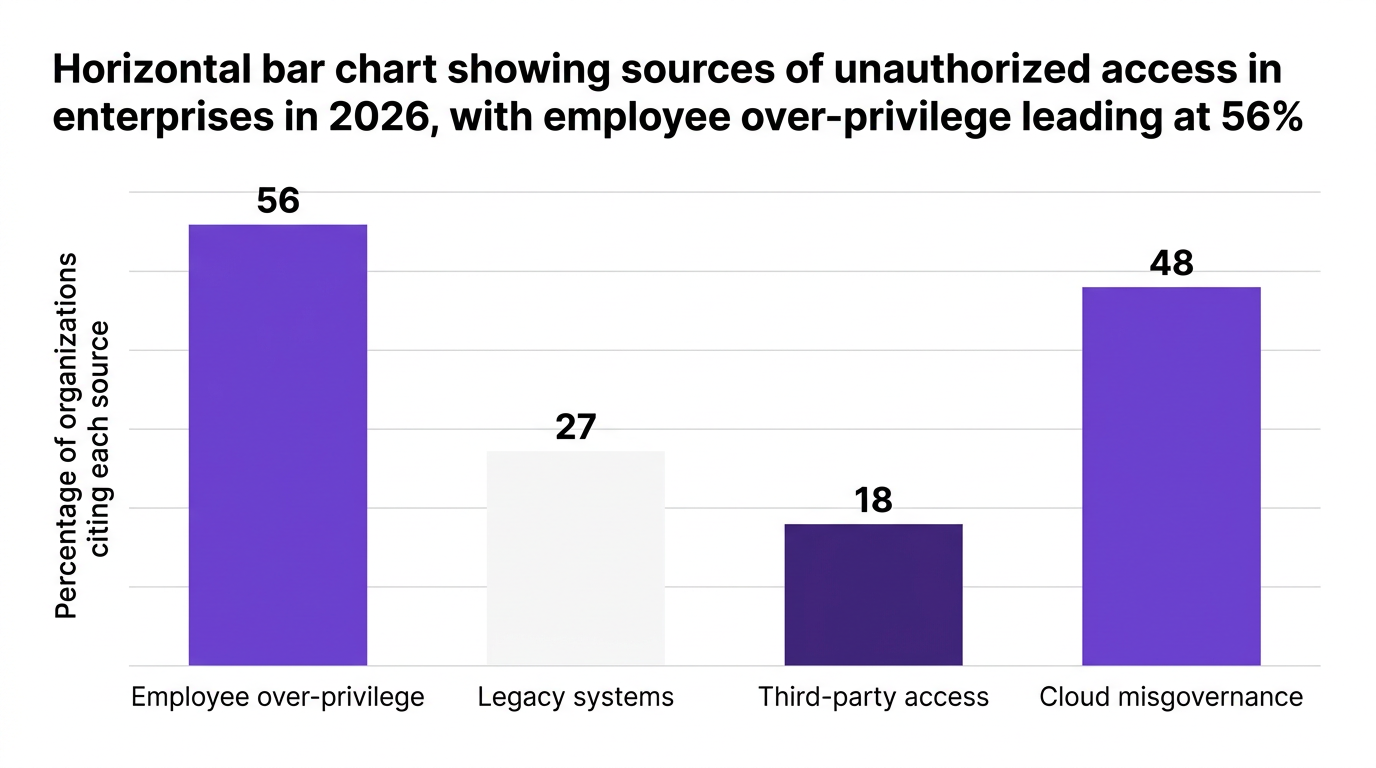
A leading Zero Trust research study from 2026 found that 56% of organizations cite employee over-privilege as the leading contributor to unauthorized access. Another report shows 52% say excessive access or entitlements are widespread. Together, these highlight why least privilege access management must be core to SaaS security.
Onboarding and role changes are where most privilege decisions happen. They are also where least privilege in cyber security often fails.
During secure onboarding, IT teams frequently over-assign permissions to avoid support tickets. When employees change roles or join projects, permissions are stacked instead of swapped. Over time, this creates permission drift, where access accumulates beyond what is necessary.
Several data points show the impact:
Over 70% of cloud security incidents in 2026 are caused by misconfigured privileges, according to industry research.
Privilege misuse accounts for about 6% of data breaches, based on aggregated breach analysis.
One breach study found 64% of financial services companies had over 1,000 sensitive files accessible to all employees, a direct failure of least privilege access control.
Expert commentary from identity governance research in 2026 summarizes the risk: "Identity and access governance must evolve alongside the explosion of machine identities and SaaS adoption. Least privilege is no longer a box to check, but the only viable approach to minimizing blast radius in modern attacks."
Onboarding and role changes are the points where this security principle least privilege succeeds or fails.
The concept of least privilege sounds simple. The execution is complicated by three trends that every CIO and security leader is facing.
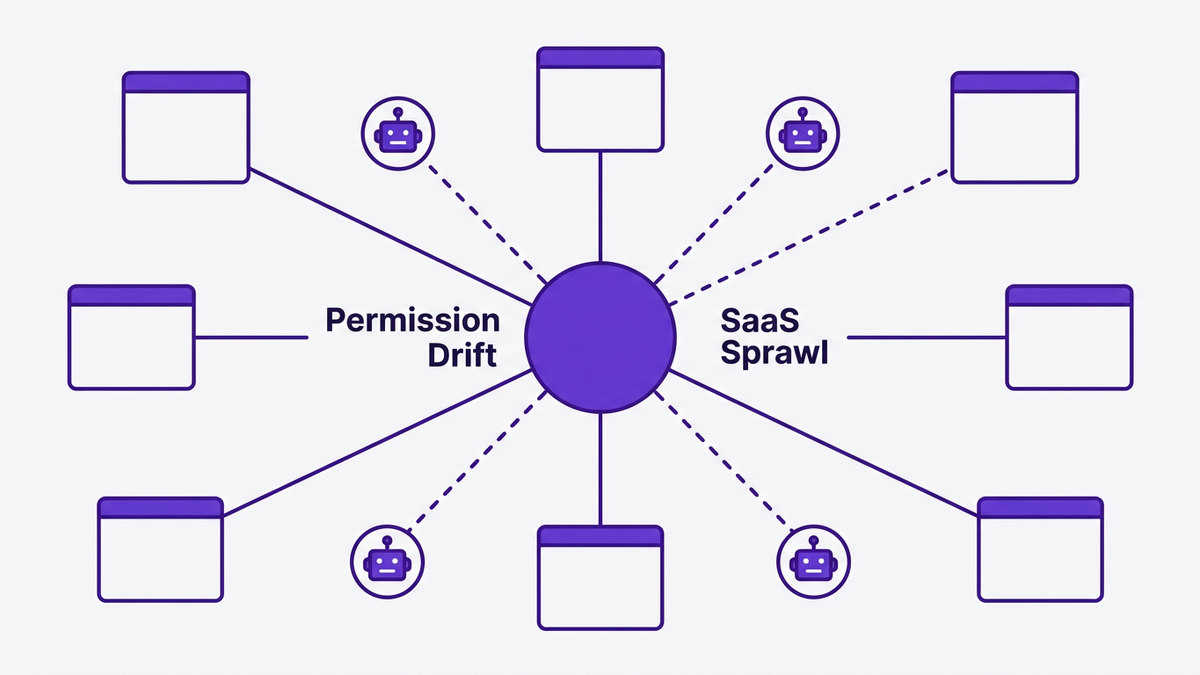
Permission drift occurs when users accumulate access as they move between teams and projects, without old permissions being removed.
For example, a product manager who moves from one business unit to another often keeps legacy access and gains new access. After a few years and multiple projects, their permissions may exceed those of their direct manager.
This violates the least privilege security principle and weakens role based access control least privilege alignment. It also undermines compliance, since audit trails show excessive entitlements that cannot be justified by current responsibilities.
Counterargument: Some leaders argue that small over-privilege is acceptable if it speeds delivery. In reality, permission drift rarely stays small. It compounds over years, creating hundreds or thousands of accounts with least permissions ignored, which increases breach risk and compliance exposure.
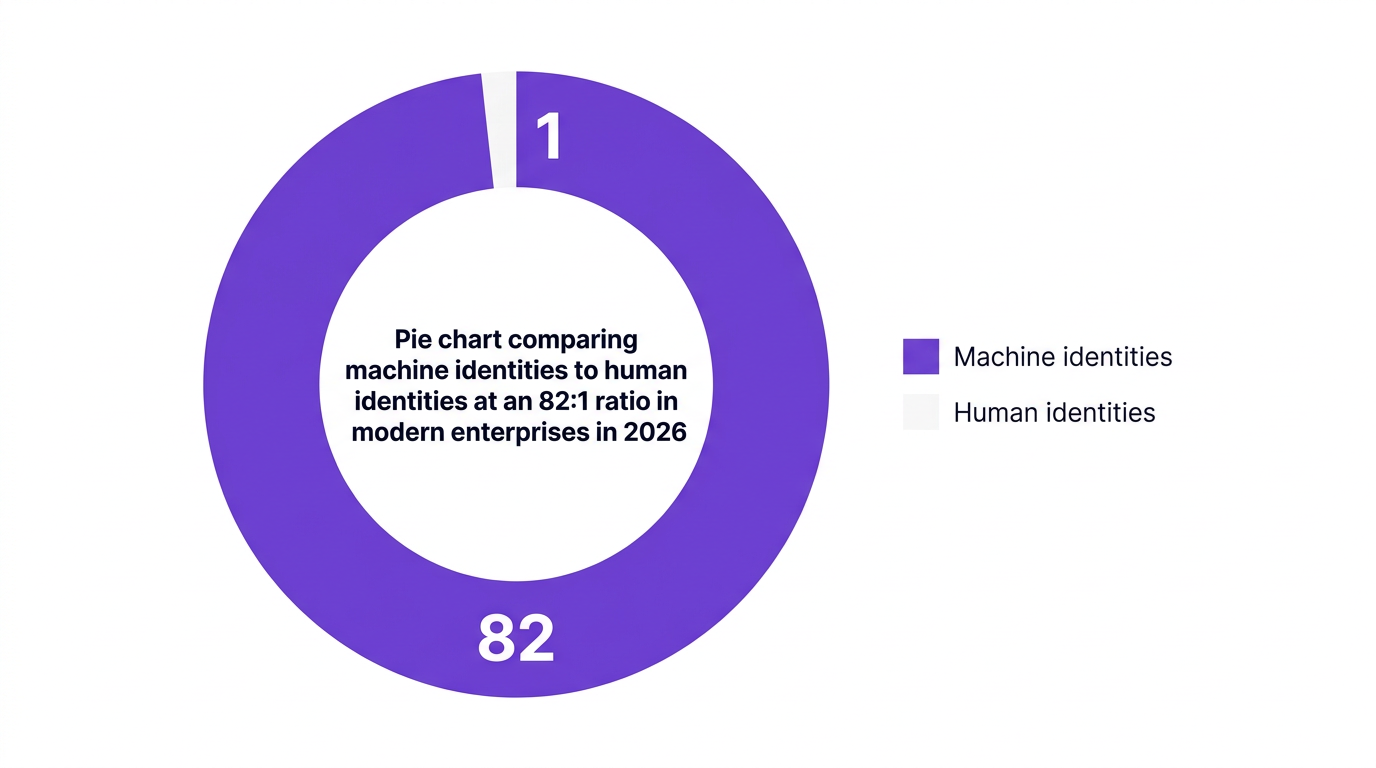
Machine identities now vastly outnumber human identities. One identity governance study cites ratios as high as 82:1 between machine and human accounts.
Every integration, bot, API, and AI agent can have access of least privilege violations. If these machine identities are granted broad privileges and not governed, they expand the attack surface far beyond traditional user accounts.
A cybersecurity trend report from 2026 notes: "Over-privilege among employees and uncontrolled access in cloud apps remain the biggest drivers of unauthorized access. Organizations have the intent, but the execution gap is alarming." That execution gap is even larger for machine identities.
Large enterprises now run hundreds of SaaS tools, each with its own permission model. Access governance teams must align the least privilege access principle across CRM, collaboration suites, DevOps tools, HR systems, analytics platforms, and more.
Cloud and SaaS misgovernance is a top driver of privilege failures. One Zero Trust report found 48% of organizations identify unmanaged app permissions as a leading risk.
This is where least privilege access management often breaks. Manual provisioning and spreadsheet-based tracking cannot keep up with the volume and complexity of entitlements.
To move from theory to practice, enterprises need an enforceable framework that operates at the user lifecycle level.
Here is a four-part model you can apply across your SaaS portfolio.
Role based access control least privilege alignment starts with clear role definitions.
For each function, define:
Core applications required to perform the job.
Permission profiles for those apps, aligned to the minimum access principle.
Guardrails for what access cannot be granted without exception approvals.
This is not a one-time exercise. Gartner and other research bodies emphasize that modern identity governance must be adaptive. As responsibilities evolve, the role catalog and least privilege security principle mappings must be updated.
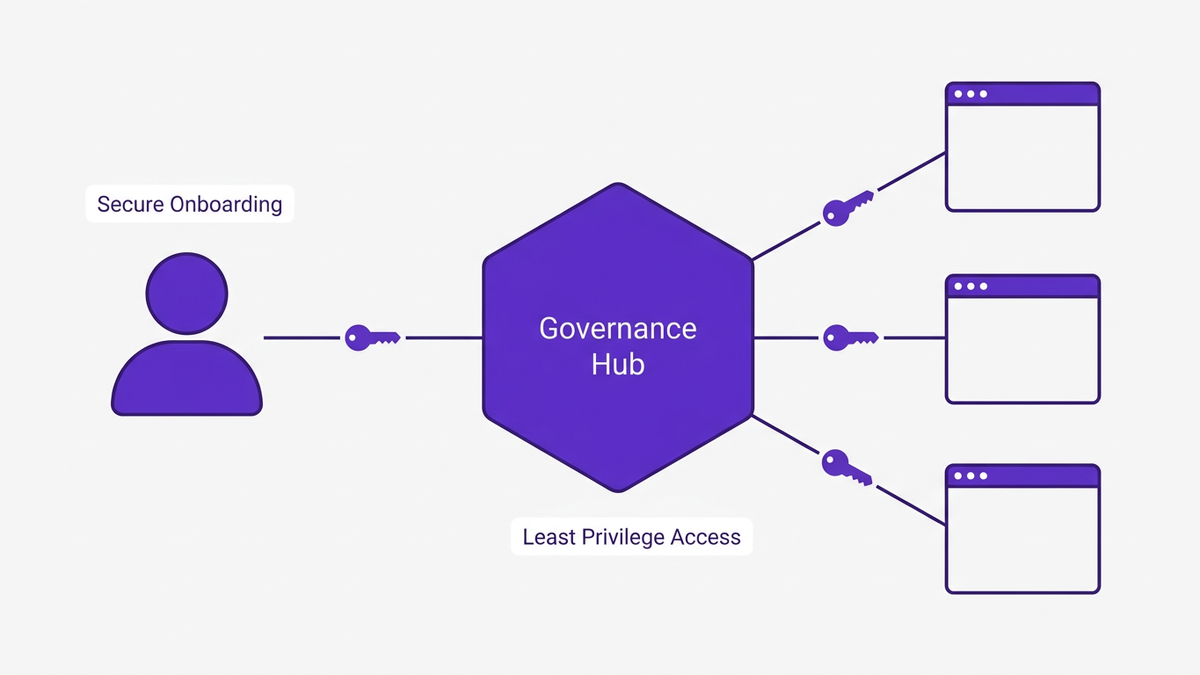
The principle of least privilege access works best when onboarding is request-based rather than blanket-based.
Instead of granting every new employee a full stack of access, use:
Self-service access requests tied to predefined roles.
Manager approvals based on role and project context.
Security reviews for any request that falls outside standard profiles.
This ensures that least access principle rules are enforced from day one, while still giving teams the flexibility to request what they need.
Manual provisioning creates variability and human error. For least privilege cybersecurity to be effective, automation is essential.
Automated provisioning aligns identities to defined roles and rights. Automated de-provisioning removes access when:
Employees leave the organization.
They change teams or job families.
Project assignments end.
A healthcare provider case study from 2026 illustrates the impact. After adopting AI-driven identity governance for onboarding and periodic access review, the organization cut provisioning errors by 60% and eliminated over 8,000 ghost user accounts within the first year.
Least privilege security is not a set-and-forget policy. Continuous access review is necessary.
Effective reviews:
Compare current permissions to the defined role catalog.
Identify over-privileged accounts and unused entitlements.
Trigger remediation workflows and track completion.
Regulatory trend analysis for 2026 notes: "Regulatory requirements now demand auditability and strict least privilege enforcement, not just for compliance, but as fundamental data protection practice." Access reviews are how you demonstrate the principle of least privilege access in audits.
Role changes and project transitions are more complex than onboarding. Access must shift in multiple directions at once.
Here is how to enforce least privilege access control when responsibilities change.
Treat role changes as a mini onboarding and offboarding event.
For each transition:
Identify all applications tied to the old role.
Identify required applications for the new role.
Map least privilege permissions for both sets.
Plan a cutover where old access is removed as new access is granted.
This prevents the common pattern where employees retain all historical access plus new entitlements, which violates the security principle least privilege.
Temporary project access is one of the biggest sources of least privilege failures.
To enforce least permissions:
Use time-bound access with automatic expiry dates.
Require project owner approvals for extensions.
Log all temporary access for review.
This simple pattern keeps least privilege in cyber security meaningful, especially for high-risk data sets and production environments.
Analytics-driven monitoring can detect permission drift early.
Useful signals include:
Accounts with roles that no longer match their permissions.
Users whose access is broader than their peers in similar roles.
Machine identities with elevated entitlements that are rarely used.
Combining these analytics with automated remediation supports least privilege access management at scale.

CloudNuro is built around a governance-first architecture that makes least privilege access practical across hundreds of SaaS and cloud applications.
For enterprises that need strong identity governance and cost discipline, CloudNuro provides the visibility and automation required to implement the policy of least privilege throughout the user lifecycle.
CloudNuro AI Custodian delivers AI-driven least privilege access management across more than 400 SaaS and cloud apps.
Key capabilities include:
Automated role-based access provisioning during onboarding, aligning identities to least privilege profiles.
Dynamic adjustment of entitlements during role changes, removing obsolete access in the same workflow that grants new rights.
Machine identity governance, ensuring bots and integrations adhere to the least privilege security principle.
This allows IT and security teams to apply the rule of least privilege consistently, even as identities and roles scale into the tens of thousands.
Collaboration and CRM platforms are common sources of over-privilege and misconfigured sharing.
CloudNuro provides specialized custodians for these environments:
Microsoft 365 Custodian delivers continuous visibility into permissions, shared content, and license usage. It automatically identifies excessive access and ghost accounts, then applies remediation aligned to the principle of least privilege.
Salesforce Custodian analyzes profiles, permission sets, and license assignments in real time. It detects privilege creep during onboarding and role changes, then enforces least privilege access principle policies through automated actions.
By connecting these capabilities under the unified SaaS management umbrella, CloudNuro ensures the least privilege security principle is not limited to a single application.
Least privilege access is a security and a financial control.
CloudNuro connects access governance with cost optimization through:
Centralized inventories of users, roles, and licenses across applications.
Automated identification of unused or over-privileged licenses.
Integration with FinOps-focused services that align entitlements with spend.
This allows IT, security, and finance to work from a single view of least privilege access control, rather than fragmented spreadsheets.
CloudNuro also supports compliance objectives, aligning least privilege in cyber security with frameworks that demand strong identity governance and auditability.
For IT security teams, the CloudNuro security solutions provide a governance-first foundation, while unified cloud custodian capabilities centralize visibility and control.
Enterprises that succeed with least privilege access share common practices. These are practical steps you can implement now.
Least privilege cybersecurity is not a one-time project. It should be a program with clear ownership.
Key elements:
A cross-functional steering group spanning IT, security, and business owners.
Defined KPIs, such as percentage of over-privileged accounts, remediation time, and ghost account count.
Regular reviews, at least quarterly, of permission drift trends.
The principle of least privilege access is easier to enforce when baselines are standardized.
Create and maintain:
A catalog of business roles mapped to SaaS applications.
Baseline permission sets for each role, aligned with the least privilege security principle.
Exception workflows for approvals when deviations are required.
Manual enforcement of least access principle rules does not scale.
Use automation to:
Provision and de-provision based on HR events and role changes.
Run scheduled access reviews with automated findings and remediation tasks.
Detect anomalies, such as sudden increases in entitlements or access outside role boundaries.
Automation not only strengthens cybersecurity least privilege enforcement but also reduces operational load on IT teams.
Technology alone cannot enforce the concept of least privilege.
Educate employees and managers on:
Why least privilege access matters for security and compliance.
How to request access responsibly.
Their role in approving or rejecting permission changes.
When business leaders understand that least privilege security is a shared responsibility, adoption improves.
Counterargument: Some argue that strict least privilege access control will slow collaboration. In reality, smart role design and automated approval flows can maintain speed while reducing unnecessary exposure. It is similar to using guardrails on a mountain road: you can still drive fast, but with much lower risk.
The principle of least privilege access states that every identity should have only the permissions strictly required to perform its tasks.
In enterprise SaaS environments, this includes human users and machine identities such as bots and integrations. The goal is to reduce the impact of any misuse or compromise by limiting what each account can do.
Onboarding is when most permissions are granted. If new employees receive broad access, the organization starts from a position of over-privilege.
By applying least privilege cybersecurity practices during onboarding, enterprises ensure accounts are created with role-based access that follows the minimum access principle. This reduces both security risk and license waste.
Permission drift occurs when users accumulate access through multiple role changes, projects, and ad hoc approvals.
Old permissions are rarely removed, so access of least privilege is gradually replaced by broad entitlements. Without automated lifecycle management and periodic access review, drift becomes pervasive.
Modern SaaS management platforms, such as CloudNuro, can automate least privilege access principle enforcement by integrating with HR systems, identity providers, and application APIs.
They provision users according to predefined role models, apply least privilege security principle policies, and remove unnecessary permissions when roles change or accounts are deactivated.
Most major security and data protection frameworks reference the policy of least privilege or minimum access principle.
They require organizations to demonstrate that access is limited to what is necessary, that permissions are reviewed periodically, and that identity governance controls are in place across systems and applications.
Least privilege access management reduces unused licenses and excessive entitlements.
By aligning permissions and licenses to actual role needs, and removing unneeded access during role changes or offboarding, enterprises cut waste. Platforms like CloudNuro connect least privilege security with FinOps metrics, enabling IT and finance to optimize spend and governance together.
CloudNuro is a leader in Enterprise SaaS Management Platforms, providing enterprises with unmatched visibility, governance, and cost optimization. Recognized twice in a row in the SaaS Management Platforms category and named a Leader in the SoftwareReviews Data Quadrant, CloudNuro is trusted by global enterprises and government agencies to bring financial discipline to SaaS, cloud, and AI. Trusted by enterprises such as Konica Minolta and Federal Signal, CloudNuro provides centralized SaaS inventory, license optimization, and renewal management along with advanced cost allocation and chargeback, giving IT and Finance leaders the visibility, control, and cost-conscious culture needed to drive financial discipline.
Request a no cost, no obligation free assessment —just 15 minutes to savings!
Get StartedLeast privilege access is no longer a theoretical cybersecurity concept. It is a practical requirement for every enterprise that depends on SaaS and cloud applications.
Onboarding, promotions, transfers, and project-based role changes are the moments when access decisions either reduce risk or silently expand it. Over-privileged accounts, unused licenses, and misaligned roles combine into a perfect storm of exposure.
This guide explains how to enforce least privilege access during onboarding and role transitions, why it matters for identity governance, and how CloudNuro helps enterprises automate the process at scale.
The principle of least privilege states that every identity, human or machine, should have only the minimum permissions required to perform its tasks, nothing more.
In practice, the principle of least privilege access means:
Granting access based on defined roles and responsibilities, not convenience.
Removing unnecessary entitlements as soon as they are no longer needed.
Continuously reviewing and adjusting permissions as roles evolve.
This least access principle is essential for reducing blast radius. When an account is compromised or misused, the damage is limited to what that user or system is allowed to do.
A leading Zero Trust research study from 2026 found that 56% of organizations cite employee over-privilege as the leading contributor to unauthorized access. Another report shows 52% say excessive access or entitlements are widespread. Together, these highlight why least privilege access management must be core to SaaS security.
Onboarding and role changes are where most privilege decisions happen. They are also where least privilege in cyber security often fails.
During secure onboarding, IT teams frequently over-assign permissions to avoid support tickets. When employees change roles or join projects, permissions are stacked instead of swapped. Over time, this creates permission drift, where access accumulates beyond what is necessary.
Several data points show the impact:
Over 70% of cloud security incidents in 2026 are caused by misconfigured privileges, according to industry research.
Privilege misuse accounts for about 6% of data breaches, based on aggregated breach analysis.
One breach study found 64% of financial services companies had over 1,000 sensitive files accessible to all employees, a direct failure of least privilege access control.
Expert commentary from identity governance research in 2026 summarizes the risk: "Identity and access governance must evolve alongside the explosion of machine identities and SaaS adoption. Least privilege is no longer a box to check, but the only viable approach to minimizing blast radius in modern attacks."
Onboarding and role changes are the points where this security principle least privilege succeeds or fails.
The concept of least privilege sounds simple. The execution is complicated by three trends that every CIO and security leader is facing.
Permission drift occurs when users accumulate access as they move between teams and projects, without old permissions being removed.
For example, a product manager who moves from one business unit to another often keeps legacy access and gains new access. After a few years and multiple projects, their permissions may exceed those of their direct manager.
This violates the least privilege security principle and weakens role based access control least privilege alignment. It also undermines compliance, since audit trails show excessive entitlements that cannot be justified by current responsibilities.
Counterargument: Some leaders argue that small over-privilege is acceptable if it speeds delivery. In reality, permission drift rarely stays small. It compounds over years, creating hundreds or thousands of accounts with least permissions ignored, which increases breach risk and compliance exposure.
Machine identities now vastly outnumber human identities. One identity governance study cites ratios as high as 82:1 between machine and human accounts.
Every integration, bot, API, and AI agent can have access of least privilege violations. If these machine identities are granted broad privileges and not governed, they expand the attack surface far beyond traditional user accounts.
A cybersecurity trend report from 2026 notes: "Over-privilege among employees and uncontrolled access in cloud apps remain the biggest drivers of unauthorized access. Organizations have the intent, but the execution gap is alarming." That execution gap is even larger for machine identities.
Large enterprises now run hundreds of SaaS tools, each with its own permission model. Access governance teams must align the least privilege access principle across CRM, collaboration suites, DevOps tools, HR systems, analytics platforms, and more.
Cloud and SaaS misgovernance is a top driver of privilege failures. One Zero Trust report found 48% of organizations identify unmanaged app permissions as a leading risk.
This is where least privilege access management often breaks. Manual provisioning and spreadsheet-based tracking cannot keep up with the volume and complexity of entitlements.
To move from theory to practice, enterprises need an enforceable framework that operates at the user lifecycle level.
Here is a four-part model you can apply across your SaaS portfolio.
Role based access control least privilege alignment starts with clear role definitions.
For each function, define:
Core applications required to perform the job.
Permission profiles for those apps, aligned to the minimum access principle.
Guardrails for what access cannot be granted without exception approvals.
This is not a one-time exercise. Gartner and other research bodies emphasize that modern identity governance must be adaptive. As responsibilities evolve, the role catalog and least privilege security principle mappings must be updated.
The principle of least privilege access works best when onboarding is request-based rather than blanket-based.
Instead of granting every new employee a full stack of access, use:
Self-service access requests tied to predefined roles.
Manager approvals based on role and project context.
Security reviews for any request that falls outside standard profiles.
This ensures that least access principle rules are enforced from day one, while still giving teams the flexibility to request what they need.
Manual provisioning creates variability and human error. For least privilege cybersecurity to be effective, automation is essential.
Automated provisioning aligns identities to defined roles and rights. Automated de-provisioning removes access when:
Employees leave the organization.
They change teams or job families.
Project assignments end.
A healthcare provider case study from 2026 illustrates the impact. After adopting AI-driven identity governance for onboarding and periodic access review, the organization cut provisioning errors by 60% and eliminated over 8,000 ghost user accounts within the first year.
Least privilege security is not a set-and-forget policy. Continuous access review is necessary.
Effective reviews:
Compare current permissions to the defined role catalog.
Identify over-privileged accounts and unused entitlements.
Trigger remediation workflows and track completion.
Regulatory trend analysis for 2026 notes: "Regulatory requirements now demand auditability and strict least privilege enforcement, not just for compliance, but as fundamental data protection practice." Access reviews are how you demonstrate the principle of least privilege access in audits.
Role changes and project transitions are more complex than onboarding. Access must shift in multiple directions at once.
Here is how to enforce least privilege access control when responsibilities change.
Treat role changes as a mini onboarding and offboarding event.
For each transition:
Identify all applications tied to the old role.
Identify required applications for the new role.
Map least privilege permissions for both sets.
Plan a cutover where old access is removed as new access is granted.
This prevents the common pattern where employees retain all historical access plus new entitlements, which violates the security principle least privilege.
Temporary project access is one of the biggest sources of least privilege failures.
To enforce least permissions:
Use time-bound access with automatic expiry dates.
Require project owner approvals for extensions.
Log all temporary access for review.
This simple pattern keeps least privilege in cyber security meaningful, especially for high-risk data sets and production environments.
Analytics-driven monitoring can detect permission drift early.
Useful signals include:
Accounts with roles that no longer match their permissions.
Users whose access is broader than their peers in similar roles.
Machine identities with elevated entitlements that are rarely used.
Combining these analytics with automated remediation supports least privilege access management at scale.
CloudNuro is built around a governance-first architecture that makes least privilege access practical across hundreds of SaaS and cloud applications.
For enterprises that need strong identity governance and cost discipline, CloudNuro provides the visibility and automation required to implement the policy of least privilege throughout the user lifecycle.
CloudNuro AI Custodian delivers AI-driven least privilege access management across more than 400 SaaS and cloud apps.
Key capabilities include:
Automated role-based access provisioning during onboarding, aligning identities to least privilege profiles.
Dynamic adjustment of entitlements during role changes, removing obsolete access in the same workflow that grants new rights.
Machine identity governance, ensuring bots and integrations adhere to the least privilege security principle.
This allows IT and security teams to apply the rule of least privilege consistently, even as identities and roles scale into the tens of thousands.
Collaboration and CRM platforms are common sources of over-privilege and misconfigured sharing.
CloudNuro provides specialized custodians for these environments:
Microsoft 365 Custodian delivers continuous visibility into permissions, shared content, and license usage. It automatically identifies excessive access and ghost accounts, then applies remediation aligned to the principle of least privilege.
Salesforce Custodian analyzes profiles, permission sets, and license assignments in real time. It detects privilege creep during onboarding and role changes, then enforces least privilege access principle policies through automated actions.
By connecting these capabilities under the unified SaaS management umbrella, CloudNuro ensures the least privilege security principle is not limited to a single application.
Least privilege access is a security and a financial control.
CloudNuro connects access governance with cost optimization through:
Centralized inventories of users, roles, and licenses across applications.
Automated identification of unused or over-privileged licenses.
Integration with FinOps-focused services that align entitlements with spend.
This allows IT, security, and finance to work from a single view of least privilege access control, rather than fragmented spreadsheets.
CloudNuro also supports compliance objectives, aligning least privilege in cyber security with frameworks that demand strong identity governance and auditability.
For IT security teams, the CloudNuro security solutions provide a governance-first foundation, while unified cloud custodian capabilities centralize visibility and control.
Enterprises that succeed with least privilege access share common practices. These are practical steps you can implement now.
Least privilege cybersecurity is not a one-time project. It should be a program with clear ownership.
Key elements:
A cross-functional steering group spanning IT, security, and business owners.
Defined KPIs, such as percentage of over-privileged accounts, remediation time, and ghost account count.
Regular reviews, at least quarterly, of permission drift trends.
The principle of least privilege access is easier to enforce when baselines are standardized.
Create and maintain:
A catalog of business roles mapped to SaaS applications.
Baseline permission sets for each role, aligned with the least privilege security principle.
Exception workflows for approvals when deviations are required.
Manual enforcement of least access principle rules does not scale.
Use automation to:
Provision and de-provision based on HR events and role changes.
Run scheduled access reviews with automated findings and remediation tasks.
Detect anomalies, such as sudden increases in entitlements or access outside role boundaries.
Automation not only strengthens cybersecurity least privilege enforcement but also reduces operational load on IT teams.
Technology alone cannot enforce the concept of least privilege.
Educate employees and managers on:
Why least privilege access matters for security and compliance.
How to request access responsibly.
Their role in approving or rejecting permission changes.
When business leaders understand that least privilege security is a shared responsibility, adoption improves.
Counterargument: Some argue that strict least privilege access control will slow collaboration. In reality, smart role design and automated approval flows can maintain speed while reducing unnecessary exposure. It is similar to using guardrails on a mountain road: you can still drive fast, but with much lower risk.
The principle of least privilege access states that every identity should have only the permissions strictly required to perform its tasks.
In enterprise SaaS environments, this includes human users and machine identities such as bots and integrations. The goal is to reduce the impact of any misuse or compromise by limiting what each account can do.
Onboarding is when most permissions are granted. If new employees receive broad access, the organization starts from a position of over-privilege.
By applying least privilege cybersecurity practices during onboarding, enterprises ensure accounts are created with role-based access that follows the minimum access principle. This reduces both security risk and license waste.
Permission drift occurs when users accumulate access through multiple role changes, projects, and ad hoc approvals.
Old permissions are rarely removed, so access of least privilege is gradually replaced by broad entitlements. Without automated lifecycle management and periodic access review, drift becomes pervasive.
Modern SaaS management platforms, such as CloudNuro, can automate least privilege access principle enforcement by integrating with HR systems, identity providers, and application APIs.
They provision users according to predefined role models, apply least privilege security principle policies, and remove unnecessary permissions when roles change or accounts are deactivated.
Most major security and data protection frameworks reference the policy of least privilege or minimum access principle.
They require organizations to demonstrate that access is limited to what is necessary, that permissions are reviewed periodically, and that identity governance controls are in place across systems and applications.
Least privilege access management reduces unused licenses and excessive entitlements.
By aligning permissions and licenses to actual role needs, and removing unneeded access during role changes or offboarding, enterprises cut waste. Platforms like CloudNuro connect least privilege security with FinOps metrics, enabling IT and finance to optimize spend and governance together.
CloudNuro is a leader in Enterprise SaaS Management Platforms, providing enterprises with unmatched visibility, governance, and cost optimization. Recognized twice in a row in the SaaS Management Platforms category and named a Leader in the SoftwareReviews Data Quadrant, CloudNuro is trusted by global enterprises and government agencies to bring financial discipline to SaaS, cloud, and AI. Trusted by enterprises such as Konica Minolta and Federal Signal, CloudNuro provides centralized SaaS inventory, license optimization, and renewal management along with advanced cost allocation and chargeback, giving IT and Finance leaders the visibility, control, and cost-conscious culture needed to drive financial discipline.
Request a no cost, no obligation free assessment - just 15 minutes to savings!
Get StartedWe're offering complimentary ServiceNow license assessments to only 25 enterprises this quarter who want to unlock immediate savings without disrupting operations.
Get Free AssessmentGet Started




CloudNuro Corp
1755 Park St. Suite 207
Naperville, IL 60563
Phone : +1-630-277-9470
Email: info@cloudnuro.com




.webp)

Recognized Leader in SaaS Management Platforms by Info-Tech SoftwareReviews


.svg)