

Sign Up
Thank you for Submitting!
Cloud adoption has revolutionized enterprise data strategy, but it has also unleashed a subtle and expensive challenge: fabric data pipeline sprawl. While the promise of analytics-ready data is irresistible, hundreds of small, fragmented pipelines quietly multiply costs and operational risks. For CIOs, CTOs, and IT leaders, understanding the full cost impact of these patterns, and how intelligent consolidation can drive cost optimization and governance, is no longer optional.
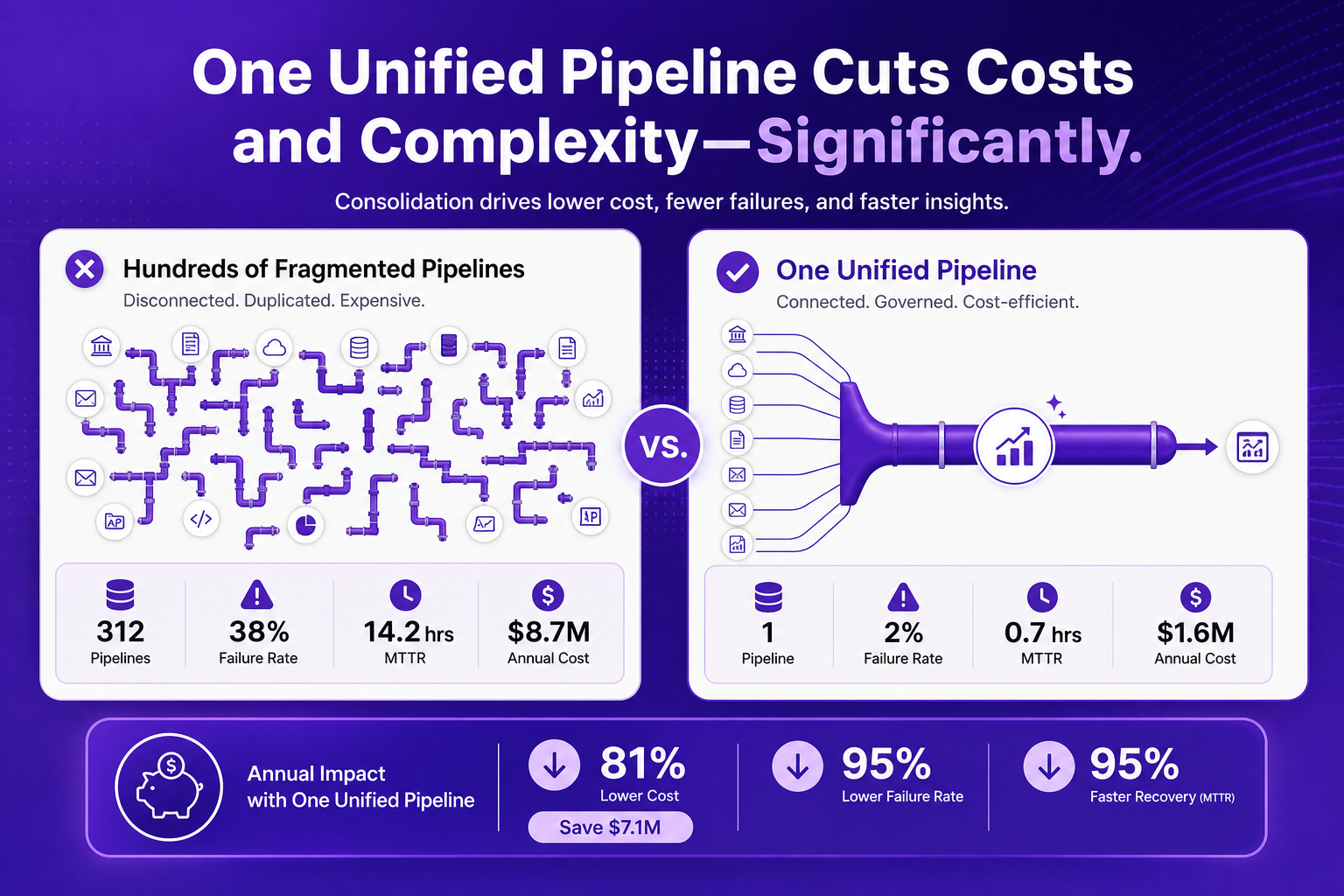
This article dives deep into why 240 small fabric data pipelines can cost 240 times as much as one, explores the challenges and hidden expenses, and outlines best practices for unifying and governing enterprise data pipelines. We will also show how CloudNuro empowers leaders to regain control, cut costs, and maximize value from their cloud and SaaS data stack.
On the surface, creating a new fabric data pipeline is effortless, just a few clicks, a new data source, and you are off. But this speed is a double-edged sword: every micro-pipeline spins up its own orchestration, compute billing cycle, and administrative overhead. Multiply that by dozens or hundreds, and costs explode.
Capacity Units Run Continuously: Each pipeline consumes Capacity Units, regardless of workload size. They run 24/7 unless auto-paused.
Incremental Copy Operations Add Up: Frequent, small incremental copy jobs can rack up to 3.0 hours of capacity per execution.
Smoothing Mechanic Conceals Costs: Deferred compute debt via smoothing can create surprise charges if capacity is paused mid-cycle.
Smaller Capacities, Larger Overhead: Limited capacities face higher compute contention, making orchestration expensive; batching is required but rarely practiced in sprawl scenarios.
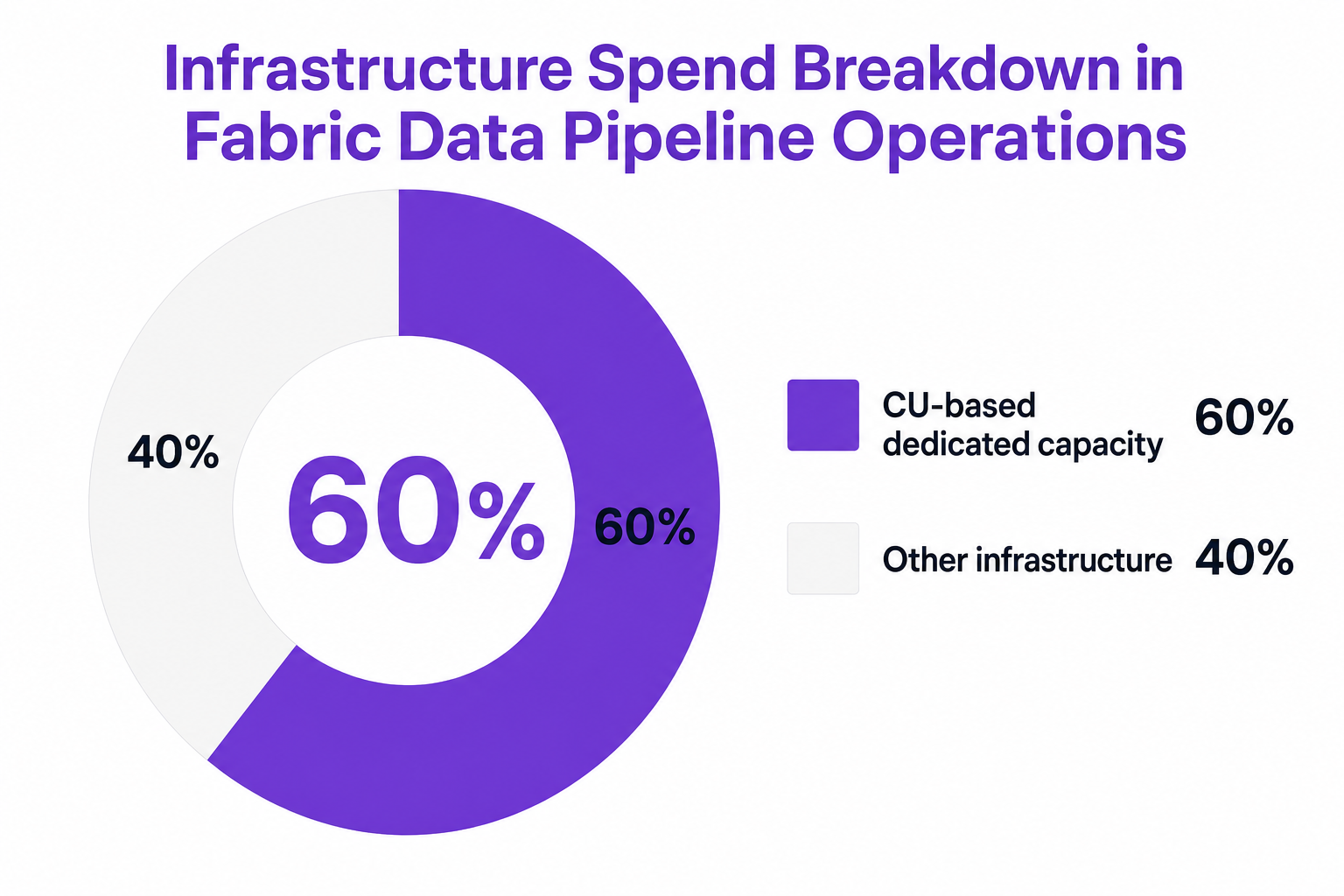
Idle Spend Is Massive: Idle, non-autopaused pipelines can represent 40% to 60% in unnecessary spend.
Key Statistic: Between 27% and 35% of cloud infrastructure spend is wasted on idle or underused capacity.
Let’s put the scale in perspective: If each of your 240 small fabric data pipelines runs independently, each one triggers its own minimum compute spend, monitoring, and management overhead. The aggregation of these micro-charges is what creates the infamous cost multiplier:
No resource sharing: Each pipeline pays the orchestration overhead.
No batching, no optimization: Each pipeline is billed at retail compute rates, with no aggregate discounts.
Manual monitoring overload: Visibility and governance break down as datasets and jobs fragment.
A multinational bank reduced premium capacity costs by 31% in one month after deploying real-time capacity analytics and chargeback dashboards.
A financial institution achieved a 25% reduction in idle capacity and $2.1M in annual cost avoidance with centralized pipeline consolidation.
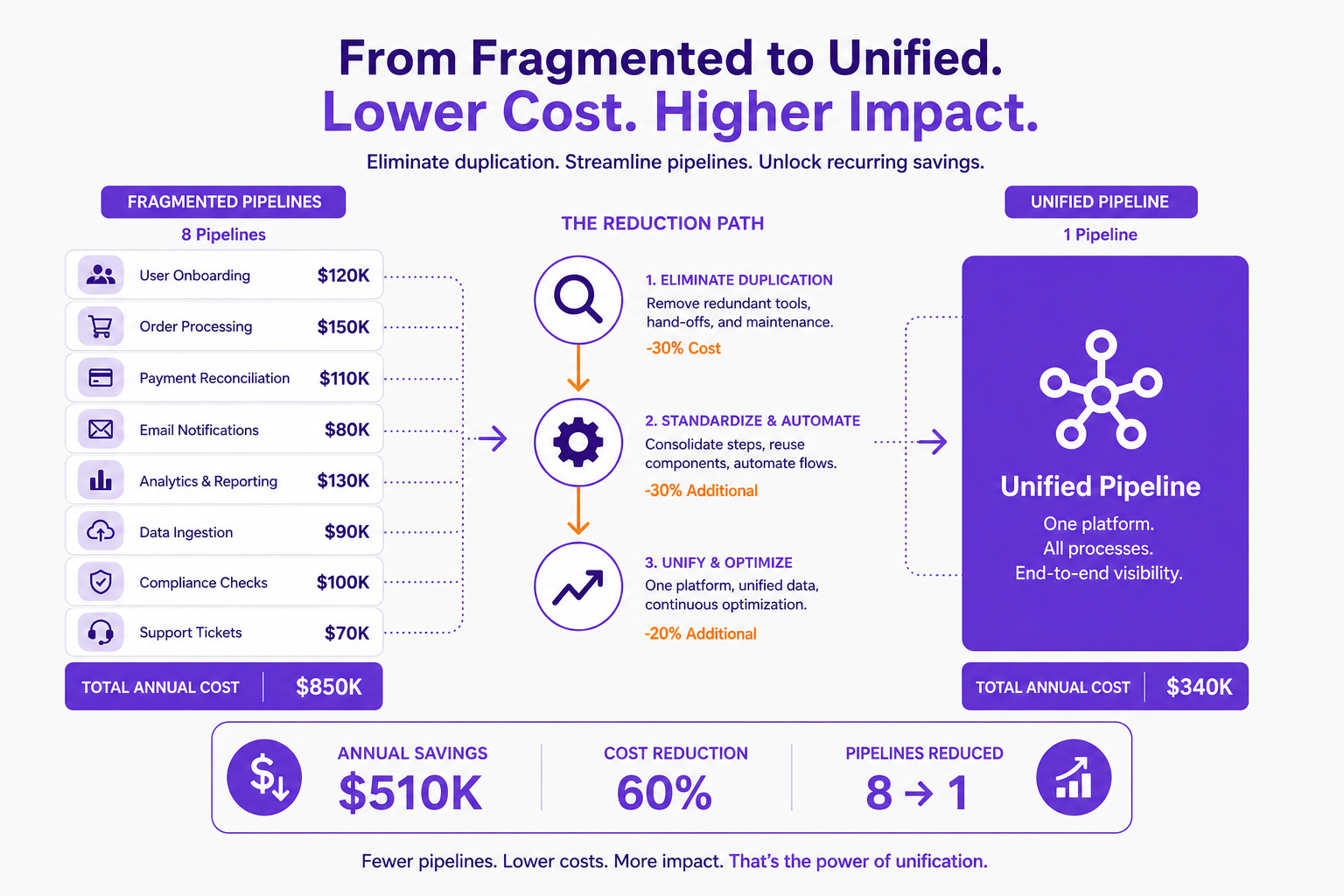
Pipeline sprawl is not simply an accident of growth; it is the combined result of:
Tool Complexity: 78% of teams face tool chaos and long development cycles; fragmentation compounds this challenge.
Short-Term Thinking: Non-production and test workloads are rarely paused or rightsized; without automation, costs go unnoticed.
Poor Visibility: Native metrics retain data only for 14 days; IT teams cannot track trends or optimize long-term.
Manual Governance: Manual review processes cannot keep up when hundreds of micro-pipelines proliferate.
Insufficient Chargeback: Without precise usage-to-cost mapping, departments lack incentives to consolidate or optimize usages.
Expert Insight: Teams that formalize cloud cost KPIs typically achieve 15.30% cost reductions as their FinOps maturity grows.
The pathway to streamlined, cost-effective pipeline operations hinges on automation, data-driven monitoring, and policy-based governance. Here is what leading organizations do differently:
Aggregate data movement into fewer, larger pipelines. Batch daily or weekly data movement, minimizing orchestration overhead and reducing compute contention.
Set default auto-pause (especially on non-production capacities) to cut 40.60% of idle spend without impacting production SLAs.
Export pipeline operations data into a centralized lakehouse for visibility beyond the 14-day retention period; analyze trends and surface anomalies.
Deploy a governance-first architecture to automatically:
Track and suspend idle or anomalous pipelines
Trigger downgrades when engagement falls
Generate chargeback reports mapped by department
Use rule-based chargeback dashboards so each department absorbs the correct operational cost, creating financial discipline.
CloudNuro’s Unified Cloud Custodian integrates these best practices into a single platform:
Automated governance policies that detect anomalies and suspend workloads off-hours
Real-time capacity analytics and rule-based chargeback dashboards
AI-driven access reviews to maintain resource hygiene
Deep integration with 400+ SaaS and cloud platforms for full visibility
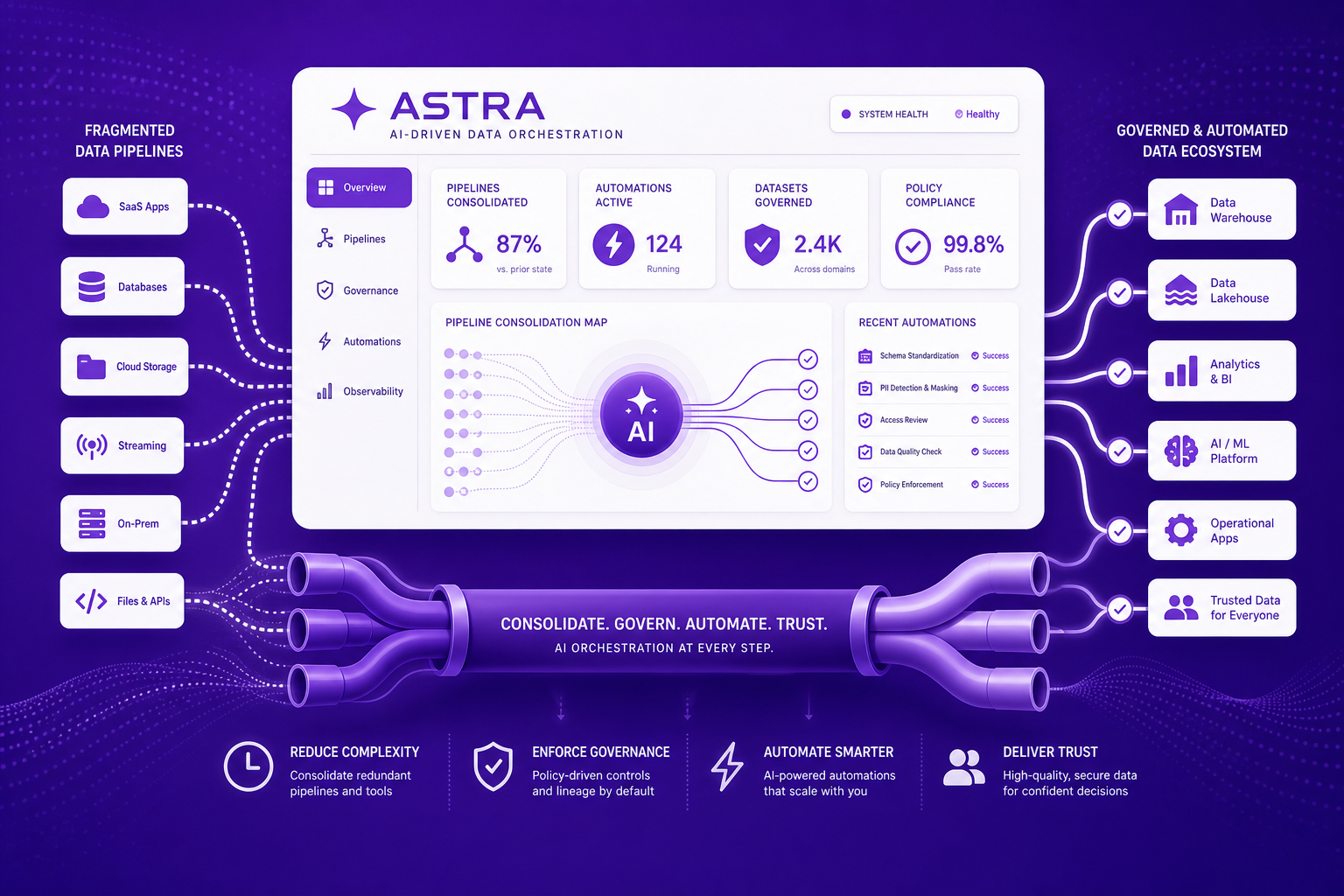
The debate often arises: should you stick with scattered dataflow gen2 pipelines, or consolidate under a single, governed fabric data pipeline?
Dataflow Gen2 vs. Fabric Data Pipelines Cost: Individual dataflows are easy to set up but become costly at scale. Consolidated pipelines allow better batching and smart scheduling, drastically cutting costs and wait times.
Fabric Data Factory Cost Control: Consolidated orchestration means fewer compute cycles, minimized chargeback disputes, and streamlined governance.
Key Statistic: Organizations implementing optimized cloud data pipelines see an average 299% ROI over three years.
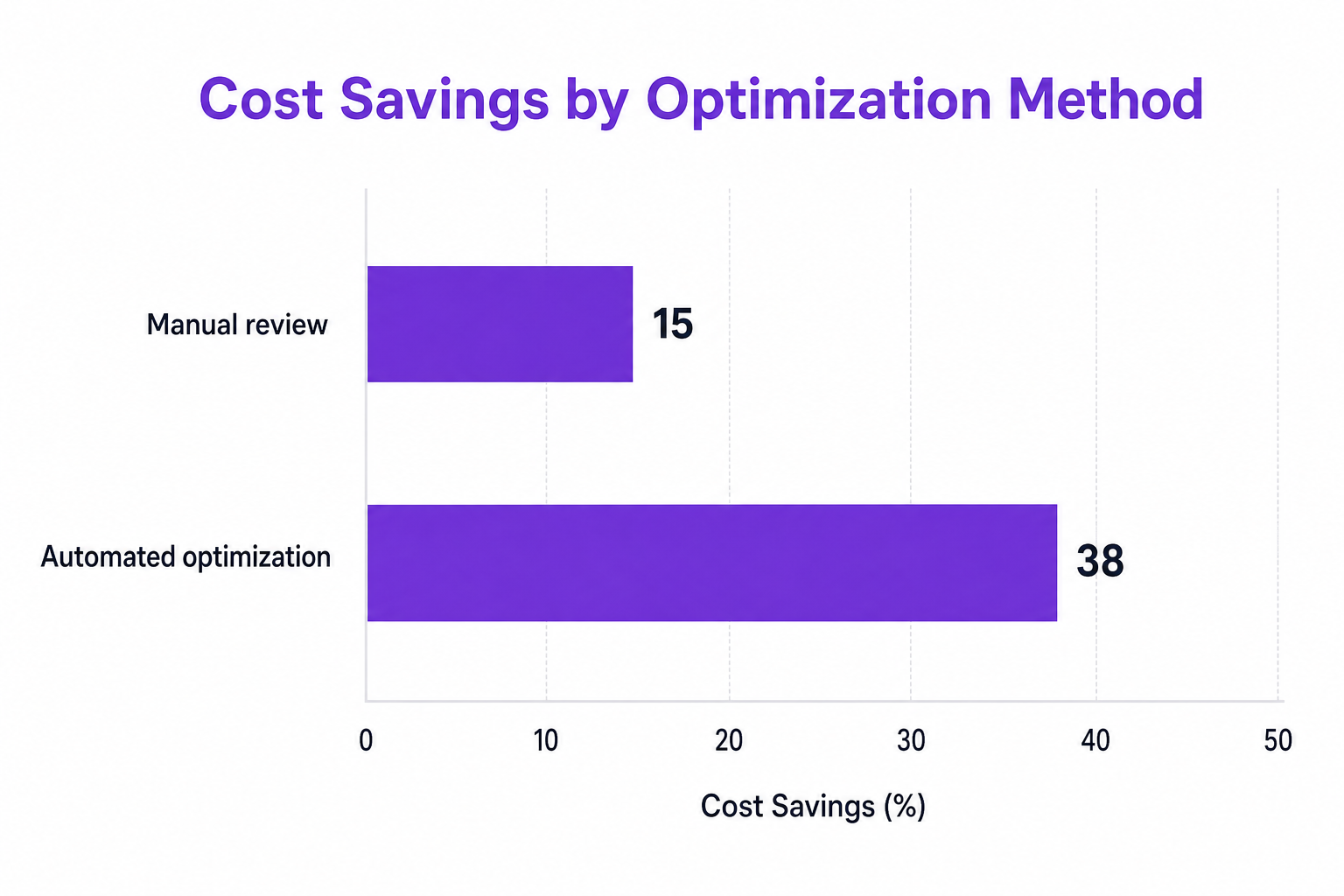
25% through 31% Cost Avoidance: Seen by top global enterprises through robust monitoring and consolidation.
Up to 60% Idle Spend Reduction: Achievable through automated pause and consolidation strategies.
Average 299% ROI: Cited for organizations with optimized, governed data pipelines.
Market Trend: 62% of enterprises cite optimizing existing cloud use for cost savings as their top priority.
CloudNuro clients routinely reclaim millions by right-sizing, cleaning up user licenses, and automating governance.
What is the cost impact of having multiple fabric data pipelines?
The cost impact is exponential. Each pipeline adds its own capacity charges, orchestration, and monitoring overhead. Hundreds of small pipelines multiply idle spend and increase the risk of unnoticed anomalies, making operational costs far exceed those of a single, consolidated pipeline.
How does pipeline consolidation in fabric data environments save money?
Consolidation eliminates redundant orchestration, enables resource pooling and batching, and simplifies governance. This can cut costs by 30% or more and dramatically reduce management complexity and idle spend.
What are best practices for fabric data pipeline consolidation?
Centralize orchestration, automate pause schedules, retain long-term operational data, deploy governance automation, and enable accurate chargeback processes for every business unit.
How does fabric data factory cost compare to consolidated pipelines?
Consolidated pipelines typically use compute more efficiently, offer better scheduling, avoid surprise smoothing mechanic charges, and support automation, making them more cost-effective than many scattered pipelines.
What are the main differences between dataflow gen2 and fabric data pipeline costs?
Dataflow gen2 is quick for simple jobs, but costs escalate at scale due to separate orchestration and monitoring for each job. Consolidated fabric data pipelines provide greater control, cost efficiency, and facilitate enforceable governance.
Fabric data pipelines have the power to transform enterprise analytics. But only when managed with discipline and visibility. Consolidating hundreds of micro-pipelines into unified, optimized, and governed orchestration is the most immediate, high-impact way for enterprise IT leaders to eliminate waste and unlock value.
CloudNuro’s FinOps Services give you the toolkit to cut costs, automate governance, and achieve centralized, AI-enabled control over your entire SaaS and cloud data stack.
Ready to replace 240 expensive, fragmented pipelines with one unified, cost-effective data operation? Let CloudNuro show you the way.
About CloudNuro. CloudNuro is a leader in Enterprise AI Adoption Management, providing enterprises with unmatched visibility, governance, and cost optimization. Recognized twice in a row in the SaaS Management Platforms category and named a Leader in the SoftwareReviews Data Quadrant, CloudNuro is trusted by global enterprises and government agencies to bring financial discipline to SaaS, cloud, and AI. Trusted by enterprises, CloudNuro provides centralized SaaS inventory, license optimization, and renewal management along with advanced cost allocation and chargeback, giving IT and Finance leaders the visibility, control, and cost-conscious culture needed to drive financial discipline.
Request a no cost, no obligation free assessment —just 15 minutes to savings!
Get StartedCloud adoption has revolutionized enterprise data strategy, but it has also unleashed a subtle and expensive challenge: fabric data pipeline sprawl. While the promise of analytics-ready data is irresistible, hundreds of small, fragmented pipelines quietly multiply costs and operational risks. For CIOs, CTOs, and IT leaders, understanding the full cost impact of these patterns, and how intelligent consolidation can drive cost optimization and governance, is no longer optional.
This article dives deep into why 240 small fabric data pipelines can cost 240 times as much as one, explores the challenges and hidden expenses, and outlines best practices for unifying and governing enterprise data pipelines. We will also show how CloudNuro empowers leaders to regain control, cut costs, and maximize value from their cloud and SaaS data stack.
On the surface, creating a new fabric data pipeline is effortless, just a few clicks, a new data source, and you are off. But this speed is a double-edged sword: every micro-pipeline spins up its own orchestration, compute billing cycle, and administrative overhead. Multiply that by dozens or hundreds, and costs explode.
Capacity Units Run Continuously: Each pipeline consumes Capacity Units, regardless of workload size. They run 24/7 unless auto-paused.
Incremental Copy Operations Add Up: Frequent, small incremental copy jobs can rack up to 3.0 hours of capacity per execution.
Smoothing Mechanic Conceals Costs: Deferred compute debt via smoothing can create surprise charges if capacity is paused mid-cycle.
Smaller Capacities, Larger Overhead: Limited capacities face higher compute contention, making orchestration expensive; batching is required but rarely practiced in sprawl scenarios.
Idle Spend Is Massive: Idle, non-autopaused pipelines can represent 40% to 60% in unnecessary spend.
Key Statistic: Between 27% and 35% of cloud infrastructure spend is wasted on idle or underused capacity.
Let’s put the scale in perspective: If each of your 240 small fabric data pipelines runs independently, each one triggers its own minimum compute spend, monitoring, and management overhead. The aggregation of these micro-charges is what creates the infamous cost multiplier:
No resource sharing: Each pipeline pays the orchestration overhead.
No batching, no optimization: Each pipeline is billed at retail compute rates, with no aggregate discounts.
Manual monitoring overload: Visibility and governance break down as datasets and jobs fragment.
A multinational bank reduced premium capacity costs by 31% in one month after deploying real-time capacity analytics and chargeback dashboards.
A financial institution achieved a 25% reduction in idle capacity and $2.1M in annual cost avoidance with centralized pipeline consolidation.
Pipeline sprawl is not simply an accident of growth; it is the combined result of:
Tool Complexity: 78% of teams face tool chaos and long development cycles; fragmentation compounds this challenge.
Short-Term Thinking: Non-production and test workloads are rarely paused or rightsized; without automation, costs go unnoticed.
Poor Visibility: Native metrics retain data only for 14 days; IT teams cannot track trends or optimize long-term.
Manual Governance: Manual review processes cannot keep up when hundreds of micro-pipelines proliferate.
Insufficient Chargeback: Without precise usage-to-cost mapping, departments lack incentives to consolidate or optimize usages.
Expert Insight: Teams that formalize cloud cost KPIs typically achieve 15.30% cost reductions as their FinOps maturity grows.
The pathway to streamlined, cost-effective pipeline operations hinges on automation, data-driven monitoring, and policy-based governance. Here is what leading organizations do differently:
Aggregate data movement into fewer, larger pipelines. Batch daily or weekly data movement, minimizing orchestration overhead and reducing compute contention.
Set default auto-pause (especially on non-production capacities) to cut 40.60% of idle spend without impacting production SLAs.
Export pipeline operations data into a centralized lakehouse for visibility beyond the 14-day retention period; analyze trends and surface anomalies.
Deploy a governance-first architecture to automatically:
Track and suspend idle or anomalous pipelines
Trigger downgrades when engagement falls
Generate chargeback reports mapped by department
Use rule-based chargeback dashboards so each department absorbs the correct operational cost, creating financial discipline.
CloudNuro’s Unified Cloud Custodian integrates these best practices into a single platform:
Automated governance policies that detect anomalies and suspend workloads off-hours
Real-time capacity analytics and rule-based chargeback dashboards
AI-driven access reviews to maintain resource hygiene
Deep integration with 400+ SaaS and cloud platforms for full visibility
The debate often arises: should you stick with scattered dataflow gen2 pipelines, or consolidate under a single, governed fabric data pipeline?
Dataflow Gen2 vs. Fabric Data Pipelines Cost: Individual dataflows are easy to set up but become costly at scale. Consolidated pipelines allow better batching and smart scheduling, drastically cutting costs and wait times.
Fabric Data Factory Cost Control: Consolidated orchestration means fewer compute cycles, minimized chargeback disputes, and streamlined governance.
Key Statistic: Organizations implementing optimized cloud data pipelines see an average 299% ROI over three years.
25% through 31% Cost Avoidance: Seen by top global enterprises through robust monitoring and consolidation.
Up to 60% Idle Spend Reduction: Achievable through automated pause and consolidation strategies.
Average 299% ROI: Cited for organizations with optimized, governed data pipelines.
Market Trend: 62% of enterprises cite optimizing existing cloud use for cost savings as their top priority.
CloudNuro clients routinely reclaim millions by right-sizing, cleaning up user licenses, and automating governance.
What is the cost impact of having multiple fabric data pipelines?
The cost impact is exponential. Each pipeline adds its own capacity charges, orchestration, and monitoring overhead. Hundreds of small pipelines multiply idle spend and increase the risk of unnoticed anomalies, making operational costs far exceed those of a single, consolidated pipeline.
How does pipeline consolidation in fabric data environments save money?
Consolidation eliminates redundant orchestration, enables resource pooling and batching, and simplifies governance. This can cut costs by 30% or more and dramatically reduce management complexity and idle spend.
What are best practices for fabric data pipeline consolidation?
Centralize orchestration, automate pause schedules, retain long-term operational data, deploy governance automation, and enable accurate chargeback processes for every business unit.
How does fabric data factory cost compare to consolidated pipelines?
Consolidated pipelines typically use compute more efficiently, offer better scheduling, avoid surprise smoothing mechanic charges, and support automation, making them more cost-effective than many scattered pipelines.
What are the main differences between dataflow gen2 and fabric data pipeline costs?
Dataflow gen2 is quick for simple jobs, but costs escalate at scale due to separate orchestration and monitoring for each job. Consolidated fabric data pipelines provide greater control, cost efficiency, and facilitate enforceable governance.
Fabric data pipelines have the power to transform enterprise analytics. But only when managed with discipline and visibility. Consolidating hundreds of micro-pipelines into unified, optimized, and governed orchestration is the most immediate, high-impact way for enterprise IT leaders to eliminate waste and unlock value.
CloudNuro’s FinOps Services give you the toolkit to cut costs, automate governance, and achieve centralized, AI-enabled control over your entire SaaS and cloud data stack.
Ready to replace 240 expensive, fragmented pipelines with one unified, cost-effective data operation? Let CloudNuro show you the way.
About CloudNuro. CloudNuro is a leader in Enterprise AI Adoption Management, providing enterprises with unmatched visibility, governance, and cost optimization. Recognized twice in a row in the SaaS Management Platforms category and named a Leader in the SoftwareReviews Data Quadrant, CloudNuro is trusted by global enterprises and government agencies to bring financial discipline to SaaS, cloud, and AI. Trusted by enterprises, CloudNuro provides centralized SaaS inventory, license optimization, and renewal management along with advanced cost allocation and chargeback, giving IT and Finance leaders the visibility, control, and cost-conscious culture needed to drive financial discipline.
Request a no cost, no obligation free assessment - just 15 minutes to savings!
Get StartedWe're offering complimentary ServiceNow license assessments to only 25 enterprises this quarter who want to unlock immediate savings without disrupting operations.
Get Free AssessmentGet Started




CloudNuro Corp
1755 Park St. Suite 207
Naperville, IL 60563
Phone : +1-630-277-9470
Email: info@cloudnuro.com





.webp)

Recognized Leader in SaaS Management Platforms by Info-Tech SoftwareReviews

%20Tools%20for%20Data%20Security%20in%202025.png)
.svg)