

Sign Up
Thank you for Submitting!
Enterprise cloud cost management and chargeback are evolving rapidly, shaped by the acceleration of SaaS, multi-cloud, and domain-based architectures. With Microsoft Fabric and unified cloud governance frameworks, organizations now have the power to structure, monitor, and allocate costs across sprawling digital estates.
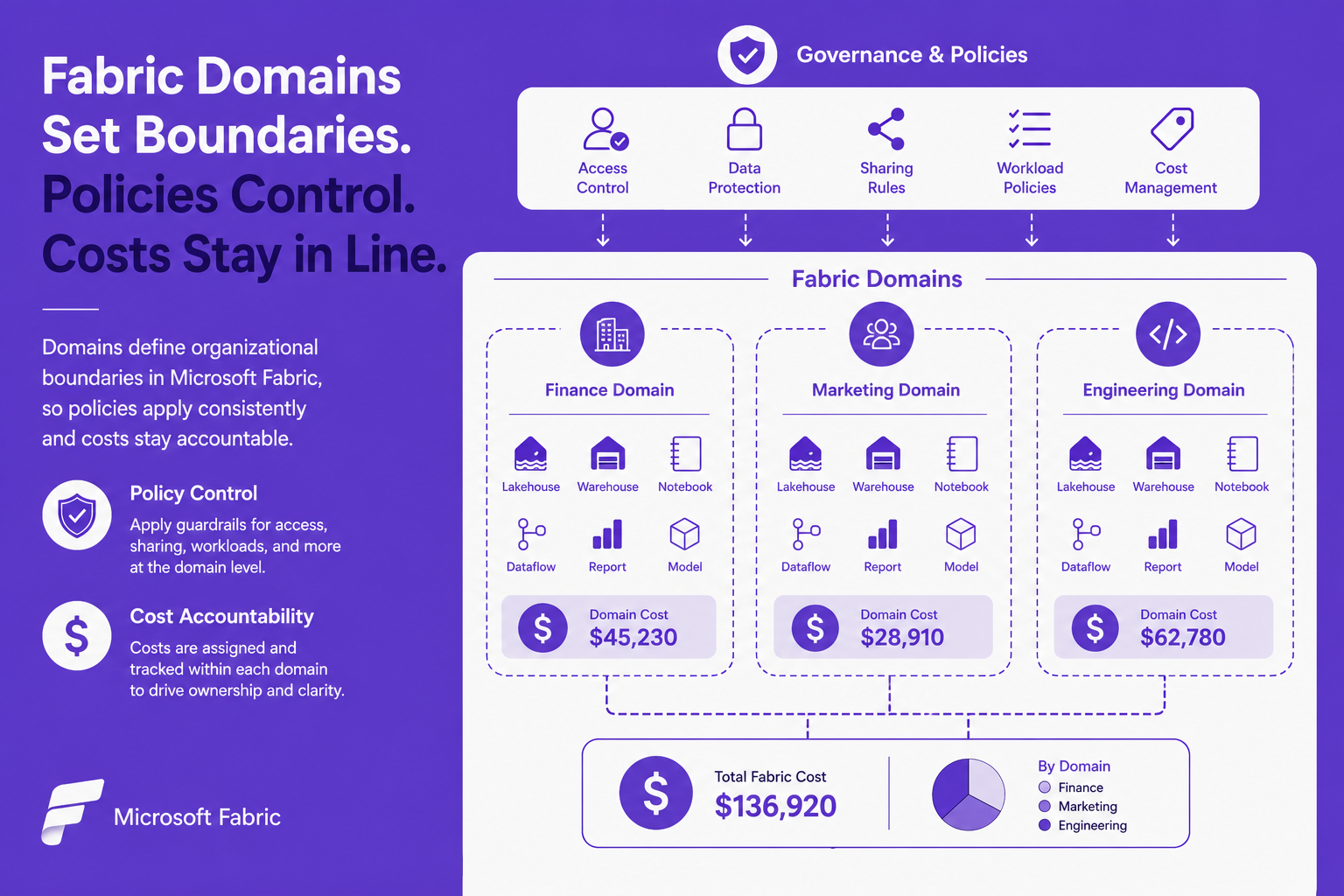
But what makes chargeback "actually work" for the enterprise? The answer lies in fabric domains: a modern, policy-driven structure for governance, visibility, and automated cost allocation. In this guide, we break down the essentials of Microsoft Fabric governance, the role of fabric domains, and practical chargeback models, highlighting how CloudNuro enables IT and finance teams to achieve true financial discipline in the age of intelligent SaaS management.
Microsoft Fabric governance is the strategic application of policies, controls, and automated workflows to ensure that data, applications, and services within Microsoft Fabric are secured, compliant, and cost-efficient. At its core, fabric governance empowers organizations to:
Key challenges include:
CloudNuro’s governance-first architecture addresses these by providing a unified dashboard for fabric, SaaS, and multi-cloud, automating critical controls, and giving IT leaders confidence in both compliance and optimization.
A fabric domain is a logical boundary within your Microsoft Fabric environment that defines ownership, access, and policy scope. Domains are typically aligned to business units, departments, or global functions such as Finance or R&D.
Key qualities:
| Criteria | Fabric Domain | Workspace |
|---|---|---|
| Purpose | Governance boundary | Collaboration space |
| Controls | Global policies | Local settings |
| Alignment | Business unit | Project/Team |
| Chargeback | Cost allocation | Usage aggregation |
A workspace sits within a domain. Policies and budget constraints set at the domain level flow down, while workspaces function mainly as organizing and collaboration spaces. Domains are where true organizational cost allocation, chargeback, begins.
The ultimate goal of fabric governance is to move from opaque, flat spending to transparent, automated cost allocation. Chargeback is the process of assigning IT and SaaS costs to the business units or domains that use them, driving both accountability and financial discipline.
Why Conventional Chargeback Models Often Fail:
What Works:
A domain-based model, combined with automation, delivers accurate, adaptable chargeback that stakeholders trust. By tracking real-time license consumption and workload activity within each fabric domain, organizations can:
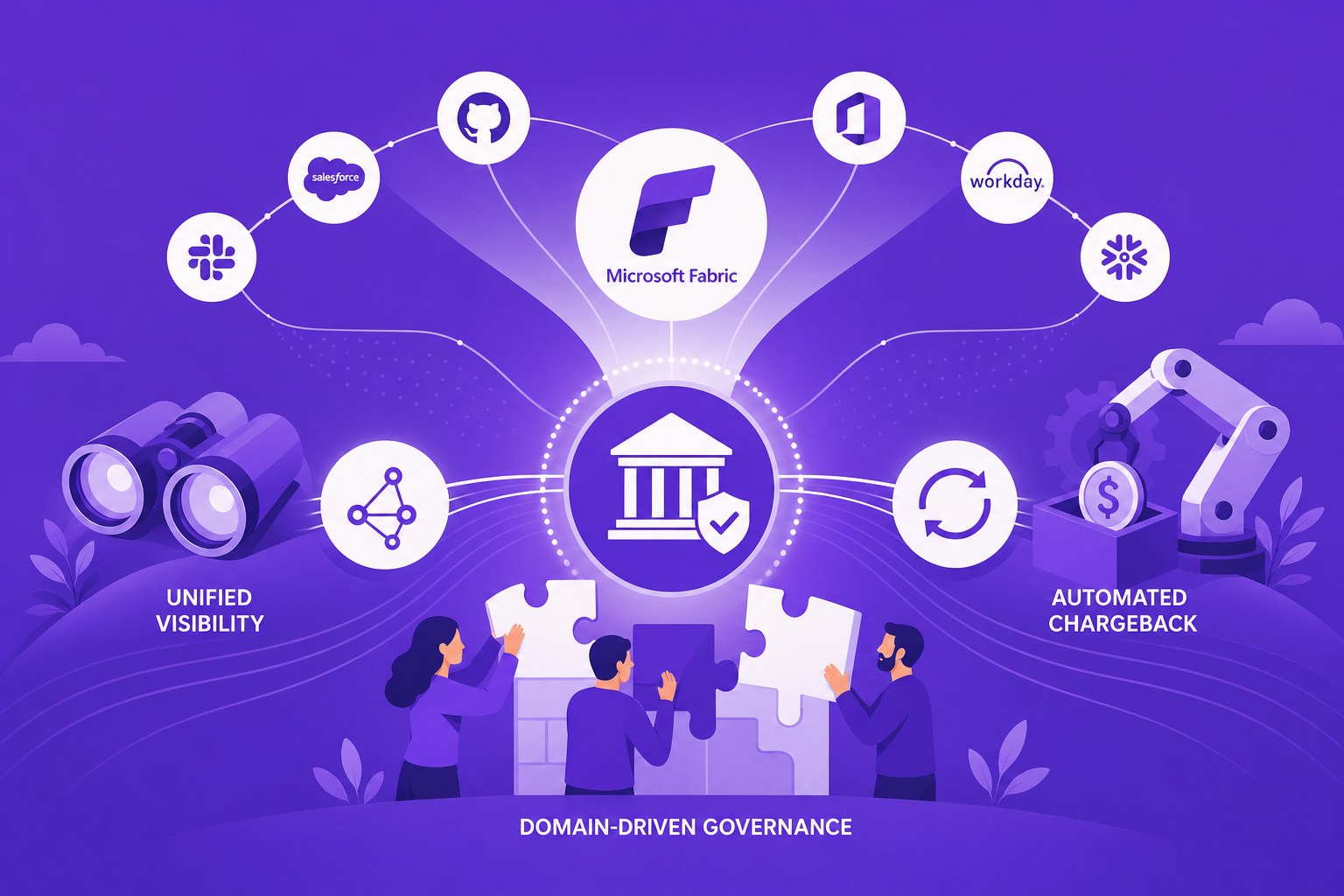
CloudNuro’s Microsoft 365 Custodian is purpose-built for domain-driven governance and cost optimization. Here’s how CloudNuro empowers chargeback to truly work in Microsoft Fabric environments:
A state government agency centralized visibility across 19 instances, governing 90,000 licenses with usage-aligned automated chargeback that required no manual reconciliation.
Customers achieve a proven 20 to 30 percent reduction in SaaS and cloud spending through automated cost optimization and usage tracking.
Learn more about CloudNuro’s SaaS Management, Chargeback, and FinOps Services.
Organizations are making strategic shifts:
Treating domains as hard governance boundaries, not just planning guides, directly aligns financial controls with compliance and risk management. The result: sustainable cost optimization and fewer internal conflicts.
1. Align Domains With Business Units:
Match domains to well-understood cost centers (departments, geographies). This simplifies reporting and ensures chargeback is perceived as fair.
2. Start With Showback:
Provide visibility before enforcing billing. Implement a showback period for at least one quarter to validate allocation rules and avoid disputes.
3. Leverage Automation:
Automate tracking, reporting, and rightsizing. Manual processes increase errors and erode trust.
4. Enforce Budget Controls at the Domain Level:
Budgets and usage constraints should cascade down. This drives direct accountability and enables proactive correction.
5. Integrate Compliance Checks:
Embed compliance management and policy enforcement. So cost optimization goes hand-in-hand with security and regulatory obligations.
6. Monitor, Report, Optimize:
Ongoing insights are the foundation for continuous improvement. Use a unified platform (like CloudNuro) for centralized dashboards and actionable recommendations.
For tailored IT governance, explore CloudNuro’s IT Operations and Microsoft License Optimization solutions.
What is Microsoft Fabric governance?
Microsoft Fabric governance is the application of policies and workflow automation to control, secure, and optimize resources within the Microsoft Fabric environment, aligning IT operations with financial, security, and compliance goals.
How do fabric domains work in a governance model?
Fabric domains act as organizational control boundaries, enabling delegated administration, role-based budgets, policy enforcement, and cost allocation. Policies set at the domain level cascade into workspaces within that domain.
What is the difference between a fabric domain and a workspace?
A fabric domain aligns to a business function and establishes global governance; a workspace is a collaboration area within the domain, with local settings but subject to domain-level policies and budgets.
How does a governance framework support chargeback?
A robust governance framework makes usage and spending transparent by mapping consumption to domains and users. This visibility, along with automated allocation and policy enforcement, enables dispute-free chargeback aligned with business priorities.
What are best practices for chargeback in Microsoft Fabric environments?
Fabric domains are at the heart of the modern organizational model that makes chargeback work at scale. By turning governance boundaries into actionable financial controls, enterprises can drive cost optimization, compliance, and security. While freeing teams from manual reconciliation and constant dispute resolution.
CloudNuro’s approach centers on automation, centralized visibility, and policy-driven governance, empowering IT and financial leaders to deliver a transparent, accountable, and cost-conscious culture.
Explore CloudNuro, request a demo, or get free savings to start optimizing your Microsoft Fabric and SaaS investments today.
CloudNuro is a leader in Enterprise AI Adoption Management, providing enterprises with unmatched visibility, governance, and cost optimization. Recognized twice in a row in the SaaS Management Platforms category and named a Leader in the SoftwareReviews Data Quadrant, CloudNuro is trusted by global enterprises and government agencies to bring financial discipline to SaaS, cloud, and AI. Trusted by enterprises, CloudNuro provides centralized SaaS inventory, license optimization, and renewal management along with advanced cost allocation and chargeback, giving IT and Finance leaders the visibility, control, and cost-conscious culture needed to drive financial discipline. Request a Demo | Get Free Savings | Explore Product
Request a no cost, no obligation free assessment —just 15 minutes to savings!
Get StartedEnterprise cloud cost management and chargeback are evolving rapidly, shaped by the acceleration of SaaS, multi-cloud, and domain-based architectures. With Microsoft Fabric and unified cloud governance frameworks, organizations now have the power to structure, monitor, and allocate costs across sprawling digital estates.
But what makes chargeback "actually work" for the enterprise? The answer lies in fabric domains: a modern, policy-driven structure for governance, visibility, and automated cost allocation. In this guide, we break down the essentials of Microsoft Fabric governance, the role of fabric domains, and practical chargeback models, highlighting how CloudNuro enables IT and finance teams to achieve true financial discipline in the age of intelligent SaaS management.
Microsoft Fabric governance is the strategic application of policies, controls, and automated workflows to ensure that data, applications, and services within Microsoft Fabric are secured, compliant, and cost-efficient. At its core, fabric governance empowers organizations to:
Key challenges include:
CloudNuro’s governance-first architecture addresses these by providing a unified dashboard for fabric, SaaS, and multi-cloud, automating critical controls, and giving IT leaders confidence in both compliance and optimization.
A fabric domain is a logical boundary within your Microsoft Fabric environment that defines ownership, access, and policy scope. Domains are typically aligned to business units, departments, or global functions such as Finance or R&D.
Key qualities:
| Criteria | Fabric Domain | Workspace |
|---|---|---|
| Purpose | Governance boundary | Collaboration space |
| Controls | Global policies | Local settings |
| Alignment | Business unit | Project/Team |
| Chargeback | Cost allocation | Usage aggregation |
A workspace sits within a domain. Policies and budget constraints set at the domain level flow down, while workspaces function mainly as organizing and collaboration spaces. Domains are where true organizational cost allocation, chargeback, begins.
The ultimate goal of fabric governance is to move from opaque, flat spending to transparent, automated cost allocation. Chargeback is the process of assigning IT and SaaS costs to the business units or domains that use them, driving both accountability and financial discipline.
Why Conventional Chargeback Models Often Fail:
What Works:
A domain-based model, combined with automation, delivers accurate, adaptable chargeback that stakeholders trust. By tracking real-time license consumption and workload activity within each fabric domain, organizations can:
CloudNuro’s Microsoft 365 Custodian is purpose-built for domain-driven governance and cost optimization. Here’s how CloudNuro empowers chargeback to truly work in Microsoft Fabric environments:
A state government agency centralized visibility across 19 instances, governing 90,000 licenses with usage-aligned automated chargeback that required no manual reconciliation.
Customers achieve a proven 20 to 30 percent reduction in SaaS and cloud spending through automated cost optimization and usage tracking.
Learn more about CloudNuro’s SaaS Management, Chargeback, and FinOps Services.
Organizations are making strategic shifts:
Treating domains as hard governance boundaries, not just planning guides, directly aligns financial controls with compliance and risk management. The result: sustainable cost optimization and fewer internal conflicts.
1. Align Domains With Business Units:
Match domains to well-understood cost centers (departments, geographies). This simplifies reporting and ensures chargeback is perceived as fair.
2. Start With Showback:
Provide visibility before enforcing billing. Implement a showback period for at least one quarter to validate allocation rules and avoid disputes.
3. Leverage Automation:
Automate tracking, reporting, and rightsizing. Manual processes increase errors and erode trust.
4. Enforce Budget Controls at the Domain Level:
Budgets and usage constraints should cascade down. This drives direct accountability and enables proactive correction.
5. Integrate Compliance Checks:
Embed compliance management and policy enforcement. So cost optimization goes hand-in-hand with security and regulatory obligations.
6. Monitor, Report, Optimize:
Ongoing insights are the foundation for continuous improvement. Use a unified platform (like CloudNuro) for centralized dashboards and actionable recommendations.
For tailored IT governance, explore CloudNuro’s IT Operations and Microsoft License Optimization solutions.
What is Microsoft Fabric governance?
Microsoft Fabric governance is the application of policies and workflow automation to control, secure, and optimize resources within the Microsoft Fabric environment, aligning IT operations with financial, security, and compliance goals.
How do fabric domains work in a governance model?
Fabric domains act as organizational control boundaries, enabling delegated administration, role-based budgets, policy enforcement, and cost allocation. Policies set at the domain level cascade into workspaces within that domain.
What is the difference between a fabric domain and a workspace?
A fabric domain aligns to a business function and establishes global governance; a workspace is a collaboration area within the domain, with local settings but subject to domain-level policies and budgets.
How does a governance framework support chargeback?
A robust governance framework makes usage and spending transparent by mapping consumption to domains and users. This visibility, along with automated allocation and policy enforcement, enables dispute-free chargeback aligned with business priorities.
What are best practices for chargeback in Microsoft Fabric environments?
Fabric domains are at the heart of the modern organizational model that makes chargeback work at scale. By turning governance boundaries into actionable financial controls, enterprises can drive cost optimization, compliance, and security. While freeing teams from manual reconciliation and constant dispute resolution.
CloudNuro’s approach centers on automation, centralized visibility, and policy-driven governance, empowering IT and financial leaders to deliver a transparent, accountable, and cost-conscious culture.
Explore CloudNuro, request a demo, or get free savings to start optimizing your Microsoft Fabric and SaaS investments today.
CloudNuro is a leader in Enterprise AI Adoption Management, providing enterprises with unmatched visibility, governance, and cost optimization. Recognized twice in a row in the SaaS Management Platforms category and named a Leader in the SoftwareReviews Data Quadrant, CloudNuro is trusted by global enterprises and government agencies to bring financial discipline to SaaS, cloud, and AI. Trusted by enterprises, CloudNuro provides centralized SaaS inventory, license optimization, and renewal management along with advanced cost allocation and chargeback, giving IT and Finance leaders the visibility, control, and cost-conscious culture needed to drive financial discipline. Request a Demo | Get Free Savings | Explore Product
Request a no cost, no obligation free assessment - just 15 minutes to savings!
Get StartedWe're offering complimentary ServiceNow license assessments to only 25 enterprises this quarter who want to unlock immediate savings without disrupting operations.
Get Free AssessmentGet Started



CloudNuro Corp
1755 Park St. Suite 207
Naperville, IL 60563
Phone : +1-630-277-9470
Email: info@cloudnuro.com





.webp)

Recognized Leader in SaaS Management Platforms by Info-Tech SoftwareReviews


.png)
.svg)