

Sign Up
Thank you for Submitting!
# The Hidden Cost of Poor SaaS Discovery: Why Most Companies Overspend by Millions SaaS has become the default way enterprises buy software, but very few have a complete inventory of what they actually own and use. The result is massive SaaS spend waste that sits buried inside fragmented contracts, self-serve purchases, and unmonitored renewals. Gartner reported in 2026 that 68% of organizations view SaaS spend waste as a critical financial issue, with the average enterprise overspending by 1.9 million dollars per year due to poor SaaS discovery. When your inventory is incomplete, every budgeting and optimization decision is built on sand. This article breaks down the real cost of poor discovery, why shadow IT is more expensive than it looks, and how governance-first SaaS management can turn millions in hidden waste into measurable savings.
SaaS spend waste is any portion of your SaaS budget that does not create commensurate business value. It typically appears as unused seats, underutilized tiers, overlapping tools, or forgotten contracts sitting on auto-renew. IDC estimated in 2026 that enterprises lose up to 35% of their SaaS budget to underutilized and unused licenses, much of it attributed to ineffective SaaS discovery. If you cannot see it, you cannot rightsize it.

At a basic level, poor discovery creates three structural problems:
Invisible contracts: Tools purchased outside IT or procurement never make it into central records.
Unmapped usage: You may know that a contract exists but not who uses it, how often, or for what.
Disconnected renewals: Auto-renewals fire based on vendor calendars, not your utilization or strategy.
In finance terms, poor discovery destroys the integrity of your SaaS cost baseline. Budget owners cannot distinguish between necessary, strategic spend and avoidable SaaS overspending.
Shadow IT is no longer limited to a few rogue servers. In SaaS, it shows up as corporate cards used on self-service signups, teams trialing tools that quietly roll into paid plans, and business units layering their own stack on top of the official one. Forrester found in 2026 that 82% of IT leaders see shadow IT as the leading factor in SaaS overspend, and over 60% admit they lack complete visibility into SaaS usage. That visibility gap is the real cost of shadow IT.
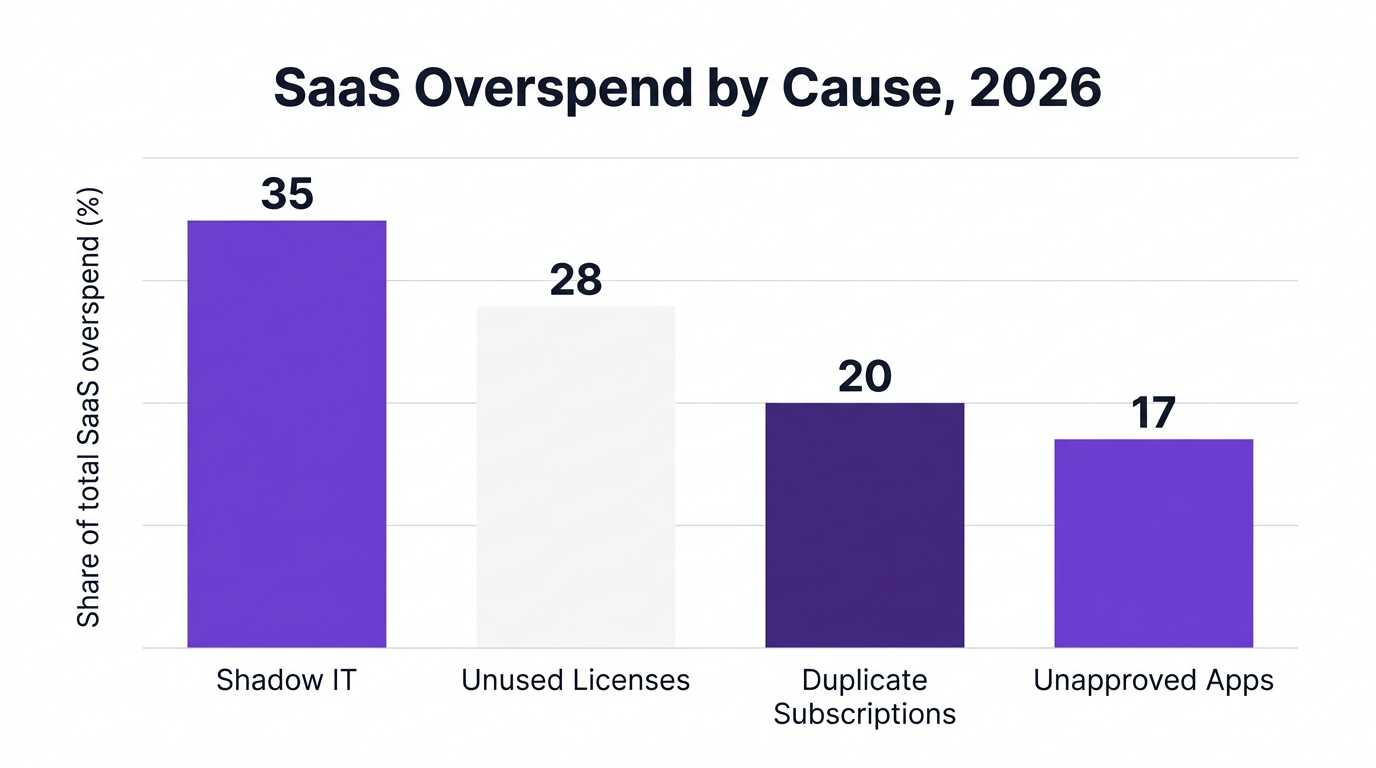
According to aggregated 2026 research data:
Shadow IT accounts for roughly 35% of SaaS overspend.
Unused licenses contribute another 28%, primarily in large suites.
Duplicate or overlapping SaaS subscriptions drive about 20% of unnecessary cost.
The hidden cost of shadow IT is not just the subscription fee. It includes:
Unbudgeted commitments that surprise finance at year end.
Risk exposure from tools that never passed security or data compliance reviews.
Support and integration drag on IT teams who must retroactively onboard and secure surprise apps.
A senior analyst at Forrester summarized the impact clearly in 2026: "Incomplete SaaS inventory is the root cause of runaway costs; visibility enables proactive budget controls."
SaaS discovery is the foundation of every other optimization effort. When discovery is incomplete, even sophisticated SaaS cost reduction strategies will underperform. There are four primary mechanisms through which poor discovery drives large scale SaaS spend waste.
License utilization rarely stays constant. Users change roles, projects end, and tools fall out of favor. Without accurate discovery and utilization analytics, this natural decay becomes structural SaaS license waste. IDC’s 2026 analysis shows up to 35% of SaaS budgets are lost to underutilized and unused licenses. That aligns with CloudNuro’s field data, where many enterprises see double digit waste in large suites alone. Common patterns include:
Departments hoarding more licenses than active headcount.
Contractors and interns retaining access long after leaving.
High tier seats assigned to low usage users who only need basic features.
When discovery is fragmented, each team builds its own micro stack. Marketing may run three different analytics tools, while sales keeps two prospecting platforms and CS pays for its own project tracker. This creates overlapping SaaS subscriptions that are functionally redundant. It is like paying three separate utilities to light the same building. You can manage a little redundancy for resilience, but blind duplication is pure SaaS overspending. CloudNuro case data frequently surfaces organizations with:
Multiple note-taking or collaboration tools with identical features.
Several webinar or conferencing products all used below 30% capacity.
Independent survey or form tools that could be consolidated.
Contracts that auto-renew without utilization review create compounding SaaS spend waste. Finance teams often see these as fixed run-rate costs even when value has eroded. PwC reported in 2026 that 53% of finance executives experienced unexpected year-end budget shortfalls tied to undiscovered or unreviewed SaaS subscriptions. When renewals are invisible, there is no chance to renegotiate, rightsize, or exit.
Even when a subscription is visible, the cost often sits on a generic IT or shared services line. Without clear internal chargeback, there is limited incentive for business units to reduce SaaS spend waste. Conversely, organizations that connect usage data to budget ownership see faster adoption of SaaS budget optimization practices. When marketing knows it owns both the adoption metrics and the bill, internal conversations change dramatically.
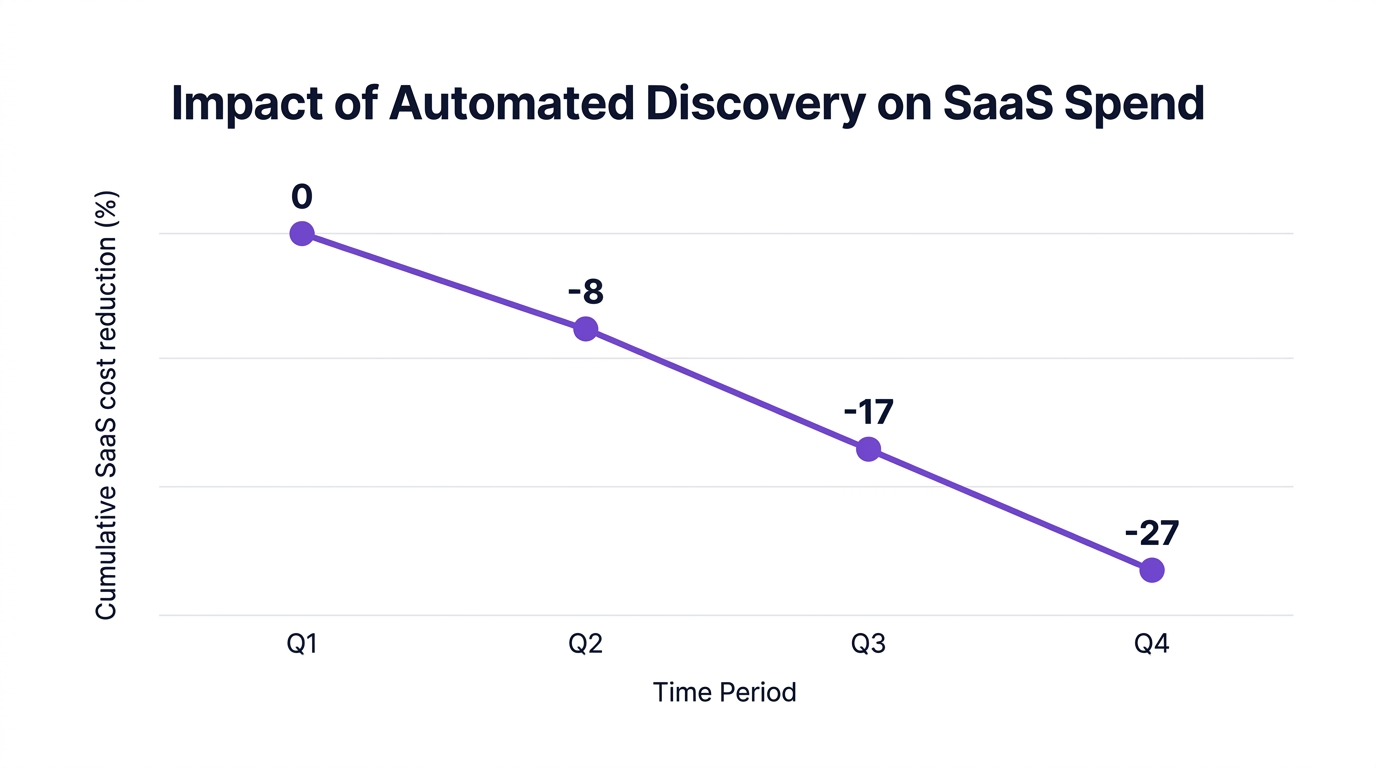
Many enterprises try to fix SaaS discovery with an annual or semi-annual manual audit. IT sends spreadsheets, finance pulls card data, and procurement checks contract repositories. The result is already stale by the time it reaches the executive team. Gartner’s 2026 research shows that automated SaaS discovery initiatives produced an average 27% reduction in annual SaaS costs among large enterprises. In contrast, manual audits typically find one-time savings but cannot sustain control.
Manual methods break down because:
They are point-in-time. New tools can be purchased hours after an audit completes.
Data is fragmented across expense systems, SSO logs, HR platforms, and vendor portals.
Ownership is unclear, so actions from the audit are not consistently implemented.
There is also an opportunity cost. High value IT, finance, and procurement staff spend weeks in spreadsheet triage instead of driving strategic SaaS optimization. A 2026 strategy lead at a global consulting firm put it bluntly: "The ROI of comprehensive SaaS discovery is now measured in millions, not thousands, annually for large enterprises." Manual discovery cannot reach that level of precision or timeliness.
Many CIOs argue that because they actively manage platforms like collaboration, CRM, and productivity suites, they have contained SaaS spend waste. That is typically only half true. Targeting the largest line items is necessary, but incomplete. CloudNuro’s discovery often reveals that smaller and mid-tier tools, purchased across dozens of teams, collectively match the spend of the big suites. Ignoring that long tail can leave millions of SaaS overspending untouched.
Identity and security tools provide important signals, but they rarely give a complete SaaS picture. Not every app is behind SSO, and many marketing, data, or niche tools bypass standard security and procurement channels. Relying solely on SSO logs is like trying to audit your personal finances by looking only at ATM withdrawals. You will miss corporate card expenses, invoiced contracts, and marketplace purchases that are exactly where the cost of shadow IT hides.
To move from awareness to action, enterprises need a repeatable framework. A useful model is the 4P SaaS Discovery Framework: Portfolio, People, Performance, and Policy. This framework helps CIOs, CFOs, and procurement leaders identify wasted SaaS spend and sustain control over time.
Start with cloud application visibility across all possible data sources:
Expense and corporate card feeds.
Contract and procurement systems.
SSO and identity providers.
Browser and agent-based discovery where allowed.
The goal is a single, continuously updated view of all SaaS subscriptions, including shadow IT and departmental purchases. Automated shadow IT SaaS discovery is essential here.
Connect every app and contract to:
Named business owner.
User list with last login and usage depth.
HR attributes such as department, region, and role.
This unlocks license utilization analytics and makes rightsizing SaaS licenses much more precise. You can eliminate unused SaaS seats and adjust tiers instead of blunt headcount-based cuts.
For each product, track utilization against thresholds that define unused SaaS licenses or underutilization. Example indicators:
Users with no login in 60 or 90 days.
Apps with fewer than 30% active users.
Features used versus features paid for across tiers.
Analyze overlap at the category level: meeting tools, project management, note taking, analytics, and so on. Build a simple shadow IT cost calculator by assigning an estimated risk and waste factor to each unmanaged or redundant product.
Once you have data, codify it with workflow automation for IT and procurement:
Standard intake process for new SaaS buying requests.
Mandatory utilization reviews before renewals.
Chargeback rules that connect usage and budget ownership.
This is where financial accountability becomes real. Governance-first architecture turns discovery insights into enduring SaaS cost reduction strategies.
CloudNuro was built to solve the discovery and waste problem at enterprise scale. Instead of periodic audits, it provides AI-enabled SaaS management that continuously scans your environment and turns data into actionable savings. At the core is CloudNuro’s 360° SaaS discovery and shadow IT tool, embedded in products such as Unified Cloud Custodian and AI Custodian. It connects to expense feeds, identity systems, and SaaS APIs to uncover every app in use, including unmanaged and unsanctioned ones. Key capabilities that directly address SaaS spend waste include:
CloudNuro builds a dynamic, centralized inventory that spans SaaS, cloud, and AI tools. It surfaces:
All known and unknown SaaS subscriptions in one place.
Shadow IT purchases across departments and regions.
Ownership, categories, and risk scores for each application.
This foundation supports governance-first saas discovery and shadow it tool capabilities that IT and security teams can trust.
CloudNuro’s license optimization engine analyzes detailed usage signals to pinpoint unused SaaS licenses and high waste areas. Clients use it for:
SaaS license optimization across suites like productivity, CRM, and ITSM.
Rightsizing SaaS licenses based on actual feature usage, not assumptions.
Automated workflows to eliminate unused SaaS seats during offboarding.
Case studies show CloudNuro clients saving over 18% on major suites, with some enterprises reducing SaaS overspend by 35% overall. You can explore how this works in depth in resources such as the CloudNuro SaaS management overview and the Microsoft license optimization solution.
CloudNuro provides role-based dashboards that give CIOs, CFOs, and budget owners real-time visibility into cost by app, department, and business unit. Built-in ROI calculators and chargeback support cost control for CFO teams. These capabilities align closely with modern FinOps practices. CloudNuro’s FinOps services help enterprises operationalize governance policies and saas cost analysis tool workflows so that optimization becomes continuous.
CloudNuro’s platform impact is captured in its case study portfolio:
A Fortune 500 healthcare provider used Unified Cloud Custodian to discover 130+ previously unknown SaaS apps and cut SaaS overspend by 32% in the first year.
A multinational financial services organization used AI Custodian to rightsize suite licenses, eliminating 2.4 million dollars in unused licenses in a single quarter.
You can review more results in the CloudNuro case studies library, which spans healthcare, finance, government, and corporate clients.
Many IT teams ask about SaaS spend management tool comparisons and how CloudNuro differs from basic trackers or point tools. Three aspects stand out:
Governance-first architecture: CloudNuro is built around compliance, security, and policy enforcement, not just cost.
AI Custodian capabilities: AI models surface high probability savings, risky shadow IT, and renewal priorities.
Unified visibility: The platform spans SaaS, cloud, and AI services, which avoids optimization silos.
For enterprises evaluating a saas cost optimization platform, this combination of discovery, automation, and governance makes CloudNuro a central control plane rather than another isolated dashboard.
SaaS spend waste is the portion of your subscription and licensing budget that does not translate into real usage or business value. Typical examples include SaaS license waste from unused seats, paying for premium tiers for basic users, maintaining redundant tools, or allowing contracts to renew after the business ha, enabling teams to reallocate that budget to higher-values moved on. Effective discovery and analytics help identify wasted SaaS spend so teams can reallocate that budget to higher value initiatives.
The most reliable approach combines automated discovery with license utilization analytics. Pull user-level data on last login, feature usage, and time-in-app from key platforms, then compare it against HR and org structures. Specialized saas license management software like CloudNuro can automate this process at scale and generate concrete recommendations to eliminate unused SaaS seats across suites and standalone tools.
The obvious cost is the subscription itself, but the larger impact comes from:
Unbudgeted and fragmented contracts that undermine planning.
Security and compliance risk from unsanctioned tools.
Duplicated capabilities that drive SaaS overspending.
Using a dedicated saas discovery and shadow IT tool reduces this risk and allows IT, finance, and security teams to stop shadow IT in SaaS before it becomes a budget and audit problem.
Accurate discovery creates a single system of record for all SaaS contracts and usage. This allows finance leaders to run reliable SaaS budget optimization exercises, model how to stop overspending on SaaS, and enforce chargeback policies. With a modern saas cost optimization software platform, optimization becomes continuous instead of a one-off annual project.
Enterprises typically move beyond spreadsheets to a dedicated saas cost optimization platform that combines discovery, utilization analytics, workflow automation, and reporting. These platforms act as a system of record for SaaS, not just a reporting layer. CloudNuro is one such platform. It brings together discovery, license optimization, governance workflows, and FinOps practices in one place so IT and finance teams can reduce SaaS spend waste year over year.
Poor SaaS discovery is not just an IT hygiene problem. It is a structural finance issue that can quietly drain millions in SaaS spend waste from even the most sophisticated enterprises. The organizations that win are using automated discovery, utilization analytics, and governance workflows to treat SaaS like any other strategic asset. They use data to consolidate overlap, rightsize licenses, control shadow IT, and tie spend directly to value. CloudNuro helps CIOs, CFOs, and procurement leaders transform SaaS from a diffuse cost center into a governed, data-driven portfolio. If you are ready to reduce SaaS spend waste, improve compliance, and give your board real SaaS cost transparency, this is the time to modernize discovery. Next step: Request a personalized walkthrough of CloudNuro’s SaaS discovery and optimization capabilities and see how much hidden waste your organization can reclaim.
CloudNuro is a leader in Enterprise SaaS Management Platforms, providing enterprises with unmatched visibility, governance, and cost optimization. Recognized twice in a row in the SaaS Management Platforms category and named a Leader in the SoftwareReviews Data Quadrant, CloudNuro is trusted by global enterprises and government agencies to bring financial discipline to SaaS, cloud, and AI. Trusted by enterprises such as Konica Minolta and Federal Signal, CloudNuro provides centralized SaaS inventory, license optimization, and renewal management along with advanced cost allocation and chargeback, giving IT and Finance leaders the visibility, control, and cost-conscious culture needed to drive financial discipline.
Request a no cost, no obligation free assessment —just 15 minutes to savings!
Get Started# The Hidden Cost of Poor SaaS Discovery: Why Most Companies Overspend by Millions SaaS has become the default way enterprises buy software, but very few have a complete inventory of what they actually own and use. The result is massive SaaS spend waste that sits buried inside fragmented contracts, self-serve purchases, and unmonitored renewals. Gartner reported in 2026 that 68% of organizations view SaaS spend waste as a critical financial issue, with the average enterprise overspending by 1.9 million dollars per year due to poor SaaS discovery. When your inventory is incomplete, every budgeting and optimization decision is built on sand. This article breaks down the real cost of poor discovery, why shadow IT is more expensive than it looks, and how governance-first SaaS management can turn millions in hidden waste into measurable savings.
SaaS spend waste is any portion of your SaaS budget that does not create commensurate business value. It typically appears as unused seats, underutilized tiers, overlapping tools, or forgotten contracts sitting on auto-renew. IDC estimated in 2026 that enterprises lose up to 35% of their SaaS budget to underutilized and unused licenses, much of it attributed to ineffective SaaS discovery. If you cannot see it, you cannot rightsize it.
At a basic level, poor discovery creates three structural problems:
Invisible contracts: Tools purchased outside IT or procurement never make it into central records.
Unmapped usage: You may know that a contract exists but not who uses it, how often, or for what.
Disconnected renewals: Auto-renewals fire based on vendor calendars, not your utilization or strategy.
In finance terms, poor discovery destroys the integrity of your SaaS cost baseline. Budget owners cannot distinguish between necessary, strategic spend and avoidable SaaS overspending.
Shadow IT is no longer limited to a few rogue servers. In SaaS, it shows up as corporate cards used on self-service signups, teams trialing tools that quietly roll into paid plans, and business units layering their own stack on top of the official one. Forrester found in 2026 that 82% of IT leaders see shadow IT as the leading factor in SaaS overspend, and over 60% admit they lack complete visibility into SaaS usage. That visibility gap is the real cost of shadow IT.
According to aggregated 2026 research data:
Shadow IT accounts for roughly 35% of SaaS overspend.
Unused licenses contribute another 28%, primarily in large suites.
Duplicate or overlapping SaaS subscriptions drive about 20% of unnecessary cost.
The hidden cost of shadow IT is not just the subscription fee. It includes:
Unbudgeted commitments that surprise finance at year end.
Risk exposure from tools that never passed security or data compliance reviews.
Support and integration drag on IT teams who must retroactively onboard and secure surprise apps.
A senior analyst at Forrester summarized the impact clearly in 2026: "Incomplete SaaS inventory is the root cause of runaway costs; visibility enables proactive budget controls."
SaaS discovery is the foundation of every other optimization effort. When discovery is incomplete, even sophisticated SaaS cost reduction strategies will underperform. There are four primary mechanisms through which poor discovery drives large scale SaaS spend waste.
License utilization rarely stays constant. Users change roles, projects end, and tools fall out of favor. Without accurate discovery and utilization analytics, this natural decay becomes structural SaaS license waste. IDC’s 2026 analysis shows up to 35% of SaaS budgets are lost to underutilized and unused licenses. That aligns with CloudNuro’s field data, where many enterprises see double digit waste in large suites alone. Common patterns include:
Departments hoarding more licenses than active headcount.
Contractors and interns retaining access long after leaving.
High tier seats assigned to low usage users who only need basic features.
When discovery is fragmented, each team builds its own micro stack. Marketing may run three different analytics tools, while sales keeps two prospecting platforms and CS pays for its own project tracker. This creates overlapping SaaS subscriptions that are functionally redundant. It is like paying three separate utilities to light the same building. You can manage a little redundancy for resilience, but blind duplication is pure SaaS overspending. CloudNuro case data frequently surfaces organizations with:
Multiple note-taking or collaboration tools with identical features.
Several webinar or conferencing products all used below 30% capacity.
Independent survey or form tools that could be consolidated.
Contracts that auto-renew without utilization review create compounding SaaS spend waste. Finance teams often see these as fixed run-rate costs even when value has eroded. PwC reported in 2026 that 53% of finance executives experienced unexpected year-end budget shortfalls tied to undiscovered or unreviewed SaaS subscriptions. When renewals are invisible, there is no chance to renegotiate, rightsize, or exit.
Even when a subscription is visible, the cost often sits on a generic IT or shared services line. Without clear internal chargeback, there is limited incentive for business units to reduce SaaS spend waste. Conversely, organizations that connect usage data to budget ownership see faster adoption of SaaS budget optimization practices. When marketing knows it owns both the adoption metrics and the bill, internal conversations change dramatically.
Many enterprises try to fix SaaS discovery with an annual or semi-annual manual audit. IT sends spreadsheets, finance pulls card data, and procurement checks contract repositories. The result is already stale by the time it reaches the executive team. Gartner’s 2026 research shows that automated SaaS discovery initiatives produced an average 27% reduction in annual SaaS costs among large enterprises. In contrast, manual audits typically find one-time savings but cannot sustain control.
Manual methods break down because:
They are point-in-time. New tools can be purchased hours after an audit completes.
Data is fragmented across expense systems, SSO logs, HR platforms, and vendor portals.
Ownership is unclear, so actions from the audit are not consistently implemented.
There is also an opportunity cost. High value IT, finance, and procurement staff spend weeks in spreadsheet triage instead of driving strategic SaaS optimization. A 2026 strategy lead at a global consulting firm put it bluntly: "The ROI of comprehensive SaaS discovery is now measured in millions, not thousands, annually for large enterprises." Manual discovery cannot reach that level of precision or timeliness.
Many CIOs argue that because they actively manage platforms like collaboration, CRM, and productivity suites, they have contained SaaS spend waste. That is typically only half true. Targeting the largest line items is necessary, but incomplete. CloudNuro’s discovery often reveals that smaller and mid-tier tools, purchased across dozens of teams, collectively match the spend of the big suites. Ignoring that long tail can leave millions of SaaS overspending untouched.
Identity and security tools provide important signals, but they rarely give a complete SaaS picture. Not every app is behind SSO, and many marketing, data, or niche tools bypass standard security and procurement channels. Relying solely on SSO logs is like trying to audit your personal finances by looking only at ATM withdrawals. You will miss corporate card expenses, invoiced contracts, and marketplace purchases that are exactly where the cost of shadow IT hides.
To move from awareness to action, enterprises need a repeatable framework. A useful model is the 4P SaaS Discovery Framework: Portfolio, People, Performance, and Policy. This framework helps CIOs, CFOs, and procurement leaders identify wasted SaaS spend and sustain control over time.
Start with cloud application visibility across all possible data sources:
Expense and corporate card feeds.
Contract and procurement systems.
SSO and identity providers.
Browser and agent-based discovery where allowed.
The goal is a single, continuously updated view of all SaaS subscriptions, including shadow IT and departmental purchases. Automated shadow IT SaaS discovery is essential here.
Connect every app and contract to:
Named business owner.
User list with last login and usage depth.
HR attributes such as department, region, and role.
This unlocks license utilization analytics and makes rightsizing SaaS licenses much more precise. You can eliminate unused SaaS seats and adjust tiers instead of blunt headcount-based cuts.
For each product, track utilization against thresholds that define unused SaaS licenses or underutilization. Example indicators:
Users with no login in 60 or 90 days.
Apps with fewer than 30% active users.
Features used versus features paid for across tiers.
Analyze overlap at the category level: meeting tools, project management, note taking, analytics, and so on. Build a simple shadow IT cost calculator by assigning an estimated risk and waste factor to each unmanaged or redundant product.
Once you have data, codify it with workflow automation for IT and procurement:
Standard intake process for new SaaS buying requests.
Mandatory utilization reviews before renewals.
Chargeback rules that connect usage and budget ownership.
This is where financial accountability becomes real. Governance-first architecture turns discovery insights into enduring SaaS cost reduction strategies.
CloudNuro was built to solve the discovery and waste problem at enterprise scale. Instead of periodic audits, it provides AI-enabled SaaS management that continuously scans your environment and turns data into actionable savings. At the core is CloudNuro’s 360° SaaS discovery and shadow IT tool, embedded in products such as Unified Cloud Custodian and AI Custodian. It connects to expense feeds, identity systems, and SaaS APIs to uncover every app in use, including unmanaged and unsanctioned ones. Key capabilities that directly address SaaS spend waste include:
CloudNuro builds a dynamic, centralized inventory that spans SaaS, cloud, and AI tools. It surfaces:
All known and unknown SaaS subscriptions in one place.
Shadow IT purchases across departments and regions.
Ownership, categories, and risk scores for each application.
This foundation supports governance-first saas discovery and shadow it tool capabilities that IT and security teams can trust.
CloudNuro’s license optimization engine analyzes detailed usage signals to pinpoint unused SaaS licenses and high waste areas. Clients use it for:
SaaS license optimization across suites like productivity, CRM, and ITSM.
Rightsizing SaaS licenses based on actual feature usage, not assumptions.
Automated workflows to eliminate unused SaaS seats during offboarding.
Case studies show CloudNuro clients saving over 18% on major suites, with some enterprises reducing SaaS overspend by 35% overall. You can explore how this works in depth in resources such as the CloudNuro SaaS management overview and the Microsoft license optimization solution.
CloudNuro provides role-based dashboards that give CIOs, CFOs, and budget owners real-time visibility into cost by app, department, and business unit. Built-in ROI calculators and chargeback support cost control for CFO teams. These capabilities align closely with modern FinOps practices. CloudNuro’s FinOps services help enterprises operationalize governance policies and saas cost analysis tool workflows so that optimization becomes continuous.
CloudNuro’s platform impact is captured in its case study portfolio:
A Fortune 500 healthcare provider used Unified Cloud Custodian to discover 130+ previously unknown SaaS apps and cut SaaS overspend by 32% in the first year.
A multinational financial services organization used AI Custodian to rightsize suite licenses, eliminating 2.4 million dollars in unused licenses in a single quarter.
You can review more results in the CloudNuro case studies library, which spans healthcare, finance, government, and corporate clients.
Many IT teams ask about SaaS spend management tool comparisons and how CloudNuro differs from basic trackers or point tools. Three aspects stand out:
Governance-first architecture: CloudNuro is built around compliance, security, and policy enforcement, not just cost.
AI Custodian capabilities: AI models surface high probability savings, risky shadow IT, and renewal priorities.
Unified visibility: The platform spans SaaS, cloud, and AI services, which avoids optimization silos.
For enterprises evaluating a saas cost optimization platform, this combination of discovery, automation, and governance makes CloudNuro a central control plane rather than another isolated dashboard.
SaaS spend waste is the portion of your subscription and licensing budget that does not translate into real usage or business value. Typical examples include SaaS license waste from unused seats, paying for premium tiers for basic users, maintaining redundant tools, or allowing contracts to renew after the business ha, enabling teams to reallocate that budget to higher-values moved on. Effective discovery and analytics help identify wasted SaaS spend so teams can reallocate that budget to higher value initiatives.
The most reliable approach combines automated discovery with license utilization analytics. Pull user-level data on last login, feature usage, and time-in-app from key platforms, then compare it against HR and org structures. Specialized saas license management software like CloudNuro can automate this process at scale and generate concrete recommendations to eliminate unused SaaS seats across suites and standalone tools.
The obvious cost is the subscription itself, but the larger impact comes from:
Unbudgeted and fragmented contracts that undermine planning.
Security and compliance risk from unsanctioned tools.
Duplicated capabilities that drive SaaS overspending.
Using a dedicated saas discovery and shadow IT tool reduces this risk and allows IT, finance, and security teams to stop shadow IT in SaaS before it becomes a budget and audit problem.
Accurate discovery creates a single system of record for all SaaS contracts and usage. This allows finance leaders to run reliable SaaS budget optimization exercises, model how to stop overspending on SaaS, and enforce chargeback policies. With a modern saas cost optimization software platform, optimization becomes continuous instead of a one-off annual project.
Enterprises typically move beyond spreadsheets to a dedicated saas cost optimization platform that combines discovery, utilization analytics, workflow automation, and reporting. These platforms act as a system of record for SaaS, not just a reporting layer. CloudNuro is one such platform. It brings together discovery, license optimization, governance workflows, and FinOps practices in one place so IT and finance teams can reduce SaaS spend waste year over year.
Poor SaaS discovery is not just an IT hygiene problem. It is a structural finance issue that can quietly drain millions in SaaS spend waste from even the most sophisticated enterprises. The organizations that win are using automated discovery, utilization analytics, and governance workflows to treat SaaS like any other strategic asset. They use data to consolidate overlap, rightsize licenses, control shadow IT, and tie spend directly to value. CloudNuro helps CIOs, CFOs, and procurement leaders transform SaaS from a diffuse cost center into a governed, data-driven portfolio. If you are ready to reduce SaaS spend waste, improve compliance, and give your board real SaaS cost transparency, this is the time to modernize discovery. Next step: Request a personalized walkthrough of CloudNuro’s SaaS discovery and optimization capabilities and see how much hidden waste your organization can reclaim.
CloudNuro is a leader in Enterprise SaaS Management Platforms, providing enterprises with unmatched visibility, governance, and cost optimization. Recognized twice in a row in the SaaS Management Platforms category and named a Leader in the SoftwareReviews Data Quadrant, CloudNuro is trusted by global enterprises and government agencies to bring financial discipline to SaaS, cloud, and AI. Trusted by enterprises such as Konica Minolta and Federal Signal, CloudNuro provides centralized SaaS inventory, license optimization, and renewal management along with advanced cost allocation and chargeback, giving IT and Finance leaders the visibility, control, and cost-conscious culture needed to drive financial discipline.
Request a no cost, no obligation free assessment - just 15 minutes to savings!
Get StartedWe're offering complimentary ServiceNow license assessments to only 25 enterprises this quarter who want to unlock immediate savings without disrupting operations.
Get Free AssessmentGet Started




CloudNuro Corp
1755 Park St. Suite 207
Naperville, IL 60563
Phone : +1-630-277-9470
Email: info@cloudnuro.com





.webp)

Recognized Leader in SaaS Management Platforms by Info-Tech SoftwareReviews
.png)


%20Solutions%20for%20Secure%20Acces.png)
.svg)