

Sign Up
Thank you for Submitting!
Achieving faster, more cost-effective AI systems without the downtime or risk of retraining is the new standard for competitive enterprises in 2026. As large language models and advanced ML systems move from proof-of-concept to mission-critical, organizations seek every edge to optimize performance, minimize costs, and lock in strong governance, without reopening Pandora’s box of base model weights. Today’s leading strategy: unlock model performance optimization using cutting-edge methods outside of conventional retraining cycles.
In this guide, we’ll explore why retraining is no longer the only path for efficiency; the strategies now winning the AI enterprise playbook; and how CloudNuro’s AI Custodian delivers unprecedented visibility, governance, and cost savings at scale.
The increasing size and complexity of AI models make retraining expensive, disruptive, and risky. For regulated industries, finance, healthcare, government, the bar is even higher: any drift from baseline requires rigorous validation, data governance, and operational downtime. As models proliferate across teams and projects, retraining does not scale with real-world need for:
Instead, optimization techniques applied to model deployment, without reopening the training process, are now the backbone for AI at scale.
Let’s break down the strategies redefining efficient AI in 2026:
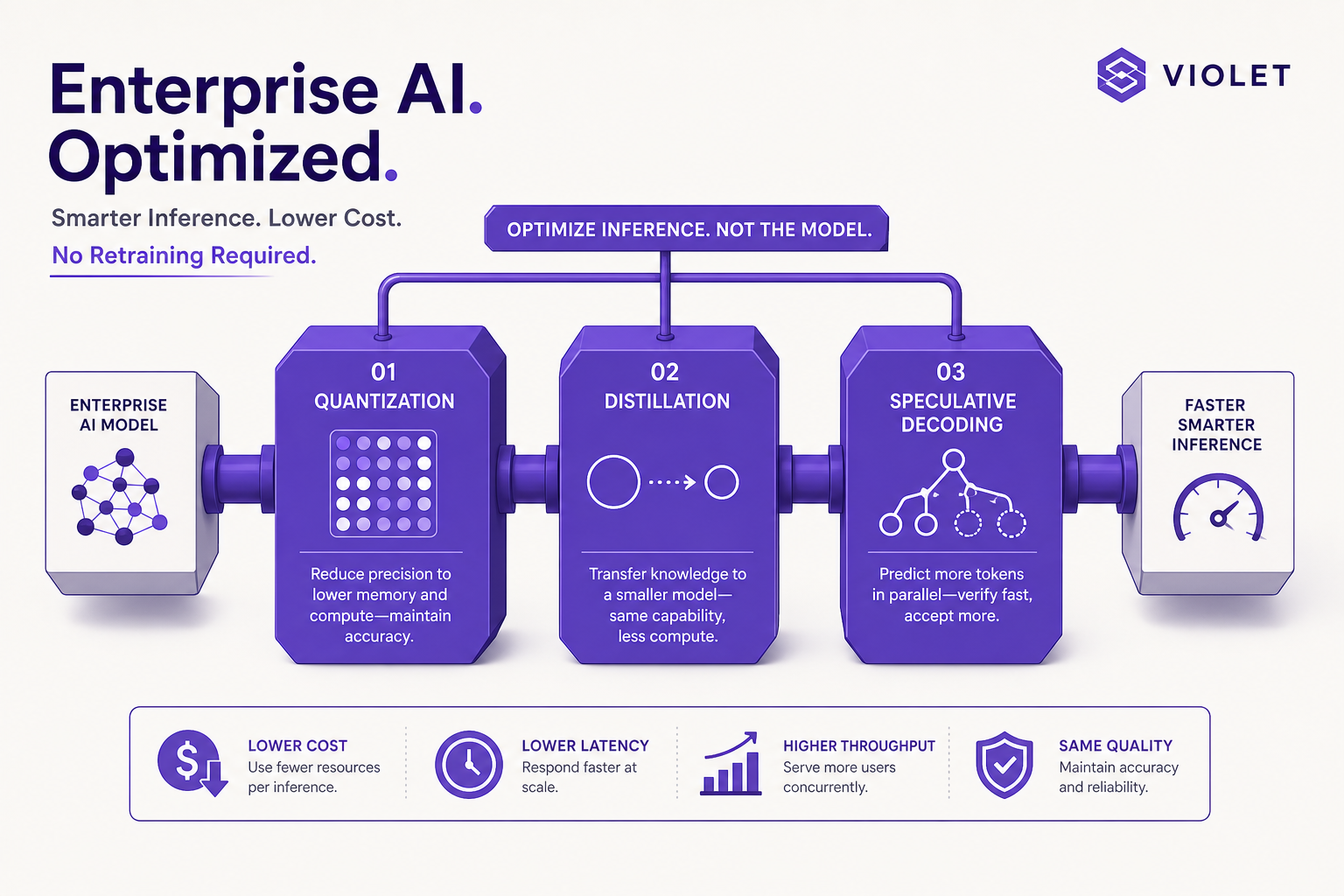
Quantization reduces the number of bits needed to represent each neural network weight. By converting models from (for example) 32-bit floating point to 8- or 4-bit representations, you dramatically cut memory and compute, enabling:
Expert recommendation: Begin with quantization and continuous batching to achieve a lower cost per token before considering more complex interventions.
Distillation compresses a large, high-performance teacher model into a smaller, efficient student model, without retraining on the full original dataset. The student mimics the outputs of the teacher, enabling:
The process of distillation can involve a series of teacher-student cycles, or focus on simple distillation targeting specific task bottlenecks.
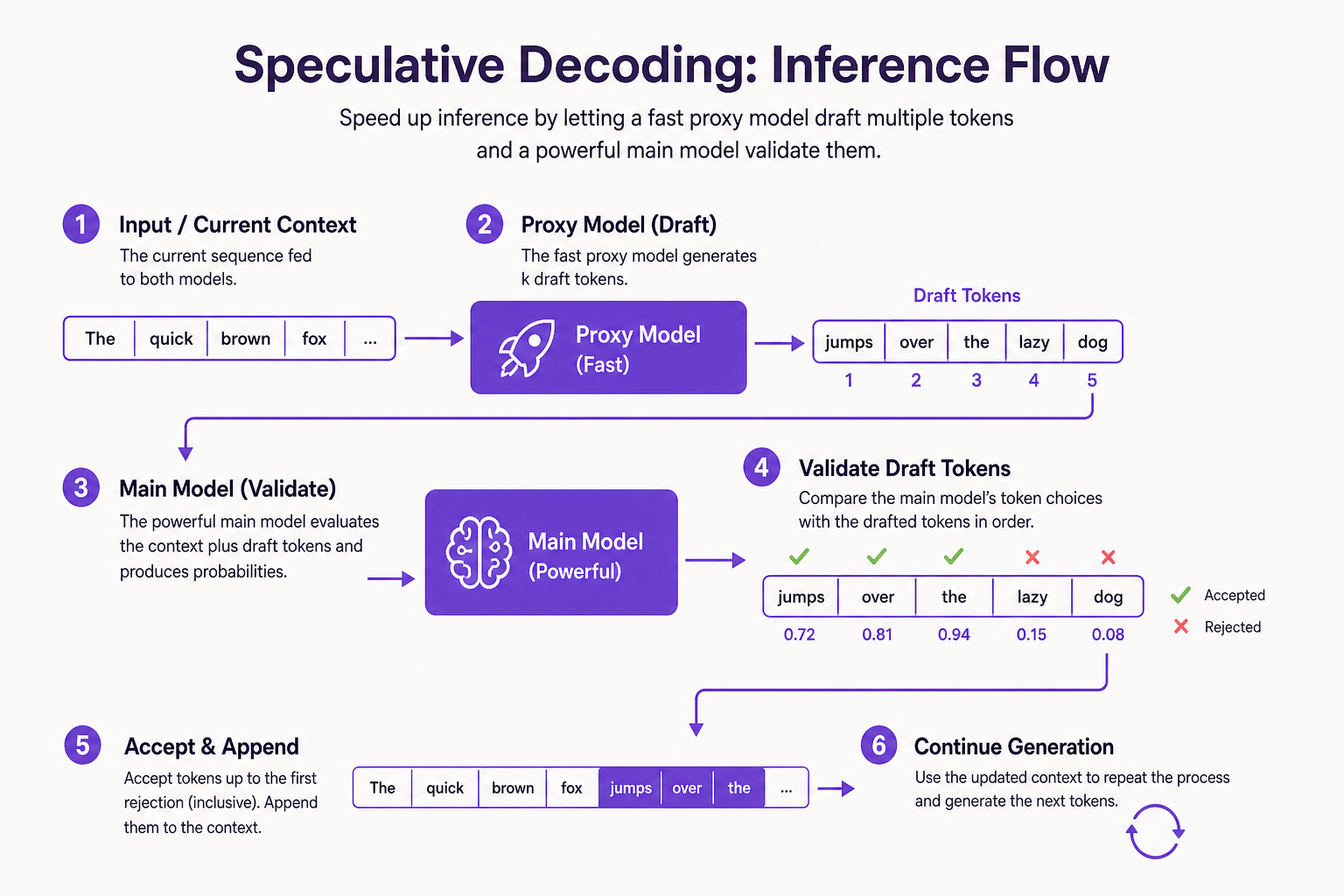
Speculative decoding leverages faster, approximate models during the initial decoding steps and confirms results with the main model only on a subset of outputs. This approach:
With speculative decoding now moving from research to production, organizations see tangible advances in latency and user experience.
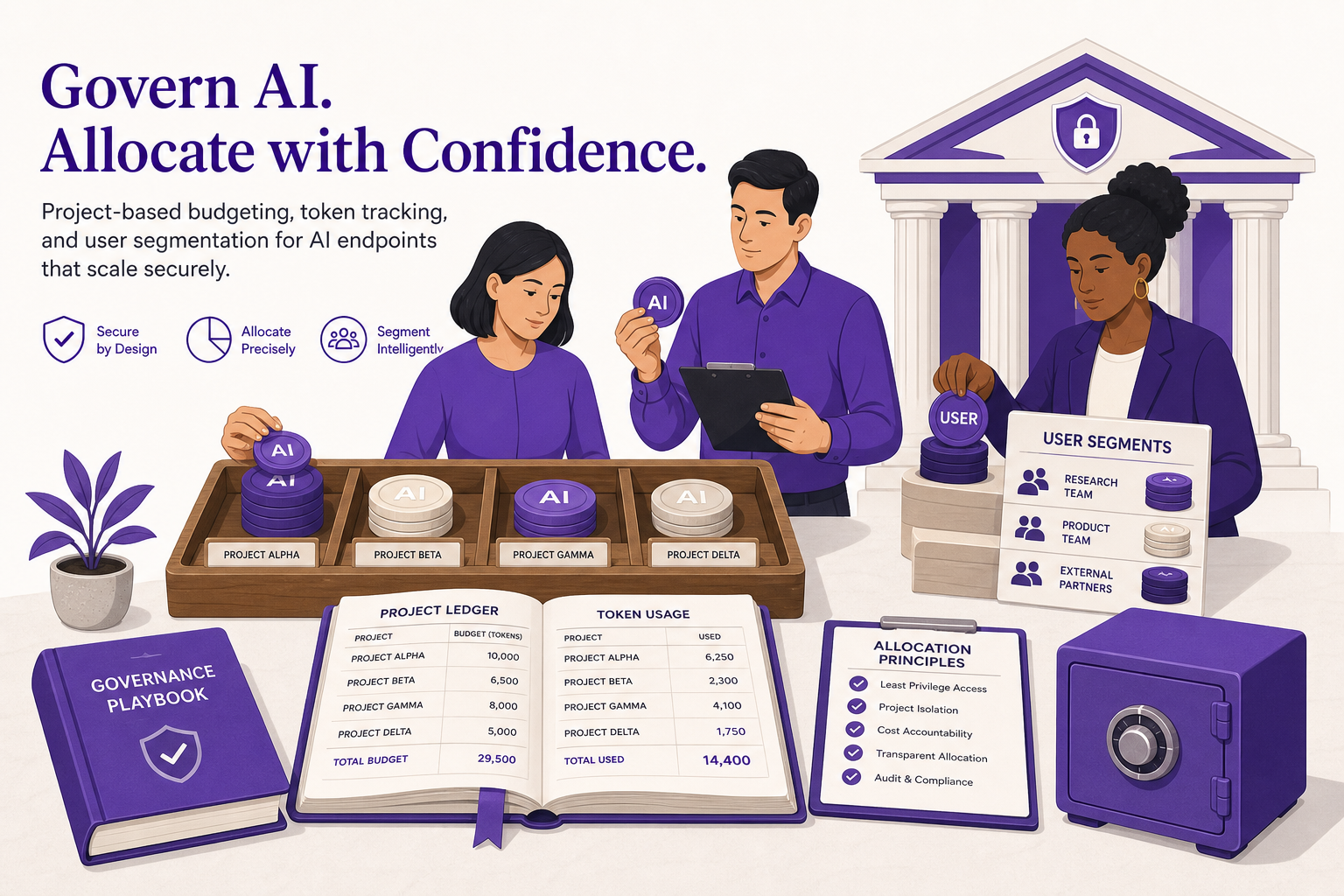
Profiling First: Always measure your actual inference workload before choosing an optimization technique. Use project-based budgeting and token tracking to understand cost drivers at a granular level.
Enabling Batching and Quantization: Implement continuous batching for high-throughput endpoints and apply quantization as your first optimization step.
Balancing Speed and Quality: Where latency remains unacceptable, add speculative decoding. For cost-sensitive batch or agent workloads, route simpler tasks to smaller distilled or quantized models.
Iterate with Governance: Every optimization must retain strict model governance, especially where sensitive or regulated use cases abound. Automated logging, policy controls, and integration with compliance tools are not optional.
Optimization without retraining isn’t just a technical win, it’s a business imperative for:
Gateway-level controls for LLMs now cover more than 62 percent of cloud deployments, and combining optimization techniques can reduce inference costs by over 80 percent.
CloudNuro’s AI Custodian is purpose-built for this new optimization landscape. Here’s how:
Proof in Practice: A large public sector organization used CloudNuro to centralize access for thousands of distributed employees, achieving unified governance and automated cost control. Where tracking AI consumption once meant managing fragmented spreadsheets, now leadership sees, secures, and optimizes every AI and SaaS license from a single pane.

Efficiency-first model serving now dominates the buy criteria for advanced AI. Organizations aiming for the efficient frontier of inference, not just bigger models, are outpacing competition.
Emerging benchmarks include:
Organizations using advanced optimization, supported by holistic governance platforms like CloudNuro, are establishing a sustainable model layer, ready for the next wave of innovation without risking cost explosions or compliance failures.
How can you optimize model performance without retraining?
You can apply quantization, distillation, batch serving, and speculative decoding to boost efficiency and reduce costs without altering underlying weights or retraining data.
What are the best techniques for LLM optimization in 2026?
Continuous batching, quantization, distillation, and speculative decoding form the core playbook, supported by governance controls and end-to-end visibility.
How do quantization and distillation improve ML models?
Quantization compresses model size, increasing speed and reducing compute. Distillation transfers capabilities from large teacher models to smaller students, retaining accuracy while slashing resource demand.
What is speculative decoding and how does it enhance AI?
It uses faster proxy models to generate draft outputs, which are then verified with a main model, cutting token latency and cost, especially in real-time use cases.
Which industries benefit most from model performance optimization strategies?
Finance, healthcare, government, and enterprise teams with security, cost, and compliance requirements benefit the most from advanced, non-retraining optimization.
In 2026, optimizing model performance is less about theoretical AI wizardry and more about practical, business-driven orchestration, all without opening the retraining black box. Solutions like CloudNuro’s AI Custodian make it possible for every CIO, CTO, and ML leader to realize the promise of cost containment, unmatched governance, and safe, performant AI, at cloud, SaaS, and enterprise scale.
Learn more:
About CloudNuro
CloudNuro is a leader in Enterprise AI Adoption Management, providing enterprises with unmatched visibility, governance, and cost optimization. Recognized twice in a row in the SaaS Management Platforms category and named a Leader in the SoftwareReviews Data Quadrant, CloudNuro is trusted by global enterprises and government agencies to bring financial discipline to SaaS, cloud, and AI. Trusted by enterprises, CloudNuro provides centralized SaaS inventory, license optimization, and renewal management along with advanced cost allocation and chargeback, giving IT and Finance leaders the visibility, control, and cost-conscious culture needed to drive financial discipline.
Request a no cost, no obligation free assessment —just 15 minutes to savings!
Get StartedAchieving faster, more cost-effective AI systems without the downtime or risk of retraining is the new standard for competitive enterprises in 2026. As large language models and advanced ML systems move from proof-of-concept to mission-critical, organizations seek every edge to optimize performance, minimize costs, and lock in strong governance, without reopening Pandora’s box of base model weights. Today’s leading strategy: unlock model performance optimization using cutting-edge methods outside of conventional retraining cycles.
In this guide, we’ll explore why retraining is no longer the only path for efficiency; the strategies now winning the AI enterprise playbook; and how CloudNuro’s AI Custodian delivers unprecedented visibility, governance, and cost savings at scale.
The increasing size and complexity of AI models make retraining expensive, disruptive, and risky. For regulated industries, finance, healthcare, government, the bar is even higher: any drift from baseline requires rigorous validation, data governance, and operational downtime. As models proliferate across teams and projects, retraining does not scale with real-world need for:
Instead, optimization techniques applied to model deployment, without reopening the training process, are now the backbone for AI at scale.
Let’s break down the strategies redefining efficient AI in 2026:
Quantization reduces the number of bits needed to represent each neural network weight. By converting models from (for example) 32-bit floating point to 8- or 4-bit representations, you dramatically cut memory and compute, enabling:
Expert recommendation: Begin with quantization and continuous batching to achieve a lower cost per token before considering more complex interventions.
Distillation compresses a large, high-performance teacher model into a smaller, efficient student model, without retraining on the full original dataset. The student mimics the outputs of the teacher, enabling:
The process of distillation can involve a series of teacher-student cycles, or focus on simple distillation targeting specific task bottlenecks.
Speculative decoding leverages faster, approximate models during the initial decoding steps and confirms results with the main model only on a subset of outputs. This approach:
With speculative decoding now moving from research to production, organizations see tangible advances in latency and user experience.
Profiling First: Always measure your actual inference workload before choosing an optimization technique. Use project-based budgeting and token tracking to understand cost drivers at a granular level.
Enabling Batching and Quantization: Implement continuous batching for high-throughput endpoints and apply quantization as your first optimization step.
Balancing Speed and Quality: Where latency remains unacceptable, add speculative decoding. For cost-sensitive batch or agent workloads, route simpler tasks to smaller distilled or quantized models.
Iterate with Governance: Every optimization must retain strict model governance, especially where sensitive or regulated use cases abound. Automated logging, policy controls, and integration with compliance tools are not optional.
Optimization without retraining isn’t just a technical win, it’s a business imperative for:
Gateway-level controls for LLMs now cover more than 62 percent of cloud deployments, and combining optimization techniques can reduce inference costs by over 80 percent.
CloudNuro’s AI Custodian is purpose-built for this new optimization landscape. Here’s how:
Proof in Practice: A large public sector organization used CloudNuro to centralize access for thousands of distributed employees, achieving unified governance and automated cost control. Where tracking AI consumption once meant managing fragmented spreadsheets, now leadership sees, secures, and optimizes every AI and SaaS license from a single pane.
Efficiency-first model serving now dominates the buy criteria for advanced AI. Organizations aiming for the efficient frontier of inference, not just bigger models, are outpacing competition.
Emerging benchmarks include:
Organizations using advanced optimization, supported by holistic governance platforms like CloudNuro, are establishing a sustainable model layer, ready for the next wave of innovation without risking cost explosions or compliance failures.
How can you optimize model performance without retraining?
You can apply quantization, distillation, batch serving, and speculative decoding to boost efficiency and reduce costs without altering underlying weights or retraining data.
What are the best techniques for LLM optimization in 2026?
Continuous batching, quantization, distillation, and speculative decoding form the core playbook, supported by governance controls and end-to-end visibility.
How do quantization and distillation improve ML models?
Quantization compresses model size, increasing speed and reducing compute. Distillation transfers capabilities from large teacher models to smaller students, retaining accuracy while slashing resource demand.
What is speculative decoding and how does it enhance AI?
It uses faster proxy models to generate draft outputs, which are then verified with a main model, cutting token latency and cost, especially in real-time use cases.
Which industries benefit most from model performance optimization strategies?
Finance, healthcare, government, and enterprise teams with security, cost, and compliance requirements benefit the most from advanced, non-retraining optimization.
In 2026, optimizing model performance is less about theoretical AI wizardry and more about practical, business-driven orchestration, all without opening the retraining black box. Solutions like CloudNuro’s AI Custodian make it possible for every CIO, CTO, and ML leader to realize the promise of cost containment, unmatched governance, and safe, performant AI, at cloud, SaaS, and enterprise scale.
Learn more:
About CloudNuro
CloudNuro is a leader in Enterprise AI Adoption Management, providing enterprises with unmatched visibility, governance, and cost optimization. Recognized twice in a row in the SaaS Management Platforms category and named a Leader in the SoftwareReviews Data Quadrant, CloudNuro is trusted by global enterprises and government agencies to bring financial discipline to SaaS, cloud, and AI. Trusted by enterprises, CloudNuro provides centralized SaaS inventory, license optimization, and renewal management along with advanced cost allocation and chargeback, giving IT and Finance leaders the visibility, control, and cost-conscious culture needed to drive financial discipline.
Request a no cost, no obligation free assessment - just 15 minutes to savings!
Get StartedWe're offering complimentary ServiceNow license assessments to only 25 enterprises this quarter who want to unlock immediate savings without disrupting operations.
Get Free AssessmentGet Started




CloudNuro Corp
1755 Park St. Suite 207
Naperville, IL 60563
Phone : +1-630-277-9470
Email: info@cloudnuro.com





.webp)

Recognized Leader in SaaS Management Platforms by Info-Tech SoftwareReviews


.svg)