

Sign Up
Thank you for Submitting!
Enterprise AI strategy is in the midst of a transformation. Gone are the days of relying on a single model or vendor for all intelligent automation and decision-making needs. Today, 64% of enterprises have adopted multi-model AI architectures, driving a new era defined by flexibility, cost discipline, and unprecedented governance capabilities. The days of managing AI as a monolithic resource are behind us. Now, CIOs and CTOs are building dynamic AI portfolios to distribute workloads, minimize vendor lock-in, and optimize spend.
Why this shift? The answers lie in risk diversification, operational efficiency, and the ability to govern increasingly complex AI environments. This report examines the drivers of multi-model adoption, analyzes real-world data on enterprise AI usage, and demonstrates how CloudNuro provides the foundation for visibility, cost control, and compliance in next-generation AI environments.
The realities of enterprise deployment are driving a clear preference for diverse AI model portfolios:
Risk Management & Vendor Neutrality: Enterprises are proactively mixing open-source and proprietary models, reducing dependence on any single technology stack or vendor. This de-risks long-term strategy and shields operations from sudden changes in commercial licenses or regulatory policy.
Optimized Model Routing: By routing AI workloads dynamically (for example, sending simple tasks to cost-effective models and reserving high-compute models for advanced analysis), enterprises maximize efficiency and minimize costs, without sacrificing performance.
Governance at Scale: Multi-model orchestration supports fine-grained control, allowing for policy-based restrictions, detailed user segmentation, and project-level budgeting. This is powerful for regulated industries, where compliance and auditability are critical.
Competitive Flexibility: With multiple models available in a single workflow, teams can select the optimal solution for each problem, whether it’s natural language processing, data classification, or summarization, ramping up innovation and speed.
Key statistic: 78% of companies now use two or more large language model families in their operations.
A clear majority, 64% of enterprise accounts, now manage their AI through multi-model routing architectures, up dramatically from prior years. Let’s break down the numbers:
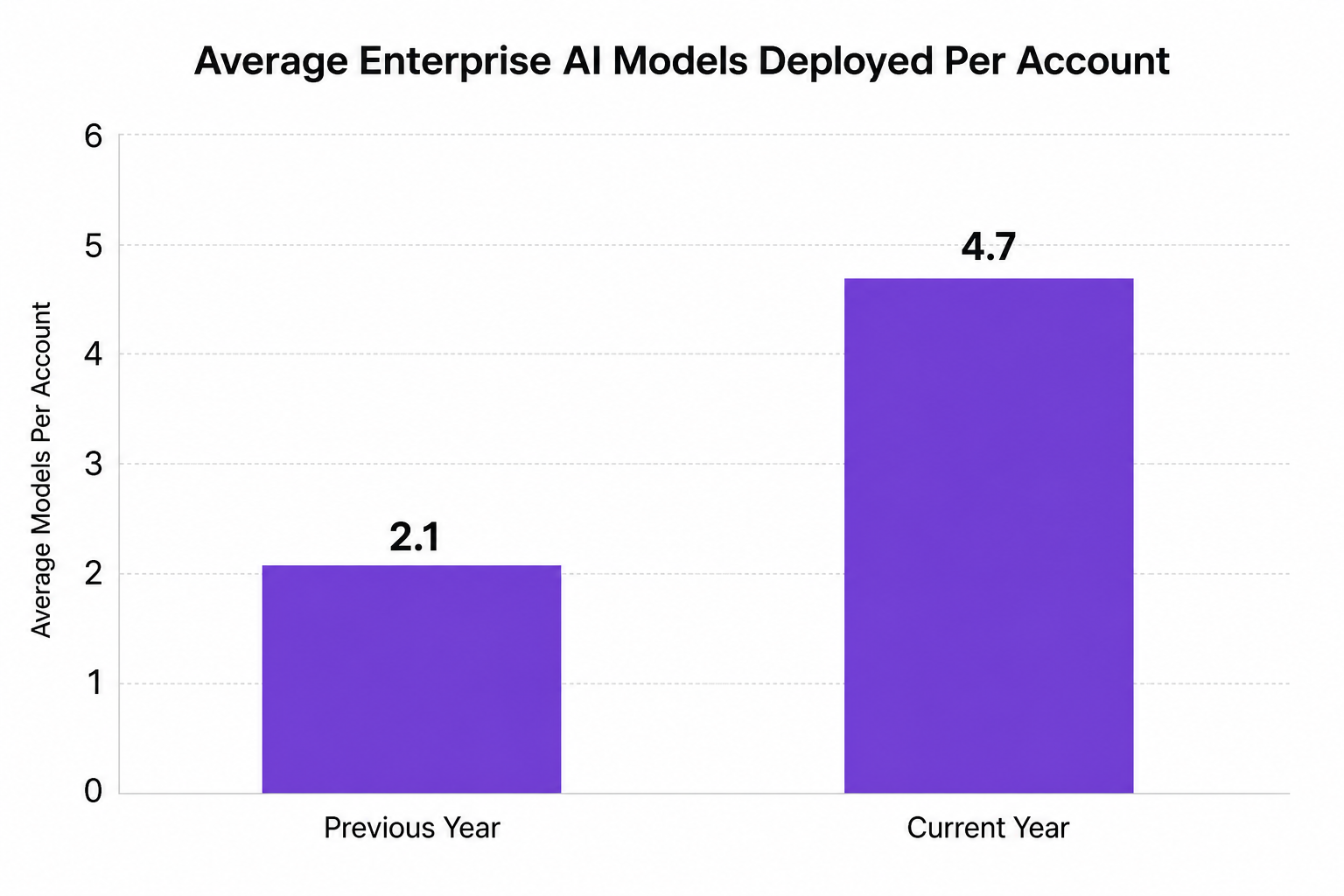
Model Count Growth: The average enterprise now deploys 4.7 distinct AI models per account, up from 2.1 just a year ago. Companies running five or more models in production have jumped to 37% of all enterprises.
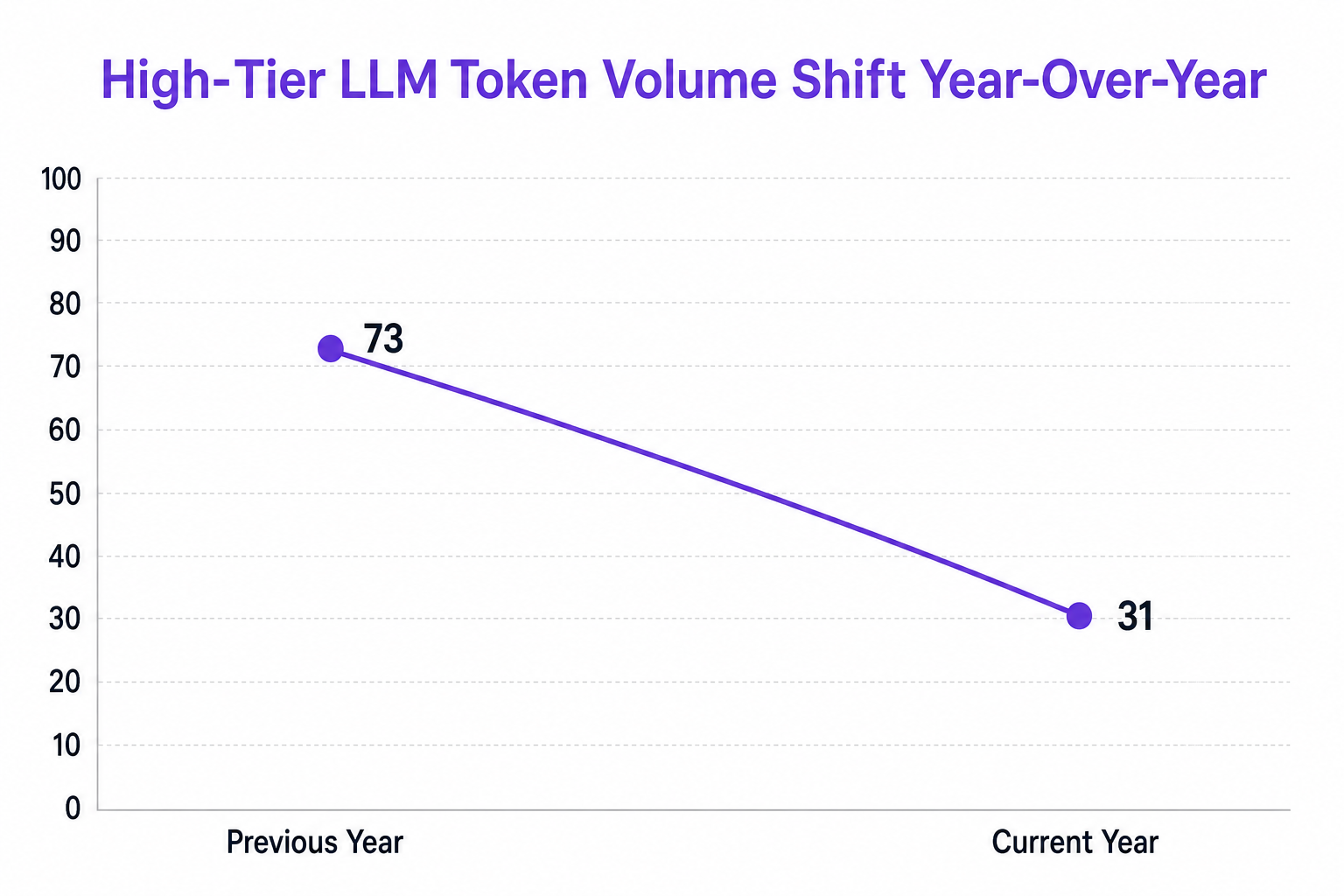
Token Volume Shift: The proportion of tokens processed by high-tier AI models (typically the most expensive) has plunged from 73% to 31% of overall volume. Enterprises are shifting substantial workloads to more cost-sensible models.
Cost Savings: On average, organizations using multi-model routing architecture report a median cost reduction of 71% compared to previously running all tokens through a single, top-tier provider. This is not theoretical; it translates into millions in annualized savings for global organizations.
Model routing is the engine of the multi-model strategy. Rather than hardcoding all queries into a single AI, model routing dynamically directs workloads to the AI model best suited for the job at hand, factoring in cost, speed, data security needs, and compliance constraints.
Task Complexity Segmentation: Routine tasks, like text summarization or basic data cleaning, are assigned to cost-efficient models, while high-value or context-sensitive work is routed to specialized or proprietary models.
Policy-Driven Assignment: Enterprise rules (think compliance checkpoints or data residency) are encoded so that sensitive queries only reach pre-approved or on-premises models.
Real-Time Optimization: Model routing engines use real-time data on latency, cost, and usage to continuously optimize which model(s) serve enterprise needs at scale.
In practice, this means that a single workflow can harness the strengths of multiple AIs, without exposing sensitive data or running up unnecessary costs.
AI model diversification allows enterprises to play to the strengths of each tool in their portfolio, while also building critical resilience into their AI operations:
Resilience: If a model experiences downtime or a vendor changes terms unexpectedly, alternative models ensure continuity of business processes.
Compliance & Security: By isolating certain workloads to compliant, trusted models, organizations minimize risk of PII exposure or regulatory breaches.
Innovation Acceleration: Flexible access to best-in-class models, across vision, language, or decisioning, means teams can experiment and iterate faster, drawing on wider capabilities than ever before.
SaaS & AI Cost Management: Advanced monitoring of license usage, idle agents, and redundant deployments helps IT and Finance leaders reallocate resources, rooting out unnecessary expenditure.
The move to multi-model AI comes with fresh challenges:
Complexity of Visibility: With multiple models, teams, and tools in play, tracking usage, compliance status, and costs becomes a significant management burden.
License & Budget Sprawl: Multiple vendors and license pools create inefficiency and risk, especially if high-priced licenses remain idle.
Data Security in AI Workflows: Sensitive enterprise data must be prevented from reaching noncompliant models or environments.
CloudNuro’s AI Custodian addresses every side of these challenges:
Centralized Visibility: CloudNuro aggregates user activity, adoption rates, and usage data across all AI-enabled applications (like Word, Excel, Teams, and more) into a single, actionable dashboard.
Dynamic User Segmentation: Users are automatically classified by prompt activity. Power, General, Low, Dormant. enabling targeted license clawbacks and budget reallocation.
Granular Cost Tracking: Project-based tools measure token usage and allocate costs not just by model, but down to individual agents or business units.
Compliance Guardrails: The platform integrates with enterprise security protocols to monitor for oversharing, PII leakage, and policy violations in AI prompts, always tracking at the metadata level for privacy.
AI Model Optimization: Automated analytics identify idle agents, duplicate deployments, and overpowered models being applied to simple tasks, streamlining operational efficiency.
Deployment is quick. CloudNuro can deliver measurable improvements within 24 hours with a 15-minute setup. and is trusted by top-performing enterprise and public sector clients.
CloudNuro’s proprietary multi-signal scoring cuts through shadow AI usage by triangulating user counts, SSO records, DNS, and telemetry to provide extraordinary detection accuracy.
End-to-end governance tools enforce budget thresholds, flag anomalies, and ensure both SaaS and AI tools align with IT and compliance policies.
With integrations for over 400 enterprise apps, CloudNuro’s AI Custodian is uniquely positioned to unify AI management, even in the most complex, heterogeneous environments.
What is multi-model AI architecture?
Multi-model AI architecture is a system where enterprises deploy and operate more than one AI model, often blending open-source and proprietary AIs, across teams and workflows. This enables greater flexibility, risk management, and cost optimization.
Why are enterprises switching to multi-model AI?
Enterprises are adopting multi-model strategies for improved operational resilience, lower costs, regulatory compliance, and the flexibility to select the best tool for each task. It breaks dependency on any single vendor or model.
How does model routing work in AI systems?
Model routing assigns each AI request to the model that best fits the query based on parameters like cost, performance, compliance, and task complexity. This is typically managed by orchestration tools that integrate rule-based and usage-based logic.
What are the benefits of AI model diversification?
Diversification reduces business risk, encourages innovation by enabling novel combinations of tools, and provides financial efficiency by selecting the optimal model for every use case.
How does multi-model strategy support enterprise AI?
A multi-model approach empowers enterprises with complete visibility, granular governance, and the capacity to enforce organizational policy while maximizing innovation and minimizing waste.
The numbers are compelling. With multi-model architecture rapidly becoming the enterprise default, IT leaders must choose platforms that bring order, visibility, and discipline to this new operational reality. CloudNuro stands at the forefront, delivering automated cost optimization, unified governance, and end-to-end compliance, all tailored to the evolving needs of the world’s most demanding organizations.
About CloudNuro
CloudNuro is a leader in Enterprise AI Adoption Management, providing enterprises with unmatched visibility, governance, and cost optimization. Recognized twice in a row in the SaaS Management Platforms category and named a Leader in the SoftwareReviews Data Quadrant, CloudNuro is trusted by global enterprises and government agencies to bring financial discipline to SaaS, cloud, and AI. Trusted by enterprises, CloudNuro provides centralized SaaS inventory, license optimization, and renewal management along with advanced cost allocation and chargeback, giving IT and Finance leaders the visibility, control, and cost-conscious culture needed to drive financial discipline.
Request a no cost, no obligation free assessment —just 15 minutes to savings!
Get StartedEnterprise AI strategy is in the midst of a transformation. Gone are the days of relying on a single model or vendor for all intelligent automation and decision-making needs. Today, 64% of enterprises have adopted multi-model AI architectures, driving a new era defined by flexibility, cost discipline, and unprecedented governance capabilities. The days of managing AI as a monolithic resource are behind us. Now, CIOs and CTOs are building dynamic AI portfolios to distribute workloads, minimize vendor lock-in, and optimize spend.
Why this shift? The answers lie in risk diversification, operational efficiency, and the ability to govern increasingly complex AI environments. This report examines the drivers of multi-model adoption, analyzes real-world data on enterprise AI usage, and demonstrates how CloudNuro provides the foundation for visibility, cost control, and compliance in next-generation AI environments.
The realities of enterprise deployment are driving a clear preference for diverse AI model portfolios:
Risk Management & Vendor Neutrality: Enterprises are proactively mixing open-source and proprietary models, reducing dependence on any single technology stack or vendor. This de-risks long-term strategy and shields operations from sudden changes in commercial licenses or regulatory policy.
Optimized Model Routing: By routing AI workloads dynamically (for example, sending simple tasks to cost-effective models and reserving high-compute models for advanced analysis), enterprises maximize efficiency and minimize costs, without sacrificing performance.
Governance at Scale: Multi-model orchestration supports fine-grained control, allowing for policy-based restrictions, detailed user segmentation, and project-level budgeting. This is powerful for regulated industries, where compliance and auditability are critical.
Competitive Flexibility: With multiple models available in a single workflow, teams can select the optimal solution for each problem, whether it’s natural language processing, data classification, or summarization, ramping up innovation and speed.
Key statistic: 78% of companies now use two or more large language model families in their operations.
A clear majority, 64% of enterprise accounts, now manage their AI through multi-model routing architectures, up dramatically from prior years. Let’s break down the numbers:
Model Count Growth: The average enterprise now deploys 4.7 distinct AI models per account, up from 2.1 just a year ago. Companies running five or more models in production have jumped to 37% of all enterprises.
Token Volume Shift: The proportion of tokens processed by high-tier AI models (typically the most expensive) has plunged from 73% to 31% of overall volume. Enterprises are shifting substantial workloads to more cost-sensible models.
Cost Savings: On average, organizations using multi-model routing architecture report a median cost reduction of 71% compared to previously running all tokens through a single, top-tier provider. This is not theoretical; it translates into millions in annualized savings for global organizations.
Model routing is the engine of the multi-model strategy. Rather than hardcoding all queries into a single AI, model routing dynamically directs workloads to the AI model best suited for the job at hand, factoring in cost, speed, data security needs, and compliance constraints.
Task Complexity Segmentation: Routine tasks, like text summarization or basic data cleaning, are assigned to cost-efficient models, while high-value or context-sensitive work is routed to specialized or proprietary models.
Policy-Driven Assignment: Enterprise rules (think compliance checkpoints or data residency) are encoded so that sensitive queries only reach pre-approved or on-premises models.
Real-Time Optimization: Model routing engines use real-time data on latency, cost, and usage to continuously optimize which model(s) serve enterprise needs at scale.
In practice, this means that a single workflow can harness the strengths of multiple AIs, without exposing sensitive data or running up unnecessary costs.
AI model diversification allows enterprises to play to the strengths of each tool in their portfolio, while also building critical resilience into their AI operations:
Resilience: If a model experiences downtime or a vendor changes terms unexpectedly, alternative models ensure continuity of business processes.
Compliance & Security: By isolating certain workloads to compliant, trusted models, organizations minimize risk of PII exposure or regulatory breaches.
Innovation Acceleration: Flexible access to best-in-class models, across vision, language, or decisioning, means teams can experiment and iterate faster, drawing on wider capabilities than ever before.
SaaS & AI Cost Management: Advanced monitoring of license usage, idle agents, and redundant deployments helps IT and Finance leaders reallocate resources, rooting out unnecessary expenditure.
The move to multi-model AI comes with fresh challenges:
Complexity of Visibility: With multiple models, teams, and tools in play, tracking usage, compliance status, and costs becomes a significant management burden.
License & Budget Sprawl: Multiple vendors and license pools create inefficiency and risk, especially if high-priced licenses remain idle.
Data Security in AI Workflows: Sensitive enterprise data must be prevented from reaching noncompliant models or environments.
CloudNuro’s AI Custodian addresses every side of these challenges:
Centralized Visibility: CloudNuro aggregates user activity, adoption rates, and usage data across all AI-enabled applications (like Word, Excel, Teams, and more) into a single, actionable dashboard.
Dynamic User Segmentation: Users are automatically classified by prompt activity. Power, General, Low, Dormant. enabling targeted license clawbacks and budget reallocation.
Granular Cost Tracking: Project-based tools measure token usage and allocate costs not just by model, but down to individual agents or business units.
Compliance Guardrails: The platform integrates with enterprise security protocols to monitor for oversharing, PII leakage, and policy violations in AI prompts, always tracking at the metadata level for privacy.
AI Model Optimization: Automated analytics identify idle agents, duplicate deployments, and overpowered models being applied to simple tasks, streamlining operational efficiency.
Deployment is quick. CloudNuro can deliver measurable improvements within 24 hours with a 15-minute setup. and is trusted by top-performing enterprise and public sector clients.
CloudNuro’s proprietary multi-signal scoring cuts through shadow AI usage by triangulating user counts, SSO records, DNS, and telemetry to provide extraordinary detection accuracy.
End-to-end governance tools enforce budget thresholds, flag anomalies, and ensure both SaaS and AI tools align with IT and compliance policies.
With integrations for over 400 enterprise apps, CloudNuro’s AI Custodian is uniquely positioned to unify AI management, even in the most complex, heterogeneous environments.
What is multi-model AI architecture?
Multi-model AI architecture is a system where enterprises deploy and operate more than one AI model, often blending open-source and proprietary AIs, across teams and workflows. This enables greater flexibility, risk management, and cost optimization.
Why are enterprises switching to multi-model AI?
Enterprises are adopting multi-model strategies for improved operational resilience, lower costs, regulatory compliance, and the flexibility to select the best tool for each task. It breaks dependency on any single vendor or model.
How does model routing work in AI systems?
Model routing assigns each AI request to the model that best fits the query based on parameters like cost, performance, compliance, and task complexity. This is typically managed by orchestration tools that integrate rule-based and usage-based logic.
What are the benefits of AI model diversification?
Diversification reduces business risk, encourages innovation by enabling novel combinations of tools, and provides financial efficiency by selecting the optimal model for every use case.
How does multi-model strategy support enterprise AI?
A multi-model approach empowers enterprises with complete visibility, granular governance, and the capacity to enforce organizational policy while maximizing innovation and minimizing waste.
The numbers are compelling. With multi-model architecture rapidly becoming the enterprise default, IT leaders must choose platforms that bring order, visibility, and discipline to this new operational reality. CloudNuro stands at the forefront, delivering automated cost optimization, unified governance, and end-to-end compliance, all tailored to the evolving needs of the world’s most demanding organizations.
About CloudNuro
CloudNuro is a leader in Enterprise AI Adoption Management, providing enterprises with unmatched visibility, governance, and cost optimization. Recognized twice in a row in the SaaS Management Platforms category and named a Leader in the SoftwareReviews Data Quadrant, CloudNuro is trusted by global enterprises and government agencies to bring financial discipline to SaaS, cloud, and AI. Trusted by enterprises, CloudNuro provides centralized SaaS inventory, license optimization, and renewal management along with advanced cost allocation and chargeback, giving IT and Finance leaders the visibility, control, and cost-conscious culture needed to drive financial discipline.
Request a no cost, no obligation free assessment - just 15 minutes to savings!
Get StartedWe're offering complimentary ServiceNow license assessments to only 25 enterprises this quarter who want to unlock immediate savings without disrupting operations.
Get Free AssessmentGet Started




CloudNuro Corp
1755 Park St. Suite 207
Naperville, IL 60563
Phone : +1-630-277-9470
Email: info@cloudnuro.com





.webp)

Recognized Leader in SaaS Management Platforms by Info-Tech SoftwareReviews

.svg)