

Sign Up
Thank you for Submitting!
Modern enterprises leveraging Microsoft Fabric and OneLake face a quiet, growing threat: runaway storage costs driven by unnecessary data duplication. While the cloud’s elastic promise is tantalizing, the reality on the ground often looks very different. Duplicated datasets, sprawling across analytics, compliance, and backup tiers, quietly erode budgets and operational flexibility. But there is a better way: OneLake Shortcuts.
CloudNuro, an AI-driven FinOps platform built for today’s complex SaaS and cloud environments, empowers FinOps and IT leaders to take control by eliminating inefficient storage practices, enforcing governance, and making every gigabyte accountable. In this guide, we’ll dissect exactly how OneLake Shortcuts prevent cost traps and why savvy Fabric teams are abandoning duplication for good.

Storage in Microsoft Fabric is elegant yet deceptively complex. At first glance, the unified lakehouse model promises seamless analytics and data sharing. Yet, without discipline, costs can escalate quickly, especially when teams fall back on legacy practices like duplicating datasets for different workloads.
Core Costs: Standard data lake storage comes in at about $0.023/GB/month. This baseline rises rapidly with duplication.
Mirrored and Backup Tiers: Mirrored storage, often set up for disaster recovery, can reach $0.0414/GB/month, nearly double the base rate.
Query Caching: Specialized caching layers for heavy analytics can cost as much as $0.246/GB/month.
A common pitfall is assuming storage ‘just comes with the platform’ without recognizing how quickly duplications can push costs into the tens of thousands monthly. Maintaining 500TB of duplicate data, for example, will rack up approximately $11,500 every month before compute even enters the equation.
OneLake Shortcuts are virtual pointers. Instead of physically copying data into new locations for every use case, shortcuts reference the original, authoritative data wherever it's needed, from analytics pipelines to compliance auditing. This zero-copy architecture ensures that each dataset exists only once in storage, while remaining accessible from multiple workspaces or tenants within Fabric.
How it works:
Administrators create a shortcut in the OneLake catalog pointing to an external dataset or table.
Users and pipelines read from the shortcut just as they would a native table, without moving or replicating the data.
Fabric securely tracks permissions and access, ensuring security, compliance, and audit needs are still met.
This dramatically reduces the consumption footprint, restricts hidden storage inflation, and aligns perfectly with FinOps-minded governance.
Data duplication is the silent budget killer. Organizations often mirror or copy datasets into ‘hot’ storage tiers, backup lakes, and intermediary staging zones, leading to a ballooning storage bill that few teams anticipate.
Some facts:
Migrating 10TB of compliance data from hot to cold storage can reduce five-year storage costs from $13,800 to just $2,400, an 83% savings.
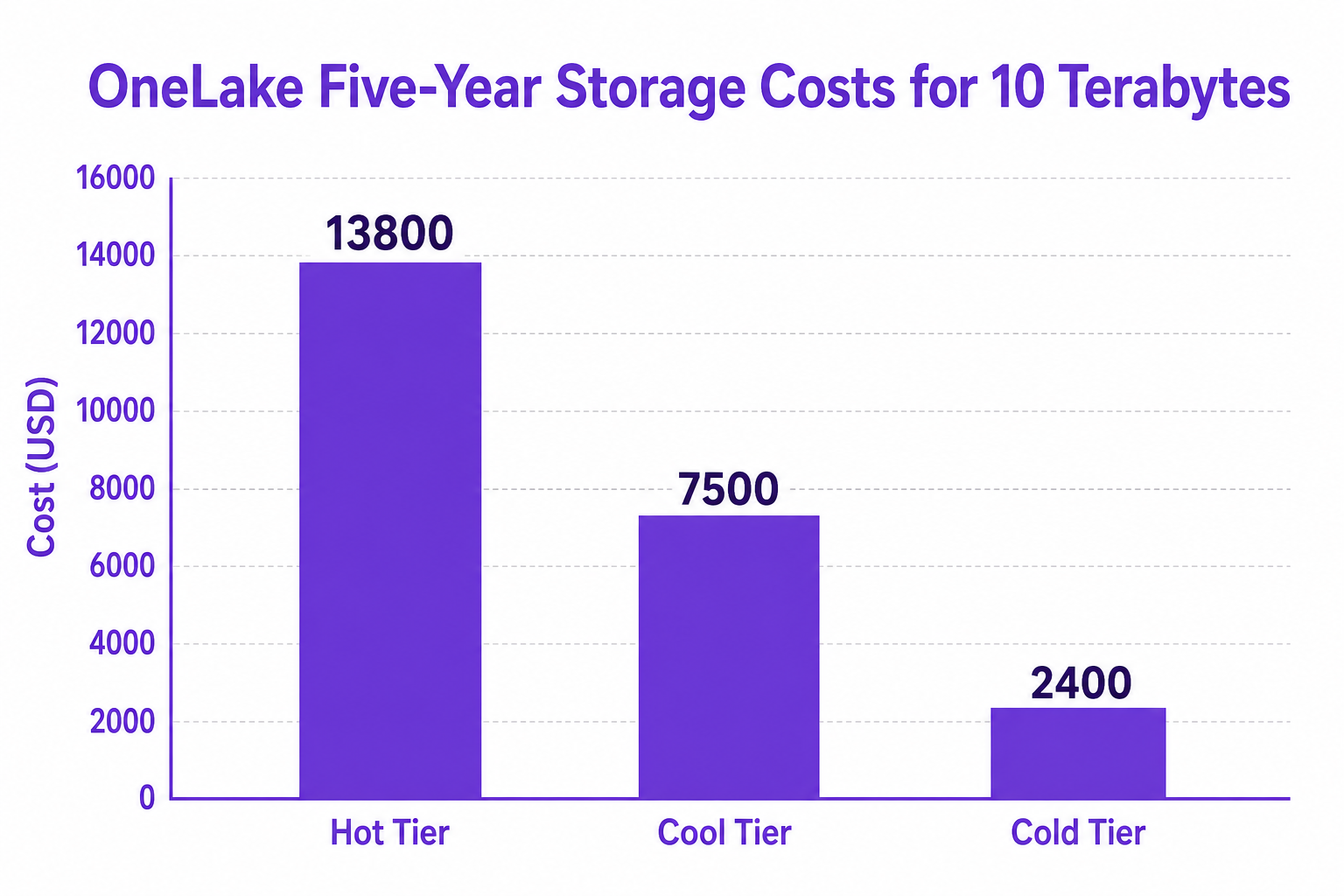
Duplicated, orphaned, or even ‘soft-deleted’ datasets continue to silently accrue charges, especially when active processing is idle.
Even automatic mirrored storage quotas are not truly free; exceed them, and overage penalties come swiftly.
The trap is clear: physical duplication offers temporary convenience at the cost of perpetual waste. The longer duplications remain, the steeper the penalty.
How do OneLake Shortcuts compare to traditional mirroring or replication?
Mirroring: Physically creates another copy of the dataset, immediately doubling storage consumption and cost. While mirrored storage can be offset by quota allowances, the limit is strictly tied to purchased workload capacity; any excess triggers expensive overage fees.
Shortcuts: Offer virtual, read-only (or optionally writable) access without any additional storage use. Permissions, lineage, and access auditing remain 100% intact and enforceable.
With shortcuts, architects avoid the fundamental flaw of mirroring: that every copy starts out needed but infrequently gets cleaned up. Shortcuts, on the other hand, are ephemeral, easily created, tracked, and decommissioned as business requirements evolve. This drives both efficiency and stronger cloud storage governance.
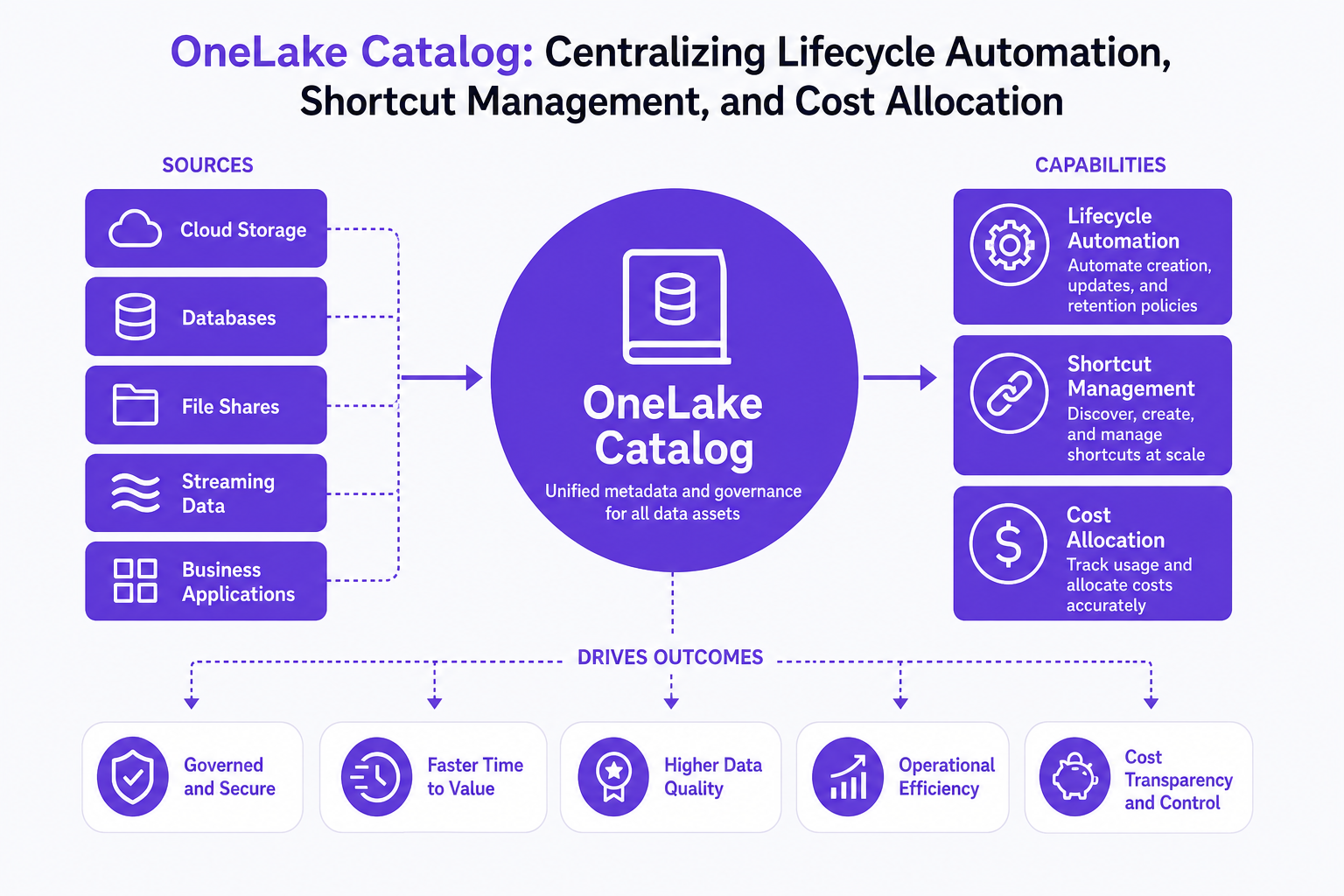
The OneLake catalog acts as the central nervous system for dataset management. With shortcuts, Data and FinOps teams gain clear visibility into which datasets are referenced, which are duplicated, and where the storage spend is concentrated.
Best practices include:
Lifecycle Automation: Use policy-based automation to move infrequently accessed datasets to cool or cold tiers based on last modified/accessed timestamps.
Table Optimization: Routinely execute file consolidation processes such as OPTIMIZE and VACUUM (especially in Delta Lake environments) to reduce fragmentation and shrink the storage footprint by up to 65%.
Idle Data Discovery: Identify and eliminate idle, unused, or orphaned data. CloudNuro integrates discovery with orchestration, automating these optimizations across the Fabric platform.
Chargeback and Governance: Allocate costs precisely to business units, leveraging unified reporting so every team is accountable for its storage consumption.
A wave of change is sweeping across the data landscape:
Engineering teams pivot away from legacy duplication, embracing shortcut-first architectures that centralize authoritative copies and slash redundant storage use.
Organizations have begun rigorous audits of mirrored storage quotas, only provisioning new workloads when true business value is proven.
Sophisticated lifecycle management and cost accountability are becoming standard, with FinOps platforms like CloudNuro leading the charge.
Feature highlights from CloudNuro:
Automated discovery engines pinpoint idle files, tables, and Parquet objects across Fabric/OneLake.
Lifecycle policy enforcement auto-graduates data between storage tiers based on granular usage analytics.
Chargeback and reporting modules allow business unit, level accountability.
Seamless, governance-first integration with Microsoft Fabric and more than 400 SaaS/cloud apps.
What are OneLake Shortcuts and how do they work?
They are virtual references that point to a dataset’s original location, letting teams access data from multiple workspaces or environments without duplicating physical storage.
How does data duplication impact storage costs in Microsoft Fabric?
Duplicate data dramatically raises baseline costs, can quickly consume mirrored storage quotas, and silently generates unnecessary spend even for idle or orphaned workspaces.
What are best practices to avoid data duplication with OneLake?
Leverage the OneLake catalog to inventory and clean up duplications, replace copies with shortcuts, and institute automated lifecycle rules that migrate infrequently used data to cheaper storage tiers.
How does OneLake Shortcuts compare to mirroring or other methods?
Shortcuts reference existing data, consuming no extra space and offering better governance, while mirroring physically duplicates and increases costs; only use mirroring when required by disaster recovery or specific backup policies.
What is the role of the OneLake catalog in managing storage?
It provides a unified view across all datasets and shortcuts, empowering admins to manage permissions, enforce policies, and optimize spend by tracking usage and lineage throughout the organization.
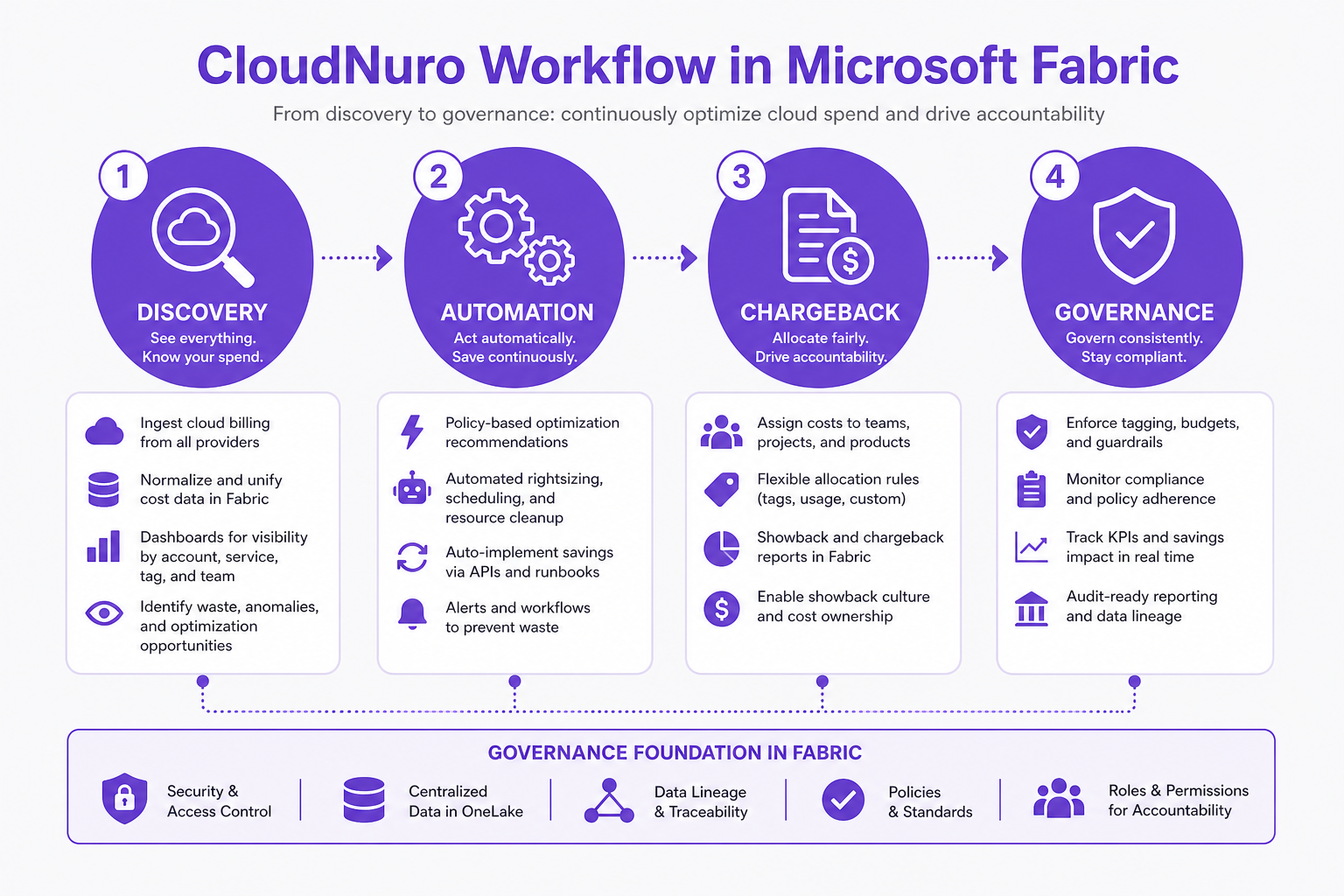
CloudNuro exists to safeguard your Microsoft Fabric investments. Offering integration and automation that transcends manual processes, CloudNuro provides:
Automated Discovery: Detects idle architectures, orphaned files, and storage anomalies across multi-tenant environments.
Lifecycle Management: Triggers data tiering based on real activity, not static policies.
Financial Discipline: Built-in chargeback/accountability ensures every department owns its storage spend.
Security and Compliance: Governance-first architecture secures datasets in flight and at rest, tracking usage every step of the way.
By uniting visibility, automation, and financial insight, CloudNuro enables Fabric teams to abandon the storage-cost traps of duplication, driving cost-efficiency and compliance.
Data growth is relentless, but storage wastage is not inevitable. OneLake Shortcuts combined with rigorous FinOps automation, delivered by platforms like CloudNuro, are transforming the economics of cloud data management. For IT and FinOps leaders in Healthcare, Finance, Government, and beyond, the path forward is clear: eliminate duplication, embrace shortcuts, and master your storage destiny.
Want to see cost optimization in action? Explore CloudNuro’s FinOps Services or learn more on our blog.
CloudNuro is a leader in Enterprise AI Adoption Management, providing enterprises with unmatched visibility, governance, and cost optimization. Recognized twice in a row in the SaaS Management Platforms category and named a Leader in the SoftwareReviews Data Quadrant, CloudNuro is trusted by global enterprises and government agencies to bring financial discipline to SaaS, cloud, and AI. Trusted by enterprises, CloudNuro provides centralized SaaS inventory, license optimization, and renewal management along with advanced cost allocation and chargeback, giving IT and Finance leaders the visibility, control, and cost-conscious culture needed to drive financial discipline.
Request a no cost, no obligation free assessment —just 15 minutes to savings!
Get StartedModern enterprises leveraging Microsoft Fabric and OneLake face a quiet, growing threat: runaway storage costs driven by unnecessary data duplication. While the cloud’s elastic promise is tantalizing, the reality on the ground often looks very different. Duplicated datasets, sprawling across analytics, compliance, and backup tiers, quietly erode budgets and operational flexibility. But there is a better way: OneLake Shortcuts.
CloudNuro, an AI-driven FinOps platform built for today’s complex SaaS and cloud environments, empowers FinOps and IT leaders to take control by eliminating inefficient storage practices, enforcing governance, and making every gigabyte accountable. In this guide, we’ll dissect exactly how OneLake Shortcuts prevent cost traps and why savvy Fabric teams are abandoning duplication for good.
Storage in Microsoft Fabric is elegant yet deceptively complex. At first glance, the unified lakehouse model promises seamless analytics and data sharing. Yet, without discipline, costs can escalate quickly, especially when teams fall back on legacy practices like duplicating datasets for different workloads.
Core Costs: Standard data lake storage comes in at about $0.023/GB/month. This baseline rises rapidly with duplication.
Mirrored and Backup Tiers: Mirrored storage, often set up for disaster recovery, can reach $0.0414/GB/month, nearly double the base rate.
Query Caching: Specialized caching layers for heavy analytics can cost as much as $0.246/GB/month.
A common pitfall is assuming storage ‘just comes with the platform’ without recognizing how quickly duplications can push costs into the tens of thousands monthly. Maintaining 500TB of duplicate data, for example, will rack up approximately $11,500 every month before compute even enters the equation.
OneLake Shortcuts are virtual pointers. Instead of physically copying data into new locations for every use case, shortcuts reference the original, authoritative data wherever it's needed, from analytics pipelines to compliance auditing. This zero-copy architecture ensures that each dataset exists only once in storage, while remaining accessible from multiple workspaces or tenants within Fabric.
How it works:
Administrators create a shortcut in the OneLake catalog pointing to an external dataset or table.
Users and pipelines read from the shortcut just as they would a native table, without moving or replicating the data.
Fabric securely tracks permissions and access, ensuring security, compliance, and audit needs are still met.
This dramatically reduces the consumption footprint, restricts hidden storage inflation, and aligns perfectly with FinOps-minded governance.
Data duplication is the silent budget killer. Organizations often mirror or copy datasets into ‘hot’ storage tiers, backup lakes, and intermediary staging zones, leading to a ballooning storage bill that few teams anticipate.
Some facts:
Migrating 10TB of compliance data from hot to cold storage can reduce five-year storage costs from $13,800 to just $2,400, an 83% savings.
Duplicated, orphaned, or even ‘soft-deleted’ datasets continue to silently accrue charges, especially when active processing is idle.
Even automatic mirrored storage quotas are not truly free; exceed them, and overage penalties come swiftly.
The trap is clear: physical duplication offers temporary convenience at the cost of perpetual waste. The longer duplications remain, the steeper the penalty.
How do OneLake Shortcuts compare to traditional mirroring or replication?
Mirroring: Physically creates another copy of the dataset, immediately doubling storage consumption and cost. While mirrored storage can be offset by quota allowances, the limit is strictly tied to purchased workload capacity; any excess triggers expensive overage fees.
Shortcuts: Offer virtual, read-only (or optionally writable) access without any additional storage use. Permissions, lineage, and access auditing remain 100% intact and enforceable.
With shortcuts, architects avoid the fundamental flaw of mirroring: that every copy starts out needed but infrequently gets cleaned up. Shortcuts, on the other hand, are ephemeral, easily created, tracked, and decommissioned as business requirements evolve. This drives both efficiency and stronger cloud storage governance.
The OneLake catalog acts as the central nervous system for dataset management. With shortcuts, Data and FinOps teams gain clear visibility into which datasets are referenced, which are duplicated, and where the storage spend is concentrated.
Best practices include:
Lifecycle Automation: Use policy-based automation to move infrequently accessed datasets to cool or cold tiers based on last modified/accessed timestamps.
Table Optimization: Routinely execute file consolidation processes such as OPTIMIZE and VACUUM (especially in Delta Lake environments) to reduce fragmentation and shrink the storage footprint by up to 65%.
Idle Data Discovery: Identify and eliminate idle, unused, or orphaned data. CloudNuro integrates discovery with orchestration, automating these optimizations across the Fabric platform.
Chargeback and Governance: Allocate costs precisely to business units, leveraging unified reporting so every team is accountable for its storage consumption.
A wave of change is sweeping across the data landscape:
Engineering teams pivot away from legacy duplication, embracing shortcut-first architectures that centralize authoritative copies and slash redundant storage use.
Organizations have begun rigorous audits of mirrored storage quotas, only provisioning new workloads when true business value is proven.
Sophisticated lifecycle management and cost accountability are becoming standard, with FinOps platforms like CloudNuro leading the charge.
Feature highlights from CloudNuro:
Automated discovery engines pinpoint idle files, tables, and Parquet objects across Fabric/OneLake.
Lifecycle policy enforcement auto-graduates data between storage tiers based on granular usage analytics.
Chargeback and reporting modules allow business unit, level accountability.
Seamless, governance-first integration with Microsoft Fabric and more than 400 SaaS/cloud apps.
What are OneLake Shortcuts and how do they work?
They are virtual references that point to a dataset’s original location, letting teams access data from multiple workspaces or environments without duplicating physical storage.
How does data duplication impact storage costs in Microsoft Fabric?
Duplicate data dramatically raises baseline costs, can quickly consume mirrored storage quotas, and silently generates unnecessary spend even for idle or orphaned workspaces.
What are best practices to avoid data duplication with OneLake?
Leverage the OneLake catalog to inventory and clean up duplications, replace copies with shortcuts, and institute automated lifecycle rules that migrate infrequently used data to cheaper storage tiers.
How does OneLake Shortcuts compare to mirroring or other methods?
Shortcuts reference existing data, consuming no extra space and offering better governance, while mirroring physically duplicates and increases costs; only use mirroring when required by disaster recovery or specific backup policies.
What is the role of the OneLake catalog in managing storage?
It provides a unified view across all datasets and shortcuts, empowering admins to manage permissions, enforce policies, and optimize spend by tracking usage and lineage throughout the organization.
CloudNuro exists to safeguard your Microsoft Fabric investments. Offering integration and automation that transcends manual processes, CloudNuro provides:
Automated Discovery: Detects idle architectures, orphaned files, and storage anomalies across multi-tenant environments.
Lifecycle Management: Triggers data tiering based on real activity, not static policies.
Financial Discipline: Built-in chargeback/accountability ensures every department owns its storage spend.
Security and Compliance: Governance-first architecture secures datasets in flight and at rest, tracking usage every step of the way.
By uniting visibility, automation, and financial insight, CloudNuro enables Fabric teams to abandon the storage-cost traps of duplication, driving cost-efficiency and compliance.
Data growth is relentless, but storage wastage is not inevitable. OneLake Shortcuts combined with rigorous FinOps automation, delivered by platforms like CloudNuro, are transforming the economics of cloud data management. For IT and FinOps leaders in Healthcare, Finance, Government, and beyond, the path forward is clear: eliminate duplication, embrace shortcuts, and master your storage destiny.
Want to see cost optimization in action? Explore CloudNuro’s FinOps Services or learn more on our blog.
CloudNuro is a leader in Enterprise AI Adoption Management, providing enterprises with unmatched visibility, governance, and cost optimization. Recognized twice in a row in the SaaS Management Platforms category and named a Leader in the SoftwareReviews Data Quadrant, CloudNuro is trusted by global enterprises and government agencies to bring financial discipline to SaaS, cloud, and AI. Trusted by enterprises, CloudNuro provides centralized SaaS inventory, license optimization, and renewal management along with advanced cost allocation and chargeback, giving IT and Finance leaders the visibility, control, and cost-conscious culture needed to drive financial discipline.
Request a no cost, no obligation free assessment - just 15 minutes to savings!
Get StartedWe're offering complimentary ServiceNow license assessments to only 25 enterprises this quarter who want to unlock immediate savings without disrupting operations.
Get Free AssessmentGet Started




CloudNuro Corp
1755 Park St. Suite 207
Naperville, IL 60563
Phone : +1-630-277-9470
Email: info@cloudnuro.com





.webp)

Recognized Leader in SaaS Management Platforms by Info-Tech SoftwareReviews



.svg)