

Sign Up
Thank you for Submitting!
Orphaned accounts are one of the most dangerous blind spots in enterprise SaaS security. These are user identities that remain active in SaaS or cloud systems after an employee, contractor, or partner has left, or after a project ends. They quietly accumulate across your stack, turning poor offboarding into a persistent offboarding security risk that blends security exposure, compliance gaps, and wasted spend.
A leading identity governance report in 2026 found that 89% of enterprise CISOs now rank orphaned accounts as a top three SaaS security governance issue, on par with privilege escalation and shadow IT. When more than half of breaches in SaaS environments involve accounts that should have been deprovisioned, according to a 2025 analysis by a cloud security provider, ignoring orphaned accounts is no longer an option.
This guide explains what orphaned accounts are, why they appear, how they harm both security and finances, and how automation, user lifecycle management, and CloudNuro can help you get ahead of this hidden risk.
At its simplest, an orphaned account is any identity that still has access rights to your SaaS or cloud environment, but no longer has a valid owner or business justification. That could be a departed employee, a contractor whose contract ended, a guest collaborator, or an integration service account nobody remembers.
A 2026 security analysis described orphaned accounts as "unlocked back doors into the enterprise" that break zero trust assumptions. The account looks legitimate to the SaaS platform, but from a governance standpoint, it is a dormant identity with no oversight.
According to a 2025 SaaS security study:
53% of SaaS breaches involved orphaned accounts that should have been deprovisioned.
Manual orphaned identity cleanup consumes over 2 hours per week per environment for IT teams, primarily to address disconnected SaaS apps.
These dormant identities undermine your identity and access management strategy in several ways:
They break zero trust assumptions about least privilege and continuous verification.
They expand your attack surface for credential stuffing, phishing, or password reuse.
They erode your security posture by masking who actually has access to sensitive data.
The analogy here is simple: orphaned accounts are like old keycards that still open office doors months after an employee's last day. Nobody tracks them, but an attacker only needs one to walk in.
Most orphaned accounts are not created by malicious insiders. They are created by process gaps. As SaaS sprawl accelerates, HR, IT, and security workflows often fail to keep up with the pace of app adoption.
In one 2024 SaaS dataset, 55.24% of accounts were guest users, not licensed employees. Many of these guest and external accounts persist long after projects end, turning into shadow IT accounts that sit outside formal control.
Common contributors to orphaned accounts include:
Disconnected HR and IT processes
Terminations are recorded in the HR system, but access rights removal in SaaS apps is manual and delayed. A contractor leaves on Friday; their accounts in CRM, collaboration tools, and project management platforms are still active weeks later.
Partial deprovisioning
The central directory account is disabled, yet direct SaaS logins, API tokens, or mobile sessions remain active. This is particularly common when apps are not integrated into a central identity management or SSO layer.
Unmanaged guest and partner identities
External collaborators are granted access via email invite, then forgotten. There is no clear owner or SaaS governance policy defining when those accounts should be reviewed or revoked.
Non-human and integration accounts
Service accounts, automation bots, and API keys are created for projects, then never cleaned up. A 2025 identity security commentary called this "identity debt" that accumulates silently until audited.
Ad hoc app adoption by business units
Teams swipe credit cards to adopt new tools. When people leave, nobody in IT knows which apps to address, so SaaS offboarding is incomplete.
The net result is a fragmented IT security offboarding process. HR drives the employee exit process, but the technical user provisioning and deprovisioning workflow only partially follows, leaving behind a trail of inactive accounts security teams cannot see.
Orphaned accounts create risk in three intertwined dimensions: security, compliance, and cost. Each of them can be significant on its own. Together, they form a compelling board-level concern.
From a security perspective, orphaned accounts are ideal targets:
Credential attacks: Attackers exploit password reuse, credential stuffing, or phishing against dormant accounts that nobody is monitoring.
Privilege creep: These accounts often retain elevated permissions. Over time, people accumulate access but rarely lose it. When these identities become orphaned, you have privileged accounts with no owner.
Internal threat: Departed employees who still have access can download data, change configurations, or disrupt services.
Security analyses in 2026 highlighted that continuous identity observability and automated detection of orphaned accounts are replacing periodic, manual security audit SaaS checks in leading enterprises. Without that visibility, you are guessing about who actually has access.
Regulatory regimes such as SOX, HIPAA, PCI DSS, and NIS2 increasingly expect timely deprovisioning and clear evidence of compliance automation around access control.
Regulatory and audit commentary from 2025 shows that supervision failures now frequently include unmanaged or orphaned accounts, especially in regulated industries. Common findings include:
Accounts for ex-employees still active in financial or healthcare SaaS platforms.
Non-human service accounts with persistent access to regulated data.
Lack of documented access control reviews or SaaS risk audit processes.
These issues translate into:
Audit findings that require costly remediation and follow-up.
Regulatory sanctions or fines for repeated failures.
Damage to trust with customers and partners who expect strong data privacy safeguards.
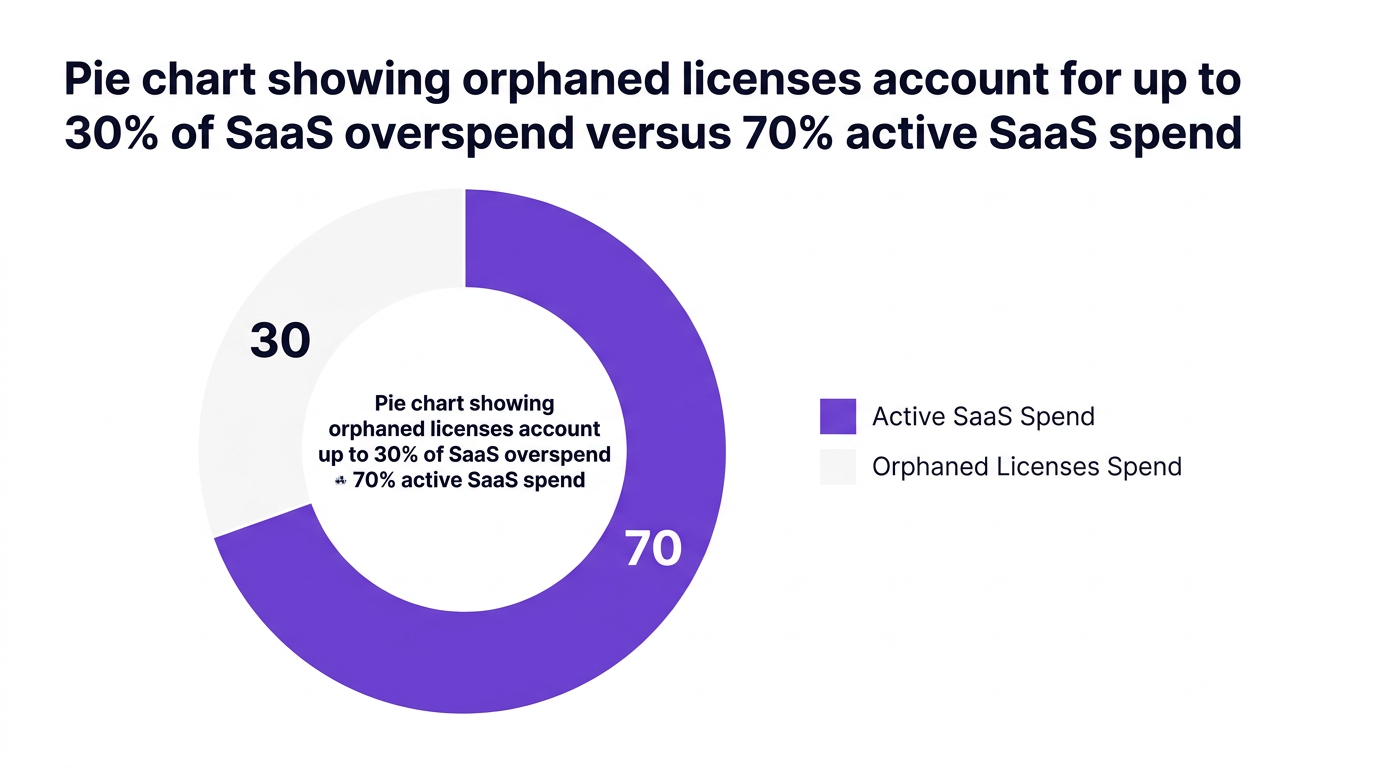
Orphaned accounts are not only risky; they are expensive. A 2026 SaaS optimization analysis estimated that orphaned licenses drive roughly 20 to 30% overspend on SaaS contracts in unmanaged environments.
Indirect costs also accumulate:
IT teams spend hours hunting down and cleaning up inactive accounts security cannot fully see.
Budget owners pay for seats tied to former employees, contractors, or unused guest accounts.
Renewal decisions are based on inflated seat counts, skewing your license optimization efforts.
In other words, orphaned accounts are a combined SaaS platform risk and a recurring expense line. They damage both your security posture and your bottom line.
Relying on periodic spreadsheets and ticket-driven cleanup is no longer sustainable. A 2025 identity governance study found that manual orphaned identity cleanup averages more than 2 hours per week per environment. That burden scales poorly once you manage hundreds of SaaS apps.
AI-driven SaaS management tools have shown up to 40% year-over-year reduction in orphaned accounts for early adopters in financial and healthcare sectors, according to a 2026 SaaS predictions report. The difference is automation and continuous telemetry rather than episodic review.
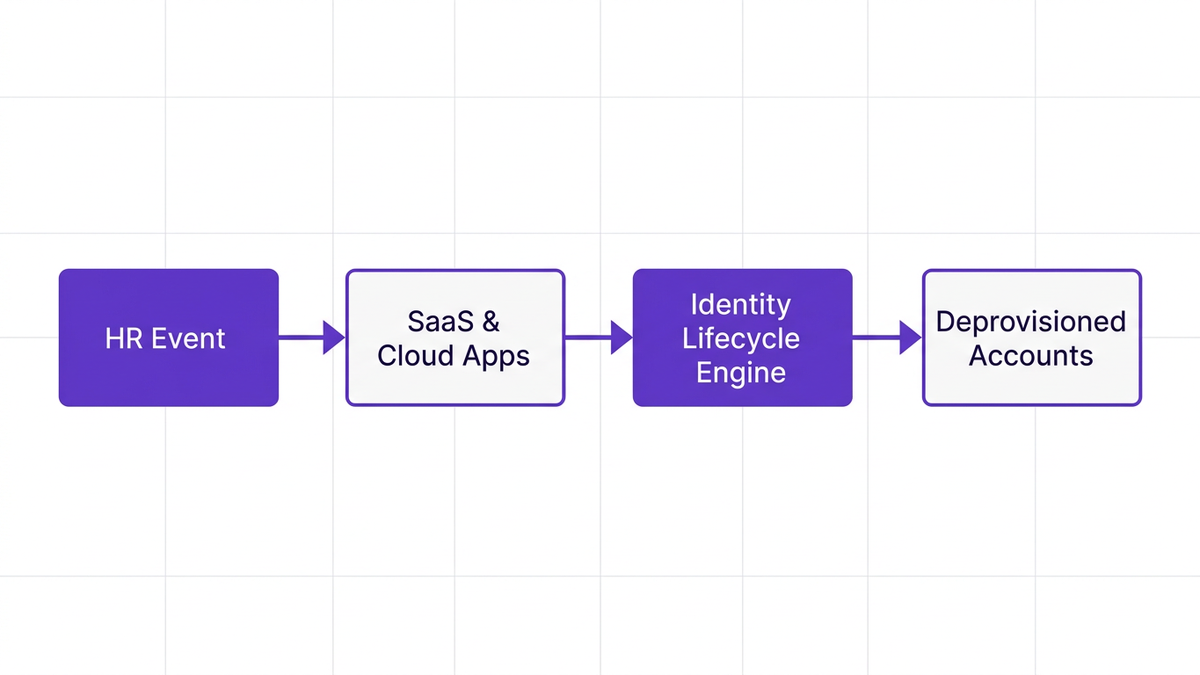
A mature cloud account governance model for orphaned accounts typically includes:
HR-driven lifecycle events
HR systems are the system of record for joiner, mover, and leaver events. These events automatically trigger user lifecycle management workflows that create, adjust, or retire access across SaaS and cloud.
Centralized identity and access management
SaaS apps are integrated into a central identity and access management layer. Direct login is minimized. When a central identity is disabled, app access vanishes immediately.
Automated deprovisioning across SaaS
Automated deprovisioning workflows remove users, revoke sessions, and reclaim licenses across every connected app, not just a subset of core platforms.
Continuous discovery and risk assessment
Tools continuously scan for accounts with no corresponding HR record, no recent usage, or mismatched status. These are flagged as potential orphaned accounts for review or automatic remediation.
Regular, automated access reviews
Periodic access reviews still matter, but they are now driven by compliance automation and are fed by real-time data, not static exports. Identity owners and managers can quickly attest to access or revoke it.
Tight integration with IT operations
Integration with IT operations solutions and IT security programs ensures orphaned account remediation aligns with incident response, change management, and broader security posture management.
Advanced organizations often describe this as moving from “identity cleanups” to continuous identity telemetry. The shift is from reactive to proactive management of enterprise SaaS security.
To make this concrete, here is a best-practice playbook for reducing orphaned accounts and lowering data breach risk SaaS exposure.
Treat offboarding as a cross-functional workflow that ties together HR, IT, security, and business owners. Your employee exit process should include:
A clear policy defining when and how access must be removed.
Roles and responsibilities across HR, IT operations, and app owners.
A defined SLA for deprovisioning (for example, within hours of termination).
If you do not have a structured process, start with an employee offboarding checklist and align it with your HR and security teams.
You cannot fix what you cannot see. Begin by cataloging:
All SaaS apps in use, including shadow IT discovered via SSO logs, network data, and expense reports.
All identities in each app, including employees, contractors, guests, and service accounts.
The relationship between identities and HR records.
A robust SaaS management capability or SaaS discovery tool is critical here. This inventory becomes the foundation for SaaS governance and SaaS offboarding automation.
Implement user provisioning and deprovisioning workflows that respond automatically to lifecycle events:
When HR creates a new employee, appropriate SaaS accounts are provisioned with least privilege.
When roles change, access rights are adjusted and privilege creep is minimized.
When employment ends, all related identities, tokens, and sessions are revoked.
Modern automation tools support this by integrating HRIS, directory services, and SaaS APIs. For deeper guidance, review an identity and access management best practices guide.
Use automation to identify suspicious accounts, such as:
Accounts with no matching HR or contractor record.
Accounts inactive for a defined period but still enabled.
Service accounts without a clear owner or business justification.
These should feed into:
Automated deactivation for low-risk cases.
Workflows to confirm usage with app owners.
Documentation for security audit SaaS evidence.
Orphaned accounts are also license optimization opportunities. Connect identity data with license usage so that when an account is deprovisioned, licenses are reclaimed or reassigned.
Reference materials such as a complete user access review checklist can help structure these reviews. The goal is to unify security and finance outcomes so that cleaning up identities also improves spend efficiency.
Finally, treat orphaned account reduction as an ongoing program, not a one-time project. Periodically:
Run targeted SaaS risk audit checks on high-value applications.
Validate that IT security offboarding SLAs are being met.
Measure reductions in orphaned accounts and recovered licenses.
This tight feedback loop helps keep cloud account governance aligned with evolving business and regulatory expectations.
CloudNuro was built for enterprises that need unified visibility and control over complex SaaS, cloud, and AI portfolios. Orphaned accounts are a natural focus, because they sit at the intersection of security, governance, and cost.
Here is how CloudNuro addresses the problem end to end.
CloudNuro discovers and continuously monitors identities across more than 400 integrated SaaS and cloud applications. It correlates:
HR records and employee status.
Directory and identity provider data.
App-level identities, roles, and usage activity.
This unified view identifies orphaned accounts for both human and non-human identities, including service accounts and API keys, and flags them as inactive accounts security should review.
CloudNuro connects HR events directly to technical deprovisioning across your estate. When an employee or contractor departs:
All associated app identities are disabled or removed.
Sessions and tokens are revoked.
Roles and group memberships are cleaned up to minimize privilege creep.
These workflows give you consistent, auditable access rights removal aligned with HR and IT asset management processes.
CloudNuro continuously evaluates SaaS compliance risks by monitoring:
Accounts without matching HR records.
Dormant or underused accounts with active access.
Policy violations like shared accounts or overprivileged roles.
Built-in reporting supports security audit SaaS needs, enabling IT and security leaders to demonstrate timely deprovisioning and effective access control in line with frameworks like zero trust.
CloudNuro connects identity data with usage and cost to expose the financial impact of orphaned accounts:
Quantifies overspend from orphaned licenses.
Automates license reclamation when accounts are deprovisioned.
Uses CloudNuro Chargeback to hold departments accountable for unused or orphaned SaaS spend.
This turns orphaned account remediation into a cost optimization lever, not just a security hygiene task.
CloudNuro can be deployed in hours, not months, and integrates with core enterprise platforms, including Microsoft 365 Custodian, Salesforce Custodian, ServiceNow Custodian, Unified Cloud Custodian, AI Custodian, CloudNuro Chargeback, and FinOps Services.
The result is a governance-first architecture that connects enterprise SaaS security, IT operations, and financial stewardship into a unified program.
An orphaned account is any user or service identity that still has access to your SaaS or cloud environment, but no longer has a valid owner or business justification. Common examples include accounts for ex-employees, former contractors, external guests from completed projects, and service accounts with no current owner.
They are dangerous because they are hard to see, yet often retain meaningful privileges. Attackers frequently exploit dormant accounts, and regulators view unmanaged access as a clear control failure. Because nobody "owns" these accounts, they fall between HR, IT, and security responsibilities.
Automation connects HR lifecycle events with automated deprovisioning across SaaS applications. When a person leaves or changes roles, their access is updated or removed across every integrated app. Automated discovery and continuous risk assessment then identify any remaining orphaned accounts for remediation.
Strong identity and access management centralizes authentication and authorization for your SaaS estate. When accounts are tied to a central identity and that identity is disabled, app access drops immediately. IAM also supports access control policies, least privilege, and regular access reviews that reduce the chance of identities becoming orphaned.
CloudNuro provides real-time visibility into all SaaS identities, their status, and their relationship to HR records. It highlights orphaned accounts, tracks deprovisioning events, and generates evidence that shows auditors how quickly and consistently you remove access when people leave or roles change.
Yes. Orphaned accounts almost always map to unused licenses and inflated seat counts. By cleaning up these identities and connecting that process to license optimization and chargeback, organizations routinely reclaim 20 to 30% of SaaS spend associated with unused or abandoned accounts.
Orphaned accounts are not a niche IT housekeeping issue. They are a primary offboarding security risk that undermines enterprise SaaS security, weakens compliance, and quietly drains budgets. The combination of SaaS sprawl, fragmented offboarding, and limited visibility makes the problem worse every quarter it is left unaddressed.
The path forward is clear: treat orphaned accounts as a continuous cloud account governance problem, automate deprovisioning wherever possible, and connect identity data to both security and cost outcomes. With CloudNuro, enterprises can discover and remediate orphaned accounts across their entire SaaS estate, strengthen zero trust, and turn identity cleanup into measurable savings.
To see how CloudNuro can help your organization reduce orphaned accounts and improve SaaS governance, request a tailored demo today.
CloudNuro is a leader in Enterprise SaaS Management Platforms, providing enterprises with unmatched visibility, governance, and cost optimization. Recognized twice in a row in the SaaS Management Platforms category and named a Leader in the SoftwareReviews Data Quadrant, CloudNuro is trusted by global enterprises and government agencies to bring financial discipline to SaaS, cloud, and AI. Trusted by enterprises such as Konica Minolta and Federal Signal, CloudNuro provides centralized SaaS inventory, license optimization, and renewal management along with advanced cost allocation and chargeback, giving IT and Finance leaders the visibility, control, and cost-conscious culture needed to drive financial discipline.
Request a no cost, no obligation free assessment —just 15 minutes to savings!
Get StartedOrphaned accounts are one of the most dangerous blind spots in enterprise SaaS security. These are user identities that remain active in SaaS or cloud systems after an employee, contractor, or partner has left, or after a project ends. They quietly accumulate across your stack, turning poor offboarding into a persistent offboarding security risk that blends security exposure, compliance gaps, and wasted spend.
A leading identity governance report in 2026 found that 89% of enterprise CISOs now rank orphaned accounts as a top three SaaS security governance issue, on par with privilege escalation and shadow IT. When more than half of breaches in SaaS environments involve accounts that should have been deprovisioned, according to a 2025 analysis by a cloud security provider, ignoring orphaned accounts is no longer an option.
This guide explains what orphaned accounts are, why they appear, how they harm both security and finances, and how automation, user lifecycle management, and CloudNuro can help you get ahead of this hidden risk.
At its simplest, an orphaned account is any identity that still has access rights to your SaaS or cloud environment, but no longer has a valid owner or business justification. That could be a departed employee, a contractor whose contract ended, a guest collaborator, or an integration service account nobody remembers.
A 2026 security analysis described orphaned accounts as "unlocked back doors into the enterprise" that break zero trust assumptions. The account looks legitimate to the SaaS platform, but from a governance standpoint, it is a dormant identity with no oversight.
According to a 2025 SaaS security study:
53% of SaaS breaches involved orphaned accounts that should have been deprovisioned.
Manual orphaned identity cleanup consumes over 2 hours per week per environment for IT teams, primarily to address disconnected SaaS apps.
These dormant identities undermine your identity and access management strategy in several ways:
They break zero trust assumptions about least privilege and continuous verification.
They expand your attack surface for credential stuffing, phishing, or password reuse.
They erode your security posture by masking who actually has access to sensitive data.
The analogy here is simple: orphaned accounts are like old keycards that still open office doors months after an employee's last day. Nobody tracks them, but an attacker only needs one to walk in.
Most orphaned accounts are not created by malicious insiders. They are created by process gaps. As SaaS sprawl accelerates, HR, IT, and security workflows often fail to keep up with the pace of app adoption.
In one 2024 SaaS dataset, 55.24% of accounts were guest users, not licensed employees. Many of these guest and external accounts persist long after projects end, turning into shadow IT accounts that sit outside formal control.
Common contributors to orphaned accounts include:
Disconnected HR and IT processes
Terminations are recorded in the HR system, but access rights removal in SaaS apps is manual and delayed. A contractor leaves on Friday; their accounts in CRM, collaboration tools, and project management platforms are still active weeks later.
Partial deprovisioning
The central directory account is disabled, yet direct SaaS logins, API tokens, or mobile sessions remain active. This is particularly common when apps are not integrated into a central identity management or SSO layer.
Unmanaged guest and partner identities
External collaborators are granted access via email invite, then forgotten. There is no clear owner or SaaS governance policy defining when those accounts should be reviewed or revoked.
Non-human and integration accounts
Service accounts, automation bots, and API keys are created for projects, then never cleaned up. A 2025 identity security commentary called this "identity debt" that accumulates silently until audited.
Ad hoc app adoption by business units
Teams swipe credit cards to adopt new tools. When people leave, nobody in IT knows which apps to address, so SaaS offboarding is incomplete.
The net result is a fragmented IT security offboarding process. HR drives the employee exit process, but the technical user provisioning and deprovisioning workflow only partially follows, leaving behind a trail of inactive accounts security teams cannot see.
Orphaned accounts create risk in three intertwined dimensions: security, compliance, and cost. Each of them can be significant on its own. Together, they form a compelling board-level concern.
From a security perspective, orphaned accounts are ideal targets:
Credential attacks: Attackers exploit password reuse, credential stuffing, or phishing against dormant accounts that nobody is monitoring.
Privilege creep: These accounts often retain elevated permissions. Over time, people accumulate access but rarely lose it. When these identities become orphaned, you have privileged accounts with no owner.
Internal threat: Departed employees who still have access can download data, change configurations, or disrupt services.
Security analyses in 2026 highlighted that continuous identity observability and automated detection of orphaned accounts are replacing periodic, manual security audit SaaS checks in leading enterprises. Without that visibility, you are guessing about who actually has access.
Regulatory regimes such as SOX, HIPAA, PCI DSS, and NIS2 increasingly expect timely deprovisioning and clear evidence of compliance automation around access control.
Regulatory and audit commentary from 2025 shows that supervision failures now frequently include unmanaged or orphaned accounts, especially in regulated industries. Common findings include:
Accounts for ex-employees still active in financial or healthcare SaaS platforms.
Non-human service accounts with persistent access to regulated data.
Lack of documented access control reviews or SaaS risk audit processes.
These issues translate into:
Audit findings that require costly remediation and follow-up.
Regulatory sanctions or fines for repeated failures.
Damage to trust with customers and partners who expect strong data privacy safeguards.
Orphaned accounts are not only risky; they are expensive. A 2026 SaaS optimization analysis estimated that orphaned licenses drive roughly 20 to 30% overspend on SaaS contracts in unmanaged environments.
Indirect costs also accumulate:
IT teams spend hours hunting down and cleaning up inactive accounts security cannot fully see.
Budget owners pay for seats tied to former employees, contractors, or unused guest accounts.
Renewal decisions are based on inflated seat counts, skewing your license optimization efforts.
In other words, orphaned accounts are a combined SaaS platform risk and a recurring expense line. They damage both your security posture and your bottom line.
Relying on periodic spreadsheets and ticket-driven cleanup is no longer sustainable. A 2025 identity governance study found that manual orphaned identity cleanup averages more than 2 hours per week per environment. That burden scales poorly once you manage hundreds of SaaS apps.
AI-driven SaaS management tools have shown up to 40% year-over-year reduction in orphaned accounts for early adopters in financial and healthcare sectors, according to a 2026 SaaS predictions report. The difference is automation and continuous telemetry rather than episodic review.
A mature cloud account governance model for orphaned accounts typically includes:
HR-driven lifecycle events
HR systems are the system of record for joiner, mover, and leaver events. These events automatically trigger user lifecycle management workflows that create, adjust, or retire access across SaaS and cloud.
Centralized identity and access management
SaaS apps are integrated into a central identity and access management layer. Direct login is minimized. When a central identity is disabled, app access vanishes immediately.
Automated deprovisioning across SaaS
Automated deprovisioning workflows remove users, revoke sessions, and reclaim licenses across every connected app, not just a subset of core platforms.
Continuous discovery and risk assessment
Tools continuously scan for accounts with no corresponding HR record, no recent usage, or mismatched status. These are flagged as potential orphaned accounts for review or automatic remediation.
Regular, automated access reviews
Periodic access reviews still matter, but they are now driven by compliance automation and are fed by real-time data, not static exports. Identity owners and managers can quickly attest to access or revoke it.
Tight integration with IT operations
Integration with IT operations solutions and IT security programs ensures orphaned account remediation aligns with incident response, change management, and broader security posture management.
Advanced organizations often describe this as moving from “identity cleanups” to continuous identity telemetry. The shift is from reactive to proactive management of enterprise SaaS security.
To make this concrete, here is a best-practice playbook for reducing orphaned accounts and lowering data breach risk SaaS exposure.
Treat offboarding as a cross-functional workflow that ties together HR, IT, security, and business owners. Your employee exit process should include:
A clear policy defining when and how access must be removed.
Roles and responsibilities across HR, IT operations, and app owners.
A defined SLA for deprovisioning (for example, within hours of termination).
If you do not have a structured process, start with an employee offboarding checklist and align it with your HR and security teams.
You cannot fix what you cannot see. Begin by cataloging:
All SaaS apps in use, including shadow IT discovered via SSO logs, network data, and expense reports.
All identities in each app, including employees, contractors, guests, and service accounts.
The relationship between identities and HR records.
A robust SaaS management capability or SaaS discovery tool is critical here. This inventory becomes the foundation for SaaS governance and SaaS offboarding automation.
Implement user provisioning and deprovisioning workflows that respond automatically to lifecycle events:
When HR creates a new employee, appropriate SaaS accounts are provisioned with least privilege.
When roles change, access rights are adjusted and privilege creep is minimized.
When employment ends, all related identities, tokens, and sessions are revoked.
Modern automation tools support this by integrating HRIS, directory services, and SaaS APIs. For deeper guidance, review an identity and access management best practices guide.
Use automation to identify suspicious accounts, such as:
Accounts with no matching HR or contractor record.
Accounts inactive for a defined period but still enabled.
Service accounts without a clear owner or business justification.
These should feed into:
Automated deactivation for low-risk cases.
Workflows to confirm usage with app owners.
Documentation for security audit SaaS evidence.
Orphaned accounts are also license optimization opportunities. Connect identity data with license usage so that when an account is deprovisioned, licenses are reclaimed or reassigned.
Reference materials such as a complete user access review checklist can help structure these reviews. The goal is to unify security and finance outcomes so that cleaning up identities also improves spend efficiency.
Finally, treat orphaned account reduction as an ongoing program, not a one-time project. Periodically:
Run targeted SaaS risk audit checks on high-value applications.
Validate that IT security offboarding SLAs are being met.
Measure reductions in orphaned accounts and recovered licenses.
This tight feedback loop helps keep cloud account governance aligned with evolving business and regulatory expectations.
CloudNuro was built for enterprises that need unified visibility and control over complex SaaS, cloud, and AI portfolios. Orphaned accounts are a natural focus, because they sit at the intersection of security, governance, and cost.
Here is how CloudNuro addresses the problem end to end.
CloudNuro discovers and continuously monitors identities across more than 400 integrated SaaS and cloud applications. It correlates:
HR records and employee status.
Directory and identity provider data.
App-level identities, roles, and usage activity.
This unified view identifies orphaned accounts for both human and non-human identities, including service accounts and API keys, and flags them as inactive accounts security should review.
CloudNuro connects HR events directly to technical deprovisioning across your estate. When an employee or contractor departs:
All associated app identities are disabled or removed.
Sessions and tokens are revoked.
Roles and group memberships are cleaned up to minimize privilege creep.
These workflows give you consistent, auditable access rights removal aligned with HR and IT asset management processes.
CloudNuro continuously evaluates SaaS compliance risks by monitoring:
Accounts without matching HR records.
Dormant or underused accounts with active access.
Policy violations like shared accounts or overprivileged roles.
Built-in reporting supports security audit SaaS needs, enabling IT and security leaders to demonstrate timely deprovisioning and effective access control in line with frameworks like zero trust.
CloudNuro connects identity data with usage and cost to expose the financial impact of orphaned accounts:
Quantifies overspend from orphaned licenses.
Automates license reclamation when accounts are deprovisioned.
Uses CloudNuro Chargeback to hold departments accountable for unused or orphaned SaaS spend.
This turns orphaned account remediation into a cost optimization lever, not just a security hygiene task.
CloudNuro can be deployed in hours, not months, and integrates with core enterprise platforms, including Microsoft 365 Custodian, Salesforce Custodian, ServiceNow Custodian, Unified Cloud Custodian, AI Custodian, CloudNuro Chargeback, and FinOps Services.
The result is a governance-first architecture that connects enterprise SaaS security, IT operations, and financial stewardship into a unified program.
An orphaned account is any user or service identity that still has access to your SaaS or cloud environment, but no longer has a valid owner or business justification. Common examples include accounts for ex-employees, former contractors, external guests from completed projects, and service accounts with no current owner.
They are dangerous because they are hard to see, yet often retain meaningful privileges. Attackers frequently exploit dormant accounts, and regulators view unmanaged access as a clear control failure. Because nobody "owns" these accounts, they fall between HR, IT, and security responsibilities.
Automation connects HR lifecycle events with automated deprovisioning across SaaS applications. When a person leaves or changes roles, their access is updated or removed across every integrated app. Automated discovery and continuous risk assessment then identify any remaining orphaned accounts for remediation.
Strong identity and access management centralizes authentication and authorization for your SaaS estate. When accounts are tied to a central identity and that identity is disabled, app access drops immediately. IAM also supports access control policies, least privilege, and regular access reviews that reduce the chance of identities becoming orphaned.
CloudNuro provides real-time visibility into all SaaS identities, their status, and their relationship to HR records. It highlights orphaned accounts, tracks deprovisioning events, and generates evidence that shows auditors how quickly and consistently you remove access when people leave or roles change.
Yes. Orphaned accounts almost always map to unused licenses and inflated seat counts. By cleaning up these identities and connecting that process to license optimization and chargeback, organizations routinely reclaim 20 to 30% of SaaS spend associated with unused or abandoned accounts.
Orphaned accounts are not a niche IT housekeeping issue. They are a primary offboarding security risk that undermines enterprise SaaS security, weakens compliance, and quietly drains budgets. The combination of SaaS sprawl, fragmented offboarding, and limited visibility makes the problem worse every quarter it is left unaddressed.
The path forward is clear: treat orphaned accounts as a continuous cloud account governance problem, automate deprovisioning wherever possible, and connect identity data to both security and cost outcomes. With CloudNuro, enterprises can discover and remediate orphaned accounts across their entire SaaS estate, strengthen zero trust, and turn identity cleanup into measurable savings.
To see how CloudNuro can help your organization reduce orphaned accounts and improve SaaS governance, request a tailored demo today.
CloudNuro is a leader in Enterprise SaaS Management Platforms, providing enterprises with unmatched visibility, governance, and cost optimization. Recognized twice in a row in the SaaS Management Platforms category and named a Leader in the SoftwareReviews Data Quadrant, CloudNuro is trusted by global enterprises and government agencies to bring financial discipline to SaaS, cloud, and AI. Trusted by enterprises such as Konica Minolta and Federal Signal, CloudNuro provides centralized SaaS inventory, license optimization, and renewal management along with advanced cost allocation and chargeback, giving IT and Finance leaders the visibility, control, and cost-conscious culture needed to drive financial discipline.
Request a no cost, no obligation free assessment - just 15 minutes to savings!
Get StartedWe're offering complimentary ServiceNow license assessments to only 25 enterprises this quarter who want to unlock immediate savings without disrupting operations.
Get Free AssessmentGet Started




CloudNuro Corp
1755 Park St. Suite 207
Naperville, IL 60563
Phone : +1-630-277-9470
Email: info@cloudnuro.com





.webp)

Recognized Leader in SaaS Management Platforms by Info-Tech SoftwareReviews


.svg)