

Sign Up
Thank you for Submitting!
Fabric Dev/Test environments are notorious budget sinkholes. Capacity is spun up for a sprint or experiment, then quietly left running. Multiply that by dozens of teams and you quickly have a material line item your FinOps dashboards cannot ignore.
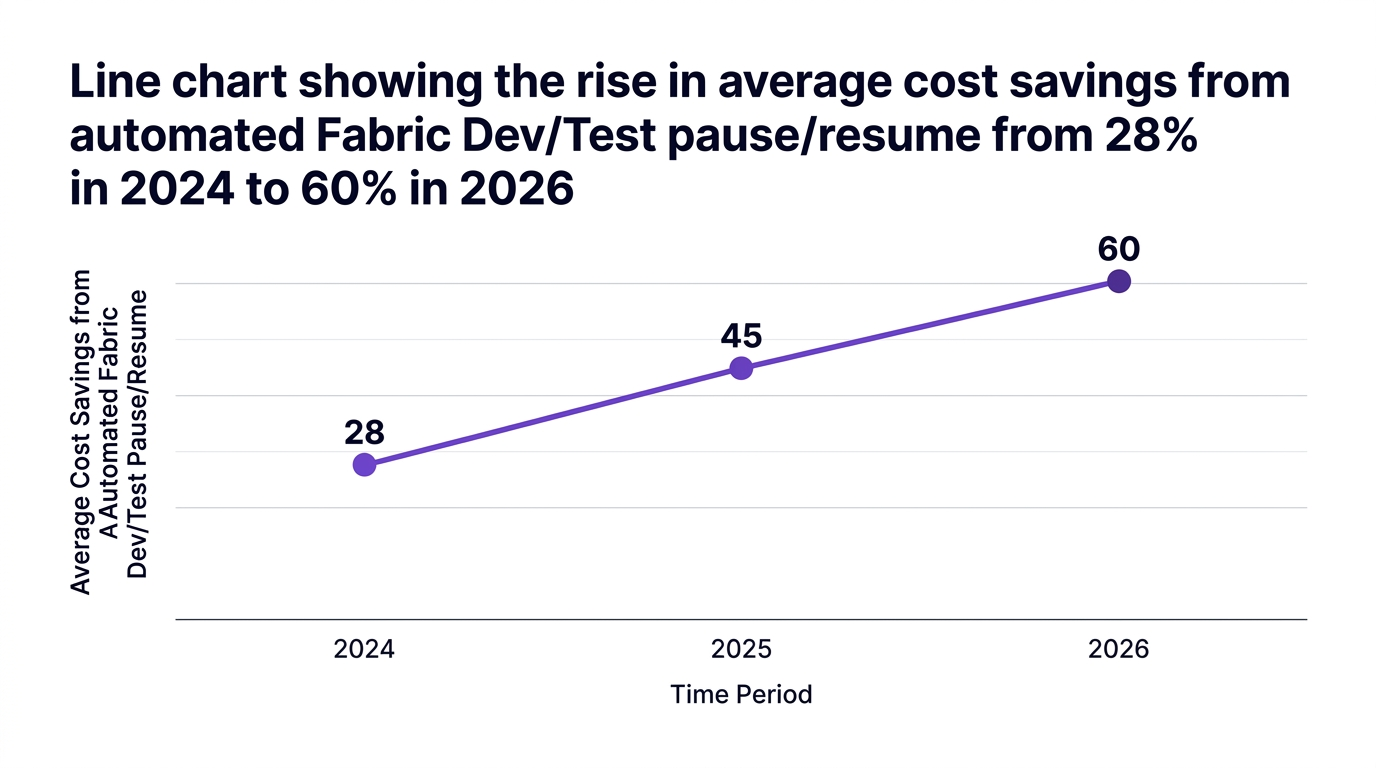
Enter fabric capacity pause resume automation. By treating non‑production capacity like a just‑in‑time utility, enterprises are cutting Dev/Test cloud costs by an average of 60% through automated scheduling for Fabric environments (Forrester 2026). This playbook shows how to get there, step by step.
Most Dev/Test workloads are bursty. Engineers need rich environments during working hours, not at 2 a.m. or on weekends. Yet capacity billing runs continuously.
IDC found that 64% of idle or under‑used resources in Dev/Test environments persist for days before manual cleanup, which drives unnecessary spend (IDC 2026). That waste is exactly what pause and resume fabric capacity strategies attack.
When you implement fabric capacity pause resume policies, you:
Eliminate idle runtime by stopping capacity outside approved windows.
Shift to usage‑aligned spend that matches how engineers actually work.
Create predictable cost baselines that finance and product leaders can trust.
A leading analyst described it simply: “Automating the pause and resume of Fabric capacity is the single highest‑leverage activity IT can take to cut Dev/Test cloud overspend in 2026” (Forrester 2026). In other words, this is not a marginal gain; it is foundational cloud cost management for Dev/Test.

Dev/Test is supposed to be cheaper than production, but in many enterprises the opposite happens. Non‑production sprawl, over‑sized capacities, and always‑on environments quietly erode margins.
Key data points illustrate the scale of the issue:
Enterprises that automated fabric environment scheduling achieved an average 60% reduction in Dev/Test cloud costs (Forrester 2026).
72% of enterprise IT leaders say automation of non‑production environments is their top FinOps initiative for 2026 (Gartner 2026).
Only 28% of organizations have fully automated non‑production scheduling as of Q1 2026 (InfoTech 2026).
That last number is your opportunity. The majority of organizations still accept idle capacity as a cost of doing business.
FinOps for Dev/Test environments is structurally different from production cost management:
Higher volatility: Environments are created and torn down frequently.
Lower uptime requirements: Few Dev/Test workloads need 24x7 availability.
More experimentation: Teams spin up short‑lived workloads to test ideas.
This makes Dev/Test ideal for FinOps automation for dev and test environments:
Start/stop schedules can be aggressive.
Rightsizing can be more frequent and less risk‑averse.
Policies can default to shutdown, with opt‑in exceptions.
Think of production as a hospital, where everything must stay on, and Dev/Test as an office building, where lights and HVAC can turn off at night. You would not pay to cool an empty building; you should not pay for unused cloud capacity either.
To cut costs, you need a structured approach, not just a plea for engineers to "remember to shut things down." Below is a five‑step playbook for dev test cloud cost optimization using fabric capacity pause resume.
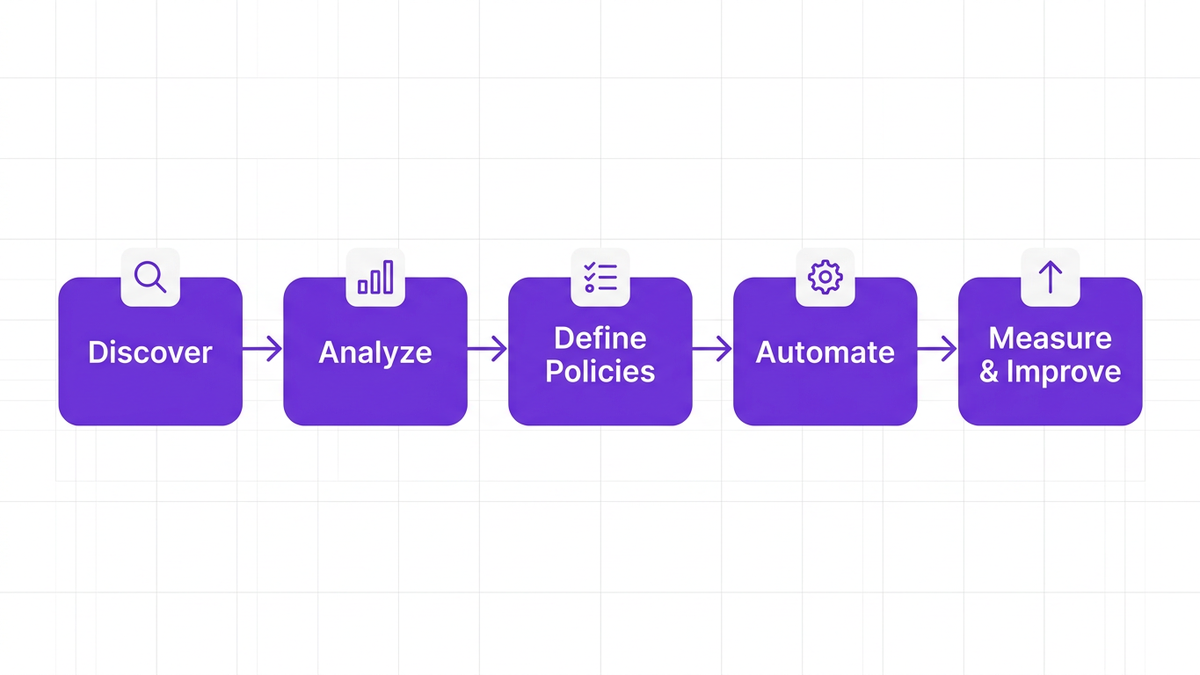
Start with infrastructure cost visibility. You cannot manage what you cannot see.
Actions:
Inventory all Fabric capacities and related cloud resources.
Tag or group them as Dev, Test, QA, Staging, or Sandbox.
Map each capacity to owning teams and cost centers with cost allocation tags.
This foundation enables cloud cost governance for engineering teams and is often accelerated by tools that provide automated SaaS discovery and cloud resource mapping.
Next, analyze when environments are actually used. Usage‑based billing only pays off if you align capacity with utilization.
Key analyses:
Hour‑by‑hour CPU, memory, and job execution trends.
Days of the week with activity versus silence.
Long‑running environments with low engagement.
Enterprises using AI‑driven optimization tools reported 2x cost reduction compared to manual methods for non‑production workloads (EMA 2026). This is where idle resource cleanup and anomaly detection identify hidden waste.
Once you know usage patterns, define policies that codify behavior.
Policy examples for rightsizing and scheduling cloud capacity:
Default Dev/Test capacity: On 8 a.m.–7 p.m. local time, Monday–Friday; off at all other times.
Heavy testing windows: Extend hours for specific teams during release cycles.
Rightsizing rules: Downgrade capacity tiers if average utilization stays below 30% for 14 days.
F-SKU pause strategy: Pause reserved or F‑SKU Fabric capacities when utilization drops below thresholds, and resume only on scheduled or on‑demand triggers.
Your governance model should document:
Who can override schedules.
How long exceptions are valid.
What audit trails and approvals are required.
This step converts policies into reliable, repeatable outcomes. Manual change windows and calendar reminders will fail at scale.
You need automated cloud cost control capabilities that:
Trigger scheduled shutdown of Dev/Test environments.
Provide on‑demand "resume" actions for developers.
Orchestrate environment start stop automation across dependent services and data.
Integrate with CI/CD and ticketing systems, so automation respects change processes.
Enterprises that reduce dev test cloud costs with scheduling report average savings of 20% or more within the first 6 months of automation (CloudNuro platform analytics 2026).
Finally, treat this as an ongoing FinOps capability, not a one‑time clean‑up.
Key practices:
Monthly reports by team: saved hours, dollars, and idle waste avoided.
Chargeback or showback using a dedicated chargeback platform to create financial accountability.
Quarterly policy reviews to adjust schedules, rightsizing thresholds, and exception rules.
This is where FinOps for dev and test becomes a cultural practice. Engineering leaders start asking not only "Is the feature done?" but also "Are we right‑sized and scheduled correctly?"
There are legitimate reasons some teams resist aggressive pause policies. An effective playbook acknowledges these concerns.
Engineers fear that paused environments will slow them down. If every morning starts with a 30‑minute warm‑up, productivity suffers.
Mitigations:
Use pre‑warm schedules that start environments 15 minutes before workday.
Offer on‑demand Fabric reservation strategy options for critical systems that must stay warm.
Measure time‑to‑ready metrics and tune schedules.
Complex Dev/Test estates may include ETL jobs, data refreshes, or nightly integration tests.
Mitigations:
Classify workloads into "safe to pause" and "always on" categories.
Attach schedules to logical application groups, not just individual capacities.
Use synthetic tests after resume to verify environment health.
Leaders worry that too much policy introduces friction.
Mitigations:
Start with high‑level guardrails: default off after hours, with easy self‑service overrides.
Use policy templates tied to environment type, such as Sandbox versus UAT.
Automate approvals for low‑risk changes.
The key insight: pause and resume fabric capacity is not all‑or‑nothing. You can phase in policies, minimize disruption, and still capture most of the non production cloud cost savings.
Sustainable savings require governance, not one‑off scripts. As cloud cost management best practices 2026 evolve, several controls are becoming standard.
Define governance policies such as:
"All non‑production Fabric capacities must have an associated schedule."
"Default schedules can only be overridden for 30 days without review."
"All new Dev/Test environments inherit standard shutdown policies."
This transforms scheduled shutdown dev environments from an ad‑hoc practice into an enforced default.
Limit who can change schedules or promote an environment to always‑on.
Best practices:
RBAC that separates requesters, approvers, and executors.
Policy exceptions logged for audit.
Automatic reversion of temporary overrides.
This protects against "permission creep," where everyone gradually gains the ability to create cost risk.
Organizations that align Dev/Test usage to budgets see better adherence to policies. A chargeback or showback practice ensures teams feel the impact of their choices.
Use financial governance to:
Allocate costs by team, project, and application.
Highlight waste from idle capacity on dashboards.
Tie cost performance to quarterly objectives.
For practical guidance, see articles on FinOps for SaaS cost management and FinOps allocation best practices.
Manual reviews cannot keep up with environment churn. Intelligent automation should:
Detect long‑running idle capacities and recommend shutdown.
Suggest rightsizing based on utilization patterns.
Integrate with FinOps workflows to approve and execute changes.
This closes the loop between cloud spend optimization, governance, and developer experience.
CloudNuro was built for this exact challenge: unifying visibility, governance, and automation across SaaS, PaaS, and IaaS. For Fabric Dev/Test, CloudNuro turns fabric capacity pause resume from a script‑driven task into an institutional capability.
CloudNuro’s Unified Cloud Custodian provides:
Automated discovery of all Fabric Dev/Test capacities, with deep tagging.
Policy templates for fabric environment scheduling by environment type.
Automated scheduled shutdown dev environments and restart workflows.
Enterprises typically see 20% or more Dev/Test spend savings in the first 6 months, often compounding to around 60% as policies mature (CloudNuro platform analytics 2026).
CloudNuro’s AI Custodian layers analytics and intelligence on top:
Real‑time usage and engagement scoring for Dev/Test workloads.
Recommendations for rightsizing and scheduling cloud capacity.
Automated actions to manage idle cloud capacity in non production.
This is where FinOps automation for dev and test environments becomes self‑improving. The system learns which policies stick, where exceptions cluster, and how to refine schedules.
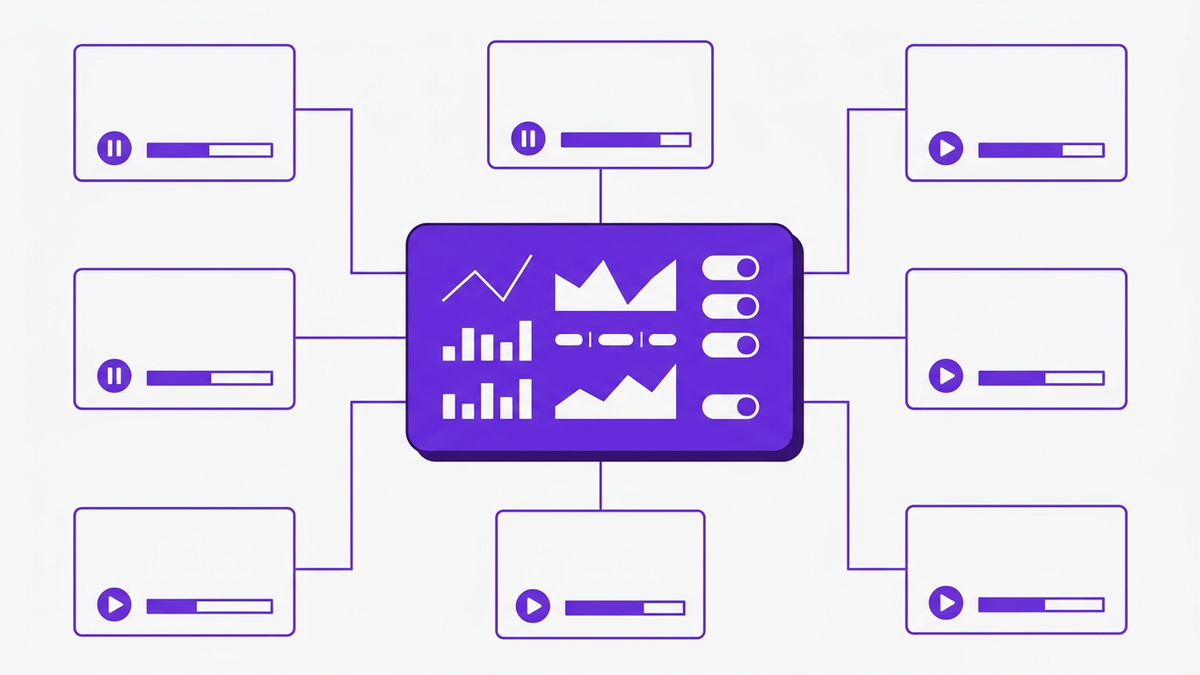
Automation is powerful, but pairing it with financial accountability changes behavior.
CloudNuro’s Chargeback Platform ties automated cloud cost control to detailed cost allocation:
Showback dashboards by team, environment, and application.
Integration with finance systems for budget tracking.
Impact reporting that quantifies savings from pause/resume and rightsizing.
You can explore CloudNuro’s broader SaaS management and FinOps capabilities on the SaaS management overview and FinOps services page.
A Fortune‑scale financial services enterprise faced runaway Fabric Dev/Test costs across dozens of global teams.
By deploying CloudNuro’s Unified Cloud Custodian:
All Fabric Dev/Test capacity was discovered and tagged within weeks.
Standard pause/resume schedules were applied by environment type and region.
Exceptions were governed through role‑based approvals.
Result: 63% reduction in Azure Fabric Dev/Test capacity costs in under 4 months, with full cost allocation and chargeback transparency for internal stakeholders (CloudNuro case study & Forrester 2026).
A global healthcare organization used CloudNuro’s FinOps Services and platform to:
Automate non‑production scheduling across Fabric and related services.
Identify idle workloads and under‑used reservations.
Generate monthly savings reports tied to business units.
Outcome: $1.2M in annualized Dev/Test cloud spend reduction and a 230% ROI within the first year (CloudNuro case study & InfoTech 2026).
Fabric billing is largely time‑based. When capacity runs, you pay, regardless of actual workload.
By automating pause during non‑working hours and resume only when needed, you eliminate idle runtime. Enterprises adopting this model have seen around 60% Dev/Test cost reduction when combined with rightsizing and governance (Forrester 2026).
Best practices include:
Use standard schedules by environment type (Dev, Test, UAT, Sandbox).
Default to aggressive shutdown policies, then allow controlled overrides.
Group related resources to avoid orphaned dependencies.
Integrate start/stop with CI/CD pipelines and ticketing.
Monitor exceptions and fine‑tune policies monthly.
The combination of schedule templates and automation reduces human error and ensures cost optimization for development and test workloads.
Dev/Test workloads:
Have lower uptime requirements.
Are more ephemeral and experimental.
Can tolerate more aggressive automation and rightsizing.
FinOps for Dev/Test therefore focuses on automate non production environment shutdown, experimentation boundaries, and non production cloud cost savings, while production FinOps prioritizes reliability, SLOs, and controlled change.
A simple method:
Calculate current monthly Dev/Test spend.
Estimate idle percentage. IDC reports 64% of Dev/Test resources show idle or under‑use for extended periods.
Apply a realistic reduction factor, typically 40–60%, based on scheduling aggressiveness.
For example, if you spend $500k monthly and conservatively assume 40% savings potential, automation could save $200k per month. Platforms like CloudNuro provide more precise modeling through infrastructure cost visibility and historical usage analytics.
Common patterns include:
Cloud provider native schedules and automation scripts.
Workflow tools that orchestrate start/stop across services.
FinOps platforms like CloudNuro that offer policy engines, AI‑driven recommendations, and integrated workload scheduling for Dev/Test.
The differentiator is how well the tool combines usage‑based billing insights, governance, and automation into a single, auditable workflow.
The evidence is clear: enterprises that treat fabric capacity pause resume as a default behavior, not an exception, are achieving 60% or more reductions in Dev/Test cloud costs while improving visibility and governance.
By combining discovery, analytics, policy‑driven fabric environment scheduling, and automation, you can stop paying for unused development environments, protect margins, and support engineering velocity.
CloudNuro makes this shift faster:
Unified visibility across Fabric and other cloud assets.
Policy‑based FinOps automation for dev and test environments.
Chargeback and reporting for durable financial discipline.
If you are ready to modernize cloud cost management for Dev/Test, explore how CloudNuro can help.
CloudNuro is a leader in Enterprise SaaS Management Platforms, providing enterprises with unmatched visibility, governance, and cost optimization. Recognized twice in a row in the SaaS Management Platforms category and named a Leader in the SoftwareReviews Data Quadrant, CloudNuro is trusted by global enterprises and government agencies to bring financial discipline to SaaS, cloud, and AI.
Trusted by enterprises such as Konica Minolta and Federal Signal, CloudNuro provides centralized SaaS inventory, license optimization, and renewal management along with advanced cost allocation and chargeback, giving IT and Finance leaders the visibility, control, and cost‑conscious culture needed to drive financial discipline.
Request a no cost, no obligation free assessment —just 15 minutes to savings!
Get StartedFabric Dev/Test environments are notorious budget sinkholes. Capacity is spun up for a sprint or experiment, then quietly left running. Multiply that by dozens of teams and you quickly have a material line item your FinOps dashboards cannot ignore.
Enter fabric capacity pause resume automation. By treating non‑production capacity like a just‑in‑time utility, enterprises are cutting Dev/Test cloud costs by an average of 60% through automated scheduling for Fabric environments (Forrester 2026). This playbook shows how to get there, step by step.
Most Dev/Test workloads are bursty. Engineers need rich environments during working hours, not at 2 a.m. or on weekends. Yet capacity billing runs continuously.
IDC found that 64% of idle or under‑used resources in Dev/Test environments persist for days before manual cleanup, which drives unnecessary spend (IDC 2026). That waste is exactly what pause and resume fabric capacity strategies attack.
When you implement fabric capacity pause resume policies, you:
Eliminate idle runtime by stopping capacity outside approved windows.
Shift to usage‑aligned spend that matches how engineers actually work.
Create predictable cost baselines that finance and product leaders can trust.
A leading analyst described it simply: “Automating the pause and resume of Fabric capacity is the single highest‑leverage activity IT can take to cut Dev/Test cloud overspend in 2026” (Forrester 2026). In other words, this is not a marginal gain; it is foundational cloud cost management for Dev/Test.
Dev/Test is supposed to be cheaper than production, but in many enterprises the opposite happens. Non‑production sprawl, over‑sized capacities, and always‑on environments quietly erode margins.
Key data points illustrate the scale of the issue:
Enterprises that automated fabric environment scheduling achieved an average 60% reduction in Dev/Test cloud costs (Forrester 2026).
72% of enterprise IT leaders say automation of non‑production environments is their top FinOps initiative for 2026 (Gartner 2026).
Only 28% of organizations have fully automated non‑production scheduling as of Q1 2026 (InfoTech 2026).
That last number is your opportunity. The majority of organizations still accept idle capacity as a cost of doing business.
FinOps for Dev/Test environments is structurally different from production cost management:
Higher volatility: Environments are created and torn down frequently.
Lower uptime requirements: Few Dev/Test workloads need 24x7 availability.
More experimentation: Teams spin up short‑lived workloads to test ideas.
This makes Dev/Test ideal for FinOps automation for dev and test environments:
Start/stop schedules can be aggressive.
Rightsizing can be more frequent and less risk‑averse.
Policies can default to shutdown, with opt‑in exceptions.
Think of production as a hospital, where everything must stay on, and Dev/Test as an office building, where lights and HVAC can turn off at night. You would not pay to cool an empty building; you should not pay for unused cloud capacity either.
To cut costs, you need a structured approach, not just a plea for engineers to "remember to shut things down." Below is a five‑step playbook for dev test cloud cost optimization using fabric capacity pause resume.
Start with infrastructure cost visibility. You cannot manage what you cannot see.
Actions:
Inventory all Fabric capacities and related cloud resources.
Tag or group them as Dev, Test, QA, Staging, or Sandbox.
Map each capacity to owning teams and cost centers with cost allocation tags.
This foundation enables cloud cost governance for engineering teams and is often accelerated by tools that provide automated SaaS discovery and cloud resource mapping.
Next, analyze when environments are actually used. Usage‑based billing only pays off if you align capacity with utilization.
Key analyses:
Hour‑by‑hour CPU, memory, and job execution trends.
Days of the week with activity versus silence.
Long‑running environments with low engagement.
Enterprises using AI‑driven optimization tools reported 2x cost reduction compared to manual methods for non‑production workloads (EMA 2026). This is where idle resource cleanup and anomaly detection identify hidden waste.
Once you know usage patterns, define policies that codify behavior.
Policy examples for rightsizing and scheduling cloud capacity:
Default Dev/Test capacity: On 8 a.m.–7 p.m. local time, Monday–Friday; off at all other times.
Heavy testing windows: Extend hours for specific teams during release cycles.
Rightsizing rules: Downgrade capacity tiers if average utilization stays below 30% for 14 days.
F-SKU pause strategy: Pause reserved or F‑SKU Fabric capacities when utilization drops below thresholds, and resume only on scheduled or on‑demand triggers.
Your governance model should document:
Who can override schedules.
How long exceptions are valid.
What audit trails and approvals are required.
This step converts policies into reliable, repeatable outcomes. Manual change windows and calendar reminders will fail at scale.
You need automated cloud cost control capabilities that:
Trigger scheduled shutdown of Dev/Test environments.
Provide on‑demand "resume" actions for developers.
Orchestrate environment start stop automation across dependent services and data.
Integrate with CI/CD and ticketing systems, so automation respects change processes.
Enterprises that reduce dev test cloud costs with scheduling report average savings of 20% or more within the first 6 months of automation (CloudNuro platform analytics 2026).
Finally, treat this as an ongoing FinOps capability, not a one‑time clean‑up.
Key practices:
Monthly reports by team: saved hours, dollars, and idle waste avoided.
Chargeback or showback using a dedicated chargeback platform to create financial accountability.
Quarterly policy reviews to adjust schedules, rightsizing thresholds, and exception rules.
This is where FinOps for dev and test becomes a cultural practice. Engineering leaders start asking not only "Is the feature done?" but also "Are we right‑sized and scheduled correctly?"
There are legitimate reasons some teams resist aggressive pause policies. An effective playbook acknowledges these concerns.
Engineers fear that paused environments will slow them down. If every morning starts with a 30‑minute warm‑up, productivity suffers.
Mitigations:
Use pre‑warm schedules that start environments 15 minutes before workday.
Offer on‑demand Fabric reservation strategy options for critical systems that must stay warm.
Measure time‑to‑ready metrics and tune schedules.
Complex Dev/Test estates may include ETL jobs, data refreshes, or nightly integration tests.
Mitigations:
Classify workloads into "safe to pause" and "always on" categories.
Attach schedules to logical application groups, not just individual capacities.
Use synthetic tests after resume to verify environment health.
Leaders worry that too much policy introduces friction.
Mitigations:
Start with high‑level guardrails: default off after hours, with easy self‑service overrides.
Use policy templates tied to environment type, such as Sandbox versus UAT.
Automate approvals for low‑risk changes.
The key insight: pause and resume fabric capacity is not all‑or‑nothing. You can phase in policies, minimize disruption, and still capture most of the non production cloud cost savings.
Sustainable savings require governance, not one‑off scripts. As cloud cost management best practices 2026 evolve, several controls are becoming standard.
Define governance policies such as:
"All non‑production Fabric capacities must have an associated schedule."
"Default schedules can only be overridden for 30 days without review."
"All new Dev/Test environments inherit standard shutdown policies."
This transforms scheduled shutdown dev environments from an ad‑hoc practice into an enforced default.
Limit who can change schedules or promote an environment to always‑on.
Best practices:
RBAC that separates requesters, approvers, and executors.
Policy exceptions logged for audit.
Automatic reversion of temporary overrides.
This protects against "permission creep," where everyone gradually gains the ability to create cost risk.
Organizations that align Dev/Test usage to budgets see better adherence to policies. A chargeback or showback practice ensures teams feel the impact of their choices.
Use financial governance to:
Allocate costs by team, project, and application.
Highlight waste from idle capacity on dashboards.
Tie cost performance to quarterly objectives.
For practical guidance, see articles on FinOps for SaaS cost management and FinOps allocation best practices.
Manual reviews cannot keep up with environment churn. Intelligent automation should:
Detect long‑running idle capacities and recommend shutdown.
Suggest rightsizing based on utilization patterns.
Integrate with FinOps workflows to approve and execute changes.
This closes the loop between cloud spend optimization, governance, and developer experience.
CloudNuro was built for this exact challenge: unifying visibility, governance, and automation across SaaS, PaaS, and IaaS. For Fabric Dev/Test, CloudNuro turns fabric capacity pause resume from a script‑driven task into an institutional capability.
CloudNuro’s Unified Cloud Custodian provides:
Automated discovery of all Fabric Dev/Test capacities, with deep tagging.
Policy templates for fabric environment scheduling by environment type.
Automated scheduled shutdown dev environments and restart workflows.
Enterprises typically see 20% or more Dev/Test spend savings in the first 6 months, often compounding to around 60% as policies mature (CloudNuro platform analytics 2026).
CloudNuro’s AI Custodian layers analytics and intelligence on top:
Real‑time usage and engagement scoring for Dev/Test workloads.
Recommendations for rightsizing and scheduling cloud capacity.
Automated actions to manage idle cloud capacity in non production.
This is where FinOps automation for dev and test environments becomes self‑improving. The system learns which policies stick, where exceptions cluster, and how to refine schedules.
Automation is powerful, but pairing it with financial accountability changes behavior.
CloudNuro’s Chargeback Platform ties automated cloud cost control to detailed cost allocation:
Showback dashboards by team, environment, and application.
Integration with finance systems for budget tracking.
Impact reporting that quantifies savings from pause/resume and rightsizing.
You can explore CloudNuro’s broader SaaS management and FinOps capabilities on the SaaS management overview and FinOps services page.
A Fortune‑scale financial services enterprise faced runaway Fabric Dev/Test costs across dozens of global teams.
By deploying CloudNuro’s Unified Cloud Custodian:
All Fabric Dev/Test capacity was discovered and tagged within weeks.
Standard pause/resume schedules were applied by environment type and region.
Exceptions were governed through role‑based approvals.
Result: 63% reduction in Azure Fabric Dev/Test capacity costs in under 4 months, with full cost allocation and chargeback transparency for internal stakeholders (CloudNuro case study & Forrester 2026).
A global healthcare organization used CloudNuro’s FinOps Services and platform to:
Automate non‑production scheduling across Fabric and related services.
Identify idle workloads and under‑used reservations.
Generate monthly savings reports tied to business units.
Outcome: $1.2M in annualized Dev/Test cloud spend reduction and a 230% ROI within the first year (CloudNuro case study & InfoTech 2026).
Fabric billing is largely time‑based. When capacity runs, you pay, regardless of actual workload.
By automating pause during non‑working hours and resume only when needed, you eliminate idle runtime. Enterprises adopting this model have seen around 60% Dev/Test cost reduction when combined with rightsizing and governance (Forrester 2026).
Best practices include:
Use standard schedules by environment type (Dev, Test, UAT, Sandbox).
Default to aggressive shutdown policies, then allow controlled overrides.
Group related resources to avoid orphaned dependencies.
Integrate start/stop with CI/CD pipelines and ticketing.
Monitor exceptions and fine‑tune policies monthly.
The combination of schedule templates and automation reduces human error and ensures cost optimization for development and test workloads.
Dev/Test workloads:
Have lower uptime requirements.
Are more ephemeral and experimental.
Can tolerate more aggressive automation and rightsizing.
FinOps for Dev/Test therefore focuses on automate non production environment shutdown, experimentation boundaries, and non production cloud cost savings, while production FinOps prioritizes reliability, SLOs, and controlled change.
A simple method:
Calculate current monthly Dev/Test spend.
Estimate idle percentage. IDC reports 64% of Dev/Test resources show idle or under‑use for extended periods.
Apply a realistic reduction factor, typically 40–60%, based on scheduling aggressiveness.
For example, if you spend $500k monthly and conservatively assume 40% savings potential, automation could save $200k per month. Platforms like CloudNuro provide more precise modeling through infrastructure cost visibility and historical usage analytics.
Common patterns include:
Cloud provider native schedules and automation scripts.
Workflow tools that orchestrate start/stop across services.
FinOps platforms like CloudNuro that offer policy engines, AI‑driven recommendations, and integrated workload scheduling for Dev/Test.
The differentiator is how well the tool combines usage‑based billing insights, governance, and automation into a single, auditable workflow.
The evidence is clear: enterprises that treat fabric capacity pause resume as a default behavior, not an exception, are achieving 60% or more reductions in Dev/Test cloud costs while improving visibility and governance.
By combining discovery, analytics, policy‑driven fabric environment scheduling, and automation, you can stop paying for unused development environments, protect margins, and support engineering velocity.
CloudNuro makes this shift faster:
Unified visibility across Fabric and other cloud assets.
Policy‑based FinOps automation for dev and test environments.
Chargeback and reporting for durable financial discipline.
If you are ready to modernize cloud cost management for Dev/Test, explore how CloudNuro can help.
CloudNuro is a leader in Enterprise SaaS Management Platforms, providing enterprises with unmatched visibility, governance, and cost optimization. Recognized twice in a row in the SaaS Management Platforms category and named a Leader in the SoftwareReviews Data Quadrant, CloudNuro is trusted by global enterprises and government agencies to bring financial discipline to SaaS, cloud, and AI.
Trusted by enterprises such as Konica Minolta and Federal Signal, CloudNuro provides centralized SaaS inventory, license optimization, and renewal management along with advanced cost allocation and chargeback, giving IT and Finance leaders the visibility, control, and cost‑conscious culture needed to drive financial discipline.
Request a no cost, no obligation free assessment - just 15 minutes to savings!
Get StartedWe're offering complimentary ServiceNow license assessments to only 25 enterprises this quarter who want to unlock immediate savings without disrupting operations.
Get Free AssessmentGet Started




CloudNuro Corp
1755 Park St. Suite 207
Naperville, IL 60563
Phone : +1-630-277-9470
Email: info@cloudnuro.com





.webp)

Recognized Leader in SaaS Management Platforms by Info-Tech SoftwareReviews




.svg)