

Sign Up
Thank you for Submitting!
Most IT and finance leaders suspect they are flying partially blind when it comes to SaaS. They are usually right.
Recent industry research shows that only 28% of organizations report full visibility into their SaaS portfolio, even as subscription counts and spend grow every quarter. Another 2026 study found that 67% of enterprise SaaS applications are procured outside IT oversight, which amplifies shadow IT, compliance risk, and wasted spend.
This is why modern SaaS discovery methods have become a board-level concern. Achieving 100% SaaS discovery is not a “nice to have”; it is the foundation for security, governance, and real cost optimization.
This guide outlines 9 proven SaaS discovery techniques that enterprises are using to close visibility gaps and how CloudNuro helps unify them into a single, intelligent SaaS management fabric.
For CIOs, CISOs, and finance leaders, incomplete SaaS discovery is like running a data center where 40% of the servers are untagged and unmanaged. You might stay operational for a while, but risk compound quietly.
A 2026 enterprise IT report found that organizations using automated SaaS discovery identify unauthorized apps 92% faster than those relying on manual inventory. Another compliance analysis showed that integrating SSO and financial data for SaaS discovery reduces compliance risk exposure by 55%.
The stakes are clear:
In short, you cannot manage, secure, or optimize what you cannot see. The rest of this article details 9 SaaS discovery methods that, when combined, move you very close to true 100% visibility.
If you want to understand how to discover SaaS applications at scale, identity systems are the logical starting point. Every sanctioned authentication event is a signal.
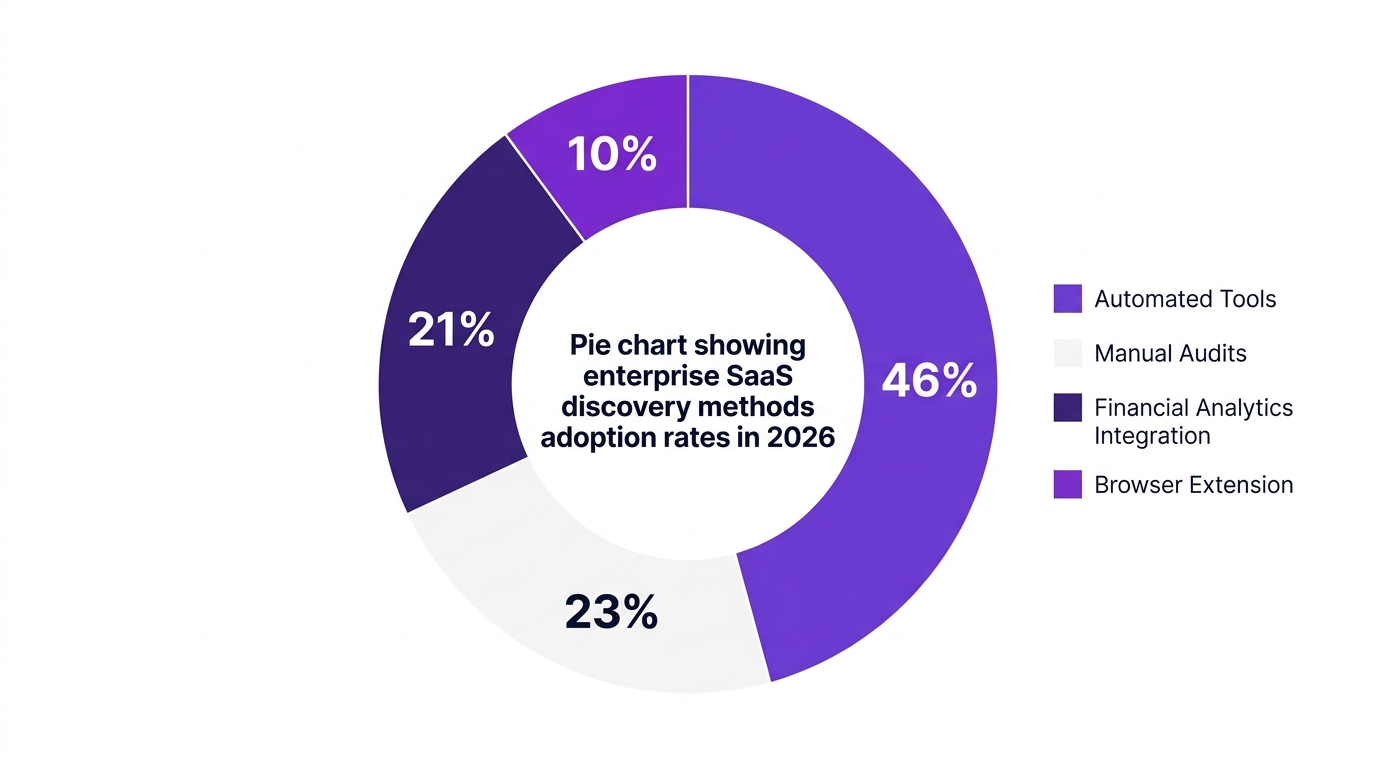
According to a 2026 compliance analytics review, organizations that use SSO SaaS discovery as a foundation see far higher visibility than those relying on manual audits alone.
How it works
This is one of the most efficient SaaS discovery techniques for sanctioned apps and provides a living, identity-driven map of your cloud application inventory.
Watch out for: SSO blind spots, such as direct logins, local credentials, or apps that do not yet support SSO. These require complementary discovery methods.

SSO alone rarely surfaces the full picture. According to a 2026 digital adoption study, browser extension-based SaaS discovery increases shadow IT mitigation efficacy by 41%.
How browser extension SaaS discovery works
This approach is particularly powerful for detecting:
Counterargument: Some leaders worry that extensions feel invasive. In practice, clear policy communications, transparent data handling, and optin pilots usually address most concerns, especially when security and compliance benefits are quantified.
Shadow IT often shows up first as spend, not as authentication logs. A 2026 procurement benchmark found that financial data analytics uncover 19% more unapproved SaaS expenses than ITonly discovery.
How financial data SaaS discovery works
This method is essential for:
Financial data SaaS discovery closes one of the biggest gaps for IT. It also directly supports SaaS spend control, renewal planning, and internal chargeback.
While identity and finance are highsignal sources, network telemetry still plays a role in cloud application discovery.
Modern application discovery tools can inspect DNS, proxy, or firewall logs to surface highvolume or highrisk SaaS domains. They tag and classify domains, then push findings into your IT asset management SaaS repository.
Key use cases:
This method tends to be noisier than SSO or finance data, but as part of a SaaS discovery automation stack, it helps catch edge cases that other methods miss.
HR systems know who works at your company, when they change roles, and when they leave. Tying SaaS discovery to these events improves SaaS access visibility and entitlement hygiene.
How HRISdriven discovery works
This supports:
The result is a more accurate and dynamic cloud application inventory that reflects real organizational structure.

Highvalue platforms such as productivity suites, CRM, or collaboration hubs are usually the largest line items in SaaS budgets. Direct SaaS platform discovery through admin APIs provides deeper visibility than logs alone.
With integrations, you can:
A 2026 market insight report found that realtime SaaS inventory platforms cut SaaSrelated costs by an average of 21% by using this type of rich integration and license utilization analysis to rightsize entitlements.
This method bridges discovery with optimization and renewal intelligence, which is crucial for SaaS renewal strategies.
Not everything is discoverable via logs. Some tools are used sparingly, or by external partners, or through shared accounts. For these, periodic thirdparty SaaS audit processes are still necessary.
Best practices include:
While manual, these audits:
Think of audits as the “hand finishing” step after your automated tools have done the heavy lifting.
Discovery is not only a tooling problem. Culture and policy drive longterm shadow IT mitigation.
Organizations that combine SaaS governance best practices with automated detection typically:
The analogy many leaders use is traffic systems: technology provides the signals and cameras, but rules of the road and enforcement are what keep things safe.
Over time, this reduces reliance on afterthefact detection and shifts behavior toward proactive SaaS access governance.
Legacy approaches to enterprise SaaS discovery treated inventory as a periodic task. That model no longer works.
A 2026 enterprise cloud strategy review concluded that continuous, realtime discovery is now table stakes, especially as subscription changes happen weekly or even daily across large enterprises.
AIdriven discovery platforms can:
This is where modern automated SaaS monitoring merges discovery, SaaS spend analysis, and governance into a single operational discipline.
Most organizations already use some mix of SaaS discovery techniques, but data is scattered across tools. CloudNuro is designed to unify these signals and turn them into actionable governance.
CloudNuro connects to leading SSO providers and identity systems to deliver SSO SaaS discovery as a firstclass capability. Every authenticated SaaS application, user, and access event feeds into a centralized inventory.
CloudNuro also offers browser extension SaaS discovery, capturing SaaS usage that never passes through SSO. This combination addresses both sanctioned and unsanctioned apps and aligns to the 41% improvement in shadow IT mitigation reported in 2026 studies.
The result is automated SaaS visibility across the estate, updated continuously.
CloudNuro’s financial data SaaS discovery module ingests data from AP systems, purchase orders, and corporate cards.
Using AI and rules engines, it:
This connects discovery directly to SaaS spend control and renewal savings, building the financial discipline that IT and finance leaders expect.
CloudNuro integrates with hundreds of SaaS platforms to extract granular data for license optimization AI and entitlement analysis.
Within a single pane of glass, CloudNuro:
This moves you from simple SaaS inventory tools to active optimization and governance.
CloudNuro is built around SaaS governance best practices.
Capabilities include:
This helps organizations reduce SaaS security risk, prepare for audits, and align to internal and external regulatory standards.
Because CloudNuro aggregates signals from SSO, browsers, finance, and integrations, it supports fully automated SaaS monitoring.
Teams can:
Instead of treating discovery as a snapshot, CloudNuro turns it into a continuous control, which brings you much closer to the goal of 100% SaaS visibility.
Adopting every method at once may not be realistic. A phased approach helps.
Phase 1: Establish your baseline
Phase 2: Expand your signal sources
Phase 3: Close gaps and operationalize
Phase 4: Optimize and automate
By following these steps with a platform like CloudNuro, organizations move quickly from fragmented discovery to reliable, AIdriven SaaS governance.
The most effective SaaS discovery methods combine multiple data sources: SSO SaaS discovery, browser extension monitoring, financial data SaaS discovery, network telemetry, and direct platform integrations.
This multisignal approach reduces blind spots, surfaces shadow IT, and connects usage data to cost and risk, which singlesource methods cannot achieve on their own.
Automation comes from integrating identity, finance, HR, and SaaS platforms into a unified SaaS inventory management solution.
Platforms like CloudNuro continuously ingest and correlate these signals to maintain an accurate cloud application inventory, while also providing policy engines and workflows for SaaS discovery automation.
Incomplete discovery leads directly to higher SaaS security risk and compliance exposure.
Untracked apps can process personal or regulated data without appropriate contracts or controls, bypass security monitoring, and create unmonitored user accounts, making it difficult to prove compliance for SaaS usage during audits.
SSO integrations provide a central record of which apps users access with corporate identities.
This SSO SaaS discovery capability offers a highfidelity starting point for automated SaaS visibility, especially for sanctioned tools, and supports downstream processes like entitlements, deprovisioning, and license optimization.
Yes. Financial data SaaS discovery across AP, corporate cards, and expenses is one of the best ways to detect unapproved or hidden subscriptions.
Analytics can identify recurring charges, map them to vendors and owners, and feed them into your SaaS spend control and governance processes to reduce waste and shadow IT.
Effective detecting shadow IT strategies combine:
Using a platform that centralizes these methods and enforces SaaS governance best practices, such as CloudNuro, turns shadow IT from an ongoing surprise into a manageable exception process.
Achieving 100% discovery is not about a single magic tool. It is about orchestrating a set of SaaS discovery methods that cross identity, browser, finance, HR, and platform data, then using automation and AI to keep everything current.
Organizations that adopt automated discovery see up to 92% faster identification of unauthorized apps and average cost reductions of around 21% from license optimization and removal of redundant tools.
CloudNuro was built to help enterprises reach that level of control quickly, consolidating discovery into a single source of truth while embedding governance and cost optimization into daily operations.
If you are ready to move from guesswork to complete SaaS visibility, explore how CloudNuro can support your journey.
Request a no cost, no obligation free assessment —just 15 minutes to savings!
Get StartedMost IT and finance leaders suspect they are flying partially blind when it comes to SaaS. They are usually right.
Recent industry research shows that only 28% of organizations report full visibility into their SaaS portfolio, even as subscription counts and spend grow every quarter. Another 2026 study found that 67% of enterprise SaaS applications are procured outside IT oversight, which amplifies shadow IT, compliance risk, and wasted spend.
This is why modern SaaS discovery methods have become a board-level concern. Achieving 100% SaaS discovery is not a “nice to have”; it is the foundation for security, governance, and real cost optimization.
This guide outlines 9 proven SaaS discovery techniques that enterprises are using to close visibility gaps and how CloudNuro helps unify them into a single, intelligent SaaS management fabric.
For CIOs, CISOs, and finance leaders, incomplete SaaS discovery is like running a data center where 40% of the servers are untagged and unmanaged. You might stay operational for a while, but risk compound quietly.
A 2026 enterprise IT report found that organizations using automated SaaS discovery identify unauthorized apps 92% faster than those relying on manual inventory. Another compliance analysis showed that integrating SSO and financial data for SaaS discovery reduces compliance risk exposure by 55%.
The stakes are clear:
In short, you cannot manage, secure, or optimize what you cannot see. The rest of this article details 9 SaaS discovery methods that, when combined, move you very close to true 100% visibility.
If you want to understand how to discover SaaS applications at scale, identity systems are the logical starting point. Every sanctioned authentication event is a signal.
According to a 2026 compliance analytics review, organizations that use SSO SaaS discovery as a foundation see far higher visibility than those relying on manual audits alone.
How it works
This is one of the most efficient SaaS discovery techniques for sanctioned apps and provides a living, identity-driven map of your cloud application inventory.
Watch out for: SSO blind spots, such as direct logins, local credentials, or apps that do not yet support SSO. These require complementary discovery methods.
SSO alone rarely surfaces the full picture. According to a 2026 digital adoption study, browser extension-based SaaS discovery increases shadow IT mitigation efficacy by 41%.
How browser extension SaaS discovery works
This approach is particularly powerful for detecting:
Counterargument: Some leaders worry that extensions feel invasive. In practice, clear policy communications, transparent data handling, and optin pilots usually address most concerns, especially when security and compliance benefits are quantified.
Shadow IT often shows up first as spend, not as authentication logs. A 2026 procurement benchmark found that financial data analytics uncover 19% more unapproved SaaS expenses than ITonly discovery.
How financial data SaaS discovery works
This method is essential for:
Financial data SaaS discovery closes one of the biggest gaps for IT. It also directly supports SaaS spend control, renewal planning, and internal chargeback.
While identity and finance are highsignal sources, network telemetry still plays a role in cloud application discovery.
Modern application discovery tools can inspect DNS, proxy, or firewall logs to surface highvolume or highrisk SaaS domains. They tag and classify domains, then push findings into your IT asset management SaaS repository.
Key use cases:
This method tends to be noisier than SSO or finance data, but as part of a SaaS discovery automation stack, it helps catch edge cases that other methods miss.
HR systems know who works at your company, when they change roles, and when they leave. Tying SaaS discovery to these events improves SaaS access visibility and entitlement hygiene.
How HRISdriven discovery works
This supports:
The result is a more accurate and dynamic cloud application inventory that reflects real organizational structure.
Highvalue platforms such as productivity suites, CRM, or collaboration hubs are usually the largest line items in SaaS budgets. Direct SaaS platform discovery through admin APIs provides deeper visibility than logs alone.
With integrations, you can:
A 2026 market insight report found that realtime SaaS inventory platforms cut SaaSrelated costs by an average of 21% by using this type of rich integration and license utilization analysis to rightsize entitlements.
This method bridges discovery with optimization and renewal intelligence, which is crucial for SaaS renewal strategies.
Not everything is discoverable via logs. Some tools are used sparingly, or by external partners, or through shared accounts. For these, periodic thirdparty SaaS audit processes are still necessary.
Best practices include:
While manual, these audits:
Think of audits as the “hand finishing” step after your automated tools have done the heavy lifting.
Discovery is not only a tooling problem. Culture and policy drive longterm shadow IT mitigation.
Organizations that combine SaaS governance best practices with automated detection typically:
The analogy many leaders use is traffic systems: technology provides the signals and cameras, but rules of the road and enforcement are what keep things safe.
Over time, this reduces reliance on afterthefact detection and shifts behavior toward proactive SaaS access governance.
Legacy approaches to enterprise SaaS discovery treated inventory as a periodic task. That model no longer works.
A 2026 enterprise cloud strategy review concluded that continuous, realtime discovery is now table stakes, especially as subscription changes happen weekly or even daily across large enterprises.
AIdriven discovery platforms can:
This is where modern automated SaaS monitoring merges discovery, SaaS spend analysis, and governance into a single operational discipline.
Most organizations already use some mix of SaaS discovery techniques, but data is scattered across tools. CloudNuro is designed to unify these signals and turn them into actionable governance.
CloudNuro connects to leading SSO providers and identity systems to deliver SSO SaaS discovery as a firstclass capability. Every authenticated SaaS application, user, and access event feeds into a centralized inventory.
CloudNuro also offers browser extension SaaS discovery, capturing SaaS usage that never passes through SSO. This combination addresses both sanctioned and unsanctioned apps and aligns to the 41% improvement in shadow IT mitigation reported in 2026 studies.
The result is automated SaaS visibility across the estate, updated continuously.
CloudNuro’s financial data SaaS discovery module ingests data from AP systems, purchase orders, and corporate cards.
Using AI and rules engines, it:
This connects discovery directly to SaaS spend control and renewal savings, building the financial discipline that IT and finance leaders expect.
CloudNuro integrates with hundreds of SaaS platforms to extract granular data for license optimization AI and entitlement analysis.
Within a single pane of glass, CloudNuro:
This moves you from simple SaaS inventory tools to active optimization and governance.
CloudNuro is built around SaaS governance best practices.
Capabilities include:
This helps organizations reduce SaaS security risk, prepare for audits, and align to internal and external regulatory standards.
Because CloudNuro aggregates signals from SSO, browsers, finance, and integrations, it supports fully automated SaaS monitoring.
Teams can:
Instead of treating discovery as a snapshot, CloudNuro turns it into a continuous control, which brings you much closer to the goal of 100% SaaS visibility.
Adopting every method at once may not be realistic. A phased approach helps.
Phase 1: Establish your baseline
Phase 2: Expand your signal sources
Phase 3: Close gaps and operationalize
Phase 4: Optimize and automate
By following these steps with a platform like CloudNuro, organizations move quickly from fragmented discovery to reliable, AIdriven SaaS governance.
The most effective SaaS discovery methods combine multiple data sources: SSO SaaS discovery, browser extension monitoring, financial data SaaS discovery, network telemetry, and direct platform integrations.
This multisignal approach reduces blind spots, surfaces shadow IT, and connects usage data to cost and risk, which singlesource methods cannot achieve on their own.
Automation comes from integrating identity, finance, HR, and SaaS platforms into a unified SaaS inventory management solution.
Platforms like CloudNuro continuously ingest and correlate these signals to maintain an accurate cloud application inventory, while also providing policy engines and workflows for SaaS discovery automation.
Incomplete discovery leads directly to higher SaaS security risk and compliance exposure.
Untracked apps can process personal or regulated data without appropriate contracts or controls, bypass security monitoring, and create unmonitored user accounts, making it difficult to prove compliance for SaaS usage during audits.
SSO integrations provide a central record of which apps users access with corporate identities.
This SSO SaaS discovery capability offers a highfidelity starting point for automated SaaS visibility, especially for sanctioned tools, and supports downstream processes like entitlements, deprovisioning, and license optimization.
Yes. Financial data SaaS discovery across AP, corporate cards, and expenses is one of the best ways to detect unapproved or hidden subscriptions.
Analytics can identify recurring charges, map them to vendors and owners, and feed them into your SaaS spend control and governance processes to reduce waste and shadow IT.
Effective detecting shadow IT strategies combine:
Using a platform that centralizes these methods and enforces SaaS governance best practices, such as CloudNuro, turns shadow IT from an ongoing surprise into a manageable exception process.
Achieving 100% discovery is not about a single magic tool. It is about orchestrating a set of SaaS discovery methods that cross identity, browser, finance, HR, and platform data, then using automation and AI to keep everything current.
Organizations that adopt automated discovery see up to 92% faster identification of unauthorized apps and average cost reductions of around 21% from license optimization and removal of redundant tools.
CloudNuro was built to help enterprises reach that level of control quickly, consolidating discovery into a single source of truth while embedding governance and cost optimization into daily operations.
If you are ready to move from guesswork to complete SaaS visibility, explore how CloudNuro can support your journey.
Request a no cost, no obligation free assessment - just 15 minutes to savings!
Get StartedWe're offering complimentary ServiceNow license assessments to only 25 enterprises this quarter who want to unlock immediate savings without disrupting operations.
Get Free AssessmentGet Started




CloudNuro Corp
1755 Park St. Suite 207
Naperville, IL 60563
Phone : +1-630-277-9470
Email: info@cloudnuro.com





.webp)

Recognized Leader in SaaS Management Platforms by Info-Tech SoftwareReviews


.svg)