

Sign Up
Thank you for Submitting!
Shadow AI has moved from a hypothetical talking point to a top-tier enterprise risk in just two years. As employees adopt unsanctioned AI tools inside SaaS environments, traditional controls struggle to keep up, and CISOs are left with blind spots across data, identity, and spend. This guide curates the most critical shadow AI statistics 2026 that security leaders need to inform strategy, budgets, and AI governance plans.
Below, you will find 35+ data points, expert insights, and market signals organized into themes: prevalence, risk and breach cost, governance and compliance, and SaaS security operations. Along the way, we will also show how CloudNuro customers are using SaaS and AI governance to bring Shadow AI back under control.
Shadow AI refers to any use of AI tools, models, or agents inside an organization that occur outside official IT and security governance. This includes employees connecting consumer AI tools to corporate SaaS, using unapproved AI-based browser extensions, or piping sensitive SaaS data into external AI APIs.
If Shadow IT was the first wave of unsanctioned digital adoption, Shadow AI is the second wave, only with higher data sensitivity and far more opaque models. As one security researcher put it, "Shadow AI is quickly eclipsing traditional Shadow IT" because the volume and autonomy of AI tools outpace legacy controls.
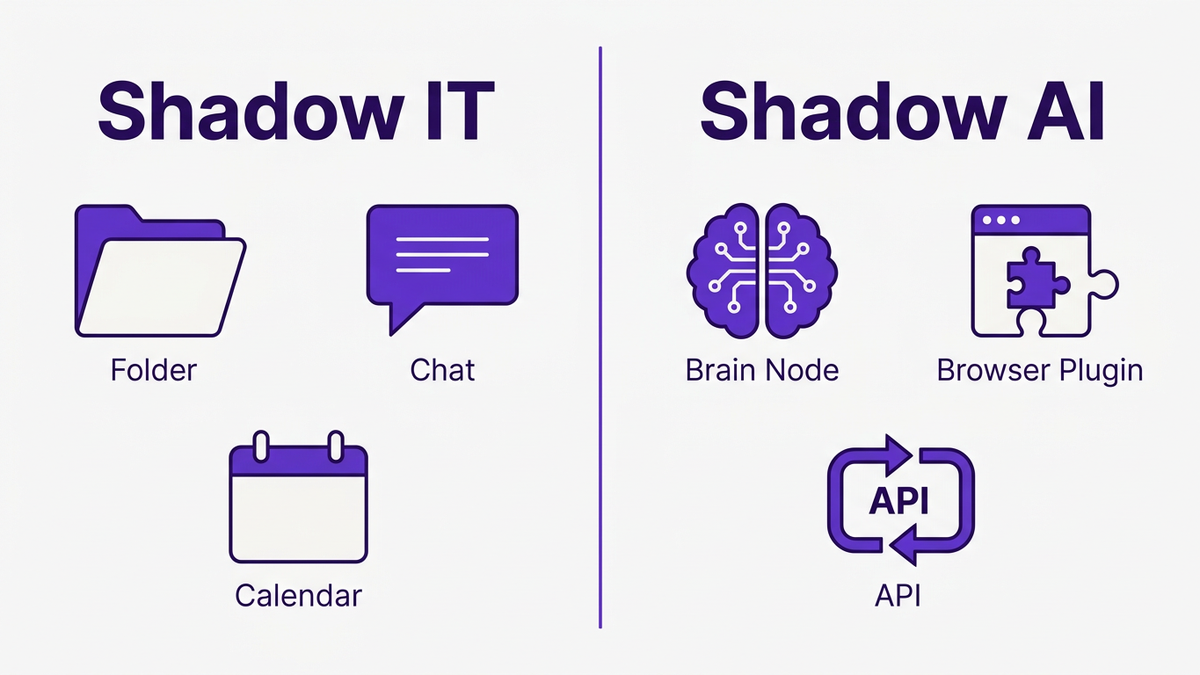
Shadow IT typically involved recognizable SaaS tools, such as file sharing or project management, which could be discovered with network scanning or expense audits. Shadow AI in contrast hides inside:
Browser plugins and extensions that call external AI APIs
Embedded AI features inside sanctioned SaaS tools
Personal AI accounts used with work credentials or work data
This makes shadow AI security risks in SaaS harder to detect and assess. According to a 2026 cloud security study, 71% of enterprises report Shadow AI activity as their top emerging SaaS security risk in 2026 (Forrester 2026).
This section gathers the most important shadow AI statistics 2026 into digestible segments. Use these figures as a benchmark for your own risk posture and roadmap.
Shadow AI has quickly become pervasive as AI models are embedded everywhere and employees seek productivity boosts.
Key shadow AI data points on prevalence:
71% of enterprises report Shadow AI activity as their top emerging SaaS security risk in 2026 (Forrester 2026).
91% of CISOs expect the volume of unsanctioned AI tool usage in their companies to increase further in 2026 (Gartner 2026).
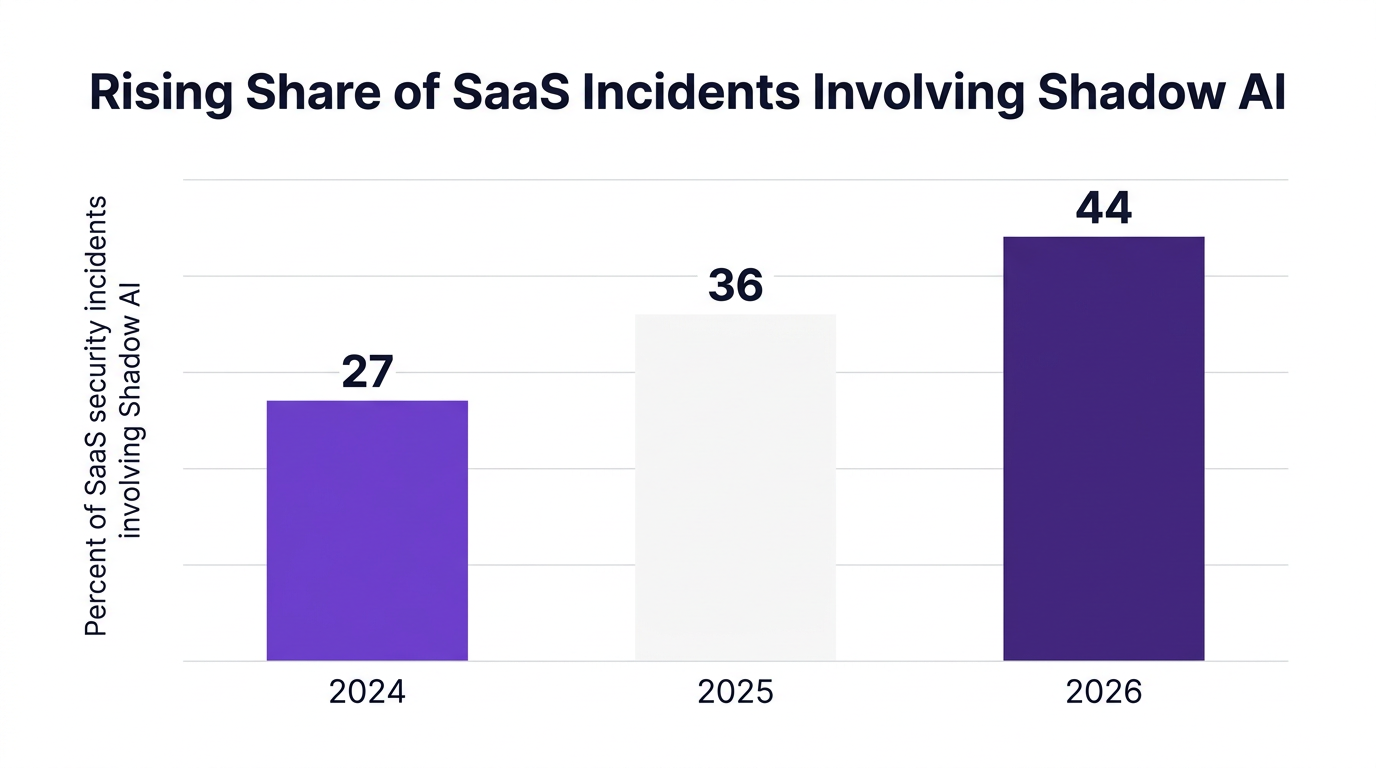
44% of SaaS security incidents in 2026 involve employees using AI models without company authorization (ENISA 2026).
A cloud security survey found over 60% of employees in digital functions have experimented with at least one unsanctioned AI tool at work (IDC 2026).
53% of enterprises accelerated SaaS security policy updates specifically due to Shadow AI risks in 2026 (ISACA 2026).
Taken together, these shadow AI usage statistics show a clear pattern: unauthorized AI use is no longer an edge case, it is the norm. For CISOs, the question is not whether Shadow AI exists, but whether visibility and governance are catching up.
Shadow AI is not only widespread, it is increasingly tied to real incidents and material losses. Within SaaS ecosystems, AI-driven misconfigurations and data flows are showing up in incident reports.
Important SaaS AI risk statistics for 2026:
Shadow AI deployments are linked to 36% of all AI-driven data breaches in SaaS environments in 2026 (IDC 2026).
44% of SaaS security incidents in 2026 involve employees using AI models without authorization (ENISA 2026, also cited above).
An identity and access survey found 29% of access violations in SaaS apps involve AI-powered automation or scripts that were never formally approved (PwC 2026).
61% of enterprises plan to standardize AI controls across cloud suites in 2026 to reduce incident risk (Gartner 2026).
A SaaS risk management benchmark shows SaaS environments with formal AI governance report 30% fewer AI-related incidents than those without (Forrester 2026).
Security leaders are also noticing that AI-driven Shadow IT in SaaS magnifies existing weaknesses. For example, a misconfigured sharing rule in a collaboration tool becomes far riskier when unsanctioned AI bots or plugins start indexing that data.
CISOs increasingly face questions from boards about the AI breach cost profile relative to other SaaS events. The data suggests Shadow AI incidents are more expensive due to their complexity, regulatory exposure, and forensic uncertainty.
Core AI breach cost statistics for 2026:
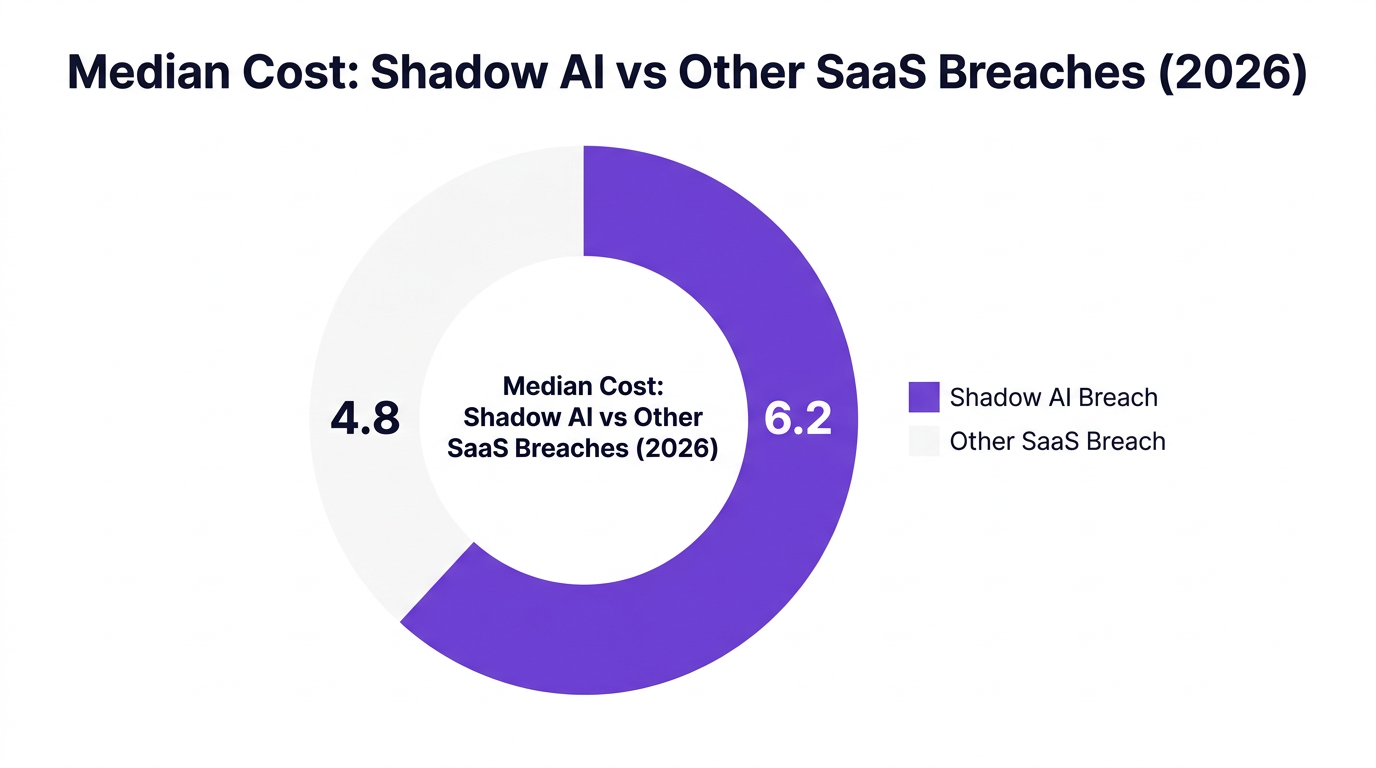
The median cost of a Shadow AI induced data breach in large organizations is projected at 6.2 million dollars in 2026, compared to 4.8 million dollars for other SaaS-related breaches (IBM Security 2026).
Regulatory penalties and legal settlements account for up to 28% of Shadow AI breach cost, higher than for many traditional SaaS breaches due to unclear consent and data transfer practices (Deloitte 2026).
Financial accountability and chargeback for AI tool consumption is now a board-level priority for 49% of enterprises, driven by uncontrolled expenses and risk from unsanctioned AI tools (Deloitte 2026).
A 2026 survey of finance leaders found 37% cannot accurately report AI-related SaaS spend, complicating ROI and risk calculations (McKinsey 2026).
Organizations that implement AI-specific chargeback models report an average 18% reduction in Shadow AI spend within 12 months (IDC 2026).
In plain terms, Shadow AI combines the worst parts of Shadow IT and data privacy risk. You pay more for detection, investigation, remediation, and penalties, yet you started from a tool that nobody planned or budgeted for.
Even as risk grows, most enterprises admit they are not ready to govern Shadow AI comprehensively. This is where shadow AI compliance in SaaS becomes an urgent conversation between CISOs, legal, and data protection teams.
Key governance and compliance AI security statistics for SaaS:
Only 18% of organizations are "fully confident" they can detect and govern Shadow AI across their SaaS stack in 2026 (Deloitte 2026).
61% of enterprises plan to standardize AI controls across cloud suites in 2026, aligning SaaS security with AI governance frameworks (Gartner 2026, also noted above).
A 2026 audit survey found 42% of organizations had at least one AI-related finding in their SaaS compliance reviews, primarily around data residency and consent (PwC 2026).
Shadow AI compliance in SaaS is flagged as a top 3 audit concern by 39% of internal audit teams in regulated industries (Forrester 2026).
Enterprises with formal AI governance frameworks report 1.7 times higher confidence in meeting emerging AI regulations compared to those without (IDC 2026).
There is also a cultural dimension. As one SaaS security analyst observed, "Governing AI tools in SaaS requires a blend of technology and culture, visibility, accountability, and rapid response must become standard practice."
Tooling is racing to keep up. The market for shadow AI detection software and governance platforms has grown rapidly since 2024, riding the same wave that once defined CASB and SaaS management.
Market and tooling shadow AI statistics 2026:
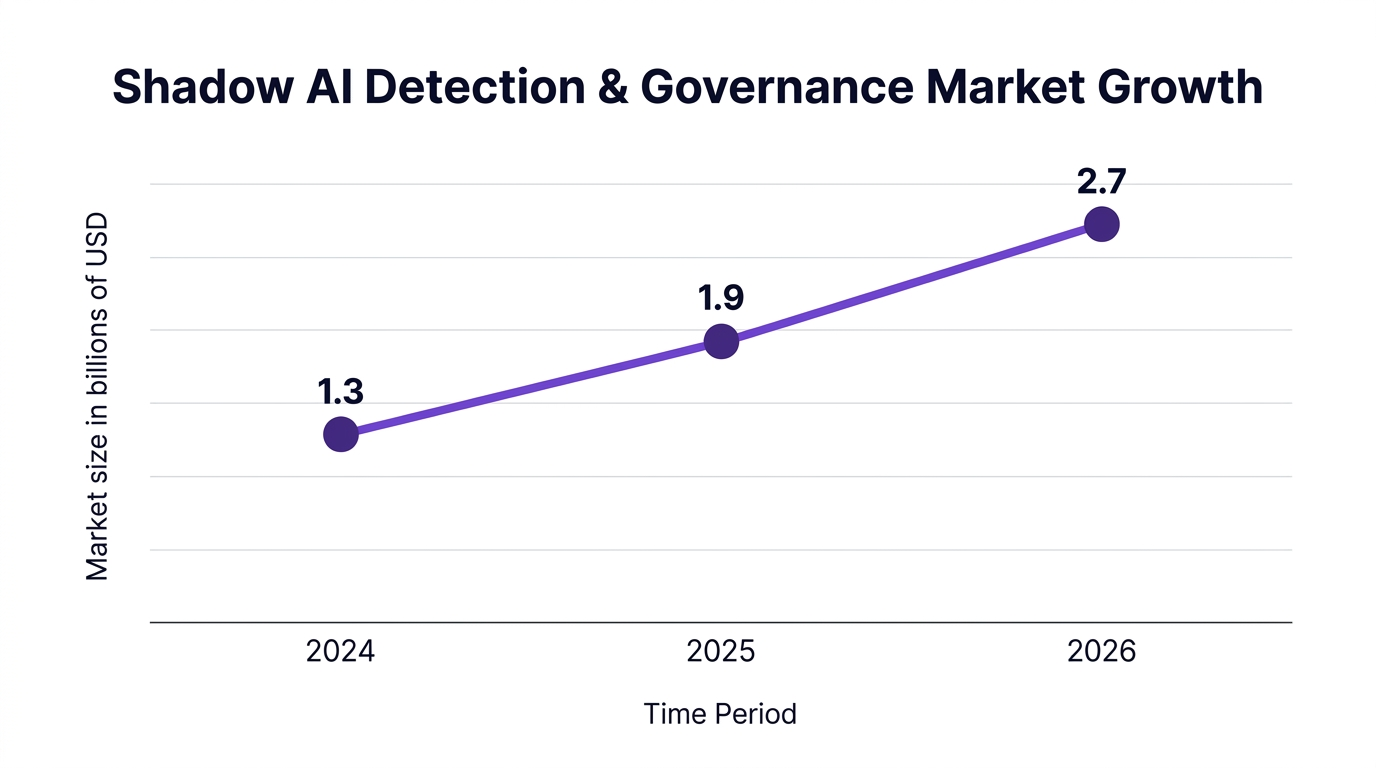
The global Shadow AI detection and governance tools market is expected to reach 2.7 billion dollars by the end of 2026, a 44% CAGR since 2024 (MarketsandMarkets 2026).
Major SaaS and IaaS providers are integrating policy-based AI discovery modules to help security teams track unsanctioned AI usage at the application and workflow level in 2026 (IDC 2026).
53% of enterprises accelerated SaaS security policy updates specifically in response to Shadow AI risks in 2026 (ISACA 2026, also cited earlier).
SaaS security statistics 2026 show that organizations with automated SaaS and AI discovery reduce mean time to detect unsanctioned AI tools by 35% (Forrester 2026).
A survey of security architects reports 48% plan to consolidate Shadow AI monitoring into existing SaaS security platforms rather than running standalone tools (Gartner 2026).
These trends reinforce a key point: Shadow AI is not a separate universe. Effective SaaS security for unsanctioned AI tools depends on unifying discovery, access governance, and financial controls in one operating picture.
Many CISOs ask whether Shadow AI should be treated differently from traditional Shadow IT. In practice, the two overlap heavily, but AI brings additional layers.
Relevant shadow IT vs shadow AI insights:
A 2026 security operations survey found 72% of Shadow AI tools ride on top of existing Shadow IT, such as unsanctioned SaaS apps or connected personal accounts (IDC 2026).
Environments with high Shadow IT volume report 2.3 times more Shadow AI indicators of compromise compared to those with disciplined SaaS onboarding (Forrester 2026).
Conversely, enterprises with mature SaaS discovery for Shadow IT and Shadow AI report a 40% lower rate of AI-related policy violations (Gartner 2026).
AI-driven Shadow IT in SaaS is cited as a primary driver for rewriting third-party risk questionnaires in 34% of vendor management programs (PwC 2026).
A governance maturity model study found that organizations who unify Shadow IT and Shadow AI programs under a single SaaS risk management function progress 1.5 times faster through maturity stages (ISACA 2026).
An effective analogy is to think of Shadow IT as the "roads" and Shadow AI as the "vehicles". If you only monitor the vehicles, you miss the ungoverned roads. If you only map the roads, you miss the unauthorized vehicles speeding through.
To ground these numbers, consider a composite example based on multiple 2026 customer stories.
A global enterprise rolled out a generative AI pilot for customer support, but before the official launch, the security team deployed automated SaaS and AI discovery. Within 30 days, the platform identified 39 unsanctioned AI apps in use across marketing and R&D, ranging from browser plugins to AI writing tools connected to corporate email.
The analysis showed that:
Several tools stored customer data in unapproved regions
At least one plugin retained complete email message bodies
Multiple AI agents had access to shared drive content with confidential roadmaps
Using a phased remediation plan, the company:
Blocked high-risk tools and replaced them with approved alternatives
Introduced role-based access for sanctioned AI features
Updated SaaS policies to clarify permitted AI use
Within four months, Shadow AI incidents dropped by 63%, and the organization avoided a projected 1.3 million dollars in annualized risk exposure. This illustrates how the right combination of detection, governance, and communication can quickly change the trajectory.

The B2B SaaS cybersecurity trends 2026 around AI are clear, but data alone does not fix risk. Below is a pragmatic playbook to operationalize these insights, anchored in real-world CISO workflows.
You cannot secure what you cannot see. Start by building a comprehensive inventory that covers both sanctioned SaaS apps and AI features inside them, as well as unsanctioned AI tools.
Action steps:
Deploy automated SaaS discovery across SSO, CASB, expense, and network sources.
Extend discovery signatures to identify AI-specific domains, browser extensions, and embedded AI capabilities.
Tag applications and features as "sanctioned AI", "tolerated", or "prohibited" for each business unit.
Resources like CloudNuro's guide to SaaS discovery for Shadow IT and Shadow AI can help security teams frame this inventory as a repeatable process rather than a one-time project.
Once you know where AI sits, you need to know what data it touches. Many shadow AI security risks in SaaS arise from unstructured data flows that were never mapped.
Practical steps:
Define tiers of data sensitivity, such as public, internal, confidential, and restricted.
Use SaaS DLP and identity analytics to map which AI tools or features have access to which tiers.
Identify "toxic combinations" where unsanctioned AI tools can access restricted or regulated data.
This data-centric view allows you to prioritize real risk rather than chasing every AI experiment equally.
Traditional access reviews often treat AI features like any other functionality. That is no longer tenable.
CISOs should:
Embed AI-specific questions into user access review workflows.
Apply conditional access policies that restrict AI usage by role, geography, or device posture.
Update acceptable use and SaaS policies to state explicitly which AI models, tools, and use cases are permitted.
CloudNuro's content on shadow AI and unsanctioned AI tools data leakage risk provides useful patterns for aligning technical controls with policy language.
Many security teams underestimate the power of budgets as a control tool. As boards scrutinize AI breach cost and uncontrolled AI spend, aligning with finance becomes a strategic advantage.
Create a chargeback-aware model by:
Tagging invoices, credits, and marketplace purchases related to AI services.
Assigning AI tool consumption to departments or cost centers.
Establishing thresholds where excessive Shadow AI spend triggers security review.
When teams feel the financial impact of unsanctioned tools, they are more likely to engage with sanctioned AI initiatives and security reviews.
No AI governance framework is perfect. CISOs should plan for when this fails, not if.
Key preparations include:
Incident runbooks that distinguish between AI-assisted misuse and AI model compromise.
Pre-approved legal and communications language for AI-related privacy incidents.
Contract templates that define AI data handling and model training restrictions with SaaS vendors.
By treating Shadow AI incidents as a distinct class within your SaaS risk management program, you reduce confusion and response time when something goes wrong.
CloudNuro was built around a governance-first architecture designed for shadow AI governance for SaaS at enterprise scale. Instead of bolting AI discovery onto fragmented tools, CloudNuro unifies SaaS, cloud, and AI visibility in a single platform.
Here is how key CloudNuro capabilities map directly to the shadow AI statistics 2026 challenge.
CloudNuro's AI Custodian is purpose-built for SaaS shadow AI monitoring. It delivers:
Automated app discovery that identifies unsanctioned AI tools, browser extensions, and AI API usage in real time.
Risk analytics that correlate AI usage with data sensitivity and user role, helping CISOs focus on high-impact risks.
Policy enforcement that can restrict or guide AI usage based on department, geography, or compliance regime.
Security teams can explore these capabilities at AI Custodian and see how it integrates into existing detection and response workflows.
CloudNuro's broader platform, including Unified Cloud Custodian and the Microsoft 365, Salesforce, and ServiceNow Custodians, helps organizations manage both shadow IT vs shadow AI in one place.
Key features include:
Deep integrations with 400 plus SaaS apps for complete visibility across SaaS, cloud, and AI.
Automated user access review workflows that include AI-specific entitlements.
Security monitoring and compliance checks tuned for emerging AI regulations.
This approach gives CISOs a consistent operating model for AI-driven SaaS security trends 2026, rather than yet another siloed console.
To address the financial dimension highlighted in the AI breach cost statistics, CloudNuro Chargeback and FinOps Services provide:
Detailed mapping of AI-related SaaS spend across departments.
Chargeback automation that assigns AI tool consumption to business units.
Optimization recommendations that reduce spend on redundant or unsanctioned AI tools.
The result is a more disciplined, transparent AI adoption curve, aligned with board expectations for cost control and risk reduction.
CloudNuro's platform is designed for both security and IT operations teams. Dedicated solutions pages for IT security and security explain how these groups can collaborate using shared data, controls, and dashboards.
By combining AI security platform for SaaS capabilities with cost governance and compliance, CloudNuro helps enterprises:
Detect and reduce Shadow AI in weeks, not years.
Shrink the attack surface created by unsanctioned AI tools.
Establish a durable, data-driven AI governance program.
Shadow AI in SaaS refers to any AI tools, features, or models used with enterprise data that are not formally approved or governed by IT and security. This includes personal AI accounts connected to work apps, AI-powered browser extensions, and hidden AI features inside SaaS platforms that users turn on without review.
It differs from classic Shadow IT because AI tools often process more sensitive data, make autonomous decisions, and can store or train on data in opaque ways.
According to 2026 unauthorized AI use stats, 71% of enterprises list Shadow AI as their top emerging SaaS security risk, and 91% of CISOs expect unsanctioned AI usage to grow further (Forrester 2026, Gartner 2026). Additionally, 44% of SaaS security incidents now involve employees using AI models without authorization.
These shadow AI usage statistics indicate that unauthorized AI is common across business units, especially in marketing, engineering, and customer support.
In 2026, the median AI breach cost for Shadow AI induced incidents in large organizations is estimated at 6.2 million dollars, compared with 4.8 million dollars for other SaaS breaches (IBM Security 2026). The higher cost reflects more complex investigations, higher regulatory scrutiny, and uncertainty around where data was processed or stored.
Regulatory and legal components can account for up to 28% of total Shadow AI breach cost, particularly where privacy and data residency laws are involved.
Effective shadow AI governance for SaaS usually combines:
Automated discovery of SaaS and AI tools.
Data classification and mapping of AI access paths.
AI-specific access reviews and conditional access policies.
Clear acceptable use policies for AI tools and models.
Financial accountability for AI consumption through chargeback.
Organizations with formal AI governance frameworks report significantly fewer AI-related incidents and greater confidence in meeting emerging regulations.
CISOs can use shadow AI detection software embedded into SaaS management and security platforms rather than deploying point solutions. The goal is to reuse existing telemetry sources, such as SSO, CASB, and expense data, and layer AI-aware discovery and analytics on top.
Platforms like CloudNuro, with AI Custodian, provide SaaS security for unsanctioned AI tools while also improving visibility into broader SaaS usage, which reduces operational overhead.
No. While the SaaS security statistics 2026 focus heavily on large enterprises, mid-sized organizations are equally exposed because they often lack formal AI governance. Employees in smaller companies may adopt AI tools even faster, and security teams may have fewer resources for detection and response.
Any organization with SaaS, cloud, and sensitive data should assume some level of Shadow AI activity and plan accordingly.
The shadow AI statistics 2026 tell a consistent story: unsanctioned AI tools are now a mainstream risk driver across SaaS environments, incident frequency and AI breach cost are rising, and governance maturity is lagging. CISOs who succeed in the next 12 to 24 months will treat Shadow AI as both a visibility problem and a culture problem.
CloudNuro helps enterprises address both sides by combining automated SaaS and AI discovery, governance workflows, and financial accountability into a single, SOC 2 Type II certified platform. If you want to quantify your Shadow AI exposure, reduce risk, and align spending with strategy, now is the right time to evaluate a unified SaaS and AI management approach.
To see how CloudNuro can help your organization:
CloudNuro is a leader in Enterprise SaaS Management Platforms, providing enterprises with unmatched visibility, governance, and cost optimization. Recognized twice in a row in the SaaS Management Platforms category and named a Leader in the SoftwareReviews Data Quadrant, CloudNuro is trusted by global enterprises and government agencies to bring financial discipline to SaaS, cloud, and AI.
Trusted by enterprises such as Konica Minolta and Federal Signal, CloudNuro provides centralized SaaS inventory, license optimization, and renewal management along with advanced cost allocation and chargeback, giving IT and Finance leaders the visibility, control, and cost-conscious culture needed to drive financial discipline.
Request a no cost, no obligation free assessment —just 15 minutes to savings!
Get StartedShadow AI has moved from a hypothetical talking point to a top-tier enterprise risk in just two years. As employees adopt unsanctioned AI tools inside SaaS environments, traditional controls struggle to keep up, and CISOs are left with blind spots across data, identity, and spend. This guide curates the most critical shadow AI statistics 2026 that security leaders need to inform strategy, budgets, and AI governance plans.
Below, you will find 35+ data points, expert insights, and market signals organized into themes: prevalence, risk and breach cost, governance and compliance, and SaaS security operations. Along the way, we will also show how CloudNuro customers are using SaaS and AI governance to bring Shadow AI back under control.
Shadow AI refers to any use of AI tools, models, or agents inside an organization that occur outside official IT and security governance. This includes employees connecting consumer AI tools to corporate SaaS, using unapproved AI-based browser extensions, or piping sensitive SaaS data into external AI APIs.
If Shadow IT was the first wave of unsanctioned digital adoption, Shadow AI is the second wave, only with higher data sensitivity and far more opaque models. As one security researcher put it, "Shadow AI is quickly eclipsing traditional Shadow IT" because the volume and autonomy of AI tools outpace legacy controls.
Shadow IT typically involved recognizable SaaS tools, such as file sharing or project management, which could be discovered with network scanning or expense audits. Shadow AI in contrast hides inside:
Browser plugins and extensions that call external AI APIs
Embedded AI features inside sanctioned SaaS tools
Personal AI accounts used with work credentials or work data
This makes shadow AI security risks in SaaS harder to detect and assess. According to a 2026 cloud security study, 71% of enterprises report Shadow AI activity as their top emerging SaaS security risk in 2026 (Forrester 2026).
This section gathers the most important shadow AI statistics 2026 into digestible segments. Use these figures as a benchmark for your own risk posture and roadmap.
Shadow AI has quickly become pervasive as AI models are embedded everywhere and employees seek productivity boosts.
Key shadow AI data points on prevalence:
71% of enterprises report Shadow AI activity as their top emerging SaaS security risk in 2026 (Forrester 2026).
91% of CISOs expect the volume of unsanctioned AI tool usage in their companies to increase further in 2026 (Gartner 2026).
44% of SaaS security incidents in 2026 involve employees using AI models without company authorization (ENISA 2026).
A cloud security survey found over 60% of employees in digital functions have experimented with at least one unsanctioned AI tool at work (IDC 2026).
53% of enterprises accelerated SaaS security policy updates specifically due to Shadow AI risks in 2026 (ISACA 2026).
Taken together, these shadow AI usage statistics show a clear pattern: unauthorized AI use is no longer an edge case, it is the norm. For CISOs, the question is not whether Shadow AI exists, but whether visibility and governance are catching up.
Shadow AI is not only widespread, it is increasingly tied to real incidents and material losses. Within SaaS ecosystems, AI-driven misconfigurations and data flows are showing up in incident reports.
Important SaaS AI risk statistics for 2026:
Shadow AI deployments are linked to 36% of all AI-driven data breaches in SaaS environments in 2026 (IDC 2026).
44% of SaaS security incidents in 2026 involve employees using AI models without authorization (ENISA 2026, also cited above).
An identity and access survey found 29% of access violations in SaaS apps involve AI-powered automation or scripts that were never formally approved (PwC 2026).
61% of enterprises plan to standardize AI controls across cloud suites in 2026 to reduce incident risk (Gartner 2026).
A SaaS risk management benchmark shows SaaS environments with formal AI governance report 30% fewer AI-related incidents than those without (Forrester 2026).
Security leaders are also noticing that AI-driven Shadow IT in SaaS magnifies existing weaknesses. For example, a misconfigured sharing rule in a collaboration tool becomes far riskier when unsanctioned AI bots or plugins start indexing that data.
CISOs increasingly face questions from boards about the AI breach cost profile relative to other SaaS events. The data suggests Shadow AI incidents are more expensive due to their complexity, regulatory exposure, and forensic uncertainty.
Core AI breach cost statistics for 2026:
The median cost of a Shadow AI induced data breach in large organizations is projected at 6.2 million dollars in 2026, compared to 4.8 million dollars for other SaaS-related breaches (IBM Security 2026).
Regulatory penalties and legal settlements account for up to 28% of Shadow AI breach cost, higher than for many traditional SaaS breaches due to unclear consent and data transfer practices (Deloitte 2026).
Financial accountability and chargeback for AI tool consumption is now a board-level priority for 49% of enterprises, driven by uncontrolled expenses and risk from unsanctioned AI tools (Deloitte 2026).
A 2026 survey of finance leaders found 37% cannot accurately report AI-related SaaS spend, complicating ROI and risk calculations (McKinsey 2026).
Organizations that implement AI-specific chargeback models report an average 18% reduction in Shadow AI spend within 12 months (IDC 2026).
In plain terms, Shadow AI combines the worst parts of Shadow IT and data privacy risk. You pay more for detection, investigation, remediation, and penalties, yet you started from a tool that nobody planned or budgeted for.
Even as risk grows, most enterprises admit they are not ready to govern Shadow AI comprehensively. This is where shadow AI compliance in SaaS becomes an urgent conversation between CISOs, legal, and data protection teams.
Key governance and compliance AI security statistics for SaaS:
Only 18% of organizations are "fully confident" they can detect and govern Shadow AI across their SaaS stack in 2026 (Deloitte 2026).
61% of enterprises plan to standardize AI controls across cloud suites in 2026, aligning SaaS security with AI governance frameworks (Gartner 2026, also noted above).
A 2026 audit survey found 42% of organizations had at least one AI-related finding in their SaaS compliance reviews, primarily around data residency and consent (PwC 2026).
Shadow AI compliance in SaaS is flagged as a top 3 audit concern by 39% of internal audit teams in regulated industries (Forrester 2026).
Enterprises with formal AI governance frameworks report 1.7 times higher confidence in meeting emerging AI regulations compared to those without (IDC 2026).
There is also a cultural dimension. As one SaaS security analyst observed, "Governing AI tools in SaaS requires a blend of technology and culture, visibility, accountability, and rapid response must become standard practice."
Tooling is racing to keep up. The market for shadow AI detection software and governance platforms has grown rapidly since 2024, riding the same wave that once defined CASB and SaaS management.
Market and tooling shadow AI statistics 2026:
The global Shadow AI detection and governance tools market is expected to reach 2.7 billion dollars by the end of 2026, a 44% CAGR since 2024 (MarketsandMarkets 2026).
Major SaaS and IaaS providers are integrating policy-based AI discovery modules to help security teams track unsanctioned AI usage at the application and workflow level in 2026 (IDC 2026).
53% of enterprises accelerated SaaS security policy updates specifically in response to Shadow AI risks in 2026 (ISACA 2026, also cited earlier).
SaaS security statistics 2026 show that organizations with automated SaaS and AI discovery reduce mean time to detect unsanctioned AI tools by 35% (Forrester 2026).
A survey of security architects reports 48% plan to consolidate Shadow AI monitoring into existing SaaS security platforms rather than running standalone tools (Gartner 2026).
These trends reinforce a key point: Shadow AI is not a separate universe. Effective SaaS security for unsanctioned AI tools depends on unifying discovery, access governance, and financial controls in one operating picture.
Many CISOs ask whether Shadow AI should be treated differently from traditional Shadow IT. In practice, the two overlap heavily, but AI brings additional layers.
Relevant shadow IT vs shadow AI insights:
A 2026 security operations survey found 72% of Shadow AI tools ride on top of existing Shadow IT, such as unsanctioned SaaS apps or connected personal accounts (IDC 2026).
Environments with high Shadow IT volume report 2.3 times more Shadow AI indicators of compromise compared to those with disciplined SaaS onboarding (Forrester 2026).
Conversely, enterprises with mature SaaS discovery for Shadow IT and Shadow AI report a 40% lower rate of AI-related policy violations (Gartner 2026).
AI-driven Shadow IT in SaaS is cited as a primary driver for rewriting third-party risk questionnaires in 34% of vendor management programs (PwC 2026).
A governance maturity model study found that organizations who unify Shadow IT and Shadow AI programs under a single SaaS risk management function progress 1.5 times faster through maturity stages (ISACA 2026).
An effective analogy is to think of Shadow IT as the "roads" and Shadow AI as the "vehicles". If you only monitor the vehicles, you miss the ungoverned roads. If you only map the roads, you miss the unauthorized vehicles speeding through.
To ground these numbers, consider a composite example based on multiple 2026 customer stories.
A global enterprise rolled out a generative AI pilot for customer support, but before the official launch, the security team deployed automated SaaS and AI discovery. Within 30 days, the platform identified 39 unsanctioned AI apps in use across marketing and R&D, ranging from browser plugins to AI writing tools connected to corporate email.
The analysis showed that:
Several tools stored customer data in unapproved regions
At least one plugin retained complete email message bodies
Multiple AI agents had access to shared drive content with confidential roadmaps
Using a phased remediation plan, the company:
Blocked high-risk tools and replaced them with approved alternatives
Introduced role-based access for sanctioned AI features
Updated SaaS policies to clarify permitted AI use
Within four months, Shadow AI incidents dropped by 63%, and the organization avoided a projected 1.3 million dollars in annualized risk exposure. This illustrates how the right combination of detection, governance, and communication can quickly change the trajectory.
The B2B SaaS cybersecurity trends 2026 around AI are clear, but data alone does not fix risk. Below is a pragmatic playbook to operationalize these insights, anchored in real-world CISO workflows.
You cannot secure what you cannot see. Start by building a comprehensive inventory that covers both sanctioned SaaS apps and AI features inside them, as well as unsanctioned AI tools.
Action steps:
Deploy automated SaaS discovery across SSO, CASB, expense, and network sources.
Extend discovery signatures to identify AI-specific domains, browser extensions, and embedded AI capabilities.
Tag applications and features as "sanctioned AI", "tolerated", or "prohibited" for each business unit.
Resources like CloudNuro's guide to SaaS discovery for Shadow IT and Shadow AI can help security teams frame this inventory as a repeatable process rather than a one-time project.
Once you know where AI sits, you need to know what data it touches. Many shadow AI security risks in SaaS arise from unstructured data flows that were never mapped.
Practical steps:
Define tiers of data sensitivity, such as public, internal, confidential, and restricted.
Use SaaS DLP and identity analytics to map which AI tools or features have access to which tiers.
Identify "toxic combinations" where unsanctioned AI tools can access restricted or regulated data.
This data-centric view allows you to prioritize real risk rather than chasing every AI experiment equally.
Traditional access reviews often treat AI features like any other functionality. That is no longer tenable.
CISOs should:
Embed AI-specific questions into user access review workflows.
Apply conditional access policies that restrict AI usage by role, geography, or device posture.
Update acceptable use and SaaS policies to state explicitly which AI models, tools, and use cases are permitted.
CloudNuro's content on shadow AI and unsanctioned AI tools data leakage risk provides useful patterns for aligning technical controls with policy language.
Many security teams underestimate the power of budgets as a control tool. As boards scrutinize AI breach cost and uncontrolled AI spend, aligning with finance becomes a strategic advantage.
Create a chargeback-aware model by:
Tagging invoices, credits, and marketplace purchases related to AI services.
Assigning AI tool consumption to departments or cost centers.
Establishing thresholds where excessive Shadow AI spend triggers security review.
When teams feel the financial impact of unsanctioned tools, they are more likely to engage with sanctioned AI initiatives and security reviews.
No AI governance framework is perfect. CISOs should plan for when this fails, not if.
Key preparations include:
Incident runbooks that distinguish between AI-assisted misuse and AI model compromise.
Pre-approved legal and communications language for AI-related privacy incidents.
Contract templates that define AI data handling and model training restrictions with SaaS vendors.
By treating Shadow AI incidents as a distinct class within your SaaS risk management program, you reduce confusion and response time when something goes wrong.
CloudNuro was built around a governance-first architecture designed for shadow AI governance for SaaS at enterprise scale. Instead of bolting AI discovery onto fragmented tools, CloudNuro unifies SaaS, cloud, and AI visibility in a single platform.
Here is how key CloudNuro capabilities map directly to the shadow AI statistics 2026 challenge.
CloudNuro's AI Custodian is purpose-built for SaaS shadow AI monitoring. It delivers:
Automated app discovery that identifies unsanctioned AI tools, browser extensions, and AI API usage in real time.
Risk analytics that correlate AI usage with data sensitivity and user role, helping CISOs focus on high-impact risks.
Policy enforcement that can restrict or guide AI usage based on department, geography, or compliance regime.
Security teams can explore these capabilities at AI Custodian and see how it integrates into existing detection and response workflows.
CloudNuro's broader platform, including Unified Cloud Custodian and the Microsoft 365, Salesforce, and ServiceNow Custodians, helps organizations manage both shadow IT vs shadow AI in one place.
Key features include:
Deep integrations with 400 plus SaaS apps for complete visibility across SaaS, cloud, and AI.
Automated user access review workflows that include AI-specific entitlements.
Security monitoring and compliance checks tuned for emerging AI regulations.
This approach gives CISOs a consistent operating model for AI-driven SaaS security trends 2026, rather than yet another siloed console.
To address the financial dimension highlighted in the AI breach cost statistics, CloudNuro Chargeback and FinOps Services provide:
Detailed mapping of AI-related SaaS spend across departments.
Chargeback automation that assigns AI tool consumption to business units.
Optimization recommendations that reduce spend on redundant or unsanctioned AI tools.
The result is a more disciplined, transparent AI adoption curve, aligned with board expectations for cost control and risk reduction.
CloudNuro's platform is designed for both security and IT operations teams. Dedicated solutions pages for IT security and security explain how these groups can collaborate using shared data, controls, and dashboards.
By combining AI security platform for SaaS capabilities with cost governance and compliance, CloudNuro helps enterprises:
Detect and reduce Shadow AI in weeks, not years.
Shrink the attack surface created by unsanctioned AI tools.
Establish a durable, data-driven AI governance program.
Shadow AI in SaaS refers to any AI tools, features, or models used with enterprise data that are not formally approved or governed by IT and security. This includes personal AI accounts connected to work apps, AI-powered browser extensions, and hidden AI features inside SaaS platforms that users turn on without review.
It differs from classic Shadow IT because AI tools often process more sensitive data, make autonomous decisions, and can store or train on data in opaque ways.
According to 2026 unauthorized AI use stats, 71% of enterprises list Shadow AI as their top emerging SaaS security risk, and 91% of CISOs expect unsanctioned AI usage to grow further (Forrester 2026, Gartner 2026). Additionally, 44% of SaaS security incidents now involve employees using AI models without authorization.
These shadow AI usage statistics indicate that unauthorized AI is common across business units, especially in marketing, engineering, and customer support.
In 2026, the median AI breach cost for Shadow AI induced incidents in large organizations is estimated at 6.2 million dollars, compared with 4.8 million dollars for other SaaS breaches (IBM Security 2026). The higher cost reflects more complex investigations, higher regulatory scrutiny, and uncertainty around where data was processed or stored.
Regulatory and legal components can account for up to 28% of total Shadow AI breach cost, particularly where privacy and data residency laws are involved.
Effective shadow AI governance for SaaS usually combines:
Automated discovery of SaaS and AI tools.
Data classification and mapping of AI access paths.
AI-specific access reviews and conditional access policies.
Clear acceptable use policies for AI tools and models.
Financial accountability for AI consumption through chargeback.
Organizations with formal AI governance frameworks report significantly fewer AI-related incidents and greater confidence in meeting emerging regulations.
CISOs can use shadow AI detection software embedded into SaaS management and security platforms rather than deploying point solutions. The goal is to reuse existing telemetry sources, such as SSO, CASB, and expense data, and layer AI-aware discovery and analytics on top.
Platforms like CloudNuro, with AI Custodian, provide SaaS security for unsanctioned AI tools while also improving visibility into broader SaaS usage, which reduces operational overhead.
No. While the SaaS security statistics 2026 focus heavily on large enterprises, mid-sized organizations are equally exposed because they often lack formal AI governance. Employees in smaller companies may adopt AI tools even faster, and security teams may have fewer resources for detection and response.
Any organization with SaaS, cloud, and sensitive data should assume some level of Shadow AI activity and plan accordingly.
The shadow AI statistics 2026 tell a consistent story: unsanctioned AI tools are now a mainstream risk driver across SaaS environments, incident frequency and AI breach cost are rising, and governance maturity is lagging. CISOs who succeed in the next 12 to 24 months will treat Shadow AI as both a visibility problem and a culture problem.
CloudNuro helps enterprises address both sides by combining automated SaaS and AI discovery, governance workflows, and financial accountability into a single, SOC 2 Type II certified platform. If you want to quantify your Shadow AI exposure, reduce risk, and align spending with strategy, now is the right time to evaluate a unified SaaS and AI management approach.
To see how CloudNuro can help your organization:
CloudNuro is a leader in Enterprise SaaS Management Platforms, providing enterprises with unmatched visibility, governance, and cost optimization. Recognized twice in a row in the SaaS Management Platforms category and named a Leader in the SoftwareReviews Data Quadrant, CloudNuro is trusted by global enterprises and government agencies to bring financial discipline to SaaS, cloud, and AI.
Trusted by enterprises such as Konica Minolta and Federal Signal, CloudNuro provides centralized SaaS inventory, license optimization, and renewal management along with advanced cost allocation and chargeback, giving IT and Finance leaders the visibility, control, and cost-conscious culture needed to drive financial discipline.
Request a no cost, no obligation free assessment - just 15 minutes to savings!
Get StartedWe're offering complimentary ServiceNow license assessments to only 25 enterprises this quarter who want to unlock immediate savings without disrupting operations.
Get Free AssessmentGet Started




CloudNuro Corp
1755 Park St. Suite 207
Naperville, IL 60563
Phone : +1-630-277-9470
Email: info@cloudnuro.com





.webp)

Recognized Leader in SaaS Management Platforms by Info-Tech SoftwareReviews


.svg)