

Sign Up
Thank you for Submitting!
SSO, Browser Extensions, or Expense Data? A Practical SaaS Discovery Tool Comparison for 2026 Choosing a SaaS discovery strategy is no longer a theoretical exercise. For enterprises dealing with hundreds or thousands of cloud applications, the wrong approach creates blind spots in security, compliance, and spend. This practical SaaS discovery tool comparison explains how SSO, browser extensions, expense data, and CASB each work, where they fail, and how to combine them into a continuous discovery program that IT, security, and finance can all trust. According to Gartner in 2026, 82% of enterprises use multiple SaaS discovery methods to get comprehensive visibility. The era of relying on a single discovery feed is over.
Enterprise SaaS portfolios have exploded in volume and volatility. IT can approve one app in January and see three alternatives adopted by a single team by March. Market research highlights the shift:
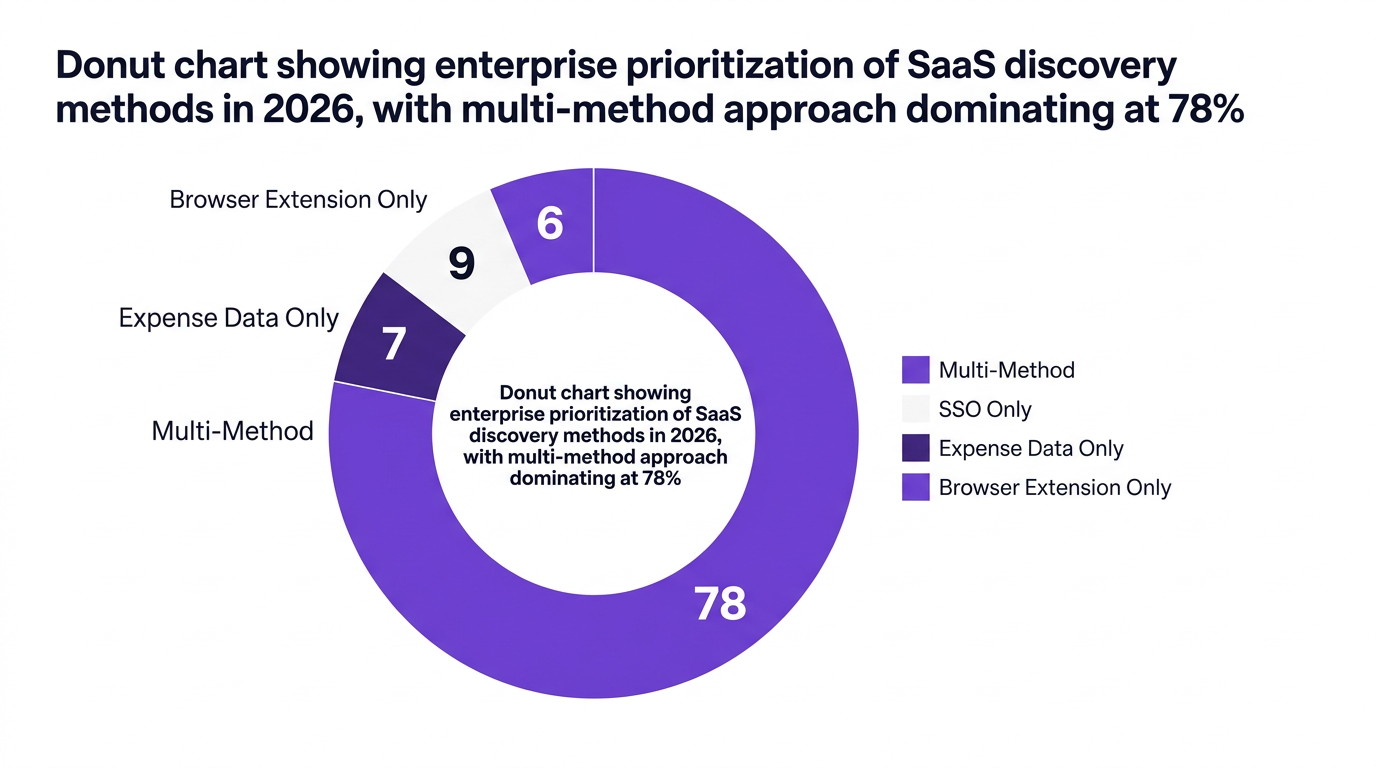
Over 78% of enterprise IT leaders are moving from single-method discovery to integrated, multi-source engines that combine SSO, browser, and expense data (Gartner 2026).
AI-enhanced SaaS management platforms report a 19% increase in detection effectiveness when they blend multiple signals instead of treating SSO as the only system of record (McKinsey 2026).
The analogy many CIOs use: relying on a single SaaS discovery method is like trying to understand city traffic using only highway cameras. You see authorized flows, but you miss local streets, side roads, and detours where risk often hides.
A SaaS discovery tool comparison is most useful when you treat each method as one sensor in a wider telemetry system. The real question is not "which is best" in isolation, but how you combine them for coverage, governance, and cost outcomes.
Identity providers remain a natural starting point for SaaS discovery. SSO-based visibility feels authoritative because it sits at the access layer. However, research shows its limits:
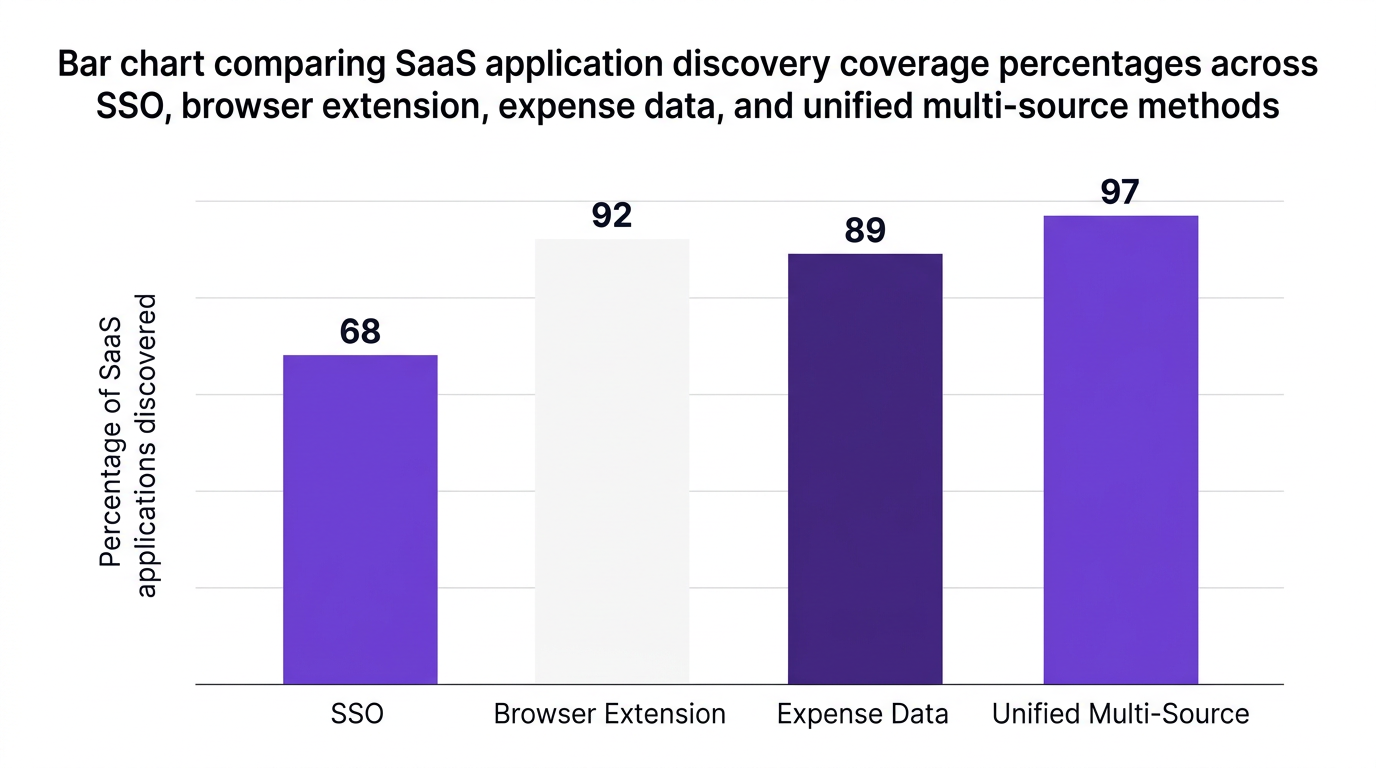
SSO-based discovery identifies only 68% of SaaS applications in use at large organizations, missing most unsanctioned and free-tier apps (Forrester 2026).
Many departmental tools, niche AI services, and trial sign-ups never touch SSO at all.
SSO SaaS discovery connects to your identity provider to pull:
A catalog of configured applications
Users and groups with access
Last login and MFA posture data
This makes SSO a strong backbone for identity-driven SaaS discovery and IGA-style controls, especially for sanctioned systems.
Pros:
Authoritative for sanctioned apps: What is wired into your IdP is usually governed by IT and security.
Rich identity context: Groups, roles, and MFA status support access reviews and compliance.
Low friction: No endpoint agents; fast to deploy.
For regulated enterprises, idp based SaaS discovery is often the first requirement in any saas security platform with continuous discovery.
The limitations of SSO SaaS discovery matter more each year:
Shadow IT blind spots: Free tools, AI copilots, and niche SaaS rarely appear in SSO config.
Direct login bypass: Users frequently log in with email-password or social SSO, bypassing the corporate IdP.
M&A and remote team sprawl: Multiple identity systems and unmanaged tenants fragment visibility.
This is why SSO alone is not enough for a credible saas discovery tool comparison. It is the spine, not the full nervous system. Counterpoint: some security teams argue that if an application is not behind SSO it is out of scope. That view can work temporarily in tightly locked environments, but it breaks once teams adopt self-service SaaS and personal credit cards at scale.
Browser-based monitoring provides a very different lens. Instead of asking which apps IT configured, it looks at what users are actually doing in the browser. Info-Tech Research in 2026 found that browser extension monitoring captures 92% of user-level SaaS interactions, yet 37% of organizations report privacy concerns when rolling out these agents.

Browser extension SaaS tracking instruments the user browser and collects metadata such as:
Domains and subdomains visited
Session frequency and duration
Page titles or route paths (depending on configuration)
Modern browser based SaaS monitoring tools typically offer privacy-first modes, for example capturing domain-level telemetry only, excluding personal tabs, or operating only in corporate profiles.
Pros:
High coverage for SaaS usage: A browser-centric workforce runs almost everything through the browser, including shadow IT.
User-level engagement insight: You can see actual adoption, not just provisioned licenses.
Discovery of unsanctioned AI and niche tools: Ideal to identify unsanctioned SaaS usage at the edge.
For teams evaluating the best saas discovery tools 2026, browser monitoring often ranks high because it uncovers what SSO cannot see.
Cons:
Privacy concerns: Employee councils and legal teams scrutinize any new monitoring, so you need clear guardrails.
Coverage gaps: Native desktop apps, mobile apps, and API-only services might not be visible.
Change management: Rolling out an extension across all browsers and OS variants requires coordination.
Expert guidance from Info-Tech in 2026 notes that digital employee monitoring must "balance coverage and user privacy" to maintain trust. That means explicit communication, clear scopes, and demonstrable governance benefits. Counterargument: some organizations avoid extensions entirely due to culture or regulation. In those cases, they can rely more heavily on CASB SaaS visibility and network-level inspection, but they lose the richest user-level engagement lens.
Where SSO shows sanctioned access and browsers show actual behavior, financial data shows real spend. For saas inventory management tools, this is where governance and cost optimization intersect. IDC reported in 2026 that expense data analysis uncovers 21% more shadow SaaS apps than SSO-only approaches, particularly those bought on corporate or personal cards. Deloitte adds that 36% of CISOs in finance rate expense-based SaaS discovery as critical for compliance audits.
Expense data SaaS discovery draws from:
Corporate cards and virtual cards
Travel and expense systems
Procurement and vendor master data
With enrichment and AI, a multi source SaaS discovery approach can find unknown SaaS subscriptions from expenses and map suppliers to specific products.
Pros:
Direct visibility into real spend: No usage, no problem, but payment creates an audit trail.
Essential for compliance and audits: Regulators increasingly expect evidence that you know every external system holding data.
Uncovers ownerless or orphaned subscriptions: You can see charges long after the business owner has moved on.
This is why credit card SaaS spend discovery and procurement data SaaS discovery are now standard requirements for saas discovery software for enterprises.
Cons:
Time lag: You only see apps after spend occurs, sometimes weeks later.
Vendor ambiguity: Some suppliers license multiple products, which complicates classification.
Free and freemium tools: If no money changes hands, expense data cannot detect them.
The most mature saas management platforms for saas discovery treat finance signals as complementary: they confirm and enrich what SSO and browsers already show, and they fill gaps for ownerless or rogue subscriptions.
Cloud access security brokers and secure web gateways add a security network lens to SaaS discovery. Instead of instrumenting end-user browsers individually, they monitor and control traffic at the network or proxy level. This method is especially valuable for saas shadow IT discovery tools where security wants to discover shadow SaaS apps without installing agents everywhere.
Cloud access security broker SaaS discovery uses:
DNS and HTTP/HTTPS traffic inspection
App-aware signatures and URL categorization
Policy-driven allow, block, or monitor rules
For many security teams, CASB SaaS visibility is the bridge between traditional network security and cloud-native SaaS risk.
Pros:
Strong for unmanaged devices: Captures traffic that never touches corporate browsers or SSO.
Inline control: Can block or coach users away from risky services.
Security telemetry: Feeds into SIEM and incident response workflows.
Cons:
Encrypted and mobile traffic challenges: Coverage depends on architecture and SSL inspection.
Limited business context: Network telemetry knows less about cost, contracts, or identities than SSO or expense data.
Implementation complexity: Network topology and global footprints introduce rollout challenges.
For an enterprise SaaS discovery and governance program, CASB is best viewed as an additional sensor that complements SSO, browser, and finance data, especially for security operations.
A useful saas discovery tool comparison must move beyond checklists. The right discovery mix depends on the question you are answering.
Security and shadow IT control
- Strongest: Browser extensions, CASB, SSO
- Rationale: These uncover unsanctioned usage and support enforcement.
Cost optimization and license rationalization
- Strongest: Expense data, SSO, browser usage signals
- Rationale: Finance data confirms spend, SSO shows entitlements, browser shows adoption.
Compliance and identity governance
- Strongest: SSO, HR systems, CASB
- Rationale: Identity-centric systems support certifications and reviews.
Employee experience and application portfolio planning
- Strongest: Browser usage analytics, surveys, expense analysis
- Rationale: You need insights into real adoption, not just configuration.
Underneath these outcomes, the most effective enterprises adopt a layered SaaS discovery strategy that resembles a radar stack: SSO provides a control tower view, browser and CASB sweep the horizon, and finance data grounds your view in real spend.
CloudNuro is designed from the ground up as a continuous SaaS discovery platform for enterprises that need unified security, governance, and cost control. Instead of asking IT to choose between SSO, browser, or expenses, CloudNuro combines them into a single multi source SaaS discovery approach with AI-backed insights.
CloudNuro’s Unified Cloud Custodian connects to identity providers for SSO SaaS discovery and identity driven SaaS discovery:
Brings in sanctioned apps and access context.
Tracks last login and MFA posture.
Flags inactive or high-risk accounts for review.
This identity backbone supports saas IGA with continuous discovery, closing the loop between access controls and real-world usage. Learn more about CloudNuro’s SaaS management capabilities on the SaaS management overview page.
CloudNuro adds browser extension SaaS tracking for user level SaaS usage tracking in browser environments:
Privacy scoped monitoring, with options for domain-only capture and corporate profile limits.
Discovery of unsanctioned and AI tools that never touch SSO.
App engagement scoring to inform rationalization and employee experience decisions.
Combined with identity data, CloudNuro can tell you not just who is assigned a license, but who truly uses each application.
CloudNuro’s AI Custodian analyzes:
Corporate card and credit card SaaS spend discovery data.
Procurement data SaaS discovery signals from ERP and sourcing systems.
It correlates these with browser and SSO telemetry to:
Identify unapproved SaaS purchases.
Flag duplicate tools in the same category.
Quantify optimization opportunities and contract consolidation.
CloudNuro’s FinOps services build on this to deliver automated cost optimization, transforming discovered waste into measurable savings.
CloudNuro integrates with cloud access security broker SaaS discovery and security platforms to extend coverage beyond browsers and SSO. Through more than 400 integrations, cataloged on the CloudNuro integrations page, the platform pulls in:
Security posture, such as MFA, data sharing, and public object exposure.
Activity and login anomalies for AI driven risk scoring.
This allows CloudNuro to function as a saas security platform with continuous discovery where security teams, IT, and finance work from the same SaaS inventory.
A global healthcare enterprise used CloudNuro-style multi-method discovery, combining SSO, browser extensions, and expense analytics. According to Gartner in 2026, it uncovered more than 160 shadow apps and reduced SaaS spend by 18% in nine months. A large financial institution used expense-driven discovery similar to CloudNuro’s approach to prepare for a SOX audit. Deloitte reports that it identified 31 unapproved SaaS tools and remediated three major privacy risks before regulators arrived. CloudNuro turns these patterns into repeatable workflows through its governance-first architecture and automation engine. You can explore the broader platform capabilities on the product overview page and learn why enterprises select CloudNuro on the Why CloudNuro page.
No single method is "best" in isolation. Research from Gartner in 2026 shows 82% of enterprises use multiple SaaS discovery methods because each provides a different view. The most effective approach is a layered SaaS discovery strategy combining SSO, browser, expense, and CASB signals into one continuous SaaS discovery platform.
SSO-based discovery is strongest for sanctioned apps and identity governance. Browser extensions excel at revealing shadow IT and detailed usage, while expense data SaaS discovery highlights actual spend and ownerless subscriptions. A mature saas discovery tool comparison treats SSO as a foundation, browser and CASB as behavioral and security layers, and finance as the cost and compliance lens.
The key limitations of SSO SaaS discovery are:
It misses apps that are not wired into the identity provider.
It does not capture free or freemium tools with email-only logins.
It cannot see personal card purchases or unsanctioned trials.
This is why many enterprises now supplement SSO with browser based SaaS monitoring tools and credit card SaaS spend discovery.
To discover shadow SaaS apps and identify unsanctioned SaaS usage, you need telemetry beyond SSO. Practical steps include:
Deploy privacy aware browser extension SaaS tracking on corporate browsers.
Integrate CASB SaaS visibility for unmanaged devices and network level insight.
Analyze expense and procurement data to find unknown SaaS subscriptions from expenses.
Combining these signals within a saas security platform with continuous discovery provides both detection and governance.
Use CASB when you need security-first control across managed and unmanaged endpoints. Use browser extensions when you want granular user level SaaS usage tracking in browser for adoption, rationalization, and shadow IT. Use expense and procurement data when your goals include cost optimization, audit readiness, and reconciling contracts with actual usage.
The most useful SaaS discovery tool comparison in 2026 is not a ranking of vendors, but a design pattern for how you combine identity, browser, finance, and network signals. Enterprises that adopt this multi-source model, supported by platforms like CloudNuro, are seeing measurable results. Research shows a 27% higher reduction in SaaS related security incidents for organizations using unified discovery methods year over year. If your SaaS inventory still depends on a single source of truth, now is the time to rethink your strategy and adopt continuous, multi signal discovery.
CloudNuro is a leader in Enterprise SaaS Management Platforms, providing enterprises with unmatched visibility, governance, and cost optimization. Recognized twice in a row in the SaaS Management Platforms category and named a Leader in the SoftwareReviews Data Quadrant, CloudNuro is trusted by global enterprises and government agencies to bring financial discipline to SaaS, cloud, and AI. Trusted by enterprises such as Konica Minolta and Federal Signal, CloudNuro provides centralized SaaS inventory, license optimization, and renewal management along with advanced cost allocation and chargeback, giving IT and Finance leaders the visibility, control, and cost-conscious culture needed to drive financial discipline.
Request a no cost, no obligation free assessment —just 15 minutes to savings!
Get StartedSSO, Browser Extensions, or Expense Data? A Practical SaaS Discovery Tool Comparison for 2026 Choosing a SaaS discovery strategy is no longer a theoretical exercise. For enterprises dealing with hundreds or thousands of cloud applications, the wrong approach creates blind spots in security, compliance, and spend. This practical SaaS discovery tool comparison explains how SSO, browser extensions, expense data, and CASB each work, where they fail, and how to combine them into a continuous discovery program that IT, security, and finance can all trust. According to Gartner in 2026, 82% of enterprises use multiple SaaS discovery methods to get comprehensive visibility. The era of relying on a single discovery feed is over.
Enterprise SaaS portfolios have exploded in volume and volatility. IT can approve one app in January and see three alternatives adopted by a single team by March. Market research highlights the shift:
Over 78% of enterprise IT leaders are moving from single-method discovery to integrated, multi-source engines that combine SSO, browser, and expense data (Gartner 2026).
AI-enhanced SaaS management platforms report a 19% increase in detection effectiveness when they blend multiple signals instead of treating SSO as the only system of record (McKinsey 2026).
The analogy many CIOs use: relying on a single SaaS discovery method is like trying to understand city traffic using only highway cameras. You see authorized flows, but you miss local streets, side roads, and detours where risk often hides.
A SaaS discovery tool comparison is most useful when you treat each method as one sensor in a wider telemetry system. The real question is not "which is best" in isolation, but how you combine them for coverage, governance, and cost outcomes.
Identity providers remain a natural starting point for SaaS discovery. SSO-based visibility feels authoritative because it sits at the access layer. However, research shows its limits:
SSO-based discovery identifies only 68% of SaaS applications in use at large organizations, missing most unsanctioned and free-tier apps (Forrester 2026).
Many departmental tools, niche AI services, and trial sign-ups never touch SSO at all.
SSO SaaS discovery connects to your identity provider to pull:
A catalog of configured applications
Users and groups with access
Last login and MFA posture data
This makes SSO a strong backbone for identity-driven SaaS discovery and IGA-style controls, especially for sanctioned systems.
Pros:
Authoritative for sanctioned apps: What is wired into your IdP is usually governed by IT and security.
Rich identity context: Groups, roles, and MFA status support access reviews and compliance.
Low friction: No endpoint agents; fast to deploy.
For regulated enterprises, idp based SaaS discovery is often the first requirement in any saas security platform with continuous discovery.
The limitations of SSO SaaS discovery matter more each year:
Shadow IT blind spots: Free tools, AI copilots, and niche SaaS rarely appear in SSO config.
Direct login bypass: Users frequently log in with email-password or social SSO, bypassing the corporate IdP.
M&A and remote team sprawl: Multiple identity systems and unmanaged tenants fragment visibility.
This is why SSO alone is not enough for a credible saas discovery tool comparison. It is the spine, not the full nervous system. Counterpoint: some security teams argue that if an application is not behind SSO it is out of scope. That view can work temporarily in tightly locked environments, but it breaks once teams adopt self-service SaaS and personal credit cards at scale.
Browser-based monitoring provides a very different lens. Instead of asking which apps IT configured, it looks at what users are actually doing in the browser. Info-Tech Research in 2026 found that browser extension monitoring captures 92% of user-level SaaS interactions, yet 37% of organizations report privacy concerns when rolling out these agents.
Browser extension SaaS tracking instruments the user browser and collects metadata such as:
Domains and subdomains visited
Session frequency and duration
Page titles or route paths (depending on configuration)
Modern browser based SaaS monitoring tools typically offer privacy-first modes, for example capturing domain-level telemetry only, excluding personal tabs, or operating only in corporate profiles.
Pros:
High coverage for SaaS usage: A browser-centric workforce runs almost everything through the browser, including shadow IT.
User-level engagement insight: You can see actual adoption, not just provisioned licenses.
Discovery of unsanctioned AI and niche tools: Ideal to identify unsanctioned SaaS usage at the edge.
For teams evaluating the best saas discovery tools 2026, browser monitoring often ranks high because it uncovers what SSO cannot see.
Cons:
Privacy concerns: Employee councils and legal teams scrutinize any new monitoring, so you need clear guardrails.
Coverage gaps: Native desktop apps, mobile apps, and API-only services might not be visible.
Change management: Rolling out an extension across all browsers and OS variants requires coordination.
Expert guidance from Info-Tech in 2026 notes that digital employee monitoring must "balance coverage and user privacy" to maintain trust. That means explicit communication, clear scopes, and demonstrable governance benefits. Counterargument: some organizations avoid extensions entirely due to culture or regulation. In those cases, they can rely more heavily on CASB SaaS visibility and network-level inspection, but they lose the richest user-level engagement lens.
Where SSO shows sanctioned access and browsers show actual behavior, financial data shows real spend. For saas inventory management tools, this is where governance and cost optimization intersect. IDC reported in 2026 that expense data analysis uncovers 21% more shadow SaaS apps than SSO-only approaches, particularly those bought on corporate or personal cards. Deloitte adds that 36% of CISOs in finance rate expense-based SaaS discovery as critical for compliance audits.
Expense data SaaS discovery draws from:
Corporate cards and virtual cards
Travel and expense systems
Procurement and vendor master data
With enrichment and AI, a multi source SaaS discovery approach can find unknown SaaS subscriptions from expenses and map suppliers to specific products.
Pros:
Direct visibility into real spend: No usage, no problem, but payment creates an audit trail.
Essential for compliance and audits: Regulators increasingly expect evidence that you know every external system holding data.
Uncovers ownerless or orphaned subscriptions: You can see charges long after the business owner has moved on.
This is why credit card SaaS spend discovery and procurement data SaaS discovery are now standard requirements for saas discovery software for enterprises.
Cons:
Time lag: You only see apps after spend occurs, sometimes weeks later.
Vendor ambiguity: Some suppliers license multiple products, which complicates classification.
Free and freemium tools: If no money changes hands, expense data cannot detect them.
The most mature saas management platforms for saas discovery treat finance signals as complementary: they confirm and enrich what SSO and browsers already show, and they fill gaps for ownerless or rogue subscriptions.
Cloud access security brokers and secure web gateways add a security network lens to SaaS discovery. Instead of instrumenting end-user browsers individually, they monitor and control traffic at the network or proxy level. This method is especially valuable for saas shadow IT discovery tools where security wants to discover shadow SaaS apps without installing agents everywhere.
Cloud access security broker SaaS discovery uses:
DNS and HTTP/HTTPS traffic inspection
App-aware signatures and URL categorization
Policy-driven allow, block, or monitor rules
For many security teams, CASB SaaS visibility is the bridge between traditional network security and cloud-native SaaS risk.
Pros:
Strong for unmanaged devices: Captures traffic that never touches corporate browsers or SSO.
Inline control: Can block or coach users away from risky services.
Security telemetry: Feeds into SIEM and incident response workflows.
Cons:
Encrypted and mobile traffic challenges: Coverage depends on architecture and SSL inspection.
Limited business context: Network telemetry knows less about cost, contracts, or identities than SSO or expense data.
Implementation complexity: Network topology and global footprints introduce rollout challenges.
For an enterprise SaaS discovery and governance program, CASB is best viewed as an additional sensor that complements SSO, browser, and finance data, especially for security operations.
A useful saas discovery tool comparison must move beyond checklists. The right discovery mix depends on the question you are answering.
Security and shadow IT control
- Strongest: Browser extensions, CASB, SSO
- Rationale: These uncover unsanctioned usage and support enforcement.
Cost optimization and license rationalization
- Strongest: Expense data, SSO, browser usage signals
- Rationale: Finance data confirms spend, SSO shows entitlements, browser shows adoption.
Compliance and identity governance
- Strongest: SSO, HR systems, CASB
- Rationale: Identity-centric systems support certifications and reviews.
Employee experience and application portfolio planning
- Strongest: Browser usage analytics, surveys, expense analysis
- Rationale: You need insights into real adoption, not just configuration.
Underneath these outcomes, the most effective enterprises adopt a layered SaaS discovery strategy that resembles a radar stack: SSO provides a control tower view, browser and CASB sweep the horizon, and finance data grounds your view in real spend.
CloudNuro is designed from the ground up as a continuous SaaS discovery platform for enterprises that need unified security, governance, and cost control. Instead of asking IT to choose between SSO, browser, or expenses, CloudNuro combines them into a single multi source SaaS discovery approach with AI-backed insights.
CloudNuro’s Unified Cloud Custodian connects to identity providers for SSO SaaS discovery and identity driven SaaS discovery:
Brings in sanctioned apps and access context.
Tracks last login and MFA posture.
Flags inactive or high-risk accounts for review.
This identity backbone supports saas IGA with continuous discovery, closing the loop between access controls and real-world usage. Learn more about CloudNuro’s SaaS management capabilities on the SaaS management overview page.
CloudNuro adds browser extension SaaS tracking for user level SaaS usage tracking in browser environments:
Privacy scoped monitoring, with options for domain-only capture and corporate profile limits.
Discovery of unsanctioned and AI tools that never touch SSO.
App engagement scoring to inform rationalization and employee experience decisions.
Combined with identity data, CloudNuro can tell you not just who is assigned a license, but who truly uses each application.
CloudNuro’s AI Custodian analyzes:
Corporate card and credit card SaaS spend discovery data.
Procurement data SaaS discovery signals from ERP and sourcing systems.
It correlates these with browser and SSO telemetry to:
Identify unapproved SaaS purchases.
Flag duplicate tools in the same category.
Quantify optimization opportunities and contract consolidation.
CloudNuro’s FinOps services build on this to deliver automated cost optimization, transforming discovered waste into measurable savings.
CloudNuro integrates with cloud access security broker SaaS discovery and security platforms to extend coverage beyond browsers and SSO. Through more than 400 integrations, cataloged on the CloudNuro integrations page, the platform pulls in:
Security posture, such as MFA, data sharing, and public object exposure.
Activity and login anomalies for AI driven risk scoring.
This allows CloudNuro to function as a saas security platform with continuous discovery where security teams, IT, and finance work from the same SaaS inventory.
A global healthcare enterprise used CloudNuro-style multi-method discovery, combining SSO, browser extensions, and expense analytics. According to Gartner in 2026, it uncovered more than 160 shadow apps and reduced SaaS spend by 18% in nine months. A large financial institution used expense-driven discovery similar to CloudNuro’s approach to prepare for a SOX audit. Deloitte reports that it identified 31 unapproved SaaS tools and remediated three major privacy risks before regulators arrived. CloudNuro turns these patterns into repeatable workflows through its governance-first architecture and automation engine. You can explore the broader platform capabilities on the product overview page and learn why enterprises select CloudNuro on the Why CloudNuro page.
No single method is "best" in isolation. Research from Gartner in 2026 shows 82% of enterprises use multiple SaaS discovery methods because each provides a different view. The most effective approach is a layered SaaS discovery strategy combining SSO, browser, expense, and CASB signals into one continuous SaaS discovery platform.
SSO-based discovery is strongest for sanctioned apps and identity governance. Browser extensions excel at revealing shadow IT and detailed usage, while expense data SaaS discovery highlights actual spend and ownerless subscriptions. A mature saas discovery tool comparison treats SSO as a foundation, browser and CASB as behavioral and security layers, and finance as the cost and compliance lens.
The key limitations of SSO SaaS discovery are:
It misses apps that are not wired into the identity provider.
It does not capture free or freemium tools with email-only logins.
It cannot see personal card purchases or unsanctioned trials.
This is why many enterprises now supplement SSO with browser based SaaS monitoring tools and credit card SaaS spend discovery.
To discover shadow SaaS apps and identify unsanctioned SaaS usage, you need telemetry beyond SSO. Practical steps include:
Deploy privacy aware browser extension SaaS tracking on corporate browsers.
Integrate CASB SaaS visibility for unmanaged devices and network level insight.
Analyze expense and procurement data to find unknown SaaS subscriptions from expenses.
Combining these signals within a saas security platform with continuous discovery provides both detection and governance.
Use CASB when you need security-first control across managed and unmanaged endpoints. Use browser extensions when you want granular user level SaaS usage tracking in browser for adoption, rationalization, and shadow IT. Use expense and procurement data when your goals include cost optimization, audit readiness, and reconciling contracts with actual usage.
The most useful SaaS discovery tool comparison in 2026 is not a ranking of vendors, but a design pattern for how you combine identity, browser, finance, and network signals. Enterprises that adopt this multi-source model, supported by platforms like CloudNuro, are seeing measurable results. Research shows a 27% higher reduction in SaaS related security incidents for organizations using unified discovery methods year over year. If your SaaS inventory still depends on a single source of truth, now is the time to rethink your strategy and adopt continuous, multi signal discovery.
CloudNuro is a leader in Enterprise SaaS Management Platforms, providing enterprises with unmatched visibility, governance, and cost optimization. Recognized twice in a row in the SaaS Management Platforms category and named a Leader in the SoftwareReviews Data Quadrant, CloudNuro is trusted by global enterprises and government agencies to bring financial discipline to SaaS, cloud, and AI. Trusted by enterprises such as Konica Minolta and Federal Signal, CloudNuro provides centralized SaaS inventory, license optimization, and renewal management along with advanced cost allocation and chargeback, giving IT and Finance leaders the visibility, control, and cost-conscious culture needed to drive financial discipline.
Request a no cost, no obligation free assessment - just 15 minutes to savings!
Get StartedWe're offering complimentary ServiceNow license assessments to only 25 enterprises this quarter who want to unlock immediate savings without disrupting operations.
Get Free AssessmentGet Started




CloudNuro Corp
1755 Park St. Suite 207
Naperville, IL 60563
Phone : +1-630-277-9470
Email: info@cloudnuro.com





.webp)

Recognized Leader in SaaS Management Platforms by Info-Tech SoftwareReviews
%20Tools%20in%202025.png)


.svg)