

Sign Up
Thank you for Submitting!
For most security and compliance leaders, the user access review has moved from an occasional checklist task to a central control in their governance program. The question is no longer if you should perform a user access review, but how often and at what level of rigor for each environment, system, and framework.
Gartner reports that 72% of enterprises in regulated industries now require quarterly user access reviews to satisfy SOC 2 and SOX requirements (2026). Deloitte notes that 76% of ISO 27001 certified organizations typically run access reviews on a quarterly cadence (2026). Getting frequency wrong can expose you to avoidable audit findings, penalties, and real security incidents.
This guide breaks down user access review frequency by industry and framework, then shows how to operationalize a sustainable, automated user access review process.
User access reviews used to be a once a year activity, often rushed before an audit. That approach no longer holds up against modern threat models or regulator expectations.
Several forces are driving higher user access review frequency:
Explosion of SaaS and cloud: More apps, more identities, more shadow IT.
Zero trust expectations: Continuous validation and least privilege access reviews.
Multi framework compliance: SOC 2, ISO 27001, SOX, HIPAA, and internal policies stacking together.
A Gartner principal analyst summarized it well in 2026: frequent and automated user access reviews are now the baseline for audit ready organizations, especially with zero trust and multi cloud deployments.
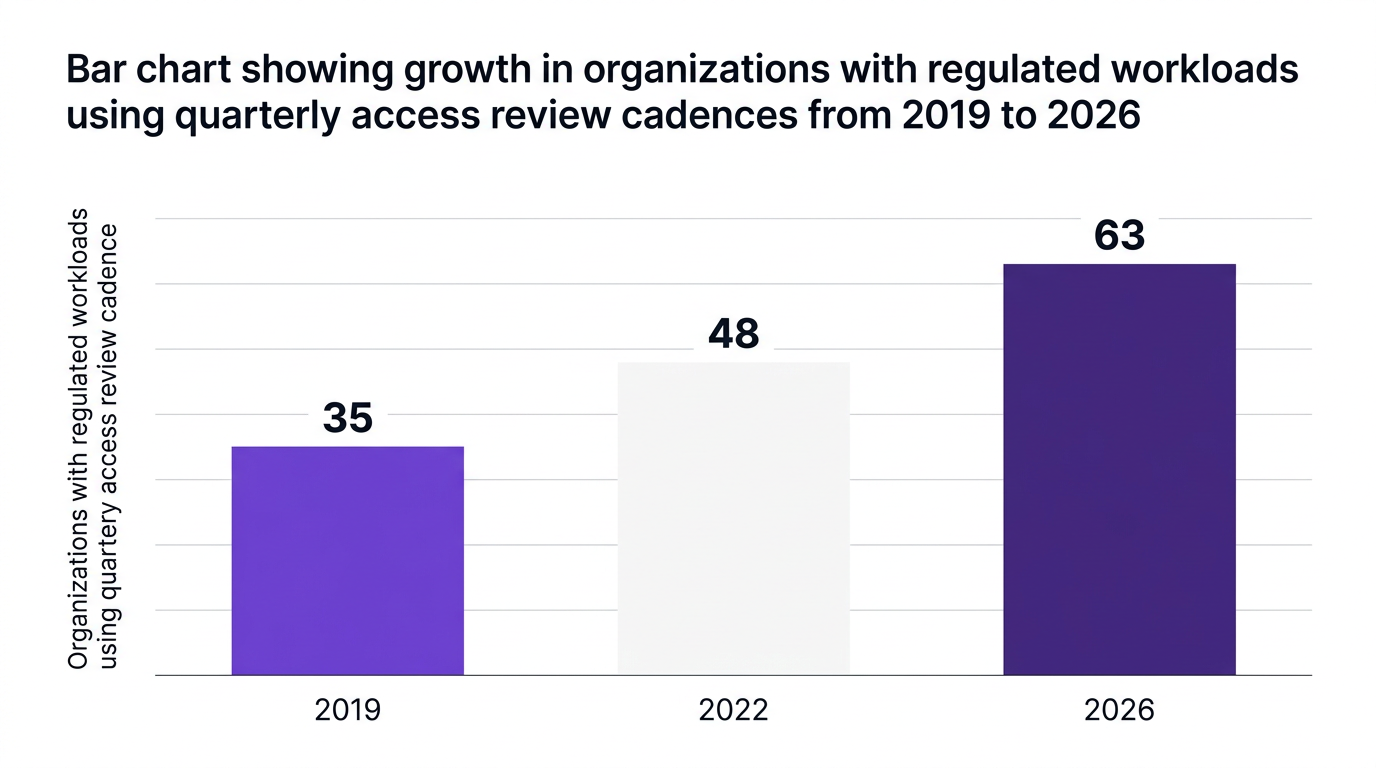
Quarterly access review cadences are already standard in 63% of organizations with regulated workloads, according to Gartner 2026. That trend will only accelerate as auditors expect evidence of ongoing control effectiveness, not just point in time reviews.
A practical way to define your user access review policy is to start from frameworks, then tune for your risk level. Below is a plain language view of what common frameworks expect for user access review frequency.
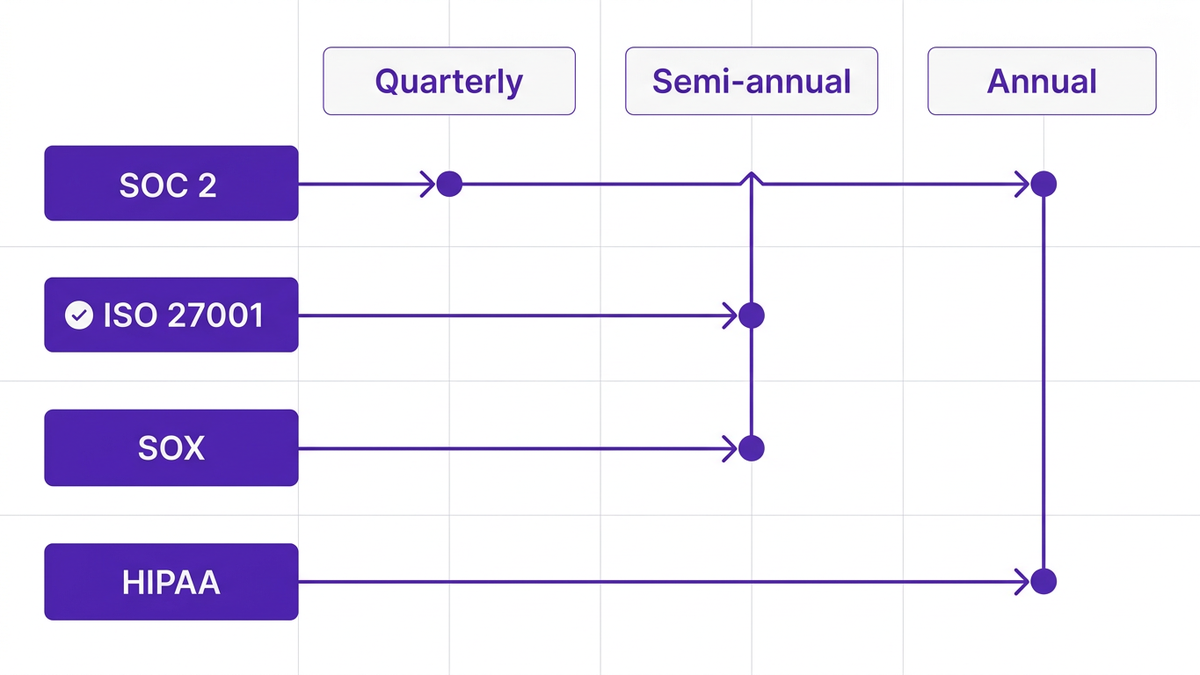
SOC 2 does not prescribe an explicit calendar for user access reviews, but auditors consistently expect periodic user access review aligned with risk. In practice, that means:
Quarterly user access review for high risk systems and privileged roles.
Semi annual or annual user access review for lower risk line of business apps.
SOC 2 auditors focus on:
Whether you have a documented user access review policy and access review cadence.
Evidence that reviews actually happened, with approvals, revocations, and timestamps.
This is where access review compliance starts to depend on automation, because manual evidence collection breaks down at scale.
ISO 27001 control A.9 expects regular review of user access rights. Deloitte found that 76% of ISO 27001 certified organizations follow a quarterly cadence for access reviews (2026).
Typical patterns for iso 27001 access review frequency:
Quarterly or semi annual RBAC access review for production and sensitive data environments.
Annual user access review for low risk or internal only systems.
Auditors often ask how you ensure least privilege access reviews, how you cover joiners, movers, and leavers, and how your user access lifecycle management aligns with your user access review process.
For financial systems, sox user access review expectations are stricter because misconfigured access can impact financial reporting.
PwC reported that financial institutions increased user access review frequency by 22% since 2024 to meet tighter SOX mandates (2026). In practice, that looks like:
Quarterly user access review for financial reporting systems and privileged access.
Monthly exception reviews for high risk roles, such as super admins.
SOX auditors care about both access recertification frequency and evidence that inappropriate access was revoked promptly. Spreadsheet based review processes often fail here, because they cannot prove timely remediation.
For HIPAA covered entities, the focus is on protecting PHI. While HIPAA does not specify exact access recertification frequency, healthcare regulators expect:
Quarterly or semi annual user access review for EHR and clinical systems.
Strong SaaS user access review for any cloud systems that store or process PHI.
Forrester noted that automation drove annual access review compliance rates to 89% in healthcare and finance by 2026, largely because platforms could finally keep up with the volume of identities.
Frameworks are only part of the story. Your actual access review cadence should align with your industry’s risk profile.
Here is a synthesized view of how often different sectors typically run user access reviews, based on 2026 research from Gartner, Deloitte, and IDC.
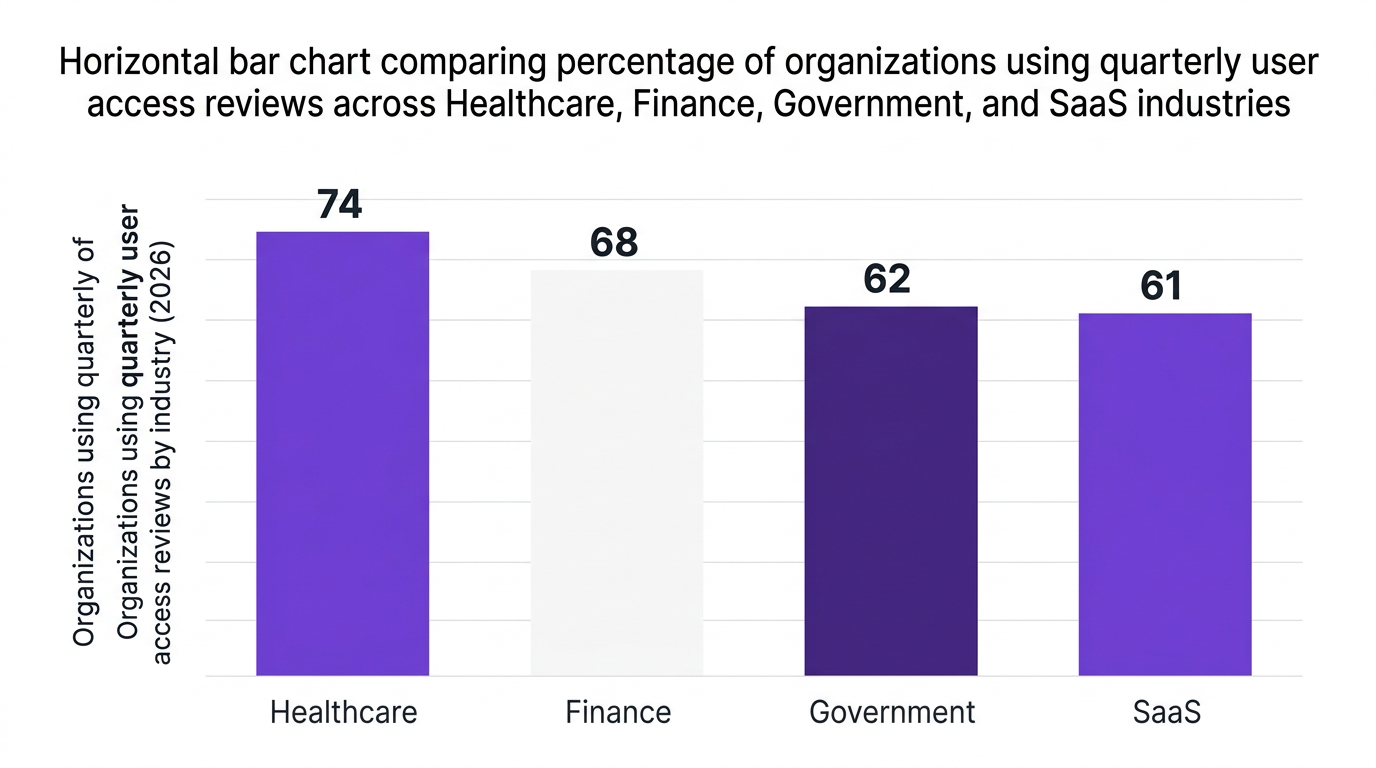
Healthcare organizations handle PHI, life critical systems, and complex vendor ecosystems. Most hospitals and health systems now:
Run quarterly user access reviews for EHR, clinical, and billing systems.
Run semi annual reviews for HR and operational SaaS.
Because clinician access changes frequently, many are moving toward role based access review with dynamic RBAC access review policies.
Banks and financial institutions face both SOX and sector specific scrutiny. Common patterns include:
Quarterly user access reviews across all financial and trading systems.
Monthly targeted reviews of privileged accounts and sensitive trading roles.
These organizations calculate when to run access review based on inherent risk, transaction volumes, and fraud patterns.
Government agencies balance classified data, citizen services, and constrained budgets. Best practice patterns are:
Quarterly user access reviews for systems with PII or national security impact.
Annual user access review for low sensitivity internal systems.
Access review compliance in the public sector is improving as agencies standardize SaaS access governance and centralize audit access review evidence.
Cloud and SaaS providers often support customer environments directly, which increases risk.
IDC reports that companies in the SaaS sector with automated review solutions saw a 61% reduction in access related compliance violations in 2026. Typical practices include:
Quarterly or even monthly access certification for production and admin consoles.
Quarterly RBAC access review for customer success, support, and engineering roles.
The common theme across industries: high risk systems rarely go more than 90 days without some form of access recertification.
Many enterprises initially set a quarterly user access review frequency on paper, then discover their manual process cannot keep up.
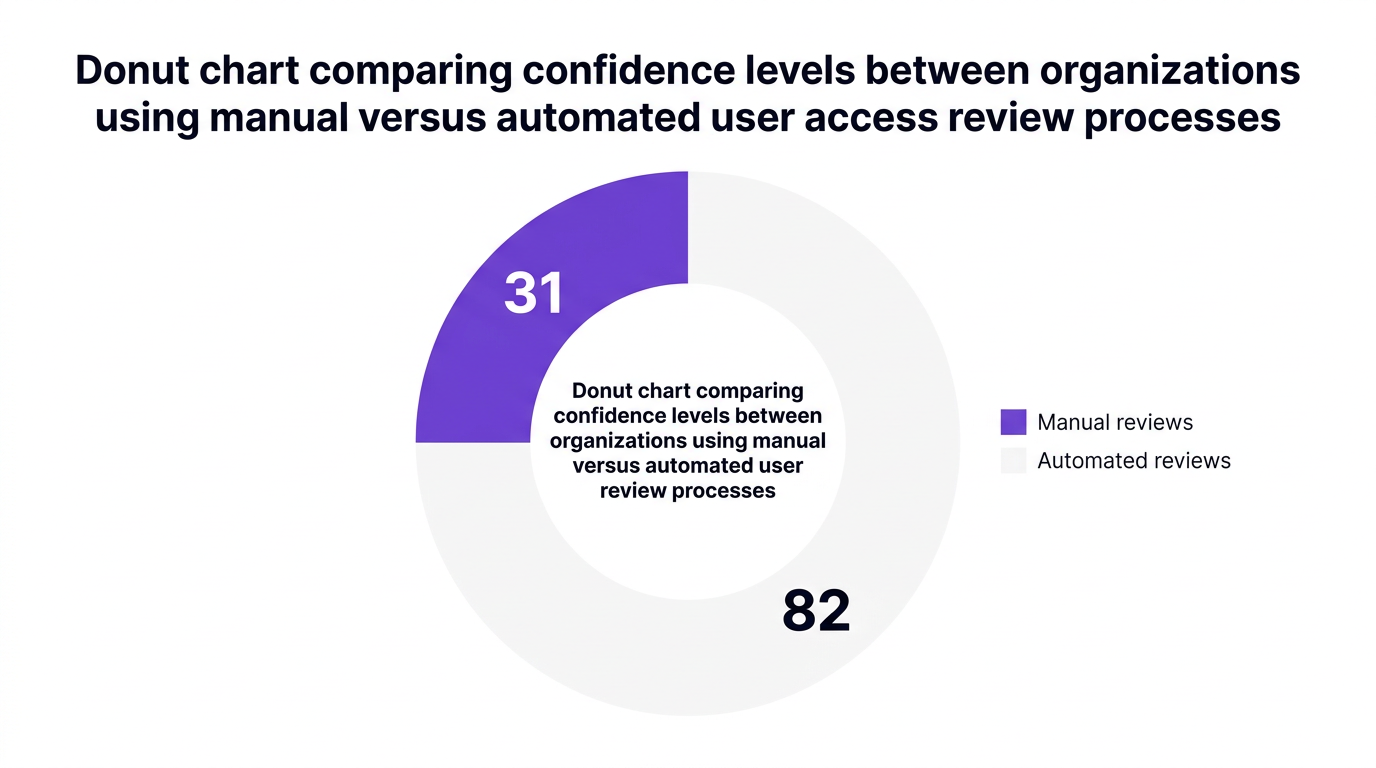
KuppingerCole found that only 31% of organizations felt confident in manually managed user access reviews, compared with 82% confidence for those using automated solutions (2026). ISACA reported that AI driven automation reduced audit preparation time by 47% on average (2026).
Manual UAR workflows typically struggle with:
Exporting and normalizing access data from dozens or hundreds of apps.
Routing reviews to the right business owners on time.
Tracking decisions and revocations for audit access review evidence.
As the number of apps and identities grows, the risk of access review compliance failure rises sharply.
Some organizations argue that an annual user access review is adequate. This might be defensible for:
Small environments with very few critical systems.
Internal tools that do not store sensitive data.
However, for any environment that handles regulated data or production workloads, annual reviews are increasingly out of step with regulator and auditor expectations.
SSO and RBAC are essential, but they do not replace periodic user access review. You still need to confirm that:
Roles and group memberships remain valid.
Temporary access was revoked.
Contractors were deprovisioned.
Think of SSO and RBAC as the rails, and the user access review as the regular track inspection that ensures the rails are still safe.
To translate frameworks and industry norms into practice, use a 3 2 1 UAR frequency framework:
3 months: Quarterly reviews for high risk systems.
2 times per year: Semi annual reviews for medium risk systems.
1 time per year: Annual reviews for low risk systems.
Start by tagging each system with a risk tier:
High: Regulated data, financial reporting, production infrastructure.
Medium: Sensitive internal data, HR, and operations.
Low: Internal collaboration or informational tools.
Use this as the backbone of your user access review template and user access review checklist.
Next, overlay frameworks like SOC 2, ISO 27001, SOX, and HIPAA onto your tiers:
If a system is in scope for SOX, it is automatically high and requires at least quarterly reviews.
If a system stores PHI, align with HIPAA expectations and at least semi annual reviews.
This alignment ensures your user access review policy is both risk based and framework aware.
Finally, define for each system:
Review owner: Business or system owner who approves access.
Cadence: Quarterly, semi annual, or annual.
Scope: All users, or only high risk roles.
Your user access review checklist should also specify evidence requirements and remediation SLAs, so that every review is audit ready by design.
For a deeper view on IAM process design, see this guide on identity and access management best practices.
Once you have a policy, the next challenge is operationalization. A strong user access review process typically includes the following elements.
A consistent user access review template keeps reviews focused and efficient. At minimum, each review should include:
System name and owner.
Review period and cadence.
User list with roles, last login, and risk indicators.
Standardizing this across your SaaS user access review scope makes it easier to automate and audit.
Reviewers make better decisions when they see context such as:
Last login and activity metrics.
Role definitions and typical peer access.
Flags for orphaned or dormant accounts.
This is where SaaS identity governance platforms excel because they aggregate permissions and context across multiple systems.
For each review cycle:
Generate the user list from your source of truth.
Route to the correct business owner automatically.
Send reminders until completion.
This level of automation is almost impossible with spreadsheets but is table stakes for user access review automation.
An effective user access review ends with action, not just approval. Best practice is to:
Automatically deprovision users marked for removal.
Downgrade roles when reviewers select reduced access.
Log every change for access review compliance evidence.
A centralized SaaS management solution accelerates this by integrating directly with your identity and app layers.
To see how this connects to broader governance, review this overview of SaaS management and IT security solutions.
CloudNuro was built to make frequent, audit ready user access reviews practical for large enterprises.
With Unified Cloud Custodian, you can schedule and automate user access reviews at any cadence, including quarterly, semi annual, or annual, across 400 plus SaaS and cloud apps. Automated workflows flag outlier access and route decisions to business owners, then orchestrate revocation and role changes.
CloudNuro’s governance first design aligns your user access review policy with SOC 2, ISO 27001, SOX, and HIPAA expectations by:
Centralizing access data and permissions for SaaS, cloud, and AI workloads.
Applying consistent access recertification frequency rules by risk tier.
Maintaining immutable audit trails for every periodic user access review.
This removes the need to manually reconcile logs, exports, and screenshots for auditors.
AI Custodian adds intelligent context to each user access review. It calculates risk scores for identities using:
Anomalous permission patterns.
Dormant or unused accounts.
Excessive privilege relative to peers.
According to ISACA 2026, organizations adopting AI driven automation reduced audit preparation time by 47%. CloudNuro operationalizes that benefit through integrated automated user access reviews and risk based review queues.
A large healthcare provider that adopted Unified Cloud Custodian automated user access reviews for more than 12,000 users. The organization hit 96% completion rates for quarterly reviews and reduced audit remediation time by 41% in 2026.
A financial institution that implemented AI Custodian for SOX compliant access review workflows cut manual review effort by 55% and achieved a no findings audit outcome in 2026.
These results are typical when organizations shift from manual, spreadsheet based reviews to a centralized, automated SaaS access governance model.
For related governance automation patterns, see this analysis of compliance automation software.
To wrap the guidance into a concrete user access review checklist, validate that your program includes the following items.
Policy and cadence
Documented user access review policy tied to risk tiers.
Defined UAR frequency: quarterly, semi annual, annual.
Mapped frameworks: SOC 2, ISO 27001, SOX, HIPAA.
Process and templates
Standard user access review template with system, owner, scope, and evidence fields.
Clear business ownership for each app and system.
SLAs for remediation after reviews.
Automation and tooling
Centralized SaaS management platform to aggregate access data.
Configurable review workflows and reminders.
Automated user provisioning and deprovisioning tied to review outcomes.
Metrics and improvement
Completion rates by review cycle and system.
Time to remediate excessive or orphaned access.
Reduction in access related audit findings and incidents.
For additional operational metrics to track, explore these SaaS management metrics to watch.
Most auditors expect quarterly user access reviews for high risk and regulated systems, including those in scope for SOX and SOC 2. Medium risk systems can often follow a semi annual cadence, while low risk internal systems may be reviewed annually if justified by a documented risk assessment.
SOC 2, ISO 27001, SOX, and HIPAA all require periodic user access review, though they rarely specify exact dates. In practice, SOC 2 and SOX environments tend to adopt quarterly cadences, ISO 27001 organizations commonly use quarterly or semi annual reviews, and HIPAA environments aim for quarterly or semi annual reviews for PHI systems.
Skipping or delaying reviews increases the chance of orphaned accounts, excessive privileges, and stale vendor access. This can lead to data breaches, fraud, and audit findings, and research in 2026 showed that organizations with automated review solutions saw a 61% reduction in access related compliance violations compared with those relying on manual processes.
Automation aggregates permissions across systems, routes reviews to the right owners, provides context like last login and peer access, and enforces remediation. Studies in 2026 showed that organizations using AI driven automation for access reviews reduced audit preparation times by 47% and reported much higher confidence in their controls compared with manual methods.
Start with your frameworks, then tune for industry risk. Healthcare, finance, and government typically use quarterly reviews for high risk systems and semi annual for medium risk. Technology and SaaS providers often review production and admin access quarterly or monthly, given their role in supporting customer environments.
Key steps include defining risk tiers, mapping frameworks to those tiers, specifying how often access review cycles run for each tier, assigning system owners, and standardizing the user access review process and templates. From there, enable user access review automation so your cadence is realistic and sustainable.
The right user access review cadence balances regulatory expectations, risk tolerance, and operational capacity. For most enterprises, that means:
Quarterly reviews for high risk and regulated systems.
Semi annual reviews for medium risk systems.
Annual reviews for low risk systems, with continuous monitoring where possible.
Automation turns this from an overwhelming spreadsheet exercise into a reliable control. Platforms like CloudNuro help organizations standardize user access review frequency, centralize evidence, and maintain continuous access review compliance across SaaS, cloud, and AI environments.
If you are ready to modernize your SaaS user access review program, CloudNuro can help you design, automate, and prove a review cadence that satisfies both auditors and security teams.
CloudNuro is a leader in Enterprise SaaS Management Platforms, providing enterprises with unmatched visibility, governance, and cost optimization. Recognized twice in a row in the SaaS Management Platforms category and named a Leader in the SoftwareReviews Data Quadrant, CloudNuro is trusted by global enterprises and government agencies to bring financial discipline to SaaS, cloud, and AI. Trusted by enterprises such as Konica Minolta and Federal Signal, CloudNuro provides centralized SaaS inventory, license optimization, and renewal management along with advanced cost allocation and chargeback, giving IT and Finance leaders the visibility, control, and cost-conscious culture needed to drive financial discipline. Request a Demo | Get Free Savings | Explore Product
Request a no cost, no obligation free assessment —just 15 minutes to savings!
Get StartedFor most security and compliance leaders, the user access review has moved from an occasional checklist task to a central control in their governance program. The question is no longer if you should perform a user access review, but how often and at what level of rigor for each environment, system, and framework.
Gartner reports that 72% of enterprises in regulated industries now require quarterly user access reviews to satisfy SOC 2 and SOX requirements (2026). Deloitte notes that 76% of ISO 27001 certified organizations typically run access reviews on a quarterly cadence (2026). Getting frequency wrong can expose you to avoidable audit findings, penalties, and real security incidents.
This guide breaks down user access review frequency by industry and framework, then shows how to operationalize a sustainable, automated user access review process.
User access reviews used to be a once a year activity, often rushed before an audit. That approach no longer holds up against modern threat models or regulator expectations.
Several forces are driving higher user access review frequency:
Explosion of SaaS and cloud: More apps, more identities, more shadow IT.
Zero trust expectations: Continuous validation and least privilege access reviews.
Multi framework compliance: SOC 2, ISO 27001, SOX, HIPAA, and internal policies stacking together.
A Gartner principal analyst summarized it well in 2026: frequent and automated user access reviews are now the baseline for audit ready organizations, especially with zero trust and multi cloud deployments.
Quarterly access review cadences are already standard in 63% of organizations with regulated workloads, according to Gartner 2026. That trend will only accelerate as auditors expect evidence of ongoing control effectiveness, not just point in time reviews.
A practical way to define your user access review policy is to start from frameworks, then tune for your risk level. Below is a plain language view of what common frameworks expect for user access review frequency.
SOC 2 does not prescribe an explicit calendar for user access reviews, but auditors consistently expect periodic user access review aligned with risk. In practice, that means:
Quarterly user access review for high risk systems and privileged roles.
Semi annual or annual user access review for lower risk line of business apps.
SOC 2 auditors focus on:
Whether you have a documented user access review policy and access review cadence.
Evidence that reviews actually happened, with approvals, revocations, and timestamps.
This is where access review compliance starts to depend on automation, because manual evidence collection breaks down at scale.
ISO 27001 control A.9 expects regular review of user access rights. Deloitte found that 76% of ISO 27001 certified organizations follow a quarterly cadence for access reviews (2026).
Typical patterns for iso 27001 access review frequency:
Quarterly or semi annual RBAC access review for production and sensitive data environments.
Annual user access review for low risk or internal only systems.
Auditors often ask how you ensure least privilege access reviews, how you cover joiners, movers, and leavers, and how your user access lifecycle management aligns with your user access review process.
For financial systems, sox user access review expectations are stricter because misconfigured access can impact financial reporting.
PwC reported that financial institutions increased user access review frequency by 22% since 2024 to meet tighter SOX mandates (2026). In practice, that looks like:
Quarterly user access review for financial reporting systems and privileged access.
Monthly exception reviews for high risk roles, such as super admins.
SOX auditors care about both access recertification frequency and evidence that inappropriate access was revoked promptly. Spreadsheet based review processes often fail here, because they cannot prove timely remediation.
For HIPAA covered entities, the focus is on protecting PHI. While HIPAA does not specify exact access recertification frequency, healthcare regulators expect:
Quarterly or semi annual user access review for EHR and clinical systems.
Strong SaaS user access review for any cloud systems that store or process PHI.
Forrester noted that automation drove annual access review compliance rates to 89% in healthcare and finance by 2026, largely because platforms could finally keep up with the volume of identities.
Frameworks are only part of the story. Your actual access review cadence should align with your industry’s risk profile.
Here is a synthesized view of how often different sectors typically run user access reviews, based on 2026 research from Gartner, Deloitte, and IDC.
Healthcare organizations handle PHI, life critical systems, and complex vendor ecosystems. Most hospitals and health systems now:
Run quarterly user access reviews for EHR, clinical, and billing systems.
Run semi annual reviews for HR and operational SaaS.
Because clinician access changes frequently, many are moving toward role based access review with dynamic RBAC access review policies.
Banks and financial institutions face both SOX and sector specific scrutiny. Common patterns include:
Quarterly user access reviews across all financial and trading systems.
Monthly targeted reviews of privileged accounts and sensitive trading roles.
These organizations calculate when to run access review based on inherent risk, transaction volumes, and fraud patterns.
Government agencies balance classified data, citizen services, and constrained budgets. Best practice patterns are:
Quarterly user access reviews for systems with PII or national security impact.
Annual user access review for low sensitivity internal systems.
Access review compliance in the public sector is improving as agencies standardize SaaS access governance and centralize audit access review evidence.
Cloud and SaaS providers often support customer environments directly, which increases risk.
IDC reports that companies in the SaaS sector with automated review solutions saw a 61% reduction in access related compliance violations in 2026. Typical practices include:
Quarterly or even monthly access certification for production and admin consoles.
Quarterly RBAC access review for customer success, support, and engineering roles.
The common theme across industries: high risk systems rarely go more than 90 days without some form of access recertification.
Many enterprises initially set a quarterly user access review frequency on paper, then discover their manual process cannot keep up.
KuppingerCole found that only 31% of organizations felt confident in manually managed user access reviews, compared with 82% confidence for those using automated solutions (2026). ISACA reported that AI driven automation reduced audit preparation time by 47% on average (2026).
Manual UAR workflows typically struggle with:
Exporting and normalizing access data from dozens or hundreds of apps.
Routing reviews to the right business owners on time.
Tracking decisions and revocations for audit access review evidence.
As the number of apps and identities grows, the risk of access review compliance failure rises sharply.
Some organizations argue that an annual user access review is adequate. This might be defensible for:
Small environments with very few critical systems.
Internal tools that do not store sensitive data.
However, for any environment that handles regulated data or production workloads, annual reviews are increasingly out of step with regulator and auditor expectations.
SSO and RBAC are essential, but they do not replace periodic user access review. You still need to confirm that:
Roles and group memberships remain valid.
Temporary access was revoked.
Contractors were deprovisioned.
Think of SSO and RBAC as the rails, and the user access review as the regular track inspection that ensures the rails are still safe.
To translate frameworks and industry norms into practice, use a 3 2 1 UAR frequency framework:
3 months: Quarterly reviews for high risk systems.
2 times per year: Semi annual reviews for medium risk systems.
1 time per year: Annual reviews for low risk systems.
Start by tagging each system with a risk tier:
High: Regulated data, financial reporting, production infrastructure.
Medium: Sensitive internal data, HR, and operations.
Low: Internal collaboration or informational tools.
Use this as the backbone of your user access review template and user access review checklist.
Next, overlay frameworks like SOC 2, ISO 27001, SOX, and HIPAA onto your tiers:
If a system is in scope for SOX, it is automatically high and requires at least quarterly reviews.
If a system stores PHI, align with HIPAA expectations and at least semi annual reviews.
This alignment ensures your user access review policy is both risk based and framework aware.
Finally, define for each system:
Review owner: Business or system owner who approves access.
Cadence: Quarterly, semi annual, or annual.
Scope: All users, or only high risk roles.
Your user access review checklist should also specify evidence requirements and remediation SLAs, so that every review is audit ready by design.
For a deeper view on IAM process design, see this guide on identity and access management best practices.
Once you have a policy, the next challenge is operationalization. A strong user access review process typically includes the following elements.
A consistent user access review template keeps reviews focused and efficient. At minimum, each review should include:
System name and owner.
Review period and cadence.
User list with roles, last login, and risk indicators.
Standardizing this across your SaaS user access review scope makes it easier to automate and audit.
Reviewers make better decisions when they see context such as:
Last login and activity metrics.
Role definitions and typical peer access.
Flags for orphaned or dormant accounts.
This is where SaaS identity governance platforms excel because they aggregate permissions and context across multiple systems.
For each review cycle:
Generate the user list from your source of truth.
Route to the correct business owner automatically.
Send reminders until completion.
This level of automation is almost impossible with spreadsheets but is table stakes for user access review automation.
An effective user access review ends with action, not just approval. Best practice is to:
Automatically deprovision users marked for removal.
Downgrade roles when reviewers select reduced access.
Log every change for access review compliance evidence.
A centralized SaaS management solution accelerates this by integrating directly with your identity and app layers.
To see how this connects to broader governance, review this overview of SaaS management and IT security solutions.
CloudNuro was built to make frequent, audit ready user access reviews practical for large enterprises.
With Unified Cloud Custodian, you can schedule and automate user access reviews at any cadence, including quarterly, semi annual, or annual, across 400 plus SaaS and cloud apps. Automated workflows flag outlier access and route decisions to business owners, then orchestrate revocation and role changes.
CloudNuro’s governance first design aligns your user access review policy with SOC 2, ISO 27001, SOX, and HIPAA expectations by:
Centralizing access data and permissions for SaaS, cloud, and AI workloads.
Applying consistent access recertification frequency rules by risk tier.
Maintaining immutable audit trails for every periodic user access review.
This removes the need to manually reconcile logs, exports, and screenshots for auditors.
AI Custodian adds intelligent context to each user access review. It calculates risk scores for identities using:
Anomalous permission patterns.
Dormant or unused accounts.
Excessive privilege relative to peers.
According to ISACA 2026, organizations adopting AI driven automation reduced audit preparation time by 47%. CloudNuro operationalizes that benefit through integrated automated user access reviews and risk based review queues.
A large healthcare provider that adopted Unified Cloud Custodian automated user access reviews for more than 12,000 users. The organization hit 96% completion rates for quarterly reviews and reduced audit remediation time by 41% in 2026.
A financial institution that implemented AI Custodian for SOX compliant access review workflows cut manual review effort by 55% and achieved a no findings audit outcome in 2026.
These results are typical when organizations shift from manual, spreadsheet based reviews to a centralized, automated SaaS access governance model.
For related governance automation patterns, see this analysis of compliance automation software.
To wrap the guidance into a concrete user access review checklist, validate that your program includes the following items.
Policy and cadence
Documented user access review policy tied to risk tiers.
Defined UAR frequency: quarterly, semi annual, annual.
Mapped frameworks: SOC 2, ISO 27001, SOX, HIPAA.
Process and templates
Standard user access review template with system, owner, scope, and evidence fields.
Clear business ownership for each app and system.
SLAs for remediation after reviews.
Automation and tooling
Centralized SaaS management platform to aggregate access data.
Configurable review workflows and reminders.
Automated user provisioning and deprovisioning tied to review outcomes.
Metrics and improvement
Completion rates by review cycle and system.
Time to remediate excessive or orphaned access.
Reduction in access related audit findings and incidents.
For additional operational metrics to track, explore these SaaS management metrics to watch.
Most auditors expect quarterly user access reviews for high risk and regulated systems, including those in scope for SOX and SOC 2. Medium risk systems can often follow a semi annual cadence, while low risk internal systems may be reviewed annually if justified by a documented risk assessment.
SOC 2, ISO 27001, SOX, and HIPAA all require periodic user access review, though they rarely specify exact dates. In practice, SOC 2 and SOX environments tend to adopt quarterly cadences, ISO 27001 organizations commonly use quarterly or semi annual reviews, and HIPAA environments aim for quarterly or semi annual reviews for PHI systems.
Skipping or delaying reviews increases the chance of orphaned accounts, excessive privileges, and stale vendor access. This can lead to data breaches, fraud, and audit findings, and research in 2026 showed that organizations with automated review solutions saw a 61% reduction in access related compliance violations compared with those relying on manual processes.
Automation aggregates permissions across systems, routes reviews to the right owners, provides context like last login and peer access, and enforces remediation. Studies in 2026 showed that organizations using AI driven automation for access reviews reduced audit preparation times by 47% and reported much higher confidence in their controls compared with manual methods.
Start with your frameworks, then tune for industry risk. Healthcare, finance, and government typically use quarterly reviews for high risk systems and semi annual for medium risk. Technology and SaaS providers often review production and admin access quarterly or monthly, given their role in supporting customer environments.
Key steps include defining risk tiers, mapping frameworks to those tiers, specifying how often access review cycles run for each tier, assigning system owners, and standardizing the user access review process and templates. From there, enable user access review automation so your cadence is realistic and sustainable.
The right user access review cadence balances regulatory expectations, risk tolerance, and operational capacity. For most enterprises, that means:
Quarterly reviews for high risk and regulated systems.
Semi annual reviews for medium risk systems.
Annual reviews for low risk systems, with continuous monitoring where possible.
Automation turns this from an overwhelming spreadsheet exercise into a reliable control. Platforms like CloudNuro help organizations standardize user access review frequency, centralize evidence, and maintain continuous access review compliance across SaaS, cloud, and AI environments.
If you are ready to modernize your SaaS user access review program, CloudNuro can help you design, automate, and prove a review cadence that satisfies both auditors and security teams.
CloudNuro is a leader in Enterprise SaaS Management Platforms, providing enterprises with unmatched visibility, governance, and cost optimization. Recognized twice in a row in the SaaS Management Platforms category and named a Leader in the SoftwareReviews Data Quadrant, CloudNuro is trusted by global enterprises and government agencies to bring financial discipline to SaaS, cloud, and AI. Trusted by enterprises such as Konica Minolta and Federal Signal, CloudNuro provides centralized SaaS inventory, license optimization, and renewal management along with advanced cost allocation and chargeback, giving IT and Finance leaders the visibility, control, and cost-conscious culture needed to drive financial discipline. Request a Demo | Get Free Savings | Explore Product
Request a no cost, no obligation free assessment - just 15 minutes to savings!
Get StartedWe're offering complimentary ServiceNow license assessments to only 25 enterprises this quarter who want to unlock immediate savings without disrupting operations.
Get Free AssessmentGet Started




CloudNuro Corp
1755 Park St. Suite 207
Naperville, IL 60563
Phone : +1-630-277-9470
Email: info@cloudnuro.com




.webp)

Recognized Leader in SaaS Management Platforms by Info-Tech SoftwareReviews


.png)
.svg)