

Sign Up
Thank you for Submitting!

In the era of enterprise analytics, maximizing the performance and efficiency of your Power BI semantic models is directly tied to your ability to govern costs and scale securely. For CIOs, CTOs, and data architects, understanding the mechanics of VertiPaq compression is essential to delivering fast, cost-effective insights, and to keeping Fabric Capacity Unit (CU) consumption under tight control. This post demystifies the VertiPaq engine, reveals proven optimization techniques, and shows how CloudNuro empowers data leaders to shrink model footprints, reduce costs, and enforce ironclad governance over your Power BI and Microsoft Fabric environments.

VertiPaq is the in-memory columnar storage engine that powers high-performance semantic models in Power BI, Analysis Services, and Microsoft Fabric. Unlike traditional row-based storage, VertiPaq encodes each column independently, performing aggressive data compression and optimization. The engine leverages techniques such as dictionary encoding, run-length encoding, and value scanning, shrinking source tables dramatically, sometimes by as much as 10 to 20 times compared to the original dataset size. This enables analytics teams to work with massive data models in-memory, drive fast queries, and remain efficient across unpredictable workloads.
The efficiency of the VertiPaq engine not only improves report performance but also plays a critical role in managing the expensive CU allocations and premium bursting characteristic of modern cloud analytics platforms.
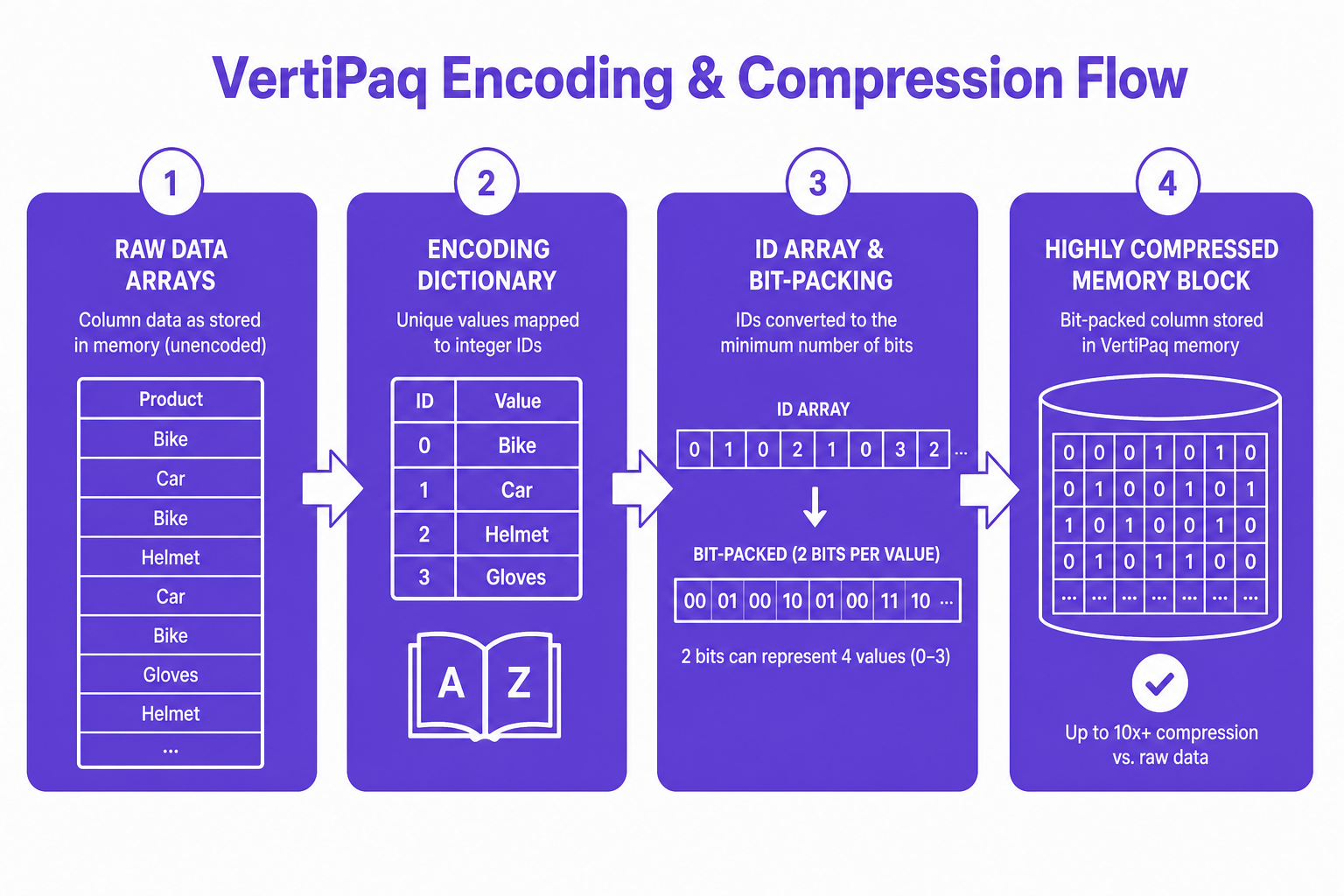
At its core, VertiPaq exploits data repetition and low cardinality (the number of unique values in a column) to compress information. Here is how the process unfolds within a Power BI semantic model:
Dictionary Encoding: Each unique column value is stored once in a dictionary. The table itself references these values using compact integer indexes.
Run-Length and Bit-Packing: Repeated values are encoded as runs instead of literal sequences, while binary storage packs data densely wherever possible.
Redundant Element Elimination: Columns can be dropped, disabled, or hidden if not used in reporting (e.g., via the IsAvailableInMDX property), achieving further memory savings.
Practical stats underscore this efficiency:
A typical 10 GB source table compresses down to just 1 GB in-memory if column cardinality remains moderate or low.
Large enterprise Fabric models often compress 400 GB datasets to as little as 20–40 GB in RAM.
Tuning column properties, such as setting IsAvailableInMDX to False where applicable, can reduce in-memory model size by around 38% and file size by 25%.
Every query, refresh, or data operation within the Power BI service consumes Fabric Capacity Units (CUs). Bloated, poorly compressed semantic models drive up CU utilization, leading to unpredictable cost spikes and, at scale, premium overages. This is especially relevant when organizations run continuous, high-frequency analytics or when autoscale is enabled.
CloudNuro’s Unified Cloud Custodian is purpose-built for this challenge. It ingests granular capacity telemetry, identifies inflated semantic models, and surfaces precisely where compression and optimization actions can cut excess CU spend. Furthermore, CloudNuro’s Chargeback module automatically maps these consumption patterns back to business units, enforcing budget discipline and real accountability for analytics costs.
Organizations seeking both performance and savings must look beyond default model design. The following best practices unlock the potential of VertiPaq while fostering governance and compliance:
Column Pruning: Remove unused columns entirely; evaluate dataset requirements ruthlessly. Each unused field increases memory usage and query latency.
Cardinality Reduction: Replace text keys with integer IDs and avoid high-cardinality DateTime fields. Split DateTime into separate Date and Time columns, drastically shrinking dictionary sizes.
Attribute Hierarchy Optimization: Switch off unused hierarchies and set IsAvailableInMDX to False wherever multidimensional queries are unnecessary. This alone can reduce model size by more than a third.
Segment Row Group Sizing: For Direct Lake models, target 400 MB file sizes and a minimum of 8 million rows per group. Use V-Order sorting for further cold-cache query acceleration and storage efficiency.
Encoding Inspection Using VertiPaq Analyzer: Leverage VertiPaq Analyzer to monitor segment counts, cardinality, and encoding ratios, guiding data engineering teams to continuously tune models in response to usage and growth.
Expert Insight: “Removing unused columns, disabling IsAvailableInMDX wherever strictly unnecessary, and switching text keys to numeric IDs are practical tuning strategies that consistently yield double-digit percentage reductions in memory footprint.”
Enterprise teams using CloudNuro’s FinOps Services realize immediate value:
25%+ reduction in idle capacity and $2.1 million in cost avoidance by automatically rightsizing commit resources.
36% drop in analytics platform spend and a 45% cut in unused capacity hours for global bank deployments using automated F-SKU rightsizing.
Model-level chargeback drives accountability, mapping inflated CU usage caused by suboptimal semantic models back to their actual business sponsors.
Dynamic cost allocation and anomaly alerts prevent runaway spend when new or changing report models threaten budgets.
CloudNuro empowers IT and finance leaders to make evidence-based decisions, not just on licenses and seats, but on the true costs of data storage, refresh, and query patterns across Power BI and Microsoft Fabric estates.
VertiPaq Analyzer is the essential tool for dissecting semantic models. Its usage provides multiple competitive advantages:
Visibility into segment size and cardinality: Visualize the memory cost of each column and table.
Spotting inefficiencies and optimizing encoding: Identify columns with unnecessarily high memory consumption due to inappropriate encoding or high cardinality.
Targeting Downsizing Opportunities: Actionable intelligence for model pruning, Direct Lake routing adoption, and property tweaking.
CloudNuro’s automated analyzer integrations bring recommendations into production, not just as dashboards, but as real-time, enforceable policies that keep memory, performance, and CU consumption on target.
What is VertiPaq compression in Power BI?
VertiPaq is the in-memory columnar storage engine in Power BI. It uses advanced encoding and compression to shrink data models, significantly reducing RAM usage and accelerating queries.
How does VertiPaq reduce semantic model size?
VertiPaq exploits data repetition and low cardinality using techniques like dictionary encoding and bit-packing. This can reduce the size of a dataset by 10–20 times relative to its raw format.
What are best practices for Power BI semantic model optimization?
Best practices include pruning unused columns, reducing cardinality (preferably using integer IDs), disabling unnecessary hierarchies and properties, and using tools like VertiPaq Analyzer to guide continuous optimization.
What is the size limit for Power BI semantic models?
In Premium workspaces, semantic models can reach up to 400 GB, but practical usage almost always demands aggressive optimization to remain cost-efficient and performant.
How does VertiPaq Analyzer help in Power BI?
VertiPaq Analyzer provides deep insights into segment structures, column cardinalities, and encoding methods, making it easier to identify bloat and optimize models for both speed and cost.
Optimizing VertiPaq compression is not just a technical tuning process, it is a strategic imperative in managing analytics cost, performance, and compliance across enterprise cloud infrastructure. Shrinking semantic models and aggressively managing CU consumption delivers both financial and operational gains.
CloudNuro’s governance-first, automation-driven FinOps platform arms your teams with telemetry, automation, and policy controls to shrink overhead, enforce cost discipline, and unleash reliable analytics at scale.
Request a demo, get a free savings assessment, or explore why CloudNuro can take your Power BI and Fabric governance to the next level.
About CloudNuro
CloudNuro is a leader in Enterprise AI Adoption Management, providing enterprises with unmatched visibility, governance, and cost optimization. Recognized twice in a row in the SaaS Management Platforms category and named a Leader in the SoftwareReviews Data Quadrant, CloudNuro is trusted by global enterprises and government agencies to bring financial discipline to SaaS, cloud, and AI. Trusted by enterprises, CloudNuro provides centralized SaaS inventory, license optimization, and renewal management along with advanced cost allocation and chargeback, giving IT and Finance leaders the visibility, control, and cost-conscious culture needed to drive financial discipline.
Request a no cost, no obligation free assessment —just 15 minutes to savings!
Get StartedIn the era of enterprise analytics, maximizing the performance and efficiency of your Power BI semantic models is directly tied to your ability to govern costs and scale securely. For CIOs, CTOs, and data architects, understanding the mechanics of VertiPaq compression is essential to delivering fast, cost-effective insights, and to keeping Fabric Capacity Unit (CU) consumption under tight control. This post demystifies the VertiPaq engine, reveals proven optimization techniques, and shows how CloudNuro empowers data leaders to shrink model footprints, reduce costs, and enforce ironclad governance over your Power BI and Microsoft Fabric environments.
VertiPaq is the in-memory columnar storage engine that powers high-performance semantic models in Power BI, Analysis Services, and Microsoft Fabric. Unlike traditional row-based storage, VertiPaq encodes each column independently, performing aggressive data compression and optimization. The engine leverages techniques such as dictionary encoding, run-length encoding, and value scanning, shrinking source tables dramatically, sometimes by as much as 10 to 20 times compared to the original dataset size. This enables analytics teams to work with massive data models in-memory, drive fast queries, and remain efficient across unpredictable workloads.
The efficiency of the VertiPaq engine not only improves report performance but also plays a critical role in managing the expensive CU allocations and premium bursting characteristic of modern cloud analytics platforms.
At its core, VertiPaq exploits data repetition and low cardinality (the number of unique values in a column) to compress information. Here is how the process unfolds within a Power BI semantic model:
Dictionary Encoding: Each unique column value is stored once in a dictionary. The table itself references these values using compact integer indexes.
Run-Length and Bit-Packing: Repeated values are encoded as runs instead of literal sequences, while binary storage packs data densely wherever possible.
Redundant Element Elimination: Columns can be dropped, disabled, or hidden if not used in reporting (e.g., via the IsAvailableInMDX property), achieving further memory savings.
Practical stats underscore this efficiency:
A typical 10 GB source table compresses down to just 1 GB in-memory if column cardinality remains moderate or low.
Large enterprise Fabric models often compress 400 GB datasets to as little as 20–40 GB in RAM.
Tuning column properties, such as setting IsAvailableInMDX to False where applicable, can reduce in-memory model size by around 38% and file size by 25%.
Every query, refresh, or data operation within the Power BI service consumes Fabric Capacity Units (CUs). Bloated, poorly compressed semantic models drive up CU utilization, leading to unpredictable cost spikes and, at scale, premium overages. This is especially relevant when organizations run continuous, high-frequency analytics or when autoscale is enabled.
CloudNuro’s Unified Cloud Custodian is purpose-built for this challenge. It ingests granular capacity telemetry, identifies inflated semantic models, and surfaces precisely where compression and optimization actions can cut excess CU spend. Furthermore, CloudNuro’s Chargeback module automatically maps these consumption patterns back to business units, enforcing budget discipline and real accountability for analytics costs.
Organizations seeking both performance and savings must look beyond default model design. The following best practices unlock the potential of VertiPaq while fostering governance and compliance:
Column Pruning: Remove unused columns entirely; evaluate dataset requirements ruthlessly. Each unused field increases memory usage and query latency.
Cardinality Reduction: Replace text keys with integer IDs and avoid high-cardinality DateTime fields. Split DateTime into separate Date and Time columns, drastically shrinking dictionary sizes.
Attribute Hierarchy Optimization: Switch off unused hierarchies and set IsAvailableInMDX to False wherever multidimensional queries are unnecessary. This alone can reduce model size by more than a third.
Segment Row Group Sizing: For Direct Lake models, target 400 MB file sizes and a minimum of 8 million rows per group. Use V-Order sorting for further cold-cache query acceleration and storage efficiency.
Encoding Inspection Using VertiPaq Analyzer: Leverage VertiPaq Analyzer to monitor segment counts, cardinality, and encoding ratios, guiding data engineering teams to continuously tune models in response to usage and growth.
Expert Insight: “Removing unused columns, disabling IsAvailableInMDX wherever strictly unnecessary, and switching text keys to numeric IDs are practical tuning strategies that consistently yield double-digit percentage reductions in memory footprint.”
Enterprise teams using CloudNuro’s FinOps Services realize immediate value:
25%+ reduction in idle capacity and $2.1 million in cost avoidance by automatically rightsizing commit resources.
36% drop in analytics platform spend and a 45% cut in unused capacity hours for global bank deployments using automated F-SKU rightsizing.
Model-level chargeback drives accountability, mapping inflated CU usage caused by suboptimal semantic models back to their actual business sponsors.
Dynamic cost allocation and anomaly alerts prevent runaway spend when new or changing report models threaten budgets.
CloudNuro empowers IT and finance leaders to make evidence-based decisions, not just on licenses and seats, but on the true costs of data storage, refresh, and query patterns across Power BI and Microsoft Fabric estates.
VertiPaq Analyzer is the essential tool for dissecting semantic models. Its usage provides multiple competitive advantages:
Visibility into segment size and cardinality: Visualize the memory cost of each column and table.
Spotting inefficiencies and optimizing encoding: Identify columns with unnecessarily high memory consumption due to inappropriate encoding or high cardinality.
Targeting Downsizing Opportunities: Actionable intelligence for model pruning, Direct Lake routing adoption, and property tweaking.
CloudNuro’s automated analyzer integrations bring recommendations into production, not just as dashboards, but as real-time, enforceable policies that keep memory, performance, and CU consumption on target.
What is VertiPaq compression in Power BI?
VertiPaq is the in-memory columnar storage engine in Power BI. It uses advanced encoding and compression to shrink data models, significantly reducing RAM usage and accelerating queries.
How does VertiPaq reduce semantic model size?
VertiPaq exploits data repetition and low cardinality using techniques like dictionary encoding and bit-packing. This can reduce the size of a dataset by 10–20 times relative to its raw format.
What are best practices for Power BI semantic model optimization?
Best practices include pruning unused columns, reducing cardinality (preferably using integer IDs), disabling unnecessary hierarchies and properties, and using tools like VertiPaq Analyzer to guide continuous optimization.
What is the size limit for Power BI semantic models?
In Premium workspaces, semantic models can reach up to 400 GB, but practical usage almost always demands aggressive optimization to remain cost-efficient and performant.
How does VertiPaq Analyzer help in Power BI?
VertiPaq Analyzer provides deep insights into segment structures, column cardinalities, and encoding methods, making it easier to identify bloat and optimize models for both speed and cost.
Optimizing VertiPaq compression is not just a technical tuning process, it is a strategic imperative in managing analytics cost, performance, and compliance across enterprise cloud infrastructure. Shrinking semantic models and aggressively managing CU consumption delivers both financial and operational gains.
CloudNuro’s governance-first, automation-driven FinOps platform arms your teams with telemetry, automation, and policy controls to shrink overhead, enforce cost discipline, and unleash reliable analytics at scale.
Request a demo, get a free savings assessment, or explore why CloudNuro can take your Power BI and Fabric governance to the next level.
About CloudNuro
CloudNuro is a leader in Enterprise AI Adoption Management, providing enterprises with unmatched visibility, governance, and cost optimization. Recognized twice in a row in the SaaS Management Platforms category and named a Leader in the SoftwareReviews Data Quadrant, CloudNuro is trusted by global enterprises and government agencies to bring financial discipline to SaaS, cloud, and AI. Trusted by enterprises, CloudNuro provides centralized SaaS inventory, license optimization, and renewal management along with advanced cost allocation and chargeback, giving IT and Finance leaders the visibility, control, and cost-conscious culture needed to drive financial discipline.
Request a no cost, no obligation free assessment - just 15 minutes to savings!
Get StartedWe're offering complimentary ServiceNow license assessments to only 25 enterprises this quarter who want to unlock immediate savings without disrupting operations.
Get Free AssessmentGet Started




CloudNuro Corp
1755 Park St. Suite 207
Naperville, IL 60563
Phone : +1-630-277-9470
Email: info@cloudnuro.com





.webp)

Recognized Leader in SaaS Management Platforms by Info-Tech SoftwareReviews




.svg)