

Sign Up
Thank you for Submitting!
Most IT and finance leaders already know they have a SaaS sprawl problem. What is less obvious is that the standard response, a one-off or annual SaaS audit, barely scratches the surface. By the time a traditional audit is complete, your environment has already changed.
A Forrester 2026 survey found that 78% of enterprises say one-time SaaS audits fail to identify ongoing shadow IT risks and orphaned accounts. This is why continuous SaaS discovery is becoming the new operating model for modern SaaS portfolio management.
This article explains why one-time audits fall short, what continuous discovery looks like in practice, and how real-time SaaS monitoring, automation, and governance can transform your cost, risk, and compliance posture.
On paper, a SaaS audit sounds reassuring. You gather contracts and invoices, reconcile them with IT records, and produce a clean inventory. In reality, that inventory starts aging the moment the audit closes.
Several structural problems limit traditional audits.
New tools are adopted every month, sometimes every week. Teams swipe credit cards to test new apps, marketing launches a new point solution, or a line-of-business leader adds an integration that opens new data paths.
By the time your annual or quarterly review comes around, the picture has shifted. Shadow IT, unapproved sign-ups, and trial accounts have already appeared and sometimes disappeared.
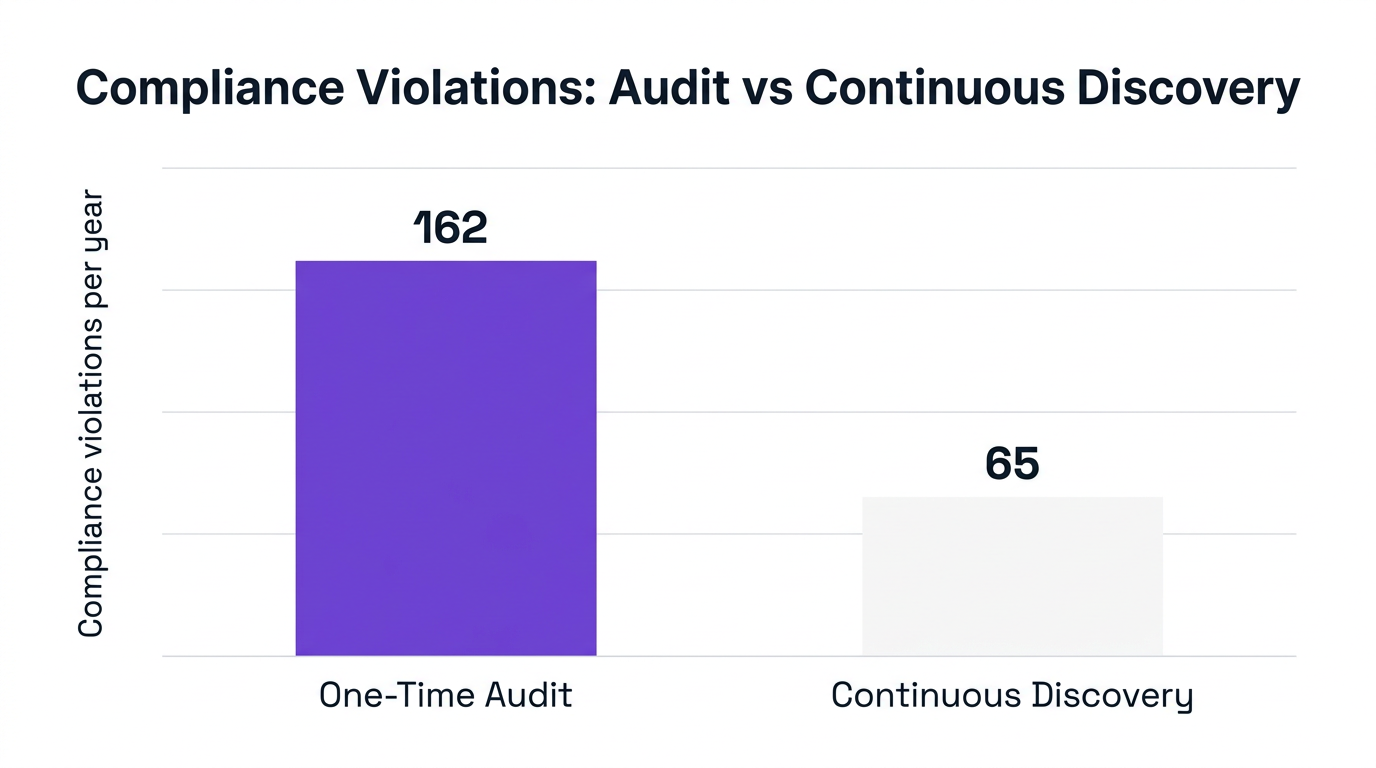
A Gartner 2026 analysis shows that continuous SaaS discovery platforms reduce compliance violations by up to 60% compared with periodic audits. The gap is created by everything that happens in the months between audit events.
Shadow IT rarely presents itself in a spreadsheet. It hides in:
unmanaged sign-ups tied to work email domains
small departmental tools purchased via credit card
free or trial tiers that later collect sensitive data
InfoTech reported in 2026 that 87% of IT leaders cite lack of continuous visibility over SaaS usage as a driver of security blind spots and license waste. A point-in-time review may capture what finance knows about, not what employees are actually using.
Similarly, orphaned accounts appear when employees leave or change roles. Unless you have automated discovery and deprovisioning, accounts can remain active for months after a departure. A static audit might record the license, but it will not spot that no one is actively accountable for it.
One-time SaaS audits usually rely on:
exporting spreadsheets from multiple systems
requesting app lists from department heads
reconciling invoices, expense reports, and IT records
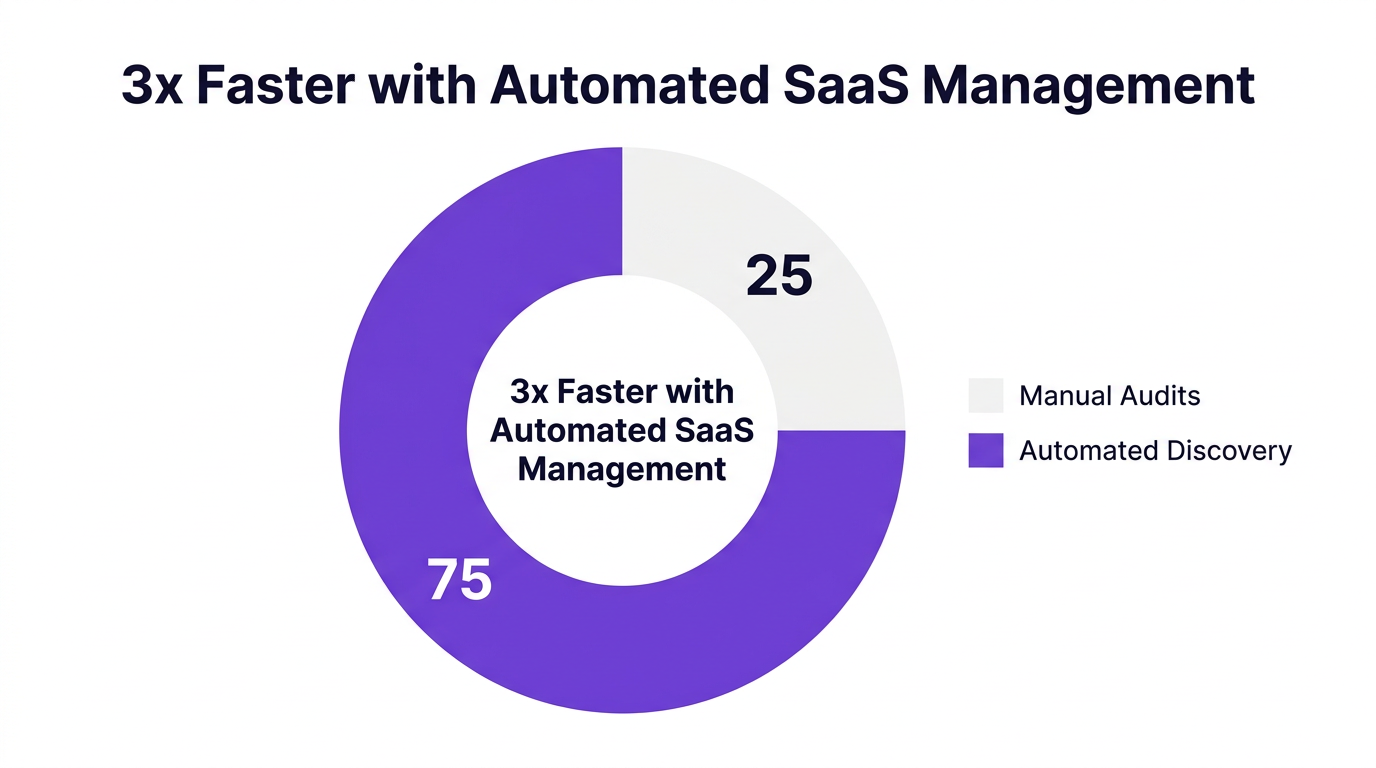
A study by a major consulting firm in 2026 found that companies with automated SaaS management tools enable onboarding and offboarding that is 3 times faster than those using manual audits. Manual processes cannot keep pace with the rate of SaaS change, and human error creeps in as teams copy and reconcile data.
Continuous SaaS discovery is a discipline and technology capability where your SaaS environment is monitored in near real time instead of only during scheduled reviews.
Think of it as moving from an annual health check to continuous vital signs monitoring. A single exam might tell you you are healthy that day. Continuous metrics help you catch issues early, track trends, and intervene before something becomes critical.
In SaaS, continuous discovery combines automated data collection, correlation, and governance workflows.
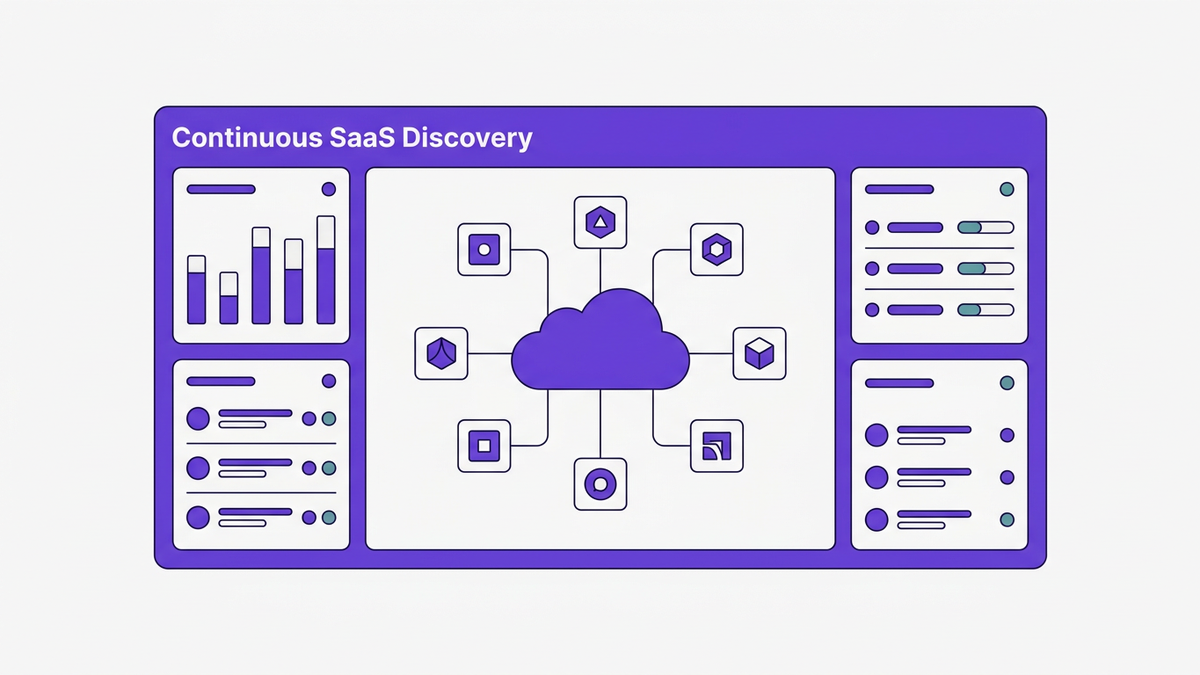
A mature ongoing SaaS discovery practice typically includes:
Real-time SaaS monitoring across identity providers, SSO, CASB logs, finance systems, and network activity. This uncovers new tools as they appear.
A unified SaaS app inventory tool that normalizes and deduplicates applications, creating a single source of truth.
SaaS user access review automation, which continuously evaluates who has access to what, how they are using it, and whether that access is appropriate.
Policy-driven governance for approvals, renewals, security checks, and data access.
Integrated financial and usage insights so that IT, security, and finance can jointly manage value and risk.
With these elements in place, an organization can move from periodic guessing to always-current visibility.
IT and finance teams often ask for a simple "SaaS audit vs continuous discovery" comparison. The difference is not only frequency, it is the operational model.
A useful analogy is photography. A one-time audit is a single snapshot. Continuous SaaS discovery is a video feed.
A snapshot shows you what licenses and contracts exist at a specific moment.
A video shows how applications are adopted, used, and abandoned over time.
The video is what you need for decisions about renewals, security posture, and governance.
1. Coverage of SaaS sprawl
One-time audits often miss:
free tools with work email sign-ups
personal accounts holding company data
workloads that move between tools between audits
Continuous discovery uses a cloud app discovery tool approach, aggregating signals from multiple systems. This makes it far more effective as a shadow IT discovery tool.
2. Governance and compliance outcomes
Gartner 2026 data shows that organizations using continuous discovery cut compliance violations from 162 to 65 per year on average, compared with those relying solely on periodic audits.
With continuous controls, access issues, MFA gaps, or data residency concerns are flagged as they emerge instead of waiting for the next review cycle.
3. Financial impact and SaaS cost optimization
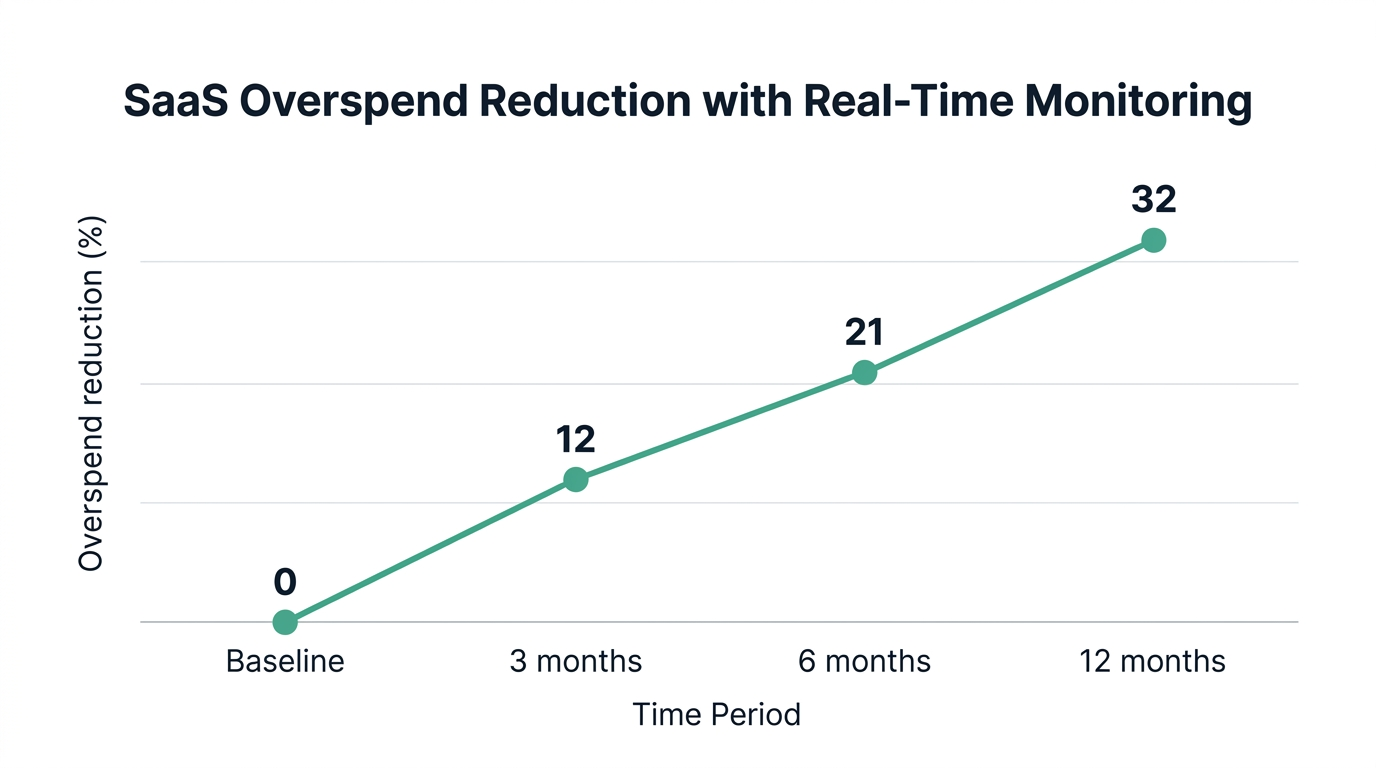
IDC reported in 2026 that organizations using real-time SaaS monitoring reduce average SaaS overspend by 32% in the first year. That level of savings is nearly impossible with a periodic review, because optimization opportunities arise monthly as teams churn through tools and seats.
A modern SaaS optimization platform combines SaaS spend management software capabilities with SaaS portfolio management software insights, so IT and finance can act in weeks, not quarters.
The business case for continuous discovery spans three disciplines: governance, security, and financial performance.
Regulators and auditors increasingly expect organizations to know where data lives, who can access which systems, and how access is controlled.
A Forrester 2026 study found that continuous SaaS discovery platforms significantly improve audit readiness, because inventories and access records are always current. This turns what used to be an ad hoc scramble into a recurring, predictable motion.
From a governance perspective, software asset management for SaaS must be ongoing. License allocations, entitlements, and usage patterns change continuously, so the controls that govern them must also be continuous.
Shadow IT is not only a finance problem. It is a security and compliance risk.
A typical enterprise has employees experimenting with AI tools, collaboration apps, and data connectors. Without real-time app discovery, sensitive information can flow into systems that have never been vetted by security or procurement.
InfoTech 2026 emphasizes that shadow IT is a moving target. Only ongoing SaaS discovery supported by automation can keep up.
McKinsey reported in 2026 that only 21% of finance teams can accurately track SaaS utilization and spend without automated, ongoing discovery. Most rely on high-level GL codes, which hide underutilized licenses and redundant tools.
By connecting a SaaS visibility tool with usage and contract data, organizations can:
identify unused or underused licenses
consolidate overlapping applications
right-size tiers ahead of renewals
This is where SaaS cost optimization tools and SaaS license management software create tangible ROI. They integrate continuous discovery into broader FinOps and chargeback practices.
Knowing that continuous discovery is necessary is one thing. Operationalizing it is another. A practical approach blends automation with clear ownership.
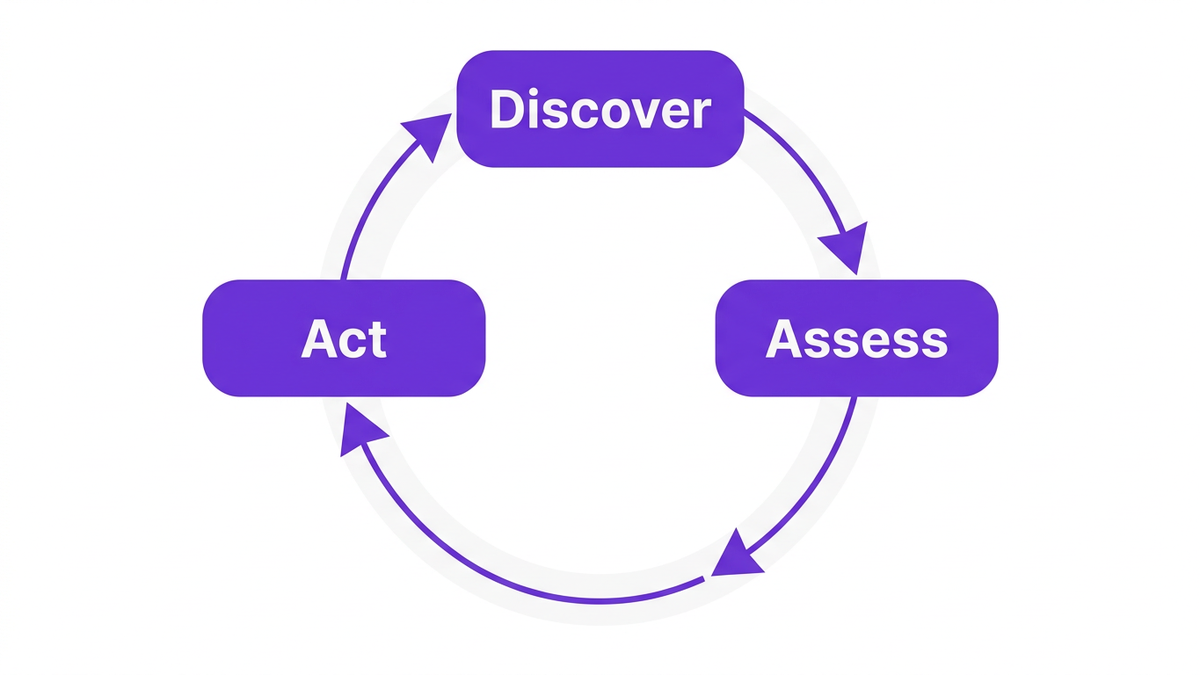
Discover
Continuously ingest data from SSO, directories, CASB logs, card spend, and vendor APIs.
Maintain a normalized catalog through SaaS application discovery software.
Assess
Enrich apps with security posture, data classification, and ownership details.
Run regular SaaS user access reviews and risk scoring.
Evaluate financial metrics such as cost per active user and utilization trends.
Act
Automate approvals, deprovisioning, and license optimization via SaaS management automation.
Trigger workflows for security review, legal checks, or vendor consolidation.
Use SaaS management platform dashboards to track outcomes over time.
Enterprises often start with 365 app discovery because so much collaboration and data movement centers on productivity suites. From there, they expand to CRM, ITSM, HR, marketing, and AI tools.
A robust cloud app discovery tool should:
integrate with core ecosystems such as productivity suites, CRM, and ITSM
cover both sanctioned and unsanctioned apps
feed results into a central SaaS app inventory tool
Over time, continuous discovery becomes part of standard enterprise SaaS management, not an isolated project.
Some leaders argue that their annual or semi-annual SaaS audit is sufficient. The problem is that risk and waste are not annual events.
Access issues, new shadow IT, and unnecessary licenses are created every month. Waiting for the next audit is like ignoring a water leak until the next scheduled building inspection. Real-time SaaS monitoring is what prevents small leaks from becoming floods.
CloudNuro has seen organizations transform their SaaS governance by shifting from periodic audits to continuous discovery.
A Fortune 500 healthcare provider relied on quarterly manual audits to track SaaS usage. Each cycle required weeks of spreadsheet wrangling across IT, security, and finance.
By implementing CloudNuro’s Unified Cloud Custodian and continuous discovery capabilities, the organization:
integrated over 400 SaaS and cloud platforms
automated discovery of new apps and accounts
embedded SaaS audit automation into onboarding and offboarding
Within 9 months, the provider reduced orphaned account risk by 70% and uncovered 2.3 million dollars in annual SaaS overspend, which was reallocated to strategic initiatives.
A global financial services firm struggled to keep access controls aligned with regulatory expectations. Quarterly reviews were always out-of-date by the time they were presented.
Using CloudNuro AI Custodian for real-time monitoring and automated access governance, the firm:
integrated 400 plus applications into a single view
received real-time governance alerts when policies were violated
automated periodic user access reviews and remediation
The result: a 54% drop in access-related compliance violations and a 28% reduction in SaaS spend in a single year.
These examples illustrate how continuous discovery, paired with automation, delivers value across security, compliance, and cost.
CloudNuro is built around a governance-first architecture that treats continuous SaaS discovery as a foundational capability, not an add-on.
CloudNuro’s Unified Cloud Custodian continuously scans integrations with Microsoft 365, Salesforce, ServiceNow, and over 400 SaaS and cloud platforms.
This provides:
complete visibility into sanctioned and unsanctioned apps
up-to-date SaaS app inventory tool views for IT, security, and finance
correlation of usage, contracts, and cost in one SaaS visibility tool
By combining app, user, and spend data, CloudNuro functions as both SaaS portfolio management software and SaaS spend management software.
CloudNuro’s AI Custodian augments discovery with policy-based automation. It enables:
continuous SaaS user access review workflows
detection of orphaned accounts, inactive users, and risky access patterns
monitoring of MFA, administrative privileges, and compliance-specific controls
This is where SaaS management automation removes the manual burden from IT and security teams.
CloudNuro connects continuous discovery to financial and operational outcomes:
automated identification of underused licenses and redundant apps
chargeback and showback capabilities for business units
integration with Finops services and practices for cloud and SaaS together
Organizations can treat CloudNuro as their SaaS optimization platform, consolidating SaaS cost optimization tools and SaaS license management software capabilities in one place.
To explore how CloudNuro supports saas management, IT, finance, and security leaders can also review our broader solutions for it operations and it asset management.
Continuous SaaS discovery is an always-on process for identifying, tracking, and governing all SaaS applications in use across an organization.
It uses integrations, logs, and APIs to build a live inventory, monitor usage, and support security, compliance, and cost optimization decisions.
One-time audits provide only a snapshot of your environment.
They miss shadow IT, orphaned accounts, and usage changes that occur between audit cycles, which is why 78% of enterprises report that periodic audits fail to identify ongoing risks and waste.
Ongoing SaaS discovery keeps your SaaS inventory, access records, and risk assessments current.
This supports better policy enforcement, faster incident response, and stronger audit readiness, since evidence is drawn from continuous data rather than ad hoc spreadsheets.
Unmanaged SaaS sprawl introduces security blind spots, inconsistent access controls, and hidden costs.
It becomes harder to prove compliance, control data locations, and optimize spend, especially when teams adopt tools outside central IT or procurement processes.
Automation connects discovery with action.
It continuously collects data, correlates it across systems, and triggers workflows such as deprovisioning, license reclamation, or security reviews, eliminating the lag between detection and response.
A SaaS audit is a periodic assessment of your SaaS inventory, contracts, and usage.
Continuous discovery is an ongoing capability that monitors apps, users, and spend in near real time, providing more accurate data for security, compliance, and financial decisions.
The evidence is clear: relying on one-time SaaS audits is an expensive form of wishful thinking. Shadow IT, orphaned accounts, and underused licenses emerge continuously, not on a schedule.
By adopting continuous SaaS discovery, enterprises can:
drastically reduce compliance violations and security blind spots
cut SaaS overspend by double-digit percentages within the first year
embed financial discipline into everyday SaaS usage
CloudNuro delivers this ongoing visibility and control through a unified SaaS management platform that combines discovery, governance, and optimization across SaaS, cloud, and AI.
If you are ready to move beyond spreadsheet-based audits and embrace continuous discovery, explore why organizations choose why cloudnuro and review our latest blogs on enterprise SaaS management.
About CloudNuro
CloudNuro is a leader in Enterprise SaaS Management Platforms, providing enterprises with unmatched visibility, governance, and cost optimization. Recognized twice in a row in the SaaS Management Platforms category and named a Leader in the SoftwareReviews Data Quadrant, CloudNuro is trusted by global enterprises and government agencies to bring financial discipline to SaaS, cloud, and AI. Trusted by enterprises such as Konica Minolta and Federal Signal, CloudNuro provides centralized SaaS inventory, license optimization, and renewal management along with advanced cost allocation and chargeback, giving IT and Finance leaders the visibility, control, and cost-conscious culture needed to drive financial discipline.
Request a no cost, no obligation free assessment —just 15 minutes to savings!
Get StartedMost IT and finance leaders already know they have a SaaS sprawl problem. What is less obvious is that the standard response, a one-off or annual SaaS audit, barely scratches the surface. By the time a traditional audit is complete, your environment has already changed.
A Forrester 2026 survey found that 78% of enterprises say one-time SaaS audits fail to identify ongoing shadow IT risks and orphaned accounts. This is why continuous SaaS discovery is becoming the new operating model for modern SaaS portfolio management.
This article explains why one-time audits fall short, what continuous discovery looks like in practice, and how real-time SaaS monitoring, automation, and governance can transform your cost, risk, and compliance posture.
On paper, a SaaS audit sounds reassuring. You gather contracts and invoices, reconcile them with IT records, and produce a clean inventory. In reality, that inventory starts aging the moment the audit closes.
Several structural problems limit traditional audits.
New tools are adopted every month, sometimes every week. Teams swipe credit cards to test new apps, marketing launches a new point solution, or a line-of-business leader adds an integration that opens new data paths.
By the time your annual or quarterly review comes around, the picture has shifted. Shadow IT, unapproved sign-ups, and trial accounts have already appeared and sometimes disappeared.
A Gartner 2026 analysis shows that continuous SaaS discovery platforms reduce compliance violations by up to 60% compared with periodic audits. The gap is created by everything that happens in the months between audit events.
Shadow IT rarely presents itself in a spreadsheet. It hides in:
unmanaged sign-ups tied to work email domains
small departmental tools purchased via credit card
free or trial tiers that later collect sensitive data
InfoTech reported in 2026 that 87% of IT leaders cite lack of continuous visibility over SaaS usage as a driver of security blind spots and license waste. A point-in-time review may capture what finance knows about, not what employees are actually using.
Similarly, orphaned accounts appear when employees leave or change roles. Unless you have automated discovery and deprovisioning, accounts can remain active for months after a departure. A static audit might record the license, but it will not spot that no one is actively accountable for it.
One-time SaaS audits usually rely on:
exporting spreadsheets from multiple systems
requesting app lists from department heads
reconciling invoices, expense reports, and IT records
A study by a major consulting firm in 2026 found that companies with automated SaaS management tools enable onboarding and offboarding that is 3 times faster than those using manual audits. Manual processes cannot keep pace with the rate of SaaS change, and human error creeps in as teams copy and reconcile data.
Continuous SaaS discovery is a discipline and technology capability where your SaaS environment is monitored in near real time instead of only during scheduled reviews.
Think of it as moving from an annual health check to continuous vital signs monitoring. A single exam might tell you you are healthy that day. Continuous metrics help you catch issues early, track trends, and intervene before something becomes critical.
In SaaS, continuous discovery combines automated data collection, correlation, and governance workflows.
A mature ongoing SaaS discovery practice typically includes:
Real-time SaaS monitoring across identity providers, SSO, CASB logs, finance systems, and network activity. This uncovers new tools as they appear.
A unified SaaS app inventory tool that normalizes and deduplicates applications, creating a single source of truth.
SaaS user access review automation, which continuously evaluates who has access to what, how they are using it, and whether that access is appropriate.
Policy-driven governance for approvals, renewals, security checks, and data access.
Integrated financial and usage insights so that IT, security, and finance can jointly manage value and risk.
With these elements in place, an organization can move from periodic guessing to always-current visibility.
IT and finance teams often ask for a simple "SaaS audit vs continuous discovery" comparison. The difference is not only frequency, it is the operational model.
A useful analogy is photography. A one-time audit is a single snapshot. Continuous SaaS discovery is a video feed.
A snapshot shows you what licenses and contracts exist at a specific moment.
A video shows how applications are adopted, used, and abandoned over time.
The video is what you need for decisions about renewals, security posture, and governance.
1. Coverage of SaaS sprawl
One-time audits often miss:
free tools with work email sign-ups
personal accounts holding company data
workloads that move between tools between audits
Continuous discovery uses a cloud app discovery tool approach, aggregating signals from multiple systems. This makes it far more effective as a shadow IT discovery tool.
2. Governance and compliance outcomes
Gartner 2026 data shows that organizations using continuous discovery cut compliance violations from 162 to 65 per year on average, compared with those relying solely on periodic audits.
With continuous controls, access issues, MFA gaps, or data residency concerns are flagged as they emerge instead of waiting for the next review cycle.
3. Financial impact and SaaS cost optimization
IDC reported in 2026 that organizations using real-time SaaS monitoring reduce average SaaS overspend by 32% in the first year. That level of savings is nearly impossible with a periodic review, because optimization opportunities arise monthly as teams churn through tools and seats.
A modern SaaS optimization platform combines SaaS spend management software capabilities with SaaS portfolio management software insights, so IT and finance can act in weeks, not quarters.
The business case for continuous discovery spans three disciplines: governance, security, and financial performance.
Regulators and auditors increasingly expect organizations to know where data lives, who can access which systems, and how access is controlled.
A Forrester 2026 study found that continuous SaaS discovery platforms significantly improve audit readiness, because inventories and access records are always current. This turns what used to be an ad hoc scramble into a recurring, predictable motion.
From a governance perspective, software asset management for SaaS must be ongoing. License allocations, entitlements, and usage patterns change continuously, so the controls that govern them must also be continuous.
Shadow IT is not only a finance problem. It is a security and compliance risk.
A typical enterprise has employees experimenting with AI tools, collaboration apps, and data connectors. Without real-time app discovery, sensitive information can flow into systems that have never been vetted by security or procurement.
InfoTech 2026 emphasizes that shadow IT is a moving target. Only ongoing SaaS discovery supported by automation can keep up.
McKinsey reported in 2026 that only 21% of finance teams can accurately track SaaS utilization and spend without automated, ongoing discovery. Most rely on high-level GL codes, which hide underutilized licenses and redundant tools.
By connecting a SaaS visibility tool with usage and contract data, organizations can:
identify unused or underused licenses
consolidate overlapping applications
right-size tiers ahead of renewals
This is where SaaS cost optimization tools and SaaS license management software create tangible ROI. They integrate continuous discovery into broader FinOps and chargeback practices.
Knowing that continuous discovery is necessary is one thing. Operationalizing it is another. A practical approach blends automation with clear ownership.
Discover
Continuously ingest data from SSO, directories, CASB logs, card spend, and vendor APIs.
Maintain a normalized catalog through SaaS application discovery software.
Assess
Enrich apps with security posture, data classification, and ownership details.
Run regular SaaS user access reviews and risk scoring.
Evaluate financial metrics such as cost per active user and utilization trends.
Act
Automate approvals, deprovisioning, and license optimization via SaaS management automation.
Trigger workflows for security review, legal checks, or vendor consolidation.
Use SaaS management platform dashboards to track outcomes over time.
Enterprises often start with 365 app discovery because so much collaboration and data movement centers on productivity suites. From there, they expand to CRM, ITSM, HR, marketing, and AI tools.
A robust cloud app discovery tool should:
integrate with core ecosystems such as productivity suites, CRM, and ITSM
cover both sanctioned and unsanctioned apps
feed results into a central SaaS app inventory tool
Over time, continuous discovery becomes part of standard enterprise SaaS management, not an isolated project.
Some leaders argue that their annual or semi-annual SaaS audit is sufficient. The problem is that risk and waste are not annual events.
Access issues, new shadow IT, and unnecessary licenses are created every month. Waiting for the next audit is like ignoring a water leak until the next scheduled building inspection. Real-time SaaS monitoring is what prevents small leaks from becoming floods.
CloudNuro has seen organizations transform their SaaS governance by shifting from periodic audits to continuous discovery.
A Fortune 500 healthcare provider relied on quarterly manual audits to track SaaS usage. Each cycle required weeks of spreadsheet wrangling across IT, security, and finance.
By implementing CloudNuro’s Unified Cloud Custodian and continuous discovery capabilities, the organization:
integrated over 400 SaaS and cloud platforms
automated discovery of new apps and accounts
embedded SaaS audit automation into onboarding and offboarding
Within 9 months, the provider reduced orphaned account risk by 70% and uncovered 2.3 million dollars in annual SaaS overspend, which was reallocated to strategic initiatives.
A global financial services firm struggled to keep access controls aligned with regulatory expectations. Quarterly reviews were always out-of-date by the time they were presented.
Using CloudNuro AI Custodian for real-time monitoring and automated access governance, the firm:
integrated 400 plus applications into a single view
received real-time governance alerts when policies were violated
automated periodic user access reviews and remediation
The result: a 54% drop in access-related compliance violations and a 28% reduction in SaaS spend in a single year.
These examples illustrate how continuous discovery, paired with automation, delivers value across security, compliance, and cost.
CloudNuro is built around a governance-first architecture that treats continuous SaaS discovery as a foundational capability, not an add-on.
CloudNuro’s Unified Cloud Custodian continuously scans integrations with Microsoft 365, Salesforce, ServiceNow, and over 400 SaaS and cloud platforms.
This provides:
complete visibility into sanctioned and unsanctioned apps
up-to-date SaaS app inventory tool views for IT, security, and finance
correlation of usage, contracts, and cost in one SaaS visibility tool
By combining app, user, and spend data, CloudNuro functions as both SaaS portfolio management software and SaaS spend management software.
CloudNuro’s AI Custodian augments discovery with policy-based automation. It enables:
continuous SaaS user access review workflows
detection of orphaned accounts, inactive users, and risky access patterns
monitoring of MFA, administrative privileges, and compliance-specific controls
This is where SaaS management automation removes the manual burden from IT and security teams.
CloudNuro connects continuous discovery to financial and operational outcomes:
automated identification of underused licenses and redundant apps
chargeback and showback capabilities for business units
integration with Finops services and practices for cloud and SaaS together
Organizations can treat CloudNuro as their SaaS optimization platform, consolidating SaaS cost optimization tools and SaaS license management software capabilities in one place.
To explore how CloudNuro supports saas management, IT, finance, and security leaders can also review our broader solutions for it operations and it asset management.
Continuous SaaS discovery is an always-on process for identifying, tracking, and governing all SaaS applications in use across an organization.
It uses integrations, logs, and APIs to build a live inventory, monitor usage, and support security, compliance, and cost optimization decisions.
One-time audits provide only a snapshot of your environment.
They miss shadow IT, orphaned accounts, and usage changes that occur between audit cycles, which is why 78% of enterprises report that periodic audits fail to identify ongoing risks and waste.
Ongoing SaaS discovery keeps your SaaS inventory, access records, and risk assessments current.
This supports better policy enforcement, faster incident response, and stronger audit readiness, since evidence is drawn from continuous data rather than ad hoc spreadsheets.
Unmanaged SaaS sprawl introduces security blind spots, inconsistent access controls, and hidden costs.
It becomes harder to prove compliance, control data locations, and optimize spend, especially when teams adopt tools outside central IT or procurement processes.
Automation connects discovery with action.
It continuously collects data, correlates it across systems, and triggers workflows such as deprovisioning, license reclamation, or security reviews, eliminating the lag between detection and response.
A SaaS audit is a periodic assessment of your SaaS inventory, contracts, and usage.
Continuous discovery is an ongoing capability that monitors apps, users, and spend in near real time, providing more accurate data for security, compliance, and financial decisions.
The evidence is clear: relying on one-time SaaS audits is an expensive form of wishful thinking. Shadow IT, orphaned accounts, and underused licenses emerge continuously, not on a schedule.
By adopting continuous SaaS discovery, enterprises can:
drastically reduce compliance violations and security blind spots
cut SaaS overspend by double-digit percentages within the first year
embed financial discipline into everyday SaaS usage
CloudNuro delivers this ongoing visibility and control through a unified SaaS management platform that combines discovery, governance, and optimization across SaaS, cloud, and AI.
If you are ready to move beyond spreadsheet-based audits and embrace continuous discovery, explore why organizations choose why cloudnuro and review our latest blogs on enterprise SaaS management.
About CloudNuro
CloudNuro is a leader in Enterprise SaaS Management Platforms, providing enterprises with unmatched visibility, governance, and cost optimization. Recognized twice in a row in the SaaS Management Platforms category and named a Leader in the SoftwareReviews Data Quadrant, CloudNuro is trusted by global enterprises and government agencies to bring financial discipline to SaaS, cloud, and AI. Trusted by enterprises such as Konica Minolta and Federal Signal, CloudNuro provides centralized SaaS inventory, license optimization, and renewal management along with advanced cost allocation and chargeback, giving IT and Finance leaders the visibility, control, and cost-conscious culture needed to drive financial discipline.
Request a no cost, no obligation free assessment - just 15 minutes to savings!
Get StartedWe're offering complimentary ServiceNow license assessments to only 25 enterprises this quarter who want to unlock immediate savings without disrupting operations.
Get Free AssessmentGet Started




CloudNuro Corp
1755 Park St. Suite 207
Naperville, IL 60563
Phone : +1-630-277-9470
Email: info@cloudnuro.com





.webp)

Recognized Leader in SaaS Management Platforms by Info-Tech SoftwareReviews


%20Solutions%20in%20Zero%20Trust%20Model.png)

.svg)