

Sign Up
Thank you for Submitting!
AI is embedded in almost every enterprise technology decision, from SaaS workflows to cloud orchestration. Yet most Fortune 1000 CIOs still cannot answer a basic board question with precision: How efficient is our AI portfolio as a whole? That is the gap an AI Efficiency Score is designed to fill.
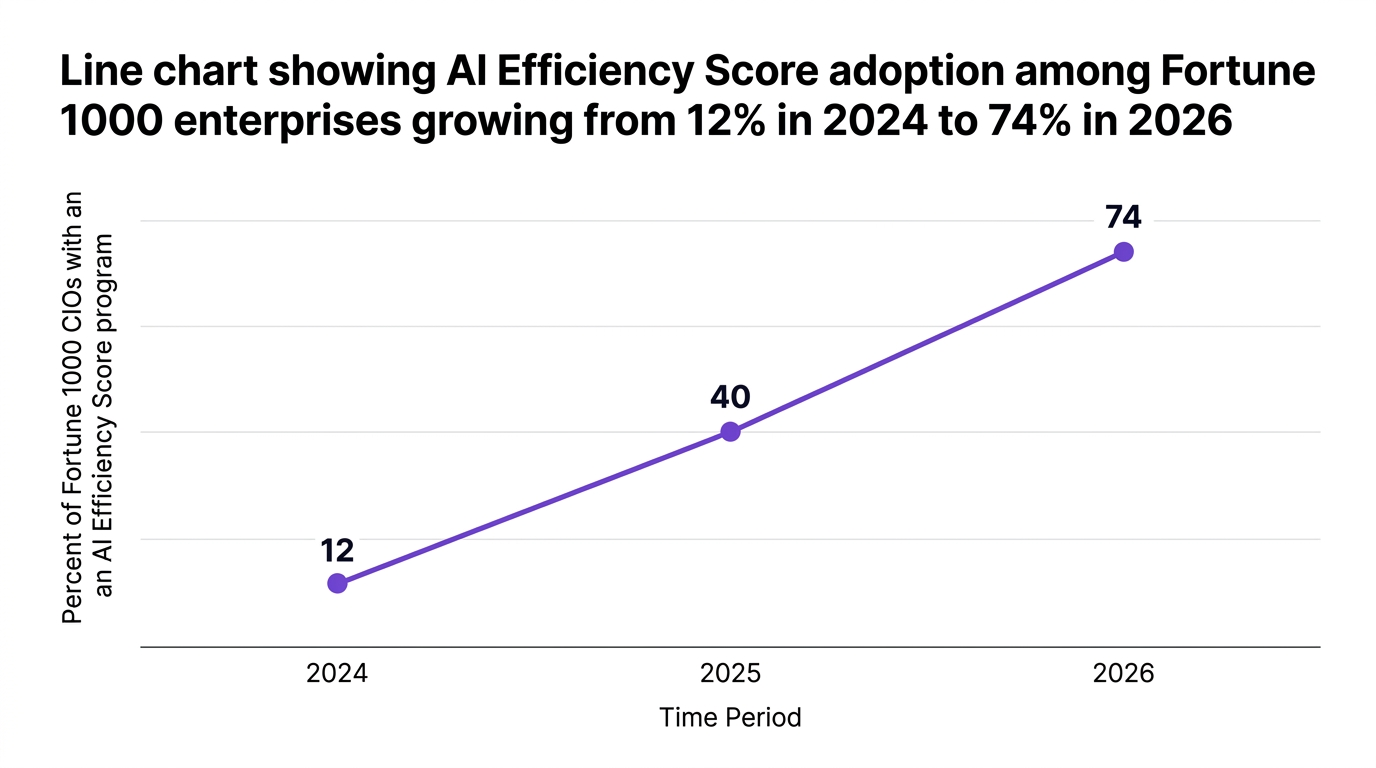
According to Gartner in 2026, 74% of Fortune 1000 CIOs plan to adopt an AI efficiency score as a key metric in their transformation roadmaps, but only 29% currently have one in place, per McKinsey in 2026. This disconnect is creating risk, wasted spend, and stalled governance.
This article defines what an AI Efficiency Score is, why it matters, how to construct it, and how platforms like CloudNuro operationalize it across SaaS and cloud.
At its core, an AI Efficiency Score is a composite KPI that quantifies how effectively AI capabilities convert cost into secure, compliant, and productive outcomes.
Think of it as the AI equivalent of a credit score for your technology estate: a single number that encapsulates complex behavior, risk, and performance across dozens or hundreds of AI-enabled services.
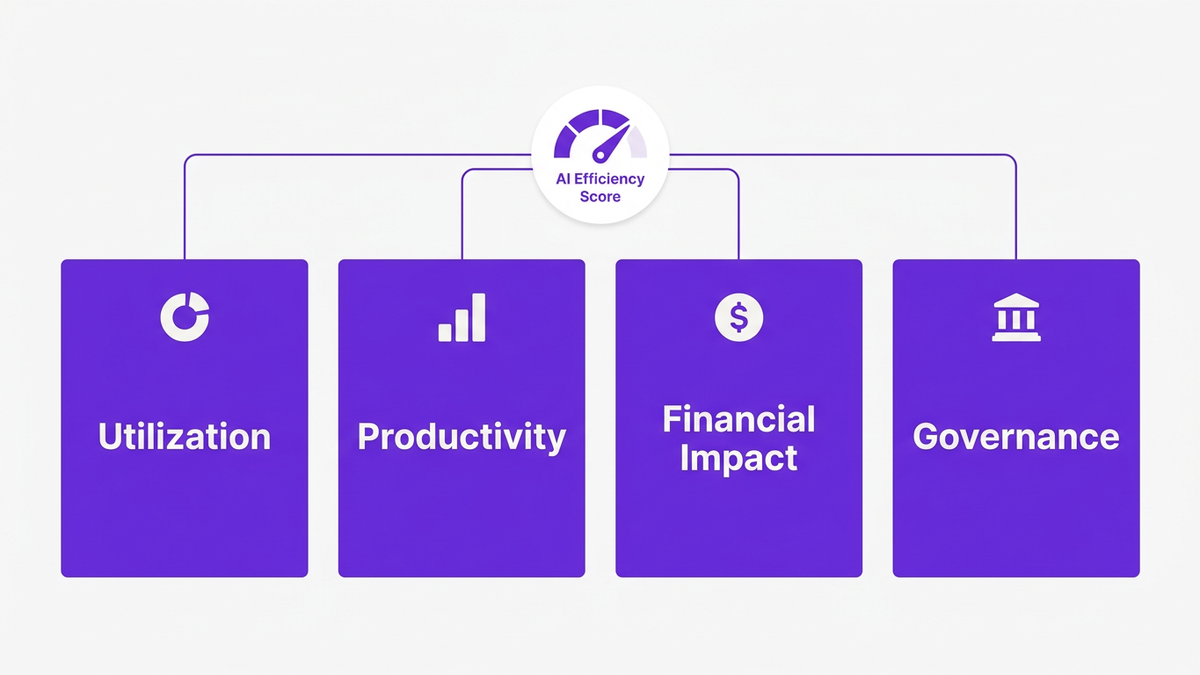
An effective AI Efficiency Score typically blends four dimensions:
For CIOs, this KPI matters for three reasons:
Gartner in 2026 notes that standardized AI efficiency scoring will become as indispensable as uptime and cost metrics. Without it, AI investments drift and efficiency erodes.
AI is no longer a sidecar feature in SaaS contracts. It is increasingly the price driver for enterprise licensing, seat types, and add-on bundles.
IDC reported in 2026 that 67% of organizations say measuring AI operational efficiency directly impacts SaaS and cloud budget approvals. In parallel, Gartner estimates that 22% of projected SaaS savings for Fortune 1000 enterprises in 2026 are contingent on accurate AI-driven efficiency assessments.

This shift creates a new pattern in CIO decision making:
However, Forrester in 2026 finds that 58% of enterprises cite lack of standardized AI efficiency benchmarks as a primary barrier to optimizing AI spend. The result is a patchwork of local KPIs, manual spreadsheets, and inconsistent reporting.
AI efficiency is not only about cost and output. It is inseparable from SaaS governance and security.
When AI features in collaboration, CRM, ITSM, or HR tools touch sensitive data, your AI Efficiency Score must factor:
A high enterprise efficiency score that ignores these controls is misleading. It can mask regulatory exposure and inflate perceived ROI.
Most CIOs already track AI ROI metrics in isolation. The challenge is to convert these into a single AI productivity score that is consistent across the portfolio.
CloudNuro recommends a 4-pillar framework, expressed as a weighted index from 0 to 100.
This pillar measures who is using AI and how often.
Key metrics:
This is where saas usage analytics are critical. You need to distinguish between vanity exposure to AI and recurring, embedded usage that drives value.
When this fails: Many enterprises count “enabled” users instead of “active” AI users, which inflates perceived utilization and distorts the AI efficiency metric.
This pillar answers the question: What did AI actually change in the work?
Examples of outcome metrics:
According to Everest Group in 2026, enterprises that implemented structured AI Efficiency Score frameworks reported a 21% increase in AI ROI in the first year, largely due to better measurement of these outcome metrics.
A practical tactic is to pilot AI on a well-defined workflow and treat each pre-AI baseline as a “control group” for ongoing comparison.
This is where it cost optimization with AI links to your financial KPIs.
Metrics to consider:
A leading financial services enterprise documented a 24% reduction in SaaS licensing costs in 12 months after implementing an AI Efficiency Score framework with an enterprise SaaS management tool. The key driver was precise identification of low-value licenses where AI features were never used.
This pillar prevents high efficiency from masking high risk.
Representative metrics:
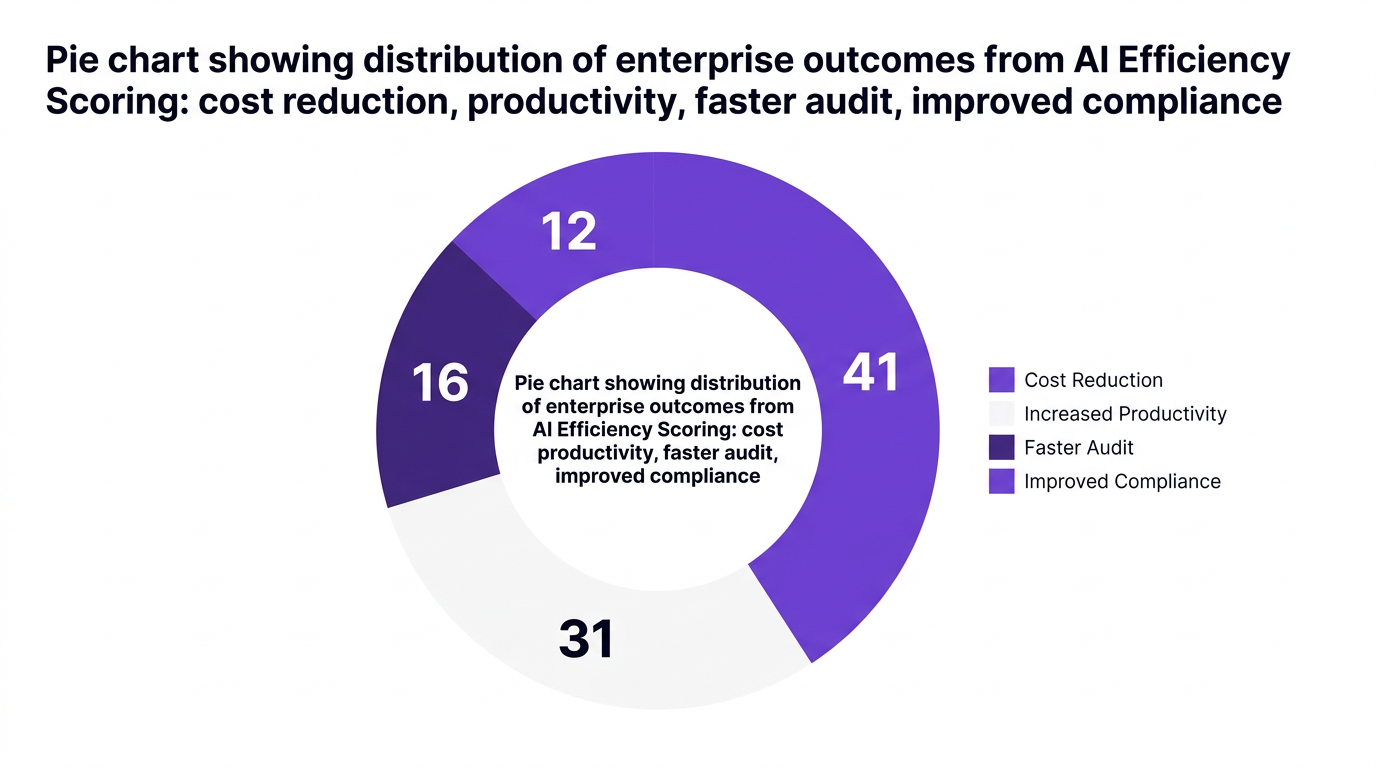
A global healthcare conglomerate that implemented role-based AI usage analytics and compliance scoring increased productive AI usage by 31% and reduced audit preparation time by 38%, according to Forrester in 2026. Their AI Efficiency Score blended these governance gains with productivity indicators.
Defining an ai efficiency scoring framework is only the first step. The harder work is turning it into a management discipline.
Here is a practical, five-step playbook CIOs can use.
Start with a full SaaS and AI inventory.
You need to know:
This is typically impossible with spreadsheets. An enterprise SaaS management platform with automatic discovery is the only scalable approach.
For each application or AI workflow, link usage to a business process.
Examples:
This mapping ensures your ai operational efficiency score reflects outcomes, not just activity.
Next, you standardize disparate metrics into a single AI Efficiency Score per app, department, and region.
A simple approach:
This creates a saas efficiency score that is easy to compare across the portfolio.
The AI Efficiency Score becomes meaningful when it influences decisions.
Example governance rules:
This is how you optimize saas spend and keep AI investments aligned with corporate risk appetite.
Finally, integrate the AI Efficiency Score into regular reporting cycles.
Best practices:
Automation is essential. Manual KPI assembly does not scale for a dynamic SaaS portfolio.
CloudNuro is built for CIOs who need a consistent ai efficiency metric across hundreds of SaaS and cloud services.
Its architecture combines SaaS discovery, usage analytics, cost optimization, and compliance monitoring into a single ai-powered saas management fabric that directly supports AI efficiency scoring.
CloudNuro’s Usage Analytics module provides granular insights into AI-related behavior inside each SaaS application.
CIOs can see:
This enables a precise AI utilization pillar and reveals where to reduce saas spend by retiring unused AI add-ons or reshaping license tiers.
CloudNuro’s Cost Optimization dashboards quantify the financial impact of AI across vendor ecosystems.
They connect AI usage to:
This is how CIOs convert abstract ai productivity score improvements into concrete savings and improved unit economics.
For a deeper view of these capabilities, see the CloudNuro product overview.
CloudNuro’s governance architecture ensures the AI Efficiency Score fully reflects security and compliance posture.
Capabilities include:
These indicators feed directly into the governance pillar of the AI Efficiency Score. That helps IT and security teams operationalize saas governance and security without sacrificing speed.
Security leaders can explore more in CloudNuro’s dedicated IT security solutions.
A score is only useful if the right people see it in the right context.
CloudNuro provides role-specific views:
This creates a common AI Efficiency Score language across the executive table.
Some leaders argue that existing metrics already cover AI.
Common objections include:
These concerns are valid, but incomplete.
Project ROI is often backward-looking and localized. It cannot answer questions such as:
An ai-powered efficiency rating that spans all AI workloads provides exactly this portfolio-level view.
Vendor usage reports are useful, but they are inherently siloed and often biased toward success stories.
CIOs need an independent ai efficiency benchmark that normalizes data across vendors and incorporates internal indicators such as compliance and risk. Without this, it is difficult to improve saas roi in a disciplined way.
An AI Efficiency Score is a composite KPI, usually on a 0 to 100 scale, that measures how effectively AI investments convert cost into secure, compliant, and productive outcomes across your SaaS and cloud portfolio.
It aggregates metrics across utilization, productivity, financial impact, and governance into a single, comparable number.
Traditional ROI focuses mainly on financial returns for a specific project.
An AI Efficiency Score is broader and ongoing. It includes usage behavior, operational efficiency with AI, risk and compliance status, and financial performance, which makes it suitable for portfolio-level decisions.
You need usage analytics at the feature level, cost and licensing data, workflow or outcome metrics, and governance indicators such as MFA coverage and audit readiness.
This typically requires an integrated saas operations management or saas portfolio management platform that can consolidate data and compute scores automatically.
Most enterprises benefit from monthly updates at the application and department level, with quarterly rollups for board and executive reporting.
During major AI rollouts or restructurings, weekly monitoring for specific use cases can help catch adoption or compliance issues early.
Smaller organizations can absolutely benefit, but the complexity is highest in Fortune 1000 environments with large SaaS portfolios and strict regulatory demands.
For smaller firms, the framework can be simplified to a lighter ai efficiency metric focused on utilization and financial impact.
CloudNuro is a leader in Enterprise SaaS Management Platforms, providing enterprises with unmatched visibility, governance, and cost optimization. Recognized twice in a row in the SaaS Management Platforms category and named a Leader in the SoftwareReviews Data Quadrant, CloudNuro is trusted by global enterprises and government agencies to bring financial discipline to SaaS, cloud, and AI. Trusted by enterprises such as Konica Minolta and Federal Signal, CloudNuro provides centralized SaaS inventory, license optimization, and renewal management along with advanced cost allocation and chargeback, giving IT and Finance leaders the visibility, control, and cost-conscious culture needed to drive financial discipline. Request a Demo | Get Free Savings | Explore Product Request a Demo Get Free Savings Explore Product
Request a no cost, no obligation free assessment —just 15 minutes to savings!
Get StartedAI is embedded in almost every enterprise technology decision, from SaaS workflows to cloud orchestration. Yet most Fortune 1000 CIOs still cannot answer a basic board question with precision: How efficient is our AI portfolio as a whole? That is the gap an AI Efficiency Score is designed to fill.
According to Gartner in 2026, 74% of Fortune 1000 CIOs plan to adopt an AI efficiency score as a key metric in their transformation roadmaps, but only 29% currently have one in place, per McKinsey in 2026. This disconnect is creating risk, wasted spend, and stalled governance.
This article defines what an AI Efficiency Score is, why it matters, how to construct it, and how platforms like CloudNuro operationalize it across SaaS and cloud.
At its core, an AI Efficiency Score is a composite KPI that quantifies how effectively AI capabilities convert cost into secure, compliant, and productive outcomes.
Think of it as the AI equivalent of a credit score for your technology estate: a single number that encapsulates complex behavior, risk, and performance across dozens or hundreds of AI-enabled services.
An effective AI Efficiency Score typically blends four dimensions:
For CIOs, this KPI matters for three reasons:
Gartner in 2026 notes that standardized AI efficiency scoring will become as indispensable as uptime and cost metrics. Without it, AI investments drift and efficiency erodes.
AI is no longer a sidecar feature in SaaS contracts. It is increasingly the price driver for enterprise licensing, seat types, and add-on bundles.
IDC reported in 2026 that 67% of organizations say measuring AI operational efficiency directly impacts SaaS and cloud budget approvals. In parallel, Gartner estimates that 22% of projected SaaS savings for Fortune 1000 enterprises in 2026 are contingent on accurate AI-driven efficiency assessments.
This shift creates a new pattern in CIO decision making:
However, Forrester in 2026 finds that 58% of enterprises cite lack of standardized AI efficiency benchmarks as a primary barrier to optimizing AI spend. The result is a patchwork of local KPIs, manual spreadsheets, and inconsistent reporting.
AI efficiency is not only about cost and output. It is inseparable from SaaS governance and security.
When AI features in collaboration, CRM, ITSM, or HR tools touch sensitive data, your AI Efficiency Score must factor:
A high enterprise efficiency score that ignores these controls is misleading. It can mask regulatory exposure and inflate perceived ROI.
Most CIOs already track AI ROI metrics in isolation. The challenge is to convert these into a single AI productivity score that is consistent across the portfolio.
CloudNuro recommends a 4-pillar framework, expressed as a weighted index from 0 to 100.
This pillar measures who is using AI and how often.
Key metrics:
This is where saas usage analytics are critical. You need to distinguish between vanity exposure to AI and recurring, embedded usage that drives value.
When this fails: Many enterprises count “enabled” users instead of “active” AI users, which inflates perceived utilization and distorts the AI efficiency metric.
This pillar answers the question: What did AI actually change in the work?
Examples of outcome metrics:
According to Everest Group in 2026, enterprises that implemented structured AI Efficiency Score frameworks reported a 21% increase in AI ROI in the first year, largely due to better measurement of these outcome metrics.
A practical tactic is to pilot AI on a well-defined workflow and treat each pre-AI baseline as a “control group” for ongoing comparison.
This is where it cost optimization with AI links to your financial KPIs.
Metrics to consider:
A leading financial services enterprise documented a 24% reduction in SaaS licensing costs in 12 months after implementing an AI Efficiency Score framework with an enterprise SaaS management tool. The key driver was precise identification of low-value licenses where AI features were never used.
This pillar prevents high efficiency from masking high risk.
Representative metrics:
A global healthcare conglomerate that implemented role-based AI usage analytics and compliance scoring increased productive AI usage by 31% and reduced audit preparation time by 38%, according to Forrester in 2026. Their AI Efficiency Score blended these governance gains with productivity indicators.
Defining an ai efficiency scoring framework is only the first step. The harder work is turning it into a management discipline.
Here is a practical, five-step playbook CIOs can use.
Start with a full SaaS and AI inventory.
You need to know:
This is typically impossible with spreadsheets. An enterprise SaaS management platform with automatic discovery is the only scalable approach.
For each application or AI workflow, link usage to a business process.
Examples:
This mapping ensures your ai operational efficiency score reflects outcomes, not just activity.
Next, you standardize disparate metrics into a single AI Efficiency Score per app, department, and region.
A simple approach:
This creates a saas efficiency score that is easy to compare across the portfolio.
The AI Efficiency Score becomes meaningful when it influences decisions.
Example governance rules:
This is how you optimize saas spend and keep AI investments aligned with corporate risk appetite.
Finally, integrate the AI Efficiency Score into regular reporting cycles.
Best practices:
Automation is essential. Manual KPI assembly does not scale for a dynamic SaaS portfolio.
CloudNuro is built for CIOs who need a consistent ai efficiency metric across hundreds of SaaS and cloud services.
Its architecture combines SaaS discovery, usage analytics, cost optimization, and compliance monitoring into a single ai-powered saas management fabric that directly supports AI efficiency scoring.
CloudNuro’s Usage Analytics module provides granular insights into AI-related behavior inside each SaaS application.
CIOs can see:
This enables a precise AI utilization pillar and reveals where to reduce saas spend by retiring unused AI add-ons or reshaping license tiers.
CloudNuro’s Cost Optimization dashboards quantify the financial impact of AI across vendor ecosystems.
They connect AI usage to:
This is how CIOs convert abstract ai productivity score improvements into concrete savings and improved unit economics.
For a deeper view of these capabilities, see the CloudNuro product overview.
CloudNuro’s governance architecture ensures the AI Efficiency Score fully reflects security and compliance posture.
Capabilities include:
These indicators feed directly into the governance pillar of the AI Efficiency Score. That helps IT and security teams operationalize saas governance and security without sacrificing speed.
Security leaders can explore more in CloudNuro’s dedicated IT security solutions.
A score is only useful if the right people see it in the right context.
CloudNuro provides role-specific views:
This creates a common AI Efficiency Score language across the executive table.
Some leaders argue that existing metrics already cover AI.
Common objections include:
These concerns are valid, but incomplete.
Project ROI is often backward-looking and localized. It cannot answer questions such as:
An ai-powered efficiency rating that spans all AI workloads provides exactly this portfolio-level view.
Vendor usage reports are useful, but they are inherently siloed and often biased toward success stories.
CIOs need an independent ai efficiency benchmark that normalizes data across vendors and incorporates internal indicators such as compliance and risk. Without this, it is difficult to improve saas roi in a disciplined way.
An AI Efficiency Score is a composite KPI, usually on a 0 to 100 scale, that measures how effectively AI investments convert cost into secure, compliant, and productive outcomes across your SaaS and cloud portfolio.
It aggregates metrics across utilization, productivity, financial impact, and governance into a single, comparable number.
Traditional ROI focuses mainly on financial returns for a specific project.
An AI Efficiency Score is broader and ongoing. It includes usage behavior, operational efficiency with AI, risk and compliance status, and financial performance, which makes it suitable for portfolio-level decisions.
You need usage analytics at the feature level, cost and licensing data, workflow or outcome metrics, and governance indicators such as MFA coverage and audit readiness.
This typically requires an integrated saas operations management or saas portfolio management platform that can consolidate data and compute scores automatically.
Most enterprises benefit from monthly updates at the application and department level, with quarterly rollups for board and executive reporting.
During major AI rollouts or restructurings, weekly monitoring for specific use cases can help catch adoption or compliance issues early.
Smaller organizations can absolutely benefit, but the complexity is highest in Fortune 1000 environments with large SaaS portfolios and strict regulatory demands.
For smaller firms, the framework can be simplified to a lighter ai efficiency metric focused on utilization and financial impact.
CloudNuro is a leader in Enterprise SaaS Management Platforms, providing enterprises with unmatched visibility, governance, and cost optimization. Recognized twice in a row in the SaaS Management Platforms category and named a Leader in the SoftwareReviews Data Quadrant, CloudNuro is trusted by global enterprises and government agencies to bring financial discipline to SaaS, cloud, and AI. Trusted by enterprises such as Konica Minolta and Federal Signal, CloudNuro provides centralized SaaS inventory, license optimization, and renewal management along with advanced cost allocation and chargeback, giving IT and Finance leaders the visibility, control, and cost-conscious culture needed to drive financial discipline. Request a Demo | Get Free Savings | Explore Product Request a Demo Get Free Savings Explore Product
Request a no cost, no obligation free assessment - just 15 minutes to savings!
Get StartedWe're offering complimentary ServiceNow license assessments to only 25 enterprises this quarter who want to unlock immediate savings without disrupting operations.
Get Free AssessmentGet Started




CloudNuro Corp
1755 Park St. Suite 207
Naperville, IL 60563
Phone : +1-630-277-9470
Email: info@cloudnuro.com





.webp)

Recognized Leader in SaaS Management Platforms by Info-Tech SoftwareReviews


.svg)