

Sign Up
Thank you for Submitting!
SaaS sprawl taught enterprise leaders hard lessons about uncontrolled adoption, invisible spend, and fragmented risk. Now AI sprawl is scaling those same problems at a much faster rate, creating an urgent need for stronger AI governance and unified controls across SaaS, cloud, and AI.
By 2026, 84% of enterprises are projected to have adopted at least five different generative AI tools, doubling the pace of SaaS adoption over the previous three years (Gartner 2026). At the same time, 65% of CIOs already cite "AI sprawl" as a top three governance concern, surpassing traditional SaaS sprawl for the first time (Forrester 2026).
This is not a future problem. The next great enterprise governance crisis is already here.
SaaS sprawl is the uncontrolled proliferation of SaaS applications across an organization. It shows up as duplicate tools, unmanaged licenses, unknown contracts, and inconsistent controls.
AI sprawl builds on the same pattern but introduces deeper risk. AI capabilities are now embedded in SaaS products, bought as separate AI tools, or accessed directly by business users with a credit card.
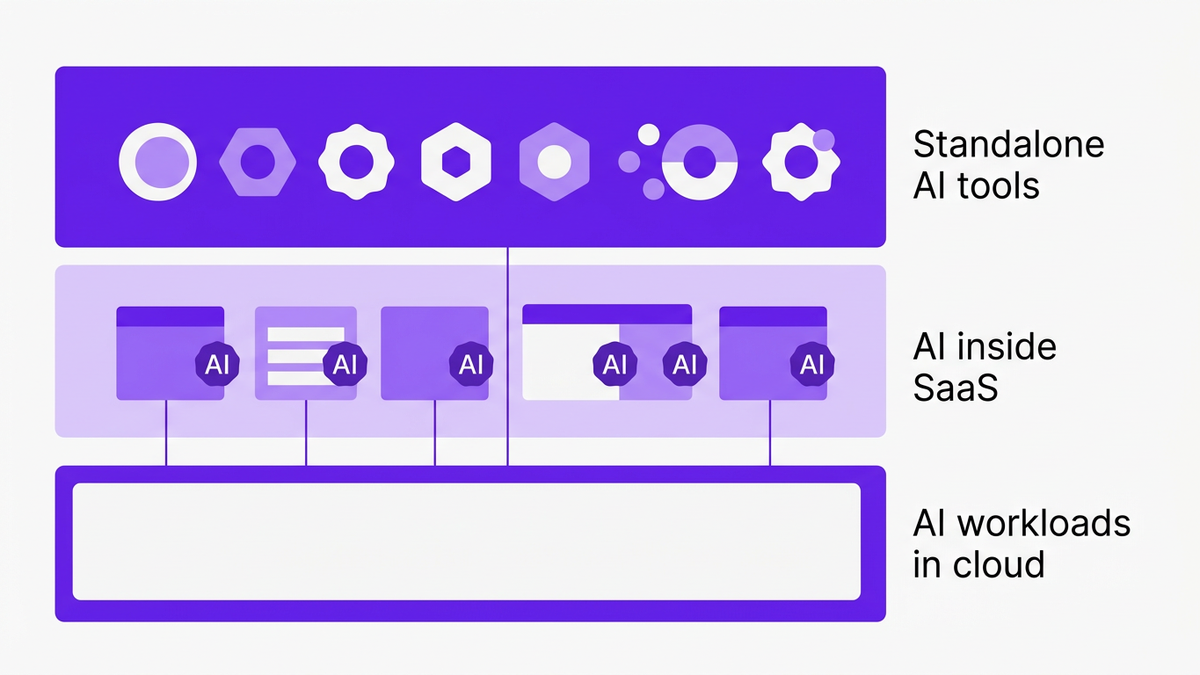
The result is a three-layer problem:
Standalone AI tools used by individuals and teams.
AI features inside existing SaaS applications, often enabled by default.
Custom AI workloads in cloud environments, connected to critical data.
AI is like SaaS on fast forward. Where SaaS sprawl took years to accumulate, AI sprawl can emerge in a single budgeting cycle.
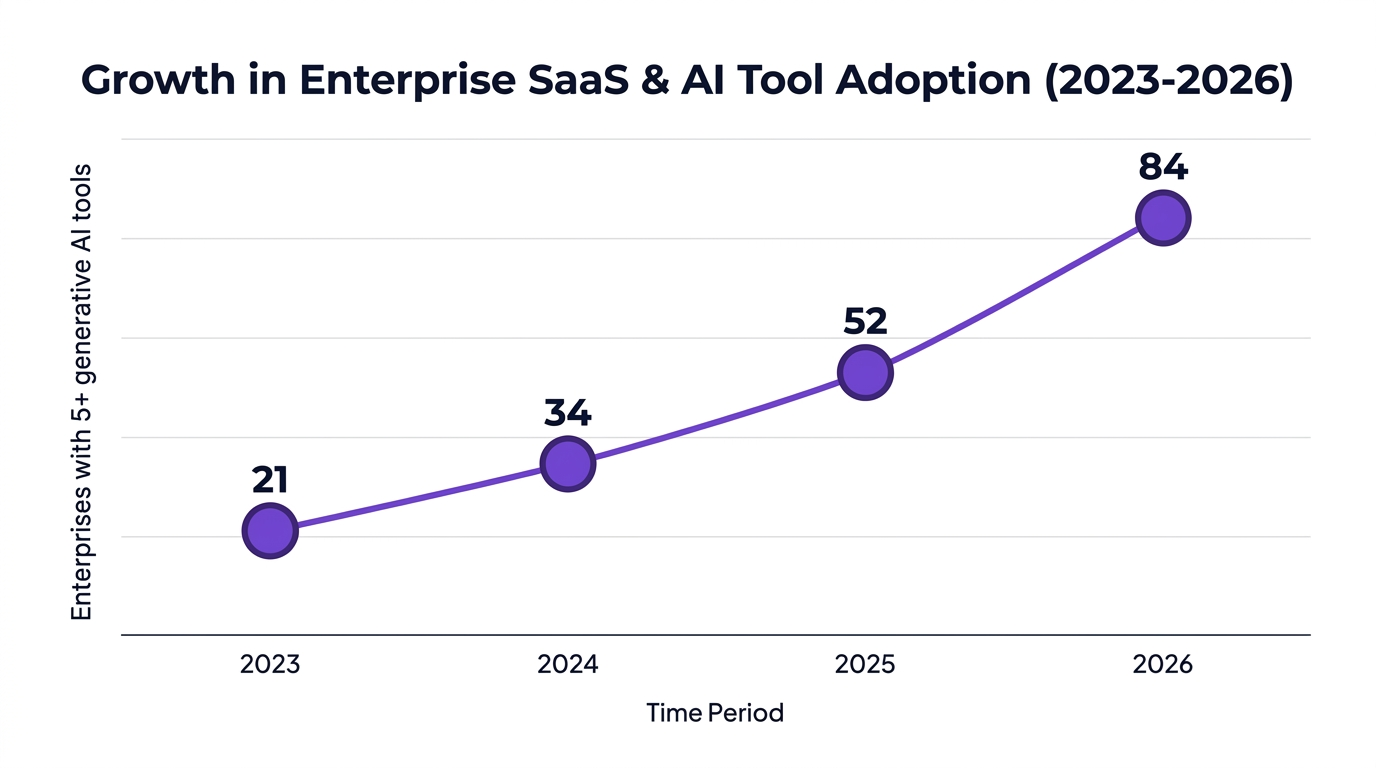
According to Gartner (2026), the growth in enterprise SaaS and AI tool adoption from 2023 to 2026 looks like this:
21% in 2023
34% in 2024
52% in 2025
84% in 2026
This accelerated adoption explains why enterprise governance practices that were barely keeping up with SaaS are now breaking under AI.
SaaS sprawl erodes financial discipline and creates security gaps. AI sprawl does all of that and increases data, privacy, and compliance risk at the same time.
A leading 2026 study found that 83% of enterprise security incidents involving AI tools were linked to lack of unified visibility and policy enforcement (Ponemon Institute 2026). More than 58% of IT leaders report an increase in non-compliance incidents tied to ungoverned AI usage (ISG 2026).
Several dynamics make AI sprawl uniquely risky:
Data gravity: AI models pull in sensitive datasets from CRM, ERP, collaboration suites, and data lakes.
Opaque behavior: Model outputs are probabilistic and hard to explain, which complicates audit and accountability.
Embedded everywhere: AI features appear inside tools you already own, bypassing traditional SaaS management processes.
As Emily Tran, VP of Research at Gartner, observed in 2026, "Without a unified governance framework, AI sprawl introduces unseen compliance and security gaps faster than any SaaS wave before it." That is the core AI governance challenge.
The key difference from classic SaaS sprawl is that AI tools often touch regulated data by default. A casual prompt can move confidential information into a third-party system, which then intersects directly with shadow IT, weak identity management, and incomplete SaaS visibility.
Some leaders argue that AI is just another feature in existing applications, so current controls are good enough. This view underestimates two factors.
First, many AI capabilities are introduced and updated frequently, often opt-out rather than opt-in. Second, AI usage patterns are highly experimental, which increases the chance of policy violations before controls catch up.
Treating AI as "just another feature" risks repeating early SaaS mistakes, only faster and with more sensitive data in play.
Traditional SaaS management tools focused on tracking applications, licenses, and contracts. AI sprawl requires an evolution from app-centric to workload visibility and policy-centric control.
In 2026, demand for unified cloud, SaaS, and AI governance platforms grew 43% (IDC 2026). This shift signals an emerging category where AI governance, cloud governance, and SaaS asset management are treated as one integrated problem.
To manage this new stack effectively, enterprises need to cover five domains:
Discovery: Continuous app discovery across SaaS, cloud services, and AI tools, including shadow SaaS and embedded AI features.
Identity and access: Strong identity management and role-based access, including just-in-time access for AI workloads.
Policy and compliance: Centralized policies for data residency, prompt content, retention, model usage, and vendor risk.
Financial discipline: Integrated SaaS spend management, AI workload cost tracking, and FinOps alignment.
Automation: Automated workflows to enforce policy, clean up access, and drive continuous cost optimization.
As Dr. Stephen Boyd from ISG put it, "AI sprawl is an inflection point where traditional SaaS management must evolve toward broader, automated enterprise governance." That evolution is effectively category creation: an expanded definition of SaaS and AI governance in one plane of control.
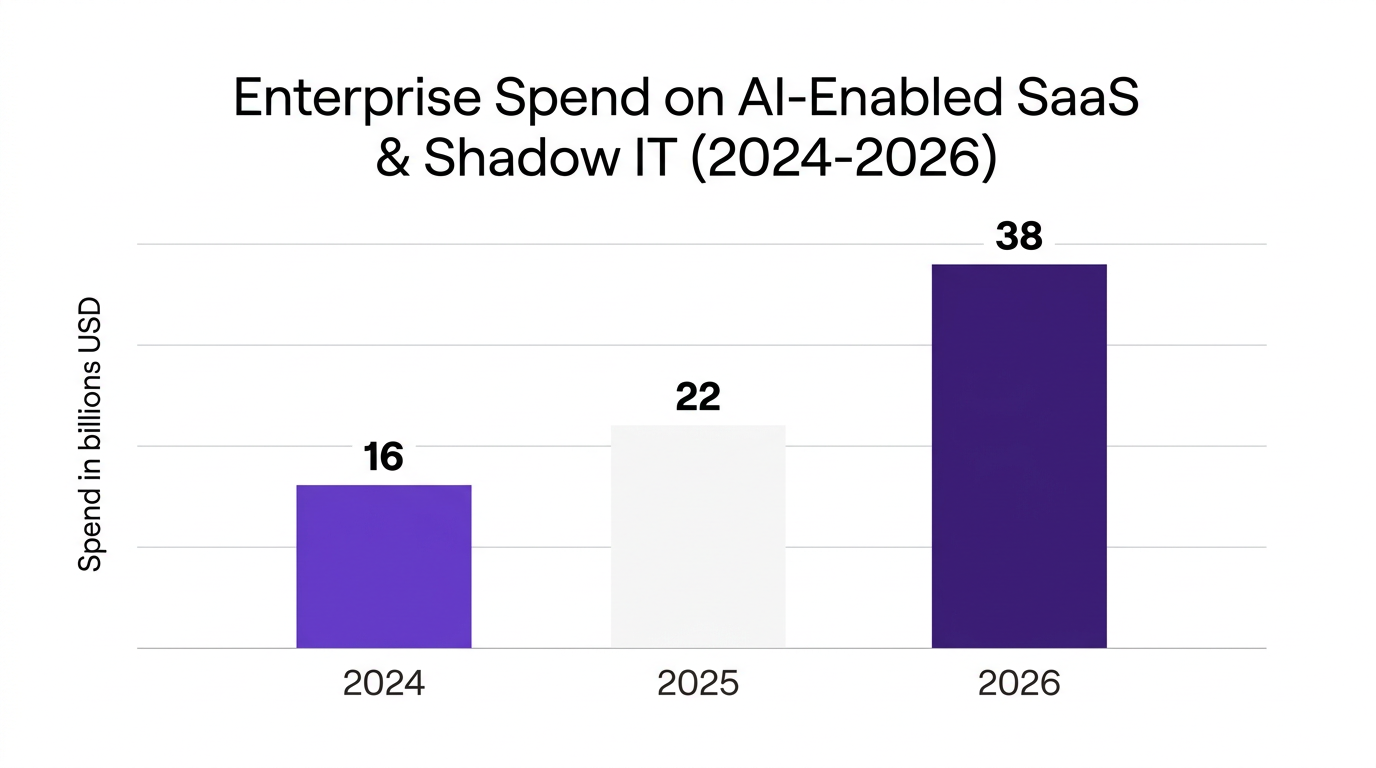
Enterprise spend on AI-enabled SaaS and shadow IT management is forecast to grow from 16 billion in 2024, to 22 billion in 2025, and 38 billion by 2026 (IDC 2026). Without stronger governance, a large share of that spend will be duplicate, underused, or misclassified.
To move from reactive clean-up to proactive control, organizations are modernizing their SaaS software management and AI governance playbooks. A practical approach blends discovery, policy, automation, and financial oversight.
Separate processes for SaaS, cloud, and AI no longer work. AI features live inside SaaS apps, and AI workloads run on cloud infrastructure.
Bring them together under unified governance:
Standardize intake and review for all apps and AI tools.
Use integrated SaaS management software to map ownership, data flows, and risk.
Align IT asset management and security teams around shared inventories and workflows.
This is where resources on SaaS sprawl understanding, managing, and overcoming challenges are a useful baseline.
Static spreadsheets and annual audits cannot keep up with AI sprawl. You need real-time SaaS visibility.
Strong discovery should:
Detect both sanctioned and unsanctioned apps in use across the enterprise.
Identify embedded AI features and external AI services.
Classify apps by business owner, data sensitivity, and compliance requirements.
In 2026, 92% of finance leaders said AI-driven app discovery is critical to budgeting for SaaS and AI cost optimization (Accenture 2026). Continuous discovery is the starting point for effective policy enforcement and risk mitigation.
Policies for acceptable AI usage cannot sit in a PDF on an intranet. They must be operational.
Modern AI governance policies should address:
What data can be sent to external AI tools.
Approved models and providers for different data classes.
Required human review for certain AI-generated outputs.
Retention and deletion rules for AI logs and prompts.
For a deeper view of these patterns, see the guidance on AI usage governance best practices for prompts and data retention.
Manual reviews cannot scale with AI adoption. Automated workflows are essential to:
Grant and revoke access based on roles and lifecycle events.
Trigger access reviews for sensitive AI tools.
Flag non-compliant usage patterns for security and compliance teams.
Rightsize licenses and AI capacity based on utilization.
Priya Nair of a global research firm noted in 2026, "Organizations need automated workflows and deep app discovery to maintain cost and risk control across hybrid SaaS and AI landscapes." Automation is the bridge from policy to practice.
AI workloads and SaaS adoption are now core components of cloud cost governance. FinOps leaders must be part of the governance design, not just the quarterly reconciliation.
Strong alignment looks like:
Tagging SaaS and AI spend by business unit and product line.
Implementing chargeback or showback models.
Using license optimization to reclaim unused seats and AI usage capacity.
Resources on FinOps for AI scope show how cost disciplines are expanding to include AI and SaaS in a unified financial model.
Many organizations discover that existing SaaS management tools begin to fail when AI enters the stack. Common failure modes include:
Blind spots on embedded AI: Tools track applications but not AI features that change data residency or retention.
Weak identity alignment: Access is granted per app, not per AI capability, which undermines precise identity management.
Siloed inventories: Separate lists for SaaS, cloud, and AI prevent true unified cloud management and policy enforcement.
A 2026 case study of a global pharmaceutical enterprise found that before adopting automated governance, unapproved AI app usage ballooned across R&D and commercial teams. After deploying an AI-enabled SaaS governance platform, they reduced unapproved AI usage by 32% and saved 14 million dollars in software licensing and compliance costs within a year (Everest Group 2026).
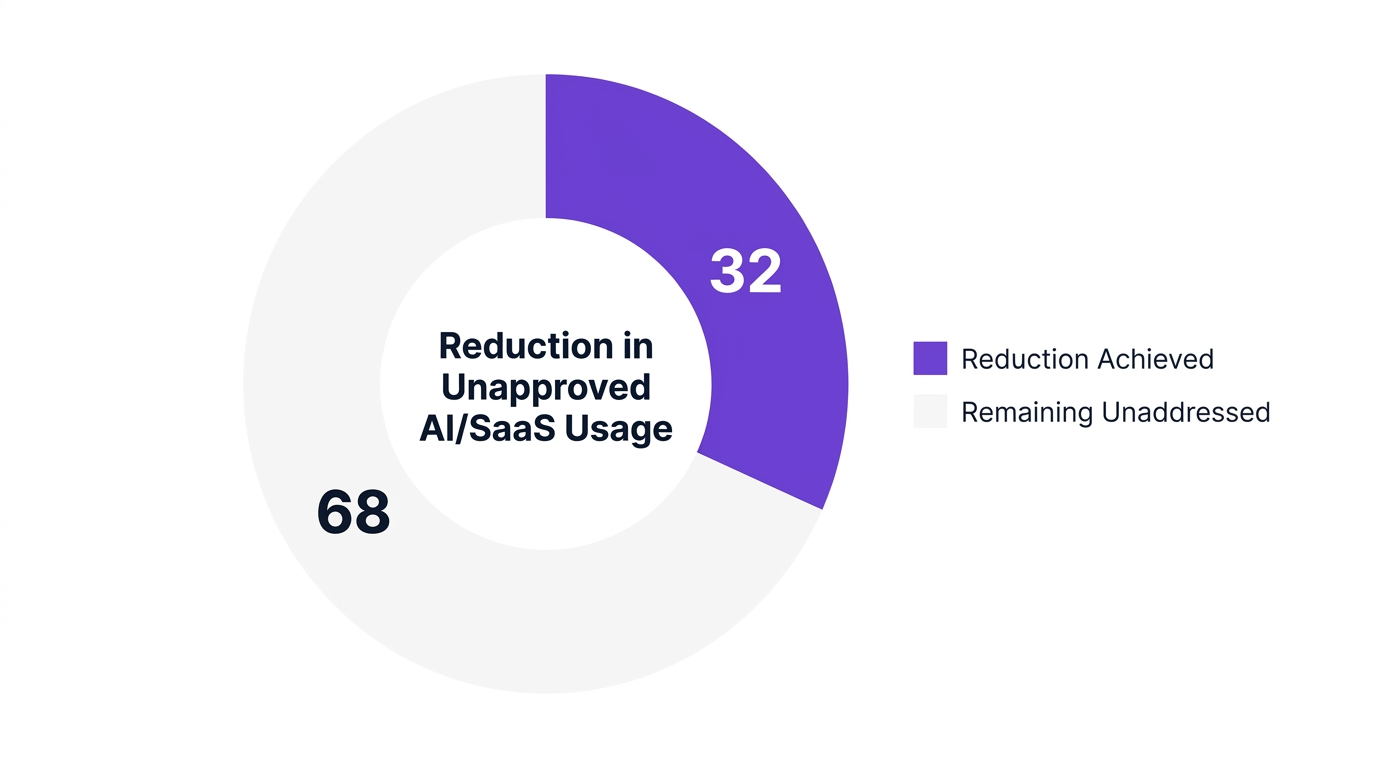
That same research highlights a 32% reduction in unapproved AI and SaaS app usage through automated governance, illustrating how integrated control can sharply reduce shadow SaaS and AI risk.
Some enterprises believe existing cloud governance and security tooling protect them from AI sprawl. Those controls are necessary, but not sufficient.
Cloud controls focus on infrastructure and workloads, whereas AI sprawl spreads through SaaS UX, browser extensions, and departmental tools. Without a unified governance layer that spans SaaS, AI, and cloud, AI usage will escape infrastructure-centric controls.
CloudNuro was designed for this exact inflection point: the convergence of SaaS sprawl, AI sprawl, and expanding enterprise governance requirements.
CloudNuro unifies SaaS management, AI governance, and cloud governance so IT, security, and finance leaders can see and control everything in one place.
CloudNuro’s Unified Cloud Custodian and AI Custodian provide:
Complete discovery across SaaS, cloud, and AI workloads, including shadow IT and embedded AI features.
Deep integrations with more than 400 applications to bring data, access, and usage insights into a single view.
Real-time risk scoring for apps and AI tools based on data access, usage patterns, and compliance posture.
This gives IT and security leaders the workload visibility they need to design and enforce effective AI governance policies.
CloudNuro’s governance-first architecture uses automated workflows to operationalize AI and SaaS policies.
Common automations include:
Automatic policy checks when new apps or AI tools appear through app discovery.
Scheduled user access reviews for high-risk tools and AI workloads.
License reclamation and license optimization based on observed usage.
Alerts and remediation when AI tools interact with sensitive data outside policy.
This reduces manual IT effort, shortens response times, and supports compliance automation across SaaS and AI.
CloudNuro’s FinOps Services help enterprises transform SaaS and AI from ungoverned spend into accountable investment.
The platform and services enable:
Granular SaaS spend management and AI workload cost tracking by cost center.
Chargeback and showback models to drive a cost-conscious culture.
Forecasting and budgeting that incorporate AI growth alongside SaaS and cloud.
In 2026, automated governance platforms reduced SaaS and AI portfolio costs by an average of 27% for large enterprises (Everest Group 2026). CloudNuro is built to help organizations reach and exceed that benchmark.
CloudNuro delivers a single governance and SaaS management platform for:
IT operations teams focused on uptime, access, and IT procurement.
Security and compliance teams managing SaaS security management and SaaS compliance software mandates.
Finance leaders responsible for cost optimization and fiscal discipline.
By aligning these stakeholders on one system of record, CloudNuro supports truly unified enterprise governance and application rationalization across SaaS, cloud, and AI.
You can explore CloudNuro’s broader saas management capabilities at the SaaS management overview and see how it fits into your IT operations strategy and IT asset management roadmap.
SaaS sprawl occurs when organizations accumulate a large number of SaaS applications with limited central control. It leads to duplicate tools, underused licenses, higher costs, and inconsistent security.
It also creates shadow IT, where business units adopt tools without IT involvement. This undermines SaaS asset management, compliance, and cloud cost governance.
AI sprawl involves the rapid and uncontrolled adoption of AI tools and AI features across SaaS, cloud, and custom workloads. It often spreads faster than SaaS because individual users can start with browser-based tools or extensions.
Unlike classic SaaS sprawl, AI sprawl typically touches sensitive data and regulated processes by default. This elevates the importance of AI governance, policy enforcement, and real-time visibility.
Key challenges include incomplete inventories, weak identity management, inconsistent policy enforcement, and fragmented risk ownership. Many organizations lack a single system of record for SaaS, cloud, and AI usage.
As AI adoption grows, these gaps create audit issues, non-compliance incidents, and increased probability of data exposure. Addressing them requires unified visibility, policy enforcement, and compliance automation.
Effective practices include continuous app discovery, standard intake for new tools, centralized policy definitions, and automated workflows that tie authorization, access, and deprovisioning together.
Pair these with FinOps alignment for SaaS and AI spend, plus regular IT asset management reviews to rationalize applications and workloads. The goal is fewer, better governed tools that deliver higher value.
Unified visibility gives IT, security, and finance teams a common source of truth for all SaaS and AI usage. Automation ensures that policies, access controls, and license optimization actions are applied consistently.
Together, they reduce manual overhead, close security gaps faster, and free budget tied up in unused or redundant tools. Research in 2026 showed that automated governance approaches reduced SaaS and AI portfolio costs by roughly 27% on average for large enterprises.
The convergence of SaaS sprawl and AI sprawl is larger than any single tool category. Organizations need a new category that unifies SaaS management, AI governance, and cloud governance in one platform.
This category creation moment is about defining that unified governance layer and adopting platforms and practices that treat applications and AI workloads as one integrated ecosystem.
AI sprawl is not a hypothetical future risk. It is already overtaking SaaS sprawl as a top governance concern, and it is magnifying long-standing issues around shadow IT, uncontrolled spend, and fragmented risk.
Enterprises that succeed will treat AI governance as a core discipline, tightly connected to saas management, cloud governance, and FinOps. They will rely on unified visibility, automated workflows, and data-driven cost optimization to enforce policy and maintain control.
CloudNuro gives CIOs, CISOs, and CFOs that unified layer across SaaS, cloud, and AI, turning the current governance crisis into an opportunity to build durable financial and risk discipline.
To see how CloudNuro can help you move from SaaS and AI sprawl to governed growth, request a personalized demo today.
About CloudNuro
CloudNuro is a leader in Enterprise SaaS Management Platforms, providing enterprises with unmatched visibility, governance, and cost optimization. Recognized twice in a row in the SaaS Management Platforms category and named a Leader in the SoftwareReviews Data Quadrant, CloudNuro is trusted by global enterprises and government agencies to bring financial discipline to SaaS, cloud, and AI. Trusted by enterprises such as Konica Minolta and Federal Signal, CloudNuro provides centralized SaaS inventory, license optimization, and renewal management along with advanced cost allocation and chargeback, giving IT and Finance leaders the visibility, control, and cost-conscious culture needed to drive financial discipline.
Request a no cost, no obligation free assessment —just 15 minutes to savings!
Get StartedSaaS sprawl taught enterprise leaders hard lessons about uncontrolled adoption, invisible spend, and fragmented risk. Now AI sprawl is scaling those same problems at a much faster rate, creating an urgent need for stronger AI governance and unified controls across SaaS, cloud, and AI.
By 2026, 84% of enterprises are projected to have adopted at least five different generative AI tools, doubling the pace of SaaS adoption over the previous three years (Gartner 2026). At the same time, 65% of CIOs already cite "AI sprawl" as a top three governance concern, surpassing traditional SaaS sprawl for the first time (Forrester 2026).
This is not a future problem. The next great enterprise governance crisis is already here.
SaaS sprawl is the uncontrolled proliferation of SaaS applications across an organization. It shows up as duplicate tools, unmanaged licenses, unknown contracts, and inconsistent controls.
AI sprawl builds on the same pattern but introduces deeper risk. AI capabilities are now embedded in SaaS products, bought as separate AI tools, or accessed directly by business users with a credit card.
The result is a three-layer problem:
Standalone AI tools used by individuals and teams.
AI features inside existing SaaS applications, often enabled by default.
Custom AI workloads in cloud environments, connected to critical data.
AI is like SaaS on fast forward. Where SaaS sprawl took years to accumulate, AI sprawl can emerge in a single budgeting cycle.
According to Gartner (2026), the growth in enterprise SaaS and AI tool adoption from 2023 to 2026 looks like this:
21% in 2023
34% in 2024
52% in 2025
84% in 2026
This accelerated adoption explains why enterprise governance practices that were barely keeping up with SaaS are now breaking under AI.
SaaS sprawl erodes financial discipline and creates security gaps. AI sprawl does all of that and increases data, privacy, and compliance risk at the same time.
A leading 2026 study found that 83% of enterprise security incidents involving AI tools were linked to lack of unified visibility and policy enforcement (Ponemon Institute 2026). More than 58% of IT leaders report an increase in non-compliance incidents tied to ungoverned AI usage (ISG 2026).
Several dynamics make AI sprawl uniquely risky:
Data gravity: AI models pull in sensitive datasets from CRM, ERP, collaboration suites, and data lakes.
Opaque behavior: Model outputs are probabilistic and hard to explain, which complicates audit and accountability.
Embedded everywhere: AI features appear inside tools you already own, bypassing traditional SaaS management processes.
As Emily Tran, VP of Research at Gartner, observed in 2026, "Without a unified governance framework, AI sprawl introduces unseen compliance and security gaps faster than any SaaS wave before it." That is the core AI governance challenge.
The key difference from classic SaaS sprawl is that AI tools often touch regulated data by default. A casual prompt can move confidential information into a third-party system, which then intersects directly with shadow IT, weak identity management, and incomplete SaaS visibility.
Some leaders argue that AI is just another feature in existing applications, so current controls are good enough. This view underestimates two factors.
First, many AI capabilities are introduced and updated frequently, often opt-out rather than opt-in. Second, AI usage patterns are highly experimental, which increases the chance of policy violations before controls catch up.
Treating AI as "just another feature" risks repeating early SaaS mistakes, only faster and with more sensitive data in play.
Traditional SaaS management tools focused on tracking applications, licenses, and contracts. AI sprawl requires an evolution from app-centric to workload visibility and policy-centric control.
In 2026, demand for unified cloud, SaaS, and AI governance platforms grew 43% (IDC 2026). This shift signals an emerging category where AI governance, cloud governance, and SaaS asset management are treated as one integrated problem.
To manage this new stack effectively, enterprises need to cover five domains:
Discovery: Continuous app discovery across SaaS, cloud services, and AI tools, including shadow SaaS and embedded AI features.
Identity and access: Strong identity management and role-based access, including just-in-time access for AI workloads.
Policy and compliance: Centralized policies for data residency, prompt content, retention, model usage, and vendor risk.
Financial discipline: Integrated SaaS spend management, AI workload cost tracking, and FinOps alignment.
Automation: Automated workflows to enforce policy, clean up access, and drive continuous cost optimization.
As Dr. Stephen Boyd from ISG put it, "AI sprawl is an inflection point where traditional SaaS management must evolve toward broader, automated enterprise governance." That evolution is effectively category creation: an expanded definition of SaaS and AI governance in one plane of control.
Enterprise spend on AI-enabled SaaS and shadow IT management is forecast to grow from 16 billion in 2024, to 22 billion in 2025, and 38 billion by 2026 (IDC 2026). Without stronger governance, a large share of that spend will be duplicate, underused, or misclassified.
To move from reactive clean-up to proactive control, organizations are modernizing their SaaS software management and AI governance playbooks. A practical approach blends discovery, policy, automation, and financial oversight.
Separate processes for SaaS, cloud, and AI no longer work. AI features live inside SaaS apps, and AI workloads run on cloud infrastructure.
Bring them together under unified governance:
Standardize intake and review for all apps and AI tools.
Use integrated SaaS management software to map ownership, data flows, and risk.
Align IT asset management and security teams around shared inventories and workflows.
This is where resources on SaaS sprawl understanding, managing, and overcoming challenges are a useful baseline.
Static spreadsheets and annual audits cannot keep up with AI sprawl. You need real-time SaaS visibility.
Strong discovery should:
Detect both sanctioned and unsanctioned apps in use across the enterprise.
Identify embedded AI features and external AI services.
Classify apps by business owner, data sensitivity, and compliance requirements.
In 2026, 92% of finance leaders said AI-driven app discovery is critical to budgeting for SaaS and AI cost optimization (Accenture 2026). Continuous discovery is the starting point for effective policy enforcement and risk mitigation.
Policies for acceptable AI usage cannot sit in a PDF on an intranet. They must be operational.
Modern AI governance policies should address:
What data can be sent to external AI tools.
Approved models and providers for different data classes.
Required human review for certain AI-generated outputs.
Retention and deletion rules for AI logs and prompts.
For a deeper view of these patterns, see the guidance on AI usage governance best practices for prompts and data retention.
Manual reviews cannot scale with AI adoption. Automated workflows are essential to:
Grant and revoke access based on roles and lifecycle events.
Trigger access reviews for sensitive AI tools.
Flag non-compliant usage patterns for security and compliance teams.
Rightsize licenses and AI capacity based on utilization.
Priya Nair of a global research firm noted in 2026, "Organizations need automated workflows and deep app discovery to maintain cost and risk control across hybrid SaaS and AI landscapes." Automation is the bridge from policy to practice.
AI workloads and SaaS adoption are now core components of cloud cost governance. FinOps leaders must be part of the governance design, not just the quarterly reconciliation.
Strong alignment looks like:
Tagging SaaS and AI spend by business unit and product line.
Implementing chargeback or showback models.
Using license optimization to reclaim unused seats and AI usage capacity.
Resources on FinOps for AI scope show how cost disciplines are expanding to include AI and SaaS in a unified financial model.
Many organizations discover that existing SaaS management tools begin to fail when AI enters the stack. Common failure modes include:
Blind spots on embedded AI: Tools track applications but not AI features that change data residency or retention.
Weak identity alignment: Access is granted per app, not per AI capability, which undermines precise identity management.
Siloed inventories: Separate lists for SaaS, cloud, and AI prevent true unified cloud management and policy enforcement.
A 2026 case study of a global pharmaceutical enterprise found that before adopting automated governance, unapproved AI app usage ballooned across R&D and commercial teams. After deploying an AI-enabled SaaS governance platform, they reduced unapproved AI usage by 32% and saved 14 million dollars in software licensing and compliance costs within a year (Everest Group 2026).
That same research highlights a 32% reduction in unapproved AI and SaaS app usage through automated governance, illustrating how integrated control can sharply reduce shadow SaaS and AI risk.
Some enterprises believe existing cloud governance and security tooling protect them from AI sprawl. Those controls are necessary, but not sufficient.
Cloud controls focus on infrastructure and workloads, whereas AI sprawl spreads through SaaS UX, browser extensions, and departmental tools. Without a unified governance layer that spans SaaS, AI, and cloud, AI usage will escape infrastructure-centric controls.
CloudNuro was designed for this exact inflection point: the convergence of SaaS sprawl, AI sprawl, and expanding enterprise governance requirements.
CloudNuro unifies SaaS management, AI governance, and cloud governance so IT, security, and finance leaders can see and control everything in one place.
CloudNuro’s Unified Cloud Custodian and AI Custodian provide:
Complete discovery across SaaS, cloud, and AI workloads, including shadow IT and embedded AI features.
Deep integrations with more than 400 applications to bring data, access, and usage insights into a single view.
Real-time risk scoring for apps and AI tools based on data access, usage patterns, and compliance posture.
This gives IT and security leaders the workload visibility they need to design and enforce effective AI governance policies.
CloudNuro’s governance-first architecture uses automated workflows to operationalize AI and SaaS policies.
Common automations include:
Automatic policy checks when new apps or AI tools appear through app discovery.
Scheduled user access reviews for high-risk tools and AI workloads.
License reclamation and license optimization based on observed usage.
Alerts and remediation when AI tools interact with sensitive data outside policy.
This reduces manual IT effort, shortens response times, and supports compliance automation across SaaS and AI.
CloudNuro’s FinOps Services help enterprises transform SaaS and AI from ungoverned spend into accountable investment.
The platform and services enable:
Granular SaaS spend management and AI workload cost tracking by cost center.
Chargeback and showback models to drive a cost-conscious culture.
Forecasting and budgeting that incorporate AI growth alongside SaaS and cloud.
In 2026, automated governance platforms reduced SaaS and AI portfolio costs by an average of 27% for large enterprises (Everest Group 2026). CloudNuro is built to help organizations reach and exceed that benchmark.
CloudNuro delivers a single governance and SaaS management platform for:
IT operations teams focused on uptime, access, and IT procurement.
Security and compliance teams managing SaaS security management and SaaS compliance software mandates.
Finance leaders responsible for cost optimization and fiscal discipline.
By aligning these stakeholders on one system of record, CloudNuro supports truly unified enterprise governance and application rationalization across SaaS, cloud, and AI.
You can explore CloudNuro’s broader saas management capabilities at the SaaS management overview and see how it fits into your IT operations strategy and IT asset management roadmap.
SaaS sprawl occurs when organizations accumulate a large number of SaaS applications with limited central control. It leads to duplicate tools, underused licenses, higher costs, and inconsistent security.
It also creates shadow IT, where business units adopt tools without IT involvement. This undermines SaaS asset management, compliance, and cloud cost governance.
AI sprawl involves the rapid and uncontrolled adoption of AI tools and AI features across SaaS, cloud, and custom workloads. It often spreads faster than SaaS because individual users can start with browser-based tools or extensions.
Unlike classic SaaS sprawl, AI sprawl typically touches sensitive data and regulated processes by default. This elevates the importance of AI governance, policy enforcement, and real-time visibility.
Key challenges include incomplete inventories, weak identity management, inconsistent policy enforcement, and fragmented risk ownership. Many organizations lack a single system of record for SaaS, cloud, and AI usage.
As AI adoption grows, these gaps create audit issues, non-compliance incidents, and increased probability of data exposure. Addressing them requires unified visibility, policy enforcement, and compliance automation.
Effective practices include continuous app discovery, standard intake for new tools, centralized policy definitions, and automated workflows that tie authorization, access, and deprovisioning together.
Pair these with FinOps alignment for SaaS and AI spend, plus regular IT asset management reviews to rationalize applications and workloads. The goal is fewer, better governed tools that deliver higher value.
Unified visibility gives IT, security, and finance teams a common source of truth for all SaaS and AI usage. Automation ensures that policies, access controls, and license optimization actions are applied consistently.
Together, they reduce manual overhead, close security gaps faster, and free budget tied up in unused or redundant tools. Research in 2026 showed that automated governance approaches reduced SaaS and AI portfolio costs by roughly 27% on average for large enterprises.
The convergence of SaaS sprawl and AI sprawl is larger than any single tool category. Organizations need a new category that unifies SaaS management, AI governance, and cloud governance in one platform.
This category creation moment is about defining that unified governance layer and adopting platforms and practices that treat applications and AI workloads as one integrated ecosystem.
AI sprawl is not a hypothetical future risk. It is already overtaking SaaS sprawl as a top governance concern, and it is magnifying long-standing issues around shadow IT, uncontrolled spend, and fragmented risk.
Enterprises that succeed will treat AI governance as a core discipline, tightly connected to saas management, cloud governance, and FinOps. They will rely on unified visibility, automated workflows, and data-driven cost optimization to enforce policy and maintain control.
CloudNuro gives CIOs, CISOs, and CFOs that unified layer across SaaS, cloud, and AI, turning the current governance crisis into an opportunity to build durable financial and risk discipline.
To see how CloudNuro can help you move from SaaS and AI sprawl to governed growth, request a personalized demo today.
About CloudNuro
CloudNuro is a leader in Enterprise SaaS Management Platforms, providing enterprises with unmatched visibility, governance, and cost optimization. Recognized twice in a row in the SaaS Management Platforms category and named a Leader in the SoftwareReviews Data Quadrant, CloudNuro is trusted by global enterprises and government agencies to bring financial discipline to SaaS, cloud, and AI. Trusted by enterprises such as Konica Minolta and Federal Signal, CloudNuro provides centralized SaaS inventory, license optimization, and renewal management along with advanced cost allocation and chargeback, giving IT and Finance leaders the visibility, control, and cost-conscious culture needed to drive financial discipline.
Request a no cost, no obligation free assessment - just 15 minutes to savings!
Get StartedWe're offering complimentary ServiceNow license assessments to only 25 enterprises this quarter who want to unlock immediate savings without disrupting operations.
Get Free AssessmentGet Started




CloudNuro Corp
1755 Park St. Suite 207
Naperville, IL 60563
Phone : +1-630-277-9470
Email: info@cloudnuro.com




.webp)

Recognized Leader in SaaS Management Platforms by Info-Tech SoftwareReviews


.svg)