

Sign Up
Thank you for Submitting!
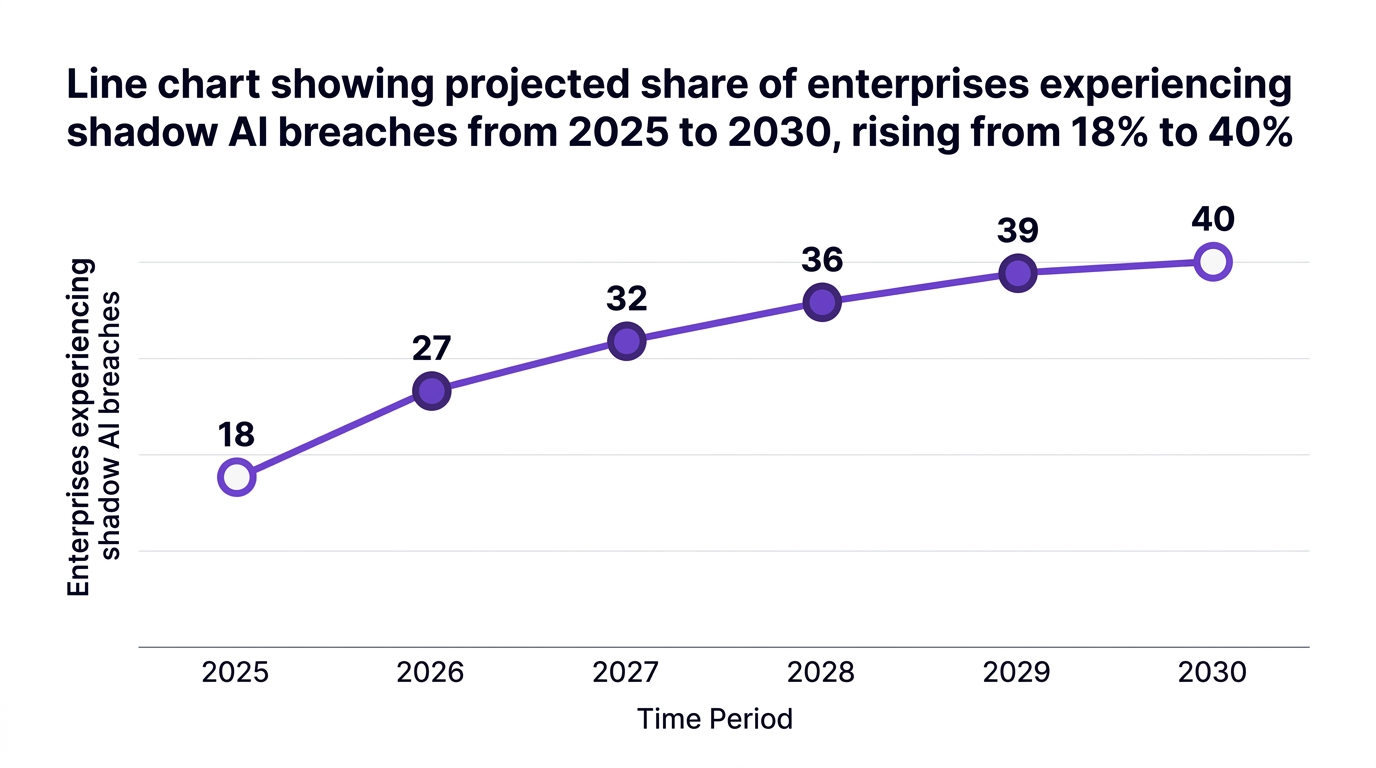
A shadow AI breach is no longer a fringe scenario. Gartner predicts that by 2030, 40% of enterprises will have experienced a shadow AI-related breach (Gartner, 2026). For CISOs, this is not just another risk category; it is a structural blind spot that traditional controls barely touch.
Shadow AI refers to employees using unapproved AI tools at work, often within SaaS platforms, to move faster. The intent is productivity, but the outcome can be catastrophic: AI data leakage, non-compliance, and sustained exposure of sensitive information. This article explains why the 40% prediction is credible, how to quantify CISO AI risk, and what a governance-first roadmap looks like.
Most boards now recognize shadow IT. Shadow AI is the AI-era equivalent, in which employees adopt AI tools without security approval, often integrating them into existing SaaS workflows.
A shadow AI breach occurs when these unsanctioned tools cause confidentiality, integrity, or availability failures. Common patterns include:
Sensitive data is pasted into public AI chatbots, then retained or used to train external models
Unapproved browser extensions scraping SaaS data to feed external AI engines
AI connectors pulling customer or patient data from CRM, ticketing, or collaboration tools into unmanaged AI services
A leading cyber risk report found that 58% of AI-related incidents in enterprises were traced back to unsanctioned or unmanaged AI tools (McKinsey, 2026). That is the operational definition of shadow AI in the enterprise.

Shadow IT is usually visible in network or expense data. Shadow AI is more subtle.
Employees invoke AI inside browsers, extensions, plugins, and embedded AI features in existing SaaS. A security team might see normal SaaS traffic while an AI data breach in saas quietly unfolds inside session content.
Key differences:
Data shape: AI prompts often combine multiple sensitive fields in a single request
Retention ambiguity: Vendors may log prompts or use them for training
Speed of adoption: A single link in a chat can spread an AI tool across teams in days
This creates a new class of AI security risks for enterprises that legacy DLP, CASB, and firewalls were not designed to address.
Gartner’s 40% shadow AI breach forecast aligns with three converging trends.
First, enterprise usage of unauthorized AI tools has increased by 41% in the last 18 months (IDC, 2026). Employees are not waiting for official rollouts. They adopt tools that help them code, write, design, and analyze data faster.
Second, 47% of SaaS platforms integrated by enterprises now include embedded AI (Forrester, 2026). This means Shadow AI in saas is often hiding inside tools you already trust.
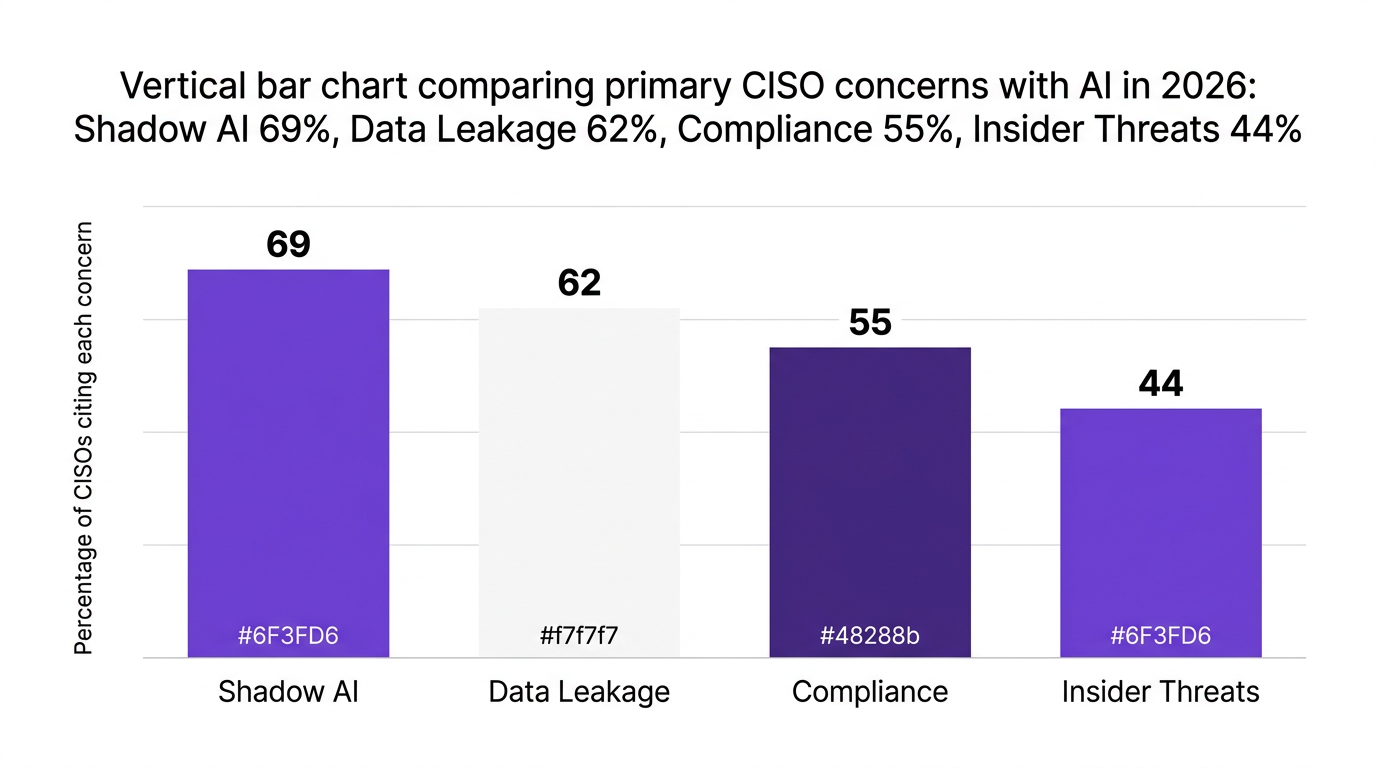
Third, security leadership is playing catch-up. One study reports 69% of CIOs and CISOs cite shadow AI as their top AI security concern (ISG Research, 2026), yet 62% of CISOs report increasing data leakage concerns from shadow AI year over year (CyberEdge, 2026). The concern is high, but structured ai governance is still immature.
If:
Unauthorized AI tool usage is up 41%
More than half of AI incidents already come from unmanaged tools (58%)
Almost half of your SaaS estate now embeds AI capabilities
Then the probability that at least one Shadow AI data breach reaches regulatory or material impact by 2030 is substantial. Even if each individual app carries a small breach risk, the aggregate exposure across hundreds of apps and tools is significant.
Think of shadow AI like misconfigured S3 buckets in the early cloud phase. One misstep did not seem fatal until the organization realized that hundreds of misconfigurations existed across accounts and regions.
Shadow AI is not only generative chatbots. It spans a wide spectrum of tools, many of which appear benign.
Typical unapproved AI tools at work include:
Public AI chatbots used for drafting emails, code, contracts, and analyses
Browser extensions that summarize web pages, emails, or SaaS records using external AI APIs
Embedded AI in SaaS where admins or end users toggle on AI features without a security review
No-code integrations and connectors that route SaaS data into AI services via webhooks or APIs
A leading cyber report found that enterprise AI usage policy for employees was unclear or absent in 54% of large organizations in 2026. In that environment, employees using unapproved ai tools are just trying to get work done.

A Fortune 100 healthcare provider used a SaaS governance platform that monitored unusual app-to-app connections. It detected unauthorized connections to a generative AI image tool that had begun accessing sensitive patient files within a cloud storage service.
The security team isolated the connector and revoked access within 4 hours. According to a 2026 incident analysis, the intervention prevented a reportable data breach that would have triggered significant regulatory exposure and reputational damage.
This is a textbook example of Shadow AI and data protection done right: proactive visibility, automated detection, and fast containment.
For CISOs, Shadow AI security conversations must move from abstract fear to concrete attack surfaces. At a minimum, you should map:
User-level risks: Employees pasting regulated data into AI prompts
Integration risks: AI plugins and connectors with broad SaaS scopes
Vendor-side risks: Third-party AI retention, training, and access models
Governance gaps: Missing or unenforced policies, weak monitoring
A 2026 study on behavioral security and Shadow AI found that over 40% of employees who used generative AI at work had done so without reading any corporate policy about AI usage. The insider threat from ai tools is often accidental, not malicious.
From observed incidents and research, the tools most likely to trigger an AI data breach in saas are:
Prompt-based assistants connected to storage, CRM, and ticketing tools
AI-powered document analyzers that ingest PDFs, contracts, or medical records
Code assistants granted access to internal repositories and build pipelines
AI transcription and meeting tools that automatically capture confidential meetings
Each of these significantly increases the risk of AI data leakage if not governed.
Addressing Shadow AI risks requires both technical and behavioral controls. The most resilient organizations treat Enterprise AI security as a continuous program.
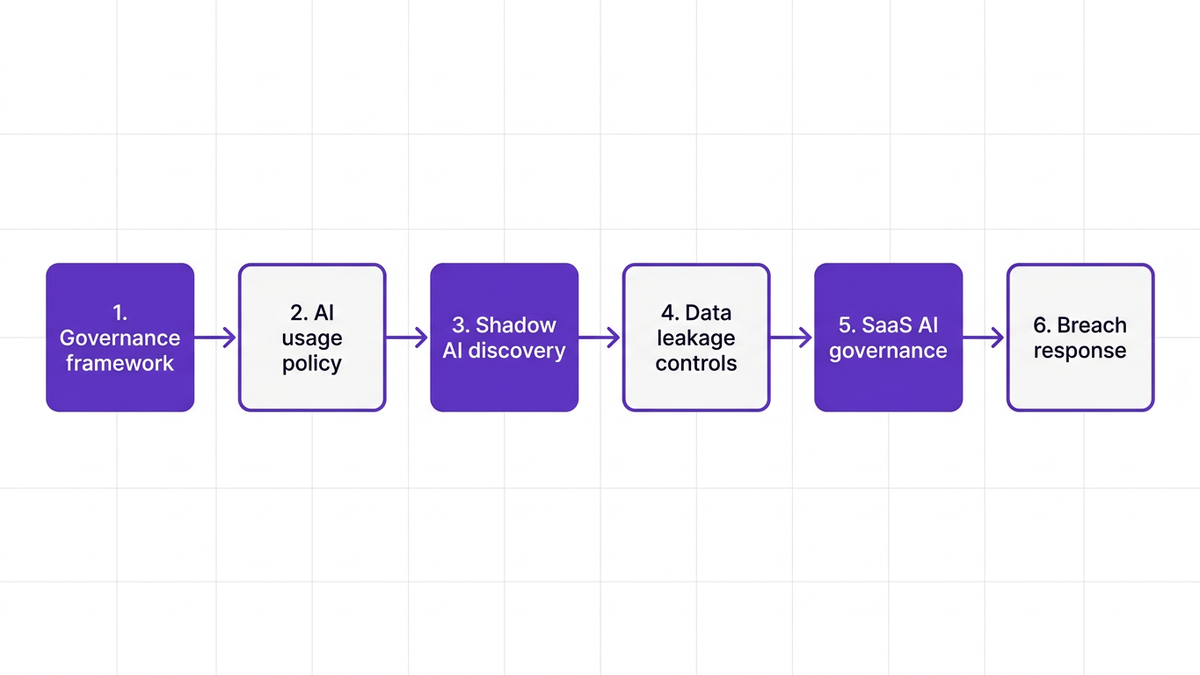
Here is a practical 6-step playbook:
Establish an AI governance framework
Define what counts as AI in your environment, including embedded features
Set clear boundaries for acceptable data types, retention expectations, and vendor requirements
Align with an AI governance framework for enterprises that includes risk tiers and approval paths
Create and enforce an AI usage policy for employees
Write plain-language guidelines on what employees can and cannot share with AI tools
Include concrete examples that map to job roles
Require acknowledgment on login or via training for high-risk groups
Discover Shadow AI in your SaaS estate
Use saas management and AI discovery tools to inventory all AI-capable apps
Identify Shadow AI in the enterprise by scanning OAuth grants, marketplace apps, and browser extension usage where feasible
Prioritize apps that touch regulated or high-value datasets
Implement technical controls for AI data leakage prevention
Use domain-level controls where available to restrict public AI access
Configure DLP for AI-specific patterns, such as large prompt payloads or export events
Apply conditional access and least privilege for AI plugins and connectors
Integrate AI governance for SaaS platforms
Require security review and AI compliance for saas vendors before enabling AI features
Maintain a central register of approved AI features and associated risk ratings
Ensure enterprise AI compliance includes data residency, retention, and training commitments
Build an enterprise AI breach response playbook
Define triage steps for suspected AI security breach 2030 scenarios, including log collection, connector revocation, and vendor notifications
Integrate AI incidents into existing incident response processes
Run tabletop exercises that simulate ai tools causing data breaches via shadow AI
For a deeper view of operating models and policy patterns, see CloudNuro’s post on AI usage governance best practices.
Some teams propose simply blocking known AI domains. This can reduce a few obvious channels, but it has limits.
Many SaaS apps embed AI behind the same domain as core services
Employees can use personal devices or networks to bypass blocks
Blocking without guidance pushes shadow AI further underground
Blocking has a role, but AI governance for saas platforms and a strong usage policy are more sustainable. Security leaders who rely solely on blocking often find that shadow AI sprawl continues, just harder to see.
CloudNuro was built around a governance-first architecture for SaaS, cloud, and AI. Its platform directly addresses the dynamics behind the Shadow AI Gartner prediction of 40% breaches by 2030.
CloudNuro AI Custodian provides real-time monitoring, detection, and mitigation of unauthorized AI tool usage across SaaS, PaaS, and IaaS.
Key capabilities for shadow AI security include:
Discovery of unapproved AI tools at work via OAuth scopes, integration patterns, and API activity
Identification of shadow AI in saas where embedded assistants are enabled without review
Policy-based alerts for high-risk behaviors that could trigger an AI data leakage incident
By correlating identity, application, and AI usage, AI Custodian helps CISOs move from occasional audits to continuous oversight.
The Unified Cloud Custodian provides a single-pane view across more than 400 SaaS and cloud applications.
For AI security, this means:
Central visibility of AI-enabled apps and services
Automated workflow approvals for new AI integrations, reducing shadow AI risks from self-installed tools
Standardized policy enforcement for AI governance for saas platforms across business units
This single control plane is critical as AI sprawl in the enterprise accelerates. Instead of chasing individual apps, CISOs define governance once and apply it consistently.
CloudNuro’s FinOps Services introduce financial accountability to AI and SaaS usage.
By tying spend to owners and business outcomes, FinOps:
Exposes unbudgeted AI services that often represent Shadow IT and shadow AI
Helps finance and security teams jointly address risky or redundant tools
Supports chargeback models that incentivize teams to use approved AI platforms
This financial perspective is a powerful lever. When every AI subscription has a named owner, the room for invisible Shadow AI in the enterprise shrinks.
To understand how CloudNuro’s governance-first platform supports IT and security leaders, explore the company’s IT security solution overview and broader SaaS management capabilities.
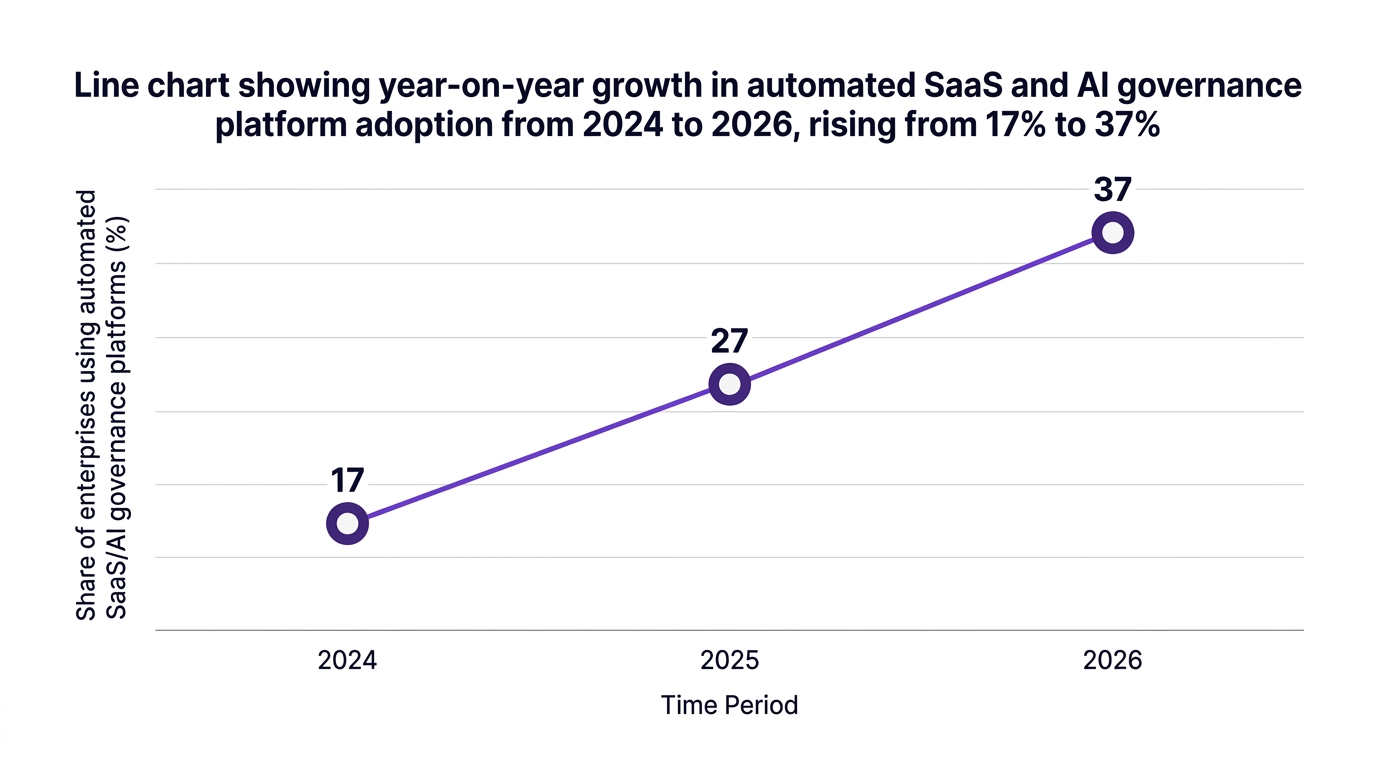
A Shadow AI breach occurs when unapproved or unmanaged AI tools cause data exposure, integrity issues, or operational disruption. Enterprises should care because research shows 58% of AI-related incidents stem from unsanctioned tools (McKinsey, 2026), and Gartner predicts 40% of enterprises will face such breaches by 2030.
Beyond direct data loss, these incidents can trigger regulatory action, damage customer trust, and complicate third-party risk management. For regulated sectors, shadow AI can also undermine audit readiness and certifications.
The Shadow AI Gartner prediction blends increased usage of unauthorized AI, pervasive embedded AI in SaaS, and lagging governance. Unauthorized AI usage grew 41% in 18 months (IDC, 2026), and almost half of SaaS tools now ship with AI capabilities.
When you combine that with weak or absent AI policies and limited monitoring, the likelihood of a material Shadow AI data breach over several years becomes high. The number is less a scare tactic and more a reflection of current adoption curves.
CISOs should start with visibility. Use platforms that discover AI-capable apps, monitor OAuth grants, and analyze usage patterns. This is especially important for Shadow AI in saas, where AI features blend into everyday workflows.
Next, implement AI governance policies, technical controls for AI data leakage prevention, and approval workflows for new AI tools. Tools like CloudNuro’s AI Custodian help operationalize this by providing real-time detection and policy enforcement.
High-risk tools typically:
Ingest large volumes of unredacted data
Connect directly to core SaaS systems
Rely on external cloud environments with unclear retention policies
Examples include public chatbots used for confidential work, AI document analyzers, code assistants with repository access, and AI meeting tools storing recordings. These are frequent culprits behind ai data leakage and ai data breach in saas scenarios.
SaaS management platforms provide the discovery and control layer that most identity or network tools lack. They surface:
Which SaaS apps include AI features
Which users have enabled or authorized AI connectors
Where data flows into external AI engines
By combining this with workflow approvals, policy enforcement, and Enterprise AI breach response capabilities, these platforms significantly reduce the attack surface. CloudNuro, for example, integrates AI-specific controls into its governance stack to address Shadow AI security directly.
Gartner’s prediction that 40% of companies will face a Shadow AI breach by 2030 should not only alarm CISOs, it should catalyze action. Shadow AI will not vanish, because the underlying driver is real productivity gain.
The organizations that avoid the worst Shadow AI risks will be those that build strong ai governance, combine SaaS and AI visibility, and treat employee AI usage as a managed behavior, not a forbidden one. CloudNuro’s governance-first platform, including AI Custodian and Unified Cloud Custodian, is designed to help enterprises move from fear to disciplined control of shadow AI.
If you want to understand why enterprises choose CloudNuro for SaaS and AI governance, explore why CloudNuro and see how a unified platform changes your AI risk posture.
CloudNuro is a leader in Enterprise SaaS Management Platforms, providing enterprises with unmatched visibility, governance, and cost optimization. Recognized twice in a row in the SaaS Management Platforms category and named a Leader in the SoftwareReviews Data Quadrant, CloudNuro is trusted by global enterprises and government agencies to bring financial discipline to SaaS, cloud, and AI. Trusted by enterprises such as Konica Minolta and Federal Signal, CloudNuro provides centralized SaaS inventory, license optimization, and renewal management along with advanced cost allocation and chargeback, giving IT and Finance leaders the visibility, control, and cost-conscious culture needed to drive financial discipline.
Request a no cost, no obligation free assessment —just 15 minutes to savings!
Get StartedA shadow AI breach is no longer a fringe scenario. Gartner predicts that by 2030, 40% of enterprises will have experienced a shadow AI-related breach (Gartner, 2026). For CISOs, this is not just another risk category; it is a structural blind spot that traditional controls barely touch.
Shadow AI refers to employees using unapproved AI tools at work, often within SaaS platforms, to move faster. The intent is productivity, but the outcome can be catastrophic: AI data leakage, non-compliance, and sustained exposure of sensitive information. This article explains why the 40% prediction is credible, how to quantify CISO AI risk, and what a governance-first roadmap looks like.
Most boards now recognize shadow IT. Shadow AI is the AI-era equivalent, in which employees adopt AI tools without security approval, often integrating them into existing SaaS workflows.
A shadow AI breach occurs when these unsanctioned tools cause confidentiality, integrity, or availability failures. Common patterns include:
Sensitive data is pasted into public AI chatbots, then retained or used to train external models
Unapproved browser extensions scraping SaaS data to feed external AI engines
AI connectors pulling customer or patient data from CRM, ticketing, or collaboration tools into unmanaged AI services
A leading cyber risk report found that 58% of AI-related incidents in enterprises were traced back to unsanctioned or unmanaged AI tools (McKinsey, 2026). That is the operational definition of shadow AI in the enterprise.
Shadow IT is usually visible in network or expense data. Shadow AI is more subtle.
Employees invoke AI inside browsers, extensions, plugins, and embedded AI features in existing SaaS. A security team might see normal SaaS traffic while an AI data breach in saas quietly unfolds inside session content.
Key differences:
Data shape: AI prompts often combine multiple sensitive fields in a single request
Retention ambiguity: Vendors may log prompts or use them for training
Speed of adoption: A single link in a chat can spread an AI tool across teams in days
This creates a new class of AI security risks for enterprises that legacy DLP, CASB, and firewalls were not designed to address.
Gartner’s 40% shadow AI breach forecast aligns with three converging trends.
First, enterprise usage of unauthorized AI tools has increased by 41% in the last 18 months (IDC, 2026). Employees are not waiting for official rollouts. They adopt tools that help them code, write, design, and analyze data faster.
Second, 47% of SaaS platforms integrated by enterprises now include embedded AI (Forrester, 2026). This means Shadow AI in saas is often hiding inside tools you already trust.
Third, security leadership is playing catch-up. One study reports 69% of CIOs and CISOs cite shadow AI as their top AI security concern (ISG Research, 2026), yet 62% of CISOs report increasing data leakage concerns from shadow AI year over year (CyberEdge, 2026). The concern is high, but structured ai governance is still immature.
If:
Unauthorized AI tool usage is up 41%
More than half of AI incidents already come from unmanaged tools (58%)
Almost half of your SaaS estate now embeds AI capabilities
Then the probability that at least one Shadow AI data breach reaches regulatory or material impact by 2030 is substantial. Even if each individual app carries a small breach risk, the aggregate exposure across hundreds of apps and tools is significant.
Think of shadow AI like misconfigured S3 buckets in the early cloud phase. One misstep did not seem fatal until the organization realized that hundreds of misconfigurations existed across accounts and regions.
Shadow AI is not only generative chatbots. It spans a wide spectrum of tools, many of which appear benign.
Typical unapproved AI tools at work include:
Public AI chatbots used for drafting emails, code, contracts, and analyses
Browser extensions that summarize web pages, emails, or SaaS records using external AI APIs
Embedded AI in SaaS where admins or end users toggle on AI features without a security review
No-code integrations and connectors that route SaaS data into AI services via webhooks or APIs
A leading cyber report found that enterprise AI usage policy for employees was unclear or absent in 54% of large organizations in 2026. In that environment, employees using unapproved ai tools are just trying to get work done.
A Fortune 100 healthcare provider used a SaaS governance platform that monitored unusual app-to-app connections. It detected unauthorized connections to a generative AI image tool that had begun accessing sensitive patient files within a cloud storage service.
The security team isolated the connector and revoked access within 4 hours. According to a 2026 incident analysis, the intervention prevented a reportable data breach that would have triggered significant regulatory exposure and reputational damage.
This is a textbook example of Shadow AI and data protection done right: proactive visibility, automated detection, and fast containment.
For CISOs, Shadow AI security conversations must move from abstract fear to concrete attack surfaces. At a minimum, you should map:
User-level risks: Employees pasting regulated data into AI prompts
Integration risks: AI plugins and connectors with broad SaaS scopes
Vendor-side risks: Third-party AI retention, training, and access models
Governance gaps: Missing or unenforced policies, weak monitoring
A 2026 study on behavioral security and Shadow AI found that over 40% of employees who used generative AI at work had done so without reading any corporate policy about AI usage. The insider threat from ai tools is often accidental, not malicious.
From observed incidents and research, the tools most likely to trigger an AI data breach in saas are:
Prompt-based assistants connected to storage, CRM, and ticketing tools
AI-powered document analyzers that ingest PDFs, contracts, or medical records
Code assistants granted access to internal repositories and build pipelines
AI transcription and meeting tools that automatically capture confidential meetings
Each of these significantly increases the risk of AI data leakage if not governed.
Addressing Shadow AI risks requires both technical and behavioral controls. The most resilient organizations treat Enterprise AI security as a continuous program.
Here is a practical 6-step playbook:
Establish an AI governance framework
Define what counts as AI in your environment, including embedded features
Set clear boundaries for acceptable data types, retention expectations, and vendor requirements
Align with an AI governance framework for enterprises that includes risk tiers and approval paths
Create and enforce an AI usage policy for employees
Write plain-language guidelines on what employees can and cannot share with AI tools
Include concrete examples that map to job roles
Require acknowledgment on login or via training for high-risk groups
Discover Shadow AI in your SaaS estate
Use saas management and AI discovery tools to inventory all AI-capable apps
Identify Shadow AI in the enterprise by scanning OAuth grants, marketplace apps, and browser extension usage where feasible
Prioritize apps that touch regulated or high-value datasets
Implement technical controls for AI data leakage prevention
Use domain-level controls where available to restrict public AI access
Configure DLP for AI-specific patterns, such as large prompt payloads or export events
Apply conditional access and least privilege for AI plugins and connectors
Integrate AI governance for SaaS platforms
Require security review and AI compliance for saas vendors before enabling AI features
Maintain a central register of approved AI features and associated risk ratings
Ensure enterprise AI compliance includes data residency, retention, and training commitments
Build an enterprise AI breach response playbook
Define triage steps for suspected AI security breach 2030 scenarios, including log collection, connector revocation, and vendor notifications
Integrate AI incidents into existing incident response processes
Run tabletop exercises that simulate ai tools causing data breaches via shadow AI
For a deeper view of operating models and policy patterns, see CloudNuro’s post on AI usage governance best practices.
Some teams propose simply blocking known AI domains. This can reduce a few obvious channels, but it has limits.
Many SaaS apps embed AI behind the same domain as core services
Employees can use personal devices or networks to bypass blocks
Blocking without guidance pushes shadow AI further underground
Blocking has a role, but AI governance for saas platforms and a strong usage policy are more sustainable. Security leaders who rely solely on blocking often find that shadow AI sprawl continues, just harder to see.
CloudNuro was built around a governance-first architecture for SaaS, cloud, and AI. Its platform directly addresses the dynamics behind the Shadow AI Gartner prediction of 40% breaches by 2030.
CloudNuro AI Custodian provides real-time monitoring, detection, and mitigation of unauthorized AI tool usage across SaaS, PaaS, and IaaS.
Key capabilities for shadow AI security include:
Discovery of unapproved AI tools at work via OAuth scopes, integration patterns, and API activity
Identification of shadow AI in saas where embedded assistants are enabled without review
Policy-based alerts for high-risk behaviors that could trigger an AI data leakage incident
By correlating identity, application, and AI usage, AI Custodian helps CISOs move from occasional audits to continuous oversight.
The Unified Cloud Custodian provides a single-pane view across more than 400 SaaS and cloud applications.
For AI security, this means:
Central visibility of AI-enabled apps and services
Automated workflow approvals for new AI integrations, reducing shadow AI risks from self-installed tools
Standardized policy enforcement for AI governance for saas platforms across business units
This single control plane is critical as AI sprawl in the enterprise accelerates. Instead of chasing individual apps, CISOs define governance once and apply it consistently.
CloudNuro’s FinOps Services introduce financial accountability to AI and SaaS usage.
By tying spend to owners and business outcomes, FinOps:
Exposes unbudgeted AI services that often represent Shadow IT and shadow AI
Helps finance and security teams jointly address risky or redundant tools
Supports chargeback models that incentivize teams to use approved AI platforms
This financial perspective is a powerful lever. When every AI subscription has a named owner, the room for invisible Shadow AI in the enterprise shrinks.
To understand how CloudNuro’s governance-first platform supports IT and security leaders, explore the company’s IT security solution overview and broader SaaS management capabilities.
A Shadow AI breach occurs when unapproved or unmanaged AI tools cause data exposure, integrity issues, or operational disruption. Enterprises should care because research shows 58% of AI-related incidents stem from unsanctioned tools (McKinsey, 2026), and Gartner predicts 40% of enterprises will face such breaches by 2030.
Beyond direct data loss, these incidents can trigger regulatory action, damage customer trust, and complicate third-party risk management. For regulated sectors, shadow AI can also undermine audit readiness and certifications.
The Shadow AI Gartner prediction blends increased usage of unauthorized AI, pervasive embedded AI in SaaS, and lagging governance. Unauthorized AI usage grew 41% in 18 months (IDC, 2026), and almost half of SaaS tools now ship with AI capabilities.
When you combine that with weak or absent AI policies and limited monitoring, the likelihood of a material Shadow AI data breach over several years becomes high. The number is less a scare tactic and more a reflection of current adoption curves.
CISOs should start with visibility. Use platforms that discover AI-capable apps, monitor OAuth grants, and analyze usage patterns. This is especially important for Shadow AI in saas, where AI features blend into everyday workflows.
Next, implement AI governance policies, technical controls for AI data leakage prevention, and approval workflows for new AI tools. Tools like CloudNuro’s AI Custodian help operationalize this by providing real-time detection and policy enforcement.
High-risk tools typically:
Ingest large volumes of unredacted data
Connect directly to core SaaS systems
Rely on external cloud environments with unclear retention policies
Examples include public chatbots used for confidential work, AI document analyzers, code assistants with repository access, and AI meeting tools storing recordings. These are frequent culprits behind ai data leakage and ai data breach in saas scenarios.
SaaS management platforms provide the discovery and control layer that most identity or network tools lack. They surface:
Which SaaS apps include AI features
Which users have enabled or authorized AI connectors
Where data flows into external AI engines
By combining this with workflow approvals, policy enforcement, and Enterprise AI breach response capabilities, these platforms significantly reduce the attack surface. CloudNuro, for example, integrates AI-specific controls into its governance stack to address Shadow AI security directly.
Gartner’s prediction that 40% of companies will face a Shadow AI breach by 2030 should not only alarm CISOs, it should catalyze action. Shadow AI will not vanish, because the underlying driver is real productivity gain.
The organizations that avoid the worst Shadow AI risks will be those that build strong ai governance, combine SaaS and AI visibility, and treat employee AI usage as a managed behavior, not a forbidden one. CloudNuro’s governance-first platform, including AI Custodian and Unified Cloud Custodian, is designed to help enterprises move from fear to disciplined control of shadow AI.
If you want to understand why enterprises choose CloudNuro for SaaS and AI governance, explore why CloudNuro and see how a unified platform changes your AI risk posture.
CloudNuro is a leader in Enterprise SaaS Management Platforms, providing enterprises with unmatched visibility, governance, and cost optimization. Recognized twice in a row in the SaaS Management Platforms category and named a Leader in the SoftwareReviews Data Quadrant, CloudNuro is trusted by global enterprises and government agencies to bring financial discipline to SaaS, cloud, and AI. Trusted by enterprises such as Konica Minolta and Federal Signal, CloudNuro provides centralized SaaS inventory, license optimization, and renewal management along with advanced cost allocation and chargeback, giving IT and Finance leaders the visibility, control, and cost-conscious culture needed to drive financial discipline.
Request a no cost, no obligation free assessment - just 15 minutes to savings!
Get StartedWe're offering complimentary ServiceNow license assessments to only 25 enterprises this quarter who want to unlock immediate savings without disrupting operations.
Get Free AssessmentGet Started




CloudNuro Corp
1755 Park St. Suite 207
Naperville, IL 60563
Phone : +1-630-277-9470
Email: info@cloudnuro.com





.webp)

Recognized Leader in SaaS Management Platforms by Info-Tech SoftwareReviews
.png)

.png)
.svg)