

Sign Up
Thank you for Submitting!
How to Build a SaaS Discovery Runbook: A Step-by-Step Guide for IT Teams A structured SaaS discovery runbook has become a critical control point for IT and security teams that need real visibility, cost discipline, and governance across their SaaS estate. Gartner reports that 69% of enterprises saw an increase in SaaS applications discovered outside IT oversight in 2026, a clear signal that Shadow IT is growing, not shrinking. At the same time, Forrester found that 81% of IT leaders ranked SaaS discovery runbooks as a top priority for enforcing governance and reducing compliance risk in 2026. If your organization still relies on ad hoc spreadsheets, one-off discovery sprints, and manual audits, you are not just behind the curve, you are exposed. This guide walks IT, security, and finance teams through how to build a practical, repeatable SaaS discovery runbook, complete with clear SaaS discovery process steps, a reusable saas discovery checklist, and examples of how automation and AI can make the process continuous rather than episodic. You will also see how CloudNuro helps teams operationalize this runbook as part of a broader saas management runbook.
A SaaS discovery runbook is a documented, repeatable set of procedures that IT teams use to identify, assess, and continuously monitor all SaaS applications in use across the organization. Think of it as your "operating manual" for how to discover SaaS apps, validate them, and keep the inventory and risk posture current. Unlike a one-time saas audit process, a runbook standardizes:
Trigger conditions, for example quarterly review, new business unit onboarding, incident response
Data sources, such as identity logs, expense data, browser extensions, and network telemetry
Roles and responsibilities across IT, security, finance, and business owners
Workflows for risk assessment, remediation, and ongoing monitoring
A leading analyst described it succinctly: "A robust SaaS discovery runbook is now non-negotiable for IT teams" because without it organizations face spiraling SaaS costs and mounting exposure. Another analyst noted that properly implemented saas discovery frameworks can cut Shadow IT incidents by half, particularly when linked to automated governance workflows.

The risks of improvising the discovery process are not hypothetical. ISACA reported that 82% of organizations experienced at least one SaaS application related security incident in 2026 due to lack of standardized discovery.
Before you build a step-by-step saas discovery playbook, it helps to define the essential building blocks. These are the elements that every discovery runbook template should contain, regardless of sector or size.
Your runbook should clearly state:
Which environments it covers: corporate, subsidiaries, remote teams, contractors
What counts as a SaaS application: subscription tools, freemium services, AI tools, line of business SaaS platforms
Primary objectives: visibility, risk reduction, cost optimization, compliance, or all of the above
A common failure pattern is a runbook that targets only well known enterprise tools but ignores departmental or AI-based SaaS. A clear scope helps IT avoid blind spots and resist scope creep.
To answer the practical question of how to discover SaaS apps at scale, your runbook should define an explicit data strategy. Typical sources include:
Identity providers and SSO logs
Expense management and corporate card data
Network and DNS logs
Browser extension and endpoint telemetry
HR and onboarding systems
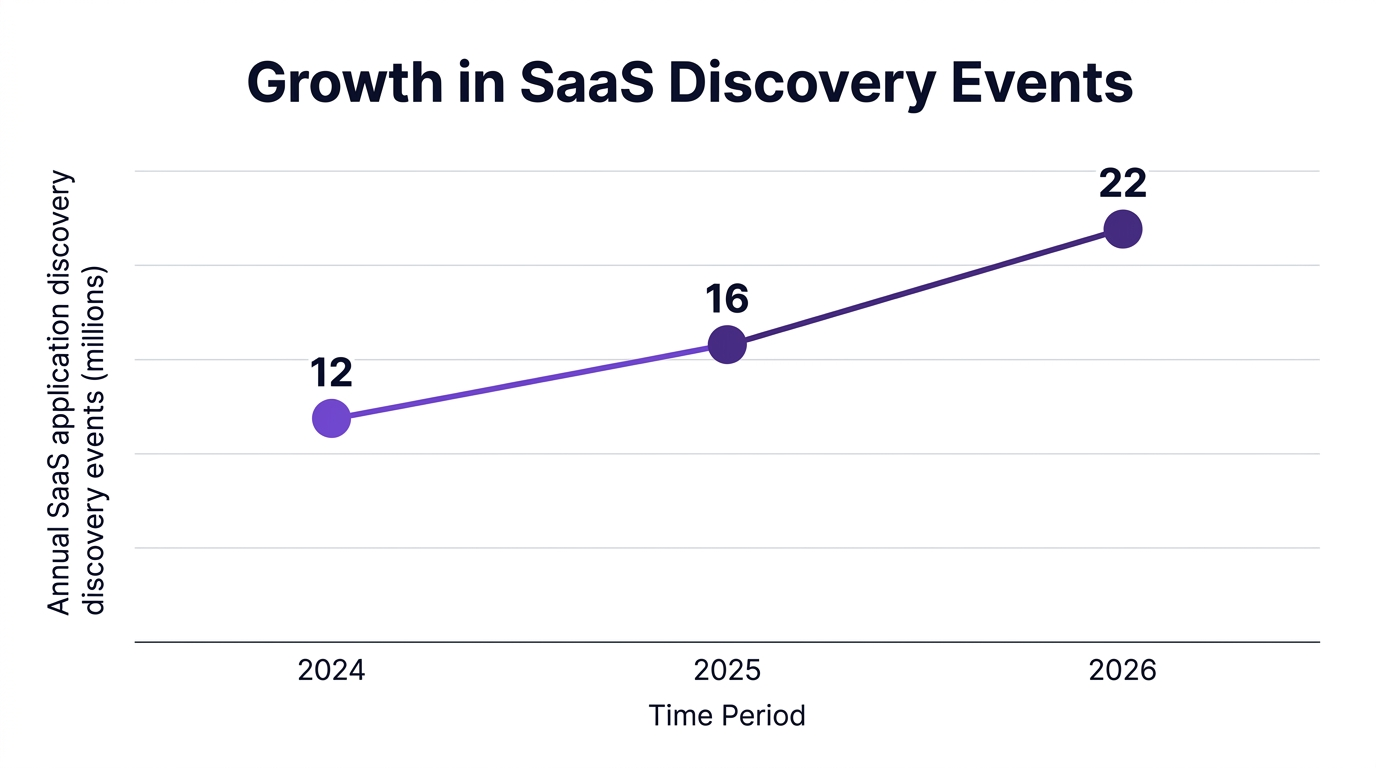
According to IDC in 2026, organizations that use automated SaaS discovery tools saw a 32% reduction in redundant SaaS spend within six months. Automation is not just a convenience, it is a cost control mechanism.
Once apps are discovered, they must be categorized. A robust saas discovery framework typically classifies applications by:
Business criticality, mission critical, important, low impact
Data sensitivity, regulated, confidential, internal, public
Ownership, business unit, sponsor, vendor contact
Risk score, combining security, compliance, and operational factors
Priya Malhotra, an IT security leader, highlighted that "having a dynamic and continuously updated SaaS discovery checklist" enables organizations to adapt faster to new risks and regulations. Embedding a repeatable classification schema into your saas discovery documentation is what makes this real.
A SaaS discovery runbook should connect directly into downstream governance. That includes:
Approval workflows for new SaaS requests
Policies for sanctioned vs unsanctioned apps
SaaS incident response runbook steps for risky or compromised apps
Rationalization criteria for redundant or underused tools
Info-Tech Research reported in 2026 that 68% of IT security teams shortened incident response times by adopting a discovery runbook integrated with real time SaaS monitoring. The key is coupling discovery with defined actions, otherwise your inventory becomes a static catalog instead of a control point.
The heart of your saas discovery runbook is a sequence of saas discovery process steps that any IT operations or security engineer can follow. Below is a practical blueprint you can adapt into your own discovery runbook template.
This phase sets the foundation for a repeatable discovery process. Treat it as a saas discovery workshop with key stakeholders. Key actions:
Define sponsors and owners
Assign executive sponsorship, often CIO or CISO.
Designate operational owners in IT operations, security, and finance.
Clarify outcomes
Agree on specific metrics, for example reduction in unknown apps, cost savings, risk reduction.
Define how results will feed into wider saas management runbook activities.
Select tools and data feeds
Identify which automated discovery tools and data sources will be connected.
Validate data access permissions and privacy requirements.
Counterargument: some teams argue they can skip formal alignment and run a saas discovery sprint informally. In practice, these efforts often stall once initial spreadsheets are produced because no one is accountable for ongoing operation.
The initial saas discovery sprint is akin to a software discovery playbook focused on visibility. It should be time-boxed, for example 2 to 4 weeks, and repeatable. Steps:
Aggregate identity and login data
Collect SSO logs and user authentication data.
Identify apps authenticated through corporate accounts.
Review financial and expense data
Analyze corporate card and expense reports.
Flag recurring SaaS-like charges.
Scan endpoints and browser extensions
Use endpoint management to discover locally configured SaaS tools.
Identify browser-based SaaS access patterns.
Compile and normalize findings
Merge results into a single discovery catalog.
Deduplicate and standardize app names and owners.
This initial sprint becomes the prototype for a discovery sprint runbook that can be triggered on a recurring schedule. A large financial institution that standardized such a sprint across five global offices saw USD 5.2 million in annual savings by cutting underused subscriptions and tightening governance, according to 2026 research.
Once you have a list of applications, you need to prioritise which ones deserve immediate attention. Here, a structured saas risk register template is critical. Key elements:
Data types processed, for example PHI, PCI, PII, internal documents
User population and geographic distribution
Integration with critical systems, identity, CRM, ERP
Security posture, MFA enforcement, public sharing, admin controls
A simple scoring model could assign points for each factor, resulting in categories such as High, Medium, Low. High risk applications feed directly into your saas incident response runbook, while medium and low risk apps follow standard approval or rationalization workflows.
This phase translates discovery insights into action. You move from visibility to control and cost discipline. Typical workflows:
Approve and register: Ensure sanctioned apps have owners, data classifications, and documented configurations.
Contain and replace: For unsanctioned apps with high risk, provide secure alternatives and plan migration.
Optimize licenses: Right size seats and plans based on actual usage.
Embed policies: Update IT and it security policies so new apps follow the standardized discovery path.
A multinational healthcare organization that adopted automated discovery and standardized response playbooks reduced Shadow IT instances by 60% and improved audit readiness in under a year, according to 2026 research.
Finally, your SaaS discovery runbook should not end after a single cycle. Modern SaaS environments require continuous monitoring. You can bring automation into the runbook using runbook automation for saas:
Scheduled discovery jobs against identity, financial, and endpoint data
Automated alerts for new high risk apps or unusual usage spikes
Integrated workflows that tie into ITSM, ticketing, and approval systems
Dashboards that give IT operations and finance leaders real time visibility
Everest Group reported that 54% of CIOs plan to invest in AI-driven SaaS discovery and management platforms by 2026. This aligns with the shift from manual discovery sprints to continuously running discovery frameworks.
Many enterprises already have various discovery artifacts, such as a technical discovery runbook, product discovery runbook, or client discovery runbook used in services and sales teams. Your saas discovery runbook should connect to these rather than exist in isolation.
A product discovery framework often focuses on understanding user needs and prioritizing features. Similarly, a saas feature discovery process aims to ensure new product capabilities match real requirements. Your SaaS discovery runbook should:
Provide a central source of truth for what existing SaaS tools can already deliver
Inform the solution discovery phase so teams avoid reinventing capabilities
Feed into a saas roadmap with effort estimates by revealing where consolidation or replacement makes sense
In other words, SaaS discovery provides the technology reality check that sits underneath higher level product and solution discovery.
Sales and customer facing teams often use a discovery call runbook to standardize discovery call questions saas. Aligning these with your SaaS discovery runbook ensures:
Client commitments about security and compliance match internal capabilities
Responses to RFPs reflect actual sanctioned SaaS tools
Any client specific SaaS onboarding flows follow the same controls
By linking customer facing client discovery runbook practices with internal SaaS governance, organizations reduce the risk of shadow solutions emerging during presales or implementation.
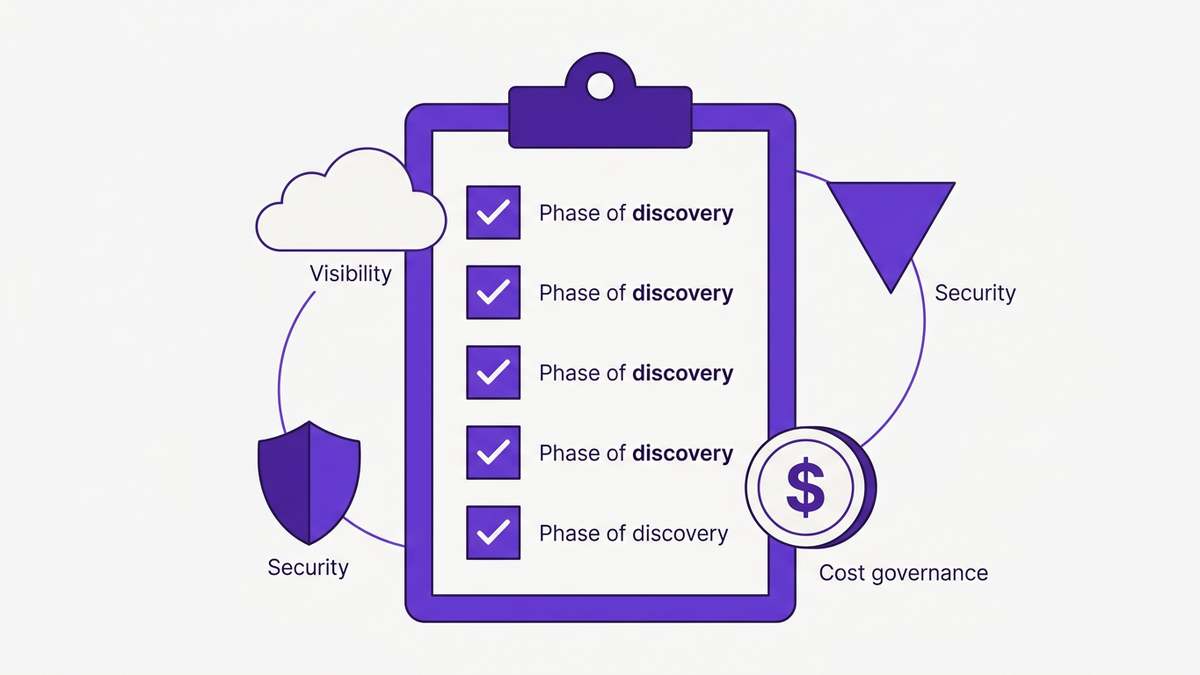
To operationalize your saas discovery playbook, it helps to distill everything into a straightforward saas discovery checklist. Teams can use this checklist as part of a saas discovery workshop or recurring saas discovery sprint. Phase 1, Preparation
[ ] Confirm executive sponsor and operational owner
[ ] Define scope, including business units and data types
[ ] Document tools and data sources to be used
Phase 2, Discovery
[ ] Pull identity and SSO logs
[ ] Extract corporate card and expense data
[ ] Scan endpoints and browser extensions
[ ] Consolidate apps into a single catalog
Phase 3, Assessment
[ ] Classify apps by business criticality and data sensitivity
[ ] Apply risk scoring and record in saas discovery documentation
[ ] Update the saas risk register template
Phase 4, Governance
[ ] Route high risk apps to saas incident response runbook flows
[ ] Assign owners to sanctioned apps
[ ] Plan rationalization for redundant or low value apps
Phase 5, Continuous monitoring
[ ] Schedule periodic saas discovery sprint cycles
[ ] Enable alerts for new or high risk apps
[ ] Review dashboards with IT operations and finance monthly
This checklist can also complement your broader saas management runbook, giving teams a repeatable, auditable process. For additional context on broader SaaS governance, see this saas management guide and this detailed overview of what is saas discovery.
A well crafted saas discovery runbook is only as effective as the data and automation behind it. CloudNuro is designed to act as the control plane that turns your discovery process from a static document into a living system.
CloudNuro’s Unified Cloud Custodian delivers 360° discovery across SaaS, cloud, and AI tools. For Phase 1 and Phase 2 of your runbook, this gives IT teams:
Automatic identification of sanctioned and unsanctioned SaaS apps in real time
Integration with identity, financial, and endpoint sources for comprehensive coverage
Built in classification capabilities that enrich your saas discovery documentation
This directly supports continuous shadow IT discovery, instead of quarterly spot checks.
With deep connectivity to more than 400 SaaS platforms, CloudNuro enables:
Fine grained license and usage visibility at the user and feature level
Automated feeds into your saas risk register template
Structured inputs for a broader saas audit process and governance reviews
This depth of integration is critical when building a software discovery playbook that does more than list app names. It lets your teams quantify risk, usage, and cost with precision.
CloudNuro’s AI Custodian brings intelligent security assessments into your saas incident response runbook. Key capabilities include:
Real time risk scoring of apps, including MFA configuration and public exposure detection
Automated security assessments that feed incident response workflows
Support for runbook automation for saas, so high risk events trigger predefined actions
This aligns strongly with Info-Tech Research findings that real time monitoring integrated with runbooks shortens incident response times for SaaS related events.
CloudNuro’s FinOps Services complement your saas discovery runbook with:
Expert guidance on cost optimization and rationalization
Implementation of chargeback and cost allocation models
Alignment with finance stakeholders to embed SaaS governance in budgeting cycles
By combining FinOps expertise with the platform’s automated discovery, organizations can move from reactive license cleanup to proactive financial discipline. For more perspective on end to end SaaS operations, CloudNuro provides a comprehensive guide to saas operations and a detailed view on why saas discovery first is essential for effective management in this article on saas discovery first for effective saas management.
A SaaS discovery runbook is a documented, repeatable set of procedures that IT and security teams use to identify, assess, and monitor SaaS applications in use across the organization. It typically includes saas discovery process steps, a saas discovery checklist, risk assessment criteria, and integration points with incident response and governance.
A complete runbook should cover:
Scope and objectives
Data sources and tools used to discover SaaS apps
Classification and risk scoring models
Governance and incident response workflows
Continuous monitoring and automation steps
Many teams also embed saas requirements gathering template artifacts and link the runbook to their broader saas management runbook.
Most enterprises start with a quarterly saas discovery sprint and move toward continuous monitoring as automation matures. High change environments, for example rapidly growing or highly regulated organizations, often shift to monthly cycles or real time alerting via runbook automation for saas.
A product discovery runbook focuses on understanding customer needs and validating features. A saas discovery runbook concentrates on identifying and governing the SaaS tools your organization uses. Both can connect, since SaaS discovery provides the technology inventory and risk context that informs product and solution decisions.
Common issues include treating discovery as a one time saas audit process, limiting scope to known enterprise apps, and failing to connect discovery findings to governance and cost control. A standardized runbook addresses these by defining recurring saas discovery process steps, linking to an incident response and optimization flow, and clarifying ownership.
Yes. By aligning your internal SaaS discovery runbook with a discovery call runbook and client discovery runbook, sales and delivery teams can ensure that commitments to clients reflect real, sanctioned SaaS capabilities and controls. This alignment reduces the risk of ad hoc solutions that bypass IT governance.
A robust saas discovery runbook gives IT, security, and finance leaders a repeatable, auditable way to control SaaS sprawl, reduce Shadow IT, and enforce compliance. It turns discovery from a reactive, spreadsheet driven activity into a continuous discipline supported by automation and AI. By combining a clear saas discovery playbook, a practical saas discovery checklist, and integrated automation, organizations can reduce redundant spend, shrink risk exposure, and strengthen governance. CloudNuro is built to help you operationalize this, plugging real time 360 degree discovery, risk scoring, and cost optimization into every phase of your runbook. If you are ready to standardize your SaaS discovery process and bring Shadow IT under control, explore how CloudNuro can support your next saas discovery sprint and beyond. About CloudNuro CloudNuro is a leader in Enterprise SaaS Management Platforms, providing enterprises with unmatched visibility, governance, and cost optimization. Recognized twice in a row in the SaaS Management Platforms category and named a Leader in the SoftwareReviews Data Quadrant, CloudNuro is trusted by global enterprises and government agencies to bring financial discipline to SaaS, cloud, and AI. Trusted by enterprises such as Konica Minolta and Federal Signal, CloudNuro provides centralized SaaS inventory, license optimization, and renewal management along with advanced cost allocation and chargeback, giving IT and Finance leaders the visibility, control, and cost-conscious culture needed to drive financial discipline.
Request a no cost, no obligation free assessment —just 15 minutes to savings!
Get StartedHow to Build a SaaS Discovery Runbook: A Step-by-Step Guide for IT Teams A structured SaaS discovery runbook has become a critical control point for IT and security teams that need real visibility, cost discipline, and governance across their SaaS estate. Gartner reports that 69% of enterprises saw an increase in SaaS applications discovered outside IT oversight in 2026, a clear signal that Shadow IT is growing, not shrinking. At the same time, Forrester found that 81% of IT leaders ranked SaaS discovery runbooks as a top priority for enforcing governance and reducing compliance risk in 2026. If your organization still relies on ad hoc spreadsheets, one-off discovery sprints, and manual audits, you are not just behind the curve, you are exposed. This guide walks IT, security, and finance teams through how to build a practical, repeatable SaaS discovery runbook, complete with clear SaaS discovery process steps, a reusable saas discovery checklist, and examples of how automation and AI can make the process continuous rather than episodic. You will also see how CloudNuro helps teams operationalize this runbook as part of a broader saas management runbook.
A SaaS discovery runbook is a documented, repeatable set of procedures that IT teams use to identify, assess, and continuously monitor all SaaS applications in use across the organization. Think of it as your "operating manual" for how to discover SaaS apps, validate them, and keep the inventory and risk posture current. Unlike a one-time saas audit process, a runbook standardizes:
Trigger conditions, for example quarterly review, new business unit onboarding, incident response
Data sources, such as identity logs, expense data, browser extensions, and network telemetry
Roles and responsibilities across IT, security, finance, and business owners
Workflows for risk assessment, remediation, and ongoing monitoring
A leading analyst described it succinctly: "A robust SaaS discovery runbook is now non-negotiable for IT teams" because without it organizations face spiraling SaaS costs and mounting exposure. Another analyst noted that properly implemented saas discovery frameworks can cut Shadow IT incidents by half, particularly when linked to automated governance workflows.
The risks of improvising the discovery process are not hypothetical. ISACA reported that 82% of organizations experienced at least one SaaS application related security incident in 2026 due to lack of standardized discovery.
Before you build a step-by-step saas discovery playbook, it helps to define the essential building blocks. These are the elements that every discovery runbook template should contain, regardless of sector or size.
Your runbook should clearly state:
Which environments it covers: corporate, subsidiaries, remote teams, contractors
What counts as a SaaS application: subscription tools, freemium services, AI tools, line of business SaaS platforms
Primary objectives: visibility, risk reduction, cost optimization, compliance, or all of the above
A common failure pattern is a runbook that targets only well known enterprise tools but ignores departmental or AI-based SaaS. A clear scope helps IT avoid blind spots and resist scope creep.
To answer the practical question of how to discover SaaS apps at scale, your runbook should define an explicit data strategy. Typical sources include:
Identity providers and SSO logs
Expense management and corporate card data
Network and DNS logs
Browser extension and endpoint telemetry
HR and onboarding systems
According to IDC in 2026, organizations that use automated SaaS discovery tools saw a 32% reduction in redundant SaaS spend within six months. Automation is not just a convenience, it is a cost control mechanism.
Once apps are discovered, they must be categorized. A robust saas discovery framework typically classifies applications by:
Business criticality, mission critical, important, low impact
Data sensitivity, regulated, confidential, internal, public
Ownership, business unit, sponsor, vendor contact
Risk score, combining security, compliance, and operational factors
Priya Malhotra, an IT security leader, highlighted that "having a dynamic and continuously updated SaaS discovery checklist" enables organizations to adapt faster to new risks and regulations. Embedding a repeatable classification schema into your saas discovery documentation is what makes this real.
A SaaS discovery runbook should connect directly into downstream governance. That includes:
Approval workflows for new SaaS requests
Policies for sanctioned vs unsanctioned apps
SaaS incident response runbook steps for risky or compromised apps
Rationalization criteria for redundant or underused tools
Info-Tech Research reported in 2026 that 68% of IT security teams shortened incident response times by adopting a discovery runbook integrated with real time SaaS monitoring. The key is coupling discovery with defined actions, otherwise your inventory becomes a static catalog instead of a control point.
The heart of your saas discovery runbook is a sequence of saas discovery process steps that any IT operations or security engineer can follow. Below is a practical blueprint you can adapt into your own discovery runbook template.
This phase sets the foundation for a repeatable discovery process. Treat it as a saas discovery workshop with key stakeholders. Key actions:
Define sponsors and owners
Assign executive sponsorship, often CIO or CISO.
Designate operational owners in IT operations, security, and finance.
Clarify outcomes
Agree on specific metrics, for example reduction in unknown apps, cost savings, risk reduction.
Define how results will feed into wider saas management runbook activities.
Select tools and data feeds
Identify which automated discovery tools and data sources will be connected.
Validate data access permissions and privacy requirements.
Counterargument: some teams argue they can skip formal alignment and run a saas discovery sprint informally. In practice, these efforts often stall once initial spreadsheets are produced because no one is accountable for ongoing operation.
The initial saas discovery sprint is akin to a software discovery playbook focused on visibility. It should be time-boxed, for example 2 to 4 weeks, and repeatable. Steps:
Aggregate identity and login data
Collect SSO logs and user authentication data.
Identify apps authenticated through corporate accounts.
Review financial and expense data
Analyze corporate card and expense reports.
Flag recurring SaaS-like charges.
Scan endpoints and browser extensions
Use endpoint management to discover locally configured SaaS tools.
Identify browser-based SaaS access patterns.
Compile and normalize findings
Merge results into a single discovery catalog.
Deduplicate and standardize app names and owners.
This initial sprint becomes the prototype for a discovery sprint runbook that can be triggered on a recurring schedule. A large financial institution that standardized such a sprint across five global offices saw USD 5.2 million in annual savings by cutting underused subscriptions and tightening governance, according to 2026 research.
Once you have a list of applications, you need to prioritise which ones deserve immediate attention. Here, a structured saas risk register template is critical. Key elements:
Data types processed, for example PHI, PCI, PII, internal documents
User population and geographic distribution
Integration with critical systems, identity, CRM, ERP
Security posture, MFA enforcement, public sharing, admin controls
A simple scoring model could assign points for each factor, resulting in categories such as High, Medium, Low. High risk applications feed directly into your saas incident response runbook, while medium and low risk apps follow standard approval or rationalization workflows.
This phase translates discovery insights into action. You move from visibility to control and cost discipline. Typical workflows:
Approve and register: Ensure sanctioned apps have owners, data classifications, and documented configurations.
Contain and replace: For unsanctioned apps with high risk, provide secure alternatives and plan migration.
Optimize licenses: Right size seats and plans based on actual usage.
Embed policies: Update IT and it security policies so new apps follow the standardized discovery path.
A multinational healthcare organization that adopted automated discovery and standardized response playbooks reduced Shadow IT instances by 60% and improved audit readiness in under a year, according to 2026 research.
Finally, your SaaS discovery runbook should not end after a single cycle. Modern SaaS environments require continuous monitoring. You can bring automation into the runbook using runbook automation for saas:
Scheduled discovery jobs against identity, financial, and endpoint data
Automated alerts for new high risk apps or unusual usage spikes
Integrated workflows that tie into ITSM, ticketing, and approval systems
Dashboards that give IT operations and finance leaders real time visibility
Everest Group reported that 54% of CIOs plan to invest in AI-driven SaaS discovery and management platforms by 2026. This aligns with the shift from manual discovery sprints to continuously running discovery frameworks.
Many enterprises already have various discovery artifacts, such as a technical discovery runbook, product discovery runbook, or client discovery runbook used in services and sales teams. Your saas discovery runbook should connect to these rather than exist in isolation.
A product discovery framework often focuses on understanding user needs and prioritizing features. Similarly, a saas feature discovery process aims to ensure new product capabilities match real requirements. Your SaaS discovery runbook should:
Provide a central source of truth for what existing SaaS tools can already deliver
Inform the solution discovery phase so teams avoid reinventing capabilities
Feed into a saas roadmap with effort estimates by revealing where consolidation or replacement makes sense
In other words, SaaS discovery provides the technology reality check that sits underneath higher level product and solution discovery.
Sales and customer facing teams often use a discovery call runbook to standardize discovery call questions saas. Aligning these with your SaaS discovery runbook ensures:
Client commitments about security and compliance match internal capabilities
Responses to RFPs reflect actual sanctioned SaaS tools
Any client specific SaaS onboarding flows follow the same controls
By linking customer facing client discovery runbook practices with internal SaaS governance, organizations reduce the risk of shadow solutions emerging during presales or implementation.
To operationalize your saas discovery playbook, it helps to distill everything into a straightforward saas discovery checklist. Teams can use this checklist as part of a saas discovery workshop or recurring saas discovery sprint. Phase 1, Preparation
[ ] Confirm executive sponsor and operational owner
[ ] Define scope, including business units and data types
[ ] Document tools and data sources to be used
Phase 2, Discovery
[ ] Pull identity and SSO logs
[ ] Extract corporate card and expense data
[ ] Scan endpoints and browser extensions
[ ] Consolidate apps into a single catalog
Phase 3, Assessment
[ ] Classify apps by business criticality and data sensitivity
[ ] Apply risk scoring and record in saas discovery documentation
[ ] Update the saas risk register template
Phase 4, Governance
[ ] Route high risk apps to saas incident response runbook flows
[ ] Assign owners to sanctioned apps
[ ] Plan rationalization for redundant or low value apps
Phase 5, Continuous monitoring
[ ] Schedule periodic saas discovery sprint cycles
[ ] Enable alerts for new or high risk apps
[ ] Review dashboards with IT operations and finance monthly
This checklist can also complement your broader saas management runbook, giving teams a repeatable, auditable process. For additional context on broader SaaS governance, see this saas management guide and this detailed overview of what is saas discovery.
A well crafted saas discovery runbook is only as effective as the data and automation behind it. CloudNuro is designed to act as the control plane that turns your discovery process from a static document into a living system.
CloudNuro’s Unified Cloud Custodian delivers 360° discovery across SaaS, cloud, and AI tools. For Phase 1 and Phase 2 of your runbook, this gives IT teams:
Automatic identification of sanctioned and unsanctioned SaaS apps in real time
Integration with identity, financial, and endpoint sources for comprehensive coverage
Built in classification capabilities that enrich your saas discovery documentation
This directly supports continuous shadow IT discovery, instead of quarterly spot checks.
With deep connectivity to more than 400 SaaS platforms, CloudNuro enables:
Fine grained license and usage visibility at the user and feature level
Automated feeds into your saas risk register template
Structured inputs for a broader saas audit process and governance reviews
This depth of integration is critical when building a software discovery playbook that does more than list app names. It lets your teams quantify risk, usage, and cost with precision.
CloudNuro’s AI Custodian brings intelligent security assessments into your saas incident response runbook. Key capabilities include:
Real time risk scoring of apps, including MFA configuration and public exposure detection
Automated security assessments that feed incident response workflows
Support for runbook automation for saas, so high risk events trigger predefined actions
This aligns strongly with Info-Tech Research findings that real time monitoring integrated with runbooks shortens incident response times for SaaS related events.
CloudNuro’s FinOps Services complement your saas discovery runbook with:
Expert guidance on cost optimization and rationalization
Implementation of chargeback and cost allocation models
Alignment with finance stakeholders to embed SaaS governance in budgeting cycles
By combining FinOps expertise with the platform’s automated discovery, organizations can move from reactive license cleanup to proactive financial discipline. For more perspective on end to end SaaS operations, CloudNuro provides a comprehensive guide to saas operations and a detailed view on why saas discovery first is essential for effective management in this article on saas discovery first for effective saas management.
A SaaS discovery runbook is a documented, repeatable set of procedures that IT and security teams use to identify, assess, and monitor SaaS applications in use across the organization. It typically includes saas discovery process steps, a saas discovery checklist, risk assessment criteria, and integration points with incident response and governance.
A complete runbook should cover:
Scope and objectives
Data sources and tools used to discover SaaS apps
Classification and risk scoring models
Governance and incident response workflows
Continuous monitoring and automation steps
Many teams also embed saas requirements gathering template artifacts and link the runbook to their broader saas management runbook.
Most enterprises start with a quarterly saas discovery sprint and move toward continuous monitoring as automation matures. High change environments, for example rapidly growing or highly regulated organizations, often shift to monthly cycles or real time alerting via runbook automation for saas.
A product discovery runbook focuses on understanding customer needs and validating features. A saas discovery runbook concentrates on identifying and governing the SaaS tools your organization uses. Both can connect, since SaaS discovery provides the technology inventory and risk context that informs product and solution decisions.
Common issues include treating discovery as a one time saas audit process, limiting scope to known enterprise apps, and failing to connect discovery findings to governance and cost control. A standardized runbook addresses these by defining recurring saas discovery process steps, linking to an incident response and optimization flow, and clarifying ownership.
Yes. By aligning your internal SaaS discovery runbook with a discovery call runbook and client discovery runbook, sales and delivery teams can ensure that commitments to clients reflect real, sanctioned SaaS capabilities and controls. This alignment reduces the risk of ad hoc solutions that bypass IT governance.
A robust saas discovery runbook gives IT, security, and finance leaders a repeatable, auditable way to control SaaS sprawl, reduce Shadow IT, and enforce compliance. It turns discovery from a reactive, spreadsheet driven activity into a continuous discipline supported by automation and AI. By combining a clear saas discovery playbook, a practical saas discovery checklist, and integrated automation, organizations can reduce redundant spend, shrink risk exposure, and strengthen governance. CloudNuro is built to help you operationalize this, plugging real time 360 degree discovery, risk scoring, and cost optimization into every phase of your runbook. If you are ready to standardize your SaaS discovery process and bring Shadow IT under control, explore how CloudNuro can support your next saas discovery sprint and beyond. About CloudNuro CloudNuro is a leader in Enterprise SaaS Management Platforms, providing enterprises with unmatched visibility, governance, and cost optimization. Recognized twice in a row in the SaaS Management Platforms category and named a Leader in the SoftwareReviews Data Quadrant, CloudNuro is trusted by global enterprises and government agencies to bring financial discipline to SaaS, cloud, and AI. Trusted by enterprises such as Konica Minolta and Federal Signal, CloudNuro provides centralized SaaS inventory, license optimization, and renewal management along with advanced cost allocation and chargeback, giving IT and Finance leaders the visibility, control, and cost-conscious culture needed to drive financial discipline.
Request a no cost, no obligation free assessment - just 15 minutes to savings!
Get StartedWe're offering complimentary ServiceNow license assessments to only 25 enterprises this quarter who want to unlock immediate savings without disrupting operations.
Get Free AssessmentGet Started




CloudNuro Corp
1755 Park St. Suite 207
Naperville, IL 60563
Phone : +1-630-277-9470
Email: info@cloudnuro.com





.webp)

Recognized Leader in SaaS Management Platforms by Info-Tech SoftwareReviews


.svg)