

Sign Up
Thank you for Submitting!
The joiner mover leaver process has quietly become one of the most critical control points for IT, security, and finance leaders. As SaaS adoption accelerates and identities multiply across hundreds of systems, every employee transition can either reduce risk and cost, or introduce hidden exposure.
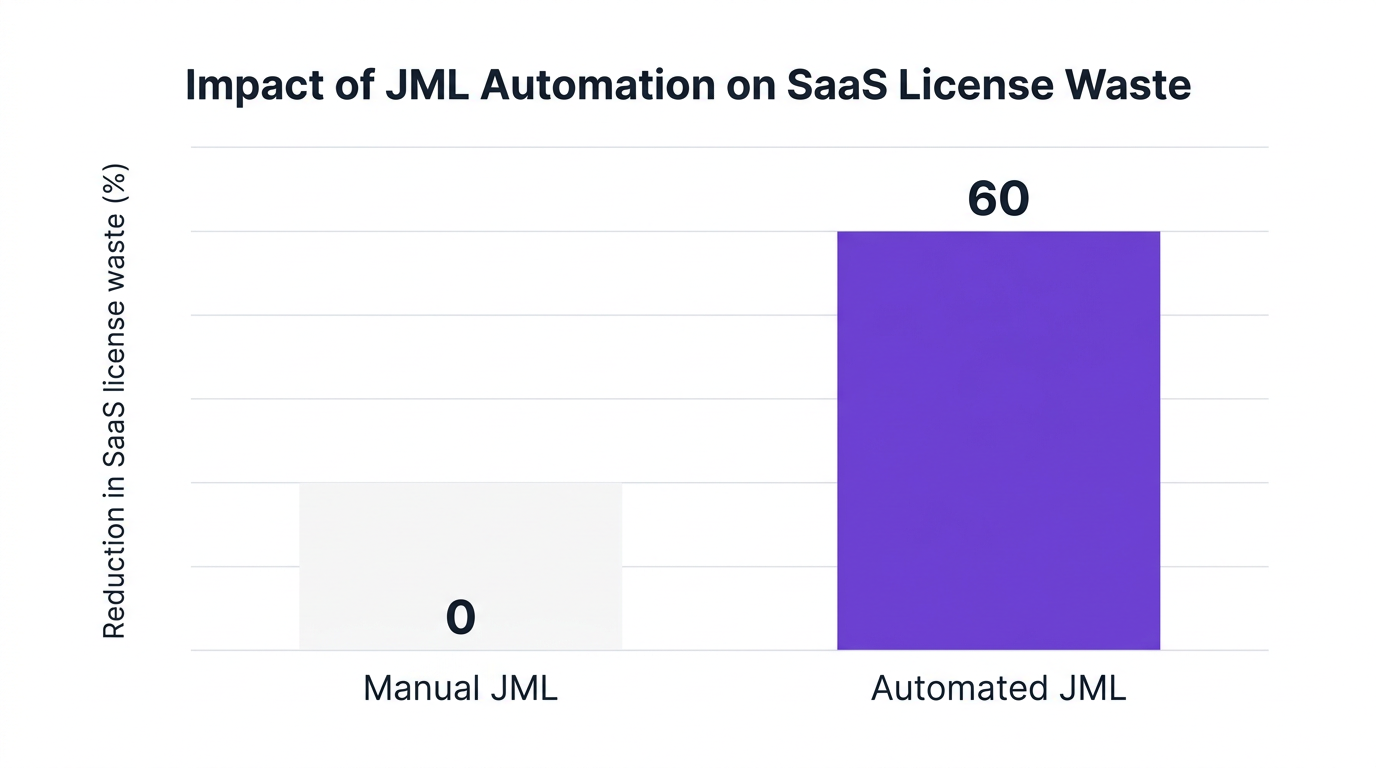
A clear, automated JML workflow is now a cornerstone of identity governance, SaaS compliance, and cloud access risk management. According to Gartner in 2026, automation of the joiner-mover-leaver process reduces time spent on provisioning and deprovisioning by 55% on average. At the same time, IDC in 2026 found that enterprises using automated JML platforms saw a 60% reduction in SaaS license waste.
This guide breaks down the JML process meaning, why IT and security teams must care, and how to operationalize JML automation at scale, with a focus on SaaS access governance and continuous compliance.
The joiner mover leaver process is a structured approach to managing digital identities and access throughout the employee lifecycle. It covers three key stages: when people join, move within, or leave the organization.
In identity and access management SaaS environments, JML is the backbone of user lifecycle management. It defines how you perform user provisioning automation, access deprovisioning, and role-based access controls consistently across all systems.
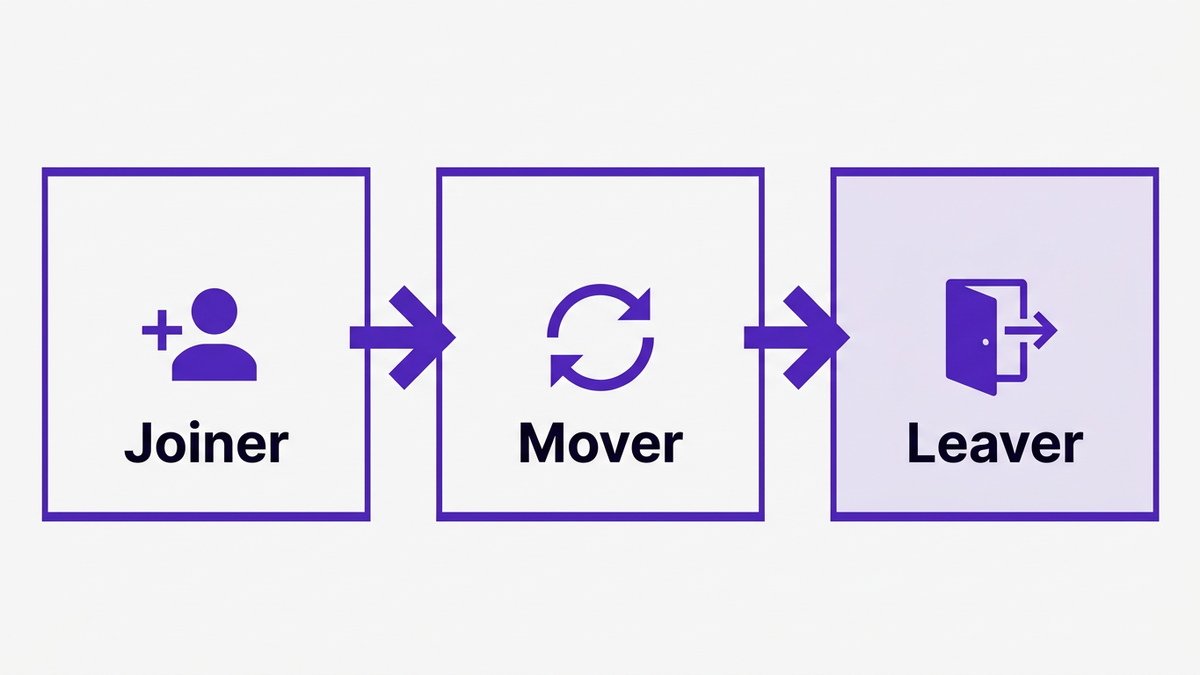
At a high level, the JML workflow includes:
In a SaaS-heavy environment, each step can touch dozens or hundreds of apps. Without standardized JML automation, inconsistencies and blind spots appear quickly.
The business case for a robust joiner mover leaver process is both defensive and offensive: reduce breach risk while cutting wasted spend and manual toil.
Identity-related risk is no longer theoretical. Verizon reported in 2026 that 81% of organizations identified inadequate employee offboarding as a primary cause of data breaches related to user lifecycle management. ISACA in 2026 found that 94% of security incidents involving leaver processes stemmed from delayed or incomplete deprovisioning.
From an IT and security perspective, strong JML controls support:
Forrester reported in 2026 that 74% of IT leaders say automating JML workflows improved audit outcomes and compliance posture. That impact extends beyond security to finance and operations.
Manual handling of mover events is a major source of access creep. KPMG reported in 2026 that 65% of enterprises faced access creep risks due to manual handling of mover events in the employee lifecycle.
The same behavior inflates SaaS license spend. IDC in 2026 reported that enterprises with automated JML platforms saw a 60% reduction in SaaS license waste. Unused or misaligned licenses fall away when access provisioning is tightly coupled to role-based access controls and user lifecycle management.
In other words, a disciplined JML process is to SaaS access what a spend policy is to corporate cards. If you do not define and automate it, cost and risk quietly spiral.
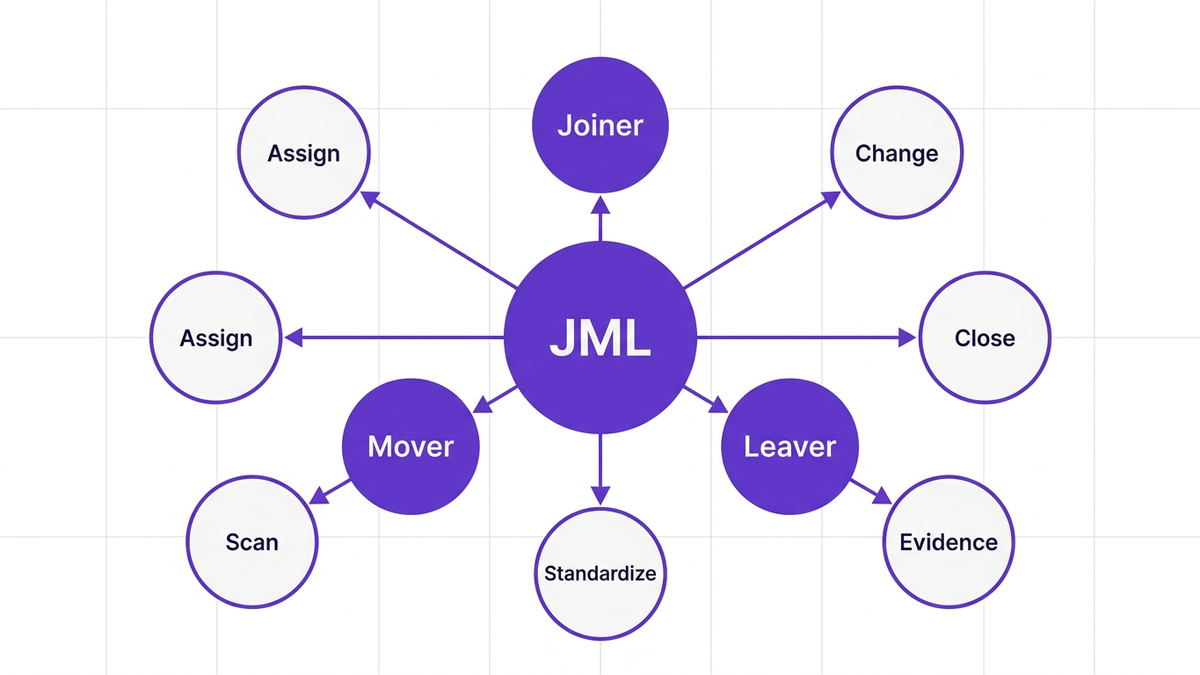
To operationalize JML automation, IT and security leaders need a control framework that spans the full employee lifecycle management journey. A useful way to approach this is the ACCESS framework: Assign, Change, Close, Evidence, Standardize, and Scan.
For joiners, the focus is on accurate, secure, and timely access provisioning.
Key controls include:
An effective enterprise onboarding process ensures that every new user has what they need on day one, without over-privileging. This is where zero trust onboarding meets productivity.
Mover events are the most underspecified aspect of the joiner mover leaver process. Promotions, internal transfers, and temporary projects all create permission drift.
Key controls for movers:
Think of mover events as “access refactoring” moments. If a developer moves into a people manager role, their production access should decrease while HR system access increases. Without automated IT security automation, the developer simply accumulates permissions over time.
Leaver events are where risk concentrates. Offboarding security failures produce orphaned accounts and uncontrolled data access.
Key controls:
ISACA’s 2026 analysis that 94% of security incidents involving leaver processes stem from delayed or incomplete deprovisioning highlights how critical timing is. Even a 24-hour lag in a high-risk role can be unacceptable.
Across all three stages, organizations should also:
These steps are essential for SaaS compliance, continuous access compliance, and cloud access risk management.
For more detail on access certification, see this complete user access review checklist and guidance on identity and access management best practices.
Automating the joiner mover leaver process is not just about speed. It is about consistency, control, and measurable improvements in both security and spend.
Gartner reported in 2026 that automation of JML processes reduces time spent on provisioning and deprovisioning by 55% on average. That time reduction turns into increased capacity for higher-value IT operations and risk mitigation IT projects.
Automated JML workflows support:
Forrester’s 2026 insight that continuous, automated access reviews embedded in the JML process are now a best practice aligns with the shift toward zero trust and continuous access compliance.
On the cost side, automated JML processes:
IDC’s 2026 finding that automated JML platforms deliver a 60% reduction in SaaS license waste is a direct reflection of this behavior. Enterprises can then reinvest those savings into strategic IT and security initiatives.
Some leaders argue that JML automation can be over-engineered and that human judgment is still required for edge cases. That is true, but it is a reason to design good exception workflows, not avoid automation.
The real failure mode is partial automation: a few systems automated, but many handled manually. This creates a false sense of security. Auditors and attackers alike will find the weakest link.
A pragmatic approach is to prioritize high-risk and high-cost systems first, such as identity providers and major SaaS platforms, then expand.
For a detailed view of critical flows, see this guide on SaaS user access provisioning and deprovisioning.
To translate theory into execution, IT and security leaders need an implementation plan that works across hybrid environments.
A practical blueprint breaks into five steps:
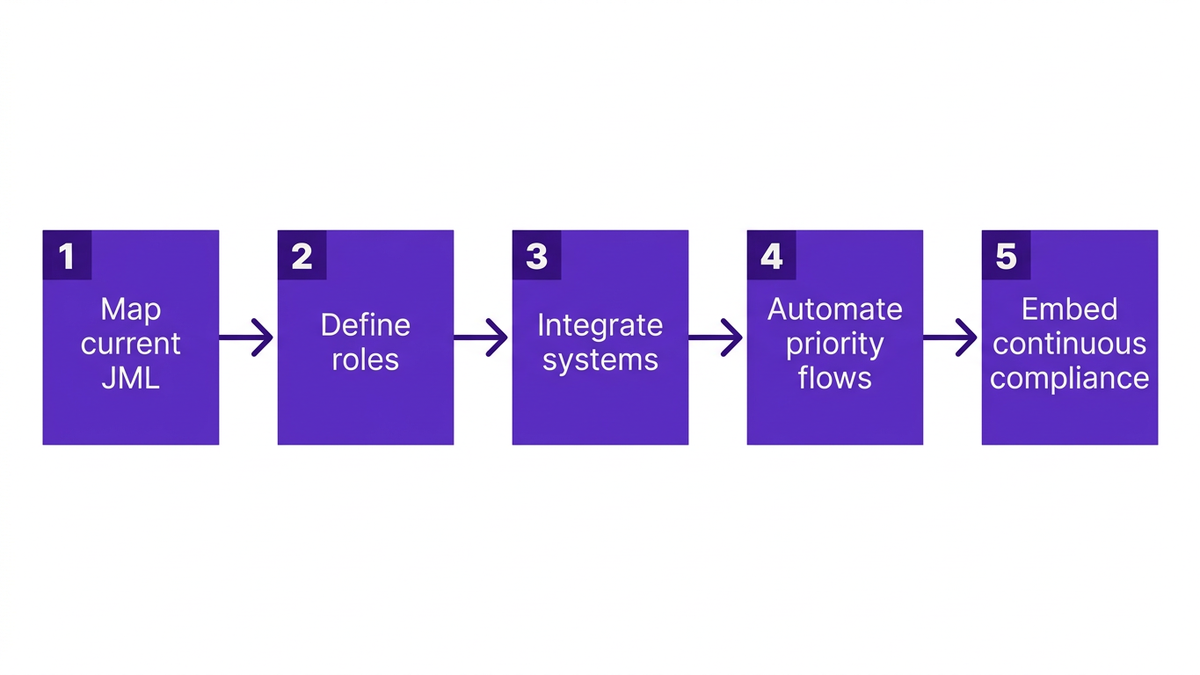
Document existing joiner mover leaver workflows across HR, IT, security, and business units.
Identify:
Treat this like an IT asset management discovery exercise. The goal is visibility, not perfection.
Work with business owners to standardize role-based access controls.
Create:
This helps reduce decision fatigue during onboarding and limits access sprawl during mover events.
A robust JML automation strategy requires tight integration among HR, identity, and target SaaS systems.
Priorities include:
This is also the stage where you select automated IT onboarding solutions or SaaS management platforms that can orchestrate the end-to-end JML workflow.
Start where the risk and ROI are highest.
Examples:
Build reusable templates so new workflows can be added with minimal friction.
Finally, embed monitoring and reviews into the JML process.
Key practices:
This turns JML from a one-time project into an ongoing control system.
For additional guidance on operationalizing lifecycle controls, explore CloudNuro’s solutions for IT security and IT operations.
CloudNuro is built for organizations that need strong JML automation, governance-first SaaS management, and measurable cost optimization.
The platform brings together identity governance, IT onboarding automation, and SaaS access governance in a single AI-enabled control plane.
CloudNuro AI Custodian automates onboarding, role transitions, and offboarding across more than 400 SaaS platforms.
Capabilities include:
This reduces manual tasks, improves offboarding security, and directly addresses JML-related audit findings.
For core SaaS platforms such as collaboration and CRM, CloudNuro provides dedicated custodians.
These modules deliver:
By connecting JML events to license optimization, organizations can reduce SaaS waste while tightening cloud access risk management.
CloudNuro’s FinOps Services extend JML automation into cost governance.
They provide:
A CloudNuro case study from 2026 showed a global financial institution reducing offboarding times by 64%, eliminating orphaned accounts, and cutting access governance audit findings by 88% with a CloudNuro-powered JML automation solution.
Another healthcare organization achieved full audit compliance and a 42% decrease in SaaS license spend by aligning mover events with automated role-based access changes.
CloudNuro’s broader SaaS management and IT asset management capabilities ensure that JML automation is not isolated, but part of an integrated governance program.
The JML process meaning refers to how an organization manages user access when people join, move within, or leave the company. It is a structured employee lifecycle management approach that ensures accounts and permissions are correctly provisioned and deprovisioned.
In practical terms, it connects HR events to IT onboarding automation, role change IT process updates, and offboarding security actions.
IT and security teams are responsible for ensuring that the right people have the right access at the right time.
A robust joiner mover leaver process reduces the risk of data breaches, supports SaaS compliance, and helps control SaaS costs.
Given that 81% of organizations cite poor offboarding as a cause of lifecycle-related breaches, and 94% of leaver incidents stem from delayed deprovisioning, JML controls are central to risk mitigation IT strategy.
JML automation standardizes IT access control best practices and embeds audit trails into every lifecycle event.
Automated JML workflows record who requested access, who approved it, when access was granted or revoked, and why. This evidence simplifies external audits and internal reviews.
Forrester in 2026 found that 74% of IT leaders saw improved audit outcomes after automating JML workflows.
Key best practices include:
These practices help organizations shift from manual, spreadsheet-driven processes to governed, automated JML programs.
Managing JML manually across large SaaS portfolios does not scale.
Organizations can adopt automated IT onboarding solutions or SaaS management platforms, such as CloudNuro, that provide connectors into hundreds of apps and centralize JML workflow orchestration.
This approach reduces integration complexity and ensures that joiner mover leaver events are consistently reflected in all connected systems.
The joiner mover leaver process is no longer a back-office HR concern. It is a frontline control for identity governance, SaaS compliance, and FinOps.
Automation of JML workflows can reduce provisioning time by more than half, cut SaaS license waste by 60%, and materially improve audit outcomes. Conversely, weak offboarding security and unmanaged mover events create both breach risk and budget drag.
CloudNuro helps IT, security, and finance leaders turn JML from a fragile manual process into a governed, AI-enabled control system that spans onboarding and offboarding automation, role change IT process flows, and continuous access compliance.
If you are ready to modernize your joiner mover leaver process and align it with your security and cost optimization goals, explore how CloudNuro can support your JML automation strategy at https://www.cloudnuro.ai/.
Request a no cost, no obligation free assessment —just 15 minutes to savings!
Get StartedThe joiner mover leaver process has quietly become one of the most critical control points for IT, security, and finance leaders. As SaaS adoption accelerates and identities multiply across hundreds of systems, every employee transition can either reduce risk and cost, or introduce hidden exposure.
A clear, automated JML workflow is now a cornerstone of identity governance, SaaS compliance, and cloud access risk management. According to Gartner in 2026, automation of the joiner-mover-leaver process reduces time spent on provisioning and deprovisioning by 55% on average. At the same time, IDC in 2026 found that enterprises using automated JML platforms saw a 60% reduction in SaaS license waste.
This guide breaks down the JML process meaning, why IT and security teams must care, and how to operationalize JML automation at scale, with a focus on SaaS access governance and continuous compliance.
The joiner mover leaver process is a structured approach to managing digital identities and access throughout the employee lifecycle. It covers three key stages: when people join, move within, or leave the organization.
In identity and access management SaaS environments, JML is the backbone of user lifecycle management. It defines how you perform user provisioning automation, access deprovisioning, and role-based access controls consistently across all systems.
At a high level, the JML workflow includes:
In a SaaS-heavy environment, each step can touch dozens or hundreds of apps. Without standardized JML automation, inconsistencies and blind spots appear quickly.
The business case for a robust joiner mover leaver process is both defensive and offensive: reduce breach risk while cutting wasted spend and manual toil.
Identity-related risk is no longer theoretical. Verizon reported in 2026 that 81% of organizations identified inadequate employee offboarding as a primary cause of data breaches related to user lifecycle management. ISACA in 2026 found that 94% of security incidents involving leaver processes stemmed from delayed or incomplete deprovisioning.
From an IT and security perspective, strong JML controls support:
Forrester reported in 2026 that 74% of IT leaders say automating JML workflows improved audit outcomes and compliance posture. That impact extends beyond security to finance and operations.
Manual handling of mover events is a major source of access creep. KPMG reported in 2026 that 65% of enterprises faced access creep risks due to manual handling of mover events in the employee lifecycle.
The same behavior inflates SaaS license spend. IDC in 2026 reported that enterprises with automated JML platforms saw a 60% reduction in SaaS license waste. Unused or misaligned licenses fall away when access provisioning is tightly coupled to role-based access controls and user lifecycle management.
In other words, a disciplined JML process is to SaaS access what a spend policy is to corporate cards. If you do not define and automate it, cost and risk quietly spiral.
To operationalize JML automation, IT and security leaders need a control framework that spans the full employee lifecycle management journey. A useful way to approach this is the ACCESS framework: Assign, Change, Close, Evidence, Standardize, and Scan.
For joiners, the focus is on accurate, secure, and timely access provisioning.
Key controls include:
An effective enterprise onboarding process ensures that every new user has what they need on day one, without over-privileging. This is where zero trust onboarding meets productivity.
Mover events are the most underspecified aspect of the joiner mover leaver process. Promotions, internal transfers, and temporary projects all create permission drift.
Key controls for movers:
Think of mover events as “access refactoring” moments. If a developer moves into a people manager role, their production access should decrease while HR system access increases. Without automated IT security automation, the developer simply accumulates permissions over time.
Leaver events are where risk concentrates. Offboarding security failures produce orphaned accounts and uncontrolled data access.
Key controls:
ISACA’s 2026 analysis that 94% of security incidents involving leaver processes stem from delayed or incomplete deprovisioning highlights how critical timing is. Even a 24-hour lag in a high-risk role can be unacceptable.
Across all three stages, organizations should also:
These steps are essential for SaaS compliance, continuous access compliance, and cloud access risk management.
For more detail on access certification, see this complete user access review checklist and guidance on identity and access management best practices.
Automating the joiner mover leaver process is not just about speed. It is about consistency, control, and measurable improvements in both security and spend.
Gartner reported in 2026 that automation of JML processes reduces time spent on provisioning and deprovisioning by 55% on average. That time reduction turns into increased capacity for higher-value IT operations and risk mitigation IT projects.
Automated JML workflows support:
Forrester’s 2026 insight that continuous, automated access reviews embedded in the JML process are now a best practice aligns with the shift toward zero trust and continuous access compliance.
On the cost side, automated JML processes:
IDC’s 2026 finding that automated JML platforms deliver a 60% reduction in SaaS license waste is a direct reflection of this behavior. Enterprises can then reinvest those savings into strategic IT and security initiatives.
Some leaders argue that JML automation can be over-engineered and that human judgment is still required for edge cases. That is true, but it is a reason to design good exception workflows, not avoid automation.
The real failure mode is partial automation: a few systems automated, but many handled manually. This creates a false sense of security. Auditors and attackers alike will find the weakest link.
A pragmatic approach is to prioritize high-risk and high-cost systems first, such as identity providers and major SaaS platforms, then expand.
For a detailed view of critical flows, see this guide on SaaS user access provisioning and deprovisioning.
To translate theory into execution, IT and security leaders need an implementation plan that works across hybrid environments.
A practical blueprint breaks into five steps:
Document existing joiner mover leaver workflows across HR, IT, security, and business units.
Identify:
Treat this like an IT asset management discovery exercise. The goal is visibility, not perfection.
Work with business owners to standardize role-based access controls.
Create:
This helps reduce decision fatigue during onboarding and limits access sprawl during mover events.
A robust JML automation strategy requires tight integration among HR, identity, and target SaaS systems.
Priorities include:
This is also the stage where you select automated IT onboarding solutions or SaaS management platforms that can orchestrate the end-to-end JML workflow.
Start where the risk and ROI are highest.
Examples:
Build reusable templates so new workflows can be added with minimal friction.
Finally, embed monitoring and reviews into the JML process.
Key practices:
This turns JML from a one-time project into an ongoing control system.
For additional guidance on operationalizing lifecycle controls, explore CloudNuro’s solutions for IT security and IT operations.
CloudNuro is built for organizations that need strong JML automation, governance-first SaaS management, and measurable cost optimization.
The platform brings together identity governance, IT onboarding automation, and SaaS access governance in a single AI-enabled control plane.
CloudNuro AI Custodian automates onboarding, role transitions, and offboarding across more than 400 SaaS platforms.
Capabilities include:
This reduces manual tasks, improves offboarding security, and directly addresses JML-related audit findings.
For core SaaS platforms such as collaboration and CRM, CloudNuro provides dedicated custodians.
These modules deliver:
By connecting JML events to license optimization, organizations can reduce SaaS waste while tightening cloud access risk management.
CloudNuro’s FinOps Services extend JML automation into cost governance.
They provide:
A CloudNuro case study from 2026 showed a global financial institution reducing offboarding times by 64%, eliminating orphaned accounts, and cutting access governance audit findings by 88% with a CloudNuro-powered JML automation solution.
Another healthcare organization achieved full audit compliance and a 42% decrease in SaaS license spend by aligning mover events with automated role-based access changes.
CloudNuro’s broader SaaS management and IT asset management capabilities ensure that JML automation is not isolated, but part of an integrated governance program.
The JML process meaning refers to how an organization manages user access when people join, move within, or leave the company. It is a structured employee lifecycle management approach that ensures accounts and permissions are correctly provisioned and deprovisioned.
In practical terms, it connects HR events to IT onboarding automation, role change IT process updates, and offboarding security actions.
IT and security teams are responsible for ensuring that the right people have the right access at the right time.
A robust joiner mover leaver process reduces the risk of data breaches, supports SaaS compliance, and helps control SaaS costs.
Given that 81% of organizations cite poor offboarding as a cause of lifecycle-related breaches, and 94% of leaver incidents stem from delayed deprovisioning, JML controls are central to risk mitigation IT strategy.
JML automation standardizes IT access control best practices and embeds audit trails into every lifecycle event.
Automated JML workflows record who requested access, who approved it, when access was granted or revoked, and why. This evidence simplifies external audits and internal reviews.
Forrester in 2026 found that 74% of IT leaders saw improved audit outcomes after automating JML workflows.
Key best practices include:
These practices help organizations shift from manual, spreadsheet-driven processes to governed, automated JML programs.
Managing JML manually across large SaaS portfolios does not scale.
Organizations can adopt automated IT onboarding solutions or SaaS management platforms, such as CloudNuro, that provide connectors into hundreds of apps and centralize JML workflow orchestration.
This approach reduces integration complexity and ensures that joiner mover leaver events are consistently reflected in all connected systems.
The joiner mover leaver process is no longer a back-office HR concern. It is a frontline control for identity governance, SaaS compliance, and FinOps.
Automation of JML workflows can reduce provisioning time by more than half, cut SaaS license waste by 60%, and materially improve audit outcomes. Conversely, weak offboarding security and unmanaged mover events create both breach risk and budget drag.
CloudNuro helps IT, security, and finance leaders turn JML from a fragile manual process into a governed, AI-enabled control system that spans onboarding and offboarding automation, role change IT process flows, and continuous access compliance.
If you are ready to modernize your joiner mover leaver process and align it with your security and cost optimization goals, explore how CloudNuro can support your JML automation strategy at https://www.cloudnuro.ai/.
Request a no cost, no obligation free assessment - just 15 minutes to savings!
Get StartedWe're offering complimentary ServiceNow license assessments to only 25 enterprises this quarter who want to unlock immediate savings without disrupting operations.
Get Free AssessmentGet Started




CloudNuro Corp
1755 Park St. Suite 207
Naperville, IL 60563
Phone : +1-630-277-9470
Email: info@cloudnuro.com




.webp)

Recognized Leader in SaaS Management Platforms by Info-Tech SoftwareReviews



.svg)