
Sign Up
Thank you for Submitting!
A model router decides which model answers each request. An AI gateway governs every request that reaches any model: identity, budgets, fallback, logging, and policy.
Most enterprise AI teams need both, with the router running inside the gateway, because routing controls cost per request while the gateway controls who spends, on what, and under which rules.
This post compares the two layers side by side, explains the five differences that matter, and gives a decision guide for choosing where to start.
Enterprise AI has moved from one model behind one chatbot to dozens of models behind hundreds of applications and agents.
That shift creates two separate problems. One is technical: which model should answer this request? The other is organizational: who is allowed to call models, how much can they spend, and what gets logged?
The model router vs AI gateway debate is really a debate about which problem to solve first. CIOs, platform engineering leads, and FinOps teams feel it most, because each owns one half of the answer.
The same pattern has played out before with shadow AI and unsanctioned AI tools: usage grows faster than the controls around it.
This guide defines both layers, compares them on ownership, scope, and cost control, and shows how enterprise teams combine them.
A model router is a decision engine. An AI gateway is a control plane that usually includes routing as one of its capabilities.
| Dimension | Model Router | AI Gateway |
|---|---|---|
| Definition | Selects the model for each request by cost, latency, capability, or predicted quality | Centralizes and governs all application-to-model traffic |
| Who owns it | Application or ML engineering team | Platform engineering, security, and FinOps together |
| Typical deployment | SDK, library, sidecar, or routing service inside an application | Shared service or reverse proxy in front of all applications and providers |
| Data required | The prompt, task type, and model benchmarks | Identity, team, project, budget, and policy metadata |
| Behaviour it drives | Lower cost and latency per request | Accountable, auditable AI usage across the enterprise |
| Best for | One high-volume application with mixed task difficulty | Many teams, many models, and audit or budget obligations |
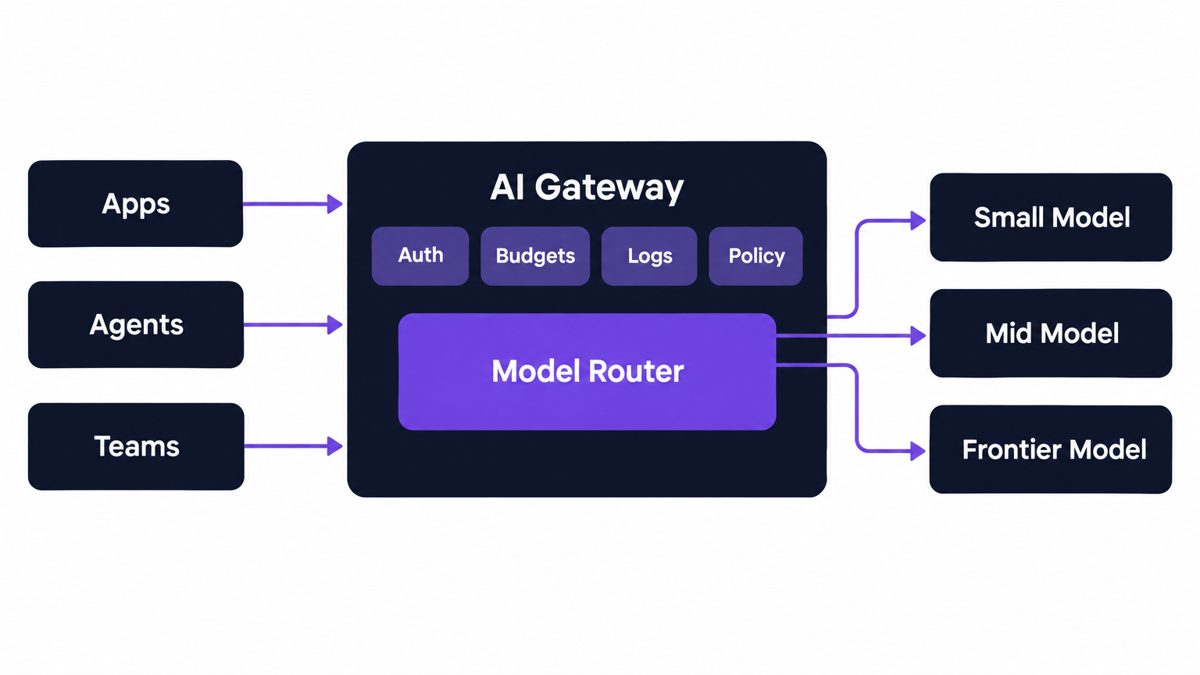
The model router sits inside the AI gateway: the gateway decides whether a request may run, and the router decides where it runs.
A model router answers one question per request: which model? It classifies the prompt with rules, a classifier, or a confidence score, then sends simple work to a smaller model and hard work to a frontier model.
An AI gateway answers a wider set: is this caller authenticated, is the team within budget, does this prompt contain restricted data, and should this call be logged for audit?
For a deeper look at routing strategies, see CloudNuro's guide to what an AI model router does and when you need one.
Verdict: the router optimizes one request; the gateway governs all requests.
A model router lowers unit cost. When most requests are routine, matching each task to the cheapest capable model reduces the token bill without changing the application.
An AI gateway controls total spend. It enforces quotas and budgets per user, team, application, project, or environment, and it attributes every token to an owner.
CloudNuro's walkthrough of how model routing cuts LLM costs covers the unit-cost side, and TokenOps as a FinOps practice covers the attribution side.
Verdict: routing makes each call cheaper; the gateway makes the total accountable.
Model routers have limited or implementation-dependent authentication. They trust the application that calls them.
AI gateways centralize API keys, provider credentials, role-based access, and tenant separation. They are where policy guardrails, data redaction, and request logs live, which is what a CISO needs for an audit.
Verdict: if an auditor will ask who called which model with what data, you need a gateway.
Some routers support fallback to a second model when the first fails. That protects one application.
Gateways apply multi-provider fallback, retries, circuit breaking, and outage controls across every application at once, so one provider incident does not take down every AI feature in the company.
Verdict: application-level fallback belongs in the router; enterprise-level resilience belongs in the gateway.
A router logs its routing decisions and basic latency and cost data. That helps engineers tune routing rules.
A gateway records token usage, latency, errors, traces, and cost by user, team, and model. That gives Finance a basis for showback and chargeback of AI spend.
Verdict: router telemetry serves engineers; gateway telemetry serves engineering, security, and Finance.
See how AgentNuro brings AI usage, models, and token spend into one governed view: request a demo.
Start with a model router if one application drives most of your AI spend and its requests vary widely in difficulty. Start with an AI gateway if several teams call several providers and nobody can say who spent what.
One product team owns one high-volume workload, uses a single provider account, and has no cross-team budget or audit requirement yet.
AI agents and copilots are spreading across departments, provider keys are scattered, and security or Finance has started asking for a usage inventory.
Most enterprises follow the same path as showback before chargeback: first make usage visible through a gateway, then add routing inside it once you know which workloads carry the cost.
Neither layer tells you about AI used outside it, such as AI features inside SaaS applications or tools bought on a corporate card. That is where AI adoption management, as described in CloudNuro's guide to FinOps beyond cloud, closes the gap.
CloudNuro delivers results in under 24 hours. Get your free savings assessment.
A model router selects which model handles each request, while an AI gateway governs all model traffic with authentication, budgets, fallback, logging, and policy. Most AI gateways include routing as one capability.
Enterprises running AI across several teams usually need both, with the router operating inside the gateway. The gateway decides whether a request may run, and the router decides which model runs it.
An AI gateway reduces LLM costs by enforcing budgets and quotas and by attributing every token to an owner. Pairing it with routing also lowers the cost of each individual request.
The AI gateway is usually owned by platform engineering, with security setting policy and FinOps setting budgets. Shared ownership keeps it from becoming a purely technical tool with no cost accountability.
A model router enforces governance only in a limited way, such as keeping sensitive tasks on approved models. Identity, audit logging, and budget enforcement belong in the gateway or a governance layer above it.
CloudNuro, through AgentNuro, adds AI adoption management above both layers: AI discovery, TokenOps, AI spend visibility, and policy guardrails across SaaS, cloud, and AI. Learn more about the CloudNuro AI Custodian.
The model router vs AI gateway choice is a question of sequence, not exclusion. Routing lowers the cost of each request; a gateway makes every request authorized, logged, and owned. Organizations that add routing without governance get cheaper calls they still cannot attribute or audit. The better model is unified visibility and accountability across SaaS, cloud, and AI, with routing as one control inside it.
AgentNuro, CloudNuro's Enterprise AI Adoption Management product, gives IT and Finance one view of AI usage, models, and token spend, including AI that never passes through your gateway. It pairs AI discovery and TokenOps with policy guardrails, so every AI cost has an owner. Explore it at AgentNuro.ai, alongside CloudNuro SaaS management.
CloudNuro is a leader in Enterprise AI Adoption Management, providing enterprises with unmatched visibility, governance, and cost optimization. Recognized twice in a row in the SaaS Management Platforms category and named a Leader in the SoftwareReviews Data Quadrant, CloudNuro is trusted by global enterprises and government agencies to bring financial discipline to SaaS, cloud, and AI. Trusted by enterprises, CloudNuro provides centralized SaaS inventory, license optimization, and renewal management along with advanced cost allocation and chargeback, giving IT and Finance leaders the visibility, control, and cost-conscious culture needed to drive financial discipline.
Request a no cost, no obligation free assessment —just 15 minutes to savings!
Get StartedA model router decides which model answers each request. An AI gateway governs every request that reaches any model: identity, budgets, fallback, logging, and policy.
Most enterprise AI teams need both, with the router running inside the gateway, because routing controls cost per request while the gateway controls who spends, on what, and under which rules.
This post compares the two layers side by side, explains the five differences that matter, and gives a decision guide for choosing where to start.
Enterprise AI has moved from one model behind one chatbot to dozens of models behind hundreds of applications and agents.
That shift creates two separate problems. One is technical: which model should answer this request? The other is organizational: who is allowed to call models, how much can they spend, and what gets logged?
The model router vs AI gateway debate is really a debate about which problem to solve first. CIOs, platform engineering leads, and FinOps teams feel it most, because each owns one half of the answer.
The same pattern has played out before with shadow AI and unsanctioned AI tools: usage grows faster than the controls around it.
This guide defines both layers, compares them on ownership, scope, and cost control, and shows how enterprise teams combine them.
A model router is a decision engine. An AI gateway is a control plane that usually includes routing as one of its capabilities.
| Dimension | Model Router | AI Gateway |
|---|---|---|
| Definition | Selects the model for each request by cost, latency, capability, or predicted quality | Centralizes and governs all application-to-model traffic |
| Who owns it | Application or ML engineering team | Platform engineering, security, and FinOps together |
| Typical deployment | SDK, library, sidecar, or routing service inside an application | Shared service or reverse proxy in front of all applications and providers |
| Data required | The prompt, task type, and model benchmarks | Identity, team, project, budget, and policy metadata |
| Behaviour it drives | Lower cost and latency per request | Accountable, auditable AI usage across the enterprise |
| Best for | One high-volume application with mixed task difficulty | Many teams, many models, and audit or budget obligations |
The model router sits inside the AI gateway: the gateway decides whether a request may run, and the router decides where it runs.
A model router answers one question per request: which model? It classifies the prompt with rules, a classifier, or a confidence score, then sends simple work to a smaller model and hard work to a frontier model.
An AI gateway answers a wider set: is this caller authenticated, is the team within budget, does this prompt contain restricted data, and should this call be logged for audit?
For a deeper look at routing strategies, see CloudNuro's guide to what an AI model router does and when you need one.
Verdict: the router optimizes one request; the gateway governs all requests.
A model router lowers unit cost. When most requests are routine, matching each task to the cheapest capable model reduces the token bill without changing the application.
An AI gateway controls total spend. It enforces quotas and budgets per user, team, application, project, or environment, and it attributes every token to an owner.
CloudNuro's walkthrough of how model routing cuts LLM costs covers the unit-cost side, and TokenOps as a FinOps practice covers the attribution side.
Verdict: routing makes each call cheaper; the gateway makes the total accountable.
Model routers have limited or implementation-dependent authentication. They trust the application that calls them.
AI gateways centralize API keys, provider credentials, role-based access, and tenant separation. They are where policy guardrails, data redaction, and request logs live, which is what a CISO needs for an audit.
Verdict: if an auditor will ask who called which model with what data, you need a gateway.
Some routers support fallback to a second model when the first fails. That protects one application.
Gateways apply multi-provider fallback, retries, circuit breaking, and outage controls across every application at once, so one provider incident does not take down every AI feature in the company.
Verdict: application-level fallback belongs in the router; enterprise-level resilience belongs in the gateway.
A router logs its routing decisions and basic latency and cost data. That helps engineers tune routing rules.
A gateway records token usage, latency, errors, traces, and cost by user, team, and model. That gives Finance a basis for showback and chargeback of AI spend.
Verdict: router telemetry serves engineers; gateway telemetry serves engineering, security, and Finance.
See how AgentNuro brings AI usage, models, and token spend into one governed view: request a demo.
Start with a model router if one application drives most of your AI spend and its requests vary widely in difficulty. Start with an AI gateway if several teams call several providers and nobody can say who spent what.
One product team owns one high-volume workload, uses a single provider account, and has no cross-team budget or audit requirement yet.
AI agents and copilots are spreading across departments, provider keys are scattered, and security or Finance has started asking for a usage inventory.
Most enterprises follow the same path as showback before chargeback: first make usage visible through a gateway, then add routing inside it once you know which workloads carry the cost.
Neither layer tells you about AI used outside it, such as AI features inside SaaS applications or tools bought on a corporate card. That is where AI adoption management, as described in CloudNuro's guide to FinOps beyond cloud, closes the gap.
CloudNuro delivers results in under 24 hours. Get your free savings assessment.
A model router selects which model handles each request, while an AI gateway governs all model traffic with authentication, budgets, fallback, logging, and policy. Most AI gateways include routing as one capability.
Enterprises running AI across several teams usually need both, with the router operating inside the gateway. The gateway decides whether a request may run, and the router decides which model runs it.
An AI gateway reduces LLM costs by enforcing budgets and quotas and by attributing every token to an owner. Pairing it with routing also lowers the cost of each individual request.
The AI gateway is usually owned by platform engineering, with security setting policy and FinOps setting budgets. Shared ownership keeps it from becoming a purely technical tool with no cost accountability.
A model router enforces governance only in a limited way, such as keeping sensitive tasks on approved models. Identity, audit logging, and budget enforcement belong in the gateway or a governance layer above it.
CloudNuro, through AgentNuro, adds AI adoption management above both layers: AI discovery, TokenOps, AI spend visibility, and policy guardrails across SaaS, cloud, and AI. Learn more about the CloudNuro AI Custodian.
The model router vs AI gateway choice is a question of sequence, not exclusion. Routing lowers the cost of each request; a gateway makes every request authorized, logged, and owned. Organizations that add routing without governance get cheaper calls they still cannot attribute or audit. The better model is unified visibility and accountability across SaaS, cloud, and AI, with routing as one control inside it.
AgentNuro, CloudNuro's Enterprise AI Adoption Management product, gives IT and Finance one view of AI usage, models, and token spend, including AI that never passes through your gateway. It pairs AI discovery and TokenOps with policy guardrails, so every AI cost has an owner. Explore it at AgentNuro.ai, alongside CloudNuro SaaS management.
CloudNuro is a leader in Enterprise AI Adoption Management, providing enterprises with unmatched visibility, governance, and cost optimization. Recognized twice in a row in the SaaS Management Platforms category and named a Leader in the SoftwareReviews Data Quadrant, CloudNuro is trusted by global enterprises and government agencies to bring financial discipline to SaaS, cloud, and AI. Trusted by enterprises, CloudNuro provides centralized SaaS inventory, license optimization, and renewal management along with advanced cost allocation and chargeback, giving IT and Finance leaders the visibility, control, and cost-conscious culture needed to drive financial discipline.
Request a no cost, no obligation free assessment - just 15 minutes to savings!
Get StartedWe're offering complimentary ServiceNow license assessments to only 25 enterprises this quarter who want to unlock immediate savings without disrupting operations.
Get Free AssessmentGet Started




CloudNuro Corp
1755 Park St. Suite 207
Naperville, IL 60563
Phone : +1-630-277-9470
Email: info@cloudnuro.com







Recognized Leader in SaaS Management Platforms by Info-Tech SoftwareReviews