

Sign Up
Thank you for Submitting!
It is a common scenario for IT teams: an employee receives a promotion, shifts to a new department, or joins a cross-functional project. While human resources updates the organizational directory, IT must untangle a complex web of SaaS access rights. This internal transition is known as a mover workflow, and it represents one of the most significant risk vectors in enterprise identity governance. When organizations fail to remove legacy permissions during these internal events, they create permission drift and access creep. In fact, 2026 data from IDSA reveals that 86% of IT security breaches involving privileged access link directly back to insufficient user access reviews during internal role changes. Managing this phase of the user lifecycle requires precision, structured workflows, and strict policy automation.
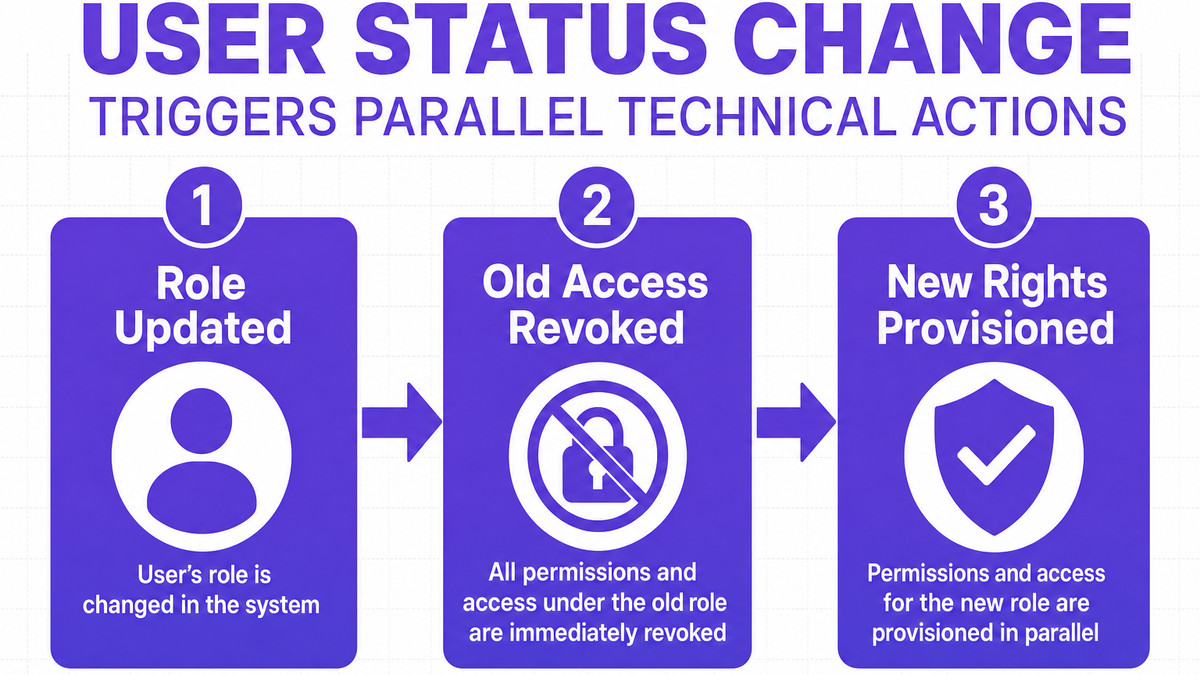
The concept of a mover workflow fits directly into the broader joiner, mover, and leaver lifecycle methodology. While onboarding new hires and offboarding departing employees are universally understood processes, internal role transitions often lack the same level of rigorous oversight. A mover event occurs anytime a user changes job functions. This event requires a net-new set of application licenses and software permissions, while simultaneously mandating the immediate revocation of their previous departmental access rights.
Executing this change manually is fraught with human error. If an employee transfers from customer support to engineering, they immediately require access to code repositories and infrastructure portals. If their legacy customer support tool permissions remain active, they accumulate excessive privileges. This overlapping access violates the fundamental principle of least privilege workflow automation. In heavily regulated industries like healthcare or finance, these dormant access rights lead directly to policy violations and heightened cybersecurity vulnerabilities.
When IT operations teams rely on helpdesk tickets and spreadsheets to manage role transitions, delays and oversights are inevitable. 2026 research from Pulse QA highlights that 45% of IT leaders pinpoint manual management of mover workflows as the root cause of at least one critical access delay or missed revocation per quarter. These missed administrative revocations directly feed long-term permission drift.
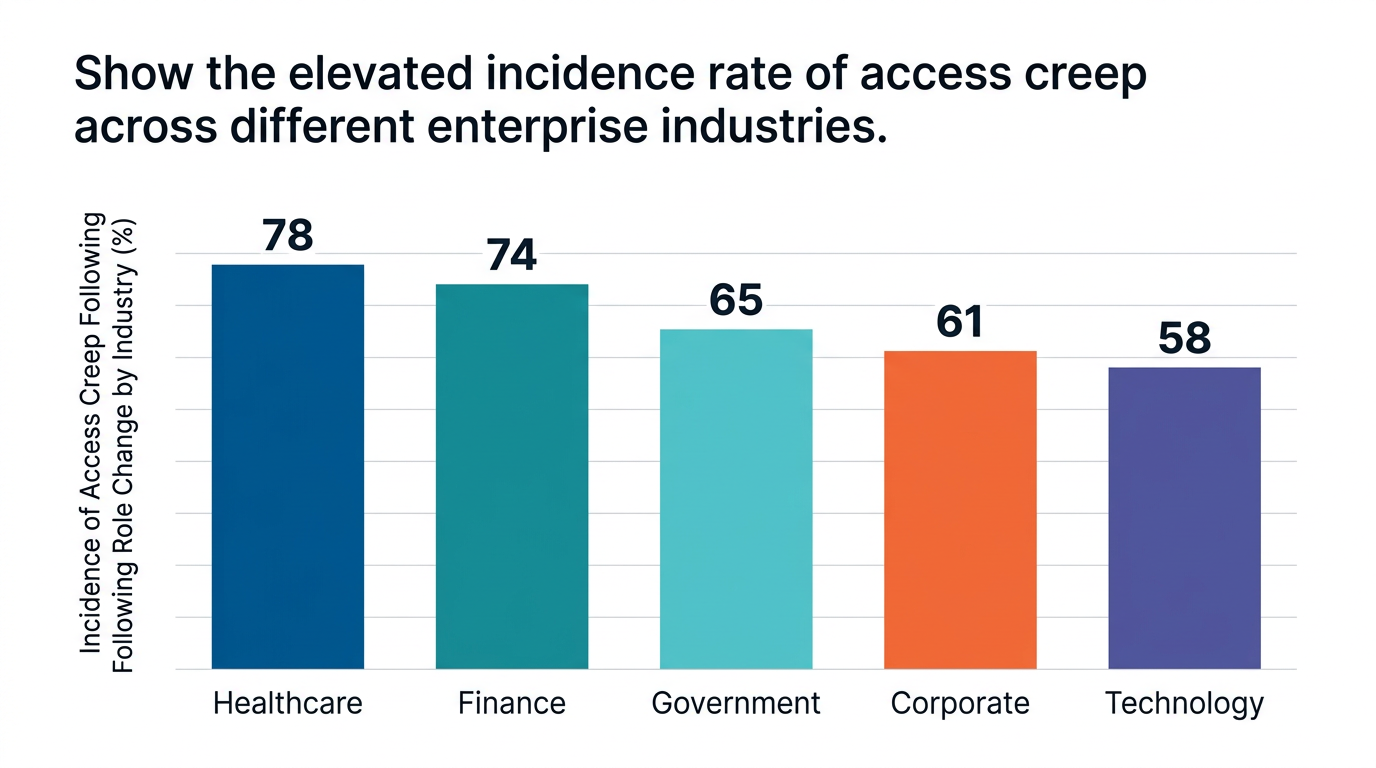
The threat is particularly pronounced across complex enterprise environments. According to a 2026 ISG report, 71% of enterprises report instances of access creep following internal role changes. Healthcare organizations experience the highest incidence rate, as intricate internal frameworks often lead to shared clinical and administrative system access points.
Regulatory bodies increasingly focus on how internal access is granted and maintained over time. Frameworks like SOC 2 and GDPR expect organizations to demonstrate total control over their protected data environments. When an auditor examines access logs, mover events are frequently heavily scrutinized. Without an automated compliance audit trail, proving that a transferred employee immediately lost access to sensitive financial or personal data becomes nearly impossible.
KPMG reported in 2026 that 61% of organizations cite automated user access review software as a primary enabler for enforcing least privilege during mover events. Generating these compliance reports manually consumes excessive administrative hours. Security and IT teams must establish automated logs that timestamp the exact moment a role change occurred, document who approved the new group policies, and verify when the target software systems successfully revoked the outdated credentials.
Beyond the immediate security vulnerabilities, access creep creates a severe cost optimization problem. Enterprise SaaS pricing models require highly accurate license allocation across active user groups. When an employee transitions to a new department and retains their previous software seats alongside their newly provisioned tools, the organization effectively pays twice for a single user.
Establishing automated policy controls stops this financial leakage instantly. A 2026 Forrester study indicates that enterprises with automated mover workflows save an average of 27% on SaaS licensing costs by proactively reclaiming unused permissions and licenses after role changes. Furthermore, a global financial institution successfully automated cross-SaaS user access reviews for role transitions and recognized $2.1M in annual savings. These results emphasize that proactive SaaS management also drives immense financial accountability.
Modern identity governance models require structured business workflow automation to function correctly at an enterprise scale. To completely eliminate permission drift, organizations must move away from reactive ticket requests and adopt proactive, systematic access control. The first step involves setting explicit baseline roles tied securely to corporate directory groups.
The second critical step is continuous access mapping. Whenever a profile update triggers a mover event, the system should automatically generate a complete list of current software entitlements. IT managers then follow an organized digital approval chain to either re-certify or revoke access. The outcomes of this process automation are highly measurable. Gartner data from 2026 shows that 69% of organizations implementing automated workflow protocols for role changes saw a documented decrease in audit findings related to core access controls.
Meeting strict compliance mandates and optimizing software expenditure requires a unified control center. CloudNuro provides enterprises with centralized SaaS and cloud governance through AI-driven automation. The CloudNuro User Access Review feature automatically tracks the detection and remediation of permission drift during role changes. This core capability constantly enforces least privilege protocols while providing a flawless, instantly auditable trail for strict SOC 2 compliance requirements.
To prevent shadow IT from complicating internal team transitions, CloudNuro utilizes advanced SaaS Discovery alongside the Unified Cloud Custodian module. These tools catalog all active applications, so role-based access updates take effect universally. By integrating with 400+ SaaS applications, CloudNuro Policy Automation connects securely to all vital systems of record. When an employee changes roles, CloudNuro Workflow Automation actively revokes old licenses and provisions new applications with zero manual intervention required.
The real-world organizational impact is swift. One Fortune 500 healthcare provider used CloudNuro to fully automate their mover workflows across their digital estate. This single administrative initiative reduced access review audit findings by 68% in one audit cycle and decreased manual IT workloads by 41%. Ultimately, IT operations teams regain hours of lost productivity while corporate security postures drastically improve.
A mover workflow is the defined technical process for adjusting an employee's software permissions and licenses when they change roles within a company. It ensures the individual acquires necessary new tools while losing access to specific systems they no longer need for their core job function.
IT teams prevent access creep by deploying strict role-based access control and systematic identity governance protocols. By using policy automation, companies verify that outdated legacy permissions are automatically revoked exactly when the new department access is officially provisioned.
Pupose-built SaaS management platforms like CloudNuro offer explicit workflow automation engines designed for these events. These platforms integrate directly with central directory services and individual cloud applications to execute precise provisioning and deprovisioning actions automatically based on predefined security rules.
The most effective approach is requiring the new department manager and the former manager to digitally sign off on a generated software entitlement report. Advanced platforms automate this exact process by sending prompt system notifications and logging all approvals to guarantee an absolute, error-free compliance audit trail.
Workflow automation removes unpredictable human error from the equation completely. It guarantees that strict offboarding or team transition policies apply constantly across all connected environments. This technical consistency minimizes the risk of unauthorized lateral movement and maintains total alignment with internal IT security frameworks.
The professional journey an employee takes through a corporate environment is rarely static. Internal mobility strengthens organizational capability but historically strains standard IT governance. Attempting to manually track daily role changes, specific application requirements, and legacy access points inevitably leads to permission drift and severely elevated risk profiles. Transitioning to a secure automated framework is the only sustainable, long-term operational strategy.
By systematically standardizing your basic identity lifecycle protocols, your organization builds a highly resilient foundation for both security administration and financial discipline. Centralized platform oversight transforms previously complicated role changes into routine, easily trackable events. Start refining your mover workflow today and eliminate access creep from your entire business SaaS environment.
CloudNuro is a leader in Enterprise SaaS Management Platforms, providing enterprises with unmatched visibility, governance, and cost optimization. Recognized twice in a row in the SaaS Management Platforms category and named a Leader in the SoftwareReviews Data Quadrant, CloudNuro is trusted by global enterprises and government agencies to bring financial discipline to SaaS, cloud, and AI. Trusted by enterprises such as Konica Minolta and Federal Signal, CloudNuro provides centralized SaaS inventory, license optimization, and renewal management along with advanced cost allocation and chargeback, giving IT and Finance leaders the visibility, control, and cost-conscious culture needed to drive financial discipline.
Request a no cost, no obligation free assessment —just 15 minutes to savings!
Get StartedIt is a common scenario for IT teams: an employee receives a promotion, shifts to a new department, or joins a cross-functional project. While human resources updates the organizational directory, IT must untangle a complex web of SaaS access rights. This internal transition is known as a mover workflow, and it represents one of the most significant risk vectors in enterprise identity governance. When organizations fail to remove legacy permissions during these internal events, they create permission drift and access creep. In fact, 2026 data from IDSA reveals that 86% of IT security breaches involving privileged access link directly back to insufficient user access reviews during internal role changes. Managing this phase of the user lifecycle requires precision, structured workflows, and strict policy automation.
The concept of a mover workflow fits directly into the broader joiner, mover, and leaver lifecycle methodology. While onboarding new hires and offboarding departing employees are universally understood processes, internal role transitions often lack the same level of rigorous oversight. A mover event occurs anytime a user changes job functions. This event requires a net-new set of application licenses and software permissions, while simultaneously mandating the immediate revocation of their previous departmental access rights.
Executing this change manually is fraught with human error. If an employee transfers from customer support to engineering, they immediately require access to code repositories and infrastructure portals. If their legacy customer support tool permissions remain active, they accumulate excessive privileges. This overlapping access violates the fundamental principle of least privilege workflow automation. In heavily regulated industries like healthcare or finance, these dormant access rights lead directly to policy violations and heightened cybersecurity vulnerabilities.
When IT operations teams rely on helpdesk tickets and spreadsheets to manage role transitions, delays and oversights are inevitable. 2026 research from Pulse QA highlights that 45% of IT leaders pinpoint manual management of mover workflows as the root cause of at least one critical access delay or missed revocation per quarter. These missed administrative revocations directly feed long-term permission drift.
The threat is particularly pronounced across complex enterprise environments. According to a 2026 ISG report, 71% of enterprises report instances of access creep following internal role changes. Healthcare organizations experience the highest incidence rate, as intricate internal frameworks often lead to shared clinical and administrative system access points.
Regulatory bodies increasingly focus on how internal access is granted and maintained over time. Frameworks like SOC 2 and GDPR expect organizations to demonstrate total control over their protected data environments. When an auditor examines access logs, mover events are frequently heavily scrutinized. Without an automated compliance audit trail, proving that a transferred employee immediately lost access to sensitive financial or personal data becomes nearly impossible.
KPMG reported in 2026 that 61% of organizations cite automated user access review software as a primary enabler for enforcing least privilege during mover events. Generating these compliance reports manually consumes excessive administrative hours. Security and IT teams must establish automated logs that timestamp the exact moment a role change occurred, document who approved the new group policies, and verify when the target software systems successfully revoked the outdated credentials.
Beyond the immediate security vulnerabilities, access creep creates a severe cost optimization problem. Enterprise SaaS pricing models require highly accurate license allocation across active user groups. When an employee transitions to a new department and retains their previous software seats alongside their newly provisioned tools, the organization effectively pays twice for a single user.
Establishing automated policy controls stops this financial leakage instantly. A 2026 Forrester study indicates that enterprises with automated mover workflows save an average of 27% on SaaS licensing costs by proactively reclaiming unused permissions and licenses after role changes. Furthermore, a global financial institution successfully automated cross-SaaS user access reviews for role transitions and recognized $2.1M in annual savings. These results emphasize that proactive SaaS management also drives immense financial accountability.
Modern identity governance models require structured business workflow automation to function correctly at an enterprise scale. To completely eliminate permission drift, organizations must move away from reactive ticket requests and adopt proactive, systematic access control. The first step involves setting explicit baseline roles tied securely to corporate directory groups.
The second critical step is continuous access mapping. Whenever a profile update triggers a mover event, the system should automatically generate a complete list of current software entitlements. IT managers then follow an organized digital approval chain to either re-certify or revoke access. The outcomes of this process automation are highly measurable. Gartner data from 2026 shows that 69% of organizations implementing automated workflow protocols for role changes saw a documented decrease in audit findings related to core access controls.
Meeting strict compliance mandates and optimizing software expenditure requires a unified control center. CloudNuro provides enterprises with centralized SaaS and cloud governance through AI-driven automation. The CloudNuro User Access Review feature automatically tracks the detection and remediation of permission drift during role changes. This core capability constantly enforces least privilege protocols while providing a flawless, instantly auditable trail for strict SOC 2 compliance requirements.
To prevent shadow IT from complicating internal team transitions, CloudNuro utilizes advanced SaaS Discovery alongside the Unified Cloud Custodian module. These tools catalog all active applications, so role-based access updates take effect universally. By integrating with 400+ SaaS applications, CloudNuro Policy Automation connects securely to all vital systems of record. When an employee changes roles, CloudNuro Workflow Automation actively revokes old licenses and provisions new applications with zero manual intervention required.
The real-world organizational impact is swift. One Fortune 500 healthcare provider used CloudNuro to fully automate their mover workflows across their digital estate. This single administrative initiative reduced access review audit findings by 68% in one audit cycle and decreased manual IT workloads by 41%. Ultimately, IT operations teams regain hours of lost productivity while corporate security postures drastically improve.
A mover workflow is the defined technical process for adjusting an employee's software permissions and licenses when they change roles within a company. It ensures the individual acquires necessary new tools while losing access to specific systems they no longer need for their core job function.
IT teams prevent access creep by deploying strict role-based access control and systematic identity governance protocols. By using policy automation, companies verify that outdated legacy permissions are automatically revoked exactly when the new department access is officially provisioned.
Pupose-built SaaS management platforms like CloudNuro offer explicit workflow automation engines designed for these events. These platforms integrate directly with central directory services and individual cloud applications to execute precise provisioning and deprovisioning actions automatically based on predefined security rules.
The most effective approach is requiring the new department manager and the former manager to digitally sign off on a generated software entitlement report. Advanced platforms automate this exact process by sending prompt system notifications and logging all approvals to guarantee an absolute, error-free compliance audit trail.
Workflow automation removes unpredictable human error from the equation completely. It guarantees that strict offboarding or team transition policies apply constantly across all connected environments. This technical consistency minimizes the risk of unauthorized lateral movement and maintains total alignment with internal IT security frameworks.
The professional journey an employee takes through a corporate environment is rarely static. Internal mobility strengthens organizational capability but historically strains standard IT governance. Attempting to manually track daily role changes, specific application requirements, and legacy access points inevitably leads to permission drift and severely elevated risk profiles. Transitioning to a secure automated framework is the only sustainable, long-term operational strategy.
By systematically standardizing your basic identity lifecycle protocols, your organization builds a highly resilient foundation for both security administration and financial discipline. Centralized platform oversight transforms previously complicated role changes into routine, easily trackable events. Start refining your mover workflow today and eliminate access creep from your entire business SaaS environment.
CloudNuro is a leader in Enterprise SaaS Management Platforms, providing enterprises with unmatched visibility, governance, and cost optimization. Recognized twice in a row in the SaaS Management Platforms category and named a Leader in the SoftwareReviews Data Quadrant, CloudNuro is trusted by global enterprises and government agencies to bring financial discipline to SaaS, cloud, and AI. Trusted by enterprises such as Konica Minolta and Federal Signal, CloudNuro provides centralized SaaS inventory, license optimization, and renewal management along with advanced cost allocation and chargeback, giving IT and Finance leaders the visibility, control, and cost-conscious culture needed to drive financial discipline.
Request a no cost, no obligation free assessment - just 15 minutes to savings!
Get StartedWe're offering complimentary ServiceNow license assessments to only 25 enterprises this quarter who want to unlock immediate savings without disrupting operations.
Get Free AssessmentGet Started




CloudNuro Corp
1755 Park St. Suite 207
Naperville, IL 60563
Phone : +1-630-277-9470
Email: info@cloudnuro.com




.webp)

Recognized Leader in SaaS Management Platforms by Info-Tech SoftwareReviews
.png)


.svg)