
Sign Up
Thank you for Submitting!
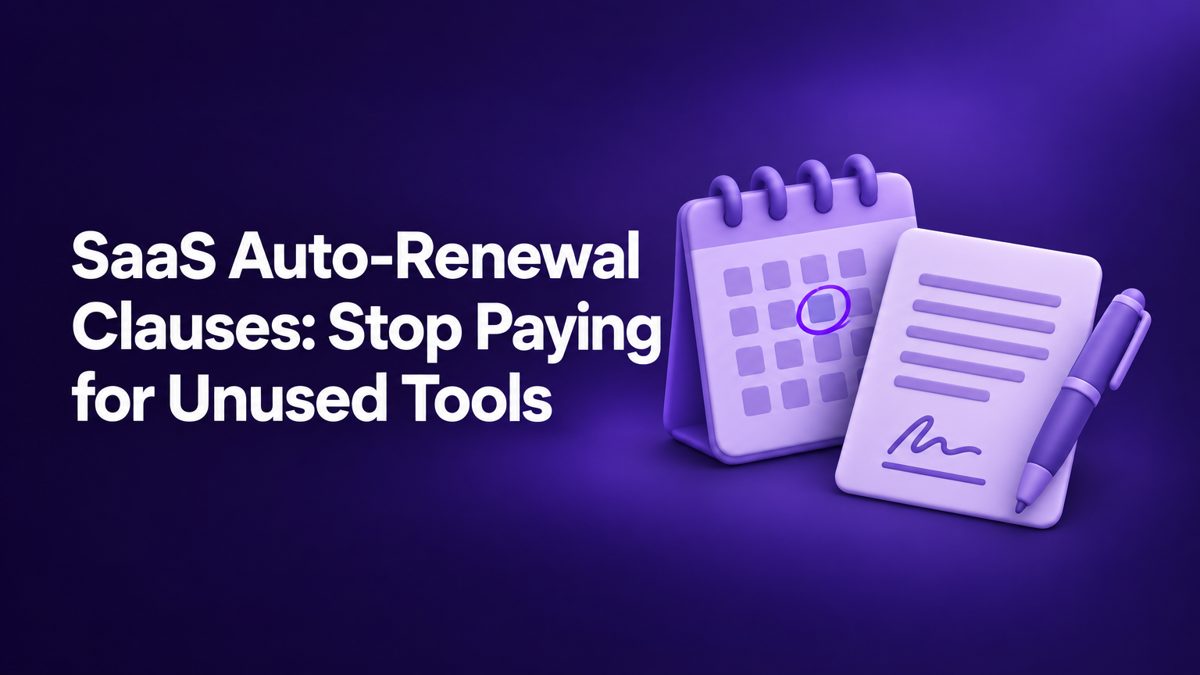
A SaaS auto-renewal clause extends a subscription for another term unless you serve non-renewal notice before a set deadline.
The clause has four levers: renewal structure, notice window, renewal price mechanism, and vendor reminder obligation. Most overspend comes from uncapped pricing and missed notice windows, not from the renewal itself.
This guide shows how to audit each lever, what language to ask for, and how to stop renewing licenses nobody uses.
CloudNuro's data shows 25-30% of SaaS licenses typically go unused, and a SaaS auto-renewal clause is the mechanism that carries those idle seats into the next contract term without anyone deciding to buy them again.
The risk is growing because renewal pricing is moving faster than general inflation, and a renewal at "then-current list price" passes every increase straight to your budget.
CIOs, CFOs, and IT procurement leaders feel it differently: IT inherits shelfware, Finance absorbs unplanned uplifts, and Procurement discovers the deadline after it has passed.
Mature teams now treat every auto-renewal as a scheduled decision backed by utilization data, as part of disciplined license management software and renewal practice.
This guide explains how an auto-renewal clause works, which terms to push back on, and a step-by-step audit that keeps unused tools out of your next term.
See which contracts auto-renew next and how many of their licenses are actually used.
Get Free Savings AssessmentA SaaS auto-renewal clause is a contract term that extends a subscription for a further period unless either party gives written non-renewal notice within a defined window. It shifts the burden of action to the customer: silence means you have bought another term.
The clause is not the problem by itself. It becomes expensive when the term re-locks for years, the notice window is short, and the renewal price is left open.
A fixed renewal term equal to the initial term creates a reassessment point at every boundary. An evergreen clause rolls indefinitely, so your team must remember the deadline every year.
Notice windows are commonly drafted at 30, 60, or 90 days. Standard SaaS paper usually sets 30 days, and 60 days is a common buyer-protective target in negotiated enterprise deals; CloudNuro's guide to the renewal notice period covers this lever in depth.
This is where money leaks. A buyer-protective clause caps any uplift at the lesser of 5% or CPI, applied once, while "then-current list price" lets the vendor reprice at will.
Most consumer auto-renewal laws do not cover business contracts, so a reminder exists only if you negotiate it. Ask for written notice of the renewal and any fee change 90 to 120 days before the deadline.
| Lever | Ask For | Red Flag |
|---|---|---|
| Renewal structure | Fixed annual term, or month-to-month after the initial term | Multi-year re-lock or evergreen with no workable opt-out |
| Notice window | 60 days, mutual, with a stated delivery channel | Under 30 days, or buried in an order form |
| Renewal price | Lesser of 5% or CPI, applied once | "Then-current list price", or a 3% cap that compounds to roughly 9% over three years |
| Reminder | Vendor notice 90 to 120 days before the deadline | "Vendor is under no obligation to notify Customer" |
| Seat count | Right to reduce quantities at renewal | Renewal at the highest seat count reached in the term |
Collect every SaaS agreement, order form, and click-through term into one repository with renewal date, notice deadline, and owner. You know it worked when no contract's notice deadline is unknown.
The date that matters is the last day to serve notice. A SaaS renewal calendar and forecast built on notice deadlines gives you time to act; CloudNuro sends alerts at 90, 60, and 30 days.
Compare purchased seats with active users over the full term, not the last month, so a pre-renewal spike does not set your tier. CloudNuro's guide on what usage data to bring into SaaS negotiations lists the metrics.
Each contract gets one decision with an owner and a cost center. Tools with overlapping functionality or dormant accounts move to right-size or exit.
Send non-renewal or reduction notice in the exact form the contract requires, even if you plan to renew on new terms. Notice preserves leverage; ready-made wording is in CloudNuro's SaaS negotiation email templates.
Raise renewal price protection before headline discounts, because vendors concede caps less readily once the discount is set. Use an ask, fallback, and walk-away ladder so every negotiator holds the same line.
Pro Tip: Mutual notice terms and a vendor reminder obligation are hard for any vendor to refuse in principle. Hold them regardless of deal size.
See how CloudNuro pairs renewal alerts with utilization data to right-size each contract.
Request a DemoFor the full timeline, pair this list with CloudNuro's 120-day renewal checklist and the broader SaaS renewal process guide.
An auto-renewal clause in a SaaS agreement extends the subscription for another term unless notice of non-renewal is served before a deadline. It defines the renewal term, the notice window, and often how price can change.
Auto-renewal clauses are generally enforceable in B2B contracts, because most auto-renewal laws protect consumers. A few state statutes reach business contracts and require vendor reminders, so have counsel check the governing law.
You can exit an auto-renewal contract by serving written non-renewal notice before the deadline, in the form the contract requires. If the deadline has passed, negotiate seat reductions or a shorter term rather than accepting the full renewal.
A reasonable notice period for SaaS auto-renewal is 30 to 60 days, with 60 days a common buyer-protective target in enterprise deals. Anything under 30 days is a red flag.
Tracking auto-renewal deadlines at scale requires one contract repository with automated alerts tied to notice deadlines. CloudNuro's SaaS management platform stores contracts, sends 90, 60, and 30-day alerts, and generates renewal requisitions with usage history.
You should cap renewal price increases in every SaaS contract, ideally at the lesser of 5% or CPI applied once. Without a cap, a clean notice window still leaves the renewal bill open-ended.
A SaaS auto-renewal clause turns inaction into a purchase. Organizations that leave renewals to the calendar keep paying for shelfware and accept whatever uplift the vendor sets. The better model treats each renewal as a governed decision, with unified visibility into contracts, utilization, and cost owners across SaaS, cloud, and AI.
Get a free assessment of upcoming renewals and the unused seats inside them.
Get Free Savings AssessmentCloudNuro acts as a centralized contract repository with renewal alerts at 90, 60, and 30 days, routed to IT and Procurement together. Historical utilization graphs flag dormant accounts and keep pre-renewal usage spikes from setting your tier, so each renewal decision rests on sustained consumption. Learn more about IT asset management with CloudNuro and proven SaaS renewal best practices. CloudNuro customers have reported up to a 35% reduction in SaaS overspend.
CloudNuro is a leader in Enterprise AI Adoption Management, providing enterprises with unmatched visibility, governance, and cost optimization. Recognized twice in a row by Gartner in the SaaS Management Platforms and named a Leader in the Info-Tech SoftwareReviews Data Quadrant, CloudNuro is trusted by global enterprises and government agencies to bring financial discipline to SaaS, cloud, and AI. Trusted by enterprises, CloudNuro provides centralized SaaS inventory, license optimization, and renewal management along with advanced cost allocation and chargeback, giving IT and Finance leaders the visibility, control, and cost-conscious culture needed to drive financial discipline.
Request a no cost, no obligation free assessment —just 15 minutes to savings!
Get StartedA SaaS auto-renewal clause extends a subscription for another term unless you serve non-renewal notice before a set deadline.
The clause has four levers: renewal structure, notice window, renewal price mechanism, and vendor reminder obligation. Most overspend comes from uncapped pricing and missed notice windows, not from the renewal itself.
This guide shows how to audit each lever, what language to ask for, and how to stop renewing licenses nobody uses.
CloudNuro's data shows 25-30% of SaaS licenses typically go unused, and a SaaS auto-renewal clause is the mechanism that carries those idle seats into the next contract term without anyone deciding to buy them again.
The risk is growing because renewal pricing is moving faster than general inflation, and a renewal at "then-current list price" passes every increase straight to your budget.
CIOs, CFOs, and IT procurement leaders feel it differently: IT inherits shelfware, Finance absorbs unplanned uplifts, and Procurement discovers the deadline after it has passed.
Mature teams now treat every auto-renewal as a scheduled decision backed by utilization data, as part of disciplined license management software and renewal practice.
This guide explains how an auto-renewal clause works, which terms to push back on, and a step-by-step audit that keeps unused tools out of your next term.
See which contracts auto-renew next and how many of their licenses are actually used.
Get Free Savings AssessmentA SaaS auto-renewal clause is a contract term that extends a subscription for a further period unless either party gives written non-renewal notice within a defined window. It shifts the burden of action to the customer: silence means you have bought another term.
The clause is not the problem by itself. It becomes expensive when the term re-locks for years, the notice window is short, and the renewal price is left open.
A fixed renewal term equal to the initial term creates a reassessment point at every boundary. An evergreen clause rolls indefinitely, so your team must remember the deadline every year.
Notice windows are commonly drafted at 30, 60, or 90 days. Standard SaaS paper usually sets 30 days, and 60 days is a common buyer-protective target in negotiated enterprise deals; CloudNuro's guide to the renewal notice period covers this lever in depth.
This is where money leaks. A buyer-protective clause caps any uplift at the lesser of 5% or CPI, applied once, while "then-current list price" lets the vendor reprice at will.
Most consumer auto-renewal laws do not cover business contracts, so a reminder exists only if you negotiate it. Ask for written notice of the renewal and any fee change 90 to 120 days before the deadline.
| Lever | Ask For | Red Flag |
|---|---|---|
| Renewal structure | Fixed annual term, or month-to-month after the initial term | Multi-year re-lock or evergreen with no workable opt-out |
| Notice window | 60 days, mutual, with a stated delivery channel | Under 30 days, or buried in an order form |
| Renewal price | Lesser of 5% or CPI, applied once | "Then-current list price", or a 3% cap that compounds to roughly 9% over three years |
| Reminder | Vendor notice 90 to 120 days before the deadline | "Vendor is under no obligation to notify Customer" |
| Seat count | Right to reduce quantities at renewal | Renewal at the highest seat count reached in the term |
Collect every SaaS agreement, order form, and click-through term into one repository with renewal date, notice deadline, and owner. You know it worked when no contract's notice deadline is unknown.
The date that matters is the last day to serve notice. A SaaS renewal calendar and forecast built on notice deadlines gives you time to act; CloudNuro sends alerts at 90, 60, and 30 days.
Compare purchased seats with active users over the full term, not the last month, so a pre-renewal spike does not set your tier. CloudNuro's guide on what usage data to bring into SaaS negotiations lists the metrics.
Each contract gets one decision with an owner and a cost center. Tools with overlapping functionality or dormant accounts move to right-size or exit.
Send non-renewal or reduction notice in the exact form the contract requires, even if you plan to renew on new terms. Notice preserves leverage; ready-made wording is in CloudNuro's SaaS negotiation email templates.
Raise renewal price protection before headline discounts, because vendors concede caps less readily once the discount is set. Use an ask, fallback, and walk-away ladder so every negotiator holds the same line.
Pro Tip: Mutual notice terms and a vendor reminder obligation are hard for any vendor to refuse in principle. Hold them regardless of deal size.
See how CloudNuro pairs renewal alerts with utilization data to right-size each contract.
Request a DemoFor the full timeline, pair this list with CloudNuro's 120-day renewal checklist and the broader SaaS renewal process guide.
An auto-renewal clause in a SaaS agreement extends the subscription for another term unless notice of non-renewal is served before a deadline. It defines the renewal term, the notice window, and often how price can change.
Auto-renewal clauses are generally enforceable in B2B contracts, because most auto-renewal laws protect consumers. A few state statutes reach business contracts and require vendor reminders, so have counsel check the governing law.
You can exit an auto-renewal contract by serving written non-renewal notice before the deadline, in the form the contract requires. If the deadline has passed, negotiate seat reductions or a shorter term rather than accepting the full renewal.
A reasonable notice period for SaaS auto-renewal is 30 to 60 days, with 60 days a common buyer-protective target in enterprise deals. Anything under 30 days is a red flag.
Tracking auto-renewal deadlines at scale requires one contract repository with automated alerts tied to notice deadlines. CloudNuro's SaaS management platform stores contracts, sends 90, 60, and 30-day alerts, and generates renewal requisitions with usage history.
You should cap renewal price increases in every SaaS contract, ideally at the lesser of 5% or CPI applied once. Without a cap, a clean notice window still leaves the renewal bill open-ended.
A SaaS auto-renewal clause turns inaction into a purchase. Organizations that leave renewals to the calendar keep paying for shelfware and accept whatever uplift the vendor sets. The better model treats each renewal as a governed decision, with unified visibility into contracts, utilization, and cost owners across SaaS, cloud, and AI.
Get a free assessment of upcoming renewals and the unused seats inside them.
Get Free Savings AssessmentCloudNuro acts as a centralized contract repository with renewal alerts at 90, 60, and 30 days, routed to IT and Procurement together. Historical utilization graphs flag dormant accounts and keep pre-renewal usage spikes from setting your tier, so each renewal decision rests on sustained consumption. Learn more about IT asset management with CloudNuro and proven SaaS renewal best practices. CloudNuro customers have reported up to a 35% reduction in SaaS overspend.
CloudNuro is a leader in Enterprise AI Adoption Management, providing enterprises with unmatched visibility, governance, and cost optimization. Recognized twice in a row by Gartner in the SaaS Management Platforms and named a Leader in the Info-Tech SoftwareReviews Data Quadrant, CloudNuro is trusted by global enterprises and government agencies to bring financial discipline to SaaS, cloud, and AI. Trusted by enterprises, CloudNuro provides centralized SaaS inventory, license optimization, and renewal management along with advanced cost allocation and chargeback, giving IT and Finance leaders the visibility, control, and cost-conscious culture needed to drive financial discipline.
Request a no cost, no obligation free assessment - just 15 minutes to savings!
Get StartedWe're offering complimentary ServiceNow license assessments to only 25 enterprises this quarter who want to unlock immediate savings without disrupting operations.
Get Free AssessmentGet Started




CloudNuro Corp
1755 Park St. Suite 207
Naperville, IL 60563
Phone : +1-630-277-9470
Email: info@cloudnuro.com







Recognized Leader in SaaS Management Platforms by Info-Tech SoftwareReviews