

Sign Up
Thank you for Submitting!
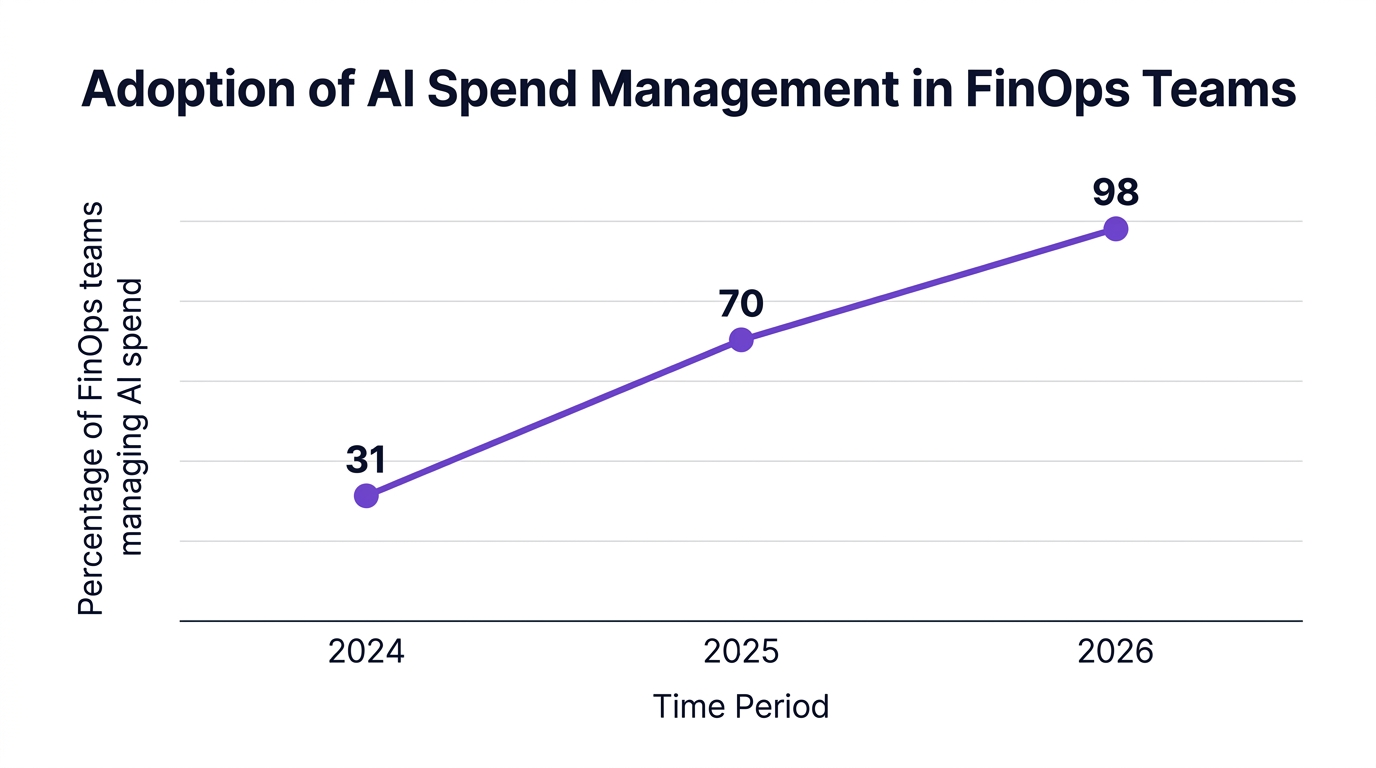
Why Your FinOps Tool Cannot Solve Your AI Cost Problem (And What Actually Will) Traditional cloud cost tools were built for VMs, storage, and bandwidth, not for large language models, vector databases, and GPU-intensive inference pipelines. As AI spending explodes, many enterprises are discovering that their existing FinOps stack simply cannot answer the most basic questions about AI: who is spending, on what models, and why. By 2026, 98% of organizations are managing AI spend in their FinOps practice, up from just 31% two years earlier (FinOps Foundation, 2026). At the same time, 72% of IT and finance leaders say GenAI-related cloud spending has become unmanageable (Flexera, 2026). The gap between responsibility and actual control is widening. This is where a governance-first approach to FinOps for AI becomes critical. Not a new dashboard on top of old data, but a different architecture that treats AI as a business capability, not just another line item in the cloud bill.
Most FinOps tools were designed around infrastructure units like CPU hours, storage GB, or reserved instances. AI workloads behave differently in several important ways. First, AI costs are driven by behavior, not just infrastructure. A single LLM feature can span:
Prompt and completion tokens across multiple models
Vector search queries in a separate data service
Orchestration layers, caching, and routing logic
None of that maps cleanly to a simple "instance" or "service" view. You can right-size a VM, but that does not tell you whether your "AI summarization" feature is profitable.
Second, AI consumption is extremely bursty and experimental. Product teams spin up new prompts, models, and experiments daily. Shadow AI usage by business teams on unmanaged SaaS platforms exposes the enterprise to surprise bills and compliance risk. Third, unit economics matters more than total spend. For AI, the question is rarely "How much did we spend on GPUs?". It is usually:
What is the cost per message in our AI assistant?
What is the cost per document processed by our AI intake workflow?
How does cost vary by model, region, or team?
Traditional FinOps tools are not instrumented at that level. They lack visibility into user, model, and feature telemetry that makes FinOps for AI meaningful.
From conversations with CIOs and FinOps leaders, and supported by recent research, several consistent limitations show up when applying legacy tooling to AI.

Most tools can tell you which cloud account or project incurred spend. Very few can tell you:
Which model family or endpoint was used
Which application or microservice triggered the AI calls
Which user, team, or business unit is driving the cost
Yet 83% of organizations are already using or experimenting with GenAI services (Flexera, 2026), and AI and GenAI services are driving cloud expenses about 30% higher on average (Flexera, 2026). Without precise AI workload visibility, your team is flying blind.
FinOps excellence for cloud often depends on tags and labels: map resources to cost centers, environments, and owners. AI introduces a new dimension: models and usage patterns. A standard cloud tagging strategy rarely captures:
Model version and provider
Prompt template or feature flag
AI usage context, for example "support bot" vs "R&D experiment"
That is why leading guidance for FinOps for AI now emphasizes normalizing AI spend into business units like cost per message or cost per outcome (FinOps Foundation, 2026). Without AI-aware allocation, it is impossible to run meaningful showback or chargeback.
AI usage changes weekly. New models, pricing tiers, and rate limits appear almost overnight. A rules-based FinOps tool that expects stable resource types and predictable growth patterns struggles in this environment. According to one industry survey, AI cost management is the number one forward-looking priority for FinOps teams in 2026, and 58% say it is the top skill they are hiring for (FinOps Foundation, 2026). Human-driven rule tuning cannot keep up with that pace of change.
As of 2026, 90% of FinOps teams also manage SaaS spend (FinOps Foundation, 2026). Yet most tools still treat SaaS as a flat subscription, not a rich, usage-based environment. GenAI is being embedded into CRM, productivity, ITSM, and analytics platforms. Those AI features are often billed on:
Per-seat plus AI add-on pricing
Per-message, per-document, or per-thousand-token usage
Tiered packages with opaque overage rules
If your stack cannot see inside those SaaS apps, you have no idea which AI experiences are actually worth their cost.
Many leaders ask, "Can we just extend what we are already doing?" You can and should reuse some FinOps practices. But FinOps for AI needs different data, different controls, and often a different operating model. Think of it like this: managing AI with a classic FinOps tool is like trying to run a digital marketing program with only your electricity bill. You might infer that higher power usage means something is happening, but you cannot see campaigns, channels, or conversions.
Traditional FinOps views the world as:
Accounts, projects, subscriptions
Resource types like compute, storage, networking
Discounts, reservations, and commitments
FinOps for AI reframes it as:
Models, prompts, agents, and workflows
Features, products, and customer journeys
Outcomes and unit economics
Gartner projects global AI spending to reach 2.59 trillion USD by 2026. The meaningful question is not how to trim five percent of that total, but how to connect that spend to revenue, risk reduction, and productivity.
AI-aware FinOps requires context-aware telemetry, not just tags. That includes:
Model name, provider, and version
Request type, user, and originating application
Data sensitivity class and compliance requirements
This richer context enables policies like "block production use of non-approved models for PII" or "route low-risk use cases to lower-cost models". Static tags alone cannot express these constraints.
AI workloads spill across IaaS, PaaS, and SaaS boundaries. A GenAI-powered support workflow might touch:
An AI inference endpoint in a cloud provider
A SaaS ticketing system that embeds AI suggestions
A data platform that prepares training or grounding data
Trying to govern that with separate tools for cloud, SaaS, and AI is like trying to manage traffic in a city using three disconnected control rooms. You need a unified AI governance platform that sees the entire path, from user to model to bill.
A better question than "Why did my FinOps tool fail?" is "What does a working future-state model look like?" Successful enterprises share a common pattern.
You cannot control what you cannot see. Effective AI cost governance starts by normalizing spend along three axes:
By model: which models, versions, and providers are used and how they compare on cost and performance
By team or BU: who owns the spend and which products or programs they support
By feature or outcome: what the business gets, for example "AI summarization per claim" or "AI co-pilot for engineering"
Organizations that do this well think in terms of unit economics. One leading financial institution, for example, adopted cost-per-message metrics for its AI messaging services, which enabled executive trade-offs about model quality versus cost at the product level.
AI usage must be bounded by clear guardrails that encode:
Approved models and regions per data classification
Budget thresholds per team, model, and environment
Allowed use cases for sensitive data
FinOps teams are increasingly using both FinOps for AI (controlling AI costs) and AI for FinOps (using AI to help manage spend) together (Flexera and FinOps Foundation, 2026). For example, anomaly detection models can flag unexpected AI usage surges long before the invoice arrives.
As AI weaves into core workflows, access controls are no longer just an IT security problem. They are also a financial and compliance problem. Robust user access review software and access review tools allow you to:
Automatically identify inactive or over-entitled users of AI features
Detect orphaned access after role changes or offboarding
Prove control effectiveness to auditors for AI-enabled SaaS
This is where user access automation intersects with SaaS cost management. Removing unused AI entitlements can yield immediate savings, reduce attack surface, and tighten compliance.
Modern environments require:
Continuous SaaS app discovery across the enterprise
Mapping of AI features embedded in those apps
Unified views of cloud spend, SaaS subscriptions, and AI consumption
That integrated inventory is a prerequisite to advanced practices like cloud cost allocation, chargeback for SaaS, and automated policy enforcement.
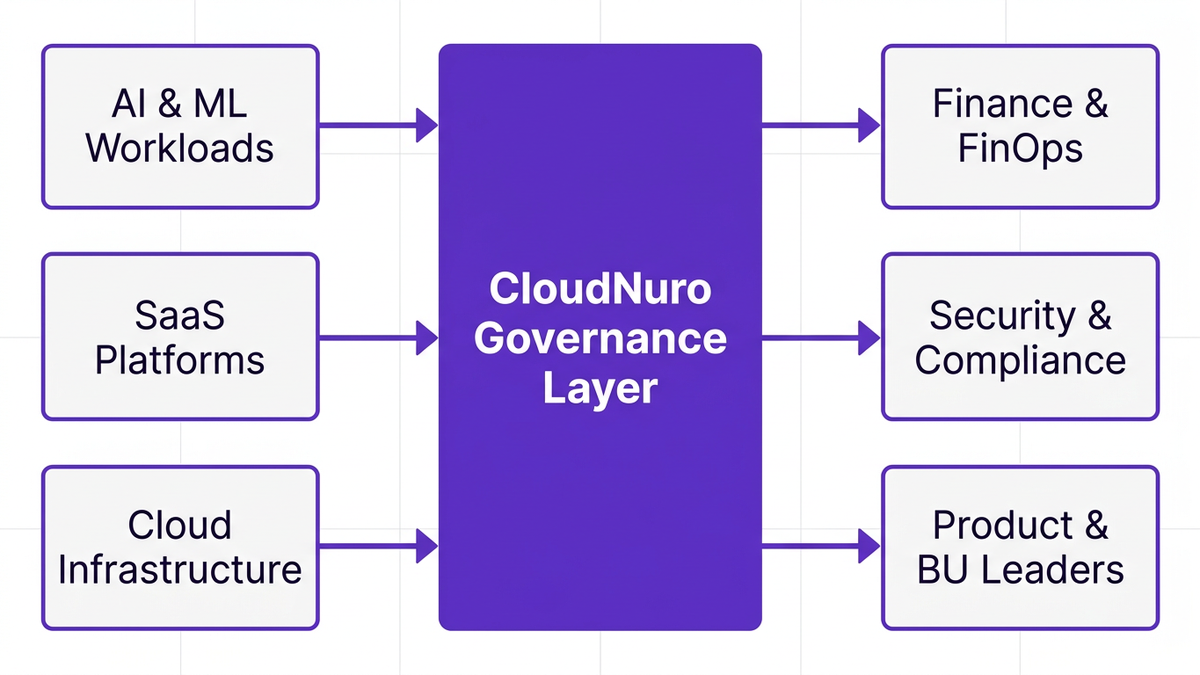
CloudNuro was built for exactly this intersection of AI, cloud, and SaaS. Rather than being a generic cloud cost tool, it provides a governance-first architecture designed for enterprise IT governance in AI-driven environments.
CloudNuro’s AI Custodian delivers:
Model-level and user-level AI workload visibility across environments
Automated tagging and spend attribution at the model, team, and feature level
Policy-driven guardrails to control which models, data, and regions can be used
For CIOs building a FinOps for AI practice, CloudNuro AI Custodian becomes the "single source of truth" for AI usage and cost, including GenAI in both cloud-native apps and SaaS platforms. It bridges the gap that classic FinOps tools leave open.
AI workloads rarely live in a single cloud. CloudNuro’s Unified Cloud Custodian provides:
360° discovery across cloud accounts and SaaS platforms
Real-time compliance and risk visibility for AI-enabled services
Consolidated insights for multi-cloud FinOps and cloud cost optimization
This unified layer is what enables accurate IT financial visibility and end-to-end governance. Cloud, SaaS, and AI spend are no longer managed in silos. To go deeper on this capability, see Unified Cloud Custodian.
CloudNuro embeds automated governance through its user access review platform capabilities:
Automated UAR campaigns across AI-enabled SaaS and cloud services
Evidence generation for SOC 2, ISO, and other compliance regimes
Removal of unused entitlements to control SaaS spend control and AI add-on costs
For organizations seeking the best access review platforms style capabilities, CloudNuro functions as high-automation uar software. It reduces the manual overhead typically associated with user access review tools while tying entitlements directly to financial outcomes. You can explore CloudNuro’s broader SaaS management automation capabilities to see how this extends beyond AI into the full SaaS portfolio.
Processes matter as much as platforms. CloudNuro’s FinOps Services help enterprises stand up:
An AI-aware cost allocation model that supports chargeback or showback
A governance framework for model approvals, usage policies, and exceptions
KPI dashboards that connect AI spend to outcomes, not just budgets
CloudNuro combines cloud SaaS financial optimization with practical coaching on FinOps for AI scope, operating models, and executive reporting. This blend of platform and expertise helps organizations move from reactive fire fighting to proactive strategy.
Consider a global enterprise that rolled out GenAI features across internal knowledge search, customer support, and sales enablement. Within nine months, their AI-related cloud bill had grown by nearly 35 percent, and finance had limited insight into which teams were responsible. Using CloudNuro’s AI Custodian and Unified Cloud Custodian, the organization:
Discovered unmanaged GenAI usage in multiple SaaS platforms via SaaS app discovery.
Normalized AI costs by model, team, and use case, exposing high-cost experiments that had never graduated to production.
Implemented policy-based controls that required review for new model usage above predefined thresholds.
Used automated access review software capabilities to right-size AI add-ons and revoke unused access.
Within two quarters the company held AI-driven cloud expenses essentially flat, even as feature usage increased. More importantly, the CIO and CFO gained a clear, shared view of which AI investments drove value and which did not.
If you are responsible for AI budgets or governance, here is a pragmatic sequence to move forward.
Clarify scope and objectives. Define what "AI" means in your context: GenAI, traditional ML, embedded AI in SaaS, or all of the above. Align on whether you are optimizing for cost reduction, reallocation, or value clarity.
Inventory AI usage. Use tools that perform SaaS app discovery and cloud service discovery to map all AI-related services and features.
Establish unit economics. Pick 2 to 3 high-impact AI capabilities and define unit costs: cost per claim triaged, per support ticket, or per sales call assisted.
Implement policy guardrails. Start with basic controls: which models are approved, where data can be processed, and what budgets apply to experiments versus production.
Automate access review. Deploy user access review software for AI-enabled apps to shrink the entitlement footprint and reduce risk and spend.
Unify reporting. Consolidate SaaS, cloud, and AI views into a single dashboard that supports CIO, CFO, and BU leader needs.
This is not a one-time project. AI usage patterns will evolve, as will pricing and regulation. The goal is to build a durable AI governance platform that can adapt without starting over each year.
AI workloads are driven by model usage, prompts, and business workflows, not just raw infrastructure. The same GPU cluster can support dozens of different AI features with very different business values.
FinOps for AI focuses on model-level visibility, unit economics, and governance of how AI is used, not just how much infrastructure is consumed.
You need platforms that combine SaaS cost management with AI-aware telemetry. That means discovering all SaaS applications in use, understanding which ones embed AI features, and correlating feature usage with billing.
CloudNuro provides integration with 400+ apps, making it easier to see AI add-ons and their utilization across the SaaS estate.
Key capabilities include:
Detailed AI workload visibility by model, team, and feature
Robust cloud cost allocation that supports AI-specific dimensions
Support for automated user access review tools across AI-enabled apps
Unified AI, SaaS, and cloud views to avoid blind spots
An effective AI governance platform should tie all of this into one operating model.
Automated UAR ensures that only the right people have access to sensitive AI capabilities and data. It reduces the risk of unauthorized data exposure and aligns with controls auditors expect for high-risk systems.
At the same time, it directly supports SaaS spend control by removing unused AI entitlements and cleaning up over-licensed roles.
Yes. Many organizations are applying AI techniques to FinOps itself. Examples include anomaly detection for AI usage spikes, recommendations on cheaper equivalent models, and automated identification of idle or low-value AI workloads.
This combination of FinOps for AI and AI for FinOps is emerging as a best practice among advanced teams.
Your AI cost challenge is not fundamentally a reporting issue. It is a governance issue. Traditional tools that focus only on infrastructure will not deliver what FinOps for AI requires: model-aware visibility, policy-driven guardrails, and integrated AI, SaaS, and cloud governance. CloudNuro delivers that governance-first foundation through AI Custodian, Unified Cloud Custodian, and FinOps Services, helping enterprises regain control over AI spend while supporting innovation. If you want to turn AI from an unbounded cost center into an accountable business capability, now is the time to rethink your approach to FinOps for AI. Take the next step:
Request a Demo to see CloudNuro in action
Get Free Savings with an AI and SaaS optimization assessment
Explore Product to understand the full platform
CloudNuro is a leader in Enterprise SaaS Management Platforms, providing enterprises with unmatched visibility, governance, and cost optimization. Recognized twice in a row in the SaaS Management Platforms category and named a Leader in the SoftwareReviews Data Quadrant, CloudNuro is trusted by global enterprises and government agencies to bring financial discipline to SaaS, cloud, and AI. Trusted by enterprises such as Konica Minolta and Federal Signal, CloudNuro provides centralized SaaS inventory, license optimization, and renewal management along with advanced cost allocation and chargeback, giving IT and Finance leaders the visibility, control, and cost-conscious culture needed to drive financial discipline.
Request a no cost, no obligation free assessment —just 15 minutes to savings!
Get StartedWhy Your FinOps Tool Cannot Solve Your AI Cost Problem (And What Actually Will) Traditional cloud cost tools were built for VMs, storage, and bandwidth, not for large language models, vector databases, and GPU-intensive inference pipelines. As AI spending explodes, many enterprises are discovering that their existing FinOps stack simply cannot answer the most basic questions about AI: who is spending, on what models, and why. By 2026, 98% of organizations are managing AI spend in their FinOps practice, up from just 31% two years earlier (FinOps Foundation, 2026). At the same time, 72% of IT and finance leaders say GenAI-related cloud spending has become unmanageable (Flexera, 2026). The gap between responsibility and actual control is widening. This is where a governance-first approach to FinOps for AI becomes critical. Not a new dashboard on top of old data, but a different architecture that treats AI as a business capability, not just another line item in the cloud bill.
Most FinOps tools were designed around infrastructure units like CPU hours, storage GB, or reserved instances. AI workloads behave differently in several important ways. First, AI costs are driven by behavior, not just infrastructure. A single LLM feature can span:
Prompt and completion tokens across multiple models
Vector search queries in a separate data service
Orchestration layers, caching, and routing logic
None of that maps cleanly to a simple "instance" or "service" view. You can right-size a VM, but that does not tell you whether your "AI summarization" feature is profitable.
Second, AI consumption is extremely bursty and experimental. Product teams spin up new prompts, models, and experiments daily. Shadow AI usage by business teams on unmanaged SaaS platforms exposes the enterprise to surprise bills and compliance risk. Third, unit economics matters more than total spend. For AI, the question is rarely "How much did we spend on GPUs?". It is usually:
What is the cost per message in our AI assistant?
What is the cost per document processed by our AI intake workflow?
How does cost vary by model, region, or team?
Traditional FinOps tools are not instrumented at that level. They lack visibility into user, model, and feature telemetry that makes FinOps for AI meaningful.
From conversations with CIOs and FinOps leaders, and supported by recent research, several consistent limitations show up when applying legacy tooling to AI.
Most tools can tell you which cloud account or project incurred spend. Very few can tell you:
Which model family or endpoint was used
Which application or microservice triggered the AI calls
Which user, team, or business unit is driving the cost
Yet 83% of organizations are already using or experimenting with GenAI services (Flexera, 2026), and AI and GenAI services are driving cloud expenses about 30% higher on average (Flexera, 2026). Without precise AI workload visibility, your team is flying blind.
FinOps excellence for cloud often depends on tags and labels: map resources to cost centers, environments, and owners. AI introduces a new dimension: models and usage patterns. A standard cloud tagging strategy rarely captures:
Model version and provider
Prompt template or feature flag
AI usage context, for example "support bot" vs "R&D experiment"
That is why leading guidance for FinOps for AI now emphasizes normalizing AI spend into business units like cost per message or cost per outcome (FinOps Foundation, 2026). Without AI-aware allocation, it is impossible to run meaningful showback or chargeback.
AI usage changes weekly. New models, pricing tiers, and rate limits appear almost overnight. A rules-based FinOps tool that expects stable resource types and predictable growth patterns struggles in this environment. According to one industry survey, AI cost management is the number one forward-looking priority for FinOps teams in 2026, and 58% say it is the top skill they are hiring for (FinOps Foundation, 2026). Human-driven rule tuning cannot keep up with that pace of change.
As of 2026, 90% of FinOps teams also manage SaaS spend (FinOps Foundation, 2026). Yet most tools still treat SaaS as a flat subscription, not a rich, usage-based environment. GenAI is being embedded into CRM, productivity, ITSM, and analytics platforms. Those AI features are often billed on:
Per-seat plus AI add-on pricing
Per-message, per-document, or per-thousand-token usage
Tiered packages with opaque overage rules
If your stack cannot see inside those SaaS apps, you have no idea which AI experiences are actually worth their cost.
Many leaders ask, "Can we just extend what we are already doing?" You can and should reuse some FinOps practices. But FinOps for AI needs different data, different controls, and often a different operating model. Think of it like this: managing AI with a classic FinOps tool is like trying to run a digital marketing program with only your electricity bill. You might infer that higher power usage means something is happening, but you cannot see campaigns, channels, or conversions.
Traditional FinOps views the world as:
Accounts, projects, subscriptions
Resource types like compute, storage, networking
Discounts, reservations, and commitments
FinOps for AI reframes it as:
Models, prompts, agents, and workflows
Features, products, and customer journeys
Outcomes and unit economics
Gartner projects global AI spending to reach 2.59 trillion USD by 2026. The meaningful question is not how to trim five percent of that total, but how to connect that spend to revenue, risk reduction, and productivity.
AI-aware FinOps requires context-aware telemetry, not just tags. That includes:
Model name, provider, and version
Request type, user, and originating application
Data sensitivity class and compliance requirements
This richer context enables policies like "block production use of non-approved models for PII" or "route low-risk use cases to lower-cost models". Static tags alone cannot express these constraints.
AI workloads spill across IaaS, PaaS, and SaaS boundaries. A GenAI-powered support workflow might touch:
An AI inference endpoint in a cloud provider
A SaaS ticketing system that embeds AI suggestions
A data platform that prepares training or grounding data
Trying to govern that with separate tools for cloud, SaaS, and AI is like trying to manage traffic in a city using three disconnected control rooms. You need a unified AI governance platform that sees the entire path, from user to model to bill.
A better question than "Why did my FinOps tool fail?" is "What does a working future-state model look like?" Successful enterprises share a common pattern.
You cannot control what you cannot see. Effective AI cost governance starts by normalizing spend along three axes:
By model: which models, versions, and providers are used and how they compare on cost and performance
By team or BU: who owns the spend and which products or programs they support
By feature or outcome: what the business gets, for example "AI summarization per claim" or "AI co-pilot for engineering"
Organizations that do this well think in terms of unit economics. One leading financial institution, for example, adopted cost-per-message metrics for its AI messaging services, which enabled executive trade-offs about model quality versus cost at the product level.
AI usage must be bounded by clear guardrails that encode:
Approved models and regions per data classification
Budget thresholds per team, model, and environment
Allowed use cases for sensitive data
FinOps teams are increasingly using both FinOps for AI (controlling AI costs) and AI for FinOps (using AI to help manage spend) together (Flexera and FinOps Foundation, 2026). For example, anomaly detection models can flag unexpected AI usage surges long before the invoice arrives.
As AI weaves into core workflows, access controls are no longer just an IT security problem. They are also a financial and compliance problem. Robust user access review software and access review tools allow you to:
Automatically identify inactive or over-entitled users of AI features
Detect orphaned access after role changes or offboarding
Prove control effectiveness to auditors for AI-enabled SaaS
This is where user access automation intersects with SaaS cost management. Removing unused AI entitlements can yield immediate savings, reduce attack surface, and tighten compliance.
Modern environments require:
Continuous SaaS app discovery across the enterprise
Mapping of AI features embedded in those apps
Unified views of cloud spend, SaaS subscriptions, and AI consumption
That integrated inventory is a prerequisite to advanced practices like cloud cost allocation, chargeback for SaaS, and automated policy enforcement.
CloudNuro was built for exactly this intersection of AI, cloud, and SaaS. Rather than being a generic cloud cost tool, it provides a governance-first architecture designed for enterprise IT governance in AI-driven environments.
CloudNuro’s AI Custodian delivers:
Model-level and user-level AI workload visibility across environments
Automated tagging and spend attribution at the model, team, and feature level
Policy-driven guardrails to control which models, data, and regions can be used
For CIOs building a FinOps for AI practice, CloudNuro AI Custodian becomes the "single source of truth" for AI usage and cost, including GenAI in both cloud-native apps and SaaS platforms. It bridges the gap that classic FinOps tools leave open.
AI workloads rarely live in a single cloud. CloudNuro’s Unified Cloud Custodian provides:
360° discovery across cloud accounts and SaaS platforms
Real-time compliance and risk visibility for AI-enabled services
Consolidated insights for multi-cloud FinOps and cloud cost optimization
This unified layer is what enables accurate IT financial visibility and end-to-end governance. Cloud, SaaS, and AI spend are no longer managed in silos. To go deeper on this capability, see Unified Cloud Custodian.
CloudNuro embeds automated governance through its user access review platform capabilities:
Automated UAR campaigns across AI-enabled SaaS and cloud services
Evidence generation for SOC 2, ISO, and other compliance regimes
Removal of unused entitlements to control SaaS spend control and AI add-on costs
For organizations seeking the best access review platforms style capabilities, CloudNuro functions as high-automation uar software. It reduces the manual overhead typically associated with user access review tools while tying entitlements directly to financial outcomes. You can explore CloudNuro’s broader SaaS management automation capabilities to see how this extends beyond AI into the full SaaS portfolio.
Processes matter as much as platforms. CloudNuro’s FinOps Services help enterprises stand up:
An AI-aware cost allocation model that supports chargeback or showback
A governance framework for model approvals, usage policies, and exceptions
KPI dashboards that connect AI spend to outcomes, not just budgets
CloudNuro combines cloud SaaS financial optimization with practical coaching on FinOps for AI scope, operating models, and executive reporting. This blend of platform and expertise helps organizations move from reactive fire fighting to proactive strategy.
Consider a global enterprise that rolled out GenAI features across internal knowledge search, customer support, and sales enablement. Within nine months, their AI-related cloud bill had grown by nearly 35 percent, and finance had limited insight into which teams were responsible. Using CloudNuro’s AI Custodian and Unified Cloud Custodian, the organization:
Discovered unmanaged GenAI usage in multiple SaaS platforms via SaaS app discovery.
Normalized AI costs by model, team, and use case, exposing high-cost experiments that had never graduated to production.
Implemented policy-based controls that required review for new model usage above predefined thresholds.
Used automated access review software capabilities to right-size AI add-ons and revoke unused access.
Within two quarters the company held AI-driven cloud expenses essentially flat, even as feature usage increased. More importantly, the CIO and CFO gained a clear, shared view of which AI investments drove value and which did not.
If you are responsible for AI budgets or governance, here is a pragmatic sequence to move forward.
Clarify scope and objectives. Define what "AI" means in your context: GenAI, traditional ML, embedded AI in SaaS, or all of the above. Align on whether you are optimizing for cost reduction, reallocation, or value clarity.
Inventory AI usage. Use tools that perform SaaS app discovery and cloud service discovery to map all AI-related services and features.
Establish unit economics. Pick 2 to 3 high-impact AI capabilities and define unit costs: cost per claim triaged, per support ticket, or per sales call assisted.
Implement policy guardrails. Start with basic controls: which models are approved, where data can be processed, and what budgets apply to experiments versus production.
Automate access review. Deploy user access review software for AI-enabled apps to shrink the entitlement footprint and reduce risk and spend.
Unify reporting. Consolidate SaaS, cloud, and AI views into a single dashboard that supports CIO, CFO, and BU leader needs.
This is not a one-time project. AI usage patterns will evolve, as will pricing and regulation. The goal is to build a durable AI governance platform that can adapt without starting over each year.
AI workloads are driven by model usage, prompts, and business workflows, not just raw infrastructure. The same GPU cluster can support dozens of different AI features with very different business values.
FinOps for AI focuses on model-level visibility, unit economics, and governance of how AI is used, not just how much infrastructure is consumed.
You need platforms that combine SaaS cost management with AI-aware telemetry. That means discovering all SaaS applications in use, understanding which ones embed AI features, and correlating feature usage with billing.
CloudNuro provides integration with 400+ apps, making it easier to see AI add-ons and their utilization across the SaaS estate.
Key capabilities include:
Detailed AI workload visibility by model, team, and feature
Robust cloud cost allocation that supports AI-specific dimensions
Support for automated user access review tools across AI-enabled apps
Unified AI, SaaS, and cloud views to avoid blind spots
An effective AI governance platform should tie all of this into one operating model.
Automated UAR ensures that only the right people have access to sensitive AI capabilities and data. It reduces the risk of unauthorized data exposure and aligns with controls auditors expect for high-risk systems.
At the same time, it directly supports SaaS spend control by removing unused AI entitlements and cleaning up over-licensed roles.
Yes. Many organizations are applying AI techniques to FinOps itself. Examples include anomaly detection for AI usage spikes, recommendations on cheaper equivalent models, and automated identification of idle or low-value AI workloads.
This combination of FinOps for AI and AI for FinOps is emerging as a best practice among advanced teams.
Your AI cost challenge is not fundamentally a reporting issue. It is a governance issue. Traditional tools that focus only on infrastructure will not deliver what FinOps for AI requires: model-aware visibility, policy-driven guardrails, and integrated AI, SaaS, and cloud governance. CloudNuro delivers that governance-first foundation through AI Custodian, Unified Cloud Custodian, and FinOps Services, helping enterprises regain control over AI spend while supporting innovation. If you want to turn AI from an unbounded cost center into an accountable business capability, now is the time to rethink your approach to FinOps for AI. Take the next step:
Request a Demo to see CloudNuro in action
Get Free Savings with an AI and SaaS optimization assessment
Explore Product to understand the full platform
CloudNuro is a leader in Enterprise SaaS Management Platforms, providing enterprises with unmatched visibility, governance, and cost optimization. Recognized twice in a row in the SaaS Management Platforms category and named a Leader in the SoftwareReviews Data Quadrant, CloudNuro is trusted by global enterprises and government agencies to bring financial discipline to SaaS, cloud, and AI. Trusted by enterprises such as Konica Minolta and Federal Signal, CloudNuro provides centralized SaaS inventory, license optimization, and renewal management along with advanced cost allocation and chargeback, giving IT and Finance leaders the visibility, control, and cost-conscious culture needed to drive financial discipline.
Request a no cost, no obligation free assessment - just 15 minutes to savings!
Get StartedWe're offering complimentary ServiceNow license assessments to only 25 enterprises this quarter who want to unlock immediate savings without disrupting operations.
Get Free AssessmentGet Started




CloudNuro Corp
1755 Park St. Suite 207
Naperville, IL 60563
Phone : +1-630-277-9470
Email: info@cloudnuro.com





.webp)

Recognized Leader in SaaS Management Platforms by Info-Tech SoftwareReviews

.svg)