

Sign Up
Thank you for Submitting!
FinOps for AI is the practice of metering, attributing, forecasting, and governing what an enterprise spends on AI models, assistants, and agents.
In 2026, 98% of FinOps teams manage AI spend, up from 31% in 2024, yet most still use tools built for static cloud infrastructure.
This post explains where traditional cloud cost management breaks on AI, what an AI-ready FinOps model needs, and how AgentNuro closes the gap.
The share of FinOps teams managing AI spend rose from 31% in 2024 to 63% in 2025 and 98% in 2026. FinOps for AI is no longer a side project; it is the core of the practice.
The problem is that AI spend does not behave like cloud spend. It arrives as tokens, API calls, seat licenses, credits, and agent runs, spread across model providers, SaaS assistants, and cloud marketplaces.
Engineering picks the model. IT finds out after the fact. Finance pays the bill. CIOs, CFOs, and FinOps leads each see one fragment and nobody sees the whole.
The discipline has had to change, as CloudNuro describes in its overview of TokenOps, the FinOps practice for the token economy.
This post shows where traditional cloud cost management falls short on AI, what an AI-ready model requires, and how to put it in place.
See how AgentNuro maps AI spend across models, assistants, and agents to the teams that use them.
Request a DemoTraditional cloud cost management was built for resources that are provisioned, tagged, and billed by the hour. A virtual machine has an owner, a tag, and a predictable rate.
AI consumption is different. A single prompt can trigger retrieval, several model calls, and tool calls, and the cost depends on context length, model choice, and retries rather than on provisioned capacity.
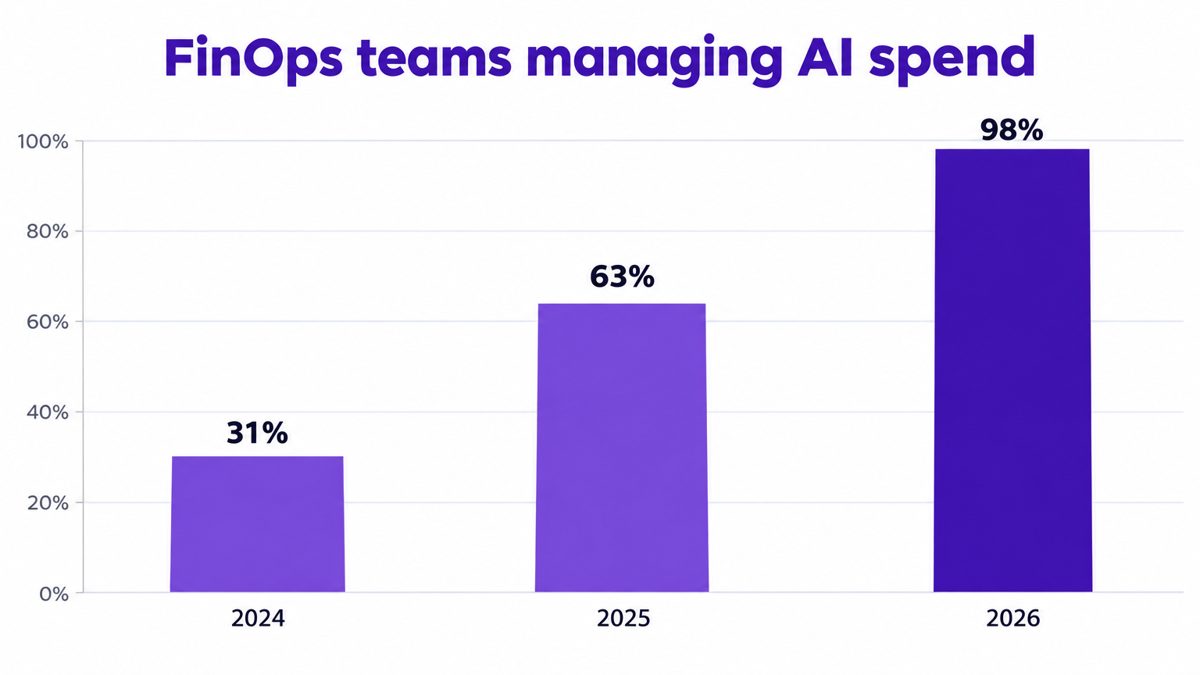
Share of FinOps teams that manage AI spend, by year.
The same practitioner base now reports managing SaaS (90%) and software licensing (64%) as well, which means FinOps already reaches beyond the cloud bill. CloudNuro makes that case in why FinOps must cover SaaS, not just cloud infrastructure.
A shared API key used by five teams produces one invoice line. Cost allocation needs every call mapped to a user, project, model, agent, and business unit, as covered in how to tag and attribute every token.
Model provider APIs, AI seats inside SaaS suites, and assistants bought on corporate cards never appear in a cloud cost report. Shadow AI stays invisible to tools that only read cloud billing exports.
An agent stuck in a retry loop can consume a quarter's budget in days. Cost management that reports monthly cannot stop spend that compounds hourly.
Cloud unit metrics measure capacity. AI needs value metrics such as cost per successful task, which CloudNuro explores in how FinOps unit metrics transform AI investments.
Teams default to the most capable model for tasks a smaller model could handle. Without visibility by model, nobody can ask whether a workload shipped on the wrong one.
| Dimension | Traditional Cloud Cost Management | FinOps for AI |
|---|---|---|
| Unit of spend | Compute hours, storage, reserved capacity | Tokens, API calls, AI seats, credits, agent runs |
| Data sources | Cloud billing exports | Model providers, SaaS assistants, cloud, expenses |
| Cost allocation | Resource tags | User, project, model, agent, business unit |
| Control speed | Monthly review | Real-time budgets and guardrails |
| Core metric | Cost per resource | Value per token, cost per successful task |
| Governance scope | Sanctioned infrastructure | Sanctioned and shadow AI, models, data exposure |
Get a read-only assessment of sanctioned and shadow AI spend across your enterprise.
Get Free Savings AssessmentAgentNuro, CloudNuro's Enterprise AI Adoption Management platform, moves every dollar of AI spend through four stages.
AgentNuro finds sanctioned and shadow AI across OpenAI, Claude, Gemini, Copilot, and more. It connects read-only, with no agents installed and no application changes.
Every dollar and token is mapped to a user, project, model, agent, and business unit, giving AI spend a denominator for ROI. See how AgentNuro attributes every dollar to teams and projects.
AgentNuro gives real-time control over model choice, data exposure, token consumption, and runaway spend, so policy is enforced while spend happens rather than reviewed afterward.
Teams move from reporting to optimization and chase value per token, not just cost per token. This builds on CloudNuro's SaaS and cloud FinOps foundation: one control plane and one source of truth for SaaS, cloud, and AI.
List every AI provider, assistant, and agent in use, sanctioned or not. You cannot allocate spend you have not found.
Replace shared keys with attribution by user, project, and cost center, then start with showback before chargeback.
Define thresholds per team and per agent that alert or stop spend, not reports that describe it a month later.
Track cost per successful task alongside cost per token, and review model choice for each high-volume workload.
Build AI forecasts from users, workloads, and model mix, as outlined in how to budget for tokens, calls, and credits.
As agents act on their own, cost, access, and policy converge into one governance question: what is this agent doing, who owns it, and is it worth what it costs.
Enterprises that answer that question from one platform will scale AI with financial discipline. Those that stitch cloud reports to spreadsheets will keep finding the bill after the fact.
FinOps for AI is the practice of metering, attributing, forecasting, and governing AI spend across models, assistants, and agents. It extends cloud FinOps to token-based and usage-based pricing.
Traditional cloud cost management reads cloud billing exports and resource tags, while much AI spend sits in model provider APIs and SaaS assistants. It also reports monthly, which is too slow for agent spend that compounds hourly.
In 2026, 98% of FinOps teams manage AI spend, up from 63% in 2025 and 31% in 2024. AI has become a standard part of FinOps scope.
TokenOps focuses on token usage, entitlements, and optimization, while FinOps for AI covers the full financial lifecycle of AI spend. CloudNuro compares both in TokenOps vs. FinOps for AI.
You allocate AI costs by mapping each API call, seat, and agent run to a user, project, and business unit. AgentNuro performs this mapping automatically across providers.
AgentNuro connects read-only in minutes and delivers insights the next day. Nothing changes in your applications.
AI has made token spend a mainstream FinOps responsibility, and cloud-era tools were not built to see it, attribute it, or stop it in time.
Organizations that keep using infrastructure reports for AI will absorb overruns they cannot explain. The better model gives every AI dollar an owner and a measure of value, inside one view of SaaS, cloud, and AI.
See how AgentNuro discovers, attributes, governs, and optimizes AI spend from one platform.
Request a DemoAgentNuro gives FinOps, IT, and Finance teams one view of AI spend across model providers, assistants, and agents, with real-time controls on budgets, models, and data exposure.
Because it runs on CloudNuro's SaaS and cloud FinOps foundation, AI spend sits next to SaaS and cloud spend in the same cost allocation model. CloudNuro's FinOps services help teams set up the operating model around it.
CloudNuro is a leader in Enterprise AI Adoption Management, providing enterprises with unmatched visibility, governance, and cost optimization. Recognized twice in a row by Gartner in the SaaS Management Platforms and named a Leader in the Info-Tech SoftwareReviews Data Quadrant, CloudNuro is trusted by global enterprises and government agencies to bring financial discipline to SaaS, cloud, and AI. Trusted by enterprises, CloudNuro provides centralized SaaS inventory, license optimization, and renewal management along with advanced cost allocation and chargeback, giving IT and Finance leaders the visibility, control, and cost-conscious culture needed to drive financial discipline.
Request a no cost, no obligation free assessment —just 15 minutes to savings!
Get StartedFinOps for AI is the practice of metering, attributing, forecasting, and governing what an enterprise spends on AI models, assistants, and agents.
In 2026, 98% of FinOps teams manage AI spend, up from 31% in 2024, yet most still use tools built for static cloud infrastructure.
This post explains where traditional cloud cost management breaks on AI, what an AI-ready FinOps model needs, and how AgentNuro closes the gap.
The share of FinOps teams managing AI spend rose from 31% in 2024 to 63% in 2025 and 98% in 2026. FinOps for AI is no longer a side project; it is the core of the practice.
The problem is that AI spend does not behave like cloud spend. It arrives as tokens, API calls, seat licenses, credits, and agent runs, spread across model providers, SaaS assistants, and cloud marketplaces.
Engineering picks the model. IT finds out after the fact. Finance pays the bill. CIOs, CFOs, and FinOps leads each see one fragment and nobody sees the whole.
The discipline has had to change, as CloudNuro describes in its overview of TokenOps, the FinOps practice for the token economy.
This post shows where traditional cloud cost management falls short on AI, what an AI-ready model requires, and how to put it in place.
See how AgentNuro maps AI spend across models, assistants, and agents to the teams that use them.
Request a DemoTraditional cloud cost management was built for resources that are provisioned, tagged, and billed by the hour. A virtual machine has an owner, a tag, and a predictable rate.
AI consumption is different. A single prompt can trigger retrieval, several model calls, and tool calls, and the cost depends on context length, model choice, and retries rather than on provisioned capacity.
Share of FinOps teams that manage AI spend, by year.
The same practitioner base now reports managing SaaS (90%) and software licensing (64%) as well, which means FinOps already reaches beyond the cloud bill. CloudNuro makes that case in why FinOps must cover SaaS, not just cloud infrastructure.
A shared API key used by five teams produces one invoice line. Cost allocation needs every call mapped to a user, project, model, agent, and business unit, as covered in how to tag and attribute every token.
Model provider APIs, AI seats inside SaaS suites, and assistants bought on corporate cards never appear in a cloud cost report. Shadow AI stays invisible to tools that only read cloud billing exports.
An agent stuck in a retry loop can consume a quarter's budget in days. Cost management that reports monthly cannot stop spend that compounds hourly.
Cloud unit metrics measure capacity. AI needs value metrics such as cost per successful task, which CloudNuro explores in how FinOps unit metrics transform AI investments.
Teams default to the most capable model for tasks a smaller model could handle. Without visibility by model, nobody can ask whether a workload shipped on the wrong one.
| Dimension | Traditional Cloud Cost Management | FinOps for AI |
|---|---|---|
| Unit of spend | Compute hours, storage, reserved capacity | Tokens, API calls, AI seats, credits, agent runs |
| Data sources | Cloud billing exports | Model providers, SaaS assistants, cloud, expenses |
| Cost allocation | Resource tags | User, project, model, agent, business unit |
| Control speed | Monthly review | Real-time budgets and guardrails |
| Core metric | Cost per resource | Value per token, cost per successful task |
| Governance scope | Sanctioned infrastructure | Sanctioned and shadow AI, models, data exposure |
Get a read-only assessment of sanctioned and shadow AI spend across your enterprise.
Get Free Savings AssessmentAgentNuro, CloudNuro's Enterprise AI Adoption Management platform, moves every dollar of AI spend through four stages.
AgentNuro finds sanctioned and shadow AI across OpenAI, Claude, Gemini, Copilot, and more. It connects read-only, with no agents installed and no application changes.
Every dollar and token is mapped to a user, project, model, agent, and business unit, giving AI spend a denominator for ROI. See how AgentNuro attributes every dollar to teams and projects.
AgentNuro gives real-time control over model choice, data exposure, token consumption, and runaway spend, so policy is enforced while spend happens rather than reviewed afterward.
Teams move from reporting to optimization and chase value per token, not just cost per token. This builds on CloudNuro's SaaS and cloud FinOps foundation: one control plane and one source of truth for SaaS, cloud, and AI.
List every AI provider, assistant, and agent in use, sanctioned or not. You cannot allocate spend you have not found.
Replace shared keys with attribution by user, project, and cost center, then start with showback before chargeback.
Define thresholds per team and per agent that alert or stop spend, not reports that describe it a month later.
Track cost per successful task alongside cost per token, and review model choice for each high-volume workload.
Build AI forecasts from users, workloads, and model mix, as outlined in how to budget for tokens, calls, and credits.
As agents act on their own, cost, access, and policy converge into one governance question: what is this agent doing, who owns it, and is it worth what it costs.
Enterprises that answer that question from one platform will scale AI with financial discipline. Those that stitch cloud reports to spreadsheets will keep finding the bill after the fact.
FinOps for AI is the practice of metering, attributing, forecasting, and governing AI spend across models, assistants, and agents. It extends cloud FinOps to token-based and usage-based pricing.
Traditional cloud cost management reads cloud billing exports and resource tags, while much AI spend sits in model provider APIs and SaaS assistants. It also reports monthly, which is too slow for agent spend that compounds hourly.
In 2026, 98% of FinOps teams manage AI spend, up from 63% in 2025 and 31% in 2024. AI has become a standard part of FinOps scope.
TokenOps focuses on token usage, entitlements, and optimization, while FinOps for AI covers the full financial lifecycle of AI spend. CloudNuro compares both in TokenOps vs. FinOps for AI.
You allocate AI costs by mapping each API call, seat, and agent run to a user, project, and business unit. AgentNuro performs this mapping automatically across providers.
AgentNuro connects read-only in minutes and delivers insights the next day. Nothing changes in your applications.
AI has made token spend a mainstream FinOps responsibility, and cloud-era tools were not built to see it, attribute it, or stop it in time.
Organizations that keep using infrastructure reports for AI will absorb overruns they cannot explain. The better model gives every AI dollar an owner and a measure of value, inside one view of SaaS, cloud, and AI.
See how AgentNuro discovers, attributes, governs, and optimizes AI spend from one platform.
Request a DemoAgentNuro gives FinOps, IT, and Finance teams one view of AI spend across model providers, assistants, and agents, with real-time controls on budgets, models, and data exposure.
Because it runs on CloudNuro's SaaS and cloud FinOps foundation, AI spend sits next to SaaS and cloud spend in the same cost allocation model. CloudNuro's FinOps services help teams set up the operating model around it.
CloudNuro is a leader in Enterprise AI Adoption Management, providing enterprises with unmatched visibility, governance, and cost optimization. Recognized twice in a row by Gartner in the SaaS Management Platforms and named a Leader in the Info-Tech SoftwareReviews Data Quadrant, CloudNuro is trusted by global enterprises and government agencies to bring financial discipline to SaaS, cloud, and AI. Trusted by enterprises, CloudNuro provides centralized SaaS inventory, license optimization, and renewal management along with advanced cost allocation and chargeback, giving IT and Finance leaders the visibility, control, and cost-conscious culture needed to drive financial discipline.
Request a no cost, no obligation free assessment - just 15 minutes to savings!
Get StartedWe're offering complimentary ServiceNow license assessments to only 25 enterprises this quarter who want to unlock immediate savings without disrupting operations.
Get Free AssessmentGet Started




CloudNuro Corp
1755 Park St. Suite 207
Naperville, IL 60563
Phone : +1-630-277-9470
Email: info@cloudnuro.com







Recognized Leader in SaaS Management Platforms by Info-Tech SoftwareReviews


