
Sign Up
Thank you for Submitting!

AI cost attribution is the practice of assigning every AI dollar and token to the user, project, model, agent, and business unit that consumed it.
More than half of organizations (53.4%) struggle to see their total AI spending, so most AI budgets are reviewed as one undivided invoice line.
This post explains why AI spend resists attribution, the five dimensions every AI dollar needs, and how AgentNuro turns provider invoices into owned, allocated, and forecastable costs.
98% of FinOps teams now manage AI spend, up from 31% in 2024. AI cost attribution moved from an experiment to a monthly finance obligation in two years.
Yet 53.4% of organizations struggle to see their total AI spending, and 40.1% cannot quantify AI value or ROI. A budget nobody can see cannot be assigned an owner.
The pattern is familiar across the enterprise: engineering picks the model, IT finds out after the fact, and Finance pays the bill.
CIOs need to know what is running, CFOs need to know whose dollar it is, and FinOps leads need a cost center for every token. The discipline that answers all three is described in CloudNuro's guide to TokenOps as the FinOps practice for the token economy.
This post explains why AI spend is hard to attribute, what a complete attribution model looks like, and how AgentNuro assigns every AI dollar to teams and projects.
The AI attribution gap is the distance between what a provider invoice shows (a total for an account or API key) and what Finance needs (cost by team, project, and outcome).
Cloud costs map to tagged resources. AI costs do not: one API key often serves several applications, one copilot seat serves several projects, and one agent calls several models in a single task.
AI vendors bill at the account or key level. Without a mapping layer, a shared key used by five product teams becomes one unallocated cost.
Usage-based API tokens, per-seat AI subscriptions, and AI features bundled into existing SaaS contracts each land in a different budget. Attribution has to join all three.
AI tools bought on corporate cards or expensed by individuals sit outside every cost center. Discovery comes before attribution, because an unseen cost cannot be assigned.
Token and API charges may represent only 10 to 25% of total AI spend once infrastructure, software, labor, and process costs are included. Attribution that stops at the token line misses most of the budget.
For the tagging mechanics behind this, see CloudNuro's guide to tagging and attributing every AI token.
To see where your AI dollars sit today, get your free savings assessment.
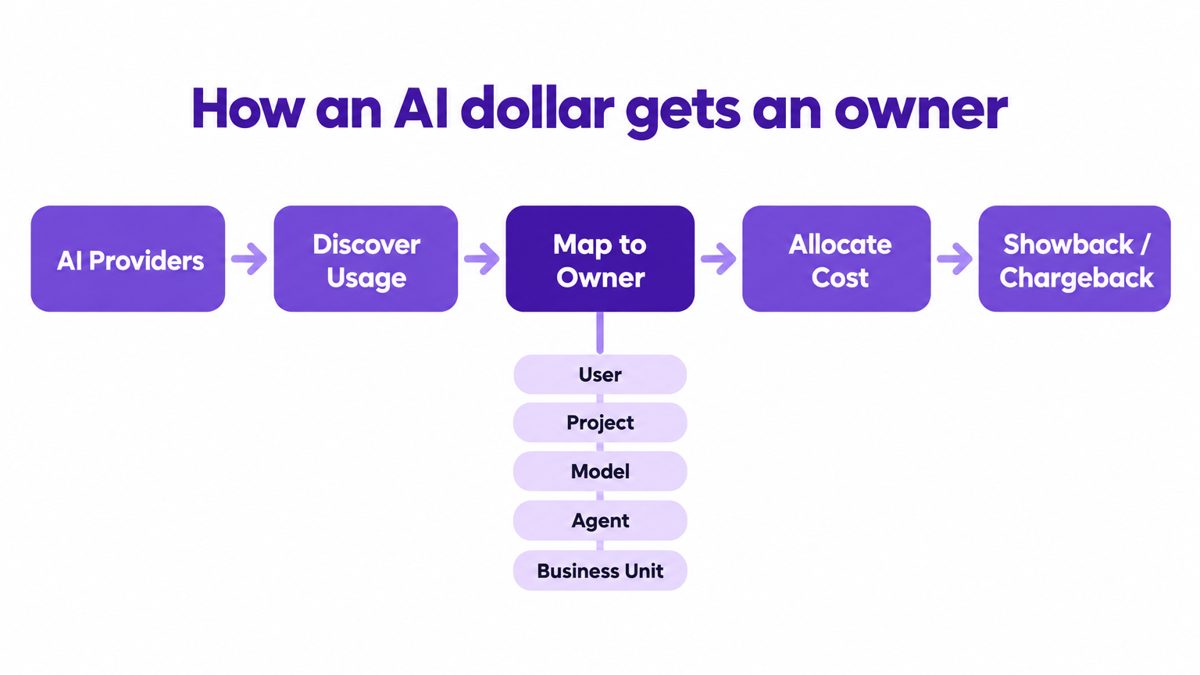
A complete AI cost attribution model answers five questions for every dollar and token: who used it, for what, on which model, through which agent, and in which business unit.
| Dimension | Question it answers | Who uses it |
|---|---|---|
| User | Who consumed this spend? | IT, CISO |
| Project | Which initiative does it fund? | Product and engineering leads |
| Model | Is the right model doing the job? | AI leaders, FinOps |
| Agent | Which autonomous workflow generated it? | Platform owners, CISO |
| Business unit | Which cost center pays? | CFO, FinOps |
The agent dimension is the newest. As autonomous agents chain model calls, one task can consume tokens across several models, and only an agent-level view shows the full cost of that task.
Cloud-only FinOps tools allocate compute, storage, and network by resource tag. They see the infrastructure under a self-hosted model, but not the per-seat AI subscriptions or the SaaS-embedded AI features.
SaaS management tools see seats, but not token consumption. Each tool sees one channel, and AI spend crosses all of them. CloudNuro explains this in detail in why your FinOps tool cannot solve your AI cost problem.
AgentNuro is CloudNuro's Enterprise AI Adoption Management platform. It moves every dollar of AI spend through four stages: discover, track spend, optimize, and govern.
AgentNuro finds sanctioned and shadow AI across the major model providers and copilots with no agents and no application changes. The connection is read-only, so nothing changes in your applications.
AgentNuro maps every dollar and token to a user, project, model, agent, and business unit. That mapping gives AI spend a denominator for ROI, which is the input Finance needs for AI unit economics.
Because AgentNuro is built on CloudNuro's SaaS and cloud FinOps foundation, attributed AI costs flow into the same cost allocation model as SaaS and cloud. Teams can follow CloudNuro's plan to implement LLM showback and chargeback in 90 days.
Once each dollar has an owner, AgentNuro applies real-time control over model choice, data exposure, token consumption, and runaway spend. Owners can be held to the LLM spending limits set per team.
Connect in minutes and see insights the next day. To see AgentNuro map your AI spend, request a demo.
Discover every AI tool, key, and subscription first. Allocation built on a partial inventory leaves shadow AI as permanent unallocated spend.
Issue keys per project or application so consumption maps to one owner. Where shared keys must remain, allocate by measured usage rather than headcount.
Let teams validate their AI costs before you bill them. The trade-offs are covered in CloudNuro's guide to chargeback vs. showback.
Cost per token shows efficiency; value per token shows return. Pair attributed cost with the outcome each project delivers.
Owner-level history makes AI budgets forecastable by team. CloudNuro covers the method in how to budget for tokens, calls, and credits.
As agents take on multi-step work, the unit of attribution shifts from the seat and the token to the task. Enterprises that already map cost to user, project, model, agent, and business unit will be able to price each task and compare it with the value it creates.
AI cost attribution is the process of assigning AI spend to the users, projects, models, agents, and business units that generated it. It turns an aggregated provider invoice into costs with owners.
AI spend is harder to allocate because it arrives through API tokens, per-seat subscriptions, and SaaS-embedded features, often behind shared keys. Cloud resources carry tags; most AI usage does not.
AgentNuro attributes AI costs by mapping every dollar and token to a user, project, model, agent, and business unit. It connects read-only, with no agents installed and no application changes.
Most enterprises start AI cost allocation with showback so teams can validate their numbers, then move to chargeback once attribution is trusted. Attribution accuracy decides when that move is safe.
AI cost attribution includes shadow AI only when discovery finds it first. AgentNuro discovers sanctioned and unsanctioned AI tools so their spend enters the allocation model.
AI cost attribution is one discipline inside TokenOps, which also covers token optimization and governance. CloudNuro compares the two in TokenOps vs. FinOps for AI.
AI spend has become a mainstream finance responsibility, but most organizations still review it as one invoice line. Without AI cost attribution, budgets grow without accountability and ROI stays unprovable. The better model gives every AI dollar a user, project, model, agent, and business unit, inside the same unified visibility that already governs SaaS and cloud.
AgentNuro, CloudNuro's Enterprise AI Adoption Management platform, discovers sanctioned and shadow AI, maps every dollar and token to an owner, and feeds those costs into the showback and chargeback model your teams already use for SaaS and cloud. Paired with CloudNuro AI Custodian, it gives IT and Finance one control plane and one source of truth for AI spend.
CloudNuro is a leader in Enterprise AI Adoption Management, providing enterprises with unmatched visibility, governance, and cost optimization. Recognized twice in a row by Gartner in the SaaS Management Platforms and named a Leader in the Info-Tech SoftwareReviews Data Quadrant, CloudNuro is trusted by global enterprises and government agencies to bring financial discipline to SaaS, cloud, and AI. Trusted by enterprises, CloudNuro provides centralized SaaS inventory, license optimization, and renewal management along with advanced cost allocation and chargeback, giving IT and Finance leaders the visibility, control, and cost-conscious culture needed to drive financial discipline.
Request a no cost, no obligation free assessment —just 15 minutes to savings!
Get StartedAI cost attribution is the practice of assigning every AI dollar and token to the user, project, model, agent, and business unit that consumed it.
More than half of organizations (53.4%) struggle to see their total AI spending, so most AI budgets are reviewed as one undivided invoice line.
This post explains why AI spend resists attribution, the five dimensions every AI dollar needs, and how AgentNuro turns provider invoices into owned, allocated, and forecastable costs.
98% of FinOps teams now manage AI spend, up from 31% in 2024. AI cost attribution moved from an experiment to a monthly finance obligation in two years.
Yet 53.4% of organizations struggle to see their total AI spending, and 40.1% cannot quantify AI value or ROI. A budget nobody can see cannot be assigned an owner.
The pattern is familiar across the enterprise: engineering picks the model, IT finds out after the fact, and Finance pays the bill.
CIOs need to know what is running, CFOs need to know whose dollar it is, and FinOps leads need a cost center for every token. The discipline that answers all three is described in CloudNuro's guide to TokenOps as the FinOps practice for the token economy.
This post explains why AI spend is hard to attribute, what a complete attribution model looks like, and how AgentNuro assigns every AI dollar to teams and projects.
The AI attribution gap is the distance between what a provider invoice shows (a total for an account or API key) and what Finance needs (cost by team, project, and outcome).
Cloud costs map to tagged resources. AI costs do not: one API key often serves several applications, one copilot seat serves several projects, and one agent calls several models in a single task.
AI vendors bill at the account or key level. Without a mapping layer, a shared key used by five product teams becomes one unallocated cost.
Usage-based API tokens, per-seat AI subscriptions, and AI features bundled into existing SaaS contracts each land in a different budget. Attribution has to join all three.
AI tools bought on corporate cards or expensed by individuals sit outside every cost center. Discovery comes before attribution, because an unseen cost cannot be assigned.
Token and API charges may represent only 10 to 25% of total AI spend once infrastructure, software, labor, and process costs are included. Attribution that stops at the token line misses most of the budget.
For the tagging mechanics behind this, see CloudNuro's guide to tagging and attributing every AI token.
To see where your AI dollars sit today, get your free savings assessment.
A complete AI cost attribution model answers five questions for every dollar and token: who used it, for what, on which model, through which agent, and in which business unit.
| Dimension | Question it answers | Who uses it |
|---|---|---|
| User | Who consumed this spend? | IT, CISO |
| Project | Which initiative does it fund? | Product and engineering leads |
| Model | Is the right model doing the job? | AI leaders, FinOps |
| Agent | Which autonomous workflow generated it? | Platform owners, CISO |
| Business unit | Which cost center pays? | CFO, FinOps |
The agent dimension is the newest. As autonomous agents chain model calls, one task can consume tokens across several models, and only an agent-level view shows the full cost of that task.
Cloud-only FinOps tools allocate compute, storage, and network by resource tag. They see the infrastructure under a self-hosted model, but not the per-seat AI subscriptions or the SaaS-embedded AI features.
SaaS management tools see seats, but not token consumption. Each tool sees one channel, and AI spend crosses all of them. CloudNuro explains this in detail in why your FinOps tool cannot solve your AI cost problem.
AgentNuro is CloudNuro's Enterprise AI Adoption Management platform. It moves every dollar of AI spend through four stages: discover, track spend, optimize, and govern.
AgentNuro finds sanctioned and shadow AI across the major model providers and copilots with no agents and no application changes. The connection is read-only, so nothing changes in your applications.
AgentNuro maps every dollar and token to a user, project, model, agent, and business unit. That mapping gives AI spend a denominator for ROI, which is the input Finance needs for AI unit economics.
Because AgentNuro is built on CloudNuro's SaaS and cloud FinOps foundation, attributed AI costs flow into the same cost allocation model as SaaS and cloud. Teams can follow CloudNuro's plan to implement LLM showback and chargeback in 90 days.
Once each dollar has an owner, AgentNuro applies real-time control over model choice, data exposure, token consumption, and runaway spend. Owners can be held to the LLM spending limits set per team.
Connect in minutes and see insights the next day. To see AgentNuro map your AI spend, request a demo.
Discover every AI tool, key, and subscription first. Allocation built on a partial inventory leaves shadow AI as permanent unallocated spend.
Issue keys per project or application so consumption maps to one owner. Where shared keys must remain, allocate by measured usage rather than headcount.
Let teams validate their AI costs before you bill them. The trade-offs are covered in CloudNuro's guide to chargeback vs. showback.
Cost per token shows efficiency; value per token shows return. Pair attributed cost with the outcome each project delivers.
Owner-level history makes AI budgets forecastable by team. CloudNuro covers the method in how to budget for tokens, calls, and credits.
As agents take on multi-step work, the unit of attribution shifts from the seat and the token to the task. Enterprises that already map cost to user, project, model, agent, and business unit will be able to price each task and compare it with the value it creates.
AI cost attribution is the process of assigning AI spend to the users, projects, models, agents, and business units that generated it. It turns an aggregated provider invoice into costs with owners.
AI spend is harder to allocate because it arrives through API tokens, per-seat subscriptions, and SaaS-embedded features, often behind shared keys. Cloud resources carry tags; most AI usage does not.
AgentNuro attributes AI costs by mapping every dollar and token to a user, project, model, agent, and business unit. It connects read-only, with no agents installed and no application changes.
Most enterprises start AI cost allocation with showback so teams can validate their numbers, then move to chargeback once attribution is trusted. Attribution accuracy decides when that move is safe.
AI cost attribution includes shadow AI only when discovery finds it first. AgentNuro discovers sanctioned and unsanctioned AI tools so their spend enters the allocation model.
AI cost attribution is one discipline inside TokenOps, which also covers token optimization and governance. CloudNuro compares the two in TokenOps vs. FinOps for AI.
AI spend has become a mainstream finance responsibility, but most organizations still review it as one invoice line. Without AI cost attribution, budgets grow without accountability and ROI stays unprovable. The better model gives every AI dollar a user, project, model, agent, and business unit, inside the same unified visibility that already governs SaaS and cloud.
AgentNuro, CloudNuro's Enterprise AI Adoption Management platform, discovers sanctioned and shadow AI, maps every dollar and token to an owner, and feeds those costs into the showback and chargeback model your teams already use for SaaS and cloud. Paired with CloudNuro AI Custodian, it gives IT and Finance one control plane and one source of truth for AI spend.
CloudNuro is a leader in Enterprise AI Adoption Management, providing enterprises with unmatched visibility, governance, and cost optimization. Recognized twice in a row by Gartner in the SaaS Management Platforms and named a Leader in the Info-Tech SoftwareReviews Data Quadrant, CloudNuro is trusted by global enterprises and government agencies to bring financial discipline to SaaS, cloud, and AI. Trusted by enterprises, CloudNuro provides centralized SaaS inventory, license optimization, and renewal management along with advanced cost allocation and chargeback, giving IT and Finance leaders the visibility, control, and cost-conscious culture needed to drive financial discipline.
Request a no cost, no obligation free assessment - just 15 minutes to savings!
Get StartedWe're offering complimentary ServiceNow license assessments to only 25 enterprises this quarter who want to unlock immediate savings without disrupting operations.
Get Free AssessmentGet Started




CloudNuro Corp
1755 Park St. Suite 207
Naperville, IL 60563
Phone : +1-630-277-9470
Email: info@cloudnuro.com







Recognized Leader in SaaS Management Platforms by Info-Tech SoftwareReviews