

Sign Up
Thank you for Submitting!
AgentNuro is CloudNuro's Enterprise AI Adoption Management product, and getting started takes six steps that move AI from unmanaged experimentation to governed, attributable spend.
This guide walks through each step, what done looks like, and a copyable onboarding checklist.
Only 31% of organizations have accurate visibility into their AI software spending, and 59% say wasted AI spend increased year over year. Enterprise AI governance cannot start with policy when leaders cannot yet see which AI tools, agents, and models are running.
The problem grows each quarter because AI pricing is usage-based. Tokens, API calls, credits, agents, and seat licenses all land on different bills, and the same prompt can cost a different amount every time it runs.
The pattern inside most enterprises is consistent: engineering picks the model, IT finds out after the fact, and Finance pays the bill. CIOs ask what AI is actually running, CFOs ask whose dollar each token is, and CISOs ask which tools nobody approved, a pattern CloudNuro covers in its guide to detecting shadow AI and unauthorized AI tools.
AgentNuro answers those questions on the same platform CloudNuro uses to govern SaaS and cloud spend. This guide explains the AI control gap, then walks through the six steps to get started with AgentNuro, from read-only discovery to real-time control.
The AI control gap is the distance between how fast employees and teams adopt AI and how fast the organization can see, attribute, and govern that use. It opens when AI tools, agents, and model endpoints appear across departments without central oversight.
It matters because AI cost and AI risk come from the same blind spot. A tool nobody registered is both an unbudgeted expense and an unreviewed path for sensitive data.
Shadow AI is now an enterprise-scale pattern. 66% of office professionals at organizations with more than $500 million in revenue have used AI tools they believed company policy did not permit, and the figure reaches 72% in organizations with at least 1,500 employees.
Agents widen the gap further. 87% of organizations encourage AI agent use, but only 47% say that use is supported by clear governance, oversight, and controls.
Policy alone has not closed it. Only 37% of organizations have policies to manage AI or detect shadow AI, and more detail sits in CloudNuro's shadow AI statistics for enterprise governance.
A single AI call can swing 5 to 10 times around its average cost, and monthly averages hide exactly the spikes that break budgets. Without cost allocation, nobody owns the overrun, as CloudNuro explains in its framework for eliminating AI tool waste.
Teams buy overlapping AI tools, run idle agents, and send simple tasks to the most expensive models. Each choice is small; together they compound into AI sprawl.
Unsanctioned AI tools can receive personally identifiable information or restricted documents with no review. Regulated industries such as financial services, healthcare, and government carry that exposure into audits.
AgentNuro moves every AI dollar through a fixed sequence: see it, attribute it, govern it, then control it. Each step below states what to do and how to know it worked.
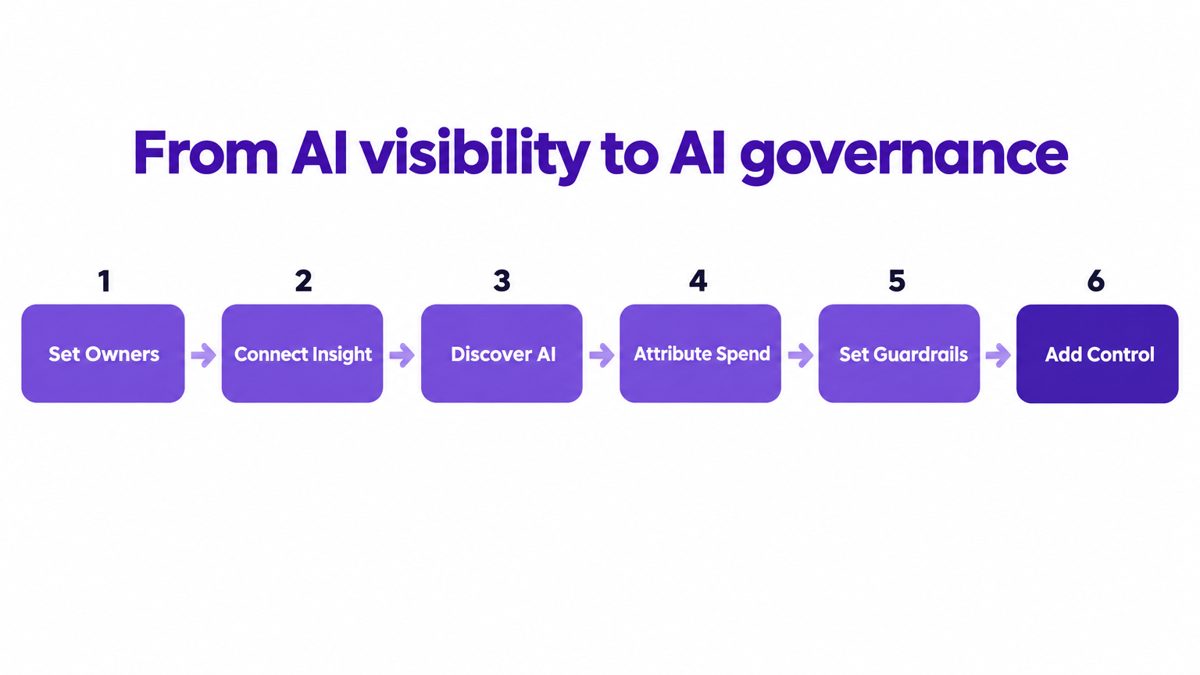
Before connecting anything, assign one owner for AI policy (usually the CIO or an AI platform lead), one for AI budgets (FinOps or Finance), and one for AI risk (the CISO). Agree on the first questions the data must answer: what is running, who owns each dollar, and what next quarter will cost.
How you know it worked: every finding AgentNuro surfaces has a named person who will act on it. CloudNuro's AI governance leadership framework covers how to structure that accountability.
AgentNuro Insight connects through your AI provider, billing, and identity APIs and correlates them into one picture of AI spend. It is read-only, so nothing in your applications changes, and you can connect in minutes with insights the next day.
Read-only first also lowers adoption risk, because security and platform teams can approve an API connection far faster than an inline change to production traffic. The difference between the two modes is laid out in AgentNuro Insight vs Control.
How you know it worked: provider, billing, and identity sources all report into one view, with no agents installed and no application changes.
Insight finds sanctioned and unsanctioned AI across major model providers and workplace copilots, including the shadow AI nobody registered. Review the inventory with the owners from step 1 and label each tool as sanctioned, under review, or to be retired.
How you know it worked: you can answer which AI tools employees use, which models teams call, and how many tools duplicate one another.
AgentNuro maps every dollar and token to a user, project, model, agent, and business unit, and its agent-level cost breakdown shows token usage, cost, and consumption trends for individual agents. That attribution gives AI spend a denominator for ROI, the core discipline described in CloudNuro's explanation of TokenOps and the token economy.
Insight also forecasts with confidence ranges fitted to your actual telemetry, so an AI budget becomes a probability Finance can defend. Enterprises formalizing this often build a token office, as outlined in the TokenOps imperative.
How you know it worked: no AI cost line sits in an "unallocated" bucket, and each business unit can see its own AI spend.
With a baseline in place, set budget limits at both the project and individual agent level to mirror internal thresholds. Turn on alerts and anomaly detection so runaway agents and unexpected consumption spikes are flagged before they become overruns.
Insight then recommends where to right-size models, cache repeated work, and trim oversized context. For workplace copilots, CloudNuro's AI Custodian monitors usage against corporate AI policy and can flag excessive personal use, compliance violations, or sharing of PII.
How you know it worked: every project and agent has a threshold, and the first alerts reach the owner named in step 1.
Move to Control when Insight keeps flagging the same oversized models, repeated prompts, or spend spikes, and teams are acting on recommendations by hand. Control adds the AgentNuro Gateway, a lightweight inline proxy that routes each request to the right model for the job, caches repeated work, and enforces caps, rate limits, and a kill switch for runaway spend.
Control also governs data exposure at runtime, so policy applies the moment a request leaves your environment. CloudNuro compares the architectural options in model router vs AI gateway.
How you know it worked: recommendations from Insight execute automatically, and one policy applies across every AI provider.
Copy this table into your rollout plan and mark each row complete only when the proof column is true.
| Step | Primary owner | Done when |
|---|---|---|
| 1. Name owners | CIO, CFO, CISO | Policy, budget, and risk each have one named owner |
| 2. Connect Insight | IT Director, AI platform lead | Provider, billing, and identity APIs connected read-only |
| 3. Discover AI | CISO, IT Director | Every tool labelled sanctioned, under review, or to be retired |
| 4. Attribute spend | FinOps Manager | No unallocated AI spend; forecasts carry confidence ranges |
| 5. Set guardrails | FinOps Manager, CISO | Project and agent thresholds, alerts, and anomaly detection live |
| 6. Add Control | CTO, AI platform lead | Gateway routes, caches, and caps requests under one policy |
CloudNuro delivers results in under 24 hours. Get your free savings assessment.
AgentNuro is CloudNuro's Enterprise AI Adoption Management product for discovering, tracking spend on, optimizing, and governing every AI tool and agent. It runs on the same SaaS and cloud FinOps foundation as CloudNuro, giving one control plane for SaaS, cloud, and AI.
Getting started with AgentNuro Insight takes minutes to connect, with insights the next day. Most of the elapsed time goes into step 1, agreeing on owners for AI policy, budget, and risk.
AgentNuro Insight changes nothing in your applications because it connects read-only through provider, billing, and identity APIs. Only AgentNuro Control places the Gateway inline, and teams add it when they are ready to enforce policy in real time.
Enterprise AI governance is the set of owners, policies, guardrails, and budget controls that keep AI use within financial, operational, and compliance boundaries. It depends on visibility first, because a policy cannot govern AI tools and agents the organization has not discovered.
AgentNuro attributes AI spend by mapping every dollar and token to a user, project, model, agent, and business unit. That attribution feeds showback and chargeback, the same model CloudNuro applies in its chargeback and showback strategy.
AI spend now behaves differently from every other technology cost: it is usage-based, distributed across teams, and invisible to most cost tools. Organizations that jump straight to enforcement write policies against guesses, and those that stop at dashboards leave waste in place. Getting started with AgentNuro in sequence (owners, read-only discovery, attribution, guardrails, then control) builds enterprise AI governance on evidence. The result is one governed view of SaaS, cloud, and AI, where every AI dollar has an owner.
AgentNuro gives IT and Finance a read-only map of every AI tool, agent, and model, assigns each AI dollar an owner, and adds the Gateway when you are ready to route and cap spend in real time. Because it sits on CloudNuro's platform, AI joins SaaS and cloud under one governance model, the case CloudNuro makes for FinOps beyond cloud.
CloudNuro is a leader in Enterprise AI Adoption Management, providing enterprises with unmatched visibility, governance, and cost optimization. Recognized twice in a row in the SaaS Management Platforms category and named a Leader in the SoftwareReviews Data Quadrant, CloudNuro is trusted by global enterprises and government agencies to bring financial discipline to SaaS, cloud, and AI. Trusted by enterprises, CloudNuro provides centralized SaaS inventory, license optimization, and renewal management along with advanced cost allocation and chargeback, giving IT and Finance leaders the visibility, control, and cost-conscious culture needed to drive financial discipline.
Request a no cost, no obligation free assessment —just 15 minutes to savings!
Get StartedAgentNuro is CloudNuro's Enterprise AI Adoption Management product, and getting started takes six steps that move AI from unmanaged experimentation to governed, attributable spend.
This guide walks through each step, what done looks like, and a copyable onboarding checklist.
Only 31% of organizations have accurate visibility into their AI software spending, and 59% say wasted AI spend increased year over year. Enterprise AI governance cannot start with policy when leaders cannot yet see which AI tools, agents, and models are running.
The problem grows each quarter because AI pricing is usage-based. Tokens, API calls, credits, agents, and seat licenses all land on different bills, and the same prompt can cost a different amount every time it runs.
The pattern inside most enterprises is consistent: engineering picks the model, IT finds out after the fact, and Finance pays the bill. CIOs ask what AI is actually running, CFOs ask whose dollar each token is, and CISOs ask which tools nobody approved, a pattern CloudNuro covers in its guide to detecting shadow AI and unauthorized AI tools.
AgentNuro answers those questions on the same platform CloudNuro uses to govern SaaS and cloud spend. This guide explains the AI control gap, then walks through the six steps to get started with AgentNuro, from read-only discovery to real-time control.
The AI control gap is the distance between how fast employees and teams adopt AI and how fast the organization can see, attribute, and govern that use. It opens when AI tools, agents, and model endpoints appear across departments without central oversight.
It matters because AI cost and AI risk come from the same blind spot. A tool nobody registered is both an unbudgeted expense and an unreviewed path for sensitive data.
Shadow AI is now an enterprise-scale pattern. 66% of office professionals at organizations with more than $500 million in revenue have used AI tools they believed company policy did not permit, and the figure reaches 72% in organizations with at least 1,500 employees.
Agents widen the gap further. 87% of organizations encourage AI agent use, but only 47% say that use is supported by clear governance, oversight, and controls.
Policy alone has not closed it. Only 37% of organizations have policies to manage AI or detect shadow AI, and more detail sits in CloudNuro's shadow AI statistics for enterprise governance.
A single AI call can swing 5 to 10 times around its average cost, and monthly averages hide exactly the spikes that break budgets. Without cost allocation, nobody owns the overrun, as CloudNuro explains in its framework for eliminating AI tool waste.
Teams buy overlapping AI tools, run idle agents, and send simple tasks to the most expensive models. Each choice is small; together they compound into AI sprawl.
Unsanctioned AI tools can receive personally identifiable information or restricted documents with no review. Regulated industries such as financial services, healthcare, and government carry that exposure into audits.
AgentNuro moves every AI dollar through a fixed sequence: see it, attribute it, govern it, then control it. Each step below states what to do and how to know it worked.
Before connecting anything, assign one owner for AI policy (usually the CIO or an AI platform lead), one for AI budgets (FinOps or Finance), and one for AI risk (the CISO). Agree on the first questions the data must answer: what is running, who owns each dollar, and what next quarter will cost.
How you know it worked: every finding AgentNuro surfaces has a named person who will act on it. CloudNuro's AI governance leadership framework covers how to structure that accountability.
AgentNuro Insight connects through your AI provider, billing, and identity APIs and correlates them into one picture of AI spend. It is read-only, so nothing in your applications changes, and you can connect in minutes with insights the next day.
Read-only first also lowers adoption risk, because security and platform teams can approve an API connection far faster than an inline change to production traffic. The difference between the two modes is laid out in AgentNuro Insight vs Control.
How you know it worked: provider, billing, and identity sources all report into one view, with no agents installed and no application changes.
Insight finds sanctioned and unsanctioned AI across major model providers and workplace copilots, including the shadow AI nobody registered. Review the inventory with the owners from step 1 and label each tool as sanctioned, under review, or to be retired.
How you know it worked: you can answer which AI tools employees use, which models teams call, and how many tools duplicate one another.
AgentNuro maps every dollar and token to a user, project, model, agent, and business unit, and its agent-level cost breakdown shows token usage, cost, and consumption trends for individual agents. That attribution gives AI spend a denominator for ROI, the core discipline described in CloudNuro's explanation of TokenOps and the token economy.
Insight also forecasts with confidence ranges fitted to your actual telemetry, so an AI budget becomes a probability Finance can defend. Enterprises formalizing this often build a token office, as outlined in the TokenOps imperative.
How you know it worked: no AI cost line sits in an "unallocated" bucket, and each business unit can see its own AI spend.
With a baseline in place, set budget limits at both the project and individual agent level to mirror internal thresholds. Turn on alerts and anomaly detection so runaway agents and unexpected consumption spikes are flagged before they become overruns.
Insight then recommends where to right-size models, cache repeated work, and trim oversized context. For workplace copilots, CloudNuro's AI Custodian monitors usage against corporate AI policy and can flag excessive personal use, compliance violations, or sharing of PII.
How you know it worked: every project and agent has a threshold, and the first alerts reach the owner named in step 1.
Move to Control when Insight keeps flagging the same oversized models, repeated prompts, or spend spikes, and teams are acting on recommendations by hand. Control adds the AgentNuro Gateway, a lightweight inline proxy that routes each request to the right model for the job, caches repeated work, and enforces caps, rate limits, and a kill switch for runaway spend.
Control also governs data exposure at runtime, so policy applies the moment a request leaves your environment. CloudNuro compares the architectural options in model router vs AI gateway.
How you know it worked: recommendations from Insight execute automatically, and one policy applies across every AI provider.
Copy this table into your rollout plan and mark each row complete only when the proof column is true.
| Step | Primary owner | Done when |
|---|---|---|
| 1. Name owners | CIO, CFO, CISO | Policy, budget, and risk each have one named owner |
| 2. Connect Insight | IT Director, AI platform lead | Provider, billing, and identity APIs connected read-only |
| 3. Discover AI | CISO, IT Director | Every tool labelled sanctioned, under review, or to be retired |
| 4. Attribute spend | FinOps Manager | No unallocated AI spend; forecasts carry confidence ranges |
| 5. Set guardrails | FinOps Manager, CISO | Project and agent thresholds, alerts, and anomaly detection live |
| 6. Add Control | CTO, AI platform lead | Gateway routes, caches, and caps requests under one policy |
CloudNuro delivers results in under 24 hours. Get your free savings assessment.
AgentNuro is CloudNuro's Enterprise AI Adoption Management product for discovering, tracking spend on, optimizing, and governing every AI tool and agent. It runs on the same SaaS and cloud FinOps foundation as CloudNuro, giving one control plane for SaaS, cloud, and AI.
Getting started with AgentNuro Insight takes minutes to connect, with insights the next day. Most of the elapsed time goes into step 1, agreeing on owners for AI policy, budget, and risk.
AgentNuro Insight changes nothing in your applications because it connects read-only through provider, billing, and identity APIs. Only AgentNuro Control places the Gateway inline, and teams add it when they are ready to enforce policy in real time.
Enterprise AI governance is the set of owners, policies, guardrails, and budget controls that keep AI use within financial, operational, and compliance boundaries. It depends on visibility first, because a policy cannot govern AI tools and agents the organization has not discovered.
AgentNuro attributes AI spend by mapping every dollar and token to a user, project, model, agent, and business unit. That attribution feeds showback and chargeback, the same model CloudNuro applies in its chargeback and showback strategy.
AI spend now behaves differently from every other technology cost: it is usage-based, distributed across teams, and invisible to most cost tools. Organizations that jump straight to enforcement write policies against guesses, and those that stop at dashboards leave waste in place. Getting started with AgentNuro in sequence (owners, read-only discovery, attribution, guardrails, then control) builds enterprise AI governance on evidence. The result is one governed view of SaaS, cloud, and AI, where every AI dollar has an owner.
AgentNuro gives IT and Finance a read-only map of every AI tool, agent, and model, assigns each AI dollar an owner, and adds the Gateway when you are ready to route and cap spend in real time. Because it sits on CloudNuro's platform, AI joins SaaS and cloud under one governance model, the case CloudNuro makes for FinOps beyond cloud.
CloudNuro is a leader in Enterprise AI Adoption Management, providing enterprises with unmatched visibility, governance, and cost optimization. Recognized twice in a row in the SaaS Management Platforms category and named a Leader in the SoftwareReviews Data Quadrant, CloudNuro is trusted by global enterprises and government agencies to bring financial discipline to SaaS, cloud, and AI. Trusted by enterprises, CloudNuro provides centralized SaaS inventory, license optimization, and renewal management along with advanced cost allocation and chargeback, giving IT and Finance leaders the visibility, control, and cost-conscious culture needed to drive financial discipline.
Request a no cost, no obligation free assessment - just 15 minutes to savings!
Get StartedWe're offering complimentary ServiceNow license assessments to only 25 enterprises this quarter who want to unlock immediate savings without disrupting operations.
Get Free AssessmentGet Started




CloudNuro Corp
1755 Park St. Suite 207
Naperville, IL 60563
Phone : +1-630-277-9470
Email: info@cloudnuro.com







Recognized Leader in SaaS Management Platforms by Info-Tech SoftwareReviews


