
Sign Up
Thank you for Submitting!
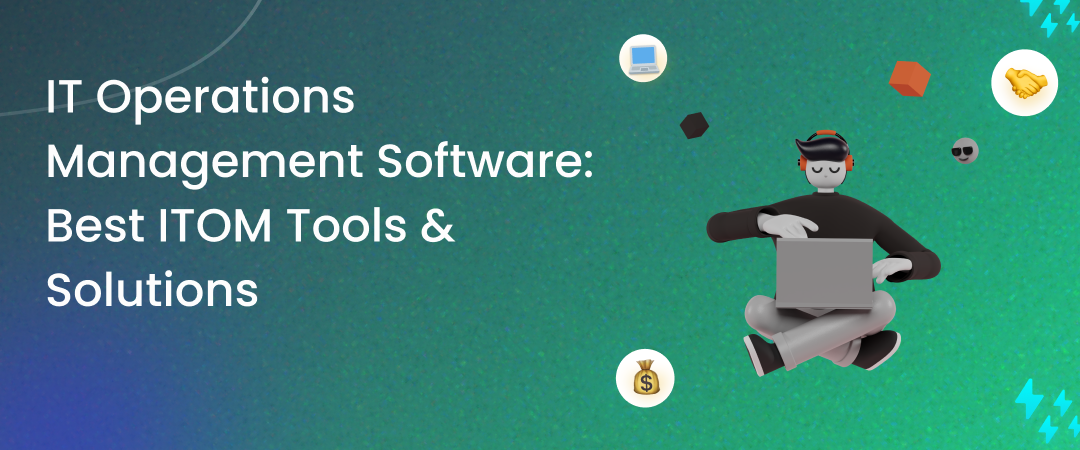
IT operations management software (ITOM) encompasses the tools and platforms that monitor, manage, and optimize IT infrastructure and services. In 2026, the best ITOM tools combine infrastructure monitoring, automation, AIOps intelligence, and cost visibility to keep complex hybrid environments running efficiently. This guide covers core capabilities, top platform categories, implementation strategies, and how modern ITOM connects to broader operations platforms for unified governance across infrastructure, cloud, and SaaS.
Here's the reality facing IT operations teams in 2026: the average enterprise manages infrastructure across multiple cloud providers, dozens of SaaS applications, legacy on-premise systems, and an increasingly distributed workforce. The complexity isn't just additive, it's multiplicative.
When an application slows down, is it the cloud infrastructure at fault? The network? The SaaS dependency? A configuration drift? Without unified IT operations management software, answering that question can take hours while business users suffer.
According to Gartner, organizations with mature ITOM practices reduce mean time to resolution (MTTR) by 50% and experience 40% fewer service disruptions. The difference between reactive firefighting and proactive operations management often determines whether IT is seen as a cost center or a business enabler.
In this guide, we'll cover what ITOM tools deliver, how they differ from IT service management, the key platform categories to evaluate, and how to build an operations practice that scales with your infrastructure complexity.
For a broader view of IT operations strategy, see our IT operations solutions overview.
IT operations management software is a category of tools that help IT teams monitor, manage, and optimize the performance, availability, and efficiency of IT infrastructure and services.
The scope of ITOM includes:
| Domain | What It Covers | Example Activities |
|---|---|---|
| Infrastructure Monitoring | Servers, networks, storage | Uptime tracking, resource utilization |
| Application Performance | App health, response times | Transaction tracing, error detection |
| Cloud Operations | Multi-cloud resources | Cost monitoring, resource optimization |
| Network Management | Connectivity, bandwidth | Traffic analysis, latency monitoring |
| Event Management | Alerts, incidents | Correlation, noise reduction |
| Automation | Routine tasks, remediation | Self-healing, orchestration |
Traditional ITOM focused on keeping servers running. Modern ITOM encompasses:
Understanding IT governance helps contextualize ITOM within a broader IT management strategy.
Effective IT operations management software integrates several interconnected capabilities:
The foundation of ITOM, continuous visibility into infrastructure health:
Server Monitoring
Track CPU, memory, disk, and process utilization across physical and virtual servers. Identify resource constraints before they impact performance.
Network Monitoring
Monitor bandwidth, latency, packet loss, and network device health. Network monitoring tools are essential for distributed environments.
Storage Monitoring
Track capacity, IOPS, and storage system health. Predict capacity exhaustion before it causes outages.
For comprehensive infrastructure visibility, see our guide on IT infrastructure monitoring tools.
Understanding how applications behave in production:
Application performance management bridges operations and development perspectives.
Making sense of the alert flood:
Moving from reactive to proactive operations:
See our guide on IT workflow automation for automation best practices.
Machine learning applied to operations:
💡 CloudNuro brings visibility to SaaS operations alongside infrastructure, request a demo to see unified IT governance.
Managing resources across cloud providers:
A common point of confusion: how does IT operations management software differ from IT service management (ITSM)?
| Aspect | ITOM | ITSM |
|---|---|---|
| Focus | Infrastructure and performance | Services and user experience |
| Primary Users | Operations engineers, SREs | Service desk, IT managers |
| Key Activities | Monitoring, automation, optimization | Ticketing, change management, CMDB |
| Orientation | Technology-centric | Process-centric |
| Typical Tools | Monitoring platforms, AIOps | ServiceNow, Jira Service Management |
The Reality: ITOM and ITSM are complementary. ITOM detects that a server is overloaded; ITSM manages the incident response process. Modern platforms increasingly blur these boundaries.
For ITSM-specific guidance, see our guide on IT service management tools.
The ITOM tools market is segmented into specialized categories:
Purpose: Comprehensive visibility into servers, networks, and storage
Key Capabilities:
Best For: Organizations needing foundational infrastructure visibility
Purpose: Deep visibility into distributed systems through logs, metrics, and traces
Key Capabilities:
For detailed comparisons, see our observability and monitoring guide.
Best For: Cloud-native, microservices architectures
Purpose: AI-driven event correlation, noise reduction, and root cause analysis
Key Capabilities:
Best For: Large enterprises with alert overload and complex environments
Purpose: Network device monitoring, configuration, and traffic analysis
Key Capabilities:
Best For: Organizations with significant network infrastructure
Purpose: Multi-cloud resource management and optimization
Key Capabilities:
Understanding cloud cost management is essential for the success of cloud operations.
Best For: Multi-cloud enterprises
Purpose: Workflow automation and orchestration
Key Capabilities:
Best For: Teams seeking to reduce manual operational work
| Category | Primary Focus | Deployment Model | AI/ML Capabilities | Cost Model | Best For |
|---|---|---|---|---|---|
| Infrastructure Monitoring | Server/network health | Agent + agentless | Basic alerting | Per-node or host | Traditional IT environments |
| Observability Platforms | Distributed tracing | Cloud-native | Anomaly detection | Usage-based | Cloud-native applications |
| AIOps Platforms | Event correlation | Hybrid | Advanced ML | Enterprise licensing | Large, complex environments |
| Network Management | Network devices | On-prem focus | Limited | Per-device | Network-heavy organizations |
| Cloud Management | Multi-cloud resources | SaaS | Optimization insights | Usage or percentage | Multi-cloud enterprises |
| IT Automation | Workflow automation | Cloud/hybrid | Workflow intelligence | Per-automation | Process-heavy IT teams |
| Unified Platforms | End-to-end visibility | Flexible | Comprehensive | Platform licensing | Enterprises wanting consolidation |
When selecting IT operations management software, ask vendors:
Here's what most ITOM tools discussions miss: operations visibility should drive cost efficiency, not just uptime.
Traditional ITOM focuses on availability and performance. But in cloud and SaaS environments, operations decisions directly impact spend:
Forward-thinking organizations connect IT operations to FinOps principles:
Resource Optimization
Use monitoring data to right-size infrastructure. If a server never exceeds 20% CPU, it's over-provisioned.
Idle Resource Detection
Identify resources running without meaningful workloads, development environments left on, unused storage volumes, orphaned load balancers.
SaaS Operations Visibility
Beyond infrastructure, SaaS cost optimization requires visibility into application usage that traditional ITOM doesn't provide.
Cost Allocation
Map infrastructure costs to applications, teams, and business units. Enable accountability for consumption.
💡 CloudNuro unifies SaaS visibility with IT operations data, see how it works.
The most mature organizations don't treat infrastructure monitoring, application performance, and SaaS governance as separate domains. They build unified visibility that answers:
Deploying ITOM tools effectively requires a phased approach:
Inventory Current State
Define Requirements
Evaluate Options
Proof of Concept
Phased Rollout
For configuration standardization, see our guide on configuration management tools.
Automation Development
Continuous Improvement
Capability Expansion
Understanding change management tools helps ensure operational changes are controlled and auditable.
💡 CloudNuro complements ITOM with SaaS visibility and cost governance, request a demo.
IT operations management software (ITOM) is a category of tools that help IT teams monitor, manage, and optimize IT infrastructure and services. This includes infrastructure monitoring (servers, networks, storage), application performance management, event correlation, automation, and increasingly, cloud and SaaS operations visibility.
ITOM tools enable IT operations teams to maintain service availability, optimize performance, reduce incident response times, and increasingly, manage operational costs across hybrid environments.
ITOM (IT Operations Management) focuses on the technology layer, monitoring infrastructure, detecting issues, and automating remediation. It's about keeping systems running.
ITSM (IT Service Management) focuses on the service layer, managing tickets, handling requests, and governing changes. It's about delivering services to users.
In practice, they're complementary. ITOM detects that a database is slow; ITSM manages the incident ticket and communication. Modern platforms increasingly integrate both, and many IT service management tools include operational monitoring.
AIOps (Artificial Intelligence for IT Operations) applies machine learning to IT operations data to:
AIOps is an evolution of traditional ITOM, adding intelligence to what was previously rule-based monitoring. It's increasingly essential as environmental complexity exceeds human capacity to analyze manually.
Your specific context should drive selection:
Start with your highest-pain use cases and expand from there. See our IT operations solutions for a modern approach.
The connection is increasingly critical:
Organizations applying cloud cost management practices leverage ITOM data for optimization decisions.
Key ITOM metrics include:
| Metric | What It Measures | Target Direction |
|---|---|---|
| MTTR | Mean time to resolution | Decrease |
| MTTD | Mean time to detection | Decrease |
| Availability | Uptime percentage | Increase (99.9%+) |
| Alert noise ratio | False positives vs. real incidents | Decrease |
| Automation rate | Percentage of automated resolutions | Increase |
| Change success rate | Changes without incidents | Increase |
| Cost per transaction | Infrastructure cost efficiency | Decrease |
✅ IT operations management software has evolved from basic server monitoring to comprehensive platforms covering infrastructure, applications, cloud, and increasingly, SaaS dependencies.
✅ Core ITOM capabilities include infrastructure monitoring, application performance management, event correlation, automation, and AIOps intelligence.
✅ ITOM and ITSM are complementary; operations focus on technology health while service management focuses on user-facing processes.
✅ The ITOM tools market is segmented into infrastructure monitoring, observability platforms, AIOps, network management, cloud management, and automation platforms, each serving different needs.
✅ Cost optimization is an overlooked ITOM benefit. Monitoring data should drive right-sizing, eliminating idle resources, and allocating spend.
✅ Modern IT operations require unified visibility across infrastructure, cloud, and SaaS, not siloed tools for each domain.
✅ Implementation should be phased: discovery, platform selection, deployment, and continuous optimization.
IT operations management software has become an essential part of modern enterprise infrastructure. The complexity of hybrid, multi-cloud, SaaS-dependent environments exceeds what manual operations can manage. Organizations without mature ITOM practices experience more extended outages, higher costs, and frustrated users.
The best ITOM tools in 2026 don't just monitor, they correlate, predict, automate, and optimize. They connect infrastructure visibility, application performance, and cost management, providing a unified view that enables data-driven decisions.
But the most significant evolution is breaking down the silos between infrastructure operations, cloud management, and SaaS governance. Organizations that achieve unified visibility across all IT domains gain a competitive advantage through faster resolution, lower costs, and more reliable services.
The question isn't whether you need operations software; it's whether your current approach provides the visibility, intelligence, and automation that modern IT complexity demands.
CloudNuro is a leader in Enterprise SaaS Management Platforms, giving enterprises unmatched visibility, governance, and cost optimization. Recognized twice in a row by Gartner in the SaaS Management Platforms Magic Quadrant (2024, 2025) and named a Leader in the Info-Tech SoftwareReviews Data Quadrant, CloudNuro is trusted by global enterprises and government agencies to bring financial discipline to SaaS, cloud, and AI.
Trusted by enterprises such as Konica Minolta and FederalSignal, CloudNuro provides centralized SaaS inventory, license optimization, and renewal management along with advanced cost allocation and chargeback, giving IT and Finance leaders the visibility, control, and cost-conscious culture needed to drive financial discipline.
As the only Unified FinOps SaaS Management Platform for the Enterprise, CloudNuro brings AI, SaaS, and IaaS management together in a unified view. With a 15-minute setup and measurable results in under 24 hours, CloudNuro gives IT teams a fast path to value.
Request a Demo | Get Free Savings Assessment | Explore Product
Request a no cost, no obligation free assessment —just 15 minutes to savings!
Get StartedIT operations management software (ITOM) encompasses the tools and platforms that monitor, manage, and optimize IT infrastructure and services. In 2026, the best ITOM tools combine infrastructure monitoring, automation, AIOps intelligence, and cost visibility to keep complex hybrid environments running efficiently. This guide covers core capabilities, top platform categories, implementation strategies, and how modern ITOM connects to broader operations platforms for unified governance across infrastructure, cloud, and SaaS.
Here's the reality facing IT operations teams in 2026: the average enterprise manages infrastructure across multiple cloud providers, dozens of SaaS applications, legacy on-premise systems, and an increasingly distributed workforce. The complexity isn't just additive, it's multiplicative.
When an application slows down, is it the cloud infrastructure at fault? The network? The SaaS dependency? A configuration drift? Without unified IT operations management software, answering that question can take hours while business users suffer.
According to Gartner, organizations with mature ITOM practices reduce mean time to resolution (MTTR) by 50% and experience 40% fewer service disruptions. The difference between reactive firefighting and proactive operations management often determines whether IT is seen as a cost center or a business enabler.
In this guide, we'll cover what ITOM tools deliver, how they differ from IT service management, the key platform categories to evaluate, and how to build an operations practice that scales with your infrastructure complexity.
For a broader view of IT operations strategy, see our IT operations solutions overview.
IT operations management software is a category of tools that help IT teams monitor, manage, and optimize the performance, availability, and efficiency of IT infrastructure and services.
The scope of ITOM includes:
| Domain | What It Covers | Example Activities |
|---|---|---|
| Infrastructure Monitoring | Servers, networks, storage | Uptime tracking, resource utilization |
| Application Performance | App health, response times | Transaction tracing, error detection |
| Cloud Operations | Multi-cloud resources | Cost monitoring, resource optimization |
| Network Management | Connectivity, bandwidth | Traffic analysis, latency monitoring |
| Event Management | Alerts, incidents | Correlation, noise reduction |
| Automation | Routine tasks, remediation | Self-healing, orchestration |
Traditional ITOM focused on keeping servers running. Modern ITOM encompasses:
Understanding IT governance helps contextualize ITOM within a broader IT management strategy.
Effective IT operations management software integrates several interconnected capabilities:
The foundation of ITOM, continuous visibility into infrastructure health:
Server Monitoring
Track CPU, memory, disk, and process utilization across physical and virtual servers. Identify resource constraints before they impact performance.
Network Monitoring
Monitor bandwidth, latency, packet loss, and network device health. Network monitoring tools are essential for distributed environments.
Storage Monitoring
Track capacity, IOPS, and storage system health. Predict capacity exhaustion before it causes outages.
For comprehensive infrastructure visibility, see our guide on IT infrastructure monitoring tools.
Understanding how applications behave in production:
Application performance management bridges operations and development perspectives.
Making sense of the alert flood:
Moving from reactive to proactive operations:
See our guide on IT workflow automation for automation best practices.
Machine learning applied to operations:
💡 CloudNuro brings visibility to SaaS operations alongside infrastructure, request a demo to see unified IT governance.
Managing resources across cloud providers:
A common point of confusion: how does IT operations management software differ from IT service management (ITSM)?
| Aspect | ITOM | ITSM |
|---|---|---|
| Focus | Infrastructure and performance | Services and user experience |
| Primary Users | Operations engineers, SREs | Service desk, IT managers |
| Key Activities | Monitoring, automation, optimization | Ticketing, change management, CMDB |
| Orientation | Technology-centric | Process-centric |
| Typical Tools | Monitoring platforms, AIOps | ServiceNow, Jira Service Management |
The Reality: ITOM and ITSM are complementary. ITOM detects that a server is overloaded; ITSM manages the incident response process. Modern platforms increasingly blur these boundaries.
For ITSM-specific guidance, see our guide on IT service management tools.
The ITOM tools market is segmented into specialized categories:
Purpose: Comprehensive visibility into servers, networks, and storage
Key Capabilities:
Best For: Organizations needing foundational infrastructure visibility
Purpose: Deep visibility into distributed systems through logs, metrics, and traces
Key Capabilities:
For detailed comparisons, see our observability and monitoring guide.
Best For: Cloud-native, microservices architectures
Purpose: AI-driven event correlation, noise reduction, and root cause analysis
Key Capabilities:
Best For: Large enterprises with alert overload and complex environments
Purpose: Network device monitoring, configuration, and traffic analysis
Key Capabilities:
Best For: Organizations with significant network infrastructure
Purpose: Multi-cloud resource management and optimization
Key Capabilities:
Understanding cloud cost management is essential for the success of cloud operations.
Best For: Multi-cloud enterprises
Purpose: Workflow automation and orchestration
Key Capabilities:
Best For: Teams seeking to reduce manual operational work
| Category | Primary Focus | Deployment Model | AI/ML Capabilities | Cost Model | Best For |
|---|---|---|---|---|---|
| Infrastructure Monitoring | Server/network health | Agent + agentless | Basic alerting | Per-node or host | Traditional IT environments |
| Observability Platforms | Distributed tracing | Cloud-native | Anomaly detection | Usage-based | Cloud-native applications |
| AIOps Platforms | Event correlation | Hybrid | Advanced ML | Enterprise licensing | Large, complex environments |
| Network Management | Network devices | On-prem focus | Limited | Per-device | Network-heavy organizations |
| Cloud Management | Multi-cloud resources | SaaS | Optimization insights | Usage or percentage | Multi-cloud enterprises |
| IT Automation | Workflow automation | Cloud/hybrid | Workflow intelligence | Per-automation | Process-heavy IT teams |
| Unified Platforms | End-to-end visibility | Flexible | Comprehensive | Platform licensing | Enterprises wanting consolidation |
When selecting IT operations management software, ask vendors:
Here's what most ITOM tools discussions miss: operations visibility should drive cost efficiency, not just uptime.
Traditional ITOM focuses on availability and performance. But in cloud and SaaS environments, operations decisions directly impact spend:
Forward-thinking organizations connect IT operations to FinOps principles:
Resource Optimization
Use monitoring data to right-size infrastructure. If a server never exceeds 20% CPU, it's over-provisioned.
Idle Resource Detection
Identify resources running without meaningful workloads, development environments left on, unused storage volumes, orphaned load balancers.
SaaS Operations Visibility
Beyond infrastructure, SaaS cost optimization requires visibility into application usage that traditional ITOM doesn't provide.
Cost Allocation
Map infrastructure costs to applications, teams, and business units. Enable accountability for consumption.
💡 CloudNuro unifies SaaS visibility with IT operations data, see how it works.
The most mature organizations don't treat infrastructure monitoring, application performance, and SaaS governance as separate domains. They build unified visibility that answers:
Deploying ITOM tools effectively requires a phased approach:
Inventory Current State
Define Requirements
Evaluate Options
Proof of Concept
Phased Rollout
For configuration standardization, see our guide on configuration management tools.
Automation Development
Continuous Improvement
Capability Expansion
Understanding change management tools helps ensure operational changes are controlled and auditable.
💡 CloudNuro complements ITOM with SaaS visibility and cost governance, request a demo.
IT operations management software (ITOM) is a category of tools that help IT teams monitor, manage, and optimize IT infrastructure and services. This includes infrastructure monitoring (servers, networks, storage), application performance management, event correlation, automation, and increasingly, cloud and SaaS operations visibility.
ITOM tools enable IT operations teams to maintain service availability, optimize performance, reduce incident response times, and increasingly, manage operational costs across hybrid environments.
ITOM (IT Operations Management) focuses on the technology layer, monitoring infrastructure, detecting issues, and automating remediation. It's about keeping systems running.
ITSM (IT Service Management) focuses on the service layer, managing tickets, handling requests, and governing changes. It's about delivering services to users.
In practice, they're complementary. ITOM detects that a database is slow; ITSM manages the incident ticket and communication. Modern platforms increasingly integrate both, and many IT service management tools include operational monitoring.
AIOps (Artificial Intelligence for IT Operations) applies machine learning to IT operations data to:
AIOps is an evolution of traditional ITOM, adding intelligence to what was previously rule-based monitoring. It's increasingly essential as environmental complexity exceeds human capacity to analyze manually.
Your specific context should drive selection:
Start with your highest-pain use cases and expand from there. See our IT operations solutions for a modern approach.
The connection is increasingly critical:
Organizations applying cloud cost management practices leverage ITOM data for optimization decisions.
Key ITOM metrics include:
| Metric | What It Measures | Target Direction |
|---|---|---|
| MTTR | Mean time to resolution | Decrease |
| MTTD | Mean time to detection | Decrease |
| Availability | Uptime percentage | Increase (99.9%+) |
| Alert noise ratio | False positives vs. real incidents | Decrease |
| Automation rate | Percentage of automated resolutions | Increase |
| Change success rate | Changes without incidents | Increase |
| Cost per transaction | Infrastructure cost efficiency | Decrease |
✅ IT operations management software has evolved from basic server monitoring to comprehensive platforms covering infrastructure, applications, cloud, and increasingly, SaaS dependencies.
✅ Core ITOM capabilities include infrastructure monitoring, application performance management, event correlation, automation, and AIOps intelligence.
✅ ITOM and ITSM are complementary; operations focus on technology health while service management focuses on user-facing processes.
✅ The ITOM tools market is segmented into infrastructure monitoring, observability platforms, AIOps, network management, cloud management, and automation platforms, each serving different needs.
✅ Cost optimization is an overlooked ITOM benefit. Monitoring data should drive right-sizing, eliminating idle resources, and allocating spend.
✅ Modern IT operations require unified visibility across infrastructure, cloud, and SaaS, not siloed tools for each domain.
✅ Implementation should be phased: discovery, platform selection, deployment, and continuous optimization.
IT operations management software has become an essential part of modern enterprise infrastructure. The complexity of hybrid, multi-cloud, SaaS-dependent environments exceeds what manual operations can manage. Organizations without mature ITOM practices experience more extended outages, higher costs, and frustrated users.
The best ITOM tools in 2026 don't just monitor, they correlate, predict, automate, and optimize. They connect infrastructure visibility, application performance, and cost management, providing a unified view that enables data-driven decisions.
But the most significant evolution is breaking down the silos between infrastructure operations, cloud management, and SaaS governance. Organizations that achieve unified visibility across all IT domains gain a competitive advantage through faster resolution, lower costs, and more reliable services.
The question isn't whether you need operations software; it's whether your current approach provides the visibility, intelligence, and automation that modern IT complexity demands.
CloudNuro is a leader in Enterprise SaaS Management Platforms, giving enterprises unmatched visibility, governance, and cost optimization. Recognized twice in a row by Gartner in the SaaS Management Platforms Magic Quadrant (2024, 2025) and named a Leader in the Info-Tech SoftwareReviews Data Quadrant, CloudNuro is trusted by global enterprises and government agencies to bring financial discipline to SaaS, cloud, and AI.
Trusted by enterprises such as Konica Minolta and FederalSignal, CloudNuro provides centralized SaaS inventory, license optimization, and renewal management along with advanced cost allocation and chargeback, giving IT and Finance leaders the visibility, control, and cost-conscious culture needed to drive financial discipline.
As the only Unified FinOps SaaS Management Platform for the Enterprise, CloudNuro brings AI, SaaS, and IaaS management together in a unified view. With a 15-minute setup and measurable results in under 24 hours, CloudNuro gives IT teams a fast path to value.
Request a Demo | Get Free Savings Assessment | Explore Product
Request a no cost, no obligation free assessment - just 15 minutes to savings!
Get StartedWe're offering complimentary ServiceNow license assessments to only 25 enterprises this quarter who want to unlock immediate savings without disrupting operations.
Get Free AssessmentGet Started




CloudNuro Corp
1755 Park St. Suite 207
Naperville, IL 60563
Phone : +1-630-277-9470
Email: info@cloudnuro.com


.svg)



.webp)

Recognized Leader in SaaS Management Platforms by Info-Tech SoftwareReviews