
Sign Up
Thank you for Submitting!

A SaaS contract negotiation checklist is a fixed list of data, dates, and clauses that IT and procurement verify before signing or renewing any software agreement.
This guide gives you the full 2026 checklist, a five-step workflow, and a copyable table your team can use on the next renewal.
SaaS renewal prices now rise 8 to 12% a year on average, and aggressive vendors ask for more. A SaaS contract negotiation checklist is how IT and procurement stop accepting those increases by default.
The problem compounds. Around 87% of SaaS agreements include an auto-renewal clause, and many require notice 30 days before the renewal date, so a missed deadline locks in another full term.
CIOs, CFOs, and IT procurement leaders feel it differently: the CIO cannot see what is actually used, the CFO sees spend rise without explanation, and procurement negotiates with partial data.
Disciplined teams now treat negotiation as a repeatable process grounded in license management software and utilization data, not a yearly scramble.
This checklist covers what to prepare, which clauses to negotiate, and how to track obligations after signature.
See which licenses are unused before your next vendor call with a free savings assessment.
Get Free Savings AssessmentSaaS contract negotiation is the process of agreeing price, quantity, term, and protective clauses with a software vendor at purchase or renewal. It decides not only what you pay this year, but how much flexibility you keep for the next three.
Most leverage is lost before the first call, through missing usage data or a missed notice date. For background on agreement structure, see CloudNuro's guide to navigating SaaS agreements.
CloudNuro's data shows 25 to 30% of SaaS licenses typically go unused. Every one of those seats renews at the new, higher price unless someone removes it.
Annual uplifts of 8 to 12% and near-universal auto-renewal terms mean an unmanaged portfolio grows in cost every year without growing in value. Understanding how SaaS vendors make money through expansion and add-ons explains why.
Cost: uncapped uplifts and shelfware inflate spend at every renewal.
Lock-in: long terms without exit or data portability rights leave you no alternative when the vendor raises prices.
Compliance: weak data processing, security, and liability terms move risk from the vendor to you.
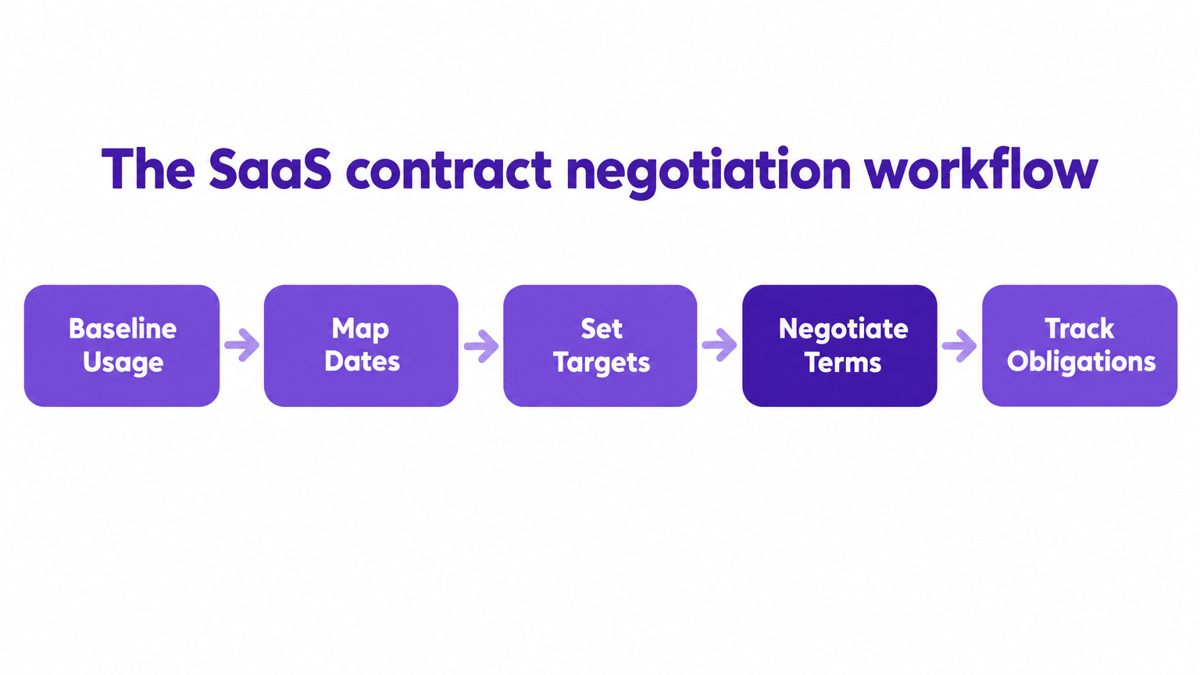
You know it worked when you can state a seat count backed by data. CloudNuro's guide to what usage data to bring into SaaS negotiations lists the exact reports. CloudNuro's SaaS management platform produces this baseline automatically.
The renewal notice period is the clause that most affects leverage, and a 120-day renewal timeline keeps it from being missed.
A SaaS renewal forecast turns these targets into numbers the CFO can approve.
Our auto-renewal clauses guide covers opt-out language, and these negotiation email templates help you open the conversation.
You know it worked when the next renewal starts on schedule, with no surprises. The full SaaS renewal process shows how this loop repeats.
See how CloudNuro maps every contract to an owner, a renewal date, and its utilization data.
Request a Demo| Item | What to Confirm | Owner |
|---|---|---|
| Utilization baseline | Active vs. purchased seats, last 90 days | IT |
| Renewal and notice dates | Renewal date, notice deadline, term | Procurement |
| Budget and targets | Target price, walk-away point, forecast | Finance |
| Price cap | Written annual uplift limit | Procurement |
| True-down rights | Seat reduction at each anniversary | Procurement |
| Exit and portability | Export format, timeline, deletion | IT, Legal |
| Security and liability | SLAs, sub-processors, liability caps | CISO, Legal |
| Post-signature tracking | Owner, cost center, alerts set | IT, Finance |
A SaaS contract negotiation checklist is a fixed list of data, dates, and clauses you verify before signing or renewing software. It keeps every negotiation consistent, whoever runs it.
You negotiate SaaS contracts by starting with utilization data, setting a target and walk-away point, and trading term length for price protection. Our guide to mastering SaaS negotiation covers tactics in depth.
A typical SaaS contract runs for one year, with multi-year terms common for strategic platforms. Longer terms should come with a documented discount and an uplift cap.
SaaS renewal negotiation should start at least 120 days before the renewal date. That leaves time to gather usage data and serve notice before the deadline.
The clauses that matter most are the renewal uplift cap, auto-renewal notice period, true-down rights, and exit terms. Security and liability terms matter most when the vendor holds sensitive data.
CloudNuro helps by unifying SaaS inventory, utilization data, and renewal dates in one view. CloudNuro customers have reported up to a 35% reduction in SaaS overspend.
Renewal prices keep rising and auto-renewal terms keep running, so negotiation by memory no longer works. Organizations without a SaaS contract negotiation checklist pay for shelfware and accept uplifts they could have capped. The better model gives IT, Finance, and procurement unified visibility into usage, dates, and owners across SaaS, cloud, and AI, so every renewal becomes a deliberate decision.
Get a free assessment of unused licenses and upcoming renewals across your SaaS portfolio.
Get Free Savings AssessmentCloudNuro gives IT and procurement the data this checklist depends on: a centralized SaaS inventory, license utilization by user, and a renewal calendar with notice deadlines. Every contract maps to an owner and a cost center, so negotiations start with facts and obligations are tracked after signature.
CloudNuro is a leader in Enterprise AI Adoption Management, providing enterprises with unmatched visibility, governance, and cost optimization. Recognized twice in a row by Gartner in the SaaS Management Platforms and named a Leader in the Info-Tech SoftwareReviews Data Quadrant, CloudNuro is trusted by global enterprises and government agencies to bring financial discipline to SaaS, cloud, and AI. Trusted by enterprises, CloudNuro provides centralized SaaS inventory, license optimization, and renewal management along with advanced cost allocation and chargeback, giving IT and Finance leaders the visibility, control, and cost-conscious culture needed to drive financial discipline.
Request a no cost, no obligation free assessment —just 15 minutes to savings!
Get StartedA SaaS contract negotiation checklist is a fixed list of data, dates, and clauses that IT and procurement verify before signing or renewing any software agreement.
This guide gives you the full 2026 checklist, a five-step workflow, and a copyable table your team can use on the next renewal.
SaaS renewal prices now rise 8 to 12% a year on average, and aggressive vendors ask for more. A SaaS contract negotiation checklist is how IT and procurement stop accepting those increases by default.
The problem compounds. Around 87% of SaaS agreements include an auto-renewal clause, and many require notice 30 days before the renewal date, so a missed deadline locks in another full term.
CIOs, CFOs, and IT procurement leaders feel it differently: the CIO cannot see what is actually used, the CFO sees spend rise without explanation, and procurement negotiates with partial data.
Disciplined teams now treat negotiation as a repeatable process grounded in license management software and utilization data, not a yearly scramble.
This checklist covers what to prepare, which clauses to negotiate, and how to track obligations after signature.
See which licenses are unused before your next vendor call with a free savings assessment.
Get Free Savings AssessmentSaaS contract negotiation is the process of agreeing price, quantity, term, and protective clauses with a software vendor at purchase or renewal. It decides not only what you pay this year, but how much flexibility you keep for the next three.
Most leverage is lost before the first call, through missing usage data or a missed notice date. For background on agreement structure, see CloudNuro's guide to navigating SaaS agreements.
CloudNuro's data shows 25 to 30% of SaaS licenses typically go unused. Every one of those seats renews at the new, higher price unless someone removes it.
Annual uplifts of 8 to 12% and near-universal auto-renewal terms mean an unmanaged portfolio grows in cost every year without growing in value. Understanding how SaaS vendors make money through expansion and add-ons explains why.
Cost: uncapped uplifts and shelfware inflate spend at every renewal.
Lock-in: long terms without exit or data portability rights leave you no alternative when the vendor raises prices.
Compliance: weak data processing, security, and liability terms move risk from the vendor to you.
You know it worked when you can state a seat count backed by data. CloudNuro's guide to what usage data to bring into SaaS negotiations lists the exact reports. CloudNuro's SaaS management platform produces this baseline automatically.
The renewal notice period is the clause that most affects leverage, and a 120-day renewal timeline keeps it from being missed.
A SaaS renewal forecast turns these targets into numbers the CFO can approve.
Our auto-renewal clauses guide covers opt-out language, and these negotiation email templates help you open the conversation.
You know it worked when the next renewal starts on schedule, with no surprises. The full SaaS renewal process shows how this loop repeats.
See how CloudNuro maps every contract to an owner, a renewal date, and its utilization data.
Request a Demo| Item | What to Confirm | Owner |
|---|---|---|
| Utilization baseline | Active vs. purchased seats, last 90 days | IT |
| Renewal and notice dates | Renewal date, notice deadline, term | Procurement |
| Budget and targets | Target price, walk-away point, forecast | Finance |
| Price cap | Written annual uplift limit | Procurement |
| True-down rights | Seat reduction at each anniversary | Procurement |
| Exit and portability | Export format, timeline, deletion | IT, Legal |
| Security and liability | SLAs, sub-processors, liability caps | CISO, Legal |
| Post-signature tracking | Owner, cost center, alerts set | IT, Finance |
A SaaS contract negotiation checklist is a fixed list of data, dates, and clauses you verify before signing or renewing software. It keeps every negotiation consistent, whoever runs it.
You negotiate SaaS contracts by starting with utilization data, setting a target and walk-away point, and trading term length for price protection. Our guide to mastering SaaS negotiation covers tactics in depth.
A typical SaaS contract runs for one year, with multi-year terms common for strategic platforms. Longer terms should come with a documented discount and an uplift cap.
SaaS renewal negotiation should start at least 120 days before the renewal date. That leaves time to gather usage data and serve notice before the deadline.
The clauses that matter most are the renewal uplift cap, auto-renewal notice period, true-down rights, and exit terms. Security and liability terms matter most when the vendor holds sensitive data.
CloudNuro helps by unifying SaaS inventory, utilization data, and renewal dates in one view. CloudNuro customers have reported up to a 35% reduction in SaaS overspend.
Renewal prices keep rising and auto-renewal terms keep running, so negotiation by memory no longer works. Organizations without a SaaS contract negotiation checklist pay for shelfware and accept uplifts they could have capped. The better model gives IT, Finance, and procurement unified visibility into usage, dates, and owners across SaaS, cloud, and AI, so every renewal becomes a deliberate decision.
Get a free assessment of unused licenses and upcoming renewals across your SaaS portfolio.
Get Free Savings AssessmentCloudNuro gives IT and procurement the data this checklist depends on: a centralized SaaS inventory, license utilization by user, and a renewal calendar with notice deadlines. Every contract maps to an owner and a cost center, so negotiations start with facts and obligations are tracked after signature.
CloudNuro is a leader in Enterprise AI Adoption Management, providing enterprises with unmatched visibility, governance, and cost optimization. Recognized twice in a row by Gartner in the SaaS Management Platforms and named a Leader in the Info-Tech SoftwareReviews Data Quadrant, CloudNuro is trusted by global enterprises and government agencies to bring financial discipline to SaaS, cloud, and AI. Trusted by enterprises, CloudNuro provides centralized SaaS inventory, license optimization, and renewal management along with advanced cost allocation and chargeback, giving IT and Finance leaders the visibility, control, and cost-conscious culture needed to drive financial discipline.
Request a no cost, no obligation free assessment - just 15 minutes to savings!
Get StartedWe're offering complimentary ServiceNow license assessments to only 25 enterprises this quarter who want to unlock immediate savings without disrupting operations.
Get Free AssessmentGet Started




CloudNuro Corp
1755 Park St. Suite 207
Naperville, IL 60563
Phone : +1-630-277-9470
Email: info@cloudnuro.com





Recognized Leader in SaaS Management Platforms by Info-Tech SoftwareReviews