
Sign Up
Thank you for Submitting!
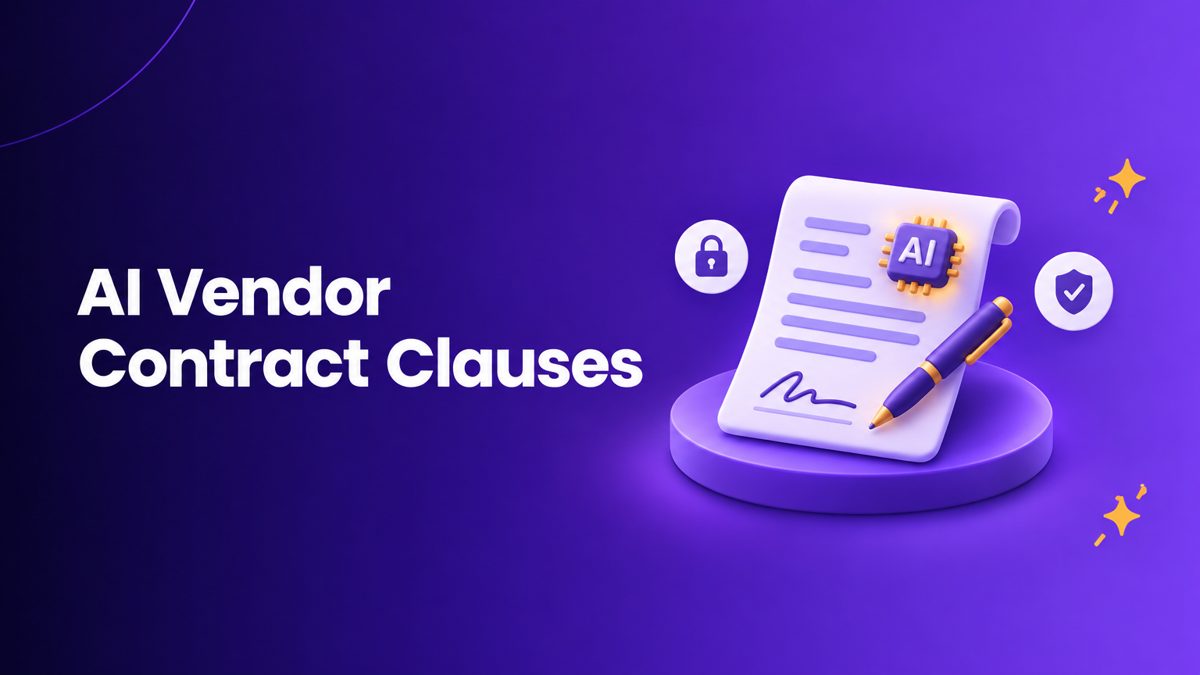
AI vendor contract clauses decide who may use your prompts, files, and outputs, and who pays when a generative AI tool causes harm.
In 2026, AI provisions appear in 53% of SaaS contracts, yet only 14% explicitly prohibit the vendor from training models on customer data.
This guide covers the six clauses to negotiate first (data use, retention, output ownership, IP indemnity, liability, and model changes), with sample language and a pre-signature checklist.
AI provisions appeared in 53% of SaaS contracts signed in the year ending June 2026, up from 47% in 2025 and 38% in 2024.
Those provisions now govern how AI vendors treat your data, and most enterprises still sign them on standard SaaS paper. AI vendor contract clauses on training rights, retention, and liability are where that paper falls short.
The gap is wide. Clauses that prohibit vendor training on customer data rose from under 1% of contracts in 2024 to 11% in 2025 and 14% in 2026. Silence in the other contracts is not a prohibition.
CIOs, CISOs, general counsel, and IT procurement leaders feel this first, because AI tools now arrive through every department, often before anyone reviews the paper. Many arrive as shadow AI that never passed procurement.
This guide explains which clauses matter, what buyer-friendly language looks like, and how to check every AI contract you already hold.
See how AgentNuro discovers every AI tool in use and maps it to an owner, a contract, and a cost.
Request a DemoAI vendor contract clauses are the terms in a software agreement that govern how an AI provider may use customer inputs and outputs, how long it keeps them, who owns generated content, and who carries liability for AI-specific harm. They sit on top of standard SaaS terms such as security, liability, and data redlines.
Standard SaaS agreements were written for software that stores your data. AI services also learn from it, transform it, and produce new content from it, so each of those actions needs its own contractual limit.

This clause decides whether your prompts, files, and outputs become training material. Only 3% of 2026 contracts expressly grant vendors training rights, but many more stay silent or point to a privacy policy the vendor can change.
Ask for an affirmative prohibition that covers affiliates, subprocessors, and underlying model providers, and that applies even to data labelled "de-identified" or "aggregated":
"Vendor shall not use Customer Data, including prompts, inputs, outputs, files, logs, metadata, or telemetry, to train, fine-tune, benchmark, or improve any model or product, for Vendor, its affiliates, subprocessors, model providers, or other customers, without Customer's prior express written consent."
Require opt-in, never an opt-out buried in documentation. The same principle applies to your data processing agreement and subprocessor list.
Retention terms decide how long prompts and outputs exist after the response is delivered. A vendor marketing page that says "we do not store your data" is not a contract term.
Output ownership decides who may use, sell, or reuse generated content. Ask for ownership, or at least a perpetual, worldwide, transferable license, with no vendor right to reuse or commercialize outputs.
Name the artifacts explicitly: generated code, embeddings, fine-tuning artifacts, custom models, prompt libraries, and evaluation sets. Pair this with data ownership and data return terms so the same artifacts come back to you at exit.
Output ownership does not protect you if an output infringes someone else's copyright. Many AI vendors carve generated outputs out of their standard IP indemnity.
Ask the vendor to defend and pay third-party claims that the service, its model components, or its outputs infringe IP rights, and to place that indemnity outside the general liability cap or under a separate, higher cap.
A cap of one times fees paid appears in 96% of 2026 SaaS agreements. For an AI tool that processes regulated data, a copyright claim or a data misuse incident can exceed that figure many times over.
Unlimited-liability carve-outs grew from roughly 1% of contracts in 2025 to more than 10% in 2026, so the request is now common enough to make. Seek carve-outs or a super-cap for:
Accept a hallucination disclaimer only if it does not waive these obligations. A probabilistic output is a known limitation; a vendor that ignores agreed safeguards is a breach.
AI vendors swap models, hosting regions, and model providers more often than traditional SaaS vendors change infrastructure. Each change can alter where your data goes and how the tool behaves.
Require advance notice of material model or provider changes, a right to object, and a termination or migration right if a change degrades compliance or accuracy. Add export rights for prompts, outputs, configurations, and evaluations to avoid the contract clauses that make switching hard.
Get a free assessment of AI and SaaS spend, renewal dates, and the tools your teams use without review.
Get Free Savings AssessmentUse this table in procurement and legal review. Every "Vendor default" row is a position worth challenging before signature.
| Clause | Typical vendor default | Buyer-friendly target | Owner |
|---|---|---|---|
| Training rights | Silent, or opt-out in policy | Written prohibition, opt-in only | CISO, Legal |
| Retention | Undefined log retention | Defined periods, deletion certificate | CISO |
| Output ownership | Customer owns, vendor may reuse | Customer owns, no vendor reuse | Legal |
| IP indemnity | Outputs excluded | Outputs covered, outside cap | Legal, CFO |
| Liability cap | 1x fees paid | Super-cap or carve-outs for data, IP, security | CFO, Legal |
| Model changes | Changes at vendor discretion | Notice, objection, exit right | CIO |
| Renewal terms | Auto-renewal, uncapped uplift | Capped uplift, usage-based right-sizing | IT procurement |
Renewal terms belong on the list because AI contracts renew like any other SaaS agreement. Track renewal notice periods and run a 120-day renewal timeline so you renegotiate AI terms before the deadline, not after.
Most enterprises cannot negotiate clauses on contracts they do not know exist. The audit starts with inventory, not legal review.
Combine SSO, expense, and browser data to list sanctioned and unsanctioned AI tools. It worked when every AI tool has a named owner and a known contract or none.
Link every tool to its order form, terms of service, and DPA. Tools bought on a card often run on click-through terms with no training prohibition at all.
Review first the tools that touch regulated data or carry the highest spend. AgentNuro tracks AI usage, prompt volumes, and costs, so this ranking uses real token and seat spend data.
Bring adoption data into the room: active users, dormant seats, and usage by team. The usage data to bring into SaaS negotiations is your leverage to trade seat reductions or price for stronger AI terms.
AI vendor contract clauses are the terms that govern how an AI provider may use, retain, and train on customer data, who owns generated outputs, and who carries liability for AI-specific harm. They extend standard SaaS terms rather than replace them.
An AI vendor may train on customer data if the contract is silent and its policies allow it. Only an explicit written prohibition, covering subprocessors and model providers, reliably prevents training.
A reasonable AI vendor liability cap depends on data sensitivity, but one times annual fees is rarely enough for tools that process regulated data. Seek a separate super-cap or carve-outs for data misuse, security incidents, and IP infringement.
Owning AI outputs does not protect you from third-party copyright claims. You need a separate IP indemnity that explicitly covers generated outputs.
Finding unreviewed AI tools requires combining identity, expense, and browser signals. CloudNuro's AI Custodian and AgentNuro bring these signals into one inventory of sanctioned and unsanctioned AI applications.
AI contract terms are easiest to renegotiate before renewal, while the notice period is still open. Start 90 to 120 days ahead, with usage data that shows which seats and tools are actually used.
AI vendors now handle prompts, files, and code that standard SaaS terms were never written to protect. Organizations that sign on default paper accept training rights, retention, and liability limits they never reviewed.
The better model treats AI vendor contract clauses as part of AI governance: every AI tool discovered, mapped to its contract, ranked by risk and spend, and renegotiated with usage data in hand.
See how AgentNuro connects AI usage, spend, and contracts so every AI tool has an owner and approved terms.
Request a DemoAgentNuro, CloudNuro's Enterprise AI Adoption Management product, discovers the AI tools your teams use, tracks adoption, prompt volumes, and token costs, and applies policy guardrails and budget thresholds. CloudNuro adds a centralized contract repository with 90, 60, and 30-day renewal alerts, so legal and procurement see every AI agreement before it renews.
Together they give IT and Finance unified visibility across SaaS, cloud, and AI, with the usage data needed to win better AI vendor terms.
CloudNuro is a leader in Enterprise AI Adoption Management, providing enterprises with unmatched visibility, governance, and cost optimization. Recognized twice in a row by Gartner in the SaaS Management Platforms and named a Leader in the Info-Tech SoftwareReviews Data Quadrant, CloudNuro is trusted by global enterprises and government agencies to bring financial discipline to SaaS, cloud, and AI. Trusted by enterprises, CloudNuro provides centralized SaaS inventory, license optimization, and renewal management along with advanced cost allocation and chargeback, giving IT and Finance leaders the visibility, control, and cost-conscious culture needed to drive financial discipline.
Request a no cost, no obligation free assessment —just 15 minutes to savings!
Get StartedAI vendor contract clauses decide who may use your prompts, files, and outputs, and who pays when a generative AI tool causes harm.
In 2026, AI provisions appear in 53% of SaaS contracts, yet only 14% explicitly prohibit the vendor from training models on customer data.
This guide covers the six clauses to negotiate first (data use, retention, output ownership, IP indemnity, liability, and model changes), with sample language and a pre-signature checklist.
AI provisions appeared in 53% of SaaS contracts signed in the year ending June 2026, up from 47% in 2025 and 38% in 2024.
Those provisions now govern how AI vendors treat your data, and most enterprises still sign them on standard SaaS paper. AI vendor contract clauses on training rights, retention, and liability are where that paper falls short.
The gap is wide. Clauses that prohibit vendor training on customer data rose from under 1% of contracts in 2024 to 11% in 2025 and 14% in 2026. Silence in the other contracts is not a prohibition.
CIOs, CISOs, general counsel, and IT procurement leaders feel this first, because AI tools now arrive through every department, often before anyone reviews the paper. Many arrive as shadow AI that never passed procurement.
This guide explains which clauses matter, what buyer-friendly language looks like, and how to check every AI contract you already hold.
See how AgentNuro discovers every AI tool in use and maps it to an owner, a contract, and a cost.
Request a DemoAI vendor contract clauses are the terms in a software agreement that govern how an AI provider may use customer inputs and outputs, how long it keeps them, who owns generated content, and who carries liability for AI-specific harm. They sit on top of standard SaaS terms such as security, liability, and data redlines.
Standard SaaS agreements were written for software that stores your data. AI services also learn from it, transform it, and produce new content from it, so each of those actions needs its own contractual limit.
This clause decides whether your prompts, files, and outputs become training material. Only 3% of 2026 contracts expressly grant vendors training rights, but many more stay silent or point to a privacy policy the vendor can change.
Ask for an affirmative prohibition that covers affiliates, subprocessors, and underlying model providers, and that applies even to data labelled "de-identified" or "aggregated":
"Vendor shall not use Customer Data, including prompts, inputs, outputs, files, logs, metadata, or telemetry, to train, fine-tune, benchmark, or improve any model or product, for Vendor, its affiliates, subprocessors, model providers, or other customers, without Customer's prior express written consent."
Require opt-in, never an opt-out buried in documentation. The same principle applies to your data processing agreement and subprocessor list.
Retention terms decide how long prompts and outputs exist after the response is delivered. A vendor marketing page that says "we do not store your data" is not a contract term.
Output ownership decides who may use, sell, or reuse generated content. Ask for ownership, or at least a perpetual, worldwide, transferable license, with no vendor right to reuse or commercialize outputs.
Name the artifacts explicitly: generated code, embeddings, fine-tuning artifacts, custom models, prompt libraries, and evaluation sets. Pair this with data ownership and data return terms so the same artifacts come back to you at exit.
Output ownership does not protect you if an output infringes someone else's copyright. Many AI vendors carve generated outputs out of their standard IP indemnity.
Ask the vendor to defend and pay third-party claims that the service, its model components, or its outputs infringe IP rights, and to place that indemnity outside the general liability cap or under a separate, higher cap.
A cap of one times fees paid appears in 96% of 2026 SaaS agreements. For an AI tool that processes regulated data, a copyright claim or a data misuse incident can exceed that figure many times over.
Unlimited-liability carve-outs grew from roughly 1% of contracts in 2025 to more than 10% in 2026, so the request is now common enough to make. Seek carve-outs or a super-cap for:
Accept a hallucination disclaimer only if it does not waive these obligations. A probabilistic output is a known limitation; a vendor that ignores agreed safeguards is a breach.
AI vendors swap models, hosting regions, and model providers more often than traditional SaaS vendors change infrastructure. Each change can alter where your data goes and how the tool behaves.
Require advance notice of material model or provider changes, a right to object, and a termination or migration right if a change degrades compliance or accuracy. Add export rights for prompts, outputs, configurations, and evaluations to avoid the contract clauses that make switching hard.
Get a free assessment of AI and SaaS spend, renewal dates, and the tools your teams use without review.
Get Free Savings AssessmentUse this table in procurement and legal review. Every "Vendor default" row is a position worth challenging before signature.
| Clause | Typical vendor default | Buyer-friendly target | Owner |
|---|---|---|---|
| Training rights | Silent, or opt-out in policy | Written prohibition, opt-in only | CISO, Legal |
| Retention | Undefined log retention | Defined periods, deletion certificate | CISO |
| Output ownership | Customer owns, vendor may reuse | Customer owns, no vendor reuse | Legal |
| IP indemnity | Outputs excluded | Outputs covered, outside cap | Legal, CFO |
| Liability cap | 1x fees paid | Super-cap or carve-outs for data, IP, security | CFO, Legal |
| Model changes | Changes at vendor discretion | Notice, objection, exit right | CIO |
| Renewal terms | Auto-renewal, uncapped uplift | Capped uplift, usage-based right-sizing | IT procurement |
Renewal terms belong on the list because AI contracts renew like any other SaaS agreement. Track renewal notice periods and run a 120-day renewal timeline so you renegotiate AI terms before the deadline, not after.
Most enterprises cannot negotiate clauses on contracts they do not know exist. The audit starts with inventory, not legal review.
Combine SSO, expense, and browser data to list sanctioned and unsanctioned AI tools. It worked when every AI tool has a named owner and a known contract or none.
Link every tool to its order form, terms of service, and DPA. Tools bought on a card often run on click-through terms with no training prohibition at all.
Review first the tools that touch regulated data or carry the highest spend. AgentNuro tracks AI usage, prompt volumes, and costs, so this ranking uses real token and seat spend data.
Bring adoption data into the room: active users, dormant seats, and usage by team. The usage data to bring into SaaS negotiations is your leverage to trade seat reductions or price for stronger AI terms.
AI vendor contract clauses are the terms that govern how an AI provider may use, retain, and train on customer data, who owns generated outputs, and who carries liability for AI-specific harm. They extend standard SaaS terms rather than replace them.
An AI vendor may train on customer data if the contract is silent and its policies allow it. Only an explicit written prohibition, covering subprocessors and model providers, reliably prevents training.
A reasonable AI vendor liability cap depends on data sensitivity, but one times annual fees is rarely enough for tools that process regulated data. Seek a separate super-cap or carve-outs for data misuse, security incidents, and IP infringement.
Owning AI outputs does not protect you from third-party copyright claims. You need a separate IP indemnity that explicitly covers generated outputs.
Finding unreviewed AI tools requires combining identity, expense, and browser signals. CloudNuro's AI Custodian and AgentNuro bring these signals into one inventory of sanctioned and unsanctioned AI applications.
AI contract terms are easiest to renegotiate before renewal, while the notice period is still open. Start 90 to 120 days ahead, with usage data that shows which seats and tools are actually used.
AI vendors now handle prompts, files, and code that standard SaaS terms were never written to protect. Organizations that sign on default paper accept training rights, retention, and liability limits they never reviewed.
The better model treats AI vendor contract clauses as part of AI governance: every AI tool discovered, mapped to its contract, ranked by risk and spend, and renegotiated with usage data in hand.
See how AgentNuro connects AI usage, spend, and contracts so every AI tool has an owner and approved terms.
Request a DemoAgentNuro, CloudNuro's Enterprise AI Adoption Management product, discovers the AI tools your teams use, tracks adoption, prompt volumes, and token costs, and applies policy guardrails and budget thresholds. CloudNuro adds a centralized contract repository with 90, 60, and 30-day renewal alerts, so legal and procurement see every AI agreement before it renews.
Together they give IT and Finance unified visibility across SaaS, cloud, and AI, with the usage data needed to win better AI vendor terms.
CloudNuro is a leader in Enterprise AI Adoption Management, providing enterprises with unmatched visibility, governance, and cost optimization. Recognized twice in a row by Gartner in the SaaS Management Platforms and named a Leader in the Info-Tech SoftwareReviews Data Quadrant, CloudNuro is trusted by global enterprises and government agencies to bring financial discipline to SaaS, cloud, and AI. Trusted by enterprises, CloudNuro provides centralized SaaS inventory, license optimization, and renewal management along with advanced cost allocation and chargeback, giving IT and Finance leaders the visibility, control, and cost-conscious culture needed to drive financial discipline.
Request a no cost, no obligation free assessment - just 15 minutes to savings!
Get StartedWe're offering complimentary ServiceNow license assessments to only 25 enterprises this quarter who want to unlock immediate savings without disrupting operations.
Get Free AssessmentGet Started




CloudNuro Corp
1755 Park St. Suite 207
Naperville, IL 60563
Phone : +1-630-277-9470
Email: info@cloudnuro.com






Recognized Leader in SaaS Management Platforms by Info-Tech SoftwareReviews