

Sign Up
Thank you for Submitting!
Shadow AI is no longer a fringe problem. It is embedded in everyday SaaS workflows, from generative assistants inside productivity tools to AI add-ons employees install without IT approval.
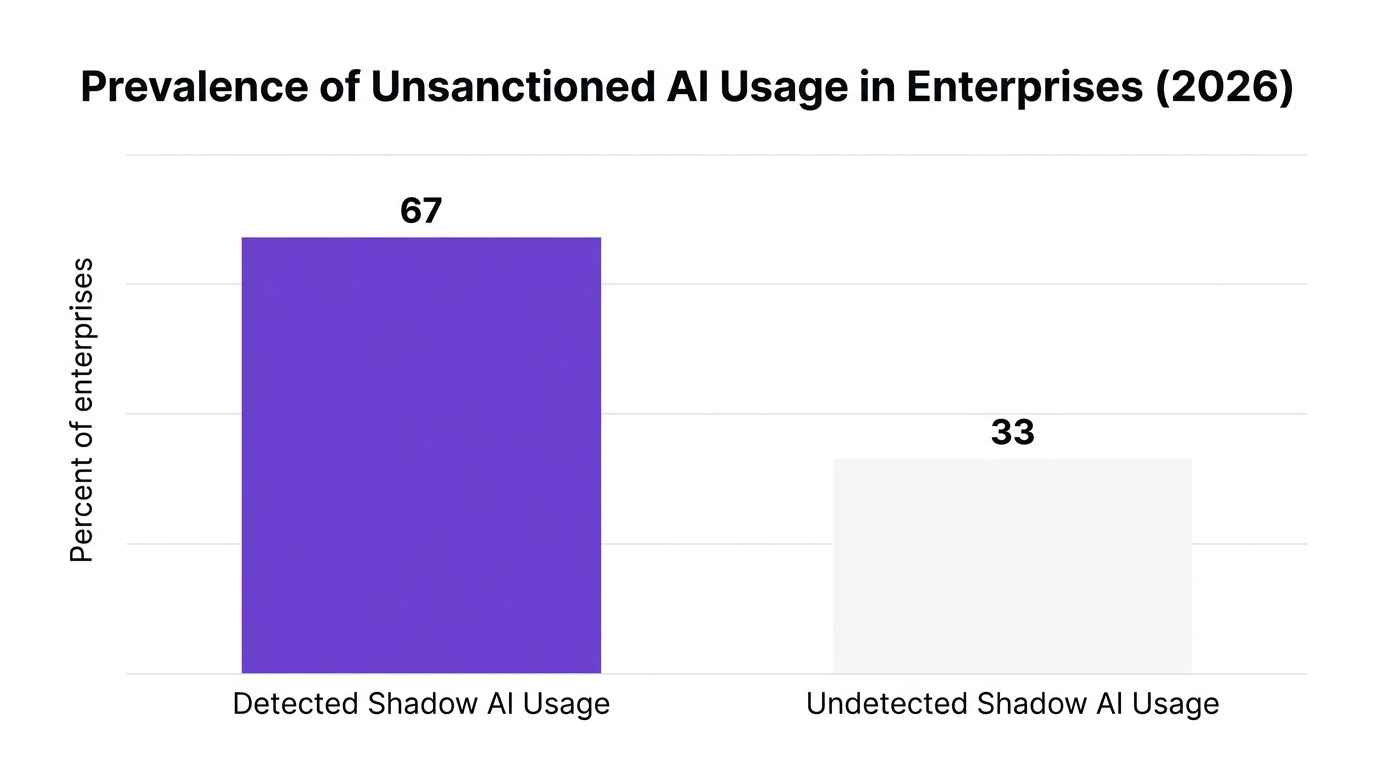
Gartner reported in 2026 that 67 percent of enterprises saw unsanctioned AI tools increase security incident risk in the past 12 months. Yet IDC found 46 percent of organizations still lack a formal shadow AI policy.
This gap is exactly where incidents, fines, and reputational damage occur. This guide gives IT and security leaders a practical framework for an enterprise shadow AI policy, plus a structured, downloadable template you can adapt for your organization.
A shadow AI policy defines how your organization detects, governs, and controls unsanctioned AI tools used across SaaS, cloud, and internal systems.
Think of it as the AI-specific counterpart to your shadow IT policy, but tuned for data exposure, model behavior, and regulatory expectations.
A strong policy covers:
What counts as shadow AI in your environment
Which AI use cases are acceptable, restricted, or prohibited
How employees must handle sensitive data in AI tools
How IT, security, and compliance teams monitor and enforce controls
Forrester reported in 2026 that 47 percent of IT leaders rank shadow AI as their top SaaS governance challenge. A well written shadow AI governance framework turns that challenge into a manageable, auditable process.
Dr. Elena Santos, a chief research analyst, noted in 2026 that enterprises must treat shadow AI with the same governance rigor as traditional shadow IT. Without a clear AI usage policy, employees fill the vacuum with their own tools and judgment.
Shadow AI and shadow IT often get lumped together. Both describe unsanctioned technology used outside formal approval channels.
However, there are important differences that your shadow AI policy must address explicitly.

1. Data exposure and model retention
Shadow IT often exposes credentials or files. Shadow AI introduces an additional layer: data used to train or tune models.
Sensitive prompts, customer data, and code snippets may be stored, logged, or used to improve external AI models. This creates shadow AI data exposure risks that persist even after the session ends.
2. Output risk and hallucinations
AI tools can generate plausible but false outputs. Unlike traditional shadow IT, the risk is not only data loss but decisions influenced by inaccurate or biased AI recommendations.
An AI acceptable use policy must define where AI output can be used directly, where human review is mandatory, and where AI is prohibited.
3. Regulatory expectations
EY reported in 2026 that 91 percent of regulated institutions treat shadow AI governance as a primary audit focus. Regulators are asking new questions:
How do you track AI usage in SaaS applications?
What are your shadow AI usage guidelines?
How do you ensure shadow AI regulatory compliance?
Traditional shadow IT controls rarely answer these questions in enough depth.
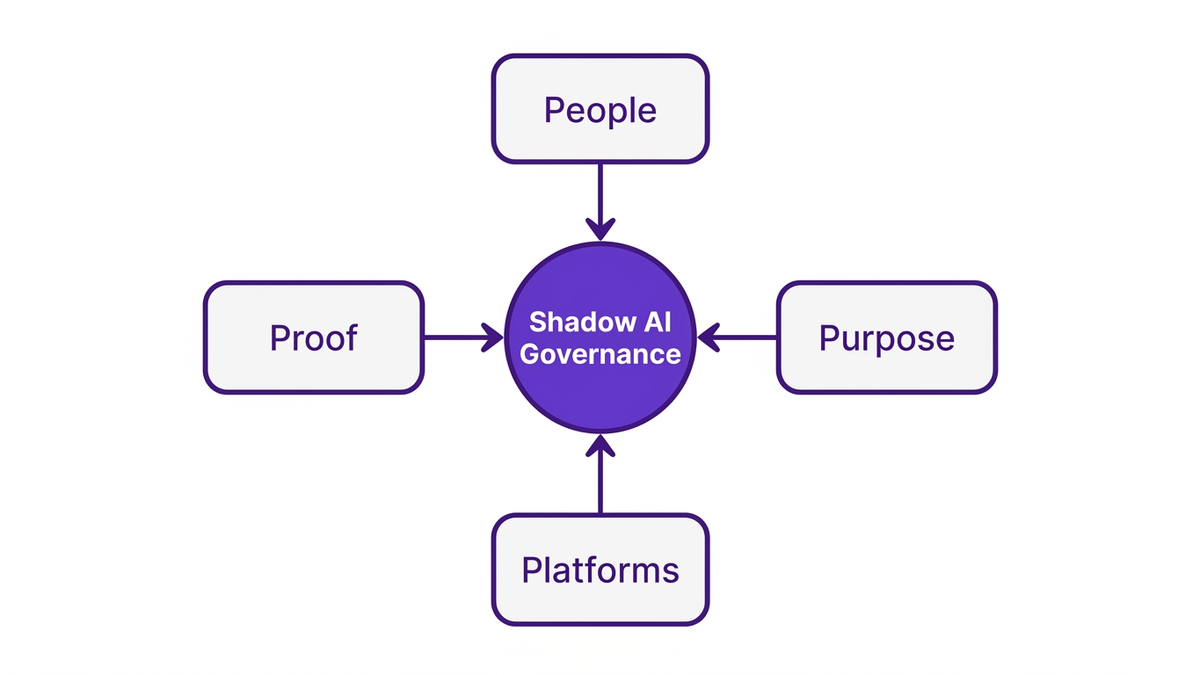
To avoid writing policy from scratch, it helps to break the work into a repeatable framework. The template in this post is built around the 4P Shadow AI Governance Model.
This model organizes your AI governance policy for SaaS into four pillars: People, Purpose, Platforms, and Proof.
A shadow AI policy fails if nobody owns it. Define clear roles:
Policy owner: typically CISO or head of IT risk
AI governance council: cross-functional group from IT, security, legal, HR, and business units
System owners: responsible for AI capabilities in their SaaS stack
Your AI usage guidelines for employees should clearly state:
Who can approve AI tools
Who manages vendor assessments
Who handles AI incident response when something goes wrong
McKinsey reported in 2026 that organizations using automated SaaS monitoring saw a 43 percent reduction in unauthorized AI usage. That reduction only happens when responsibilities are well defined.
Employees need simple rules of thumb. Your AI acceptable use policy should define three categories.
Acceptable use
Examples:
Drafting non confidential documents or emails
Brainstorming ideas for internal campaigns
Generating synthetic test data without real PII
Restricted use (requires approvals and controls):
Using AI for customer facing content in regulated industries
Analyzing quasi sensitive datasets (aggregated or anonymized)
Building AI automations that integrate into production workflows
Prohibited use:
Uploading regulated data such as PHI, PCI, or classified information
Using AI for hiring decisions or credit decisions without formal approval
Combining AI tools with unapproved data exports from core SaaS systems
Clearly tag each example in your shadow AI usage guidelines so employees can self assess before adopting new tools.
This pillar covers your shadow AI detection in SaaS and classification strategy.
Sanctioned: AI tools that are fully approved, integrated with SSO, and covered by contracts and DPAs
Tolerable: low risk tools allowed for specific use cases, often in pilot status
Banned: AI tools explicitly prohibited because of data handling, jurisdiction, or poor security posture
Your shadow AI governance framework should align with existing SaaS categories. For example, the same review processes used for new SaaS apps can be extended with AI specific questions.
Leading enterprises already allocate 35 percent of their cloud/SaaS risk budgets to shadow AI detection and enforcement, according to Deloitte 2026. You cannot manage that investment without a clear platform taxonomy.
Finally, your policy must be provable. Auditors will ask for evidence, not just intent.
A strong shadow AI compliance policy defines:
How shadow AI usage is discovered in SaaS logs, identity systems, and expense data
How often AI usage is reviewed by IT and risk teams
What constitutes a shadow AI incident and how it triggers an AI incident response plan
CSA reported in 2026 that 84 percent of companies with a documented shadow AI policy saw a 2x reduction in SaaS related data breaches. Proof is not optional. It directly correlates with fewer incidents and lower costs.
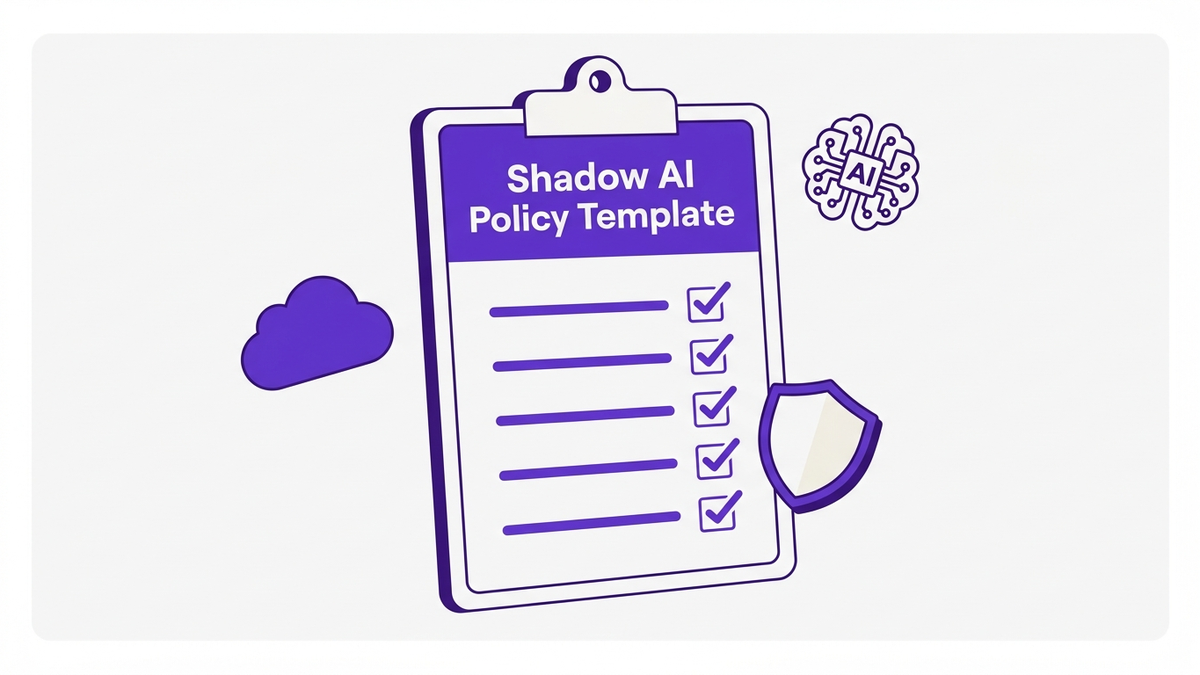
Instead of writing from scratch, use this shadow AI policy template structure as your starting point. You can adapt each section to local regulations and industry requirements.
This template also mirrors CloudNuro's governance model, so it can be mapped directly into monitoring and enforcement workflows.
Clearly define the purpose of the policy:
Protect sensitive data from exposure to unsanctioned AI tools
Ensure shadow AI risk management aligns with enterprise risk appetite
Support compliance with applicable regulations and internal standards
Scope should cover:
All employees, contractors, and third parties accessing corporate systems
All SaaS applications, cloud platforms, and on premises systems
Any AI feature, model, or plugin used to process corporate data
Include crisp definitions so employees do not debate semantics.
Key terms to define:
Shadow AI
Generative AI
Sanctioned vs unsanctioned AI tools
Sensitive and regulated data types relevant to your sector
Also describe your shadow AI acceptable use policy categories: acceptable, restricted, and prohibited.
Map responsibilities to existing governance processes.
Include:
Policy owner and approver
AI governance council responsibilities
System owner obligations for AI enabled SaaS apps
Employee responsibilities for tool selection and usage
Tie this to an AI governance checklist that becomes part of your change management or new SaaS intake process.
This is the most visible part of your AI usage policy. It should be written in clear, plain language.
Cover at least:
Explicit do and do not lists for different roles (developers, analysts, sales, HR)
Rules for handling confidential and regulated data in AI tools
Requirements for human review of AI generated outputs
Link these rules to a centralized reference such as your organization wide AI usage policy so employees see consistent guidance.
Your template should specify:
Data sources for shadow AI detection in SaaS (SSO logs, CASB, SaaS management platforms, expense reports)
Frequency of reviews and thresholds that trigger investigation
Disciplinary or corrective actions for repeated violations
This section must also set expectations for shadow AI audit readiness. For instance, how quickly your teams can produce evidence of AI usage trends and policy enforcement.
No AI risk management framework for SaaS is perfect. Your template must assume incidents will occur.
Define:
How to classify an AI incident (e.g., data exposure, misuse of AI outputs)
Who participates in the incident response team
How lessons learned feed back into updated shadow AI best practices
A leading security working group observed in 2026 that shadow AI is now a board level concern, not just an IT issue. Including explicit board reporting and oversight in this section sends the right signal.
A written shadow AI policy is essential. However, without operational tooling, enforcement will lag behind usage.
CloudNuro is designed to turn policy into practice by combining real time discovery, governance workflows, and financial accountability across SaaS and AI.
CloudNuro's AI Custodian provides continuous shadow AI detection in SaaS, covering more than 400 integrated applications.
It automatically discovers:
AI add ons inside productivity and collaboration tools
Generative AI features embedded in CRM, ITSM, and ERP platforms
Unsanctioned AI web apps accessed through SSO or browser extensions
This discovery feeds directly into your shadow AI security policy, so you can classify tools as sanctioned, tolerable, or banned.
CloudNuro's Unified Cloud Custodian extends your shadow AI governance framework with:
Automated user access reviews for AI enabled SaaS apps
Policy driven workflows for approvals, exceptions, and deprovisioning
Centralized audit logs for shadow AI regulatory compliance and shadow AI audit readiness
By aligning with your AI governance policy for SaaS, CloudNuro ensures that every AI capability is tracked, risk scored, and controlled in one platform.
Shadow AI is not just a security issue. It is also a financial one.
CloudNuro's chargeback and FinOps Services bring financial discipline to AI usage by:
Allocating AI related SaaS spend to departments and projects
Highlighting redundant or underutilized AI subscriptions
Prioritizing decommissioning of high risk, low value tools
According to Deloitte 2026, 35 percent of SaaS risk budgets now focus on shadow AI detection and enforcement. CloudNuro helps ensure those investments reduce both risk and waste.
To see how this works in a broader SaaS context, explore the platform's SaaS management capabilities and how they support IT security teams through IT security solutions.
In one CloudNuro client story, a large healthcare organization used AI Custodian across more than 300 SaaS applications.
Within a year, they reported a 37 percent decrease in data exposure incidents related to unsanctioned AI tools and passed a complex regulatory audit with zero AI related findings.
Their process followed a simple pattern:
Use AI Custodian to discover shadow AI tools and classify them
Update their enterprise shadow AI policy based on real usage patterns
Automate enforcement and periodic reviews through Unified Cloud Custodian
This combination of policy and platform turned a previously invisible risk into a measured, governed, and budgeted program.
A policy document alone will not reduce incidents. You need a focused rollout plan.
Here is a practical 30 90 day roadmap to operationalize your shadow AI policy template.
Start with visibility.
Use your SaaS management platform or tools like CloudNuro to discover AI usage
Map AI capabilities to data types they access
Rank applications by risk: regulated data access, external model training, lack of DPAs
This creates a factual baseline for your shadow AI risk management decisions.
Using the template:
Tailor definitions and categories to your industry and regulatory environment
Align acceptable, restricted, and prohibited uses with your broader AI usage governance strategy
Validate with legal, compliance, and business stakeholders
Aim for a version that is detailed enough for auditors but clear enough for employees.
Policy must be embedded into daily operations.
Add AI specific checks to your SaaS intake process
Update your security monitoring rules for AI usage indicators
Integrate CloudNuro or similar platforms into your AI incident response plan
This is also the time to align with IT operations teams by referencing shared processes documented in IT operations solutions.
Rollout should be multi channel:
Short mandatory training on shadow AI usage guidelines
Targeted sessions for high risk roles such as developers, data scientists, and customer facing teams
Clear path for employees to request new AI tools
Reinforce with periodic reminders and updated examples, especially as new AI capabilities appear in your SaaS stack.
Finally, treat your shadow AI governance framework as a living document.
Conduct quarterly reviews of AI usage data
Capture lessons learned from incidents and near misses
Adjust categories, approvals, and controls as tools evolve
An AI governance checklist can help standardize these reviews and ensure they align with both security and business objectives.
A shadow AI policy is a set of rules and controls that govern unsanctioned AI tools used across your SaaS and cloud ecosystem.
It is necessary because AI capabilities are now embedded in many applications and employees adopt them faster than IT can approve them. Without clear rules, organizations face increased shadow AI security risks, data exposure, and regulatory findings.
Shadow IT covers any unsanctioned technology used without IT approval. Shadow AI is a subset focused on AI models, features, and tools.
The difference is in the risk profile: shadow AI introduces model training concerns, hallucinated outputs, and specific regulatory expectations around AI usage that traditional shadow IT policies rarely address.
An effective shadow AI governance framework includes:
Clear definitions and categories for AI tools and use cases
An AI acceptable use policy with examples for employees
Monitoring and detection across SaaS applications
A documented AI incident response plan
Regular audits and updates tied to regulatory requirements
It should also integrate with your broader AI risk management framework for SaaS and existing IT governance processes.
IT leaders can detect shadow AI in enterprise SaaS by combining:
Identity and SSO logs to see AI app access
SaaS management tools like CloudNuro for real time discovery
Expense and procurement data to identify AI subscriptions
According to Gartner 2026, 62 percent of enterprises have implemented continuous monitoring for AI usage. Automated detection is becoming standard for shadow AI best practices.
Start with a clear list of allowed, restricted, and prohibited use cases. Involve legal, compliance, and business stakeholders to ensure these categories reflect your risk appetite and regulatory environment.
Then, translate those categories into role specific guidelines, using concrete examples. Finally, connect the policy to monitoring tools and training programs so employees understand both expectations and consequences.
A shadow AI compliance policy establishes documented controls for how AI tools are selected, used, monitored, and reviewed.
This evidence is critical for auditors, especially in regulated sectors where shadow AI regulatory requirements now include explicit expectations around AI usage, data protection, and incident reporting.
CloudNuro is a leader in Enterprise SaaS Management Platforms, providing enterprises with unmatched visibility, governance, and cost optimization. Recognized twice in a row in the SaaS Management Platforms category and named a Leader in the SoftwareReviews Data Quadrant, CloudNuro is trusted by global enterprises and government agencies to bring financial discipline to SaaS, cloud, and AI.
Trusted by enterprises such as Konica Minolta and Federal Signal, CloudNuro provides centralized SaaS inventory, license optimization, and renewal management along with advanced cost allocation and chargeback, giving IT and Finance leaders the visibility, control, and cost conscious culture needed to drive financial discipline.
Request a no cost, no obligation free assessment —just 15 minutes to savings!
Get StartedShadow AI is no longer a fringe problem. It is embedded in everyday SaaS workflows, from generative assistants inside productivity tools to AI add-ons employees install without IT approval.
Gartner reported in 2026 that 67 percent of enterprises saw unsanctioned AI tools increase security incident risk in the past 12 months. Yet IDC found 46 percent of organizations still lack a formal shadow AI policy.
This gap is exactly where incidents, fines, and reputational damage occur. This guide gives IT and security leaders a practical framework for an enterprise shadow AI policy, plus a structured, downloadable template you can adapt for your organization.
A shadow AI policy defines how your organization detects, governs, and controls unsanctioned AI tools used across SaaS, cloud, and internal systems.
Think of it as the AI-specific counterpart to your shadow IT policy, but tuned for data exposure, model behavior, and regulatory expectations.
A strong policy covers:
What counts as shadow AI in your environment
Which AI use cases are acceptable, restricted, or prohibited
How employees must handle sensitive data in AI tools
How IT, security, and compliance teams monitor and enforce controls
Forrester reported in 2026 that 47 percent of IT leaders rank shadow AI as their top SaaS governance challenge. A well written shadow AI governance framework turns that challenge into a manageable, auditable process.
Dr. Elena Santos, a chief research analyst, noted in 2026 that enterprises must treat shadow AI with the same governance rigor as traditional shadow IT. Without a clear AI usage policy, employees fill the vacuum with their own tools and judgment.
Shadow AI and shadow IT often get lumped together. Both describe unsanctioned technology used outside formal approval channels.
However, there are important differences that your shadow AI policy must address explicitly.
1. Data exposure and model retention
Shadow IT often exposes credentials or files. Shadow AI introduces an additional layer: data used to train or tune models.
Sensitive prompts, customer data, and code snippets may be stored, logged, or used to improve external AI models. This creates shadow AI data exposure risks that persist even after the session ends.
2. Output risk and hallucinations
AI tools can generate plausible but false outputs. Unlike traditional shadow IT, the risk is not only data loss but decisions influenced by inaccurate or biased AI recommendations.
An AI acceptable use policy must define where AI output can be used directly, where human review is mandatory, and where AI is prohibited.
3. Regulatory expectations
EY reported in 2026 that 91 percent of regulated institutions treat shadow AI governance as a primary audit focus. Regulators are asking new questions:
How do you track AI usage in SaaS applications?
What are your shadow AI usage guidelines?
How do you ensure shadow AI regulatory compliance?
Traditional shadow IT controls rarely answer these questions in enough depth.
To avoid writing policy from scratch, it helps to break the work into a repeatable framework. The template in this post is built around the 4P Shadow AI Governance Model.
This model organizes your AI governance policy for SaaS into four pillars: People, Purpose, Platforms, and Proof.
A shadow AI policy fails if nobody owns it. Define clear roles:
Policy owner: typically CISO or head of IT risk
AI governance council: cross-functional group from IT, security, legal, HR, and business units
System owners: responsible for AI capabilities in their SaaS stack
Your AI usage guidelines for employees should clearly state:
Who can approve AI tools
Who manages vendor assessments
Who handles AI incident response when something goes wrong
McKinsey reported in 2026 that organizations using automated SaaS monitoring saw a 43 percent reduction in unauthorized AI usage. That reduction only happens when responsibilities are well defined.
Employees need simple rules of thumb. Your AI acceptable use policy should define three categories.
Acceptable use
Examples:
Drafting non confidential documents or emails
Brainstorming ideas for internal campaigns
Generating synthetic test data without real PII
Restricted use (requires approvals and controls):
Using AI for customer facing content in regulated industries
Analyzing quasi sensitive datasets (aggregated or anonymized)
Building AI automations that integrate into production workflows
Prohibited use:
Uploading regulated data such as PHI, PCI, or classified information
Using AI for hiring decisions or credit decisions without formal approval
Combining AI tools with unapproved data exports from core SaaS systems
Clearly tag each example in your shadow AI usage guidelines so employees can self assess before adopting new tools.
This pillar covers your shadow AI detection in SaaS and classification strategy.
Sanctioned: AI tools that are fully approved, integrated with SSO, and covered by contracts and DPAs
Tolerable: low risk tools allowed for specific use cases, often in pilot status
Banned: AI tools explicitly prohibited because of data handling, jurisdiction, or poor security posture
Your shadow AI governance framework should align with existing SaaS categories. For example, the same review processes used for new SaaS apps can be extended with AI specific questions.
Leading enterprises already allocate 35 percent of their cloud/SaaS risk budgets to shadow AI detection and enforcement, according to Deloitte 2026. You cannot manage that investment without a clear platform taxonomy.
Finally, your policy must be provable. Auditors will ask for evidence, not just intent.
A strong shadow AI compliance policy defines:
How shadow AI usage is discovered in SaaS logs, identity systems, and expense data
How often AI usage is reviewed by IT and risk teams
What constitutes a shadow AI incident and how it triggers an AI incident response plan
CSA reported in 2026 that 84 percent of companies with a documented shadow AI policy saw a 2x reduction in SaaS related data breaches. Proof is not optional. It directly correlates with fewer incidents and lower costs.
Instead of writing from scratch, use this shadow AI policy template structure as your starting point. You can adapt each section to local regulations and industry requirements.
This template also mirrors CloudNuro's governance model, so it can be mapped directly into monitoring and enforcement workflows.
Clearly define the purpose of the policy:
Protect sensitive data from exposure to unsanctioned AI tools
Ensure shadow AI risk management aligns with enterprise risk appetite
Support compliance with applicable regulations and internal standards
Scope should cover:
All employees, contractors, and third parties accessing corporate systems
All SaaS applications, cloud platforms, and on premises systems
Any AI feature, model, or plugin used to process corporate data
Include crisp definitions so employees do not debate semantics.
Key terms to define:
Shadow AI
Generative AI
Sanctioned vs unsanctioned AI tools
Sensitive and regulated data types relevant to your sector
Also describe your shadow AI acceptable use policy categories: acceptable, restricted, and prohibited.
Map responsibilities to existing governance processes.
Include:
Policy owner and approver
AI governance council responsibilities
System owner obligations for AI enabled SaaS apps
Employee responsibilities for tool selection and usage
Tie this to an AI governance checklist that becomes part of your change management or new SaaS intake process.
This is the most visible part of your AI usage policy. It should be written in clear, plain language.
Cover at least:
Explicit do and do not lists for different roles (developers, analysts, sales, HR)
Rules for handling confidential and regulated data in AI tools
Requirements for human review of AI generated outputs
Link these rules to a centralized reference such as your organization wide AI usage policy so employees see consistent guidance.
Your template should specify:
Data sources for shadow AI detection in SaaS (SSO logs, CASB, SaaS management platforms, expense reports)
Frequency of reviews and thresholds that trigger investigation
Disciplinary or corrective actions for repeated violations
This section must also set expectations for shadow AI audit readiness. For instance, how quickly your teams can produce evidence of AI usage trends and policy enforcement.
No AI risk management framework for SaaS is perfect. Your template must assume incidents will occur.
Define:
How to classify an AI incident (e.g., data exposure, misuse of AI outputs)
Who participates in the incident response team
How lessons learned feed back into updated shadow AI best practices
A leading security working group observed in 2026 that shadow AI is now a board level concern, not just an IT issue. Including explicit board reporting and oversight in this section sends the right signal.
A written shadow AI policy is essential. However, without operational tooling, enforcement will lag behind usage.
CloudNuro is designed to turn policy into practice by combining real time discovery, governance workflows, and financial accountability across SaaS and AI.
CloudNuro's AI Custodian provides continuous shadow AI detection in SaaS, covering more than 400 integrated applications.
It automatically discovers:
AI add ons inside productivity and collaboration tools
Generative AI features embedded in CRM, ITSM, and ERP platforms
Unsanctioned AI web apps accessed through SSO or browser extensions
This discovery feeds directly into your shadow AI security policy, so you can classify tools as sanctioned, tolerable, or banned.
CloudNuro's Unified Cloud Custodian extends your shadow AI governance framework with:
Automated user access reviews for AI enabled SaaS apps
Policy driven workflows for approvals, exceptions, and deprovisioning
Centralized audit logs for shadow AI regulatory compliance and shadow AI audit readiness
By aligning with your AI governance policy for SaaS, CloudNuro ensures that every AI capability is tracked, risk scored, and controlled in one platform.
Shadow AI is not just a security issue. It is also a financial one.
CloudNuro's chargeback and FinOps Services bring financial discipline to AI usage by:
Allocating AI related SaaS spend to departments and projects
Highlighting redundant or underutilized AI subscriptions
Prioritizing decommissioning of high risk, low value tools
According to Deloitte 2026, 35 percent of SaaS risk budgets now focus on shadow AI detection and enforcement. CloudNuro helps ensure those investments reduce both risk and waste.
To see how this works in a broader SaaS context, explore the platform's SaaS management capabilities and how they support IT security teams through IT security solutions.
In one CloudNuro client story, a large healthcare organization used AI Custodian across more than 300 SaaS applications.
Within a year, they reported a 37 percent decrease in data exposure incidents related to unsanctioned AI tools and passed a complex regulatory audit with zero AI related findings.
Their process followed a simple pattern:
Use AI Custodian to discover shadow AI tools and classify them
Update their enterprise shadow AI policy based on real usage patterns
Automate enforcement and periodic reviews through Unified Cloud Custodian
This combination of policy and platform turned a previously invisible risk into a measured, governed, and budgeted program.
A policy document alone will not reduce incidents. You need a focused rollout plan.
Here is a practical 30 90 day roadmap to operationalize your shadow AI policy template.
Start with visibility.
Use your SaaS management platform or tools like CloudNuro to discover AI usage
Map AI capabilities to data types they access
Rank applications by risk: regulated data access, external model training, lack of DPAs
This creates a factual baseline for your shadow AI risk management decisions.
Using the template:
Tailor definitions and categories to your industry and regulatory environment
Align acceptable, restricted, and prohibited uses with your broader AI usage governance strategy
Validate with legal, compliance, and business stakeholders
Aim for a version that is detailed enough for auditors but clear enough for employees.
Policy must be embedded into daily operations.
Add AI specific checks to your SaaS intake process
Update your security monitoring rules for AI usage indicators
Integrate CloudNuro or similar platforms into your AI incident response plan
This is also the time to align with IT operations teams by referencing shared processes documented in IT operations solutions.
Rollout should be multi channel:
Short mandatory training on shadow AI usage guidelines
Targeted sessions for high risk roles such as developers, data scientists, and customer facing teams
Clear path for employees to request new AI tools
Reinforce with periodic reminders and updated examples, especially as new AI capabilities appear in your SaaS stack.
Finally, treat your shadow AI governance framework as a living document.
Conduct quarterly reviews of AI usage data
Capture lessons learned from incidents and near misses
Adjust categories, approvals, and controls as tools evolve
An AI governance checklist can help standardize these reviews and ensure they align with both security and business objectives.
A shadow AI policy is a set of rules and controls that govern unsanctioned AI tools used across your SaaS and cloud ecosystem.
It is necessary because AI capabilities are now embedded in many applications and employees adopt them faster than IT can approve them. Without clear rules, organizations face increased shadow AI security risks, data exposure, and regulatory findings.
Shadow IT covers any unsanctioned technology used without IT approval. Shadow AI is a subset focused on AI models, features, and tools.
The difference is in the risk profile: shadow AI introduces model training concerns, hallucinated outputs, and specific regulatory expectations around AI usage that traditional shadow IT policies rarely address.
An effective shadow AI governance framework includes:
Clear definitions and categories for AI tools and use cases
An AI acceptable use policy with examples for employees
Monitoring and detection across SaaS applications
A documented AI incident response plan
Regular audits and updates tied to regulatory requirements
It should also integrate with your broader AI risk management framework for SaaS and existing IT governance processes.
IT leaders can detect shadow AI in enterprise SaaS by combining:
Identity and SSO logs to see AI app access
SaaS management tools like CloudNuro for real time discovery
Expense and procurement data to identify AI subscriptions
According to Gartner 2026, 62 percent of enterprises have implemented continuous monitoring for AI usage. Automated detection is becoming standard for shadow AI best practices.
Start with a clear list of allowed, restricted, and prohibited use cases. Involve legal, compliance, and business stakeholders to ensure these categories reflect your risk appetite and regulatory environment.
Then, translate those categories into role specific guidelines, using concrete examples. Finally, connect the policy to monitoring tools and training programs so employees understand both expectations and consequences.
A shadow AI compliance policy establishes documented controls for how AI tools are selected, used, monitored, and reviewed.
This evidence is critical for auditors, especially in regulated sectors where shadow AI regulatory requirements now include explicit expectations around AI usage, data protection, and incident reporting.
CloudNuro is a leader in Enterprise SaaS Management Platforms, providing enterprises with unmatched visibility, governance, and cost optimization. Recognized twice in a row in the SaaS Management Platforms category and named a Leader in the SoftwareReviews Data Quadrant, CloudNuro is trusted by global enterprises and government agencies to bring financial discipline to SaaS, cloud, and AI.
Trusted by enterprises such as Konica Minolta and Federal Signal, CloudNuro provides centralized SaaS inventory, license optimization, and renewal management along with advanced cost allocation and chargeback, giving IT and Finance leaders the visibility, control, and cost conscious culture needed to drive financial discipline.
Request a no cost, no obligation free assessment - just 15 minutes to savings!
Get StartedWe're offering complimentary ServiceNow license assessments to only 25 enterprises this quarter who want to unlock immediate savings without disrupting operations.
Get Free AssessmentGet Started




CloudNuro Corp
1755 Park St. Suite 207
Naperville, IL 60563
Phone : +1-630-277-9470
Email: info@cloudnuro.com




.webp)

Recognized Leader in SaaS Management Platforms by Info-Tech SoftwareReviews
.png)

.svg)