
Sign Up
Thank you for Submitting!

Microsoft Copilot and Copilot Studio agents now run on two cost models at once: per-user licenses and tenant-level Copilot Credits consumed by agents.
Microsoft's native controls govern agents inside the Microsoft estate, but CIOs, CFOs, and CISOs still need one view that ties every agent and every credit to an owner, a cost center, and a business outcome alongside the rest of their AI spend.
This guide explains the Copilot agent cost model, the governance lifecycle from discovery to retirement, and how AgentNuro adds attribution, budget controls, and cross-vendor visibility on top of Microsoft's admin tooling.
Since September 1, 2025, Copilot Studio usage is metered in Copilot Credits instead of messages, and token-based activity is billed at 10 Copilot Credits per 1,000 tokens.
That change turns every Microsoft Copilot and Copilot Studio agent into a consumption line item. An agent built by one department in an afternoon can draw on shared tenant capacity that Finance budgeted for someone else.
Starting in July 2026, Copilot Studio automatically creates a Microsoft Entra Agent ID for every new agent. Agents are now distinct identities with their own access, actions, and spending, not extensions of the employee who built them.
CIOs ask what agents are running. CFOs ask whose budget each credit belongs to. CISOs ask which agents touch sensitive data. These questions sit inside the broader challenge of detecting shadow AI and unauthorized AI tools.
This guide explains how Copilot agents are priced, what Microsoft's native controls cover, where gaps remain, and how AgentNuro closes them in a phased governance program.
Microsoft Copilot agents are billed through two layers: per-user, per-month Microsoft 365 Copilot licenses, and Copilot Credits consumed at the tenant level through prepaid capacity or pay-as-you-go. Usage is based on total credits the organization consumes, not on named users, so agent activity rarely maps cleanly to one budget.
Microsoft's current billing table lists these rates:
| Agent activity | Copilot Credits consumed | Governance implication |
|---|---|---|
| Classic answer | 1 credit | Low cost per call, high volume risk |
| Generative answer | 2 credits | Doubles cost for each conversational reply |
| Token-based usage | 10 credits per 1,000 tokens | Long prompts and retrieval context scale spend fast |
Three billing rules shape governance. Unused Copilot Credits do not carry over to the next month. Enforcement triggers when a tenant reaches 125% of prepaid capacity. Classic and generative answers carry no charge when the user holds a Microsoft 365 Copilot license, so licensing decisions and agent costs are linked.
The license layer has its own waste profile, covered in CloudNuro's guide to Microsoft 365 Copilot license optimization.
See how AgentNuro maps every Copilot Credit to an owner: request a demo.
Microsoft has moved Copilot Studio toward a centrally managed agent control plane. Administrators should use these controls first.
Microsoft Agent 365, generally available since May 2026, gives a consolidated view of agent inventory, permissions, behavior, and activity across Microsoft agents.
Entra Agent ID lets security teams scope connector permissions, Conditional Access, and data loss prevention to a specific agent rather than to its maker.
Admins can limit sharing at the managed environment level, control Editor and Viewer permissions, require lifecycle approval, and use DLP policies to block agents from publishing to supported channels.
The Power Platform admin center supports agent-level monthly limits, notification thresholds, hard stops, and capacity reallocation.
Microsoft's tooling governs agents inside Microsoft. Enterprise AI governance has to answer questions that cross that boundary.
Credit limits stop overspend, but they do not tell Finance which cost center, project, or product owns each credit. Without cost allocation, Copilot spend stays an IT overhead line.
Solution: Map every agent to a user, project, and business unit, then run showback before moving to chargeback and showback.
Copilot is one AI line among several. Teams also run OpenAI, Claude, and Gemini, and a Copilot-only view hides how total AI spend is moving.
Solution: Consolidate Copilot data with every other AI provider, as described in CloudNuro's guide on how Copilot licensing became the largest ungoverned AI spend.
Consumption metrics show what an agent costs, not whether it delivers. Without a value measure, idle and low-value agents keep drawing credits.
Solution: Give each agent a denominator (tasks completed, tickets resolved, hours saved) and track value per token, not just cost per token.
A tight Copilot policy can push users toward unsanctioned tools. Governance that only watches the sanctioned platform misses the displacement.
Solution: Run continuous shadow AI discovery alongside Copilot governance, as outlined in why enterprises need an AI governance strategy.
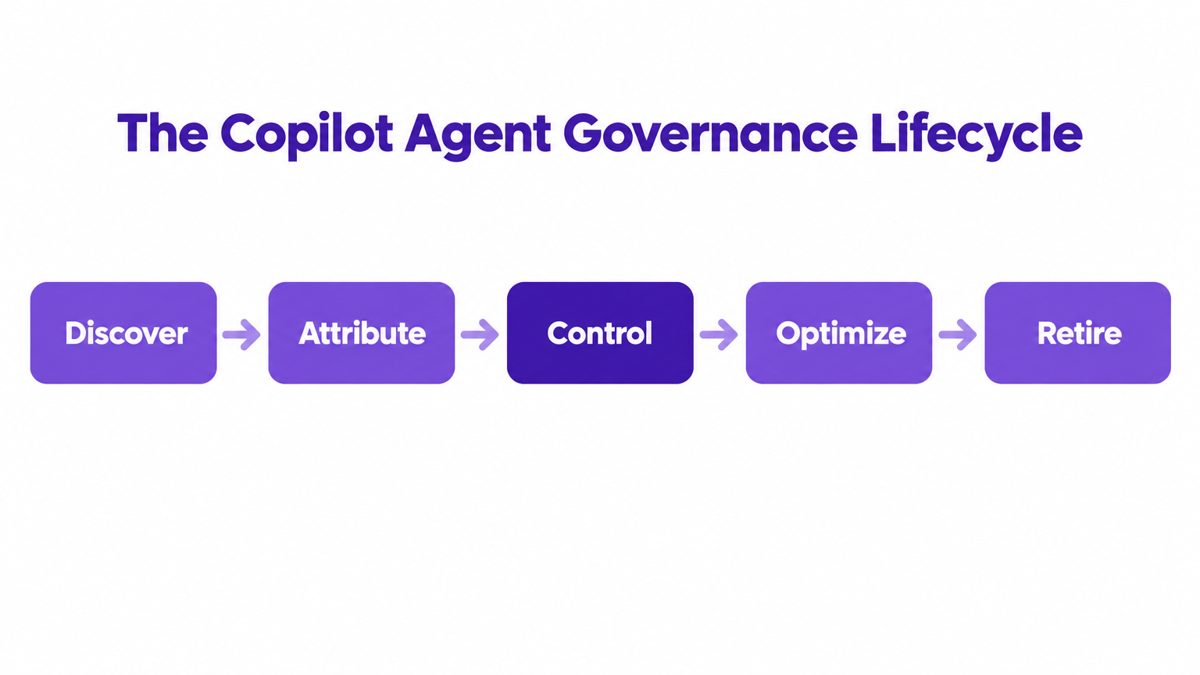
Effective Copilot Studio agent governance runs every agent through five stages. Each stage has an owner and a test that shows it worked.
Build a complete inventory of Copilot agents, makers, connectors, and environments, plus non-Microsoft AI tools in use. It worked when no agent appears in billing that is missing from the inventory.
Assign every agent an accountable owner and a cost center. It worked when Finance can read monthly Copilot Credit consumption by business unit.
Set agent-level budgets, alert thresholds, and hard stops, and scope data access through Entra Agent ID. It worked when no tenant approaches the 125% enforcement threshold by surprise.
Compare cost against value per agent, right-size prompts and retrieval context, and decide which users need a full Copilot license. It worked when credit spend per completed task falls quarter over quarter.
Deprecate idle agents, revoke their identities and connectors, and reclaim capacity. It worked when every agent without an owner or recent activity is gone.
AgentNuro connects read-only and delivers insights the next day. Get your free savings assessment.
AgentNuro is CloudNuro's Enterprise AI Adoption Management platform. It sits above Microsoft's native controls and treats Copilot as one part of the enterprise AI estate.
AgentNuro is built on CloudNuro's SaaS and cloud FinOps foundation, so Copilot license data, Copilot Credits, and the rest of the SaaS management estate sit in one control plane. Teams that already use the AI Custodian extend the same governance to agents.
To see Copilot agents and every other AI tool in one view, see it in action.
| Control | Owner | Where it runs |
|---|---|---|
| Complete agent and maker inventory | CIO / IT | Agent 365 plus AgentNuro discovery |
| Entra Agent ID scoped access and DLP | CISO | Entra and Power Platform admin center |
| Agent-level credit limits and alerts | IT / FinOps | Power Platform admin center plus AgentNuro budgets |
| Credits allocated to cost centers | CFO / FinOps | AgentNuro attribution |
| Value per agent reviewed quarterly | AI leader | AgentNuro optimization |
| Idle agents retired, identities revoked | IT / CISO | Agent 365 and Entra |
For a broader operating model, read CloudNuro's guide on governing AI agents at enterprise scale.
Copilot Studio agent governance is the set of controls that decide who can build, share, and publish agents, what data they reach, and how much capacity they consume. It covers the full lifecycle from discovery to retirement.
Copilot Studio agents are charged in Copilot Credits: 1 credit for a classic answer, 2 for a generative answer, and 10 per 1,000 tokens for token-based usage. Credits come from prepaid capacity or pay-as-you-go and do not roll over.
Enforcement triggers when a tenant reaches 125% of prepaid Copilot Credit capacity. Admins can reallocate capacity, buy more, or configure a pay-as-you-go meter.
Every new Copilot Studio agent gets an Entra Agent ID so security teams can scope permissions, Conditional Access, and DLP to the agent itself. This treats agents as non-human identities with their own access.
AgentNuro complements Microsoft's admin tools by attributing Copilot spend to users, projects, and business units and placing it beside OpenAI, Claude, and Gemini spend. It adds budget controls and value-per-token measurement across the whole AI estate.
Copilot agent costs can be charged back once each agent has an owner and cost center. Most enterprises start with showback, then move to chargeback, a path covered in CloudNuro's guide to TokenOps.
Copilot Credits and Entra Agent IDs have made every Microsoft agent a metered, identifiable actor. Organizations that govern agents only through admin toggles will control access but still lose track of who owns the spend and whether it pays back. The stronger model pairs Microsoft's native controls with unified visibility and accountability across SaaS, cloud, and AI.
AgentNuro, CloudNuro's Enterprise AI Adoption Management platform, discovers Copilot agents and shadow AI, attributes every Copilot Credit to an owner and cost center, and applies real-time budget controls. Copilot then sits in one control plane with the rest of your SaaS, cloud, and AI spend.
CloudNuro is a leader in Enterprise AI Adoption Management, providing enterprises with unmatched visibility, governance, and cost optimization. Recognized twice in a row by Gartner in the SaaS Management Platforms and named a Leader in the Info-Tech SoftwareReviews Data Quadrant, CloudNuro is trusted by global enterprises and government agencies to bring financial discipline to SaaS, cloud, and AI. Trusted by enterprises, CloudNuro provides centralized SaaS inventory, license optimization, and renewal management along with advanced cost allocation and chargeback, giving IT and Finance leaders the visibility, control, and cost-conscious culture needed to drive financial discipline.
Request a no cost, no obligation free assessment —just 15 minutes to savings!
Get StartedMicrosoft Copilot and Copilot Studio agents now run on two cost models at once: per-user licenses and tenant-level Copilot Credits consumed by agents.
Microsoft's native controls govern agents inside the Microsoft estate, but CIOs, CFOs, and CISOs still need one view that ties every agent and every credit to an owner, a cost center, and a business outcome alongside the rest of their AI spend.
This guide explains the Copilot agent cost model, the governance lifecycle from discovery to retirement, and how AgentNuro adds attribution, budget controls, and cross-vendor visibility on top of Microsoft's admin tooling.
Since September 1, 2025, Copilot Studio usage is metered in Copilot Credits instead of messages, and token-based activity is billed at 10 Copilot Credits per 1,000 tokens.
That change turns every Microsoft Copilot and Copilot Studio agent into a consumption line item. An agent built by one department in an afternoon can draw on shared tenant capacity that Finance budgeted for someone else.
Starting in July 2026, Copilot Studio automatically creates a Microsoft Entra Agent ID for every new agent. Agents are now distinct identities with their own access, actions, and spending, not extensions of the employee who built them.
CIOs ask what agents are running. CFOs ask whose budget each credit belongs to. CISOs ask which agents touch sensitive data. These questions sit inside the broader challenge of detecting shadow AI and unauthorized AI tools.
This guide explains how Copilot agents are priced, what Microsoft's native controls cover, where gaps remain, and how AgentNuro closes them in a phased governance program.
Microsoft Copilot agents are billed through two layers: per-user, per-month Microsoft 365 Copilot licenses, and Copilot Credits consumed at the tenant level through prepaid capacity or pay-as-you-go. Usage is based on total credits the organization consumes, not on named users, so agent activity rarely maps cleanly to one budget.
Microsoft's current billing table lists these rates:
| Agent activity | Copilot Credits consumed | Governance implication |
|---|---|---|
| Classic answer | 1 credit | Low cost per call, high volume risk |
| Generative answer | 2 credits | Doubles cost for each conversational reply |
| Token-based usage | 10 credits per 1,000 tokens | Long prompts and retrieval context scale spend fast |
Three billing rules shape governance. Unused Copilot Credits do not carry over to the next month. Enforcement triggers when a tenant reaches 125% of prepaid capacity. Classic and generative answers carry no charge when the user holds a Microsoft 365 Copilot license, so licensing decisions and agent costs are linked.
The license layer has its own waste profile, covered in CloudNuro's guide to Microsoft 365 Copilot license optimization.
See how AgentNuro maps every Copilot Credit to an owner: request a demo.
Microsoft has moved Copilot Studio toward a centrally managed agent control plane. Administrators should use these controls first.
Microsoft Agent 365, generally available since May 2026, gives a consolidated view of agent inventory, permissions, behavior, and activity across Microsoft agents.
Entra Agent ID lets security teams scope connector permissions, Conditional Access, and data loss prevention to a specific agent rather than to its maker.
Admins can limit sharing at the managed environment level, control Editor and Viewer permissions, require lifecycle approval, and use DLP policies to block agents from publishing to supported channels.
The Power Platform admin center supports agent-level monthly limits, notification thresholds, hard stops, and capacity reallocation.
Microsoft's tooling governs agents inside Microsoft. Enterprise AI governance has to answer questions that cross that boundary.
Credit limits stop overspend, but they do not tell Finance which cost center, project, or product owns each credit. Without cost allocation, Copilot spend stays an IT overhead line.
Solution: Map every agent to a user, project, and business unit, then run showback before moving to chargeback and showback.
Copilot is one AI line among several. Teams also run OpenAI, Claude, and Gemini, and a Copilot-only view hides how total AI spend is moving.
Solution: Consolidate Copilot data with every other AI provider, as described in CloudNuro's guide on how Copilot licensing became the largest ungoverned AI spend.
Consumption metrics show what an agent costs, not whether it delivers. Without a value measure, idle and low-value agents keep drawing credits.
Solution: Give each agent a denominator (tasks completed, tickets resolved, hours saved) and track value per token, not just cost per token.
A tight Copilot policy can push users toward unsanctioned tools. Governance that only watches the sanctioned platform misses the displacement.
Solution: Run continuous shadow AI discovery alongside Copilot governance, as outlined in why enterprises need an AI governance strategy.
Effective Copilot Studio agent governance runs every agent through five stages. Each stage has an owner and a test that shows it worked.
Build a complete inventory of Copilot agents, makers, connectors, and environments, plus non-Microsoft AI tools in use. It worked when no agent appears in billing that is missing from the inventory.
Assign every agent an accountable owner and a cost center. It worked when Finance can read monthly Copilot Credit consumption by business unit.
Set agent-level budgets, alert thresholds, and hard stops, and scope data access through Entra Agent ID. It worked when no tenant approaches the 125% enforcement threshold by surprise.
Compare cost against value per agent, right-size prompts and retrieval context, and decide which users need a full Copilot license. It worked when credit spend per completed task falls quarter over quarter.
Deprecate idle agents, revoke their identities and connectors, and reclaim capacity. It worked when every agent without an owner or recent activity is gone.
AgentNuro connects read-only and delivers insights the next day. Get your free savings assessment.
AgentNuro is CloudNuro's Enterprise AI Adoption Management platform. It sits above Microsoft's native controls and treats Copilot as one part of the enterprise AI estate.
AgentNuro is built on CloudNuro's SaaS and cloud FinOps foundation, so Copilot license data, Copilot Credits, and the rest of the SaaS management estate sit in one control plane. Teams that already use the AI Custodian extend the same governance to agents.
To see Copilot agents and every other AI tool in one view, see it in action.
| Control | Owner | Where it runs |
|---|---|---|
| Complete agent and maker inventory | CIO / IT | Agent 365 plus AgentNuro discovery |
| Entra Agent ID scoped access and DLP | CISO | Entra and Power Platform admin center |
| Agent-level credit limits and alerts | IT / FinOps | Power Platform admin center plus AgentNuro budgets |
| Credits allocated to cost centers | CFO / FinOps | AgentNuro attribution |
| Value per agent reviewed quarterly | AI leader | AgentNuro optimization |
| Idle agents retired, identities revoked | IT / CISO | Agent 365 and Entra |
For a broader operating model, read CloudNuro's guide on governing AI agents at enterprise scale.
Copilot Studio agent governance is the set of controls that decide who can build, share, and publish agents, what data they reach, and how much capacity they consume. It covers the full lifecycle from discovery to retirement.
Copilot Studio agents are charged in Copilot Credits: 1 credit for a classic answer, 2 for a generative answer, and 10 per 1,000 tokens for token-based usage. Credits come from prepaid capacity or pay-as-you-go and do not roll over.
Enforcement triggers when a tenant reaches 125% of prepaid Copilot Credit capacity. Admins can reallocate capacity, buy more, or configure a pay-as-you-go meter.
Every new Copilot Studio agent gets an Entra Agent ID so security teams can scope permissions, Conditional Access, and DLP to the agent itself. This treats agents as non-human identities with their own access.
AgentNuro complements Microsoft's admin tools by attributing Copilot spend to users, projects, and business units and placing it beside OpenAI, Claude, and Gemini spend. It adds budget controls and value-per-token measurement across the whole AI estate.
Copilot agent costs can be charged back once each agent has an owner and cost center. Most enterprises start with showback, then move to chargeback, a path covered in CloudNuro's guide to TokenOps.
Copilot Credits and Entra Agent IDs have made every Microsoft agent a metered, identifiable actor. Organizations that govern agents only through admin toggles will control access but still lose track of who owns the spend and whether it pays back. The stronger model pairs Microsoft's native controls with unified visibility and accountability across SaaS, cloud, and AI.
AgentNuro, CloudNuro's Enterprise AI Adoption Management platform, discovers Copilot agents and shadow AI, attributes every Copilot Credit to an owner and cost center, and applies real-time budget controls. Copilot then sits in one control plane with the rest of your SaaS, cloud, and AI spend.
CloudNuro is a leader in Enterprise AI Adoption Management, providing enterprises with unmatched visibility, governance, and cost optimization. Recognized twice in a row by Gartner in the SaaS Management Platforms and named a Leader in the Info-Tech SoftwareReviews Data Quadrant, CloudNuro is trusted by global enterprises and government agencies to bring financial discipline to SaaS, cloud, and AI. Trusted by enterprises, CloudNuro provides centralized SaaS inventory, license optimization, and renewal management along with advanced cost allocation and chargeback, giving IT and Finance leaders the visibility, control, and cost-conscious culture needed to drive financial discipline.
Request a no cost, no obligation free assessment - just 15 minutes to savings!
Get StartedWe're offering complimentary ServiceNow license assessments to only 25 enterprises this quarter who want to unlock immediate savings without disrupting operations.
Get Free AssessmentGet Started




CloudNuro Corp
1755 Park St. Suite 207
Naperville, IL 60563
Phone : +1-630-277-9470
Email: info@cloudnuro.com







Recognized Leader in SaaS Management Platforms by Info-Tech SoftwareReviews