

Sign Up
Thank you for Submitting!
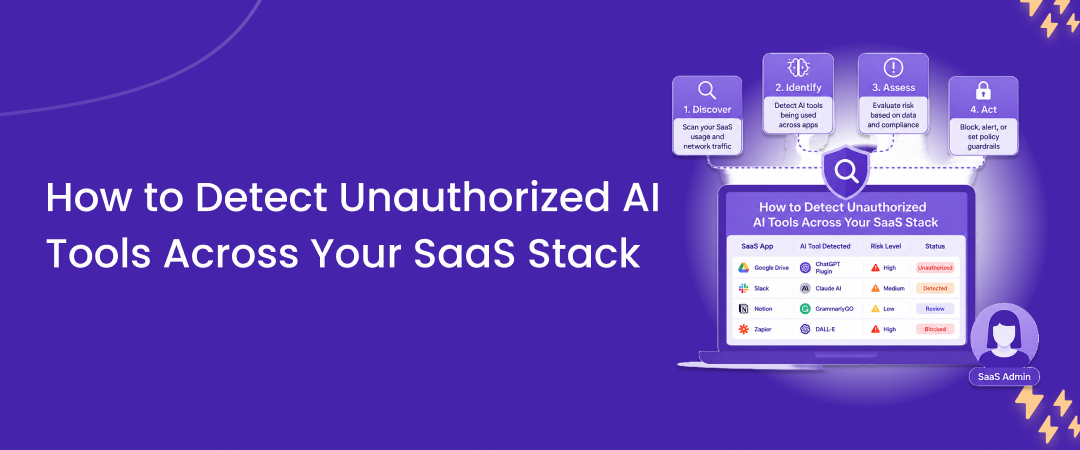
Shadow AI detection has become a top priority for CIOs, CISOs, and FinOps leaders as unsanctioned AI tools spread across enterprise SaaS environments. Generative AI plugins, browser extensions, and AI-powered SaaS add-ons are being adopted faster than IT can review them, which creates blind spots for security and compliance.
Gartner reports that 81% of enterprises saw an increase in unauthorized AI tool usage in their SaaS environments in the past year (2026). Forrester finds that 67% of IT leaders now cite shadow AI as their top compliance risk, up from 48% in 2025. Shadow AI detection is no longer a “nice to have” feature. It is a core control for cloud security, data protection, and financial governance.
Shadow AI refers to any AI-powered tool, integration, or feature used inside your organization without formal approval or governance. This can include standalone AI SaaS apps, embedded AI copilots inside existing tools, or third-party plugins that access sensitive data.
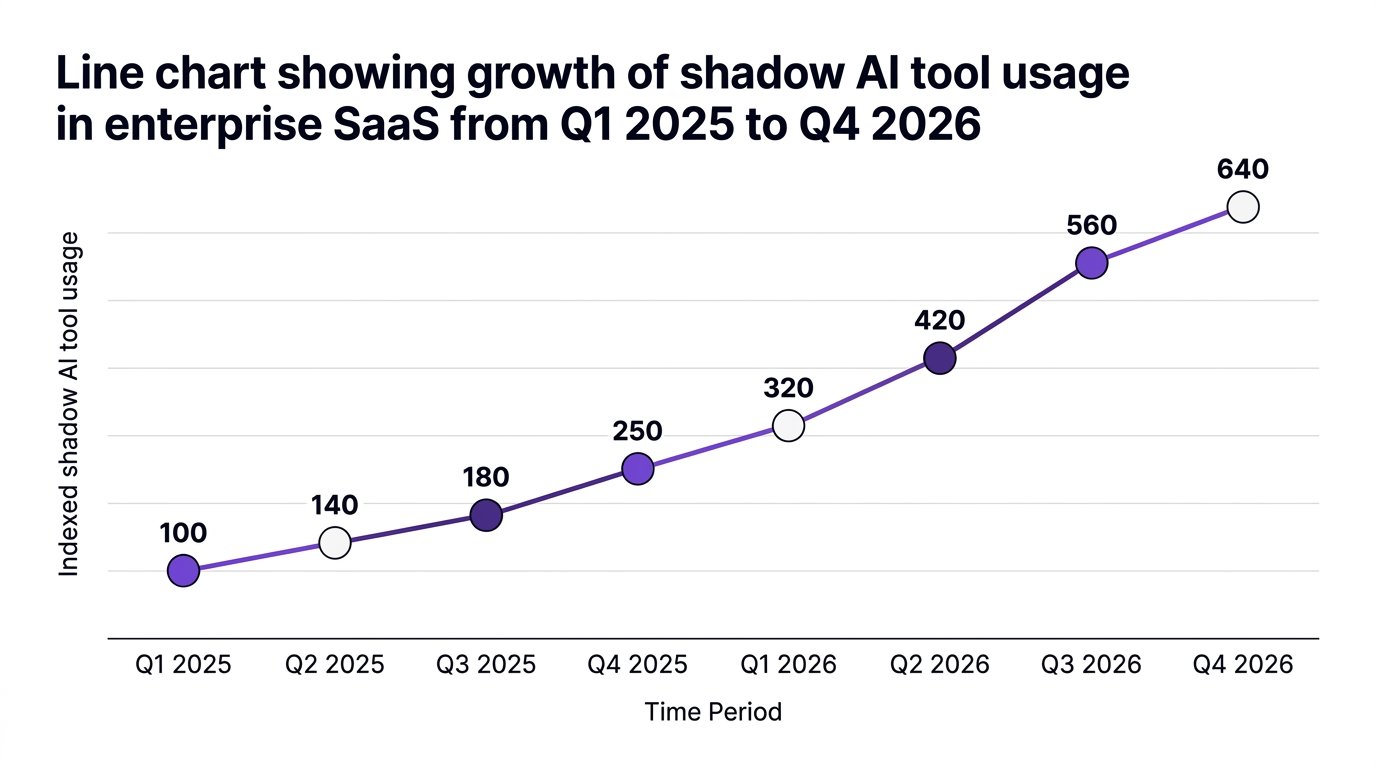
By 2026, Forrester estimates that AI-powered SaaS apps outside IT control will make up 41% of all enterprise AI tool usage. In other words, almost half of your AI footprint may live in the shadows.
Shadow AI is particularly risky because:
Data flows are opaque. Sensitive data may be copied into AI tools with unclear retention, training, or residency policies.
Access paths bypass controls. AI extensions and plugins can skirt traditional identity, access, and DLP controls.
Compliance evidence is weak. Auditors increasingly ask for demonstrable AI usage monitoring and governance for AI tools, which shadow AI undermines.
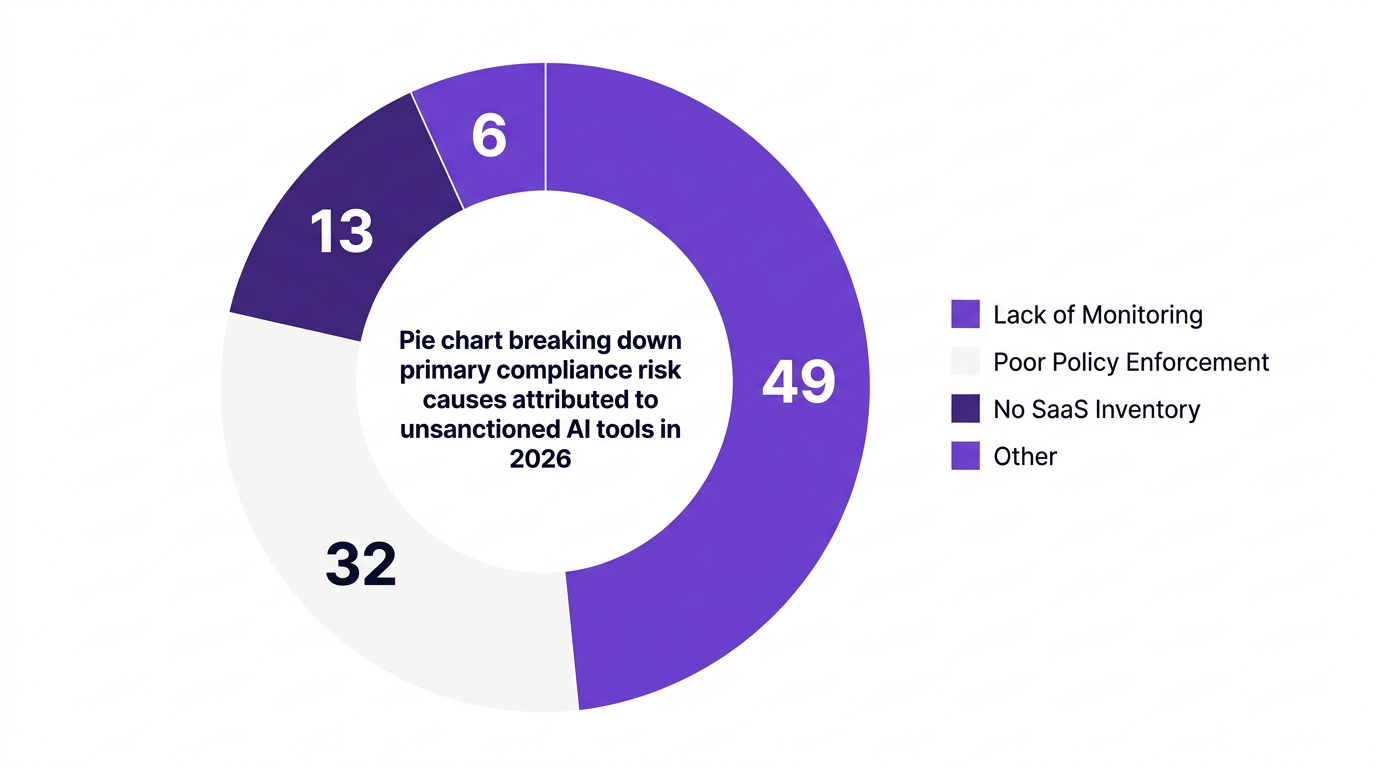
A security report in 2026 found that 94% of breaches tied to shadow AI stemmed from lack of centralized monitoring and governance. Shadow AI detection is the prerequisite to any realistic AI risk management strategy.
Many enterprises assume that existing shadow IT detection and SaaS discovery capabilities cover shadow AI. In reality, they do not. Shadow AI is more like a fast-growing vine wrapped around your SaaS stack than a standalone plant you can see at a glance.
There are three critical blind spots:
Embedded AI features inside approved SaaS.
Your SaaS tool inventory may show “sanctioned” apps, but not which AI features or copilots are turned on.
AI usage monitoring at the feature level is rarely enabled by default.
Plugins, extensions, and integrations.
AI browser extensions, marketplace add-ons, and chatbots often bypass standard SaaS procurement.
Traditional shadow IT detection might see the primary app but not the AI plugin traffic or data flows.
API and integration-based AI services.
Teams may wire AI APIs into internal tools or no-code platforms without central visibility.
Without AI integration monitoring, you cannot see which systems are feeding data into which models.
A leading SaaS governance study in 2026 found that less than 30% of organizations had automated discovery for AI-powered SaaS applications. This gap explains why 81% are seeing unauthorized AI usage grow, even when they believe they have shadow IT detection in place.
Counterpoint: Some leaders argue that strict access controls at the network or identity layer are enough. In practice, users find workarounds, such as personal accounts, unmonitored devices, or browser extensions. Prevention without monitoring often creates a false sense of security.
To detect unauthorized AI tools effectively, enterprises need to treat AI as a first-class object in SaaS governance. A useful way to think about this is the 4C Shadow AI Detection Framework:
Catalog: Build and maintain a live SaaS and AI tool inventory.
Classify: Label AI tools by sensitivity, capabilities, and business function.
Control: Apply policies, access rules, and controls specific to AI usage.
Continuously Monitor: Track AI usage patterns over time and across systems.
Traditional SaaS discovery focuses on applications. Shadow AI detection requires discovery at the AI capability level.
Key actions:
Use a SaaS discovery engine that detects:
Standalone AI SaaS applications.
AI features, copilots, and assistants inside major SaaS tools.
AI plugins, browser extensions, and marketplace apps.
Combine SSO logs, CASB data, expense reports, and browser telemetry to build a single SaaS tool inventory.
Mark AI-enabled apps and features explicitly within your SaaS management platform.
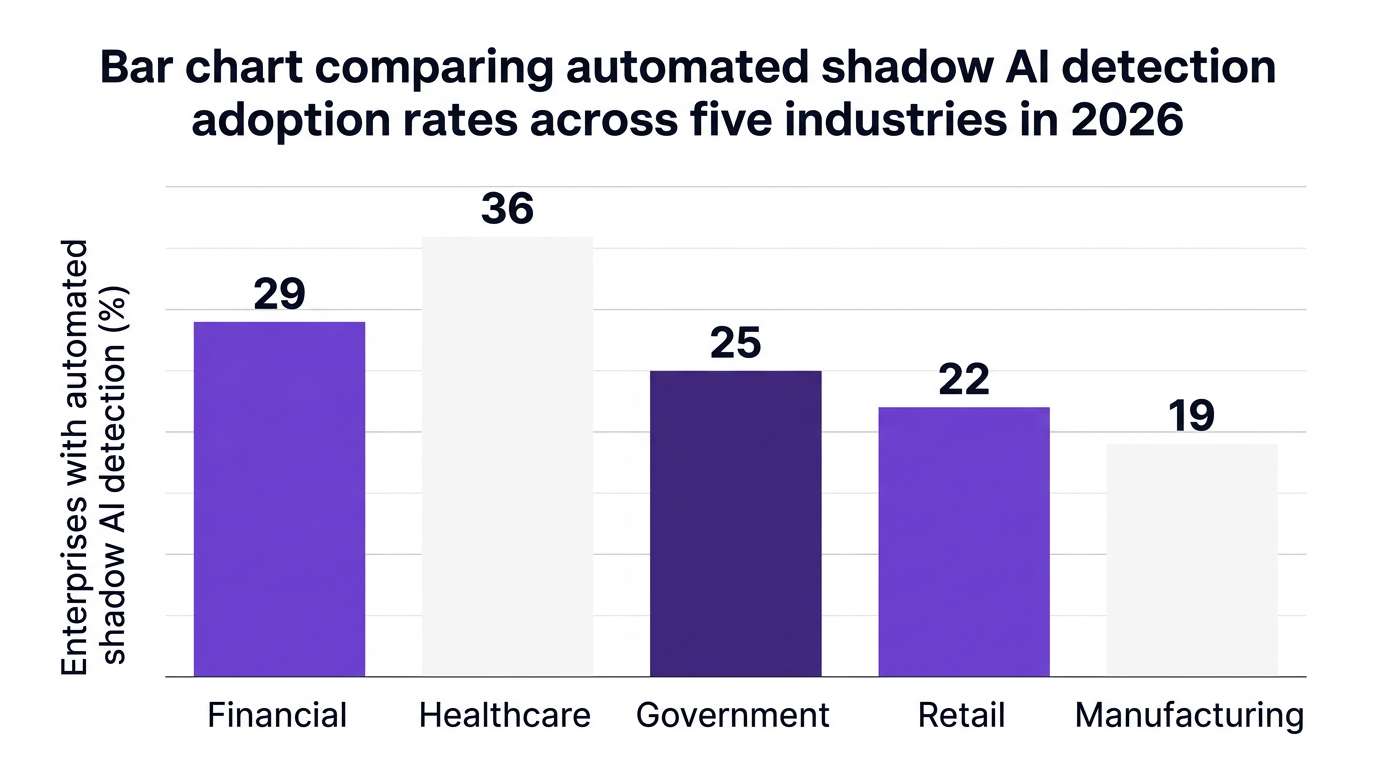
This is where a dedicated AI governance platform or an AI-aware SaaS management solution becomes critical. IDC reported in 2026 that only 29% of financial institutions and 25% of government organizations had automated shadow AI detection. Those that did had materially better audit outcomes.
Once discovered, AI tools must be classified by risk and business purpose, not just by name.
Useful classification dimensions:
Data sensitivity: Does the tool touch PII, PHI, financial data, or source code?
AI capability: Generative text, code generation, summarization, image creation, analytics, or prediction.
Deployment model: SaaS, plugin, embedded feature, or API.
Compliance impact: Relevance to regulations such as GDPR, HIPAA, PCI, or public sector mandates.
This classification feeds AI tool risk management decisions. For example, you may allow generative AI for marketing copy with guardrails, but restrict code generation tools from accessing production repositories.
A written generative AI policy is not enough without enforcement at the SaaS and AI layers.
Control mechanisms should include:
AI access control rules:
Role-based access to AI features inside approved apps.
Blocking high-risk AI domains or extensions where needed.
Conditional usage policies:
Allow AI use only from corporate devices or networks.
Restrict upload of regulated data categories.
AI usage monitoring aligned with policy:
Monitor prompts, usage frequency, and data movement.
Trigger alerts for violations or anomalous activity.
A compliance coalition study in 2026 concluded that real-time policy enforcement and automated discovery are now mandatory for regulated industries, not optional. Shadow AI detection is the enforcement engine for your written policies.
Static SaaS stack audit projects quickly become stale as AI tools evolve and new plugins appear weekly.
To stay ahead, organizations should:
Implement enterprise AI monitoring dashboards that:
Show AI usage trends by department, app, and data category.
Highlight unsanctioned AI usage in near real time.
Integrate shadow IT detection with AI-specific signals such as generative AI domains and AI marketplace usage.
Tie AI usage monitoring to SaaS spend management, surfacing where unsanctioned AI is incurring cost.
McKinsey reported a 5x growth in unsanctioned generative AI tool downloads across enterprise SaaS stacks between 2025 and 2026. Without continuous monitoring, your risk grows at that same exponential pace.
A global financial institution (described in Gartner research, 2026) deployed an AI-powered SaaS security management and discovery platform to address audit findings around AI usage.
Within months, they:
Identified over 200 previously unknown AI tools in use across the organization, many embedded as extensions and plugins.
Mapped AI data flows between customer data systems and generative AI tools.
Implemented policy controls that reduced unsanctioned AI app traffic by 43%.
Used the AI tool inventory to demonstrate comprehensive governance for AI tools during a regulatory review, which helped avert a significant compliance fine.
A healthcare technology organization saw similar benefits. By enabling automated shadow AI detection from a leading SaaS governance provider, they:
Reduced unauthorized AI-related data exports by 72% within four months.
Centralized AI compliance SaaS reporting to respond faster to audits.
Informed procurement decisions by distinguishing high-value AI tools from redundant or risky ones.
These examples illustrate a crucial point: shadow AI detection is not only a security exercise, it is a compliance and financial protection function.
Choosing the right AI security tools for shadow AI detection is a strategic decision. The platform you select should serve IT, Security, and FinOps simultaneously.
Critical capabilities include:
Deep SaaS discovery and AI context
Discovery across SSO, network, and finance data that surfaces unauthorized SaaS apps and AI plugins.
Ability to identify AI features inside large SaaS platforms, not only standalone tools.
AI usage monitoring and analytics
Granular usage analytics on AI prompts, features, and integrations.
Department, user, and region level views for targeted remediation.
Governance for AI tools and policy enforcement
Native support for governance for AI tools, including policy templates for different risk profiles.
Alerting and workflow automation for violations and exceptions.
Integration mapping and AI integration monitoring
Visual integration mapping that shows which systems feed data to which AI tools.
AI integration monitoring across APIs, iPaaS, and no-code platforms.
Cost and risk alignment
Ties AI usage to SaaS spend management data so that FinOps and ITAM can quantify the business impact.
Support for license management and optimization so you are not paying for redundant or unsanctioned AI tools.
A 2026 SaaS management survey showed that only 24% of FinOps and ITAM teams had integrated real-time AI tool detection into their processes. Organizations that bridge that gap gain a significant advantage in both risk management and cost control.
For additional context, see CloudNuro resources on SaaS Management and AI Usage Governance Best Practices.
CloudNuro was built for this exact intersection of cloud SaaS AI visibility, security, and cost optimization. Its AI-enabled platform embeds shadow SaaS monitoring and Shadow AI detection into a single governance fabric.
Here is how CloudNuro addresses the challenges discussed above.
CloudNuro AI Custodian applies machine learning to perform application discovery across more than 400 integrated apps. It:
Automatically discovers detect unauthorized AI tools at the app, feature, and plugin level.
Identifies AI-enabled capabilities inside suites such as productivity and CRM platforms.
Correlates identity logs, financial data, and usage patterns to flag unsanctioned AI activity.
This gives IT and security teams cloud SaaS AI visibility without custom scripts or endpoint agents. For deeper exploration of this topic, CloudNuro provides detailed guidance in its article on SaaS Discovery for Shadow IT and Shadow AI.
CloudNuro enriches its enterprise AI monitoring with business and risk context:
AI usage is mapped by user, department, data classification, and geography.
Tools are auto-classified for AI risk management based on capabilities and data sensitivity.
Dashboards highlight high-risk unsanctioned AI usage that touches regulated data.
This enables security teams to focus on the 10 to 20 percent of shadow AI activities that present the highest risk rather than chasing every new plugin equally.
CloudNuro’s governance-first architecture supports strong AI access control and compliance workflows:
Policy templates for generative AI, code generation, analytics, and industry-specific guardrails.
Automated enforcement actions for shadow IT AI, such as blocking, quarantining, or routing for review.
Customizable AI compliance SaaS reports aligned to regulator expectations.
This makes CloudNuro a powerful AI governance platform for security and compliance leaders who need provable controls.
CloudNuro’s FinOps Services connect Shadow AI detection to SaaS spend management outcomes:
Unsanctioned AI usage is tied directly to spend, showing where budgets are leaking.
Redundant or low-value AI tools are candidates for elimination or consolidation.
Approved AI investments can be right-sized through license management and usage-based optimization.
This shared view creates a strong partnership between FinOps, IT Asset Management, and security teams. It also supports broader IT Security and IT Asset Management initiatives.
For leaders evaluating platforms, CloudNuro explains its governance-first approach in more depth in Why CloudNuro and its dedicated AI Custodian solution overview.
To reduce Shadow AI risk over the next 3 to 6 months, organizations can:
Establish a unified AI steering group.
Include IT, Security, Legal, Compliance, and FinOps.
Define risk tiers and acceptable use for AI across business units.
Perform a rapid SaaS stack audit with an AI focus.
Use Shadow AI detection capabilities to baseline AI usage.
Identify top unsanctioned AI categories by risk and spend.
Deploy AI usage monitoring in critical systems.
Prioritize productivity suites, CRM, collaboration tools, and developer platforms.
Turn on logs and AI integration monitoring where available.
Operationalize a generative AI policy.
Translate policy into concrete technical controls in your SaaS security management platform.
Communicate guidelines clearly, with examples of allowed and prohibited use.
Align remediation with value.
For low-risk, high-value tools, move them through fast-track review and formal approval.
For high-risk, low-value tools, block or phase out usage, while providing approved alternatives.
Counterargument to avoid: A common belief is that tight blocking will “stop innovation.” In practice, organizations that combine Shadow AI detection with clear guardrails usually see healthier AI adoption. Teams get access to safer, governed tools instead of unreviewed ones.
Shadow AI refers to AI tools, features, and integrations used inside your organization without formal approval or governance. This includes standalone AI SaaS apps, embedded copilots in existing tools, browser extensions, and AI APIs wired into internal systems.
In a SaaS context, Shadow AI often rides on top of approved applications, which makes it easy to miss with traditional shadow IT detection methods.
Shadow AI increases risk because information flows into tools that have not been assessed for data handling, retention, or regulatory compliance. A 2026 security report found that 94% of breaches tied to shadow AI were linked to lack of centralized monitoring and governance.
For regulated industries, this directly affects audit readiness, cross-border data transfer controls, and data residency obligations.
Start by using a SaaS discovery platform that explicitly supports Shadow AI detection. It should:
Discover AI-enabled apps, features, and extensions.
Provide AI usage monitoring and analytics by user and department.
Surface unsanctioned tools and data flows that touch sensitive systems.
Combine that with stronger AI access control and a clear generative AI policy that can be enforced technically.
FinOps and IT Asset Management teams are essential partners because Shadow AI is also a spend and redundancy problem, not only a security issue. They can:
Map AI usage to cost centers and budgets.
Identify duplicate or low-utilization AI tools for consolidation.
Ensure that Shadow AI detection data feeds into SaaS spend management and renewal decisions.
This collaboration turns AI risk into a quantified financial conversation, not only a theoretical threat.
CloudNuro AI Custodian automatically discovers AI tools across your SaaS landscape, including embedded features and plugins. It provides:
Granular AI usage monitoring by user, department, and data category.
Classification and risk scoring for AI tools and integrations.
Native governance for AI tools with policy enforcement and compliance reporting.
Combined with CloudNuro’s FinOps and SaaS management capabilities, this enables organizations to address Shadow AI as both a security and financial governance priority.
Shadow AI detection is now a foundational capability for any organization that relies on cloud applications and AI. The data is clear: Shadow AI is growing faster than traditional controls, and less than one third of enterprises have automated detection in place.
By implementing a structured approach to Shadow AI detection, strengthening AI usage monitoring, and aligning IT, Security, and FinOps around a shared inventory and policy set, organizations can turn AI from an unmanaged risk into a governed asset.
CloudNuro is built to help you detect unauthorized AI tools, gain complete cloud SaaS AI visibility, and tie AI governance directly to cost and compliance outcomes. To see how this works in your environment, request a personalized walkthrough from the CloudNuro team today.
CloudNuro is a leader in Enterprise SaaS Management Platforms, providing enterprises with unmatched visibility, governance, and cost optimization. Recognized twice in a row in the SaaS Management Platforms category and named a Leader in the SoftwareReviews Data Quadrant, CloudNuro is trusted by global enterprises and government agencies to bring financial discipline to SaaS, cloud, and AI. Trusted by enterprises such as Konica Minolta and Federal Signal, CloudNuro provides centralized SaaS inventory, license optimization, and renewal management along with advanced cost allocation and chargeback, giving IT and Finance leaders the visibility, control, and cost-conscious culture needed to drive financial discipline.
Request a no cost, no obligation free assessment —just 15 minutes to savings!
Get StartedShadow AI detection has become a top priority for CIOs, CISOs, and FinOps leaders as unsanctioned AI tools spread across enterprise SaaS environments. Generative AI plugins, browser extensions, and AI-powered SaaS add-ons are being adopted faster than IT can review them, which creates blind spots for security and compliance.
Gartner reports that 81% of enterprises saw an increase in unauthorized AI tool usage in their SaaS environments in the past year (2026). Forrester finds that 67% of IT leaders now cite shadow AI as their top compliance risk, up from 48% in 2025. Shadow AI detection is no longer a “nice to have” feature. It is a core control for cloud security, data protection, and financial governance.
Shadow AI refers to any AI-powered tool, integration, or feature used inside your organization without formal approval or governance. This can include standalone AI SaaS apps, embedded AI copilots inside existing tools, or third-party plugins that access sensitive data.
By 2026, Forrester estimates that AI-powered SaaS apps outside IT control will make up 41% of all enterprise AI tool usage. In other words, almost half of your AI footprint may live in the shadows.
Shadow AI is particularly risky because:
Data flows are opaque. Sensitive data may be copied into AI tools with unclear retention, training, or residency policies.
Access paths bypass controls. AI extensions and plugins can skirt traditional identity, access, and DLP controls.
Compliance evidence is weak. Auditors increasingly ask for demonstrable AI usage monitoring and governance for AI tools, which shadow AI undermines.
A security report in 2026 found that 94% of breaches tied to shadow AI stemmed from lack of centralized monitoring and governance. Shadow AI detection is the prerequisite to any realistic AI risk management strategy.
Many enterprises assume that existing shadow IT detection and SaaS discovery capabilities cover shadow AI. In reality, they do not. Shadow AI is more like a fast-growing vine wrapped around your SaaS stack than a standalone plant you can see at a glance.
There are three critical blind spots:
Embedded AI features inside approved SaaS.
Your SaaS tool inventory may show “sanctioned” apps, but not which AI features or copilots are turned on.
AI usage monitoring at the feature level is rarely enabled by default.
Plugins, extensions, and integrations.
AI browser extensions, marketplace add-ons, and chatbots often bypass standard SaaS procurement.
Traditional shadow IT detection might see the primary app but not the AI plugin traffic or data flows.
API and integration-based AI services.
Teams may wire AI APIs into internal tools or no-code platforms without central visibility.
Without AI integration monitoring, you cannot see which systems are feeding data into which models.
A leading SaaS governance study in 2026 found that less than 30% of organizations had automated discovery for AI-powered SaaS applications. This gap explains why 81% are seeing unauthorized AI usage grow, even when they believe they have shadow IT detection in place.
Counterpoint: Some leaders argue that strict access controls at the network or identity layer are enough. In practice, users find workarounds, such as personal accounts, unmonitored devices, or browser extensions. Prevention without monitoring often creates a false sense of security.
To detect unauthorized AI tools effectively, enterprises need to treat AI as a first-class object in SaaS governance. A useful way to think about this is the 4C Shadow AI Detection Framework:
Catalog: Build and maintain a live SaaS and AI tool inventory.
Classify: Label AI tools by sensitivity, capabilities, and business function.
Control: Apply policies, access rules, and controls specific to AI usage.
Continuously Monitor: Track AI usage patterns over time and across systems.
Traditional SaaS discovery focuses on applications. Shadow AI detection requires discovery at the AI capability level.
Key actions:
Use a SaaS discovery engine that detects:
Standalone AI SaaS applications.
AI features, copilots, and assistants inside major SaaS tools.
AI plugins, browser extensions, and marketplace apps.
Combine SSO logs, CASB data, expense reports, and browser telemetry to build a single SaaS tool inventory.
Mark AI-enabled apps and features explicitly within your SaaS management platform.
This is where a dedicated AI governance platform or an AI-aware SaaS management solution becomes critical. IDC reported in 2026 that only 29% of financial institutions and 25% of government organizations had automated shadow AI detection. Those that did had materially better audit outcomes.
Once discovered, AI tools must be classified by risk and business purpose, not just by name.
Useful classification dimensions:
Data sensitivity: Does the tool touch PII, PHI, financial data, or source code?
AI capability: Generative text, code generation, summarization, image creation, analytics, or prediction.
Deployment model: SaaS, plugin, embedded feature, or API.
Compliance impact: Relevance to regulations such as GDPR, HIPAA, PCI, or public sector mandates.
This classification feeds AI tool risk management decisions. For example, you may allow generative AI for marketing copy with guardrails, but restrict code generation tools from accessing production repositories.
A written generative AI policy is not enough without enforcement at the SaaS and AI layers.
Control mechanisms should include:
AI access control rules:
Role-based access to AI features inside approved apps.
Blocking high-risk AI domains or extensions where needed.
Conditional usage policies:
Allow AI use only from corporate devices or networks.
Restrict upload of regulated data categories.
AI usage monitoring aligned with policy:
Monitor prompts, usage frequency, and data movement.
Trigger alerts for violations or anomalous activity.
A compliance coalition study in 2026 concluded that real-time policy enforcement and automated discovery are now mandatory for regulated industries, not optional. Shadow AI detection is the enforcement engine for your written policies.
Static SaaS stack audit projects quickly become stale as AI tools evolve and new plugins appear weekly.
To stay ahead, organizations should:
Implement enterprise AI monitoring dashboards that:
Show AI usage trends by department, app, and data category.
Highlight unsanctioned AI usage in near real time.
Integrate shadow IT detection with AI-specific signals such as generative AI domains and AI marketplace usage.
Tie AI usage monitoring to SaaS spend management, surfacing where unsanctioned AI is incurring cost.
McKinsey reported a 5x growth in unsanctioned generative AI tool downloads across enterprise SaaS stacks between 2025 and 2026. Without continuous monitoring, your risk grows at that same exponential pace.
A global financial institution (described in Gartner research, 2026) deployed an AI-powered SaaS security management and discovery platform to address audit findings around AI usage.
Within months, they:
Identified over 200 previously unknown AI tools in use across the organization, many embedded as extensions and plugins.
Mapped AI data flows between customer data systems and generative AI tools.
Implemented policy controls that reduced unsanctioned AI app traffic by 43%.
Used the AI tool inventory to demonstrate comprehensive governance for AI tools during a regulatory review, which helped avert a significant compliance fine.
A healthcare technology organization saw similar benefits. By enabling automated shadow AI detection from a leading SaaS governance provider, they:
Reduced unauthorized AI-related data exports by 72% within four months.
Centralized AI compliance SaaS reporting to respond faster to audits.
Informed procurement decisions by distinguishing high-value AI tools from redundant or risky ones.
These examples illustrate a crucial point: shadow AI detection is not only a security exercise, it is a compliance and financial protection function.
Choosing the right AI security tools for shadow AI detection is a strategic decision. The platform you select should serve IT, Security, and FinOps simultaneously.
Critical capabilities include:
Deep SaaS discovery and AI context
Discovery across SSO, network, and finance data that surfaces unauthorized SaaS apps and AI plugins.
Ability to identify AI features inside large SaaS platforms, not only standalone tools.
AI usage monitoring and analytics
Granular usage analytics on AI prompts, features, and integrations.
Department, user, and region level views for targeted remediation.
Governance for AI tools and policy enforcement
Native support for governance for AI tools, including policy templates for different risk profiles.
Alerting and workflow automation for violations and exceptions.
Integration mapping and AI integration monitoring
Visual integration mapping that shows which systems feed data to which AI tools.
AI integration monitoring across APIs, iPaaS, and no-code platforms.
Cost and risk alignment
Ties AI usage to SaaS spend management data so that FinOps and ITAM can quantify the business impact.
Support for license management and optimization so you are not paying for redundant or unsanctioned AI tools.
A 2026 SaaS management survey showed that only 24% of FinOps and ITAM teams had integrated real-time AI tool detection into their processes. Organizations that bridge that gap gain a significant advantage in both risk management and cost control.
For additional context, see CloudNuro resources on SaaS Management and AI Usage Governance Best Practices.
CloudNuro was built for this exact intersection of cloud SaaS AI visibility, security, and cost optimization. Its AI-enabled platform embeds shadow SaaS monitoring and Shadow AI detection into a single governance fabric.
Here is how CloudNuro addresses the challenges discussed above.
CloudNuro AI Custodian applies machine learning to perform application discovery across more than 400 integrated apps. It:
Automatically discovers detect unauthorized AI tools at the app, feature, and plugin level.
Identifies AI-enabled capabilities inside suites such as productivity and CRM platforms.
Correlates identity logs, financial data, and usage patterns to flag unsanctioned AI activity.
This gives IT and security teams cloud SaaS AI visibility without custom scripts or endpoint agents. For deeper exploration of this topic, CloudNuro provides detailed guidance in its article on SaaS Discovery for Shadow IT and Shadow AI.
CloudNuro enriches its enterprise AI monitoring with business and risk context:
AI usage is mapped by user, department, data classification, and geography.
Tools are auto-classified for AI risk management based on capabilities and data sensitivity.
Dashboards highlight high-risk unsanctioned AI usage that touches regulated data.
This enables security teams to focus on the 10 to 20 percent of shadow AI activities that present the highest risk rather than chasing every new plugin equally.
CloudNuro’s governance-first architecture supports strong AI access control and compliance workflows:
Policy templates for generative AI, code generation, analytics, and industry-specific guardrails.
Automated enforcement actions for shadow IT AI, such as blocking, quarantining, or routing for review.
Customizable AI compliance SaaS reports aligned to regulator expectations.
This makes CloudNuro a powerful AI governance platform for security and compliance leaders who need provable controls.
CloudNuro’s FinOps Services connect Shadow AI detection to SaaS spend management outcomes:
Unsanctioned AI usage is tied directly to spend, showing where budgets are leaking.
Redundant or low-value AI tools are candidates for elimination or consolidation.
Approved AI investments can be right-sized through license management and usage-based optimization.
This shared view creates a strong partnership between FinOps, IT Asset Management, and security teams. It also supports broader IT Security and IT Asset Management initiatives.
For leaders evaluating platforms, CloudNuro explains its governance-first approach in more depth in Why CloudNuro and its dedicated AI Custodian solution overview.
To reduce Shadow AI risk over the next 3 to 6 months, organizations can:
Establish a unified AI steering group.
Include IT, Security, Legal, Compliance, and FinOps.
Define risk tiers and acceptable use for AI across business units.
Perform a rapid SaaS stack audit with an AI focus.
Use Shadow AI detection capabilities to baseline AI usage.
Identify top unsanctioned AI categories by risk and spend.
Deploy AI usage monitoring in critical systems.
Prioritize productivity suites, CRM, collaboration tools, and developer platforms.
Turn on logs and AI integration monitoring where available.
Operationalize a generative AI policy.
Translate policy into concrete technical controls in your SaaS security management platform.
Communicate guidelines clearly, with examples of allowed and prohibited use.
Align remediation with value.
For low-risk, high-value tools, move them through fast-track review and formal approval.
For high-risk, low-value tools, block or phase out usage, while providing approved alternatives.
Counterargument to avoid: A common belief is that tight blocking will “stop innovation.” In practice, organizations that combine Shadow AI detection with clear guardrails usually see healthier AI adoption. Teams get access to safer, governed tools instead of unreviewed ones.
Shadow AI refers to AI tools, features, and integrations used inside your organization without formal approval or governance. This includes standalone AI SaaS apps, embedded copilots in existing tools, browser extensions, and AI APIs wired into internal systems.
In a SaaS context, Shadow AI often rides on top of approved applications, which makes it easy to miss with traditional shadow IT detection methods.
Shadow AI increases risk because information flows into tools that have not been assessed for data handling, retention, or regulatory compliance. A 2026 security report found that 94% of breaches tied to shadow AI were linked to lack of centralized monitoring and governance.
For regulated industries, this directly affects audit readiness, cross-border data transfer controls, and data residency obligations.
Start by using a SaaS discovery platform that explicitly supports Shadow AI detection. It should:
Discover AI-enabled apps, features, and extensions.
Provide AI usage monitoring and analytics by user and department.
Surface unsanctioned tools and data flows that touch sensitive systems.
Combine that with stronger AI access control and a clear generative AI policy that can be enforced technically.
FinOps and IT Asset Management teams are essential partners because Shadow AI is also a spend and redundancy problem, not only a security issue. They can:
Map AI usage to cost centers and budgets.
Identify duplicate or low-utilization AI tools for consolidation.
Ensure that Shadow AI detection data feeds into SaaS spend management and renewal decisions.
This collaboration turns AI risk into a quantified financial conversation, not only a theoretical threat.
CloudNuro AI Custodian automatically discovers AI tools across your SaaS landscape, including embedded features and plugins. It provides:
Granular AI usage monitoring by user, department, and data category.
Classification and risk scoring for AI tools and integrations.
Native governance for AI tools with policy enforcement and compliance reporting.
Combined with CloudNuro’s FinOps and SaaS management capabilities, this enables organizations to address Shadow AI as both a security and financial governance priority.
Shadow AI detection is now a foundational capability for any organization that relies on cloud applications and AI. The data is clear: Shadow AI is growing faster than traditional controls, and less than one third of enterprises have automated detection in place.
By implementing a structured approach to Shadow AI detection, strengthening AI usage monitoring, and aligning IT, Security, and FinOps around a shared inventory and policy set, organizations can turn AI from an unmanaged risk into a governed asset.
CloudNuro is built to help you detect unauthorized AI tools, gain complete cloud SaaS AI visibility, and tie AI governance directly to cost and compliance outcomes. To see how this works in your environment, request a personalized walkthrough from the CloudNuro team today.
CloudNuro is a leader in Enterprise SaaS Management Platforms, providing enterprises with unmatched visibility, governance, and cost optimization. Recognized twice in a row in the SaaS Management Platforms category and named a Leader in the SoftwareReviews Data Quadrant, CloudNuro is trusted by global enterprises and government agencies to bring financial discipline to SaaS, cloud, and AI. Trusted by enterprises such as Konica Minolta and Federal Signal, CloudNuro provides centralized SaaS inventory, license optimization, and renewal management along with advanced cost allocation and chargeback, giving IT and Finance leaders the visibility, control, and cost-conscious culture needed to drive financial discipline.
Request a no cost, no obligation free assessment - just 15 minutes to savings!
Get StartedWe're offering complimentary ServiceNow license assessments to only 25 enterprises this quarter who want to unlock immediate savings without disrupting operations.
Get Free AssessmentGet Started




CloudNuro Corp
1755 Park St. Suite 207
Naperville, IL 60563
Phone : +1-630-277-9470
Email: info@cloudnuro.com




.webp)

Recognized Leader in SaaS Management Platforms by Info-Tech SoftwareReviews

.png)
.svg)