

Sign Up
Thank you for Submitting!

Power BI Embedded has transformed the way independent software vendors (ISVs) deliver analytics inside modern applications. Its dedicated capacities offer scalable business intelligence services, but as SaaS providers race to deliver richer insights, subtle changes in how you license and operate your Power BI infrastructure can change your platform economics overnight.
For ISVs, selecting between Power BI’s two capacity models, A-SKU (Azure-based, pauseable) versus F-SKU (unified, always-on), is not just a technical exercise. It is a critical financial and governance decision that directly impacts SaaS profitability, cost predictability, and the ability to enforce license compliance at scale.
Leveraging CloudNuro’s AI-powered SaaS and cloud cost governance platform, this guide breaks down the nuanced, often-overlooked costs of Power BI Embedded. If you are a SaaS product owner, technical lead, or finance executive overseeing cloud BI platform expenditures, read on for a data-driven comparison, real-world optimization proof points, and a clear strategy for choosing the right SKU, and license management model, for your ISV’s needs.
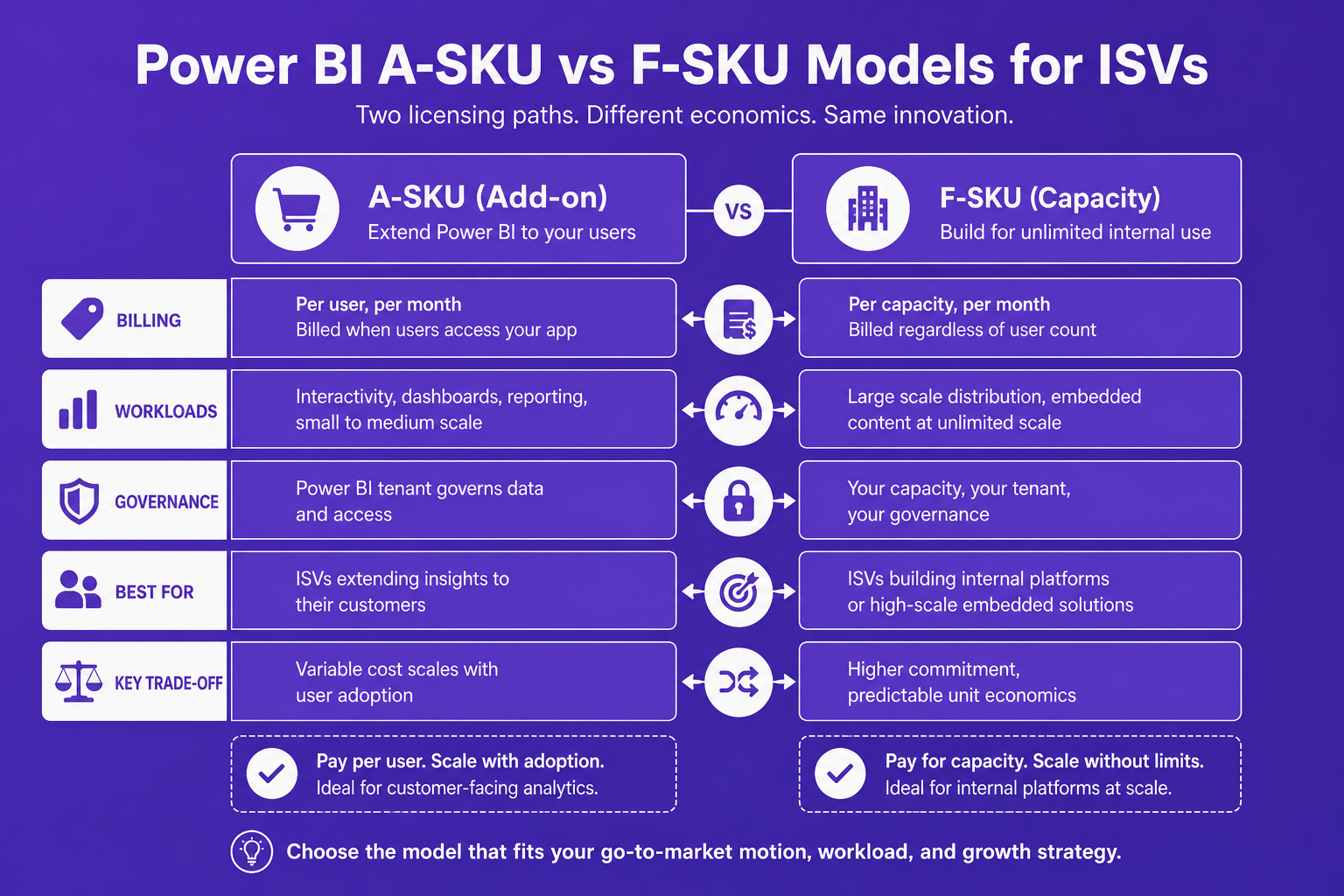
Power BI Embedded offers dedicated analytics capacity, unlocking premium features such as faster data refresh, increased concurrency, and seamless embedding into your SaaS product. For ISVs targeting enterprise customers, two distinct SKU families determine your operational model and cost structure: A-SKU and F-SKU.
| Feature | A-SKU | F-SKU |
|---|---|---|
| Billing | Hourly | Monthly/Annual |
| Pause/Resume | Yes | No |
| Workloads | Embedded | Embedded + Full Data Platform |
| Suitable for | Dev/Test | Production, Scaling |
ISVs must select not only the right capacity tier for their user count and data volumes, but also whether pauseable or always-on capacity aligns with their product’s usage model and cost management strategy.
Surface pricing for both A-SKU and F-SKU is transparent on paper. However, true lifetime cost is shaped by three hidden economic drivers every ISV must consider:
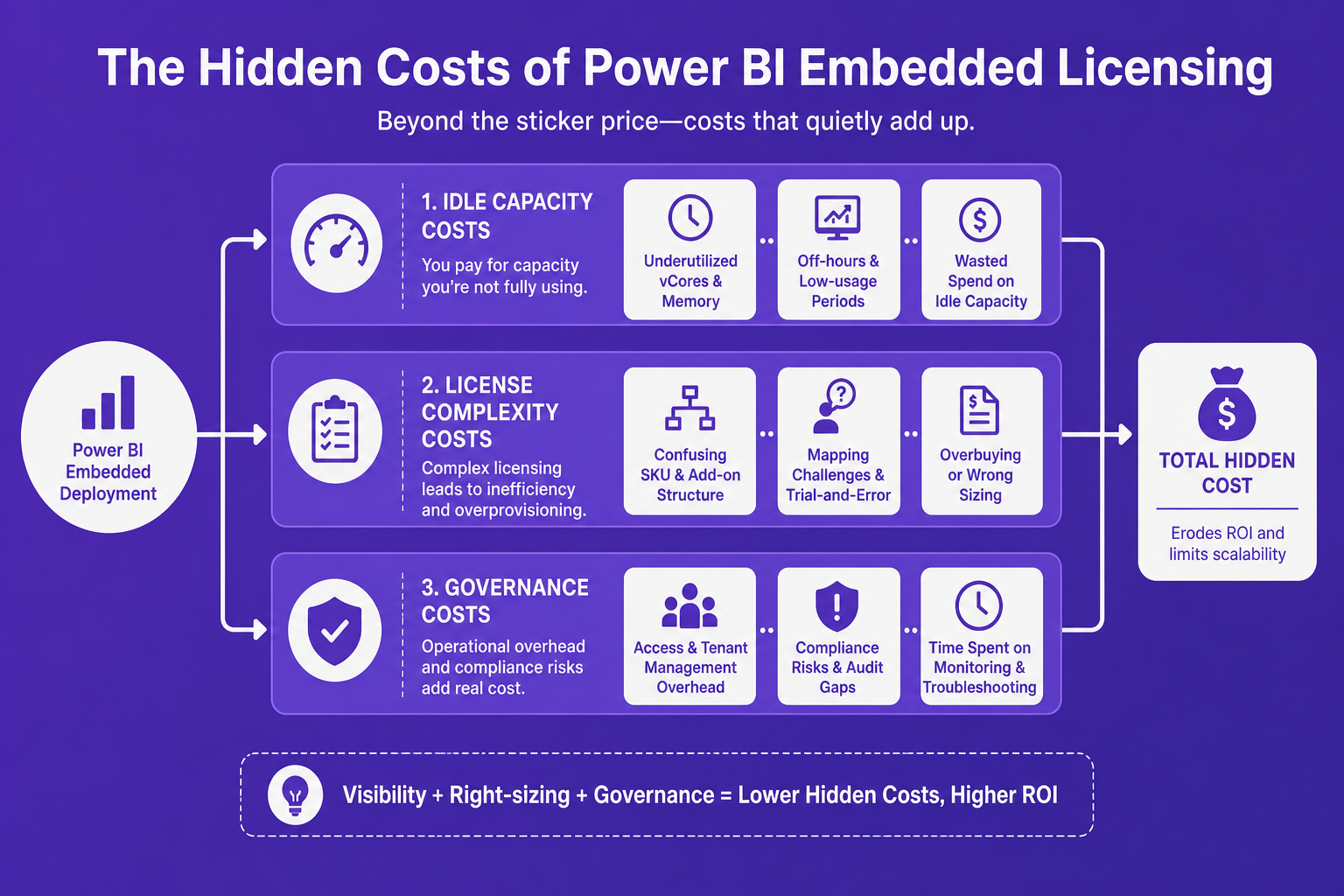
Selecting the right model means understanding capacity costs across usage patterns, reserve options, and ancillary expenses. Let’s break down the real-world economics for ISVs:
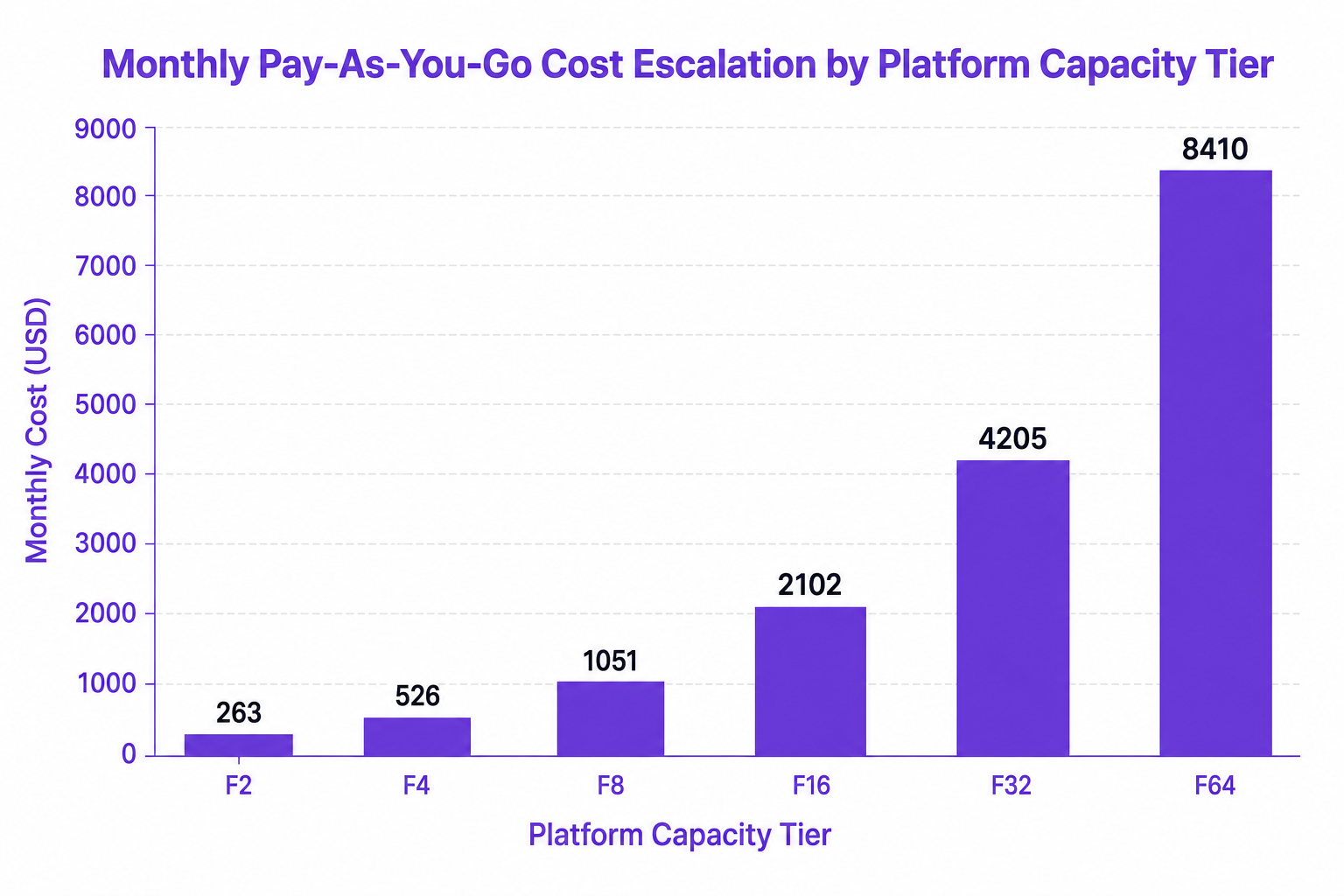
CloudNuro clients showcase the power of data-driven optimization:
CloudNuro’s Microsoft 365 Custodian discovers underused A-SKU and F-SKU capacities in real time, exposing shadow workspaces and making economic trade-offs visible. The platform’s Unified Cloud Custodian module tracks resource use and ties capacity to business units for accurate cost recovery and budgeting.
The ISV landscape is evolving:
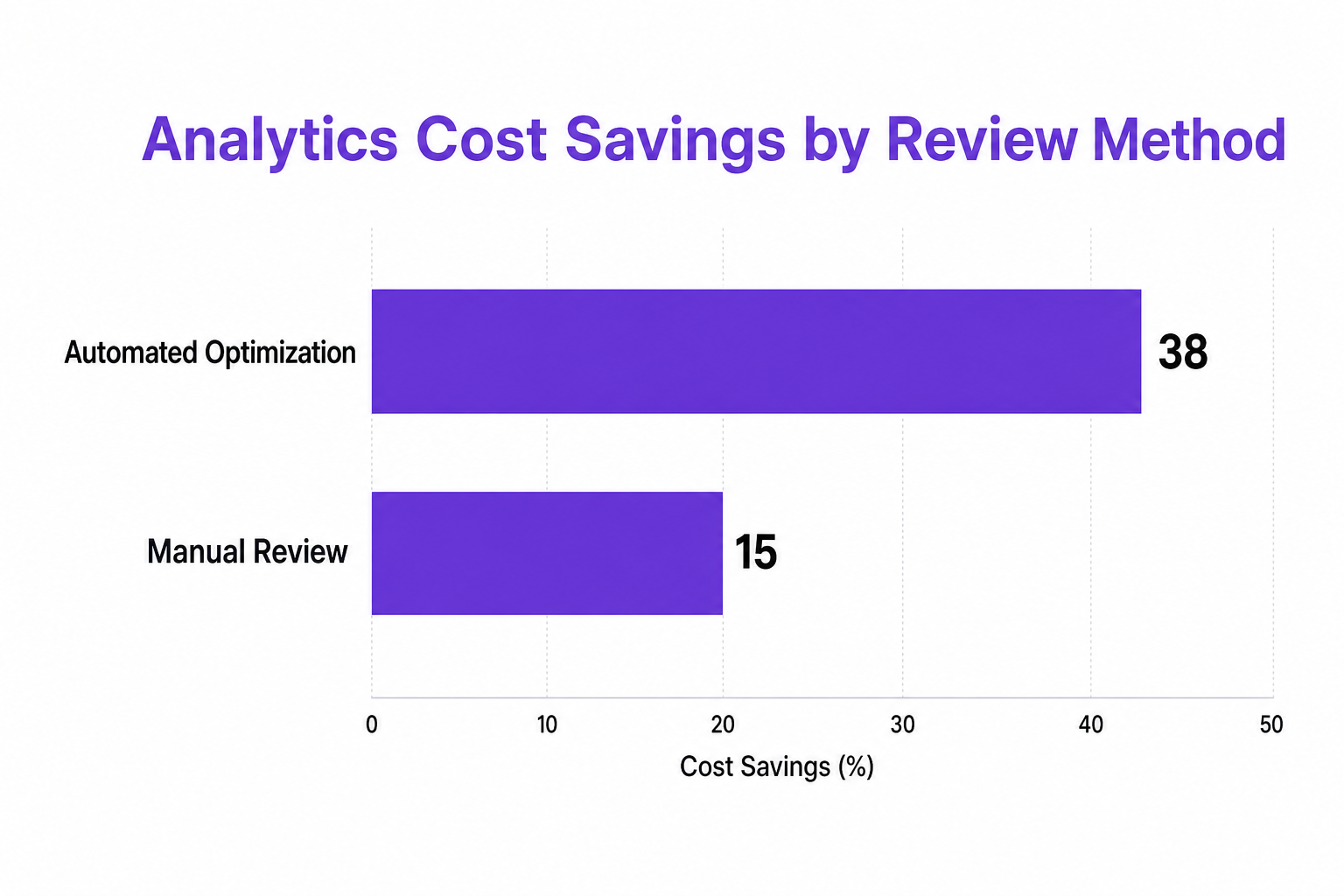
ISVs don’t just need a pricing calculator. They need active governance and automated optimization to avoid the financial pitfalls of Power BI Embedded. Here’s how CloudNuro delivers:
Explore CloudNuro’s FinOps Maturity Assessment, learn about FinOps Services, or see our SaaS Management offering and Microsoft License Optimization.
What is the difference between A-SKU and F-SKU in Power BI Embedded?
A-SKU is a pauseable, hourly-billed Azure-based capacity, ideal for dev/test and spiky workloads; F-SKU provides always-on, unified capacity (with broader analytics/data workloads) and is optimal for steady-state production SaaS platforms.
How do Power BI Embedded costs compare for ISVs?
For continuous production and scaling, reserved F-SKU typically costs 40 to 42 percent less than equivalent A-SKU capacities when both are left running full-time. A-SKU is cheaper if usage is intermittent and pauseable.
What are the hidden costs of Power BI Embedded?
Hidden costs include underused idle capacity (especially when A-SKU is not paused), misaligned licensing from hybrid strategies, and lack of financial visibility or chargeback context. Automation and governance greatly reduce this exposure.
How do A-SKU and F-SKU pricing impact SaaS profitability?
Continuous workloads on A-SKU often cause runaway platform costs, reducing profit margins. F-SKU with optimization (especially reserved) improves predictability and reduces TCO, boosting SaaS profitability for ISVs.
Which Power BI Embedded SKU is right for my ISV product?
Early-stage/low-volume or seasonal apps may benefit from A-SKU’s pause capability. Most growth/enterprise-focused ISVs achieve better economics and reporting with F-SKU, plus internal user licensing and expanded capabilities.
Selecting between A-SKU and F-SKU for Power BI Embedded is about far more than sticker price. ISVs must weigh operational realities, license complexity, and long-term governance impact. CloudNuro empowers ISVs to uncover hidden costs, optimize their analytics spend, and enforce license compliance through automation, visibility, and continuous improvement. With the right FinOps foundation, ISVs can deliver analytics at scale, price it in competitively, and keep cloud budgets under control.
CloudNuro is a leader in Enterprise AI Adoption Management, providing enterprises with unmatched visibility, governance, and cost optimization. Recognized twice in a row in the SaaS Management Platforms category and named a Leader in the SoftwareReviews Data Quadrant, CloudNuro is trusted by global enterprises and government agencies to bring financial discipline to SaaS, cloud, and AI. Trusted by enterprises, CloudNuro provides centralized SaaS inventory, license optimization, and renewal management along with advanced cost allocation and chargeback, giving IT and Finance leaders the visibility, control, and cost-conscious culture needed to drive financial discipline. Request a Demo | Get Free Savings | Explore Product
Request a no cost, no obligation free assessment —just 15 minutes to savings!
Get StartedPower BI Embedded has transformed the way independent software vendors (ISVs) deliver analytics inside modern applications. Its dedicated capacities offer scalable business intelligence services, but as SaaS providers race to deliver richer insights, subtle changes in how you license and operate your Power BI infrastructure can change your platform economics overnight.
For ISVs, selecting between Power BI’s two capacity models, A-SKU (Azure-based, pauseable) versus F-SKU (unified, always-on), is not just a technical exercise. It is a critical financial and governance decision that directly impacts SaaS profitability, cost predictability, and the ability to enforce license compliance at scale.
Leveraging CloudNuro’s AI-powered SaaS and cloud cost governance platform, this guide breaks down the nuanced, often-overlooked costs of Power BI Embedded. If you are a SaaS product owner, technical lead, or finance executive overseeing cloud BI platform expenditures, read on for a data-driven comparison, real-world optimization proof points, and a clear strategy for choosing the right SKU, and license management model, for your ISV’s needs.
Power BI Embedded offers dedicated analytics capacity, unlocking premium features such as faster data refresh, increased concurrency, and seamless embedding into your SaaS product. For ISVs targeting enterprise customers, two distinct SKU families determine your operational model and cost structure: A-SKU and F-SKU.
| Feature | A-SKU | F-SKU |
|---|---|---|
| Billing | Hourly | Monthly/Annual |
| Pause/Resume | Yes | No |
| Workloads | Embedded | Embedded + Full Data Platform |
| Suitable for | Dev/Test | Production, Scaling |
ISVs must select not only the right capacity tier for their user count and data volumes, but also whether pauseable or always-on capacity aligns with their product’s usage model and cost management strategy.
Surface pricing for both A-SKU and F-SKU is transparent on paper. However, true lifetime cost is shaped by three hidden economic drivers every ISV must consider:
Selecting the right model means understanding capacity costs across usage patterns, reserve options, and ancillary expenses. Let’s break down the real-world economics for ISVs:
CloudNuro clients showcase the power of data-driven optimization:
CloudNuro’s Microsoft 365 Custodian discovers underused A-SKU and F-SKU capacities in real time, exposing shadow workspaces and making economic trade-offs visible. The platform’s Unified Cloud Custodian module tracks resource use and ties capacity to business units for accurate cost recovery and budgeting.
The ISV landscape is evolving:
ISVs don’t just need a pricing calculator. They need active governance and automated optimization to avoid the financial pitfalls of Power BI Embedded. Here’s how CloudNuro delivers:
Explore CloudNuro’s FinOps Maturity Assessment, learn about FinOps Services, or see our SaaS Management offering and Microsoft License Optimization.
What is the difference between A-SKU and F-SKU in Power BI Embedded?
A-SKU is a pauseable, hourly-billed Azure-based capacity, ideal for dev/test and spiky workloads; F-SKU provides always-on, unified capacity (with broader analytics/data workloads) and is optimal for steady-state production SaaS platforms.
How do Power BI Embedded costs compare for ISVs?
For continuous production and scaling, reserved F-SKU typically costs 40 to 42 percent less than equivalent A-SKU capacities when both are left running full-time. A-SKU is cheaper if usage is intermittent and pauseable.
What are the hidden costs of Power BI Embedded?
Hidden costs include underused idle capacity (especially when A-SKU is not paused), misaligned licensing from hybrid strategies, and lack of financial visibility or chargeback context. Automation and governance greatly reduce this exposure.
How do A-SKU and F-SKU pricing impact SaaS profitability?
Continuous workloads on A-SKU often cause runaway platform costs, reducing profit margins. F-SKU with optimization (especially reserved) improves predictability and reduces TCO, boosting SaaS profitability for ISVs.
Which Power BI Embedded SKU is right for my ISV product?
Early-stage/low-volume or seasonal apps may benefit from A-SKU’s pause capability. Most growth/enterprise-focused ISVs achieve better economics and reporting with F-SKU, plus internal user licensing and expanded capabilities.
Selecting between A-SKU and F-SKU for Power BI Embedded is about far more than sticker price. ISVs must weigh operational realities, license complexity, and long-term governance impact. CloudNuro empowers ISVs to uncover hidden costs, optimize their analytics spend, and enforce license compliance through automation, visibility, and continuous improvement. With the right FinOps foundation, ISVs can deliver analytics at scale, price it in competitively, and keep cloud budgets under control.
CloudNuro is a leader in Enterprise AI Adoption Management, providing enterprises with unmatched visibility, governance, and cost optimization. Recognized twice in a row in the SaaS Management Platforms category and named a Leader in the SoftwareReviews Data Quadrant, CloudNuro is trusted by global enterprises and government agencies to bring financial discipline to SaaS, cloud, and AI. Trusted by enterprises, CloudNuro provides centralized SaaS inventory, license optimization, and renewal management along with advanced cost allocation and chargeback, giving IT and Finance leaders the visibility, control, and cost-conscious culture needed to drive financial discipline. Request a Demo | Get Free Savings | Explore Product
Request a no cost, no obligation free assessment - just 15 minutes to savings!
Get StartedWe're offering complimentary ServiceNow license assessments to only 25 enterprises this quarter who want to unlock immediate savings without disrupting operations.
Get Free AssessmentGet Started




CloudNuro Corp
1755 Park St. Suite 207
Naperville, IL 60563
Phone : +1-630-277-9470
Email: info@cloudnuro.com





.webp)

Recognized Leader in SaaS Management Platforms by Info-Tech SoftwareReviews

.svg)