
Sign Up
Thank you for Submitting!
AI showback reports generative AI costs to the teams that create them; AI chargeback bills those costs back to their budgets.
Most enterprises now manage AI spend, but far fewer can allocate it accurately by team, project, model, and agent, which is the precondition for either model.
This post compares the two approaches side by side, explains where each fits, and lays out how AgentNuro moves an enterprise from showback to chargeback without disputes.
In 2026, 98% of FinOps practitioners say their organizations manage AI spend, up from 63% a year earlier. Yet 39% still struggle to allocate AI costs equitably.
The AI showback vs. chargeback decision sits at the center of that gap. Generative AI is billed per token, per seat, per agent run, and per commitment, across several providers at once, so a single invoice rarely maps to a single cost center.
CIOs need to know what is running, CFOs need to know whose dollar it is, and FinOps leads need an allocation model that business units accept. More than half of organizations report no clear owner for AI costs.
The allocation playbook that works for SaaS and cloud, described in CloudNuro's chargeback and showback strategy guide, now has to stretch to tokens, models, and autonomous agents.
This guide defines both models for generative AI, compares them on five real differences, and shows how organizations move from one to the other.
See how AgentNuro maps AI spend to a user, project, model, agent, and business unit.
Request a DemoAI showback is the practice of reporting generative AI costs (tokens, seats, agent runs, and model commitments) to the teams, projects, and business units that consumed them, without moving money. AI chargeback goes further: those allocated costs are billed back to each cost center's budget through internal transfers.
Both models depend on the same foundation: token-level attribution, which CloudNuro covers in its guide to TokenOps as a FinOps practice.
| Dimension | AI Showback | AI Chargeback |
|---|---|---|
| Definition | Reports AI costs to consumers | Bills AI costs to consumers' budgets |
| Who owns it | FinOps and IT | Finance, with FinOps and IT |
| Data required | Directionally accurate attribution by team and model | Auditable attribution by user, project, agent, and cost center, plus shared-cost rules |
| Behaviour it drives | Awareness and voluntary optimization | Budget accountability and model choice discipline |
| Best for | Early adoption, pilots, shared platforms | Scaled production AI with stable usage patterns |
Showback tolerates estimates. A team that sees its AI spend within a reasonable margin still learns which models and agents drive its bill.
Chargeback does not tolerate estimates, because a budget owner will dispute any line they cannot trace. That requires every token tied to an identity, project, and agent, the attribution model described in how AgentNuro attributes every AI dollar to teams and projects.
Verdict: showback first, until attribution is accurate enough to survive an audit.
Generative AI carries costs no single team owns: enterprise model commitments, gateway infrastructure, vector databases, and evaluation pipelines. Showback can display them as an unallocated pool.
Chargeback must split them by an agreed rule (proportional token share, fixed percentage, or tiered platform fee). The same split logic CloudNuro applies in LLM showback and chargeback implementation applies to routers and gateways too, as covered in model router vs. AI gateway.
Verdict: agree on shared-cost rules during showback, before money moves.
Showback informs; chargeback changes decisions. When a business unit pays for its own tokens, engineers start asking whether a smaller model handles the task, a pattern discussed in how model routing cuts LLM costs.
The risk is the opposite reaction: teams under chargeback may avoid valuable AI experiments to protect their budgets.
Verdict: keep innovation and pilot spend under showback even after production moves to chargeback.
AI consumption changes daily as agents scale, retry, and call tools. Yet 42% of organizations review AI costs only quarterly.
Showback works on weekly or near real-time dashboards. Chargeback usually runs on the monthly finance close, so it needs real-time controls alongside it to stop overruns before they reach the invoice. Forecasting ties both together, as outlined in AI cost forecasting for tokens, calls, and credits.
Verdict: showback for daily visibility, chargeback for monthly accountability.
40% of organizations struggle to quantify value from AI projects. Allocation gives AI spend a denominator: once cost sits with a cost center, it can be compared with the outcomes that team delivers.
Chargeback makes that comparison formal, which supports the full-cost view in CloudNuro's TCO model for enterprise AI.
Verdict: chargeback fits best when leaders want AI spend judged against business results.
For most enterprises, the answer is a sequence: showback first, then chargeback for production workloads once attribution is trusted.
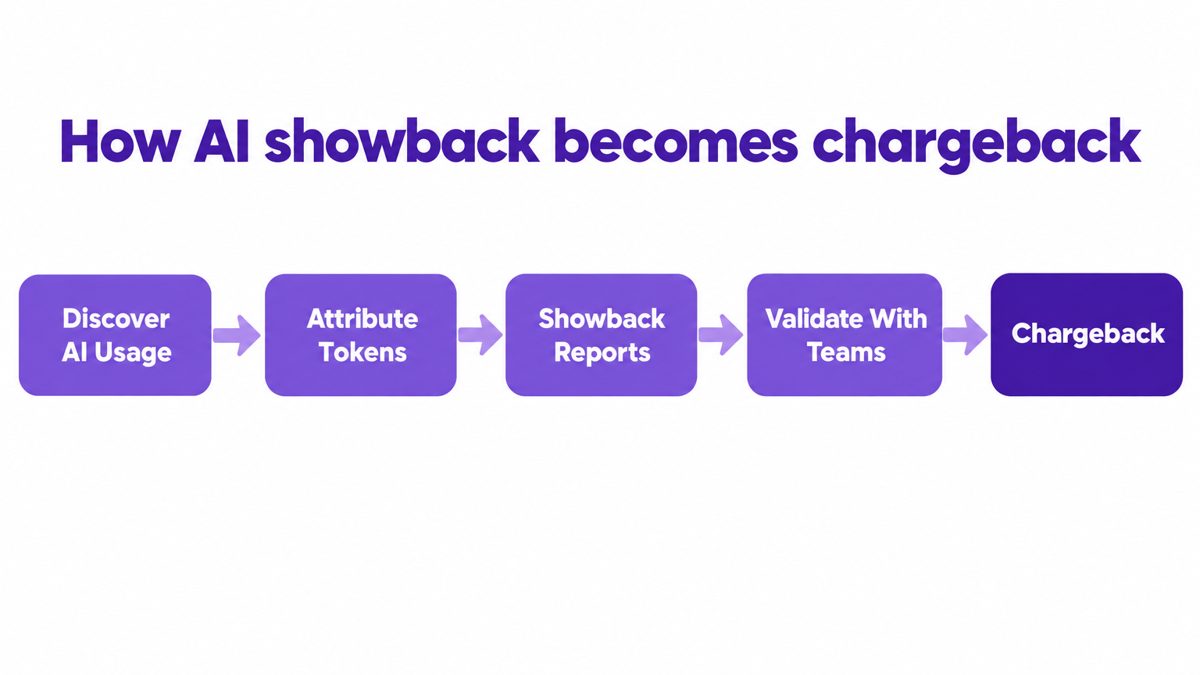
Find sanctioned and shadow AI across every provider. Allocation cannot cover spend nobody can see; 53.4% of organizations struggle to understand the full scope of their AI spending.
Map every dollar and token to a user, project, model, agent, and business unit, in one view, as described in tracking AI spend across providers in one view.
Send each cost center its AI costs by model and agent, with the shared-cost pool shown separately.
Let budget owners challenge their numbers for two or three cycles. Every resolved dispute improves the attribution rules.
Bill stable production workloads back to budgets through general ledger mapping, while pilots stay on showback.
Get a read-only assessment of your AI usage, spend, and unallocated costs.
Get Free Savings AssessmentAgentNuro, CloudNuro's Enterprise AI Adoption Management platform, discovers sanctioned and shadow AI across OpenAI, Claude, Gemini, Copilot, and more, with no agents and no app changes. It connects read-only in minutes, with insights the next day.
AgentNuro maps every dollar and token to a user, project, model, agent, and business unit, which gives showback its data and chargeback its audit trail. Real-time controls over model choice, token consumption, and runaway spend keep allocated budgets intact between monthly closes.
Because it is built on CloudNuro's chargeback foundation, AI costs flow through the same rule-based allocation, markups, and general ledger mapping already used for SaaS and cloud, alongside agent-level governance from AI Custodian.
AI showback reports generative AI costs to the teams that used them, while AI chargeback bills those costs to their budgets. Showback builds awareness; chargeback creates financial accountability.
Enterprises should start with AI showback, because chargeback needs attribution accurate enough to withstand disputes. Two or three showback cycles usually expose the gaps to fix first.
Shared AI costs are allocated by an agreed rule, such as each team's proportional token share or a fixed platform fee. Agree on the rule during showback, before any money moves.
AI chargeback requires token and spend data tied to a user, project, model, agent, and cost center, plus shared-cost rules. AgentNuro produces that attribution across providers from read-only connections.
AI chargeback can discourage experimentation if pilots are billed like production. Many organizations keep pilot spend on showback, with guidance from programs such as CloudNuro's FinOps services.
AI cost allocation must handle tokens, seats, agents, and several model providers, not just tagged infrastructure. CloudNuro explains the gap in TokenOps vs. FinOps for AI.
The AI showback vs. chargeback choice is a question of sequence, not preference. Organizations that skip attribution end up with AI bills nobody owns and chargebacks nobody trusts. The better model gives every AI dollar an owner through showback, then moves production workloads to chargeback inside one governed view of SaaS, cloud, and AI.
See AgentNuro run AI showback and chargeback across every model and agent.
Request a DemoCloudNuro and AgentNuro give IT and Finance one source of truth for AI costs: discovery of every AI tool and agent, attribution of every token to a cost center, and the chargeback engine already used for SaaS and cloud. Teams start with showback, resolve disputes in a shared workflow, and move to chargeback when the numbers hold.
CloudNuro is a leader in Enterprise AI Adoption Management, providing enterprises with unmatched visibility, governance, and cost optimization. Recognized twice in a row by Gartner in the SaaS Management Platforms and named a Leader in the Info-Tech SoftwareReviews Data Quadrant, CloudNuro is trusted by global enterprises and government agencies to bring financial discipline to SaaS, cloud, and AI. Trusted by enterprises, CloudNuro provides centralized SaaS inventory, license optimization, and renewal management along with advanced cost allocation and chargeback, giving IT and Finance leaders the visibility, control, and cost-conscious culture needed to drive financial discipline.
Request a no cost, no obligation free assessment —just 15 minutes to savings!
Get StartedAI showback reports generative AI costs to the teams that create them; AI chargeback bills those costs back to their budgets.
Most enterprises now manage AI spend, but far fewer can allocate it accurately by team, project, model, and agent, which is the precondition for either model.
This post compares the two approaches side by side, explains where each fits, and lays out how AgentNuro moves an enterprise from showback to chargeback without disputes.
In 2026, 98% of FinOps practitioners say their organizations manage AI spend, up from 63% a year earlier. Yet 39% still struggle to allocate AI costs equitably.
The AI showback vs. chargeback decision sits at the center of that gap. Generative AI is billed per token, per seat, per agent run, and per commitment, across several providers at once, so a single invoice rarely maps to a single cost center.
CIOs need to know what is running, CFOs need to know whose dollar it is, and FinOps leads need an allocation model that business units accept. More than half of organizations report no clear owner for AI costs.
The allocation playbook that works for SaaS and cloud, described in CloudNuro's chargeback and showback strategy guide, now has to stretch to tokens, models, and autonomous agents.
This guide defines both models for generative AI, compares them on five real differences, and shows how organizations move from one to the other.
See how AgentNuro maps AI spend to a user, project, model, agent, and business unit.
Request a DemoAI showback is the practice of reporting generative AI costs (tokens, seats, agent runs, and model commitments) to the teams, projects, and business units that consumed them, without moving money. AI chargeback goes further: those allocated costs are billed back to each cost center's budget through internal transfers.
Both models depend on the same foundation: token-level attribution, which CloudNuro covers in its guide to TokenOps as a FinOps practice.
| Dimension | AI Showback | AI Chargeback |
|---|---|---|
| Definition | Reports AI costs to consumers | Bills AI costs to consumers' budgets |
| Who owns it | FinOps and IT | Finance, with FinOps and IT |
| Data required | Directionally accurate attribution by team and model | Auditable attribution by user, project, agent, and cost center, plus shared-cost rules |
| Behaviour it drives | Awareness and voluntary optimization | Budget accountability and model choice discipline |
| Best for | Early adoption, pilots, shared platforms | Scaled production AI with stable usage patterns |
Showback tolerates estimates. A team that sees its AI spend within a reasonable margin still learns which models and agents drive its bill.
Chargeback does not tolerate estimates, because a budget owner will dispute any line they cannot trace. That requires every token tied to an identity, project, and agent, the attribution model described in how AgentNuro attributes every AI dollar to teams and projects.
Verdict: showback first, until attribution is accurate enough to survive an audit.
Generative AI carries costs no single team owns: enterprise model commitments, gateway infrastructure, vector databases, and evaluation pipelines. Showback can display them as an unallocated pool.
Chargeback must split them by an agreed rule (proportional token share, fixed percentage, or tiered platform fee). The same split logic CloudNuro applies in LLM showback and chargeback implementation applies to routers and gateways too, as covered in model router vs. AI gateway.
Verdict: agree on shared-cost rules during showback, before money moves.
Showback informs; chargeback changes decisions. When a business unit pays for its own tokens, engineers start asking whether a smaller model handles the task, a pattern discussed in how model routing cuts LLM costs.
The risk is the opposite reaction: teams under chargeback may avoid valuable AI experiments to protect their budgets.
Verdict: keep innovation and pilot spend under showback even after production moves to chargeback.
AI consumption changes daily as agents scale, retry, and call tools. Yet 42% of organizations review AI costs only quarterly.
Showback works on weekly or near real-time dashboards. Chargeback usually runs on the monthly finance close, so it needs real-time controls alongside it to stop overruns before they reach the invoice. Forecasting ties both together, as outlined in AI cost forecasting for tokens, calls, and credits.
Verdict: showback for daily visibility, chargeback for monthly accountability.
40% of organizations struggle to quantify value from AI projects. Allocation gives AI spend a denominator: once cost sits with a cost center, it can be compared with the outcomes that team delivers.
Chargeback makes that comparison formal, which supports the full-cost view in CloudNuro's TCO model for enterprise AI.
Verdict: chargeback fits best when leaders want AI spend judged against business results.
For most enterprises, the answer is a sequence: showback first, then chargeback for production workloads once attribution is trusted.
Find sanctioned and shadow AI across every provider. Allocation cannot cover spend nobody can see; 53.4% of organizations struggle to understand the full scope of their AI spending.
Map every dollar and token to a user, project, model, agent, and business unit, in one view, as described in tracking AI spend across providers in one view.
Send each cost center its AI costs by model and agent, with the shared-cost pool shown separately.
Let budget owners challenge their numbers for two or three cycles. Every resolved dispute improves the attribution rules.
Bill stable production workloads back to budgets through general ledger mapping, while pilots stay on showback.
Get a read-only assessment of your AI usage, spend, and unallocated costs.
Get Free Savings AssessmentAgentNuro, CloudNuro's Enterprise AI Adoption Management platform, discovers sanctioned and shadow AI across OpenAI, Claude, Gemini, Copilot, and more, with no agents and no app changes. It connects read-only in minutes, with insights the next day.
AgentNuro maps every dollar and token to a user, project, model, agent, and business unit, which gives showback its data and chargeback its audit trail. Real-time controls over model choice, token consumption, and runaway spend keep allocated budgets intact between monthly closes.
Because it is built on CloudNuro's chargeback foundation, AI costs flow through the same rule-based allocation, markups, and general ledger mapping already used for SaaS and cloud, alongside agent-level governance from AI Custodian.
AI showback reports generative AI costs to the teams that used them, while AI chargeback bills those costs to their budgets. Showback builds awareness; chargeback creates financial accountability.
Enterprises should start with AI showback, because chargeback needs attribution accurate enough to withstand disputes. Two or three showback cycles usually expose the gaps to fix first.
Shared AI costs are allocated by an agreed rule, such as each team's proportional token share or a fixed platform fee. Agree on the rule during showback, before any money moves.
AI chargeback requires token and spend data tied to a user, project, model, agent, and cost center, plus shared-cost rules. AgentNuro produces that attribution across providers from read-only connections.
AI chargeback can discourage experimentation if pilots are billed like production. Many organizations keep pilot spend on showback, with guidance from programs such as CloudNuro's FinOps services.
AI cost allocation must handle tokens, seats, agents, and several model providers, not just tagged infrastructure. CloudNuro explains the gap in TokenOps vs. FinOps for AI.
The AI showback vs. chargeback choice is a question of sequence, not preference. Organizations that skip attribution end up with AI bills nobody owns and chargebacks nobody trusts. The better model gives every AI dollar an owner through showback, then moves production workloads to chargeback inside one governed view of SaaS, cloud, and AI.
See AgentNuro run AI showback and chargeback across every model and agent.
Request a DemoCloudNuro and AgentNuro give IT and Finance one source of truth for AI costs: discovery of every AI tool and agent, attribution of every token to a cost center, and the chargeback engine already used for SaaS and cloud. Teams start with showback, resolve disputes in a shared workflow, and move to chargeback when the numbers hold.
CloudNuro is a leader in Enterprise AI Adoption Management, providing enterprises with unmatched visibility, governance, and cost optimization. Recognized twice in a row by Gartner in the SaaS Management Platforms and named a Leader in the Info-Tech SoftwareReviews Data Quadrant, CloudNuro is trusted by global enterprises and government agencies to bring financial discipline to SaaS, cloud, and AI. Trusted by enterprises, CloudNuro provides centralized SaaS inventory, license optimization, and renewal management along with advanced cost allocation and chargeback, giving IT and Finance leaders the visibility, control, and cost-conscious culture needed to drive financial discipline.
Request a no cost, no obligation free assessment - just 15 minutes to savings!
Get StartedWe're offering complimentary ServiceNow license assessments to only 25 enterprises this quarter who want to unlock immediate savings without disrupting operations.
Get Free AssessmentGet Started




CloudNuro Corp
1755 Park St. Suite 207
Naperville, IL 60563
Phone : +1-630-277-9470
Email: info@cloudnuro.com







Recognized Leader in SaaS Management Platforms by Info-Tech SoftwareReviews