
Sign Up
Thank you for Submitting!
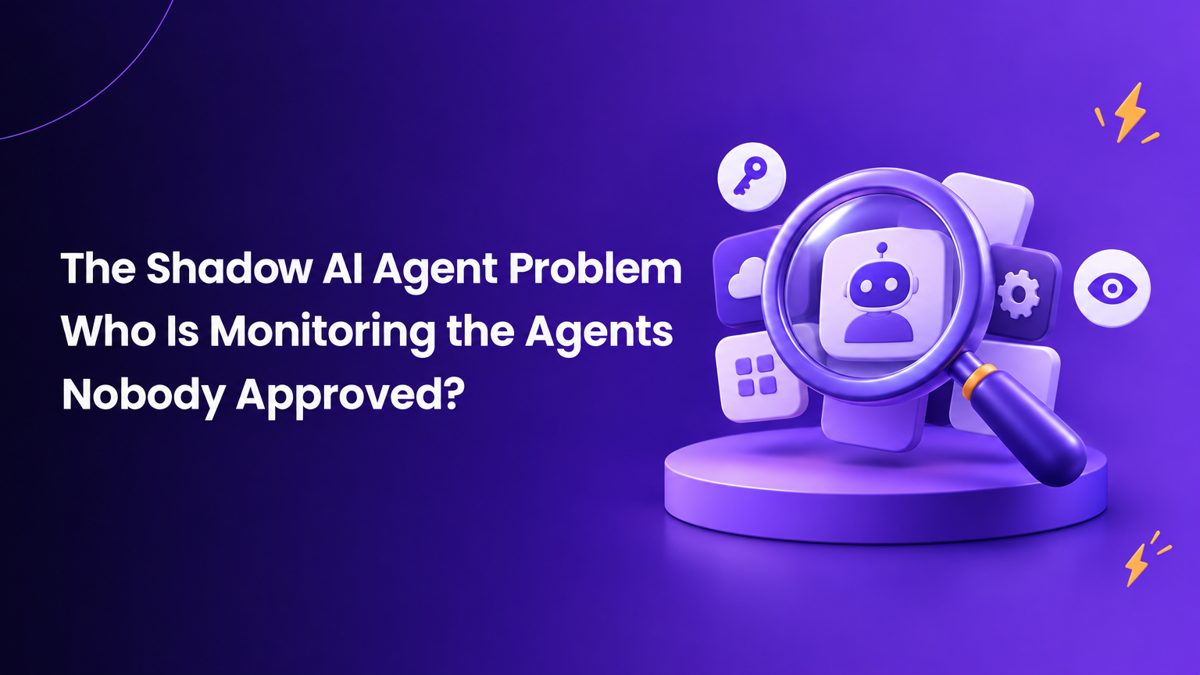
Shadow AI agents are autonomous AI systems that hold credentials, call APIs, and change records inside the enterprise without formal IT, security, or finance approval.
Only 14.4% of organizations deploy AI agents to production with complete security or IT approval, while 82% of executives believe existing policies prevent unauthorized agent actions.
This post explains why unapproved agents are harder to see than shadow SaaS, who should own them, and how AgentNuro brings every agent under one governed view of usage, spend, and risk.
40% of enterprise applications are expected to include task-specific AI agents by the end of 2026, up from fewer than 5% in 2025. The shadow AI agent problem is the gap between that adoption curve and the governance behind it.
Two years ago, shadow AI meant an employee pasting text into an unapproved chatbot. Today it means an agent built in a low-code tool, wired to a CRM with a personal API key, running every night on a credit card nobody reconciles.
CIOs cannot list these agents. CISOs cannot say what data they touch. CFOs cannot say which cost center pays for their tokens.
This post explains why unapproved agents escape traditional controls, what they cost in risk and money, and how to assign every agent an owner before the next audit asks.
A shadow AI agent is any autonomous AI workflow that acts on company systems or data without being inventoried, approved, and monitored by IT, security, and finance. It differs from a shadow chatbot because it acts, not just answers.
Three properties make agents harder to govern than shadow SaaS:
An agent runs on an API key, OAuth token, or service account. That makes it a non-human identity with access rights that no access review was designed to catch.
Agents call tools, retry, and chain to other agents without a human in the loop. As CloudNuro has described in its analysis of the agentic AI governance gap, policies written for human sessions cannot keep up.
An agent's cost scales with its activity, not a seat count. A single misconfigured loop can consume a month's budget before anyone sees the invoice.
See how AgentNuro finds every agent running in your estate: request a demo.
The largest risk in agent adoption is a mismatch between belief and practice. 82% of executives express confidence that existing policies prevent unauthorized agent actions, yet only 14.4% of organizations deploy agents to production with complete security or IT approval.
Visibility is just as thin. Only 24.4% of organizations report full visibility into which AI agents communicate with one another, and nearly half of agents operate without security oversight or logging.
The behaviour underneath is already common: 69% of organizations suspect or have evidence that employees use prohibited public generative AI tools. Agents inherit that habit and add system access to it.
For more data points, see CloudNuro's roundup of shadow AI statistics every CISO should know.
Shadow AI already carries a measurable breach premium. One in five organizations reported a breach linked to shadow AI, and organizations with high shadow AI use incurred roughly $670,000 more per breach.
Only 37% of organizations had policies to manage or detect shadow AI. The full breakdown is in CloudNuro's analysis of the real cost of a shadow AI breach.
The financial cost is quieter but constant. Unapproved agents run on personal or departmental API keys, so their token spend never reaches a cost center, a forecast, or a renewal discussion. This is the gap TokenOps exists to close.
No single team can monitor shadow AI agents alone. IT owns the inventory, security owns access and data exposure, and finance owns the spend, so the answer is a shared control plane where each team sees the same agent record.
| Role | Question about each agent | What they need to see |
|---|---|---|
| CIO / IT | Does this agent exist, and who built it? | Inventory of sanctioned and unsanctioned agents, models, and providers |
| CISO | What can it access, and what data leaves? | Credentials, connected systems, data exposure, action logs |
| CFO / FinOps | Whose dollar is this? | Token spend mapped to user, project, agent, and business unit |
| Business owner | Is it worth what it costs? | Cost per outcome, model choice, usage trend |
CloudNuro's guide on how to govern AI agents at enterprise scale covers the operating model in more depth.
AgentNuro, CloudNuro's Enterprise AI Adoption Management platform, moves every agent and every AI dollar through the same sequence.

AgentNuro finds sanctioned and shadow AI across OpenAI, Claude, Gemini, Copilot, and more. Discovery is read-only, with no agents to install and no application changes.
Every dollar and token is mapped to a user, project, model, agent, and business unit. That gives AI spend a denominator for ROI.
Once an agent is attributed, it has an accountable owner. An agent nobody approved becomes an agent somebody answers for.
AgentNuro adds real-time control over model choice, data exposure, token consumption, and runaway spend. Policy moves from a PDF to runtime, the theme of CloudNuro's post on the AI governance blindspot.
With ownership and spend in one view, teams chase value per token rather than cost per token alone.
AgentNuro connects in minutes and delivers insights the next day. Get your free savings assessment.
Blocking tools you cannot see pushes agents further underground. Build the read-only inventory first, then decide what to sanction.
Each agent needs an owner, scoped credentials, and a review date, the same as a service account.
Spend without an owner is spend nobody optimizes. Showback by business unit makes unapproved agents visible to the budget holders who fund them.
Log what each agent calls and changes. CloudNuro's AI agent monitoring playbook lists the signals worth tracking.
Per-agent and per-team budgets with alerts stop a retry loop from becoming a quarterly variance.
As agents spread into most enterprise applications, the count of non-human actors will outgrow manual review. Governance will shift from periodic approval to continuous discovery, attribution, and runtime control.
Organizations that already govern SaaS and cloud spend in one place have a head start, because agents are the next line item in the same technology estate.
A shadow AI agent is an autonomous AI workflow that acts on company systems or data without IT, security, or finance approval. Unlike a shadow chatbot, it holds credentials and takes actions.
Shadow AI agents are harder to detect because they often run on API keys and automation platforms rather than user logins. They rarely appear in SSO logs or expense reports as a distinct application.
Monitoring AI agents is a shared responsibility: IT owns inventory, security owns access, and finance owns spend. Each agent should also have a named business owner accountable for its value.
AgentNuro discovers shadow AI agents through read-only connections across AI providers such as OpenAI, Claude, Gemini, and Copilot, with no agents to install and no app changes. See what AgentNuro does for the full capability set.
Enterprises should inventory unapproved AI agents before blocking them. Many deliver real value, and the better path is to sanction useful agents, assign owners, and retire the rest.
With AgentNuro, teams connect in minutes and see insights the next day. CloudNuro's guide to getting started with AgentNuro walks through the rollout.
The shadow AI agent problem is a governance gap, not a technology gap: agents are scaling faster than approval, logging, and cost ownership. Organizations that wait inherit credentials nobody reviews and spend nobody forecasts. The better model is one governed view of SaaS, cloud, and AI where every agent has an owner, a budget, and an audit trail.
AgentNuro, built on CloudNuro's SaaS and cloud FinOps foundation, discovers sanctioned and shadow AI agents, maps every token to an owner and business unit, and adds real-time controls over models, budgets, and data exposure. It complements CloudNuro's AI Custodian so IT, security, and finance govern AI from one control plane.
CloudNuro is a leader in Enterprise AI Adoption Management, providing enterprises with unmatched visibility, governance, and cost optimization. Recognized twice in a row by Gartner in the SaaS Management Platforms and named a Leader in the Info-Tech SoftwareReviews Data Quadrant, CloudNuro is trusted by global enterprises and government agencies to bring financial discipline to SaaS, cloud, and AI. Trusted by enterprises, CloudNuro provides centralized SaaS inventory, license optimization, and renewal management along with advanced cost allocation and chargeback, giving IT and Finance leaders the visibility, control, and cost-conscious culture needed to drive financial discipline.
Request a no cost, no obligation free assessment —just 15 minutes to savings!
Get StartedShadow AI agents are autonomous AI systems that hold credentials, call APIs, and change records inside the enterprise without formal IT, security, or finance approval.
Only 14.4% of organizations deploy AI agents to production with complete security or IT approval, while 82% of executives believe existing policies prevent unauthorized agent actions.
This post explains why unapproved agents are harder to see than shadow SaaS, who should own them, and how AgentNuro brings every agent under one governed view of usage, spend, and risk.
40% of enterprise applications are expected to include task-specific AI agents by the end of 2026, up from fewer than 5% in 2025. The shadow AI agent problem is the gap between that adoption curve and the governance behind it.
Two years ago, shadow AI meant an employee pasting text into an unapproved chatbot. Today it means an agent built in a low-code tool, wired to a CRM with a personal API key, running every night on a credit card nobody reconciles.
CIOs cannot list these agents. CISOs cannot say what data they touch. CFOs cannot say which cost center pays for their tokens.
This post explains why unapproved agents escape traditional controls, what they cost in risk and money, and how to assign every agent an owner before the next audit asks.
A shadow AI agent is any autonomous AI workflow that acts on company systems or data without being inventoried, approved, and monitored by IT, security, and finance. It differs from a shadow chatbot because it acts, not just answers.
Three properties make agents harder to govern than shadow SaaS:
An agent runs on an API key, OAuth token, or service account. That makes it a non-human identity with access rights that no access review was designed to catch.
Agents call tools, retry, and chain to other agents without a human in the loop. As CloudNuro has described in its analysis of the agentic AI governance gap, policies written for human sessions cannot keep up.
An agent's cost scales with its activity, not a seat count. A single misconfigured loop can consume a month's budget before anyone sees the invoice.
See how AgentNuro finds every agent running in your estate: request a demo.
The largest risk in agent adoption is a mismatch between belief and practice. 82% of executives express confidence that existing policies prevent unauthorized agent actions, yet only 14.4% of organizations deploy agents to production with complete security or IT approval.
Visibility is just as thin. Only 24.4% of organizations report full visibility into which AI agents communicate with one another, and nearly half of agents operate without security oversight or logging.
The behaviour underneath is already common: 69% of organizations suspect or have evidence that employees use prohibited public generative AI tools. Agents inherit that habit and add system access to it.
For more data points, see CloudNuro's roundup of shadow AI statistics every CISO should know.
Shadow AI already carries a measurable breach premium. One in five organizations reported a breach linked to shadow AI, and organizations with high shadow AI use incurred roughly $670,000 more per breach.
Only 37% of organizations had policies to manage or detect shadow AI. The full breakdown is in CloudNuro's analysis of the real cost of a shadow AI breach.
The financial cost is quieter but constant. Unapproved agents run on personal or departmental API keys, so their token spend never reaches a cost center, a forecast, or a renewal discussion. This is the gap TokenOps exists to close.
No single team can monitor shadow AI agents alone. IT owns the inventory, security owns access and data exposure, and finance owns the spend, so the answer is a shared control plane where each team sees the same agent record.
| Role | Question about each agent | What they need to see |
|---|---|---|
| CIO / IT | Does this agent exist, and who built it? | Inventory of sanctioned and unsanctioned agents, models, and providers |
| CISO | What can it access, and what data leaves? | Credentials, connected systems, data exposure, action logs |
| CFO / FinOps | Whose dollar is this? | Token spend mapped to user, project, agent, and business unit |
| Business owner | Is it worth what it costs? | Cost per outcome, model choice, usage trend |
CloudNuro's guide on how to govern AI agents at enterprise scale covers the operating model in more depth.
AgentNuro, CloudNuro's Enterprise AI Adoption Management platform, moves every agent and every AI dollar through the same sequence.
AgentNuro finds sanctioned and shadow AI across OpenAI, Claude, Gemini, Copilot, and more. Discovery is read-only, with no agents to install and no application changes.
Every dollar and token is mapped to a user, project, model, agent, and business unit. That gives AI spend a denominator for ROI.
Once an agent is attributed, it has an accountable owner. An agent nobody approved becomes an agent somebody answers for.
AgentNuro adds real-time control over model choice, data exposure, token consumption, and runaway spend. Policy moves from a PDF to runtime, the theme of CloudNuro's post on the AI governance blindspot.
With ownership and spend in one view, teams chase value per token rather than cost per token alone.
AgentNuro connects in minutes and delivers insights the next day. Get your free savings assessment.
Blocking tools you cannot see pushes agents further underground. Build the read-only inventory first, then decide what to sanction.
Each agent needs an owner, scoped credentials, and a review date, the same as a service account.
Spend without an owner is spend nobody optimizes. Showback by business unit makes unapproved agents visible to the budget holders who fund them.
Log what each agent calls and changes. CloudNuro's AI agent monitoring playbook lists the signals worth tracking.
Per-agent and per-team budgets with alerts stop a retry loop from becoming a quarterly variance.
As agents spread into most enterprise applications, the count of non-human actors will outgrow manual review. Governance will shift from periodic approval to continuous discovery, attribution, and runtime control.
Organizations that already govern SaaS and cloud spend in one place have a head start, because agents are the next line item in the same technology estate.
A shadow AI agent is an autonomous AI workflow that acts on company systems or data without IT, security, or finance approval. Unlike a shadow chatbot, it holds credentials and takes actions.
Shadow AI agents are harder to detect because they often run on API keys and automation platforms rather than user logins. They rarely appear in SSO logs or expense reports as a distinct application.
Monitoring AI agents is a shared responsibility: IT owns inventory, security owns access, and finance owns spend. Each agent should also have a named business owner accountable for its value.
AgentNuro discovers shadow AI agents through read-only connections across AI providers such as OpenAI, Claude, Gemini, and Copilot, with no agents to install and no app changes. See what AgentNuro does for the full capability set.
Enterprises should inventory unapproved AI agents before blocking them. Many deliver real value, and the better path is to sanction useful agents, assign owners, and retire the rest.
With AgentNuro, teams connect in minutes and see insights the next day. CloudNuro's guide to getting started with AgentNuro walks through the rollout.
The shadow AI agent problem is a governance gap, not a technology gap: agents are scaling faster than approval, logging, and cost ownership. Organizations that wait inherit credentials nobody reviews and spend nobody forecasts. The better model is one governed view of SaaS, cloud, and AI where every agent has an owner, a budget, and an audit trail.
AgentNuro, built on CloudNuro's SaaS and cloud FinOps foundation, discovers sanctioned and shadow AI agents, maps every token to an owner and business unit, and adds real-time controls over models, budgets, and data exposure. It complements CloudNuro's AI Custodian so IT, security, and finance govern AI from one control plane.
CloudNuro is a leader in Enterprise AI Adoption Management, providing enterprises with unmatched visibility, governance, and cost optimization. Recognized twice in a row by Gartner in the SaaS Management Platforms and named a Leader in the Info-Tech SoftwareReviews Data Quadrant, CloudNuro is trusted by global enterprises and government agencies to bring financial discipline to SaaS, cloud, and AI. Trusted by enterprises, CloudNuro provides centralized SaaS inventory, license optimization, and renewal management along with advanced cost allocation and chargeback, giving IT and Finance leaders the visibility, control, and cost-conscious culture needed to drive financial discipline.
Request a no cost, no obligation free assessment - just 15 minutes to savings!
Get StartedWe're offering complimentary ServiceNow license assessments to only 25 enterprises this quarter who want to unlock immediate savings without disrupting operations.
Get Free AssessmentGet Started




CloudNuro Corp
1755 Park St. Suite 207
Naperville, IL 60563
Phone : +1-630-277-9470
Email: info@cloudnuro.com







Recognized Leader in SaaS Management Platforms by Info-Tech SoftwareReviews